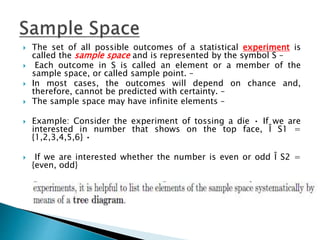
 The set of all possible outcomes of a statistical experiment is
called the sample space and is represented by the symbol S –
 Each outcome in S is called an element or a member of the
sample space, or called sample point. –
 In most cases, the outcomes will depend on chance and,
therefore, cannot be predicted with certainty. –
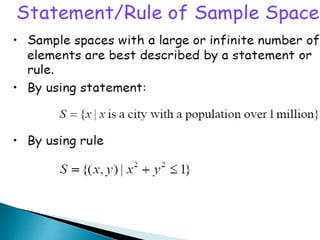
 The sample space may have infinite elements –
 Example: Consider the experiment of tossing a die • If we are
interested in number that shows on the top face, Î S1 =
{1,2,3,4,5,6} •
 If we are interested whether the number is even or odd Î S2 =
{even, odd}
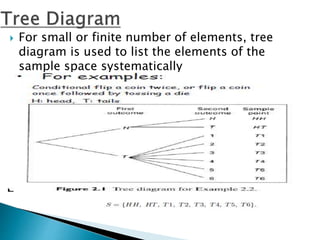
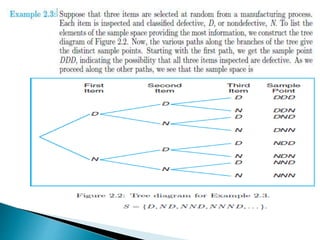
 For small or finite number of elements, tree
diagram is used to list the elements of the
sample space systematically

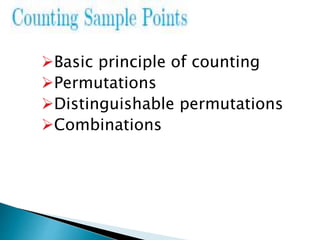
Basic principle of counting
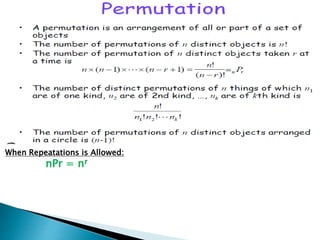
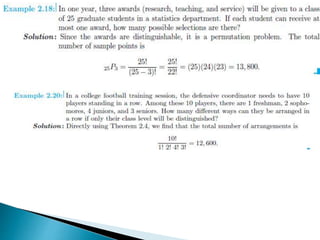
Permutations
Distinguishable permutations
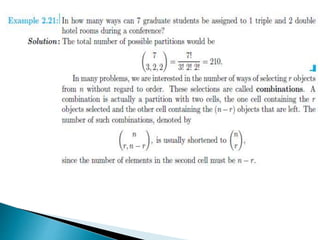
Combinations
When Repeatations is Allowed:
nPr = nr
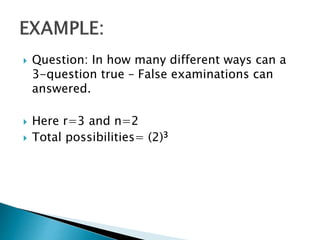
 Question: In how many different ways can a
3-question true – False examinations can
answered.
 Here r=3 and n=2
 Total possibilities= (2)3
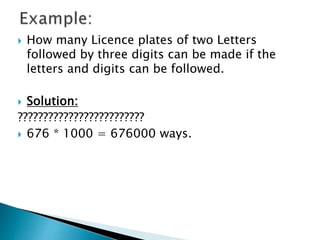
 How many Licence plates of two Letters
followed by three digits can be made if the
letters and digits can be followed.
 Solution:
?????????????????????????
 676 * 1000 = 676000 ways.
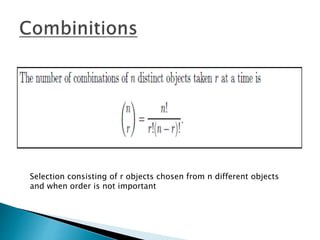
Selection consisting of r objects chosen from n different objects
and when order is not important
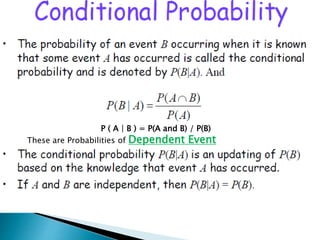
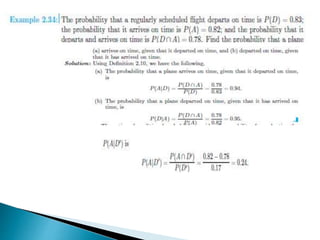
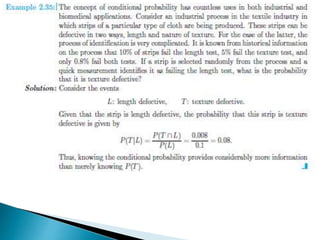
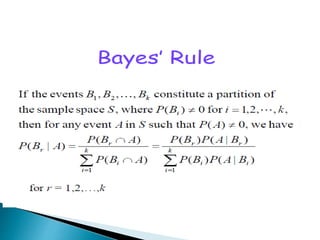
P ( A | B ) = P(A and B) / P(B)
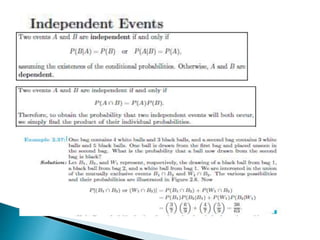
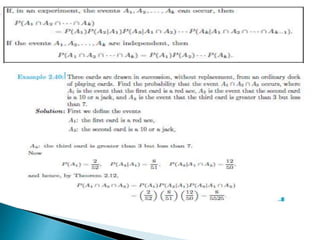
These are Probabilities of Dependent Event
Combinatorial analysis-and-probability final

Combinatorial analysis-and-probability final

  • 2.
     The setof all possible outcomes of a statistical experiment is called the sample space and is represented by the symbol S –  Each outcome in S is called an element or a member of the sample space, or called sample point. –  In most cases, the outcomes will depend on chance and, therefore, cannot be predicted with certainty. –  The sample space may have infinite elements –  Example: Consider the experiment of tossing a die • If we are interested in number that shows on the top face, Î S1 = {1,2,3,4,5,6} •  If we are interested whether the number is even or odd Î S2 = {even, odd}
  • 3.
     For smallor finite number of elements, tree diagram is used to list the elements of the sample space systematically 
  • 8.
    Basic principle ofcounting Permutations Distinguishable permutations Combinations
  • 12.
    When Repeatations isAllowed: nPr = nr
  • 15.
     Question: Inhow many different ways can a 3-question true – False examinations can answered.  Here r=3 and n=2  Total possibilities= (2)3
  • 16.
     How manyLicence plates of two Letters followed by three digits can be made if the letters and digits can be followed.  Solution: ?????????????????????????  676 * 1000 = 676000 ways.
  • 17.
    Selection consisting ofr objects chosen from n different objects and when order is not important
  • 26.
    P ( A| B ) = P(A and B) / P(B) These are Probabilities of Dependent Event