Introduction to ASP.NET Kevin McManus  Adapted from material by Gill Windall and Mark Sapossnek
Contents An overview of what .NET is and some of its key features Describe the areas of .NET likely to have an impact on how web applications are developed What is Microsoft .NET? Some views Web Services ASP .NET versus ASP .NET Platform and .NET Framework Common Language Runtime (CLR)
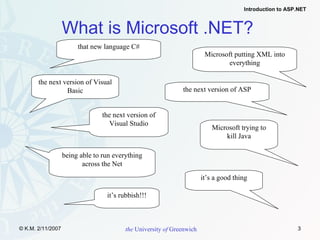
What is Microsoft .NET?   that new language C# Microsoft putting XML into everything the next version of Visual Basic the next version of ASP the next version of Visual Studio Microsoft trying to kill Java being able to run everything across the Net it’s a good thing it’s rubbish!!!
What is Microsoft .NET? Initially announced as the latest release of everything Microsoft ASP.NET, VB.NET,  VisualStudio.NET With are some big changes the new language C# got rid of VB at last  the Common Language Runtime (CLR) language integration - shared libraries possible platform independence – Mono CLR an attack on JRE ability to develop and use software components over the web XML based Web Services simplified deployment of Windoze software an end to DLL hell no use of the “registry” http://zdnet.com.com/2100-1104-991369.html no more mixing HTML and script code in ASP
Web Services  Allow remote access to software components via standard web protocols Use XML to exchange structured data Microsoft .NET is just one implementation of Web Services but there are many others The idea of Web Services is not exclusive to Microsoft “ Last Wednesday, Microsoft released a new software development program called Visual Studio.Net. …. it represents the company's big leap into Web services, which many hope will trigger the next generation of corporate computing innovation. Microsoft spent $2 billion developing Visual Studio.Net and C#, but just about every other technology company on the planet -- including IBM and Sun Microsystems -- is also placing big bets on Web services.” ZDNet Feb 2002
Web Services and Microsoft .NET There are three main angles on this: 1. Microsoft plans to provide a number of Web Services that application developers can use for a fee Microsoft .NET Passport - authentication service offers single sign-on capability for any Web site now Windows Live ID Microsoft .NET My Services - set of user-centric, XML Web services to manage, protect personal information e.g. Calendar, Contact, Inbox 2. Using ASP.NET you can create Web Services that others can use  3. Using a .NET language (or ASP.NET) you can write a program that uses Web Services
Programming the Web Server-Side Code What is server-side code? Software that runs on the server, not the client Receives input from URL parameters HTML form data Cookies HTTP headers Can access server-side databases, e-mail servers, files, mainframes, etc. Dynamically builds a custom HTML response  for a client
Programming the Web Server-Side Code Why server-side code? Availability You can reach the Internet from any browser, any device, any time, anywhere Manageability Does not require distribution of application code Easy to change code Security Source code is not exposed Once user is authenticated, can only allow certain actions Scalability Web-based 3-tier architecture can scale out
Programming the Web Server-Side Technologies Common Gateway Interface (CGI) not language specific Internet Server API (ISAPI) Netscape Server API (NSAPI) Active Server Pages (ASP) now obsolete  Java Server Pages (JSP) PHP Hypertext Processor (PHP) Cold Fusion (CFM) actually J2EE with the arrival of ColdFusion MX ASP.NET
Programming the Web   Active Server Pages (ASP) Technology to easily create server-side applications ASP pages are written in a scripting language usually VBScript but also Jscript or PerlScript An ASP page contains static HTML interspersed with server-side code ASP script is commonly used to access and update a database 3-tier systems
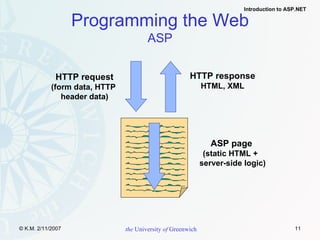
Programming the Web ASP HTTP request (form data, HTTP  header data) HTTP response HTML, XML ASP page (static HTML +   server-side logic)
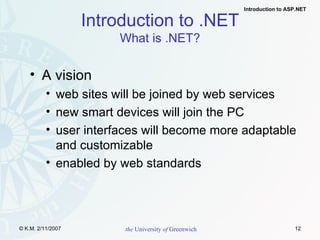
Introduction to .NET What is .NET? A vision web sites will be joined by web services new smart devices will join the PC user interfaces will become more adaptable  and customizable enabled by web standards
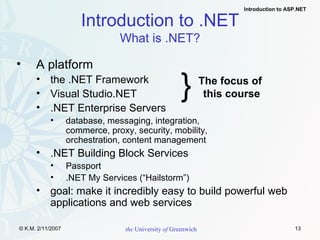
A platform the .NET Framework Visual Studio.NET .NET Enterprise Servers database, messaging, integration,  commerce, proxy, security, mobility,  orchestration, content management .NET Building Block Services Passport .NET My Services (“Hailstorm”) goal: make it incredibly easy to build powerful web applications and web services Introduction to .NET What is .NET? } The focus of  this course
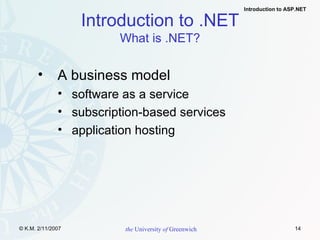
A business model software as a service subscription-based services application hosting Introduction to .NET What is .NET?
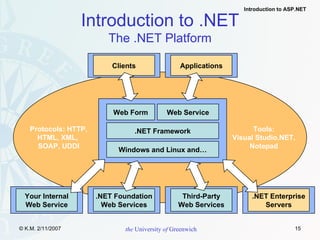
Introduction to .NET The .NET Platform Web Form .NET Framework Windows and Linux and… Web Service .NET Foundation Web Services Your Internal Web Service Third-Party Web Services .NET Enterprise Servers Clients Applications Protocols: HTTP, HTML, XML,  SOAP, UDDI Tools: Visual Studio.NET, Notepad
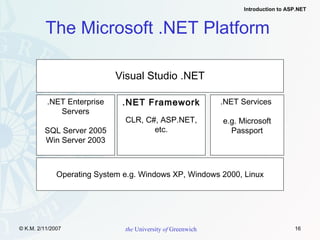
The Microsoft .NET Platform   Visual Studio .NET .NET Enterprise Servers SQL Server 2005 Win Server 2003 .NET Framework CLR, C#, ASP.NET, etc. .NET Services  e.g. Microsoft Passport Operating System e.g. Windows XP, Windows 2000, Linux
Web Services A programmable application component accessible via standard web protocols The centre of the .NET architecture Exposes functionality over the Web Built on existing and emerging standards HTTP, XML, SOAP, UDDI, WSDL, …
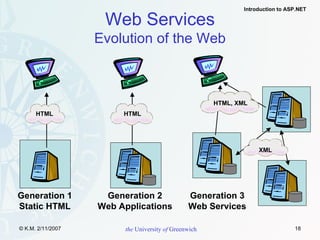
Web Services Evolution of the Web Generation 2 Web Applications HTML Generation 1 Static HTML HTML HTML, XML Generation 3 Web Services XML
A set of technologies for developing and using components to create: web forms web services windows applications  Supports the software lifecycle development debugging deployment  maintenance The .NET Framework What Is the .NET Framework?
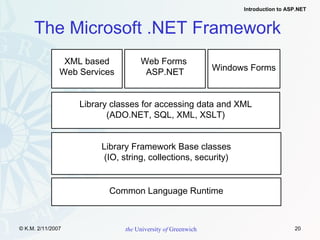
The Microsoft .NET Framework   XML based Web Services Web Forms  ASP.NET Windows Forms Library classes for accessing data and XML (ADO.NET, SQL, XML, XSLT) Library Framework Base classes (IO, string, collections, security) Common Language Runtime
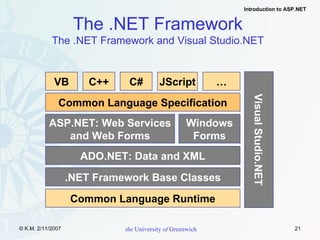
The .NET Framework The .NET Framework and Visual Studio.NET Common Language Specification Common Language Runtime VB C++ C# ASP.NET: Web Services and Web Forms JScript … Windows Forms .NET Framework Base Classes ADO.NET: Data and XML Visual Studio.NET
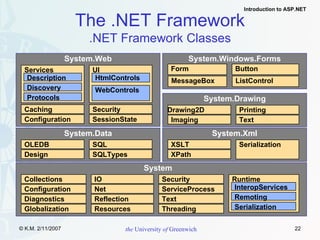
The .NET Framework .NET Framework Classes System.Data Design OLEDB SQLTypes SQL System  Globalization Diagnostics Configuration Collections Resources Reflection Net IO Threading Text ServiceProcess Security Runtime InteropServices Remoting Serialization System.Xml XPath XSLT Serialization System.Web Configuration SessionState Caching Security Services Description Discovery Protocols UI HtmlControls WebControls System.Drawing Imaging Drawing2D Text Printing System.Windows.Forms Form Button MessageBox ListControl
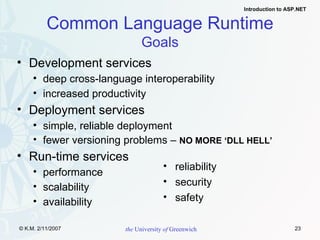
Common Language Runtime Goals Development services deep cross-language interoperability increased productivity Deployment services simple, reliable deployment fewer versioning problems –  NO MORE ‘DLL HELL’ Run-time services performance  scalability  availability reliability security safety
Common Language Runtime Programs can run on any platform for which the CLR has been implemented just like the JVM The CLR is no longer only available for Microsoft operating systems there are initiatives to port to other platforms Mono on Linux released 24 th  Nov 2004 There are many .NET languages Microsoft C# , C++, VB.NET, JScript Third Party Cobol, Fortran, Perl, Python, Smalltalk CLR gives language integration a class written in one language can be used by a class written in another share  exactly  the same libraries one  API to learn
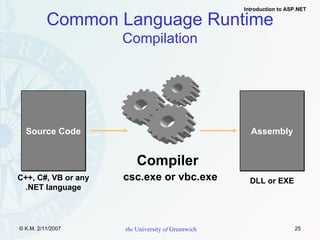
Common Language Runtime Compilation Source Code C++, C#, VB or any .NET language csc.exe or vbc.exe Compiler Assembly DLL or EXE
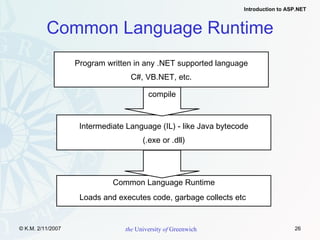
Common Language Runtime Program written in any .NET supported language C#, VB.NET, etc. Intermediate Language (IL) - like Java bytecode (.exe or .dll) compile Common Language Runtime Loads and executes code, garbage collects etc
Assembly logical unit of deployment contains manifest, metadata, MSIL and resources Manifest metadata about the components in an assembly (version, types, dependencies, etc.) Type metadata completely describes all types defined in  an assembly: properties, methods, arguments, return values, attributes, base classes, … Common Language Runtime Assemblies
Common Language Runtime Assemblies Microsoft Intermediate Language MSIL or IL all languages compile to IL (managed code) IL is always compiled to native code before  being executed Just In Time (JIT) compilation Resources data, images, audio, etc.
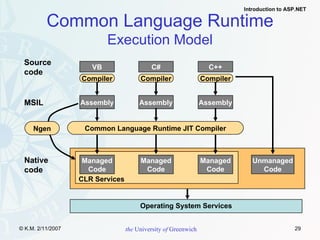
Common Language Runtime Execution Model CLR VB Source code Compiler C++ C# Assembly Assembly Assembly Operating System Services MSIL Common Language Runtime JIT Compiler Compiler Compiler Native code Managed Code Managed Code Managed Code Unmanaged Code CLR Services Ngen
Common Language Runtime Services Code management Conversion of MSIL to native code  Loading and execution of managed code  Creation and management of metadata Verification of type safety Insertion and execution of security checks Memory management and isolation Garbage collection Handling exceptions across languages Interoperation between .NET Framework objects, COM objects and Win32 DLLs Automation of object layout for late binding Developer services (profiling, debugging, etc.)
Common Type System (CTS) superset of the data types used by most modern programming languages Common Language Specification (CLS) subset of CTS that allows code written in different languages to interoperate What languages? Microsoft -  C#, C++, VB.NET, Jscript third party Perl, Ada, Cobol, Java, Fortran, Delphi Eiffel, Smalltalk, Scheme, Oberon, Haskell, Python,… only practical if the language supports some sort of encapsulation Common Language Runtime Multiple Language Support
Common Language Runtime Applications An application consists of one or more assemblies How does one assembly bind to another? based upon metadata and policy local (preferred) Assembly Global Cache (AGC) (accurate garbage collection?) Multiple versions of an assembly may exist on  the same machine easier software deployment, updates and removal multiple versions of an assembly can even be used by the same application like this is a new thing?
Common Language Runtime Security Evidence-based security (authentication) Based on user identity and code identity Configurable policies Imperative and declarative interfaces
Windows Forms Framework for building rich clients Built upon .NET Framework, languages Rapid Application Development (RAD) Visual inheritance Anchoring and docking Rich set of controls Extensible controls Data-aware Easily hooked into  Web Services ActiveX support Licensing support Printing support Advanced graphics
Web Forms Built with ASP.NET logical evolution of ASP similar development model: edit the page and go Requires less code actually more code but less programming New programming model event-driven/server-side controls rich controls (e.g. data grid, validation) data binding controls generate browser-specific code simplified handling of page state
Web Forms Allows separation of UI and business logic separation of concerns is a good thing cleaner, more maintainable code no more VB   Uses .NET languages not just scripting Easy to use components XCOPY/FTP deployment Simple configuration (XML-based)
Web Forms Caching (pages, fragments, custom) Scalable session state management Tracing support ASP.NET is extensible no ISAPI / ASP dichotomy Automatic process rollover Forms-based authentication
Similar to ADO, but better factored Language-neutral data access Supports two styles of data access disconnected forward-only, read-only access Supports data binding DataSet: a collection of tables Can view and process data relationally (tables) or hierarchically (XML) ADO.NET ActiveX Data Objects
Languages   C # New language created for .NET a Java rip-off Safe, productive evolution of C++ but not as safe as Java until M$ sort out the exceptions Key concepts: component-oriented everything is an object robust and durable code preserving your investment whatever that means Submitted to the ECMA for standardization
Languages   Visual Basic.NET Modernizes and simplifies Visual Basic because the old VB was pants Now provides inheritance threading exception handling Support for late binding whatever that is Actually just C# with a different syntax almost
Conclusion dotNET is pretty neat really e ven if it does come from M$ A whole lot of good ideas have been gathered together without the accumulation of legacy bugware is observed in other M$ products Although .NET initially looked like another attempt by Mr Evil to take over the world it is remarkably open and standard compliant compared with other M$ offerings The best bit is probably Visual Studio with it’s tooled up approach to application development
More Resources .NET http://www.microsoft.com/net/ http://msdn.microsoft.com/net/ http://www.gotdotnet.com msnews.microsoft.com news server microsoft.public.dotnet.general newsgroup XML http://msdn.microsoft.com/xml/default.asp http://www.w3.org/XML/

As Pdotnet

  • 1.
    Introduction to ASP.NETKevin McManus Adapted from material by Gill Windall and Mark Sapossnek
  • 2.
    Contents An overviewof what .NET is and some of its key features Describe the areas of .NET likely to have an impact on how web applications are developed What is Microsoft .NET? Some views Web Services ASP .NET versus ASP .NET Platform and .NET Framework Common Language Runtime (CLR)
  • 3.
    What is Microsoft.NET? that new language C# Microsoft putting XML into everything the next version of Visual Basic the next version of ASP the next version of Visual Studio Microsoft trying to kill Java being able to run everything across the Net it’s a good thing it’s rubbish!!!
  • 4.
    What is Microsoft.NET? Initially announced as the latest release of everything Microsoft ASP.NET, VB.NET, VisualStudio.NET With are some big changes the new language C# got rid of VB at last the Common Language Runtime (CLR) language integration - shared libraries possible platform independence – Mono CLR an attack on JRE ability to develop and use software components over the web XML based Web Services simplified deployment of Windoze software an end to DLL hell no use of the “registry” http://zdnet.com.com/2100-1104-991369.html no more mixing HTML and script code in ASP
  • 5.
    Web Services Allow remote access to software components via standard web protocols Use XML to exchange structured data Microsoft .NET is just one implementation of Web Services but there are many others The idea of Web Services is not exclusive to Microsoft “ Last Wednesday, Microsoft released a new software development program called Visual Studio.Net. …. it represents the company's big leap into Web services, which many hope will trigger the next generation of corporate computing innovation. Microsoft spent $2 billion developing Visual Studio.Net and C#, but just about every other technology company on the planet -- including IBM and Sun Microsystems -- is also placing big bets on Web services.” ZDNet Feb 2002
  • 6.
    Web Services andMicrosoft .NET There are three main angles on this: 1. Microsoft plans to provide a number of Web Services that application developers can use for a fee Microsoft .NET Passport - authentication service offers single sign-on capability for any Web site now Windows Live ID Microsoft .NET My Services - set of user-centric, XML Web services to manage, protect personal information e.g. Calendar, Contact, Inbox 2. Using ASP.NET you can create Web Services that others can use 3. Using a .NET language (or ASP.NET) you can write a program that uses Web Services
  • 7.
    Programming the WebServer-Side Code What is server-side code? Software that runs on the server, not the client Receives input from URL parameters HTML form data Cookies HTTP headers Can access server-side databases, e-mail servers, files, mainframes, etc. Dynamically builds a custom HTML response for a client
  • 8.
    Programming the WebServer-Side Code Why server-side code? Availability You can reach the Internet from any browser, any device, any time, anywhere Manageability Does not require distribution of application code Easy to change code Security Source code is not exposed Once user is authenticated, can only allow certain actions Scalability Web-based 3-tier architecture can scale out
  • 9.
    Programming the WebServer-Side Technologies Common Gateway Interface (CGI) not language specific Internet Server API (ISAPI) Netscape Server API (NSAPI) Active Server Pages (ASP) now obsolete Java Server Pages (JSP) PHP Hypertext Processor (PHP) Cold Fusion (CFM) actually J2EE with the arrival of ColdFusion MX ASP.NET
  • 10.
    Programming the Web Active Server Pages (ASP) Technology to easily create server-side applications ASP pages are written in a scripting language usually VBScript but also Jscript or PerlScript An ASP page contains static HTML interspersed with server-side code ASP script is commonly used to access and update a database 3-tier systems
  • 11.
    Programming the WebASP HTTP request (form data, HTTP header data) HTTP response HTML, XML ASP page (static HTML + server-side logic)
  • 12.
    Introduction to .NETWhat is .NET? A vision web sites will be joined by web services new smart devices will join the PC user interfaces will become more adaptable and customizable enabled by web standards
  • 13.
    A platform the.NET Framework Visual Studio.NET .NET Enterprise Servers database, messaging, integration, commerce, proxy, security, mobility, orchestration, content management .NET Building Block Services Passport .NET My Services (“Hailstorm”) goal: make it incredibly easy to build powerful web applications and web services Introduction to .NET What is .NET? } The focus of this course
  • 14.
    A business modelsoftware as a service subscription-based services application hosting Introduction to .NET What is .NET?
  • 15.
    Introduction to .NETThe .NET Platform Web Form .NET Framework Windows and Linux and… Web Service .NET Foundation Web Services Your Internal Web Service Third-Party Web Services .NET Enterprise Servers Clients Applications Protocols: HTTP, HTML, XML, SOAP, UDDI Tools: Visual Studio.NET, Notepad
  • 16.
    The Microsoft .NETPlatform Visual Studio .NET .NET Enterprise Servers SQL Server 2005 Win Server 2003 .NET Framework CLR, C#, ASP.NET, etc. .NET Services e.g. Microsoft Passport Operating System e.g. Windows XP, Windows 2000, Linux
  • 17.
    Web Services Aprogrammable application component accessible via standard web protocols The centre of the .NET architecture Exposes functionality over the Web Built on existing and emerging standards HTTP, XML, SOAP, UDDI, WSDL, …
  • 18.
    Web Services Evolutionof the Web Generation 2 Web Applications HTML Generation 1 Static HTML HTML HTML, XML Generation 3 Web Services XML
  • 19.
    A set oftechnologies for developing and using components to create: web forms web services windows applications Supports the software lifecycle development debugging deployment maintenance The .NET Framework What Is the .NET Framework?
  • 20.
    The Microsoft .NETFramework XML based Web Services Web Forms ASP.NET Windows Forms Library classes for accessing data and XML (ADO.NET, SQL, XML, XSLT) Library Framework Base classes (IO, string, collections, security) Common Language Runtime
  • 21.
    The .NET FrameworkThe .NET Framework and Visual Studio.NET Common Language Specification Common Language Runtime VB C++ C# ASP.NET: Web Services and Web Forms JScript … Windows Forms .NET Framework Base Classes ADO.NET: Data and XML Visual Studio.NET
  • 22.
    The .NET Framework.NET Framework Classes System.Data Design OLEDB SQLTypes SQL System Globalization Diagnostics Configuration Collections Resources Reflection Net IO Threading Text ServiceProcess Security Runtime InteropServices Remoting Serialization System.Xml XPath XSLT Serialization System.Web Configuration SessionState Caching Security Services Description Discovery Protocols UI HtmlControls WebControls System.Drawing Imaging Drawing2D Text Printing System.Windows.Forms Form Button MessageBox ListControl
  • 23.
    Common Language RuntimeGoals Development services deep cross-language interoperability increased productivity Deployment services simple, reliable deployment fewer versioning problems – NO MORE ‘DLL HELL’ Run-time services performance scalability availability reliability security safety
  • 24.
    Common Language RuntimePrograms can run on any platform for which the CLR has been implemented just like the JVM The CLR is no longer only available for Microsoft operating systems there are initiatives to port to other platforms Mono on Linux released 24 th Nov 2004 There are many .NET languages Microsoft C# , C++, VB.NET, JScript Third Party Cobol, Fortran, Perl, Python, Smalltalk CLR gives language integration a class written in one language can be used by a class written in another share exactly the same libraries one API to learn
  • 25.
    Common Language RuntimeCompilation Source Code C++, C#, VB or any .NET language csc.exe or vbc.exe Compiler Assembly DLL or EXE
  • 26.
    Common Language RuntimeProgram written in any .NET supported language C#, VB.NET, etc. Intermediate Language (IL) - like Java bytecode (.exe or .dll) compile Common Language Runtime Loads and executes code, garbage collects etc
  • 27.
    Assembly logical unitof deployment contains manifest, metadata, MSIL and resources Manifest metadata about the components in an assembly (version, types, dependencies, etc.) Type metadata completely describes all types defined in an assembly: properties, methods, arguments, return values, attributes, base classes, … Common Language Runtime Assemblies
  • 28.
    Common Language RuntimeAssemblies Microsoft Intermediate Language MSIL or IL all languages compile to IL (managed code) IL is always compiled to native code before being executed Just In Time (JIT) compilation Resources data, images, audio, etc.
  • 29.
    Common Language RuntimeExecution Model CLR VB Source code Compiler C++ C# Assembly Assembly Assembly Operating System Services MSIL Common Language Runtime JIT Compiler Compiler Compiler Native code Managed Code Managed Code Managed Code Unmanaged Code CLR Services Ngen
  • 30.
    Common Language RuntimeServices Code management Conversion of MSIL to native code Loading and execution of managed code Creation and management of metadata Verification of type safety Insertion and execution of security checks Memory management and isolation Garbage collection Handling exceptions across languages Interoperation between .NET Framework objects, COM objects and Win32 DLLs Automation of object layout for late binding Developer services (profiling, debugging, etc.)
  • 31.
    Common Type System(CTS) superset of the data types used by most modern programming languages Common Language Specification (CLS) subset of CTS that allows code written in different languages to interoperate What languages? Microsoft - C#, C++, VB.NET, Jscript third party Perl, Ada, Cobol, Java, Fortran, Delphi Eiffel, Smalltalk, Scheme, Oberon, Haskell, Python,… only practical if the language supports some sort of encapsulation Common Language Runtime Multiple Language Support
  • 32.
    Common Language RuntimeApplications An application consists of one or more assemblies How does one assembly bind to another? based upon metadata and policy local (preferred) Assembly Global Cache (AGC) (accurate garbage collection?) Multiple versions of an assembly may exist on the same machine easier software deployment, updates and removal multiple versions of an assembly can even be used by the same application like this is a new thing?
  • 33.
    Common Language RuntimeSecurity Evidence-based security (authentication) Based on user identity and code identity Configurable policies Imperative and declarative interfaces
  • 34.
    Windows Forms Frameworkfor building rich clients Built upon .NET Framework, languages Rapid Application Development (RAD) Visual inheritance Anchoring and docking Rich set of controls Extensible controls Data-aware Easily hooked into Web Services ActiveX support Licensing support Printing support Advanced graphics
  • 35.
    Web Forms Builtwith ASP.NET logical evolution of ASP similar development model: edit the page and go Requires less code actually more code but less programming New programming model event-driven/server-side controls rich controls (e.g. data grid, validation) data binding controls generate browser-specific code simplified handling of page state
  • 36.
    Web Forms Allowsseparation of UI and business logic separation of concerns is a good thing cleaner, more maintainable code no more VB  Uses .NET languages not just scripting Easy to use components XCOPY/FTP deployment Simple configuration (XML-based)
  • 37.
    Web Forms Caching(pages, fragments, custom) Scalable session state management Tracing support ASP.NET is extensible no ISAPI / ASP dichotomy Automatic process rollover Forms-based authentication
  • 38.
    Similar to ADO,but better factored Language-neutral data access Supports two styles of data access disconnected forward-only, read-only access Supports data binding DataSet: a collection of tables Can view and process data relationally (tables) or hierarchically (XML) ADO.NET ActiveX Data Objects
  • 39.
    Languages C # New language created for .NET a Java rip-off Safe, productive evolution of C++ but not as safe as Java until M$ sort out the exceptions Key concepts: component-oriented everything is an object robust and durable code preserving your investment whatever that means Submitted to the ECMA for standardization
  • 40.
    Languages Visual Basic.NET Modernizes and simplifies Visual Basic because the old VB was pants Now provides inheritance threading exception handling Support for late binding whatever that is Actually just C# with a different syntax almost
  • 41.
    Conclusion dotNET ispretty neat really e ven if it does come from M$ A whole lot of good ideas have been gathered together without the accumulation of legacy bugware is observed in other M$ products Although .NET initially looked like another attempt by Mr Evil to take over the world it is remarkably open and standard compliant compared with other M$ offerings The best bit is probably Visual Studio with it’s tooled up approach to application development
  • 42.
    More Resources .NEThttp://www.microsoft.com/net/ http://msdn.microsoft.com/net/ http://www.gotdotnet.com msnews.microsoft.com news server microsoft.public.dotnet.general newsgroup XML http://msdn.microsoft.com/xml/default.asp http://www.w3.org/XML/

Editor's Notes

  • #8 This course will focus on server-side .NET technologies.
  • #12 An ASP page receives input from a HTTP request, and then dynamically generates a new HTML page that is returned to the client. ASP can also return XML or other types of data.
  • #13 .NET will enable the next generation of applications.
  • #14 Microsoft is providing a suite of products and services to facilitate building this next generation. This course focuses on the .NET Framework and Visual Studio.NET.
  • #16 Each blue box represents a separate computer (or cluster of computers).
  • #18 The definition of a Web service is “a programmable application component accessible via standard Web protocols.” In other words, it is a component that can be called remotely from a client application, over the Internet. Web Services will allow people, companies, customers, suppliers, doctors, patients, etc. to interact using different computers, different operating systems, and different applications. For example, you could use the same Web Service to store your personal and work calendar information. You could access this information from different applications and view and change it in different ways.
  • #20 The .NET Framework provides a set of technologies that makes creating, deploying, using and maintaining applications (including Web applications and Web Services) much easier and more robust.
  • #22 The .NET framework exposes numerous classes to the developer. These classes allow the development of rich client applications and Web-based applications alike. The classes are shown here, divided into four areas. ASP.NET provides the core Web infrastructure, such as Web Forms for UI-based development and Web Services for programmatic interface development. User interface development on the Windows platform can be done using Windows Forms. ADO.NET and XML provide the functionality for data access. The core base classes provide infrastructure services such as security and transaction management. You can create code in any of a large number of languages. This code will integrate in a deep, seamless manner via a standard called the Common Language Specification. Visual Studio.NET provides tools that increases your productivity when creating applications.
  • #23 This is but a brief illustration of the breadth of classes provided by the .NET Framework. We will explore many of these classes during this course. All of these classes are available to ALL languages.
  • #24 The Common Language Runtime provides the underlying infrastructure for the .NET Framework. It provides very little application-visible functionality itself (security being a notable exception), but provides services to make development, deployment and execution much better in almost every way.
  • #26 As a developer you can write code in the language of your choice. Your code is compiled into an Assembly, which is represented as a DLL or EXE.
  • #28 IL is always compiled, never interpreted.
  • #30 When an assembly starts running, the JIT (Just In Time) compiler in the Common Language Runtime converts the IL in the assembly to efficient machine code. It is this code that is actually executed.
  • #31 The CLR provides many sophisticated services.
  • #32 The CTS supports many types of data. It allows each language to implement its own unique features. The CLS allows different languages to interoperate in a deep manner. For example, you can create a class in C# that derives from a class written in Eiffel, and is called from a Perl program.
  • #33 When we execute an application, how are the required assemblies located? Quite simply; the class loader (part of the CLR) will search the current directory for any assemblies. Assemblies should be kept within the same directory as the application that requires them. This allows different versions of the software to be installed on the machine without interfering with each other. However, if required, it is possible to share an assembly using the global assembly cache.
  • #34 Before code in an assembly is run, the CLR looks at the identity of both the user and the code. You can specify policies that determine which code can be executed, and the priviledges that code will have when it runs.
  • #35 Windows Forms is a framework for building rich Windows client applications, and can be written in any language that supports .NET. Windows Forms provide the developer with many features, such as: The simplicity that Visual Basic 6 programmers are used to. Easy deployment. Windows Forms (as .NET applications) automatically takes advantage of the versioning and deployment features of the .NET Framework. Windows Forms offers an architecture for controls and control containers based on concrete implementation of the control and container classes. This significantly reduces control-container interoperability issues. Security. Windows Forms takes full advantage of the security features of .NET. This means that Windows Forms can be used to implement everything from an untrusted control running in the browser to a fully trusted application installed on a user's hard drive. Web Services Support. Windows Forms offer full support for quickly and easily connecting to Web Services. Rich Graphics. Controls. Windows Forms offer a rich set of controls that encompass all of the controls offered by Windows and new features such as new "flat look" styles for Buttons, Radio Buttons and Checkboxes. Data Awareness. Windows Forms offer full support for the ADO.NET data model. ActiveX Controls. Windows Forms offer full support for ActiveX controls. You can easily host ActiveX controls in a Windows Forms application. You can also host a Windows Form control as an ActiveX control. Licensing. Windows Forms take advantage of the .NET Framework enhanced licensing model. Printing. Windows Forms offer a printing framework that enables applications to provide comprehensive reports. Accessibility. Windows Form controls implement the interfaces defined by Microsoft Active Accessibility (MSAA), making it straightforward to build applications that support accessibility aids such as screen readers.
  • #36 The first incarnation of ASP proved very successful. As part of the .NET Framework, Microsoft supports ASP.NET. ASP.NET is a logical evolution of ASP that addresses many of the issues previously associated with ASP. ASP.NET is now compiled and not interpreted. This of course can go some way towards improving efficiency and also means that code can now support strongly typed variables other than VARIANTS. This makes ASP.NET much more flexible and easier to code. A great deal of work has also been done to make sure that ASP.NET development has become cleaner and more productive.
  • #39 ADO.NET evolves from ADO, and is designed to deal with the issues of state, scalability and XML compatibility. Although existing ADO developers will find all of the old ADO classes inside the ADO.NET data model, they will also find that a few new classes have been introduced, including the DataSets, DataReaders and DataSetCommands classes.
  • #40 C# is a new language designed to take advantage of most of the features of the .NET Framework. C# was designed from the ground up to support component concepts like events, methods and properties. In C#, everything is an object, which allows the creation of very clean designs. C# was designed to make it easy to create robust and maintainable software. C# should allow you to preserve your existing investment by integrating easily with your existing code.
  • #41 VB.NET is a modernized version of Visual Basic. It is integrated with the .NET Framework, but still provides language constructs, features and syntax that is familiar to Visual Basic developers.