VARIETIES OF ENGLISH:
Words & Collocations
Readings:
Y. Kachru & L. Smith, Ch 7
 How varieties of English, native and non-native
vary in terms of their
◦ Sounds and rhythms
◦ Phrases and sentences
 We also saw how these variations among non-
native varieties of English are often the result of
transfer from the native language of the
speakers.
 In this lecture, we will look at how varieties of
English differ in terms of their words (lexicon)
and collocations.
 Who is Rush Limbaugh?
 Why has he been in the news recently?
 What’s your opinion of his actions in this
particular case? Why do you feel that way?
 Who are Terry Gross and Geoff Nunberg?
A four-letter word
 Why does Nunberg speculate that people have
reacted so strongly againts what Limbaugh said?
From NPR’s ‘Fresh Air’ with Terry Gross
 What’s the difference between Ed Schultz’ use of
the word last year and Rush Limbaugh’s recent
use of the word?
 Is the word ‘slut’ obscene and indecent, or is it a
sexist slur?
 What’s the difference, if any, between ‘slut’ and
‘player’?
 What’s the difference, if any, between ‘slut’ and
‘queer’?
 What’s the original meaning of ‘slut’?
 Why did people find it offensive?
From: Lowenberg, Non-native Varieties of English: Nativization,
Norms, and Implication, pp. 5-6.
What do these mean?
1. My friend wants to go down the bus
2. Did you know that Richard is moving with
Eunice?
3. Britain derecognized the DK in 1979.
4. This is an outstation call.
5. He overlistened to the boys’ conversation.
6. Most of the students here are bed-spacers.
7. Our son is England-returned.
8. You have to be careful with these been-to
boys.
5
 In the previous two chapters, we saw how
cultures adopt English either
◦ as a lingua franca or auxiliary language within a
country (e.g., India, Nigeria, Singapore, all Outer
Circle countries)
or
◦ as a language of wider communication for use with
speakers of other languages more globally (e.g.,
Japan, Thailand, China, all countries). Expanding
Circle
 We also saw how, in the process of doing so, the
varieties of English used in these contexts may
change in terms of
◦ Pronunciation
or
◦ syntax
 These changes are the result of language contact
and often transfer of linguistic features from the
first languages of those cultures.
 These changes are often collectively referred to
as ‘nativization’ (or ‘indigenization’):
◦ The adaptation that a language may undergo when it
is used in a different cultural and social situation.
◦ Indian English, Nigerian English, Singapore English,
etc. for example, are said to have undergone
nativization because changes have occurred in
aspects of their phonology, and syntax.
 Nativization also occurs in the areas
of
◦Lexicon (vocabulary)
and
◦Collocations (the ways in which
words are regularly used together)
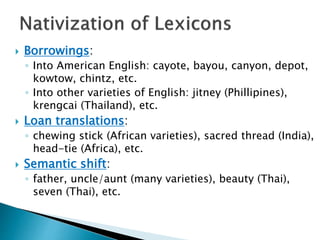
 Borrowings:
◦ Into American English: cayote, bayou, canyon, depot,
kowtow, chintz, etc.
◦ Into other varieties of English: jitney (Phillipines),
krengcai (Thailand), etc.
 Loan translations:
◦ chewing stick (African varieties), sacred thread (India),
head-tie (Africa), etc.
 Semantic shift:
◦ father, uncle/aunt (many varieties), beauty (Thai),
seven (Thai), etc.
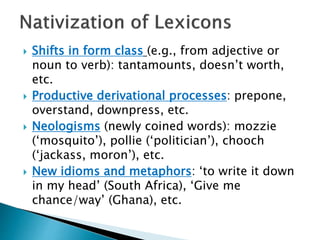
 Shifts in form class (e.g., from adjective or
noun to verb): tantamounts, doesn’t worth,
etc.
 Productive derivational processes: prepone,
overstand, downpress, etc.
 Neologisms (newly coined words): mozzie
(‘mosquito’), pollie (‘politician’), chooch
(‘jackass, moron’), etc.
 New idioms and metaphors: ‘to write it down
in my head’ (South Africa), ‘Give me
chance/way’ (Ghana), etc.
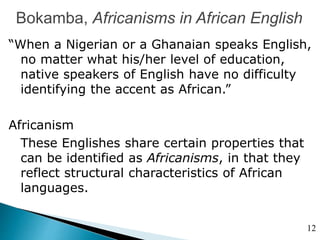
Bokamba, Africanisms in African English
“When a Nigerian or a Ghanaian speaks English,
no matter what his/her level of education,
native speakers of English have no difficulty
identifying the accent as African.”
Africanism
These Englishes share certain properties that
can be identified as Africanisms, in that they
reflect structural characteristics of African
languages.
12
Bokamba, Africanisms in African English
1. Example of Syntactic Construction
With much pleasre [pleasure] and respect I
inscribe you this few lines and with the hope
that it will meet you in good condition of
health. [Bokamba, p. 126].
Q: What are the non-STD American usages?
13
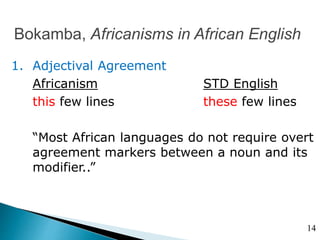
Bokamba, Africanisms in African English
1. Adjectival Agreement
Africanism STD English
this few lines these few lines
“Most African languages do not require overt
agreement markers between a noun and its
modifier..”
14
Bokamba, Africanisms
2. Subject Verb Agreement
In STD English the subject NP of a sentence
requires that the form of the verb agrees
with whether it is singular or plural where
possible (in all third person present tense):
Arthur sleeps in a bed
The twins sleep in a bunk
Kim lives in Berkeley
Yoko and Arthur live in Richmond
“With much pleasre [pleasure] and respect I
inscribe you this few lines and with the hope
that it will meet you in good condition of
health.” 15
Bokamba, Africanisms
3. Word Choice
“In many African languages the verbs find,
meet, and encounter are realized by a single
verb which is often the equivalent of meet in
English.”
“With much pleasre [pleasure] and respect I
inscribe you this few lines and with the hope
that it will meet you in good condition of
health.”
16
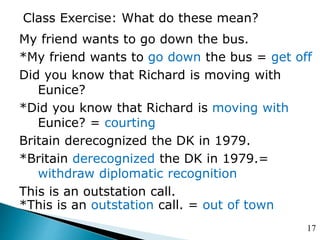
Class Exercise: What do these mean?
My friend wants to go down the bus.
*My friend wants to go down the bus = get off
Did you know that Richard is moving with
Eunice?
*Did you know that Richard is moving with
Eunice? = courting
Britain derecognized the DK in 1979.
*Britain derecognized the DK in 1979.=
withdraw diplomatic recognition
This is an outstation call.
*This is an outstation call. = out of town
17
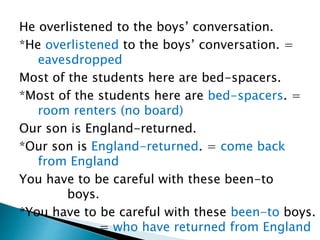
He overlistened to the boys’ conversation.
*He overlistened to the boys’ conversation. =
eavesdropped
Most of the students here are bed-spacers.
*Most of the students here are bed-spacers. =
room renters (no board)
Our son is England-returned.
*Our son is England-returned. = come back
from England
You have to be careful with these been-to
boys.
*You have to be careful with these been-to boys.
= who have returned from England
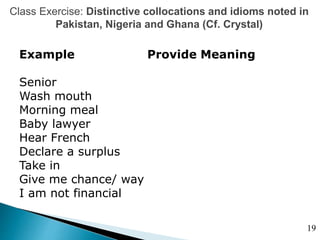
Class Exercise: Distinctive collocations and idioms noted in
Pakistan, Nigeria and Ghana (Cf. Crystal)
Example Provide Meaning
Senior
Wash mouth
Morning meal
Baby lawyer
Hear French
Declare a surplus
Take in
Give me chance/ way
I am not financial
19
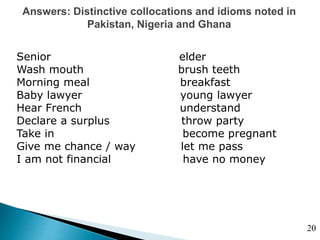
Answers: Distinctive collocations and idioms noted in
Pakistan, Nigeria and Ghana
Senior elder
Wash mouth brush teeth
Morning meal breakfast
Baby lawyer young lawyer
Hear French understand
Declare a surplus throw party
Take in become pregnant
Give me chance / way let me pass
I am not financial have no money
20
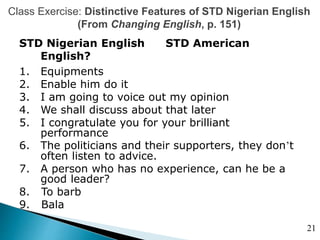
Class Exercise: Distinctive Features of STD Nigerian English
(From Changing English, p. 151)
STD Nigerian English STD American
English?
1. Equipments
2. Enable him do it
3. I am going to voice out my opinion
4. We shall discuss about that later
5. I congratulate you for your brilliant
performance
6. The politicians and their supporters, they don’t
often listen to advice.
7. A person who has no experience, can he be a
good leader?
8. To barb
9. Bala
21
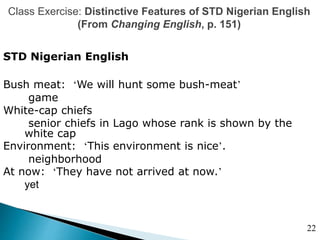
Class Exercise: Distinctive Features of STD Nigerian English
(From Changing English, p. 151)
STD Nigerian English
Bush meat: ‘We will hunt some bush-meat’
game
White-cap chiefs
senior chiefs in Lago whose rank is shown by the
white cap
Environment: ‘This environment is nice’.
neighborhood
At now: ‘They have not arrived at now.’
yet
22
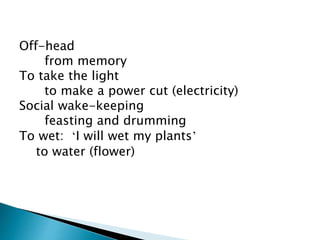
Off-head
from memory
To take the light
to make a power cut (electricity)
Social wake-keeping
feasting and drumming
To wet: ‘I will wet my plants’
to water (flower)
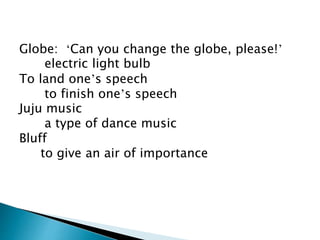
Globe: ‘Can you change the globe, please!’
electric light bulb
To land one’s speech
to finish one’s speech
Juju music
a type of dance music
Bluff
to give an air of importance
Bokamba, Africanisms
4. Greeting Style (Cultural)
“African languages characteristically inquire
about or make reference to an addressee’s
welfare as an initial step in either face-to-
face greetings or letter writing.”
25
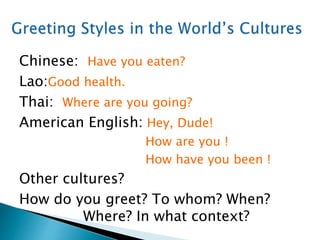
Chinese: Have you eaten?
Lao:Good health.
Thai: Where are you going?
American English: Hey, Dude!
How are you !
How have you been !
Other cultures?
How do you greet? To whom? When?
Where? In what context?
 How do these changes become the standard
form of Outer Circle varieties of English?
 Codification: use of this variety in media,
literature, publication of style sheets,
grammars, dictionaries, etc.
 Lexicography: The art and science of
dictionary making
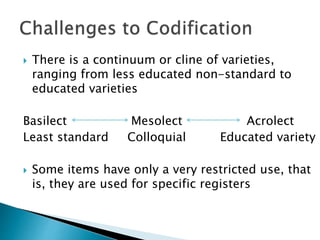
 There is a continuum or cline of varieties,
ranging from less educated non-standard to
educated varieties
Basilect Mesolect Acrolect
Least standard Colloquial Educated variety
 Some items have only a very restricted use, that
is, they are used for specific registers
29
“Th-th-th-that's all folks!"

Collocations.ppt

  • 1.
    VARIETIES OF ENGLISH: Words& Collocations Readings: Y. Kachru & L. Smith, Ch 7
  • 2.
     How varietiesof English, native and non-native vary in terms of their ◦ Sounds and rhythms ◦ Phrases and sentences  We also saw how these variations among non- native varieties of English are often the result of transfer from the native language of the speakers.  In this lecture, we will look at how varieties of English differ in terms of their words (lexicon) and collocations.
  • 3.
     Who isRush Limbaugh?  Why has he been in the news recently?  What’s your opinion of his actions in this particular case? Why do you feel that way?  Who are Terry Gross and Geoff Nunberg? A four-letter word  Why does Nunberg speculate that people have reacted so strongly againts what Limbaugh said? From NPR’s ‘Fresh Air’ with Terry Gross
  • 4.
     What’s thedifference between Ed Schultz’ use of the word last year and Rush Limbaugh’s recent use of the word?  Is the word ‘slut’ obscene and indecent, or is it a sexist slur?  What’s the difference, if any, between ‘slut’ and ‘player’?  What’s the difference, if any, between ‘slut’ and ‘queer’?  What’s the original meaning of ‘slut’?  Why did people find it offensive?
  • 5.
    From: Lowenberg, Non-nativeVarieties of English: Nativization, Norms, and Implication, pp. 5-6. What do these mean? 1. My friend wants to go down the bus 2. Did you know that Richard is moving with Eunice? 3. Britain derecognized the DK in 1979. 4. This is an outstation call. 5. He overlistened to the boys’ conversation. 6. Most of the students here are bed-spacers. 7. Our son is England-returned. 8. You have to be careful with these been-to boys. 5
  • 6.
     In theprevious two chapters, we saw how cultures adopt English either ◦ as a lingua franca or auxiliary language within a country (e.g., India, Nigeria, Singapore, all Outer Circle countries) or ◦ as a language of wider communication for use with speakers of other languages more globally (e.g., Japan, Thailand, China, all countries). Expanding Circle
  • 7.
     We alsosaw how, in the process of doing so, the varieties of English used in these contexts may change in terms of ◦ Pronunciation or ◦ syntax  These changes are the result of language contact and often transfer of linguistic features from the first languages of those cultures.
  • 8.
     These changesare often collectively referred to as ‘nativization’ (or ‘indigenization’): ◦ The adaptation that a language may undergo when it is used in a different cultural and social situation. ◦ Indian English, Nigerian English, Singapore English, etc. for example, are said to have undergone nativization because changes have occurred in aspects of their phonology, and syntax.
  • 9.
     Nativization alsooccurs in the areas of ◦Lexicon (vocabulary) and ◦Collocations (the ways in which words are regularly used together)
  • 10.
     Borrowings: ◦ IntoAmerican English: cayote, bayou, canyon, depot, kowtow, chintz, etc. ◦ Into other varieties of English: jitney (Phillipines), krengcai (Thailand), etc.  Loan translations: ◦ chewing stick (African varieties), sacred thread (India), head-tie (Africa), etc.  Semantic shift: ◦ father, uncle/aunt (many varieties), beauty (Thai), seven (Thai), etc.
  • 11.
     Shifts inform class (e.g., from adjective or noun to verb): tantamounts, doesn’t worth, etc.  Productive derivational processes: prepone, overstand, downpress, etc.  Neologisms (newly coined words): mozzie (‘mosquito’), pollie (‘politician’), chooch (‘jackass, moron’), etc.  New idioms and metaphors: ‘to write it down in my head’ (South Africa), ‘Give me chance/way’ (Ghana), etc.
  • 12.
    Bokamba, Africanisms inAfrican English “When a Nigerian or a Ghanaian speaks English, no matter what his/her level of education, native speakers of English have no difficulty identifying the accent as African.” Africanism These Englishes share certain properties that can be identified as Africanisms, in that they reflect structural characteristics of African languages. 12
  • 13.
    Bokamba, Africanisms inAfrican English 1. Example of Syntactic Construction With much pleasre [pleasure] and respect I inscribe you this few lines and with the hope that it will meet you in good condition of health. [Bokamba, p. 126]. Q: What are the non-STD American usages? 13
  • 14.
    Bokamba, Africanisms inAfrican English 1. Adjectival Agreement Africanism STD English this few lines these few lines “Most African languages do not require overt agreement markers between a noun and its modifier..” 14
  • 15.
    Bokamba, Africanisms 2. SubjectVerb Agreement In STD English the subject NP of a sentence requires that the form of the verb agrees with whether it is singular or plural where possible (in all third person present tense): Arthur sleeps in a bed The twins sleep in a bunk Kim lives in Berkeley Yoko and Arthur live in Richmond “With much pleasre [pleasure] and respect I inscribe you this few lines and with the hope that it will meet you in good condition of health.” 15
  • 16.
    Bokamba, Africanisms 3. WordChoice “In many African languages the verbs find, meet, and encounter are realized by a single verb which is often the equivalent of meet in English.” “With much pleasre [pleasure] and respect I inscribe you this few lines and with the hope that it will meet you in good condition of health.” 16
  • 17.
    Class Exercise: Whatdo these mean? My friend wants to go down the bus. *My friend wants to go down the bus = get off Did you know that Richard is moving with Eunice? *Did you know that Richard is moving with Eunice? = courting Britain derecognized the DK in 1979. *Britain derecognized the DK in 1979.= withdraw diplomatic recognition This is an outstation call. *This is an outstation call. = out of town 17
  • 18.
    He overlistened tothe boys’ conversation. *He overlistened to the boys’ conversation. = eavesdropped Most of the students here are bed-spacers. *Most of the students here are bed-spacers. = room renters (no board) Our son is England-returned. *Our son is England-returned. = come back from England You have to be careful with these been-to boys. *You have to be careful with these been-to boys. = who have returned from England
  • 19.
    Class Exercise: Distinctivecollocations and idioms noted in Pakistan, Nigeria and Ghana (Cf. Crystal) Example Provide Meaning Senior Wash mouth Morning meal Baby lawyer Hear French Declare a surplus Take in Give me chance/ way I am not financial 19
  • 20.
    Answers: Distinctive collocationsand idioms noted in Pakistan, Nigeria and Ghana Senior elder Wash mouth brush teeth Morning meal breakfast Baby lawyer young lawyer Hear French understand Declare a surplus throw party Take in become pregnant Give me chance / way let me pass I am not financial have no money 20
  • 21.
    Class Exercise: DistinctiveFeatures of STD Nigerian English (From Changing English, p. 151) STD Nigerian English STD American English? 1. Equipments 2. Enable him do it 3. I am going to voice out my opinion 4. We shall discuss about that later 5. I congratulate you for your brilliant performance 6. The politicians and their supporters, they don’t often listen to advice. 7. A person who has no experience, can he be a good leader? 8. To barb 9. Bala 21
  • 22.
    Class Exercise: DistinctiveFeatures of STD Nigerian English (From Changing English, p. 151) STD Nigerian English Bush meat: ‘We will hunt some bush-meat’ game White-cap chiefs senior chiefs in Lago whose rank is shown by the white cap Environment: ‘This environment is nice’. neighborhood At now: ‘They have not arrived at now.’ yet 22
  • 23.
    Off-head from memory To takethe light to make a power cut (electricity) Social wake-keeping feasting and drumming To wet: ‘I will wet my plants’ to water (flower)
  • 24.
    Globe: ‘Can youchange the globe, please!’ electric light bulb To land one’s speech to finish one’s speech Juju music a type of dance music Bluff to give an air of importance
  • 25.
    Bokamba, Africanisms 4. GreetingStyle (Cultural) “African languages characteristically inquire about or make reference to an addressee’s welfare as an initial step in either face-to- face greetings or letter writing.” 25
  • 26.
    Chinese: Have youeaten? Lao:Good health. Thai: Where are you going? American English: Hey, Dude! How are you ! How have you been ! Other cultures? How do you greet? To whom? When? Where? In what context?
  • 27.
     How dothese changes become the standard form of Outer Circle varieties of English?  Codification: use of this variety in media, literature, publication of style sheets, grammars, dictionaries, etc.  Lexicography: The art and science of dictionary making
  • 28.
     There isa continuum or cline of varieties, ranging from less educated non-standard to educated varieties Basilect Mesolect Acrolect Least standard Colloquial Educated variety  Some items have only a very restricted use, that is, they are used for specific registers
  • 29.