VARIETIES OF LANGUAGE
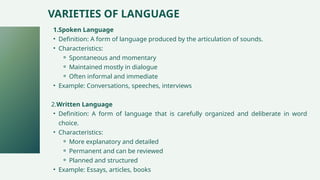
1.SpokenLanguage
• Definition: A form of language produced by the articulation of sounds.
• Characteristics:
⚬ Spontaneous and momentary
⚬ Maintained mostly in dialogue
⚬ Often informal and immediate
• Example: Conversations, speeches, interviews
2.Written Language
• Definition: A form of language that is carefully organized and deliberate in word
choice.
• Characteristics:
⚬ More explanatory and detailed
⚬ Permanent and can be reviewed
⚬ Planned and structured
• Example: Essays, articles, books
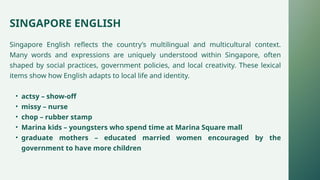
3.
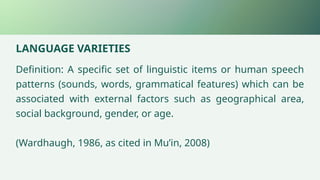
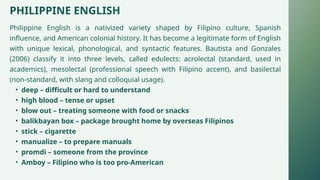
LANGUAGE VARIETIES
Definition: Aspecific set of linguistic items or human speech
patterns (sounds, words, grammatical features) which can be
associated with external factors such as geographical area,
social background, gender, or age.
(Wardhaugh, 1986, as cited in Mu’in, 2008)
4.
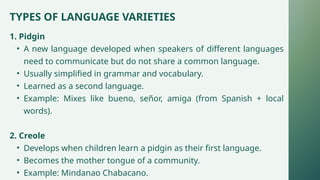
TYPES OF LANGUAGEVARIETIES
1. Pidgin
• A new language developed when speakers of different languages
need to communicate but do not share a common language.
• Usually simplified in grammar and vocabulary.
• Learned as a second language.
• Example: Mixes like bueno, señor, amiga (from Spanish + local
words).
2. Creole
• Develops when children learn a pidgin as their first language.
• Becomes the mother tongue of a community.
• Example: Mindanao Chabacano.
5.
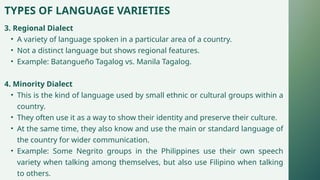
TYPES OF LANGUAGEVARIETIES
3. Regional Dialect
• A variety of language spoken in a particular area of a country.
• Not a distinct language but shows regional features.
• Example: Batangueño Tagalog vs. Manila Tagalog.
4. Minority Dialect
• This is the kind of language used by small ethnic or cultural groups within a
country.
• They often use it as a way to show their identity and preserve their culture.
• At the same time, they also know and use the main or standard language of
the country for wider communication.
• Example: Some Negrito groups in the Philippines use their own speech
variety when talking among themselves, but also use Filipino when talking
to others.
6.
TYPES OF LANGUAGEVARIETIES
5. Indigenized Variety
• Spoken mainly as second languages in former colonies with
multilingual populations.
• Reflects local culture and identity.
• Example: Philippine English, Indian English.
7.
LESSON I: VARIETIESOF ENGLISH
English is spoken worldwide, but it changes depending on history, culture, and
location. These differences are called varieties of English.
1. American English (AmE)
• Definition: English spoken mainly in the United States.
• Origin: Introduced by British settlers in the 17th century.
• Note: Developed its own spelling, pronunciation, and vocabulary.
• Example: color (AmE) vs. colour (BrE).
2. Australian English (AuE)
• Definition: English spoken mainly in Australia.
• Origin: Started diverging from British English in the late 18th century.
• Features: Shares similarities with New Zealand English and some dialects from
Southeast England.
• Example: Unique slang like arvo (afternoon).
8.
LESSON I: VARIETIESOF ENGLISH
3. Black English
• Definition: English spoken by black communities in the US, UK, the Caribbean,
and Africa.
• Features: Influenced by African languages and culture, giving it distinct rhythm
and expressions.
• Example: African American Vernacular English (AAVE) in the US.
4. British English (BrE)
• Definition: English spoken mainly in the United Kingdom.
• Importance: Alongside American English, it is one of the most commonly taught
in ESL (English as a Second Language) and EFL (English as a Foreign Language)
programs.
• Example: lift (BrE) vs. elevator (AmE).
9.
LESSON I: VARIETIESOF ENGLISH
5. Philippine English
• Definition: A localized or nativized variety of English spoken in the Philippines.
• Origin: Introduced by American teachers after 1898.
• Use: Widely used in science, technology, government, education, and law.
• Features: Influenced by Filipino culture and expressions.
• Example: “Open the light” (instead of “turn on the light”).
10.
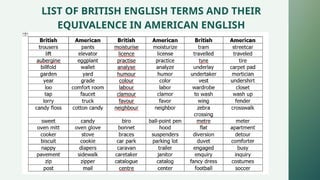
LIST OF BRITISHENGLISH TERMS AND THEIR
EQUIVALENCE IN AMERICAN ENGLISH
11.
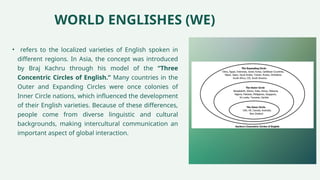
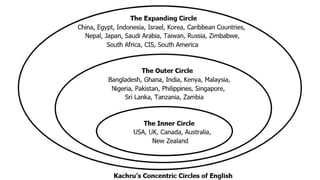
WORLD ENGLISHES (WE)
•refers to the localized varieties of English spoken in
different regions. In Asia, the concept was introduced
by Braj Kachru through his model of the “Three
Concentric Circles of English.” Many countries in the
Outer and Expanding Circles were once colonies of
Inner Circle nations, which influenced the development
of their English varieties. Because of these differences,
people come from diverse linguistic and cultural
backgrounds, making intercultural communication an
important aspect of global interaction.
13.
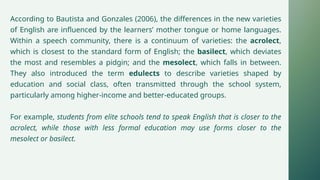
According to Bautistaand Gonzales (2006), the differences in the new varieties
of English are influenced by the learners’ mother tongue or home languages.
Within a speech community, there is a continuum of varieties: the acrolect,
which is closest to the standard form of English; the basilect, which deviates
the most and resembles a pidgin; and the mesolect, which falls in between.
They also introduced the term edulects to describe varieties shaped by
education and social class, often transmitted through the school system,
particularly among higher-income and better-educated groups.
For example, students from elite schools tend to speak English that is closer to the
acrolect, while those with less formal education may use forms closer to the
mesolect or basilect.
14.
Kachru and Nelson(2006) explain that structural variations in English across
regions are shaped by local languages, affecting grammar, pronunciation,
vocabulary, and discourse. This leads to differences in word stress, such as
Nigerians pronouncing success as success (second syllable stressed) instead
of success (first syllable stressed). Similarly, Indians and Nigerians say recognize
instead of recognize. In pronunciation, speakers from these circles often do not
differentiate nouns and verbs by stress (e.g., import vs. import), unlike Inner
Circle speakers. They also avoid contrastive stress for emphasis, which Inner Circle
speakers commonly use. In terms of sounds, Outer and Expanding Circle
speakers often skip the initial aspiration of p, t, k, making pat sound closer to
bat. Some Japanese speakers, for example, have difficulty distinguishing r
and l, leading to mispronunciations such as saying lice instead of rice.
15.
Kachru and Nelson(2006) explain that structural variations in English across
regions are shaped by local languages, affecting grammar, pronunciation,
vocabulary, and discourse. This leads to differences in word stress, such as
Nigerians pronouncing success as success (second syllable stressed) instead
of success (first syllable stressed). Similarly, Indians and Nigerians say recognize
instead of recognize. In pronunciation, speakers from these circles often do not
differentiate nouns and verbs by stress (e.g., import vs. import), unlike Inner
Circle speakers. They also avoid contrastive stress for emphasis, which Inner Circle
speakers commonly use. In terms of sounds, Outer and Expanding Circle
speakers often skip the initial aspiration of p, t, k, making pat sound closer to
bat. Some Japanese speakers, for example, have difficulty distinguishing r
and l, leading to mispronunciations such as saying lice instead of rice.
16.
SINGAPORE ENGLISH
Singapore Englishreflects the country’s multilingual and multicultural context.
Many words and expressions are uniquely understood within Singapore, often
shaped by social practices, government policies, and local creativity. These lexical
items show how English adapts to local life and identity.
• actsy – show-off
• missy – nurse
• chop – rubber stamp
• Marina kids – youngsters who spend time at Marina Square mall
• graduate mothers – educated married women encouraged by the
government to have more children
17.
PHILIPPINE ENGLISH
Philippine Englishis a nativized variety shaped by Filipino culture, Spanish
influence, and American colonial history. It has become a legitimate form of English
with unique lexical, phonological, and syntactic features. Bautista and Gonzales
(2006) classify it into three levels, called edulects: acrolectal (standard, used in
academics), mesolectal (professional speech with Filipino accent), and basilectal
(non-standard, with slang and colloquial usage).
• deep – difficult or hard to understand
• high blood – tense or upset
• blow out – treating someone with food or snacks
• balikbayan box – package brought home by overseas Filipinos
• stick – cigarette
• manualize – to prepare manuals
• promdi – someone from the province
• Amboy – Filipino who is too pro-American
18.
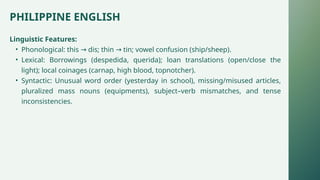
PHILIPPINE ENGLISH
Linguistic Features:
•Phonological: this dis; thin tin; vowel confusion (ship/sheep).
→ →
• Lexical: Borrowings (despedida, querida); loan translations (open/close the
light); local coinages (carnap, high blood, topnotcher).
• Syntactic: Unusual word order (yesterday in school), missing/misused articles,
pluralized mass nouns (equipments), subject–verb mismatches, and tense
inconsistencies.
19.
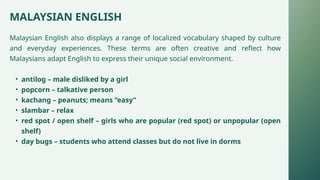
MALAYSIAN ENGLISH
Malaysian Englishalso displays a range of localized vocabulary shaped by culture
and everyday experiences. These terms are often creative and reflect how
Malaysians adapt English to express their unique social environment.
• antilog – male disliked by a girl
• popcorn – talkative person
• kachang – peanuts; means “easy”
• slambar – relax
• red spot / open shelf – girls who are popular (red spot) or unpopular (open
shelf)
• day bugs – students who attend classes but do not live in dorms
20.
STANDARD PHILIPPINE ENGLISHDEBATE
Bautista (2000) raised the question of whether there is
a Standard Philippine English, arguing that just like
Indian or Singaporean English, it is a legitimate variety
with its own rules. Gonzalez (1985) pointed out that
what may appear as “errors” can become accepted
features when used widely by educated speakers.
21.
STANDARD PHILIPPINE ENGLISHDEBATE
LEXICAL FEATURES (GONZALEZ, 1985)
• Preference for words like shall, could, such, wherein
• In Philippine English, these words are often used more frequently than in
American English.
✅ AmE correction: Use will instead of shall (e.g., I will go not I shall go). Use
simpler alternatives to wherein (e.g., in which).
• Unusual collocations: results to instead of results in
❌ The accident resulted to many injuries.
✅ AmE correction: The accident resulted in many injuries.
• Non-standard prepositions: omission or addition of prepositions
❌ He explained me the lesson.
✅ AmE correction: He explained the lesson to me.
❌ She discussed about the problem.
✅ AmE correction: She discussed the problem.
22.
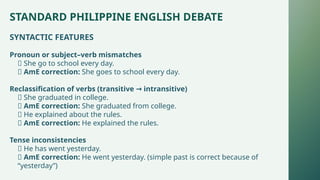
STANDARD PHILIPPINE ENGLISHDEBATE
SYNTACTIC FEATURES
• Unusual adverb placement (yesterday in school)
❌ Yesterday in school I saw my friend.
✅ AmE correction: I saw my friend in school yesterday.
• Misuse or absence of articles (the or a)
❌ She went to market.
✅ AmE correction: She went to the market.
❌ He is engineer.
✅ AmE correction: He is an engineer.
• Pluralized mass nouns (furnitures)
❌ The furnitures are new.
✅ AmE correction: The furniture is new. (mass noun = no plural)
23.
STANDARD PHILIPPINE ENGLISHDEBATE
SYNTACTIC FEATURES
Pronoun or subject–verb mismatches
❌ She go to school every day.
✅ AmE correction: She goes to school every day.
Reclassification of verbs (transitive intransitive)
→
❌ She graduated in college.
✅ AmE correction: She graduated from college.
❌ He explained about the rules.
✅ AmE correction: He explained the rules.
Tense inconsistencies
❌ He has went yesterday.
✅ AmE correction: He went yesterday. (simple past is correct because of
“yesterday”)
24.
DYNAMIC NATURE OFENGLISH
The study of Singaporean, Philippine, and Malaysian English
varieties shows how English evolves to meet the needs of local
communities. These features should not always be judged as
errors, but as legitimate expressions of identity and culture. As
Gemino Abad (1997) said, “English is ours. We have colonized it
too.” Recognizing these differences is crucial for intercultural
communication, as it reduces misunderstandings, prevents
breakdowns, and fosters more respectful interactions across
cultures.
Editor's Notes
#1 Language is dynamic and takes many forms.
It can be spoken or written, and it also adapts to social, cultural, and geographical contexts.
Understanding language varieties helps us see how people communicate differently across situations.