 Introduction:
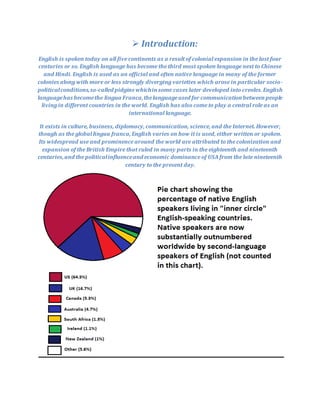
English is spoken today on all five continents as a result of colonial expansion in the last four
centuries or so. English language has become the third most spoken language next to Chinese
and Hindi. English is used as an official and often native language in many of the former
colonies along with more or less strongly diverging varieties which arose in particular socio-
politicalconditions,so-called pidgins whichinsome cases later developed into creoles. English
languagehas becomethe lingua Franca,thelanguageused for communicationbetweenpeople
living in different countries in the world. English has also come to play a central role as an
international language.
It exists in culture, business, diplomacy, communication, science, and the Internet. However,
though as the global lingua franca, English varies on how it is used, either written or spoken.
Its widespread use and prominence around the world are attributed to the colonization and
expansion of the British Empire that ruled in many parts in the eighteenth and nineteenth
centuries,and the politicalinfluenceand economic dominance of USA from the late nineteenth
century to the present day.
 Verities in English language:
The two maingroups areBritainand America.Foreach there are standardforms ofEnglish
which areused as yardsticks forcomparingothervarieties ofthe respectivearea.
In Britainthestandard is called Received Pronunciation.Theterm refers to the pronunciation
of English which is accepted -thatis, received -in English society.
In America there is a standard which is referred toby any ofa numberoftitles, General
Americanand NetworkAmericanEnglish beingthetwo mostcommon.General Americanis
spokenby the majority ofAmericans English characteristicofthis area is found typically
amongthe AfricanAmericansections ofthecommunity.TheirEnglish is quitedifferentfrom
that of the rest of the United States.
English is one of the officiallanguages.However, there aresome significantdifferences in
spelling, grammar,formatting,word usageand evenabbreviationsamongtheBritish
influenced varieties.Inallcountries whereEnglish is used there arevariations invocabulary
and usagethat arepeculiarboth to that country and toregions withinit. Differences of nature
and materialcivilization,and generally contactwith someforeigntongue, areclearly Reflected
inthe vocabulary.Allthese differences depend upon Flora and Faunasocompletely different
fromanythingseenby them before.
There are many othervarieties ofEnglish around theworld,includingforexampleAustralian
English,New Zealand English,CanadianEnglish,South AfricanEnglish,American English,
IndianEnglish and CaribbeanEnglish.
Australia and New Zealand:
AustralianEnglish uses many words thatwould notbeunderstood inEngland orAmerica.
Some ofthese areold words thathaveacquired new meanings by beingapplied tonew things.
Thus the term robinis used forvarious birds notknowninEurope.Theword jackass
(shortened fromlaughingjackass)means a birdwhosecry is likea donkey’s bray.Otherwords
havebeen borrowed fromtheaboriginallanguages ofAustralia and fromMaori inNew
Zealand.The English of Australia notonly is characterized by interestingdifferences of
vocabularybutvaries strikingly inpronunciationfromthereceived standard ofEngland.The
accentof the majority of Australians has characteristics oftenassociated with Cockney (a type
of informalEnglish thatcockneys speak) especially inthequality of the vowels and diphthongs
that occurinthe words say,so,beat, boot, high,and how.
South Africa:
The samethingis true ina somewhatdifferentway ofAfrica,themost multilingualcontinent
on earth.The present RepublicofSouth Africa had beenoccupied successively by theBushmen,
Hottentots, Bantus,Portuguese, and Dutch beforethe English settlers came.From all these
sources,butespecially fromDutch and its South Africandevelopment,Afrikaans,theEnglish
languagehas acquired elements. A few words thatoccurred earlierinpeculiarly South African
contexts havepassed intothegeneral English vocabulary. Thegreat majority ofAfrikanerisms
(i.e., words and expressions borrowed fromDutch and Afrikaans)would stillbegenerally
meaningless inotherparts of the English-speakingworld yetare quite commoninthe daily life
of South Africans.
 The Differences between Canadian English & British English:
o Canadians Have Language Flexibility:
Canadiandialectis directly influenced by theUnited States becauseofits close proximity.The
truth is,Canadians canspell"colour"with the"u" or without,like "color," as Americans do.
Canadians havethechoiceof spellingthe Americanway orthe British way,when creating
prose.CanadianEnglish is moreflexiblethanBritish English,wherespelling rules are more
rigid.Although CanadiansdohavesomeAmericanword spellings intheirlanguage,most
words follow British word spellings.
o Spelling:
Verbs such as,"recognize"and "analyze"end with a "z"in Canada,and inBritainthey replace
the "z" with an"s" letter, which spells "recognise"and "analyse.
 English in India:
English has been with India sincetheearly 1600's,whentheEast India Company started
tradingand English missionaries firstbegantheirefforts. English becamethe officialand
academiclanguageofIndia by theearly twentieth century. The English which is spokenin
India is differentfromthatspokeninother regions of the world,and it is regarded as the
uniquevariety which is called IndianEnglish.
DISTINGUISHING CHARACTERISTICS OF INDIAN ENGLISH:
IndianEnglish is a distinctvariety ofthe English language.Many Indians claimthatitis very
similartoBritish English,butthis opinionis based ona surfacelevelexaminationoflexical
similarities.Theseoperateon various phonological,morphological,lexical,and syntacticlevels
o PHONOLOGY:
 English alveolar/t/ articulated as theIndianretroflex/t/ or as the dental /t/
 IndianEnglish tends to havea reduced vowelsystem
o MORPHOLOGY:
IndianEnglish morphology is very creativeand itis filled with new terms and usages.Indian
English uses compound formationextensively,as inEnglish-speakingclasses.Thecompounds
cousin-brotherand cousin-sisterallow theIndianEnglish speakertodesignatewhethertheir
cousinis maleor female Indians alsopluralizemany English mass nouns and end up with
words such as litters,furniture’s,and woods.
 British English vs. American English:
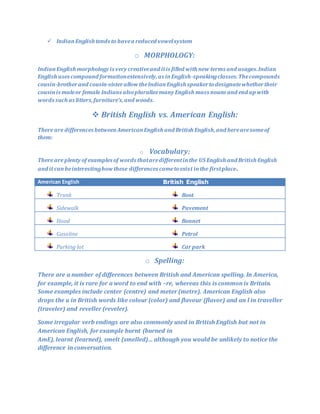
There are differences betweenAmericanEnglish and British English,and herearesomeof
them:
o Vocabulary:
There are plenty of examples of words thataredifferentinthe US English and British English
and it canbeinterestinghow these differences cametoexist inthe firstplace.
American English British English
Trunk Boot
Sidewalk Pavement
Hood Bonnet
Gasoline Petrol
Parking lot Carpark
o Spelling:
There are a number of differences between British and American spelling. In America,
for example, it is rare for a word to end with –re, whereas this is common is Britain.
Some examples include center (centre) and meter (metre). American English also
drops the u in British words like colour (color) and flavour (flavor) and an l in traveller
(traveler) and reveller (reveler).
Some irregular verb endings are also commonly used in British English but not in
American English, for example burnt (burned in
AmE), learnt (learned), smelt (smelled)… although you would be unlikely to notice the
difference in conversation.
o Grammar:
There are subtle differences between British and American grammar that have
developed over the centuries, for example:
BrE: Metallica are playing in London tonight.
AmE: Metallica is playing in Boston tonight.
BrE: Our team are here to help.
AmE: Our team is here to help.
 Conclusion:
English isspoken today on all fivecontinents. English is used as an official
and often nativelanguagein many countries.English hasalsocome to
play a central roleas an international language.It exists in culture,
business, diplomacy,communication,science,and theInternet. English
varieson how it is used, either written or spoken. However,there aresome
significant differencesin spelling,grammar,formatting,word usageand
even abbreviationsamong theBritish influenced varieties.Thereare
many other varietiesof English around theworld,including for example
Australian English,New Zealand English,Canadian English,South African
English,Indian English and Caribbean English.

Verities Found In English Language

  • 2.
     Introduction: English isspoken today on all five continents as a result of colonial expansion in the last four centuries or so. English language has become the third most spoken language next to Chinese and Hindi. English is used as an official and often native language in many of the former colonies along with more or less strongly diverging varieties which arose in particular socio- politicalconditions,so-called pidgins whichinsome cases later developed into creoles. English languagehas becomethe lingua Franca,thelanguageused for communicationbetweenpeople living in different countries in the world. English has also come to play a central role as an international language. It exists in culture, business, diplomacy, communication, science, and the Internet. However, though as the global lingua franca, English varies on how it is used, either written or spoken. Its widespread use and prominence around the world are attributed to the colonization and expansion of the British Empire that ruled in many parts in the eighteenth and nineteenth centuries,and the politicalinfluenceand economic dominance of USA from the late nineteenth century to the present day.
  • 3.
     Verities inEnglish language: The two maingroups areBritainand America.Foreach there are standardforms ofEnglish which areused as yardsticks forcomparingothervarieties ofthe respectivearea. In Britainthestandard is called Received Pronunciation.Theterm refers to the pronunciation of English which is accepted -thatis, received -in English society. In America there is a standard which is referred toby any ofa numberoftitles, General Americanand NetworkAmericanEnglish beingthetwo mostcommon.General Americanis spokenby the majority ofAmericans English characteristicofthis area is found typically amongthe AfricanAmericansections ofthecommunity.TheirEnglish is quitedifferentfrom that of the rest of the United States. English is one of the officiallanguages.However, there aresome significantdifferences in spelling, grammar,formatting,word usageand evenabbreviationsamongtheBritish influenced varieties.Inallcountries whereEnglish is used there arevariations invocabulary and usagethat arepeculiarboth to that country and toregions withinit. Differences of nature and materialcivilization,and generally contactwith someforeigntongue, areclearly Reflected inthe vocabulary.Allthese differences depend upon Flora and Faunasocompletely different fromanythingseenby them before. There are many othervarieties ofEnglish around theworld,includingforexampleAustralian English,New Zealand English,CanadianEnglish,South AfricanEnglish,American English, IndianEnglish and CaribbeanEnglish. Australia and New Zealand: AustralianEnglish uses many words thatwould notbeunderstood inEngland orAmerica. Some ofthese areold words thathaveacquired new meanings by beingapplied tonew things. Thus the term robinis used forvarious birds notknowninEurope.Theword jackass (shortened fromlaughingjackass)means a birdwhosecry is likea donkey’s bray.Otherwords havebeen borrowed fromtheaboriginallanguages ofAustralia and fromMaori inNew Zealand.The English of Australia notonly is characterized by interestingdifferences of vocabularybutvaries strikingly inpronunciationfromthereceived standard ofEngland.The accentof the majority of Australians has characteristics oftenassociated with Cockney (a type of informalEnglish thatcockneys speak) especially inthequality of the vowels and diphthongs that occurinthe words say,so,beat, boot, high,and how.
  • 4.
    South Africa: The samethingistrue ina somewhatdifferentway ofAfrica,themost multilingualcontinent on earth.The present RepublicofSouth Africa had beenoccupied successively by theBushmen, Hottentots, Bantus,Portuguese, and Dutch beforethe English settlers came.From all these sources,butespecially fromDutch and its South Africandevelopment,Afrikaans,theEnglish languagehas acquired elements. A few words thatoccurred earlierinpeculiarly South African contexts havepassed intothegeneral English vocabulary. Thegreat majority ofAfrikanerisms (i.e., words and expressions borrowed fromDutch and Afrikaans)would stillbegenerally meaningless inotherparts of the English-speakingworld yetare quite commoninthe daily life of South Africans.  The Differences between Canadian English & British English: o Canadians Have Language Flexibility: Canadiandialectis directly influenced by theUnited States becauseofits close proximity.The truth is,Canadians canspell"colour"with the"u" or without,like "color," as Americans do. Canadians havethechoiceof spellingthe Americanway orthe British way,when creating prose.CanadianEnglish is moreflexiblethanBritish English,wherespelling rules are more rigid.Although CanadiansdohavesomeAmericanword spellings intheirlanguage,most words follow British word spellings. o Spelling: Verbs such as,"recognize"and "analyze"end with a "z"in Canada,and inBritainthey replace the "z" with an"s" letter, which spells "recognise"and "analyse.  English in India: English has been with India sincetheearly 1600's,whentheEast India Company started tradingand English missionaries firstbegantheirefforts. English becamethe officialand academiclanguageofIndia by theearly twentieth century. The English which is spokenin India is differentfromthatspokeninother regions of the world,and it is regarded as the uniquevariety which is called IndianEnglish. DISTINGUISHING CHARACTERISTICS OF INDIAN ENGLISH: IndianEnglish is a distinctvariety ofthe English language.Many Indians claimthatitis very similartoBritish English,butthis opinionis based ona surfacelevelexaminationoflexical similarities.Theseoperateon various phonological,morphological,lexical,and syntacticlevels o PHONOLOGY:  English alveolar/t/ articulated as theIndianretroflex/t/ or as the dental /t/
  • 5.
     IndianEnglish tendsto havea reduced vowelsystem o MORPHOLOGY: IndianEnglish morphology is very creativeand itis filled with new terms and usages.Indian English uses compound formationextensively,as inEnglish-speakingclasses.Thecompounds cousin-brotherand cousin-sisterallow theIndianEnglish speakertodesignatewhethertheir cousinis maleor female Indians alsopluralizemany English mass nouns and end up with words such as litters,furniture’s,and woods.  British English vs. American English: There are differences betweenAmericanEnglish and British English,and herearesomeof them: o Vocabulary: There are plenty of examples of words thataredifferentinthe US English and British English and it canbeinterestinghow these differences cametoexist inthe firstplace. American English British English Trunk Boot Sidewalk Pavement Hood Bonnet Gasoline Petrol Parking lot Carpark o Spelling: There are a number of differences between British and American spelling. In America, for example, it is rare for a word to end with –re, whereas this is common is Britain. Some examples include center (centre) and meter (metre). American English also drops the u in British words like colour (color) and flavour (flavor) and an l in traveller (traveler) and reveller (reveler). Some irregular verb endings are also commonly used in British English but not in American English, for example burnt (burned in AmE), learnt (learned), smelt (smelled)… although you would be unlikely to notice the difference in conversation.
  • 6.
    o Grammar: There aresubtle differences between British and American grammar that have developed over the centuries, for example: BrE: Metallica are playing in London tonight. AmE: Metallica is playing in Boston tonight. BrE: Our team are here to help. AmE: Our team is here to help.  Conclusion: English isspoken today on all fivecontinents. English is used as an official and often nativelanguagein many countries.English hasalsocome to play a central roleas an international language.It exists in culture, business, diplomacy,communication,science,and theInternet. English varieson how it is used, either written or spoken. However,there aresome significant differencesin spelling,grammar,formatting,word usageand even abbreviationsamong theBritish influenced varieties.Thereare many other varietiesof English around theworld,including for example Australian English,New Zealand English,Canadian English,South African English,Indian English and Caribbean English.