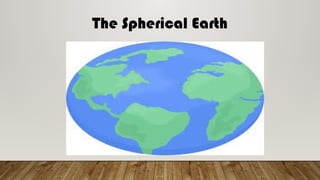
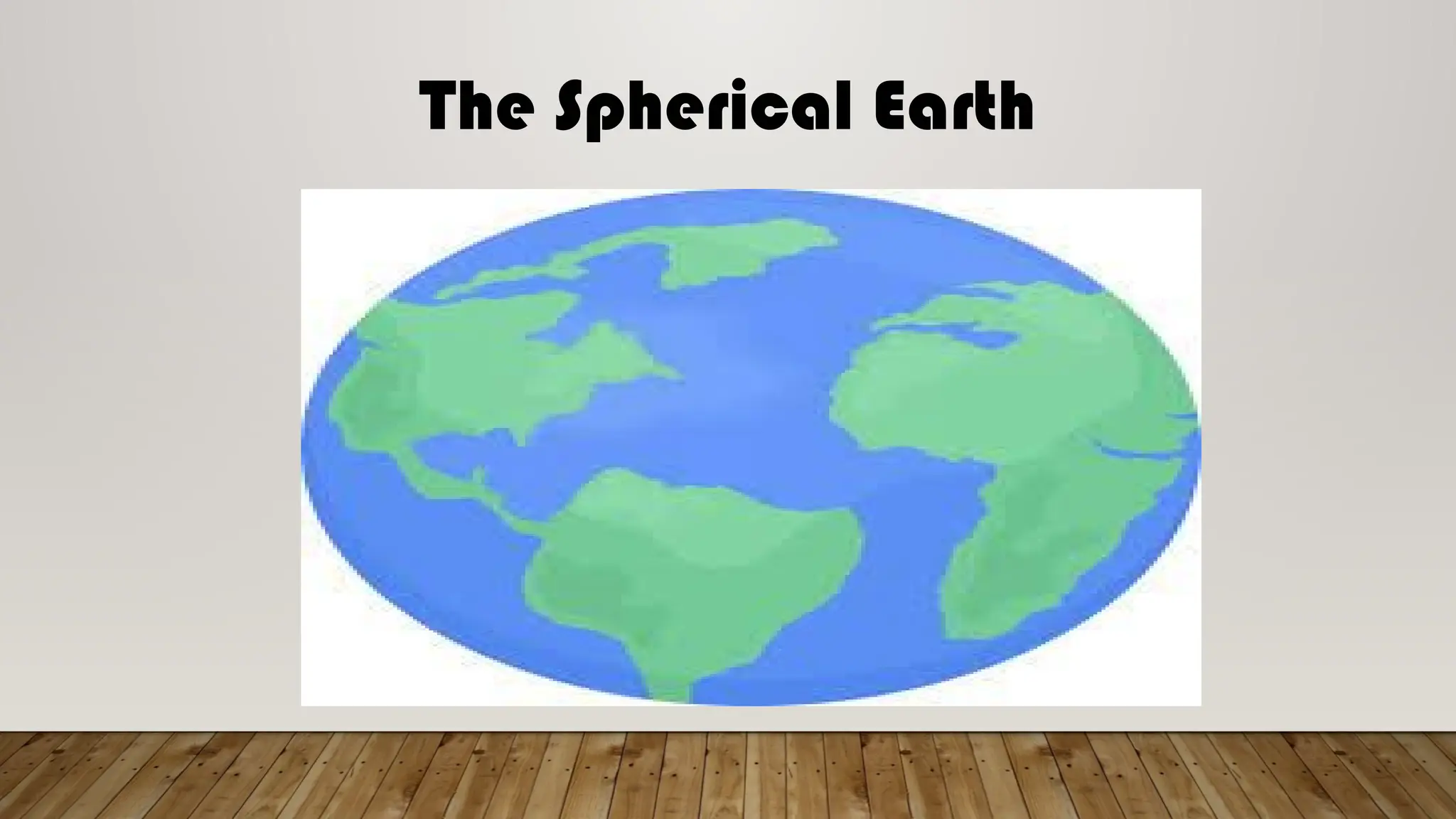
The Spherical Earth
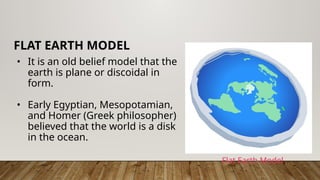
• It is an old belief model that the
earth is plane or discoidal in
form.
• Early Egyptian, Mesopotamian,
and Homer (Greek philosopher)
believed that the world is a disk
in the ocean.
FLAT EARTH MODEL
Flat Earth Model
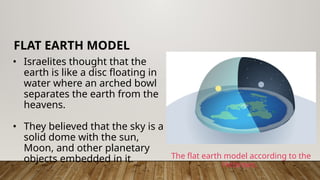
• Israelites thought that the
earth is like a disc floating in
water where an arched bowl
separates the earth from the
heavens.
• They believed that the sky is a
solid dome with the sun,
Moon, and other planetary
objects embedded in it.
FLAT EARTH MODEL
The flat earth model according to the
Hebrews.
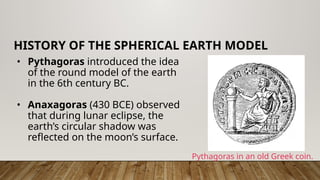
• Pythagoras introduced the idea
of the round model of the earth
in the 6th century BC.
• Anaxagoras (430 BCE) observed
that during lunar eclipse, the
earth’s circular shadow was
reflected on the moon’s surface.
HISTORY OF THE SPHERICAL EARTH MODEL
Pythagoras in an old Greek coin.
Around 340 BCE, Aristotle listed several arguments for a
spherical Earth:
• Earth was also spherical since the moon and the sun were
both spherical
• The North Star is closer to the horizon for places nearer
the equator
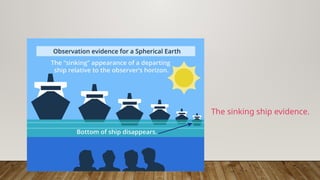
• When the ship sailed, the hull disappeared first, which
implied that the surface of the earth was curved.
HISTORY OF THE SPHERICAL EARTH MODEL
The sinking ship evidence.
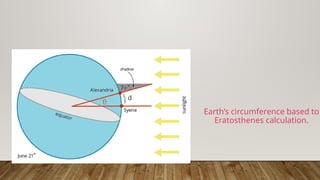
• Around 240 BCE, Eratosthenes attempted to measure the
circumference of the earth.
• In Syene in Southern Egypt, a vertical object did not cast
any shadow during the summer solstice, which was not
the case in Alexandria.
• He determined the angle that the sun rays made with the
vertical direction by measuring the shadow a vertical stick
cast.
HISTORY OF THE SPHERICAL EARTH MODEL
• In Alexandria, the sun rays make an angle of 7.2° from the
vertical, whereas, in Syene, it makes an angle of 0°.
• He hypothesized that the light rays coming from the sun
were parallel, and the earth was curved.
• He computed the circumference of the earth to be
approximately 250 000 stadia or 46 250 km (1 stadia - 185
m).
HISTORY OF THE SPHERICAL EARTH MODEL
Earth’s circumference based to
Eratosthenes calculation.
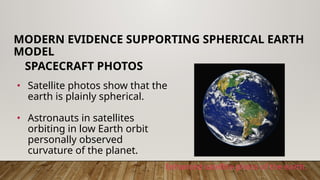
• Satellite photos show that the
earth is plainly spherical.
• Astronauts in satellites
orbiting in low Earth orbit
personally observed
curvature of the planet.
MODERN EVIDENCE SUPPORTING SPHERICAL EARTH
MODEL
SPACECRAFT PHOTOS
Enhanced satellite photo of the earth.
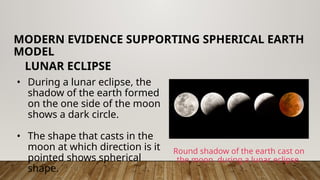
• During a lunar eclipse, the
shadow of the earth formed
on the one side of the moon
shows a dark circle.
• The shape that casts in the
moon at which direction is it
pointed shows spherical
shape.
MODERN EVIDENCE SUPPORTING SPHERICAL EARTH
MODEL
LUNAR ECLIPSE
Round shadow of the earth cast on
the moon during a lunar eclipse.
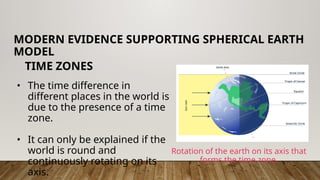
• The time difference in
different places in the world is
due to the presence of a time
zone.
• It can only be explained if the
world is round and
continuously rotating on its
axis.
MODERN EVIDENCE SUPPORTING SPHERICAL EARTH
MODEL
TIME ZONES
Rotation of the earth on its axis that
forms the time zone.
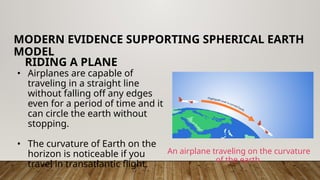
• Airplanes are capable of
traveling in a straight line
without falling off any edges
even for a period of time and it
can circle the earth without
stopping.
• The curvature of Earth on the
horizon is noticeable if you
travel in transatlantic flight.
MODERN EVIDENCE SUPPORTING SPHERICAL EARTH
MODEL
RIDING A PLANE
An airplane traveling on the curvature
of the earth.
Early Egyptian and Mesopotamian believed that the world
is a disk in the ocean.
Homer​
, a Greek philosopher in the 8th century BC.
According to this belief, the body of water surrounds the
circular flat Earth.
1
2
Israelites thought that the earth is like a disc floating on
water where an arched bowl separates the earth from the
heavens. They believed that the sky is a solid dome with
the sun, Moon, and other planetary objects embedded
in it.
Pythagoras at 6th century BC, introduced the idea of the
round model of Earth.
3
4
Around 340 BCE, Aristotle listed several arguments for a
spherical Earth, which included the shape of the moon
and the sun, the positions of the North Star, and the
disappearance of the ships when they sailed over the
horizon.
Eratosthenes attempted to measure the circumference of
the earth. He computed the circumference of the earth to
be approximately 250 000 stadia or 46 250 km ​
(1 stadia =
185 m).
5
6

3.the spherical earth powerpoint presentation in physical science

  • 1.
  • 2.
    • It isan old belief model that the earth is plane or discoidal in form. • Early Egyptian, Mesopotamian, and Homer (Greek philosopher) believed that the world is a disk in the ocean. FLAT EARTH MODEL Flat Earth Model
  • 3.
    • Israelites thoughtthat the earth is like a disc floating in water where an arched bowl separates the earth from the heavens. • They believed that the sky is a solid dome with the sun, Moon, and other planetary objects embedded in it. FLAT EARTH MODEL The flat earth model according to the Hebrews.
  • 4.
    • Pythagoras introducedthe idea of the round model of the earth in the 6th century BC. • Anaxagoras (430 BCE) observed that during lunar eclipse, the earth’s circular shadow was reflected on the moon’s surface. HISTORY OF THE SPHERICAL EARTH MODEL Pythagoras in an old Greek coin.
  • 5.
    Around 340 BCE,Aristotle listed several arguments for a spherical Earth: • Earth was also spherical since the moon and the sun were both spherical • The North Star is closer to the horizon for places nearer the equator • When the ship sailed, the hull disappeared first, which implied that the surface of the earth was curved. HISTORY OF THE SPHERICAL EARTH MODEL
  • 6.
  • 7.
    • Around 240BCE, Eratosthenes attempted to measure the circumference of the earth. • In Syene in Southern Egypt, a vertical object did not cast any shadow during the summer solstice, which was not the case in Alexandria. • He determined the angle that the sun rays made with the vertical direction by measuring the shadow a vertical stick cast. HISTORY OF THE SPHERICAL EARTH MODEL
  • 8.
    • In Alexandria,the sun rays make an angle of 7.2° from the vertical, whereas, in Syene, it makes an angle of 0°. • He hypothesized that the light rays coming from the sun were parallel, and the earth was curved. • He computed the circumference of the earth to be approximately 250 000 stadia or 46 250 km (1 stadia - 185 m). HISTORY OF THE SPHERICAL EARTH MODEL
  • 9.
    Earth’s circumference basedto Eratosthenes calculation.
  • 10.
    • Satellite photosshow that the earth is plainly spherical. • Astronauts in satellites orbiting in low Earth orbit personally observed curvature of the planet. MODERN EVIDENCE SUPPORTING SPHERICAL EARTH MODEL SPACECRAFT PHOTOS Enhanced satellite photo of the earth.
  • 11.
    • During alunar eclipse, the shadow of the earth formed on the one side of the moon shows a dark circle. • The shape that casts in the moon at which direction is it pointed shows spherical shape. MODERN EVIDENCE SUPPORTING SPHERICAL EARTH MODEL LUNAR ECLIPSE Round shadow of the earth cast on the moon during a lunar eclipse.
  • 12.
    • The timedifference in different places in the world is due to the presence of a time zone. • It can only be explained if the world is round and continuously rotating on its axis. MODERN EVIDENCE SUPPORTING SPHERICAL EARTH MODEL TIME ZONES Rotation of the earth on its axis that forms the time zone.
  • 13.
    • Airplanes arecapable of traveling in a straight line without falling off any edges even for a period of time and it can circle the earth without stopping. • The curvature of Earth on the horizon is noticeable if you travel in transatlantic flight. MODERN EVIDENCE SUPPORTING SPHERICAL EARTH MODEL RIDING A PLANE An airplane traveling on the curvature of the earth.
  • 14.
    Early Egyptian andMesopotamian believed that the world is a disk in the ocean. Homer​ , a Greek philosopher in the 8th century BC. According to this belief, the body of water surrounds the circular flat Earth. 1 2
  • 15.
    Israelites thought thatthe earth is like a disc floating on water where an arched bowl separates the earth from the heavens. They believed that the sky is a solid dome with the sun, Moon, and other planetary objects embedded in it. Pythagoras at 6th century BC, introduced the idea of the round model of Earth. 3 4
  • 16.
    Around 340 BCE,Aristotle listed several arguments for a spherical Earth, which included the shape of the moon and the sun, the positions of the North Star, and the disappearance of the ships when they sailed over the horizon. Eratosthenes attempted to measure the circumference of the earth. He computed the circumference of the earth to be approximately 250 000 stadia or 46 250 km ​ (1 stadia = 185 m). 5 6