UNIT II INTELLIGENT STORAGE
SYSTEMS AND RAID
COMPONENTS OF AN INTELLIGENT
STORAGE SYSTEM
 Business-critical applications require high levels of
performance, availability, security, and scalability
 A hard disk drive is a core element of storage that governs
the performance of any storage system.
 Some of the older disk array technologies could not
overcome performance constraints due to the limitations
of a hard disk and its mechanical components.
 RAID technology made an important contribution to
enhancing storage performance and reliability.
 With advancements in technology, a new breed of
storage solutions known as an intelligent storage
system has evolved.
 These storage systems are configured with large
amounts of memory called cache and use
sophisticated algorithms to meet the I/O
requirements of performance sensitive applications.
COMPONENTS OF AN INTELLIGENT
STORAGE SYSTEM
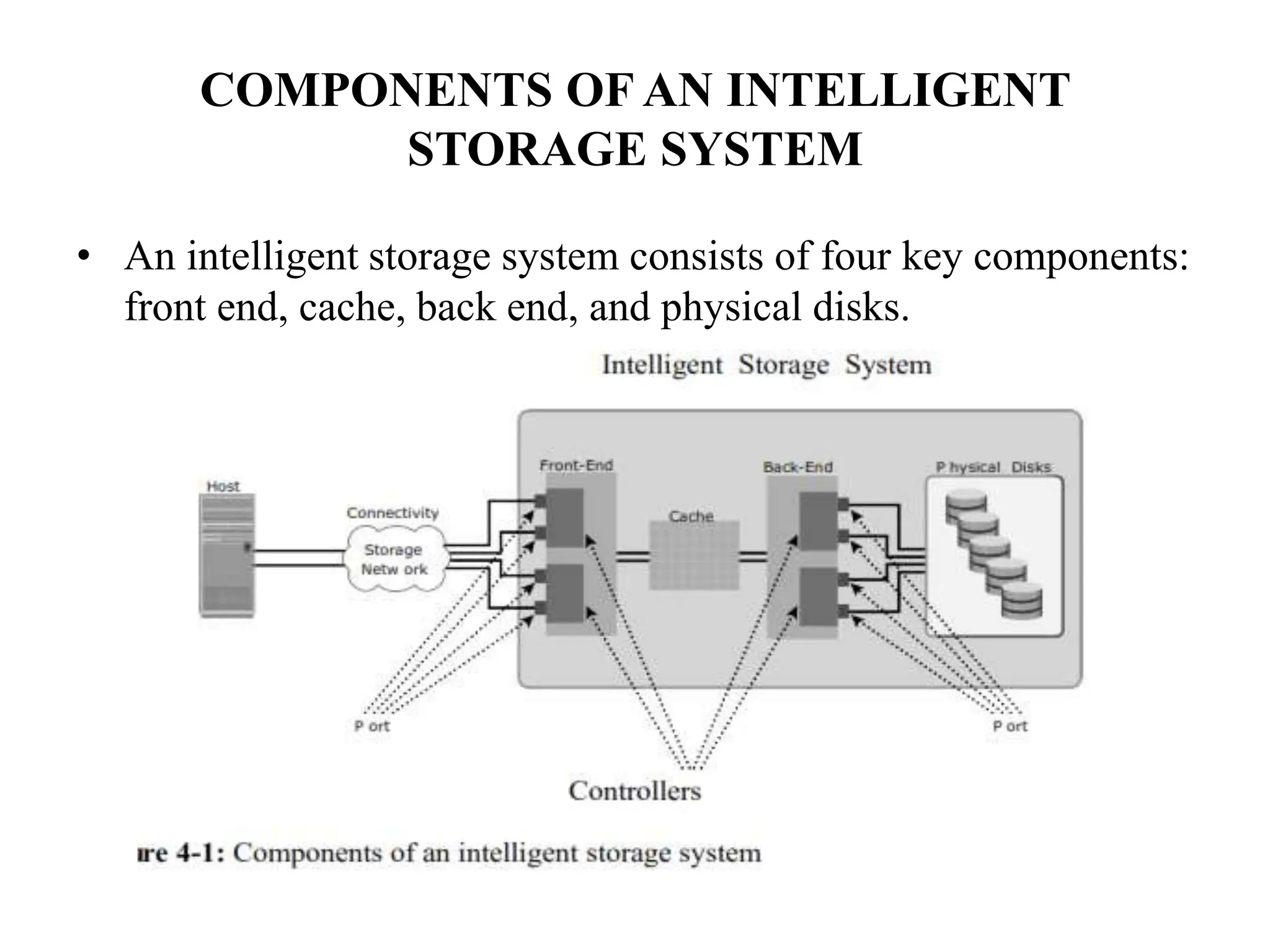
• An intelligent storage system consists of four key components:
front end, cache, back end, and physical disks.
FRONT END
• The front end provides the interface between the
storage system and the host. It consists of two
components: front-end ports and front-end
controllers.
• The front-end ports enable hosts to connect to the
intelligent storage system. Each front-end port has
processing logic that executes the appropriate
transport protocol, such as SCSI , Fibre Channel,or
iSCSI,for storage connections.
• Redundant ports are provided on the front end for
high availability.
• Front-end controllers route data to and from
cache via the internal data bus.
• When cache receives write data, the controller
sends an acknowledgment message back to the
host. Controllers optimize I/O processing by
using command queuing algorithms
Front-End Command Queuing
• Command queuing is a technique implemented on
front-end controllers. It determines the execution
order of received commands and can reduce
unnecessary drive head movements and improve disk
performance.
• When a command is received for execution, the
command queuing algorithms assigns a tag that
defines a sequence in which commands should be
executed.
• With command queuing, multiple commands can be
executed concurrently
• based on the organization of data on the disk, regardless of the
order in which the commands were received.
command queuing algorithms
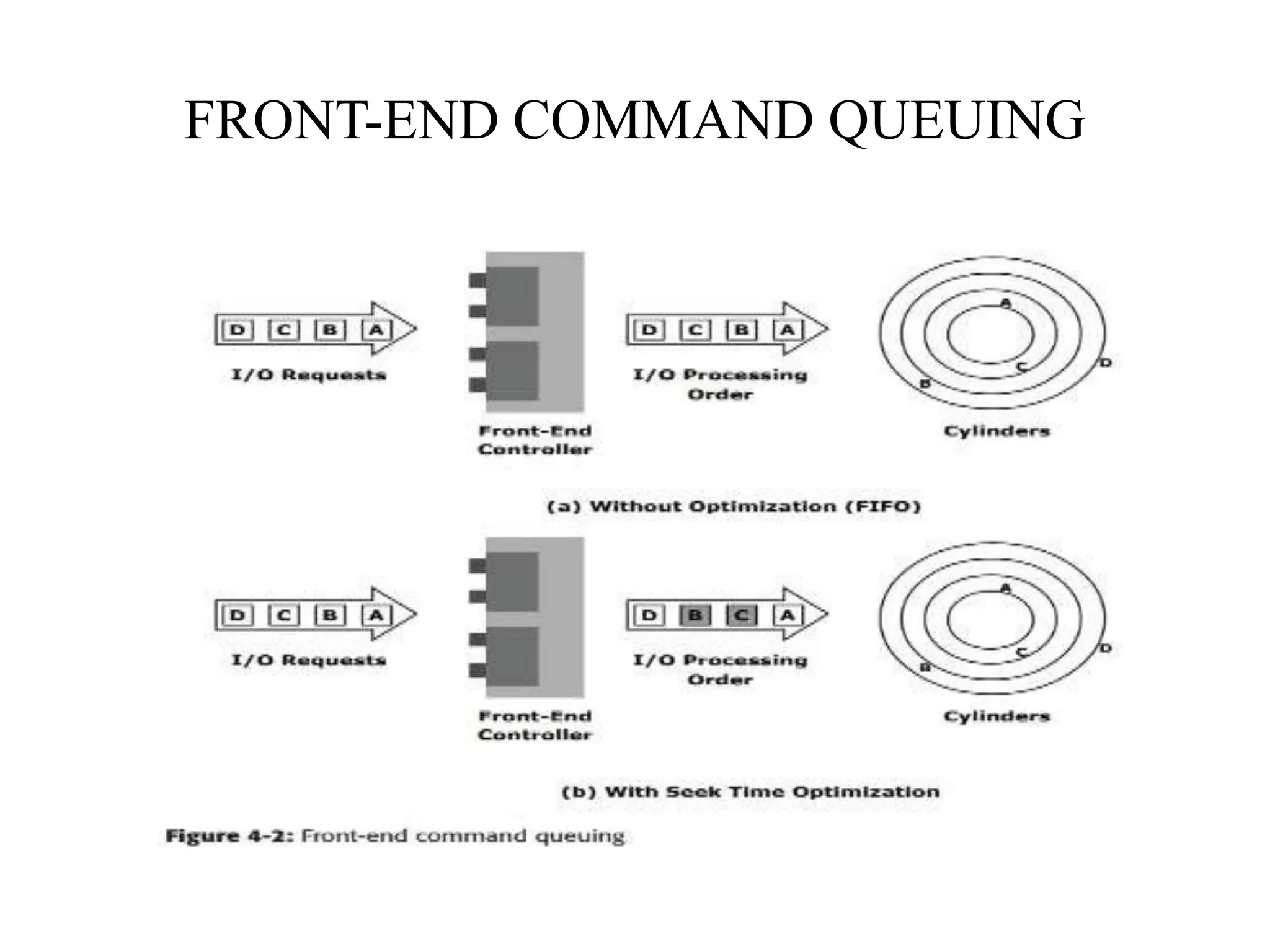
• First In First Out (FIFO): This is the default
algorithm where commands are executed in the order in
which they are received (Figure 4-2 [a]). There is no
reordering of requests for optimization; therefore, it is
inefficient in terms of performance.
• Seek Time Optimization: Commands are executed
based on optimizing read/write head movements, which
may result in reordering of commands. Without seek
time optimization, the commands are executed in the
order they are received.
• For example, as shown in Figure 4-2(a), the
commands are executed in the order A, B, C and D.
The radial movement required by the head to execute
C immediately after A is less than what would be
required to execute B.
• With seek time optimization, the command execution
sequence would be A, C, B and D, as shown in Figure
4-2(b).
FRONT-END COMMAND QUEUING
• Access Time Optimization: Commands are
executed based on the combination of seek time
optimization and an analysis of rotational latency for
optimal performance
CACHE
 Cache is an important component that enhances the
I/O performance in an intelligent storage system.
 Cache is semiconductor memory where data is
placed temporarily to reduce the time required to
service I/O requests from the host.
 Cache improves storage system performance by
isolating hosts from the mechanical delays associated
with physical disks, which are the slowest components
of an intelligent storage system.
Accessing data from a physical disk usu- ally takes
a few milliseconds because of seek times and
rotational latency. If a disk has to be accessed by
the host for every
I/O operation, requests are queued, which results in
a delayed response.
Accessing data from cache takes less than a
millisecond. Write data is placed in
cache and then written to disk. After the data is
securely placed in cache, the host
is acknowledged immediately
 Accessing data from a physical disk usu- ally
takes a few milliseconds because of seek times
and rotational latency. If a disk has to be accessed
by the host for every I/O operation, requests are
queued, which results in a delayed response.
 Accessing data from cache takes less than a
millisecond. Write data is placed incache and then
written to disk. After the data is securely placed in
cache, the host is acknowledged immediately
Structure of Cache
 Cache is organized into pages or slots, which is the smallest
unit of cache allocation.
 The size of a cache page is configured according to the
application I/O size.Cache consists of the data store and tag
RAM.
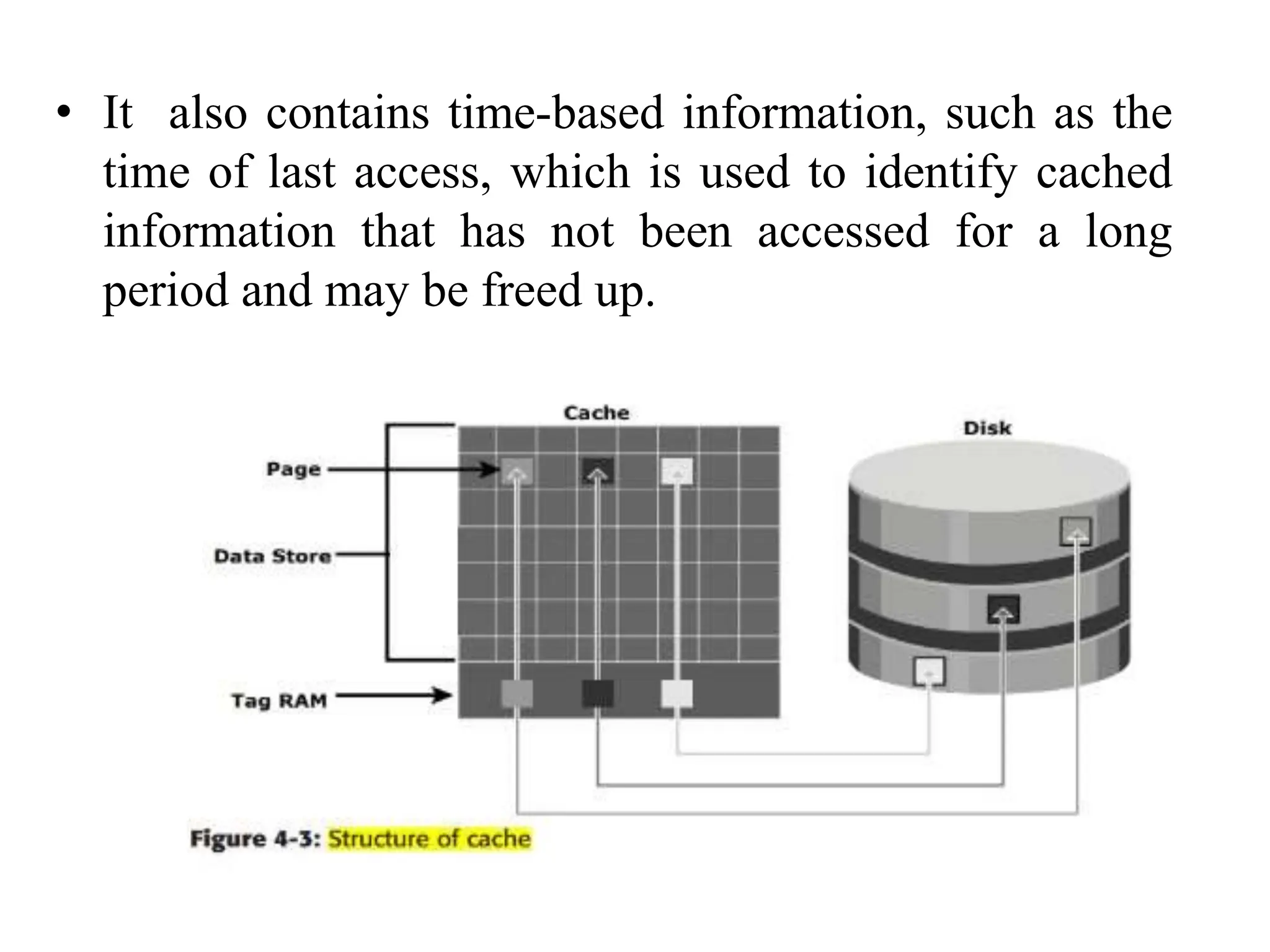
 The data store holds the data while tag RAM tracks the
location of the data in the data store (see Figure 4-3) and in
disk.
 Entries in tag RAM indicate where data is found in cache and
where the data belongs on the disk. Tag RAM includes a
dirty bit flag, which indicates whether the data in cache has
been committed to the disk or not.
• It also contains time-based information, such as the
time of last access, which is used to identify cached
information that has not been accessed for a long
period and may be freed up.
READ OPERATION WITH CACHE
• When a host issues a read request, the front-
end controller accesses the tag RAM to
determine whether the required data is available
in cache.
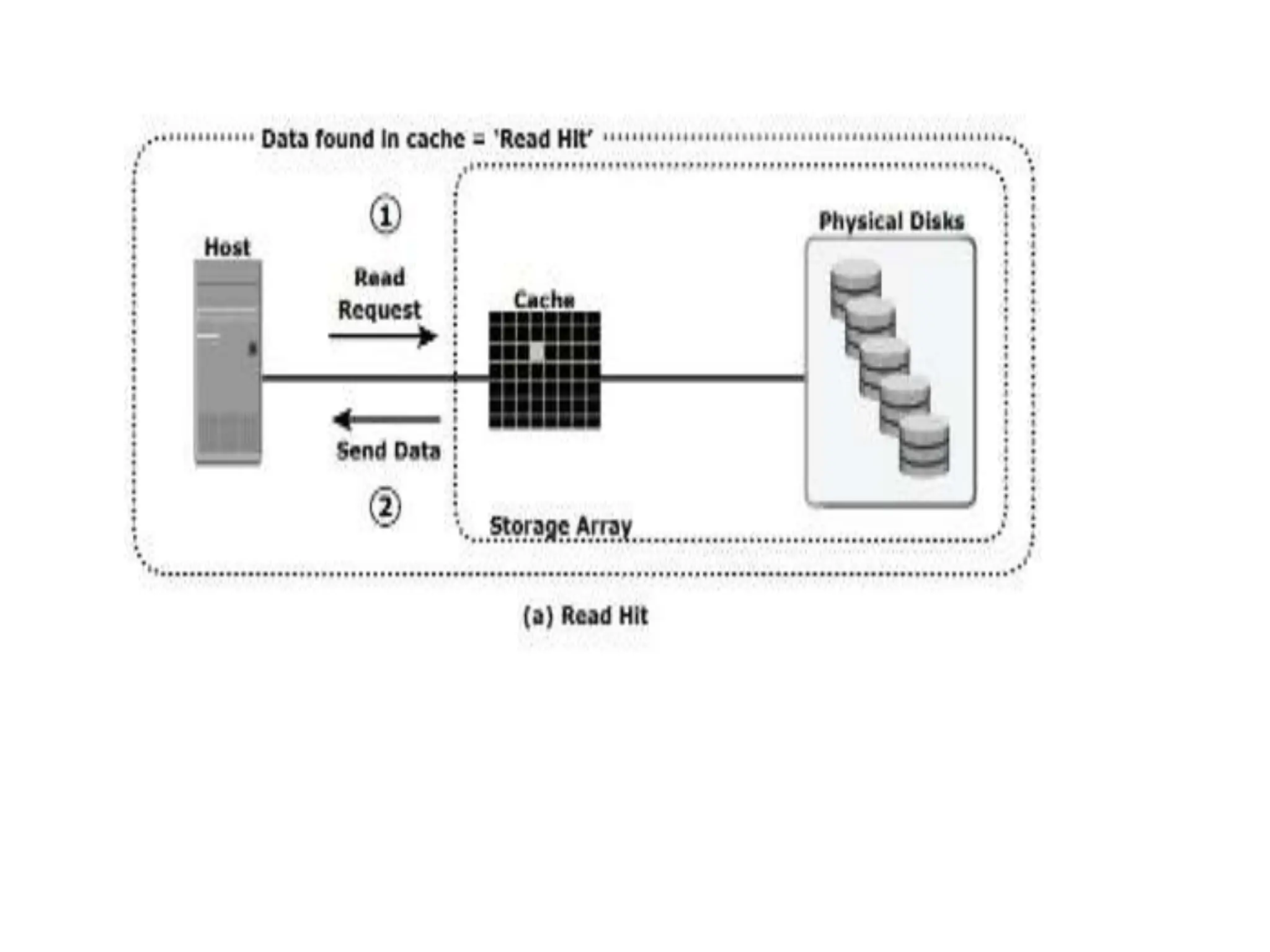
• If the requested data is found in the cache, it is
called a read cache hit or read hit and data is sent
directly to the host, without any disk operation
(see Figure 4-4[a]).This provides a fast response
time to the host (about a millisecond).
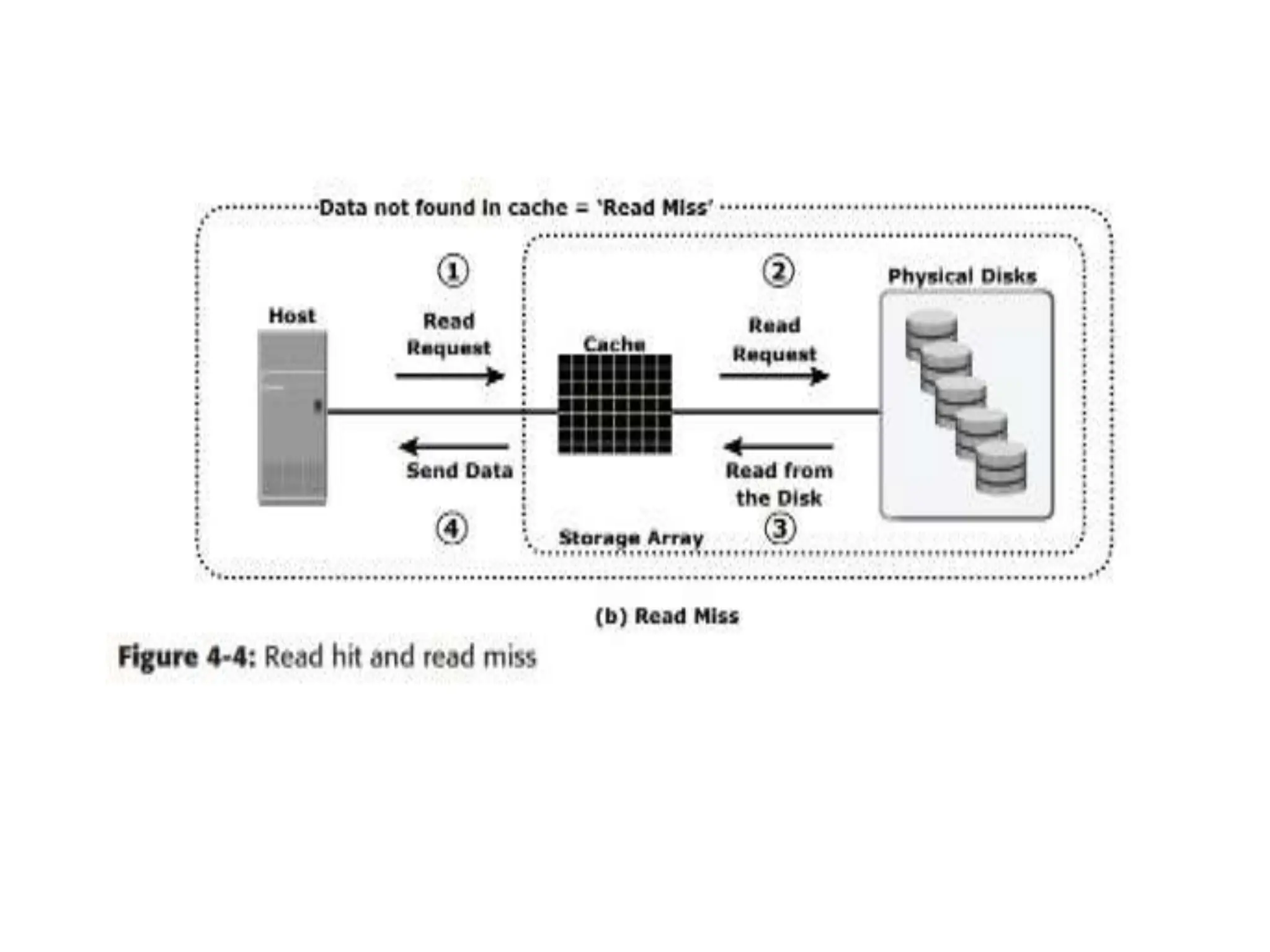
 If the requested data is not found in cache, it is called a cache
miss and the data must be read from the disk (see Figure 4-
4[b]).
 The back-end controller accesses the appropriate disk and
retrieves the requested data. Data is then placed in cache and is
finally sent to the host through the frontend controller.
 Cache misses increase I/O response time.
 A pre-fetch, or read-ahead, algorithm is used when read
requests are sequential. In a sequential read request, a
contiguous set of associated blocks is retrieved.
 Several other blocks that have not yet been requested by the
host can be read from the disk and placed into cache in
advance.
 The intelligent storage system offers fixed and variable pre-
fetch sizes.
 In fixed pre-fetch, the intelligent storage system pre-fetches a
fixed amount of data. It is most suitable when I/O sizes are
uniform.
 In variable pre-fetch, the storage system pre-fetches an amount
of data in multiples of the size of the host request.
 Read performance is measured in terms of the read hit ratio,
or the hit rate, usually expressed as a percentage.
 This ratio is the number of read hits with respect to the total
number of read requests.
 A higher read hit ratio improves the read performance.
Write Operation with Cache
 Write operations with cache provide performance
advantages over writing directly to disks. When an
I/O is written to cache and acknowledged, it is
completed in far less time (from the host’s
perspective) than it would take to write directly to
disk.
 A write operation with cache is implemented in the
following ways:
Write-back cache: Data is placed in cache and an
acknowledgment is sent to the host immediately. Later, data
from several writes are committed (de-staged) to the disk.
 Write response times are much faster, as the write operations
are isolated from the mechanical delays of the disk. However,
uncommitted data is at risk of loss in the event of cache
failures.
Write-through cache: Data is placed in the cache and
immediately writ- ten to the disk, and an acknowledgment is
sent to the host.
 Because data is committed to disk as it arrives, the risks of
data loss are low but write response time is longer because of
the disk operations.
• Cache can be bypassed under certain
conditions, such as very large size write I/O.
• In this implementation, if the size of an I/O
request exceeds the pre- defined size,
• called write aside size, writes are sent to the
disk directly to reduce the impact of large
• writes consuming a large cache area.
Cache Implementation
Cache can be implemented as either
dedicated cache or global cache. With
dedicated cache, separate sets of memory
locations are reserved for reads and writes.
In global cache, both reads and writes can
use any of the available memory addresses.
Cache management is more efficient in a
global cache implementation, As only one
global set of addresses has to be managed.
Cache Management
• Cache is a finite and expensive resource that needs proper management.
• Even though intelligent storage systems can be configured with large
amounts of cache, when all cache pages are filled, some pages have to be
freed up to accommodate new data and avoid performance degradation.
• Various cache management algorithms are implemented in intelligent
storage systems :
• Least Recently Used (LRU): An algorithm that continuously monitors data
access in cache and identifies the cache pages that have not been
accessed for a long time. LRU either frees up these pages or marks them
for reuse.
• Most Recently Used (MRU): An algorithm that is the converse of LRU. In
• MRU, the pages that have been accessed most recently are freed up
ormarked for reuse.
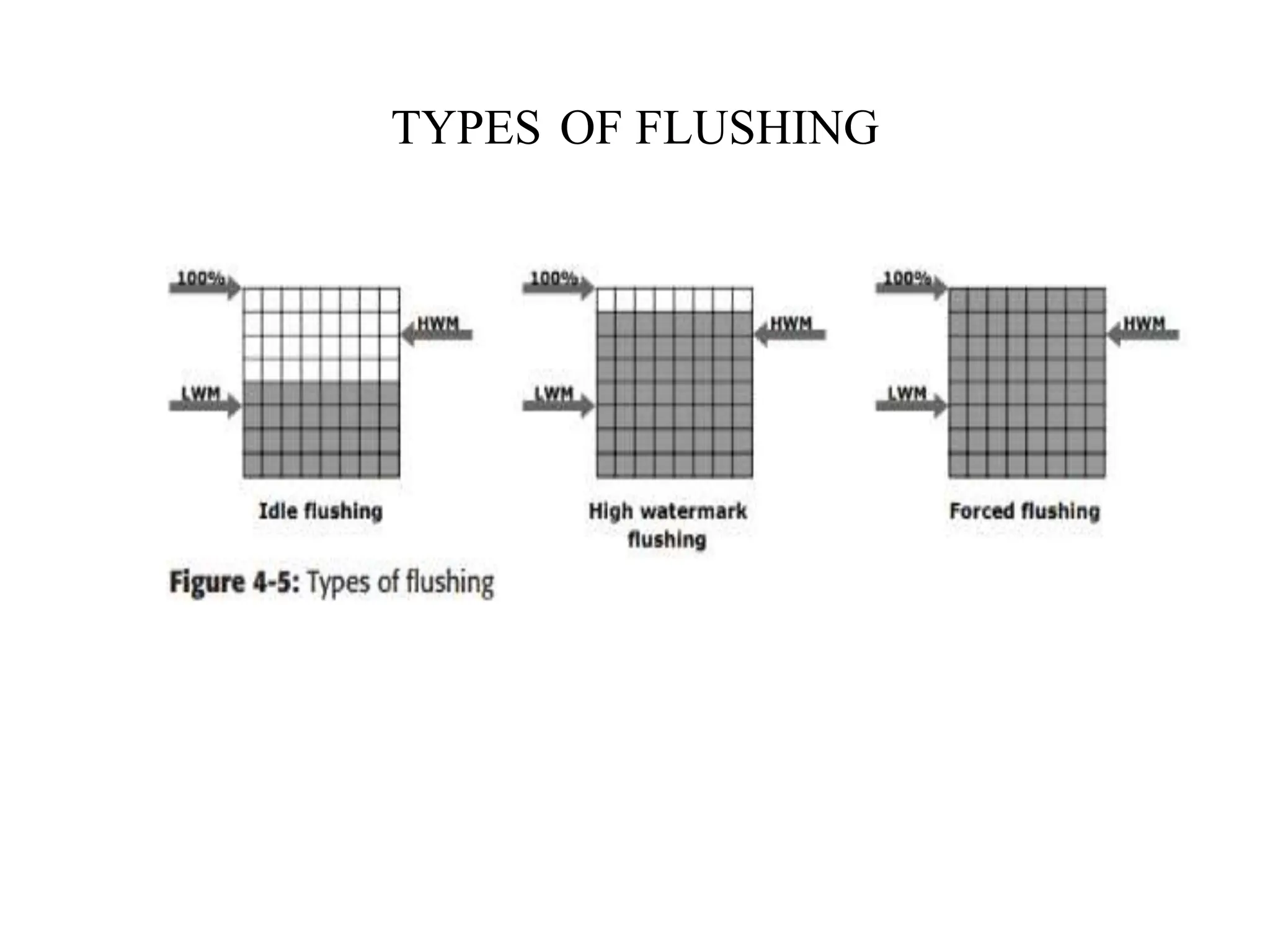
 As cache fills, the storage system must take action to flush
dirty pages (data written into the cahce but not yet written
to the disk) in order to manage its availability.
 Flushing is the process of committing data from cache to
the disk. On the basis of the I/O access rate and pattern,
high and low levels called watermarks are set in cache to
manage the flushing process.
 High watermark (HWM) is the cache utilization level at
which the storage system starts high- speed flushing of
cache data.
 Low watermark (LWM) is the point at which the storage
system stops the high-speed or forced flushing and returns
to idle flush behavior.
The cache utilization level, as shown in Figure 4-5, drives the mode of
flushing to be used:
Idle flushing: Occurs continuously, at a modest rate, when the cache
utilization level is between the high and low watermark.
High watermark flushing: Activated when cache utilization hits the high
watermark. The storage system dedicates some additional resources to
flushing.
Forced flushing: Occurs in the event of a large I/O burst when cache
reaches 100 percent of its capacity, which significantly affects the
I/O response time.
In forced flushing, dirty pages are forcibly flushed to disk.
TYPES OF FLUSHING
CACHE DATA PROTECTION
 Cache is volatile memory, so a power failure or any
kind of cache failure will cause the loss of data not yet
committed to the disk.
 This risk of losing uncommitted data held in cache can
be mitigated using cache mirroring and cache vaulting:
 Cache mirroring: Each write to cache is held in two
different memory locations on two independent
memory cards. In the event of a cache failure,the write
data will still be safe in the mirrored location and can
be committed to the disk.
In cache mirroring approaches, the problem of
maintaining cache coherency is introduced.
Cache coherency means that data in two different
cache locations must be identical at all times.
Cache vaulting: Cache is exposed to the risk of
uncommitted data loss due to power failure.
This problem can be addressed in various ways:
powering the memory with a battery until AC
power is restored or using battery power to write
the cache content to the disk.
BACKEND
 The back end provides an interface between cache and the
physical disks. It consists of two components: back-end ports
and back-end controllers.
 The back end controls data transfers between cache and the
physical disks. From cache, data is sent to the back end and
then routed to the destination disk. Physical disks are
connected to ports on the back end.
 The back end controller communicates with the disks when
performing reads and writes and also provides additional, but
lim ited, temporary data storage.
PHYSICAL DISK
• A physical disk stores data persistently.
• Disks are connected to the back-end with
either SCSI or a Fibre Channel interface.
• An intelligent storage system enables the use
of a mixture of SCSI or Fibre Channel drives
and IDE/ATA drives.
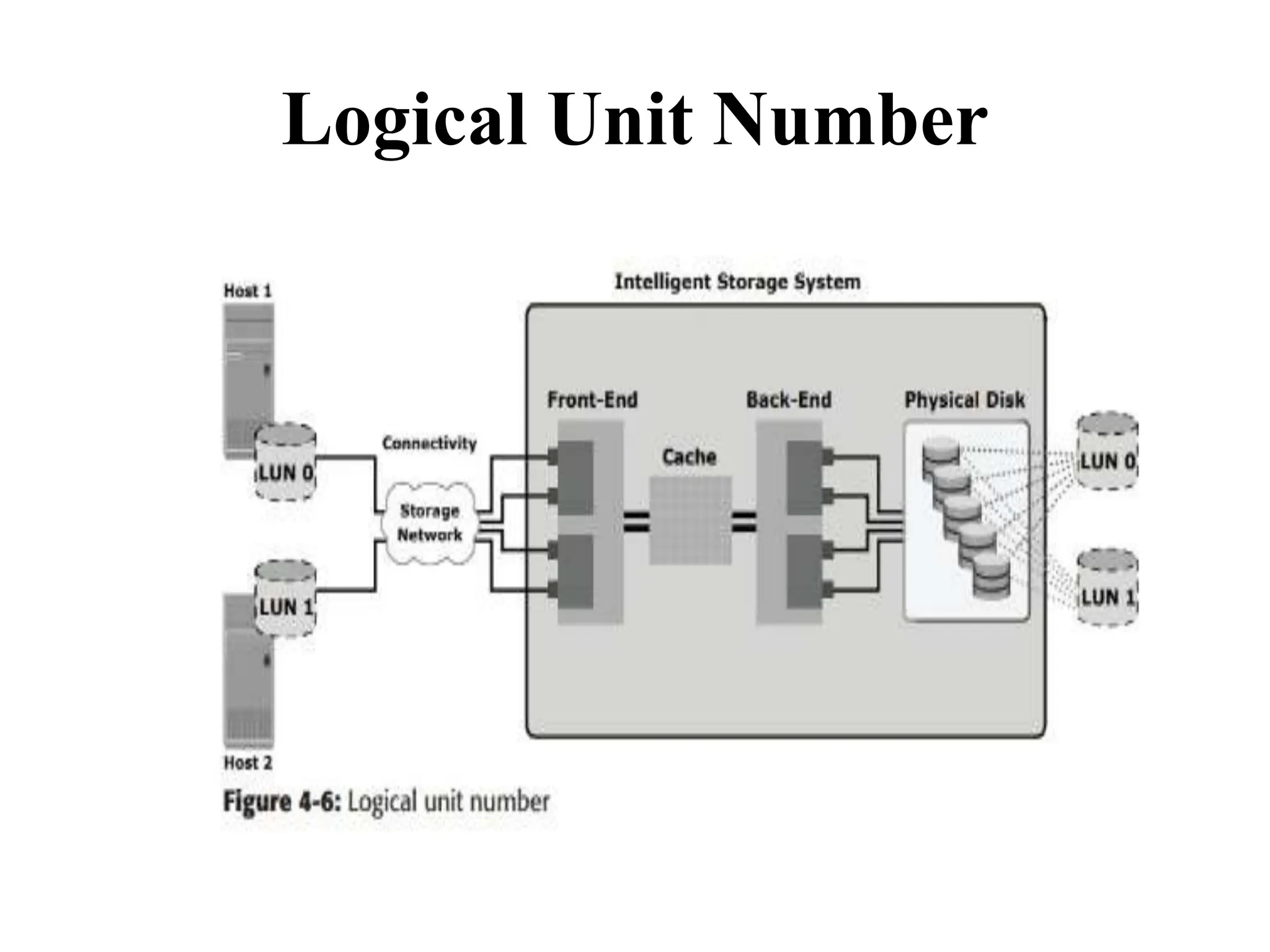
Logical Unit Number
 Physical drives or groups of RAID protected drives can be
logically split into vol- umes known as logical volumes,
commonly referred to as Logical Unit Numbers (LUNs).
 The use of LUNs improves disk utilization.
 For example, without the use of LUNs, a host requiring only
200 GB could be allocated an entire 1TB physical disk. Using
LUNs, only the required 200 GB would be allocated to the
host, allowing the remaining 800 GB to be allocated to other
hosts.
 For example, Figure 4-6 shows a RAID set consisting of five
disks that have been sliced, or partitioned, into several LUNs.
LUNs 0 and 1 are shown in the figure.
 Note how a portion of each LUN resides on each physical disk
in the RAID set.
Logical Unit Number
 LUNs 0 and 1 are presented to hosts 1 and 2,
respectively, as physical volumes for storing and
retrieving data. Usable capacity of the physical
volumes is determined by the RAID type of the
RAID set.
 The capacity of a LUN can be expanded by
aggregating other LUNs with it. The result of this
aggregation is a larger capacity LUN, known as a
meta- LUN.
 The mapping of LUNs to their physical location on
the drives is man- aged by the operating environment
of an intelligent storage system.
LUN Masking
 LUN masking is a process that provides data access
control by defining which LUNs a host can access.
 LUN masking function is typically implemented at
the front end controller. This ensures that volume
access by servers is controlled appropriately,
preventing unauthorized or accidental use in a
distributed environment.
 For example, consider a storage array with two LUNs
that store data of the sales and finance departments.
Without LUN masking, both departments can easily
see and modify each other’s data, posing a high risk
to data integrity and security.
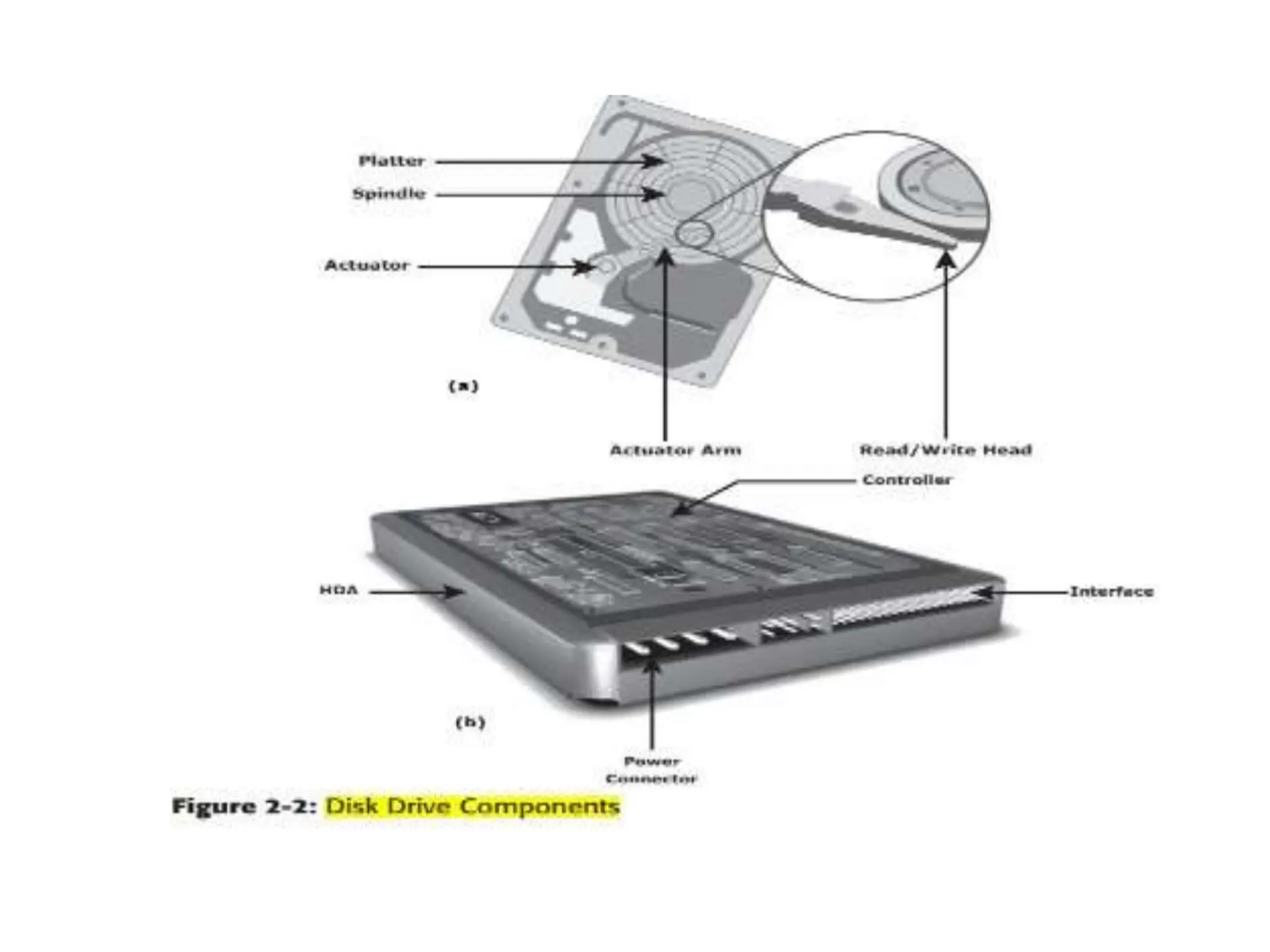
HDD DRIVE COMPONENTS
• A disk drive uses a rapidly moving arm to read and write data
across a flat platter coated with magnetic particles. Data is
transferred from the magnetic platter through the R/W head to
the computer.
• Several platters are assembled together with the R/W head and
controller, most commonly referred to as a hard disk drive
(HDD).
• Data can be recorded and erased on a magnetic disk any
number of times.
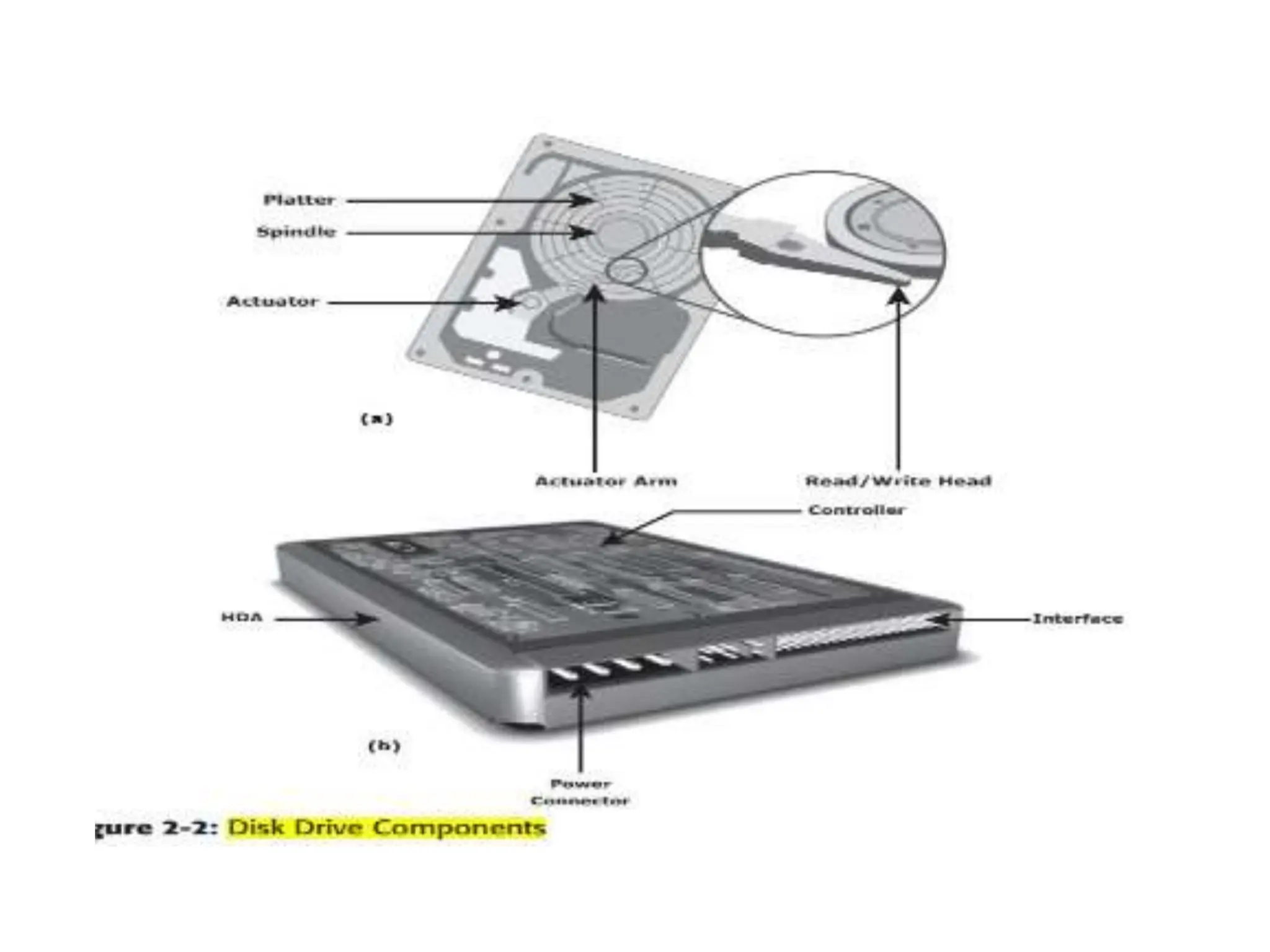
• Key components of a disk drive are platter, spindle, read/write
head, actuator arm assembly, and controller (Figure 2-2):
PLATTER
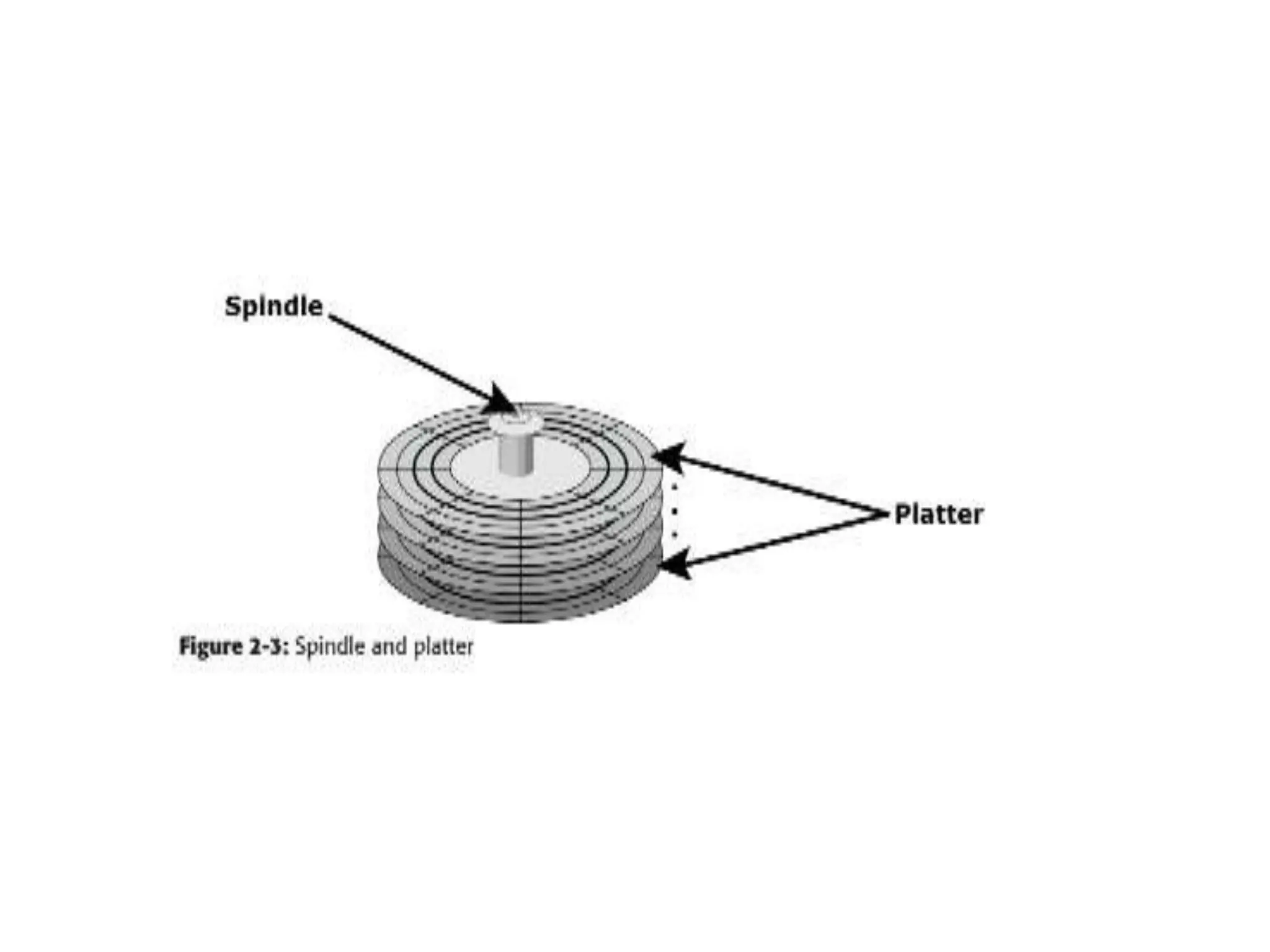
 A typical HDD consists of one or more flat circular
disks called platters (Figure2-3). The data is recorded
on these platters in binary codes (0s and 1s).
 The set of rotating platters is sealed in a case, called
a Head Disk Assembly(HDA). A platter is a rigid,
round disk coated with magnetic material on both
surfaces (top and bottom).
 The data is encoded by polarizing the magnetic area,
or domains, of the disk surface. Data can be written to
or read from both surfaces of the platter.
 The number of platters and the storage capacity of
each platter determine the total capacity of the drive.
SPINDLE
 A spindle connects all the platters, as shown in Figure
2-3, and is connected to a motor. The motor of the
spindle rotates with a constant speed.
 The disk platter spins at a speed of several thousands
of revolutions per minute(rpm). Disk drives have
spindle speeds of 7,200 rpm, 10,000 rpm, or
15,000rpm. Disks used on current storage systems
have a platter diameter of 3.5” (90mm).
 When the platter spins at 15,000 rpm, the outer edge
is moving at around 25 percent of the speed of sound.
READ/WRITE HEAD
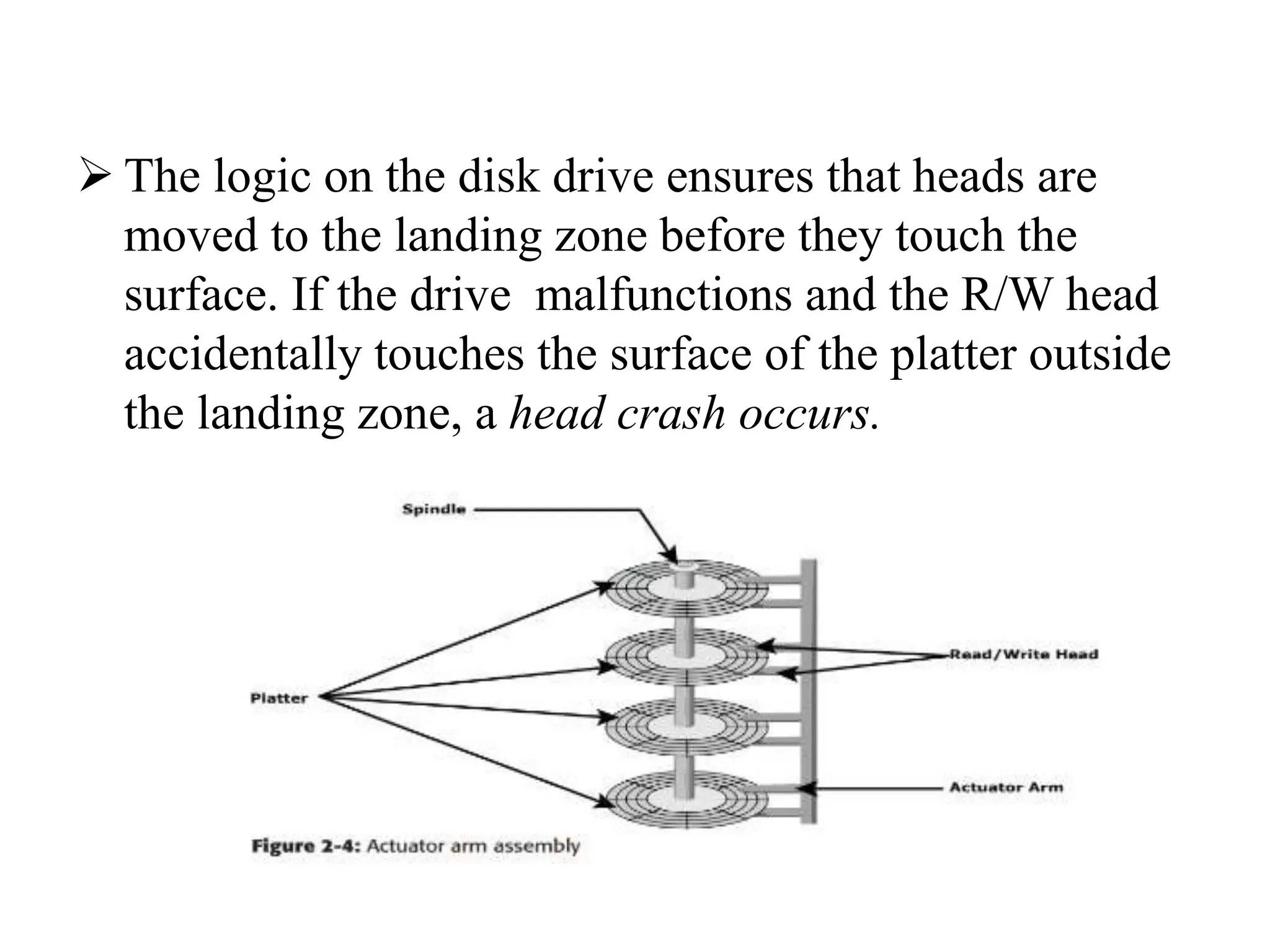
 Read/Write (R/W) heads, shown in Figure 2-4, read and write
data from or to a platter.
 Drives have two R/W heads per platter, one for each surface of
the platter.
 The R/W head changes the magnetic polarization on the
surface ofthe platter when writing data. While reading data,
this head detects magnetic polarization on the surface of the
platter.
 During reads and writes, the R/W head senses the magnetic
polarization and never touches the surface of the platter. When
the spindle is rotating, there is a microscopic air gap between
the R/W heads and the platters, known as the head flying
height.
• This air gap is removed when the spindle stops
rotating and the R/W head rests on a special
area on the platter near the spindle. This area is
called the landing zone. The
• landing zone is coated with a lubricant to
reduce friction between the head and the
platter.
 The logic on the disk drive ensures that heads are
moved to the landing zone before they touch the
surface. If the drive malfunctions and the R/W head
accidentally touches the surface of the platter outside
the landing zone, a head crash occurs.
ACTIVATOR ARM ASSEMBLY
The R/W heads are mounted on the actuator
arm assembly (refer to Figure 2-2 [a]),which
positions the R/W head at the location on the
platter where the data needs to be written or
read. The R/W heads for all platters on a drive
are attached to one actuator arm assembly
and move across the platters simultaneously.
CONTROLLER
• The controller (see Figure 2-2 [b]) is a printed circuit
board, mounted at the bot- tom of a disk drive. It
consists of a microprocessor, internal memory,circuitry,
and firmware.
• The firmware controls power to the spindle motor
and the speed of the motor. It also manages
communication between the drive and the host.
• In addition, it controls the R/W operations by moving
the actuator arm and switching between different R/W
heads, and performs the optimization of data access.
PHYSICAL DISK STRUCTURE
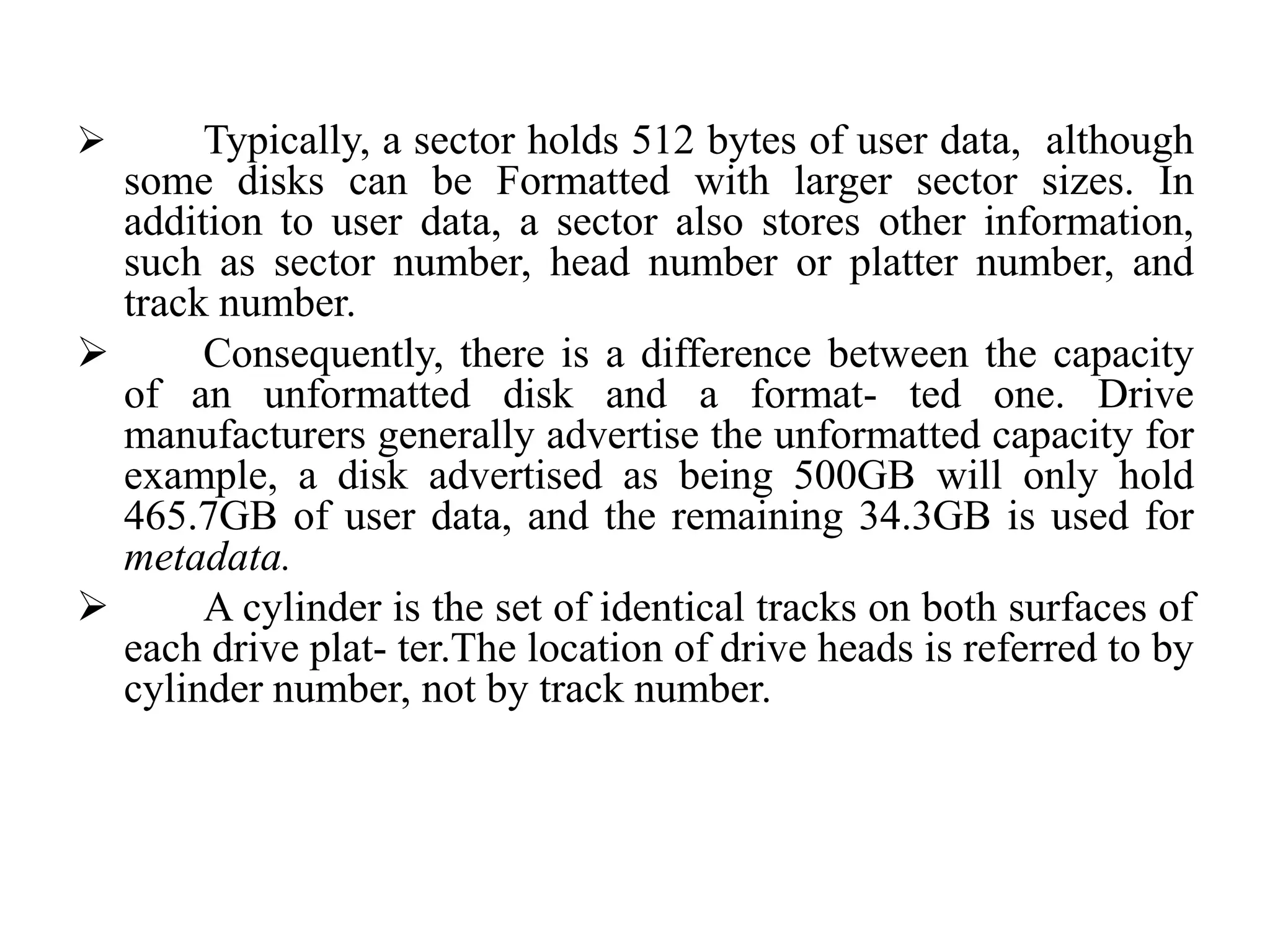
 Data on the disk is recorded on tracks, which are
concentric rings on the platter around the spindle, as
shown in Figure 2-5. The tracks are numbered,
starting from zero, from the outer edge of the platter.
The number of tracks per inch (TPI) on the platter (or
the track density) measures how tightly the tracks are
packed on a platter.
 Each track is divided into smaller units called sectors.
A sector is the smallest, individually addressable unit
of storage. The track and sector structure is written
on the platter by the drive manufacturer using a
formatting operation.
 Typically, a sector holds 512 bytes of user data, although
some disks can be Formatted with larger sector sizes. In
addition to user data, a sector also stores other information,
such as sector number, head number or platter number, and
track number.
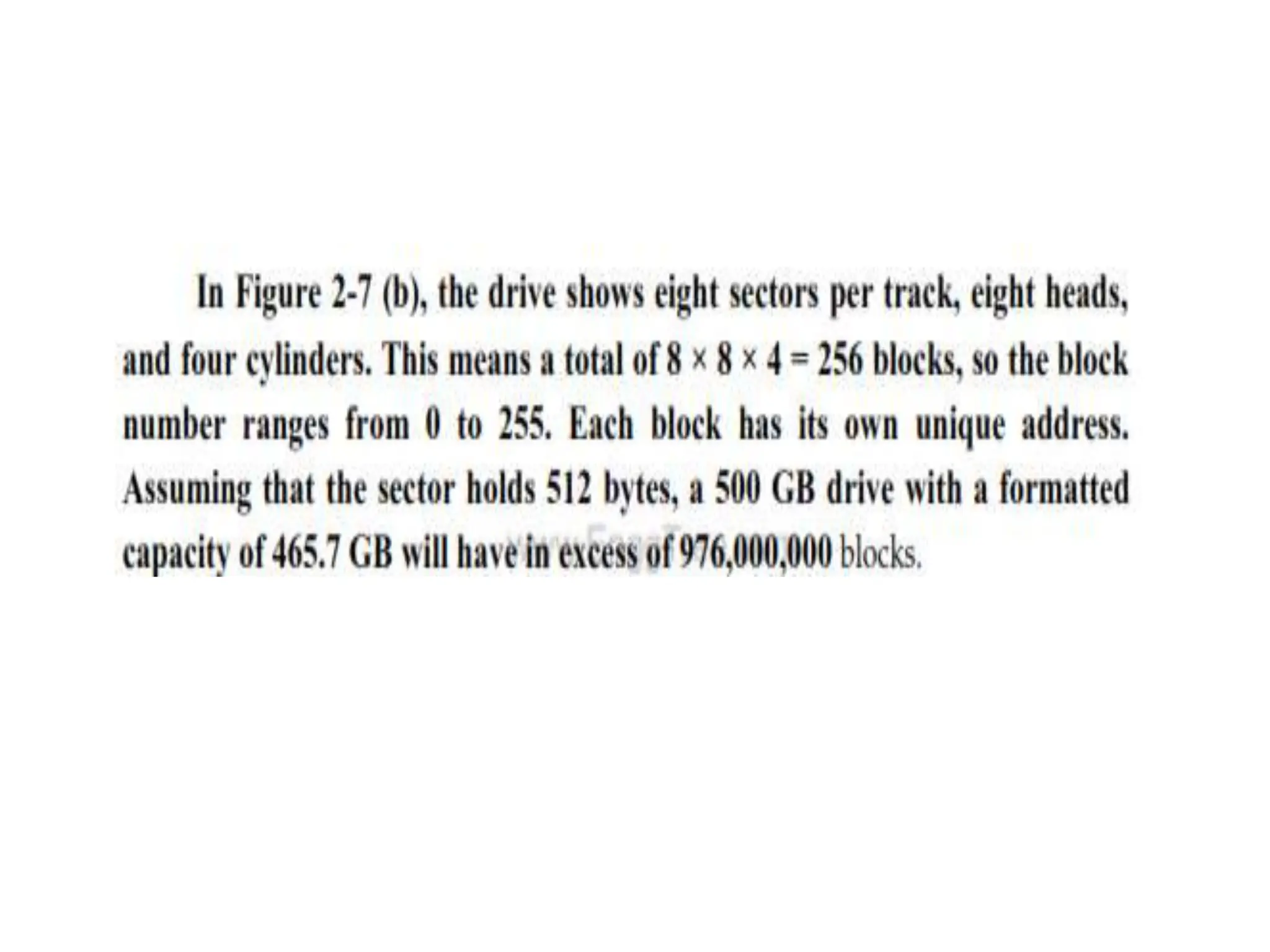
 Consequently, there is a difference between the capacity
of an unformatted disk and a format- ted one. Drive
manufacturers generally advertise the unformatted capacity for
example, a disk advertised as being 500GB will only hold
465.7GB of user data, and the remaining 34.3GB is used for
metadata.
 A cylinder is the set of identical tracks on both surfaces of
each drive plat- ter.The location of drive heads is referred to by
cylinder number, not by track number.
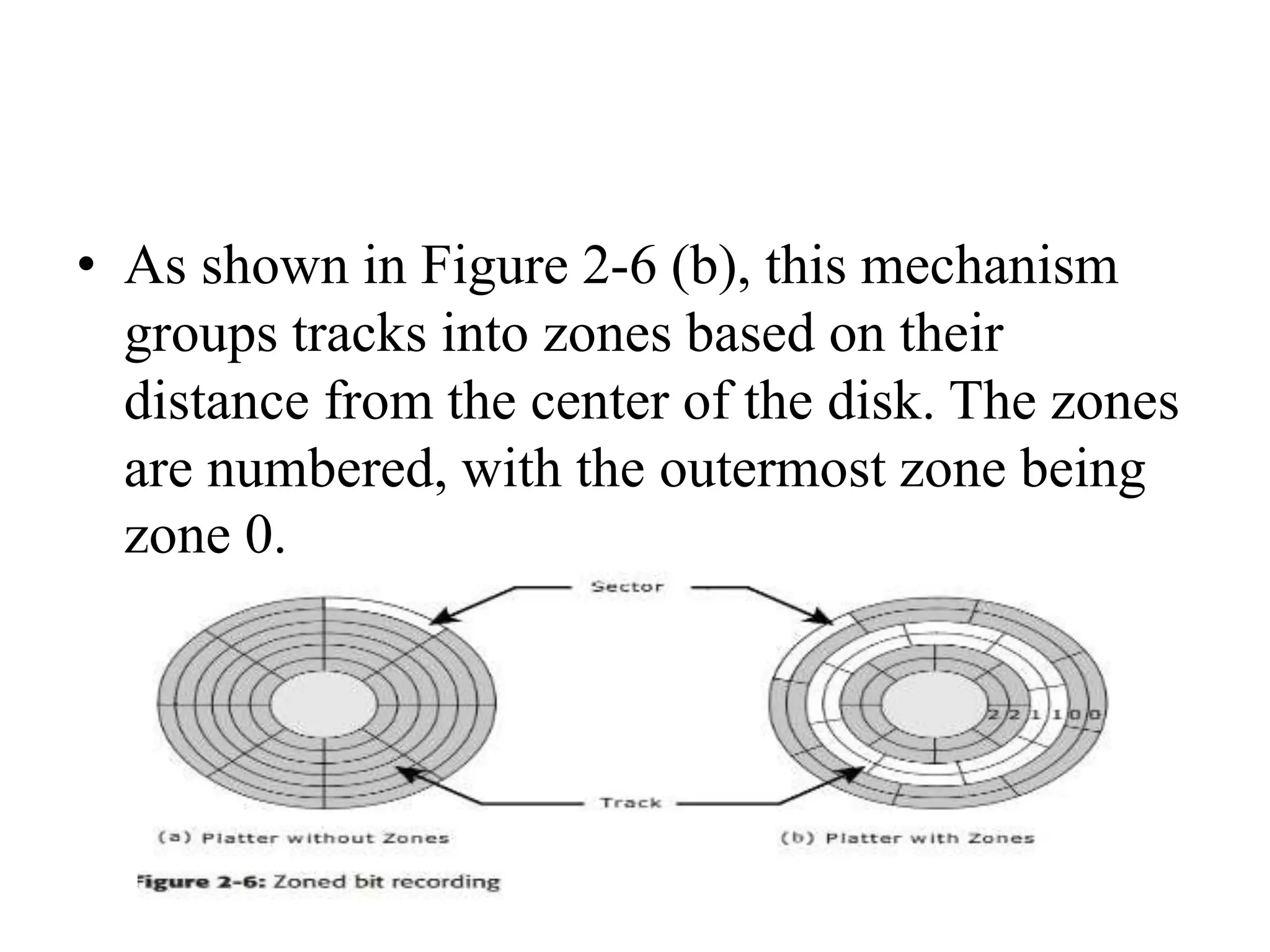
ZONED Bit Recording
 Because the platters are made of concentric
tracks, the outer tracks can hold more data than the
inner tracks, because the outer tracks are physically
longer than the inner tracks, as shown in Figure 2-6
(a).
 On older disk drives, the outer tracks had the
same number of sectors as theinner tracks, so data
density was low on the outer tracks. This was an
inefficient use of available space. Zone bit recording
utilizes the disk efficiently.

• As shown in Figure 2-6 (b), this mechanism
groups tracks into zones based on their
distance from the center of the disk. The zones
are numbered, with the outermost zone being
zone 0.
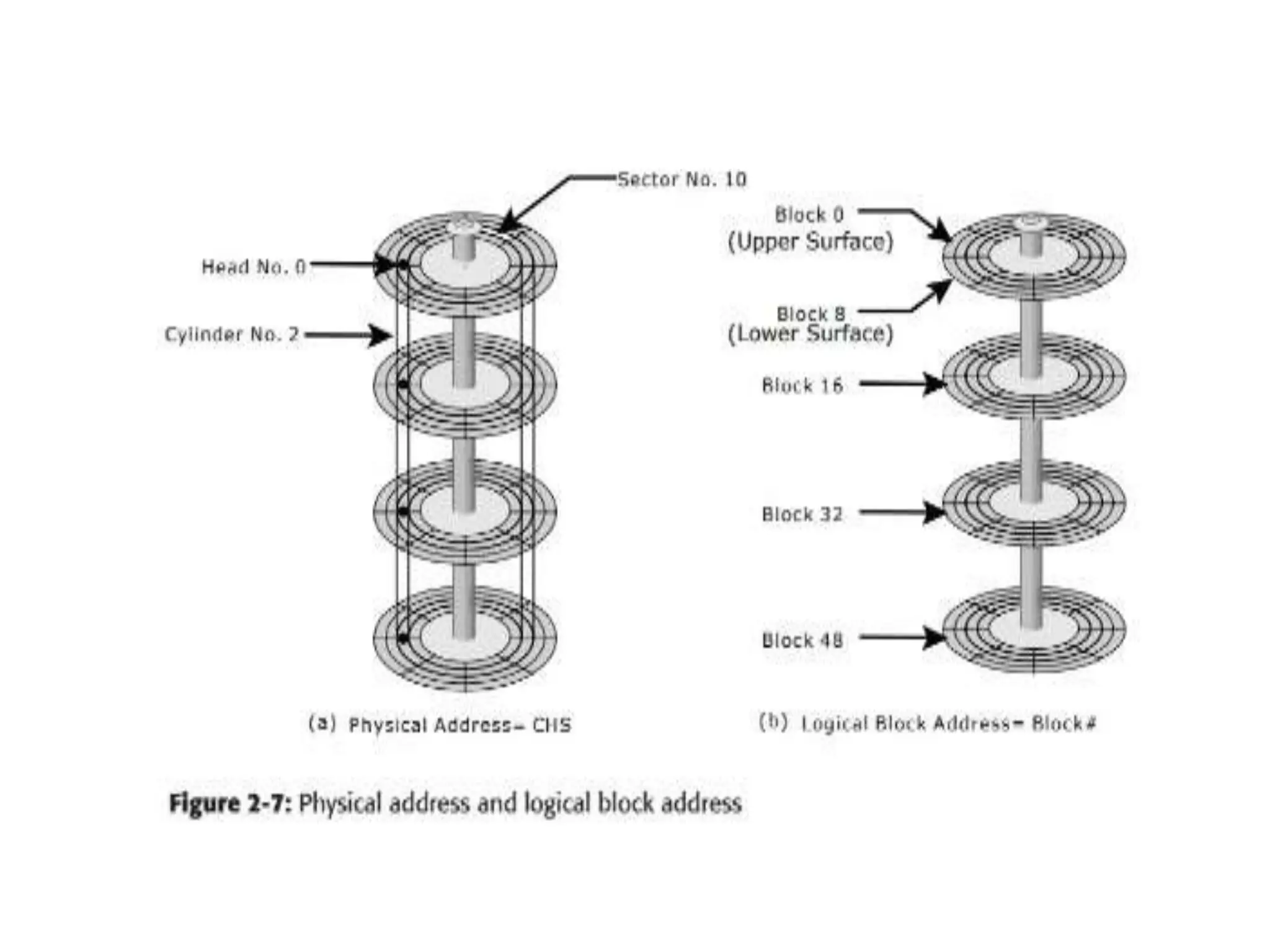
LOGICAL BLOCK ADDRESSING
 Earlier drives used physical addresses consisting of the
cylinder, head, and sector (CHS) number to refer to specific
locations on the disk, as shown in Figure 2-7(a).
 The host operating system had to be aware of the geometry of
each disk being used. Logical block addressing (LBA), shown
in Figure 2-7 (b), simplifies addressing by using a linear
address to access physical blocks of data.
 The disk controller translates LBA to a CHS address, and the
host only needs to know the size of the disk drive in terms of
the number of blocks. The logical blocks are mapped to
physical sectors on a 1:1 basis.
• DISK DRIVE PERFORMANCE: A disk drive is an
electromechanical device that governs the overall
performance of the storage system environment. The
various factors that affect the performance of disk
drives are discussed in this section.
• Service Time
Disk service time is the time taken by a disk to
complete an I/O request. Components that contribute
to service time on a disk drive are seek time,
rotational latency, and data transfer rate.
• Seek Time
 The seek time (also called access time) describes the time
taken to position the R/W heads across the platter with a radial
movement (moving along the radius of the platter).
 In other words, it is the time taken to reposition and settle the
arm and the head over the correct track. The lower the seek
time, the faster the I/O operation.
• Disk vendors publish the following seek time specifications:
• Full Stroke: The time taken by the R/W head to move across
the entire width of the disk, from the innermost track to the
outermost track.
• Average: The average time taken by the R/W
head to move from one random track to
another, normally listed as the time for one-
third of a full stroke.
• Track-to-Track: The time taken by the R/W
head to move between adjacent tracks.
• Each of these specifications is measured in milliseconds.
The average seek time ona modern disk is typically in
the range of 3 to 15 milliseconds. Seek time has more
impact on the read operation of random tracks rather
than adjacent tracks.
• To minimize the seek time, data can be written to only a
subset of the available cylinders. This results in lower
usable capacity than the actual capacity of the drive.
• For example, a 500 GB disk drive is set up to use only
the first 40 percent of the cylinders and is effectively
treated as a 200 GB drive. This is known as short-
stroking the drive.
Rotional Latency
• To access data, the actuator arm moves the R/W head
over the platter to a particular track while The platter
spins to position the requested sector under the R/W
head.
• The time taken by the platter to rotate and position
the data under the R/W head is called rotational
latency.
• This latency depends on the rotation speed of the
spindle and is measured in milliseconds. The average
rotational latency is one-half of the time taken for a
full rotation.
Data Transfer Rate
• The data transfer rate (also called transfer rate) refers to
the average amount of data per unit time that the drive
can deliver to the HBA. In a read operation, the data
first moves from disk platters to R/W heads, and then it
moves to the drive’s internal buffer. Finally, data moves
from the buffer through the interface to the host HBA.
• In a write operation, the data moves from the HBA to
the internal buffer of the disk drive through the drive’s
interface. The data then moves from the buffer to the
R/W heads. Finally, it moves from the R/W heads to
the platters.
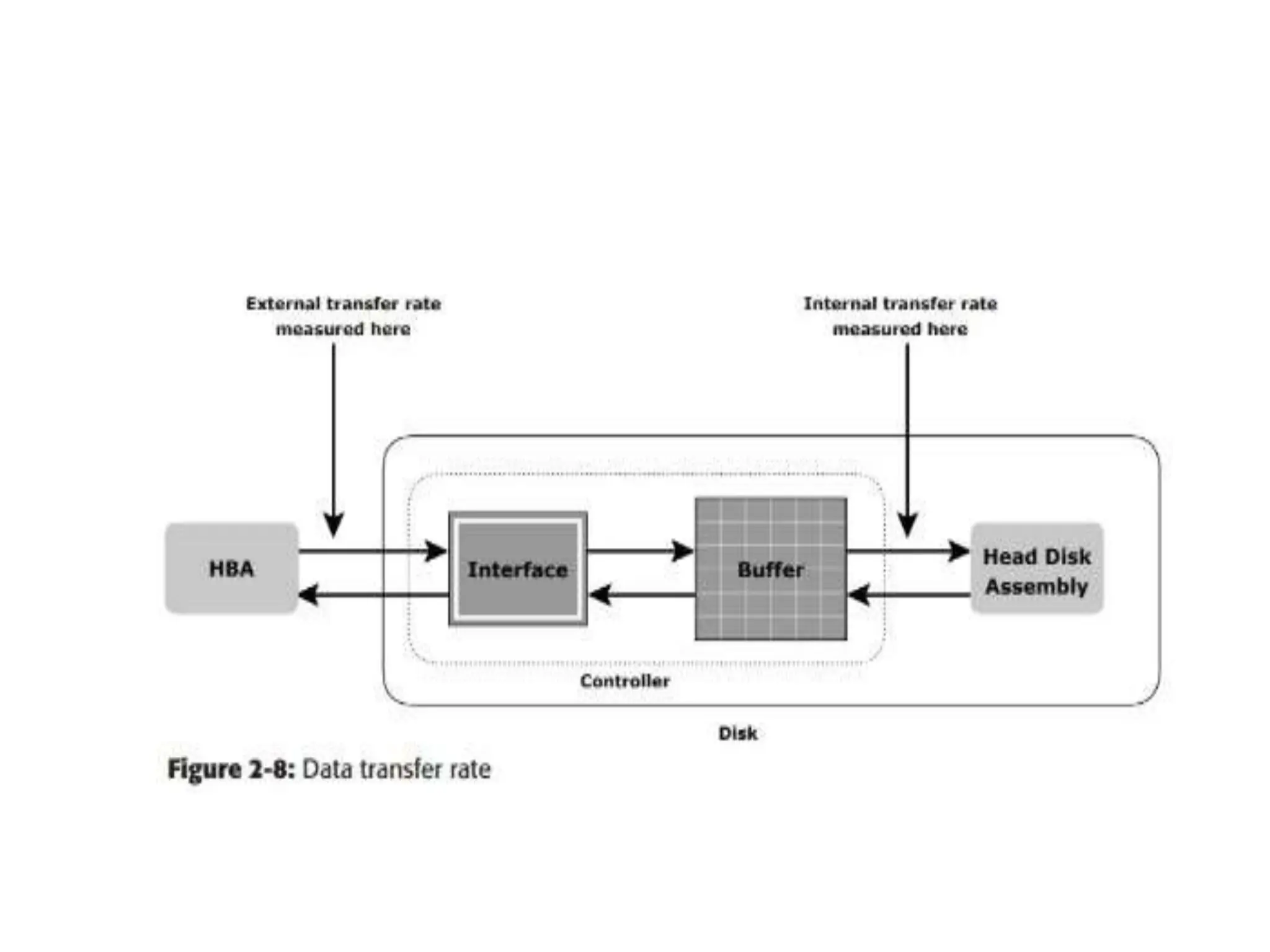
• The data transfer rates during the R/W operations are
measured in terms of internal and external transfer
rates, as shown in Figure 2-8.
• Internal transfer rate is the speed at which data
moves from a single track of a platter’s surface to
internal buffer (cache) of the disk. Internal transfer
rate takes into account factors such as the seek time.
• External transfer rate is the rate at which data can be
moved through the interface to the HBA. External
transfer rate is generally the advertised speed of the
interface, such as 133 MB/s for ATA. The sustained
external transfer rate is lower than the interface speed.

UNIT II INTELLIGENT STORAGE SYSTEMS AND RAID.pptx

  • 1.
    UNIT II INTELLIGENTSTORAGE SYSTEMS AND RAID
  • 2.
    COMPONENTS OF ANINTELLIGENT STORAGE SYSTEM  Business-critical applications require high levels of performance, availability, security, and scalability  A hard disk drive is a core element of storage that governs the performance of any storage system.  Some of the older disk array technologies could not overcome performance constraints due to the limitations of a hard disk and its mechanical components.  RAID technology made an important contribution to enhancing storage performance and reliability.
  • 3.
     With advancementsin technology, a new breed of storage solutions known as an intelligent storage system has evolved.  These storage systems are configured with large amounts of memory called cache and use sophisticated algorithms to meet the I/O requirements of performance sensitive applications.
  • 4.
    COMPONENTS OF ANINTELLIGENT STORAGE SYSTEM • An intelligent storage system consists of four key components: front end, cache, back end, and physical disks.
  • 5.
    FRONT END • Thefront end provides the interface between the storage system and the host. It consists of two components: front-end ports and front-end controllers. • The front-end ports enable hosts to connect to the intelligent storage system. Each front-end port has processing logic that executes the appropriate transport protocol, such as SCSI , Fibre Channel,or iSCSI,for storage connections. • Redundant ports are provided on the front end for high availability.
  • 6.
    • Front-end controllersroute data to and from cache via the internal data bus. • When cache receives write data, the controller sends an acknowledgment message back to the host. Controllers optimize I/O processing by using command queuing algorithms
  • 7.
    Front-End Command Queuing •Command queuing is a technique implemented on front-end controllers. It determines the execution order of received commands and can reduce unnecessary drive head movements and improve disk performance. • When a command is received for execution, the command queuing algorithms assigns a tag that defines a sequence in which commands should be executed.
  • 8.
    • With commandqueuing, multiple commands can be executed concurrently • based on the organization of data on the disk, regardless of the order in which the commands were received.
  • 9.
    command queuing algorithms •First In First Out (FIFO): This is the default algorithm where commands are executed in the order in which they are received (Figure 4-2 [a]). There is no reordering of requests for optimization; therefore, it is inefficient in terms of performance. • Seek Time Optimization: Commands are executed based on optimizing read/write head movements, which may result in reordering of commands. Without seek time optimization, the commands are executed in the order they are received.
  • 10.
    • For example,as shown in Figure 4-2(a), the commands are executed in the order A, B, C and D. The radial movement required by the head to execute C immediately after A is less than what would be required to execute B. • With seek time optimization, the command execution sequence would be A, C, B and D, as shown in Figure 4-2(b).
  • 11.
  • 12.
    • Access TimeOptimization: Commands are executed based on the combination of seek time optimization and an analysis of rotational latency for optimal performance
  • 13.
    CACHE  Cache isan important component that enhances the I/O performance in an intelligent storage system.  Cache is semiconductor memory where data is placed temporarily to reduce the time required to service I/O requests from the host.  Cache improves storage system performance by isolating hosts from the mechanical delays associated with physical disks, which are the slowest components of an intelligent storage system.
  • 14.
    Accessing data froma physical disk usu- ally takes a few milliseconds because of seek times and rotational latency. If a disk has to be accessed by the host for every I/O operation, requests are queued, which results in a delayed response. Accessing data from cache takes less than a millisecond. Write data is placed in cache and then written to disk. After the data is securely placed in cache, the host is acknowledged immediately
  • 15.
     Accessing datafrom a physical disk usu- ally takes a few milliseconds because of seek times and rotational latency. If a disk has to be accessed by the host for every I/O operation, requests are queued, which results in a delayed response.  Accessing data from cache takes less than a millisecond. Write data is placed incache and then written to disk. After the data is securely placed in cache, the host is acknowledged immediately
  • 16.
    Structure of Cache Cache is organized into pages or slots, which is the smallest unit of cache allocation.  The size of a cache page is configured according to the application I/O size.Cache consists of the data store and tag RAM.  The data store holds the data while tag RAM tracks the location of the data in the data store (see Figure 4-3) and in disk.  Entries in tag RAM indicate where data is found in cache and where the data belongs on the disk. Tag RAM includes a dirty bit flag, which indicates whether the data in cache has been committed to the disk or not.
  • 17.
    • It alsocontains time-based information, such as the time of last access, which is used to identify cached information that has not been accessed for a long period and may be freed up.
  • 18.
    READ OPERATION WITHCACHE • When a host issues a read request, the front- end controller accesses the tag RAM to determine whether the required data is available in cache. • If the requested data is found in the cache, it is called a read cache hit or read hit and data is sent directly to the host, without any disk operation (see Figure 4-4[a]).This provides a fast response time to the host (about a millisecond).
  • 20.
     If therequested data is not found in cache, it is called a cache miss and the data must be read from the disk (see Figure 4- 4[b]).  The back-end controller accesses the appropriate disk and retrieves the requested data. Data is then placed in cache and is finally sent to the host through the frontend controller.  Cache misses increase I/O response time.  A pre-fetch, or read-ahead, algorithm is used when read requests are sequential. In a sequential read request, a contiguous set of associated blocks is retrieved.  Several other blocks that have not yet been requested by the host can be read from the disk and placed into cache in advance.
  • 22.
     The intelligentstorage system offers fixed and variable pre- fetch sizes.  In fixed pre-fetch, the intelligent storage system pre-fetches a fixed amount of data. It is most suitable when I/O sizes are uniform.  In variable pre-fetch, the storage system pre-fetches an amount of data in multiples of the size of the host request.  Read performance is measured in terms of the read hit ratio, or the hit rate, usually expressed as a percentage.  This ratio is the number of read hits with respect to the total number of read requests.  A higher read hit ratio improves the read performance.
  • 23.
    Write Operation withCache  Write operations with cache provide performance advantages over writing directly to disks. When an I/O is written to cache and acknowledged, it is completed in far less time (from the host’s perspective) than it would take to write directly to disk.  A write operation with cache is implemented in the following ways:
  • 24.
    Write-back cache: Datais placed in cache and an acknowledgment is sent to the host immediately. Later, data from several writes are committed (de-staged) to the disk.  Write response times are much faster, as the write operations are isolated from the mechanical delays of the disk. However, uncommitted data is at risk of loss in the event of cache failures. Write-through cache: Data is placed in the cache and immediately writ- ten to the disk, and an acknowledgment is sent to the host.  Because data is committed to disk as it arrives, the risks of data loss are low but write response time is longer because of the disk operations.
  • 25.
    • Cache canbe bypassed under certain conditions, such as very large size write I/O. • In this implementation, if the size of an I/O request exceeds the pre- defined size, • called write aside size, writes are sent to the disk directly to reduce the impact of large • writes consuming a large cache area.
  • 26.
    Cache Implementation Cache canbe implemented as either dedicated cache or global cache. With dedicated cache, separate sets of memory locations are reserved for reads and writes. In global cache, both reads and writes can use any of the available memory addresses. Cache management is more efficient in a global cache implementation, As only one global set of addresses has to be managed.
  • 27.
    Cache Management • Cacheis a finite and expensive resource that needs proper management. • Even though intelligent storage systems can be configured with large amounts of cache, when all cache pages are filled, some pages have to be freed up to accommodate new data and avoid performance degradation. • Various cache management algorithms are implemented in intelligent storage systems : • Least Recently Used (LRU): An algorithm that continuously monitors data access in cache and identifies the cache pages that have not been accessed for a long time. LRU either frees up these pages or marks them for reuse. • Most Recently Used (MRU): An algorithm that is the converse of LRU. In • MRU, the pages that have been accessed most recently are freed up ormarked for reuse.
  • 28.
     As cachefills, the storage system must take action to flush dirty pages (data written into the cahce but not yet written to the disk) in order to manage its availability.  Flushing is the process of committing data from cache to the disk. On the basis of the I/O access rate and pattern, high and low levels called watermarks are set in cache to manage the flushing process.  High watermark (HWM) is the cache utilization level at which the storage system starts high- speed flushing of cache data.  Low watermark (LWM) is the point at which the storage system stops the high-speed or forced flushing and returns to idle flush behavior.
  • 29.
    The cache utilizationlevel, as shown in Figure 4-5, drives the mode of flushing to be used: Idle flushing: Occurs continuously, at a modest rate, when the cache utilization level is between the high and low watermark. High watermark flushing: Activated when cache utilization hits the high watermark. The storage system dedicates some additional resources to flushing. Forced flushing: Occurs in the event of a large I/O burst when cache reaches 100 percent of its capacity, which significantly affects the I/O response time. In forced flushing, dirty pages are forcibly flushed to disk.
  • 30.
  • 31.
    CACHE DATA PROTECTION Cache is volatile memory, so a power failure or any kind of cache failure will cause the loss of data not yet committed to the disk.  This risk of losing uncommitted data held in cache can be mitigated using cache mirroring and cache vaulting:  Cache mirroring: Each write to cache is held in two different memory locations on two independent memory cards. In the event of a cache failure,the write data will still be safe in the mirrored location and can be committed to the disk.
  • 32.
    In cache mirroringapproaches, the problem of maintaining cache coherency is introduced. Cache coherency means that data in two different cache locations must be identical at all times. Cache vaulting: Cache is exposed to the risk of uncommitted data loss due to power failure. This problem can be addressed in various ways: powering the memory with a battery until AC power is restored or using battery power to write the cache content to the disk.
  • 33.
    BACKEND  The backend provides an interface between cache and the physical disks. It consists of two components: back-end ports and back-end controllers.  The back end controls data transfers between cache and the physical disks. From cache, data is sent to the back end and then routed to the destination disk. Physical disks are connected to ports on the back end.  The back end controller communicates with the disks when performing reads and writes and also provides additional, but lim ited, temporary data storage.
  • 34.
    PHYSICAL DISK • Aphysical disk stores data persistently. • Disks are connected to the back-end with either SCSI or a Fibre Channel interface. • An intelligent storage system enables the use of a mixture of SCSI or Fibre Channel drives and IDE/ATA drives.
  • 35.
    Logical Unit Number Physical drives or groups of RAID protected drives can be logically split into vol- umes known as logical volumes, commonly referred to as Logical Unit Numbers (LUNs).  The use of LUNs improves disk utilization.  For example, without the use of LUNs, a host requiring only 200 GB could be allocated an entire 1TB physical disk. Using LUNs, only the required 200 GB would be allocated to the host, allowing the remaining 800 GB to be allocated to other hosts.  For example, Figure 4-6 shows a RAID set consisting of five disks that have been sliced, or partitioned, into several LUNs. LUNs 0 and 1 are shown in the figure.  Note how a portion of each LUN resides on each physical disk in the RAID set.
  • 36.
  • 37.
     LUNs 0and 1 are presented to hosts 1 and 2, respectively, as physical volumes for storing and retrieving data. Usable capacity of the physical volumes is determined by the RAID type of the RAID set.  The capacity of a LUN can be expanded by aggregating other LUNs with it. The result of this aggregation is a larger capacity LUN, known as a meta- LUN.  The mapping of LUNs to their physical location on the drives is man- aged by the operating environment of an intelligent storage system.
  • 38.
    LUN Masking  LUNmasking is a process that provides data access control by defining which LUNs a host can access.  LUN masking function is typically implemented at the front end controller. This ensures that volume access by servers is controlled appropriately, preventing unauthorized or accidental use in a distributed environment.  For example, consider a storage array with two LUNs that store data of the sales and finance departments. Without LUN masking, both departments can easily see and modify each other’s data, posing a high risk to data integrity and security.
  • 39.
    HDD DRIVE COMPONENTS •A disk drive uses a rapidly moving arm to read and write data across a flat platter coated with magnetic particles. Data is transferred from the magnetic platter through the R/W head to the computer. • Several platters are assembled together with the R/W head and controller, most commonly referred to as a hard disk drive (HDD). • Data can be recorded and erased on a magnetic disk any number of times. • Key components of a disk drive are platter, spindle, read/write head, actuator arm assembly, and controller (Figure 2-2):
  • 41.
    PLATTER  A typicalHDD consists of one or more flat circular disks called platters (Figure2-3). The data is recorded on these platters in binary codes (0s and 1s).  The set of rotating platters is sealed in a case, called a Head Disk Assembly(HDA). A platter is a rigid, round disk coated with magnetic material on both surfaces (top and bottom).  The data is encoded by polarizing the magnetic area, or domains, of the disk surface. Data can be written to or read from both surfaces of the platter.  The number of platters and the storage capacity of each platter determine the total capacity of the drive.
  • 43.
    SPINDLE  A spindleconnects all the platters, as shown in Figure 2-3, and is connected to a motor. The motor of the spindle rotates with a constant speed.  The disk platter spins at a speed of several thousands of revolutions per minute(rpm). Disk drives have spindle speeds of 7,200 rpm, 10,000 rpm, or 15,000rpm. Disks used on current storage systems have a platter diameter of 3.5” (90mm).  When the platter spins at 15,000 rpm, the outer edge is moving at around 25 percent of the speed of sound.
  • 44.
    READ/WRITE HEAD  Read/Write(R/W) heads, shown in Figure 2-4, read and write data from or to a platter.  Drives have two R/W heads per platter, one for each surface of the platter.  The R/W head changes the magnetic polarization on the surface ofthe platter when writing data. While reading data, this head detects magnetic polarization on the surface of the platter.  During reads and writes, the R/W head senses the magnetic polarization and never touches the surface of the platter. When the spindle is rotating, there is a microscopic air gap between the R/W heads and the platters, known as the head flying height.
  • 45.
    • This airgap is removed when the spindle stops rotating and the R/W head rests on a special area on the platter near the spindle. This area is called the landing zone. The • landing zone is coated with a lubricant to reduce friction between the head and the platter.
  • 46.
     The logicon the disk drive ensures that heads are moved to the landing zone before they touch the surface. If the drive malfunctions and the R/W head accidentally touches the surface of the platter outside the landing zone, a head crash occurs.
  • 47.
    ACTIVATOR ARM ASSEMBLY TheR/W heads are mounted on the actuator arm assembly (refer to Figure 2-2 [a]),which positions the R/W head at the location on the platter where the data needs to be written or read. The R/W heads for all platters on a drive are attached to one actuator arm assembly and move across the platters simultaneously.
  • 48.
    CONTROLLER • The controller(see Figure 2-2 [b]) is a printed circuit board, mounted at the bot- tom of a disk drive. It consists of a microprocessor, internal memory,circuitry, and firmware. • The firmware controls power to the spindle motor and the speed of the motor. It also manages communication between the drive and the host. • In addition, it controls the R/W operations by moving the actuator arm and switching between different R/W heads, and performs the optimization of data access.
  • 50.
    PHYSICAL DISK STRUCTURE Data on the disk is recorded on tracks, which are concentric rings on the platter around the spindle, as shown in Figure 2-5. The tracks are numbered, starting from zero, from the outer edge of the platter. The number of tracks per inch (TPI) on the platter (or the track density) measures how tightly the tracks are packed on a platter.  Each track is divided into smaller units called sectors. A sector is the smallest, individually addressable unit of storage. The track and sector structure is written on the platter by the drive manufacturer using a formatting operation.
  • 52.
     Typically, asector holds 512 bytes of user data, although some disks can be Formatted with larger sector sizes. In addition to user data, a sector also stores other information, such as sector number, head number or platter number, and track number.  Consequently, there is a difference between the capacity of an unformatted disk and a format- ted one. Drive manufacturers generally advertise the unformatted capacity for example, a disk advertised as being 500GB will only hold 465.7GB of user data, and the remaining 34.3GB is used for metadata.  A cylinder is the set of identical tracks on both surfaces of each drive plat- ter.The location of drive heads is referred to by cylinder number, not by track number.
  • 53.
    ZONED Bit Recording Because the platters are made of concentric tracks, the outer tracks can hold more data than the inner tracks, because the outer tracks are physically longer than the inner tracks, as shown in Figure 2-6 (a).  On older disk drives, the outer tracks had the same number of sectors as theinner tracks, so data density was low on the outer tracks. This was an inefficient use of available space. Zone bit recording utilizes the disk efficiently. 
  • 54.
    • As shownin Figure 2-6 (b), this mechanism groups tracks into zones based on their distance from the center of the disk. The zones are numbered, with the outermost zone being zone 0.
  • 55.
    LOGICAL BLOCK ADDRESSING Earlier drives used physical addresses consisting of the cylinder, head, and sector (CHS) number to refer to specific locations on the disk, as shown in Figure 2-7(a).  The host operating system had to be aware of the geometry of each disk being used. Logical block addressing (LBA), shown in Figure 2-7 (b), simplifies addressing by using a linear address to access physical blocks of data.  The disk controller translates LBA to a CHS address, and the host only needs to know the size of the disk drive in terms of the number of blocks. The logical blocks are mapped to physical sectors on a 1:1 basis.
  • 58.
    • DISK DRIVEPERFORMANCE: A disk drive is an electromechanical device that governs the overall performance of the storage system environment. The various factors that affect the performance of disk drives are discussed in this section. • Service Time Disk service time is the time taken by a disk to complete an I/O request. Components that contribute to service time on a disk drive are seek time, rotational latency, and data transfer rate.
  • 59.
    • Seek Time The seek time (also called access time) describes the time taken to position the R/W heads across the platter with a radial movement (moving along the radius of the platter).  In other words, it is the time taken to reposition and settle the arm and the head over the correct track. The lower the seek time, the faster the I/O operation. • Disk vendors publish the following seek time specifications: • Full Stroke: The time taken by the R/W head to move across the entire width of the disk, from the innermost track to the outermost track.
  • 60.
    • Average: Theaverage time taken by the R/W head to move from one random track to another, normally listed as the time for one- third of a full stroke. • Track-to-Track: The time taken by the R/W head to move between adjacent tracks.
  • 61.
    • Each ofthese specifications is measured in milliseconds. The average seek time ona modern disk is typically in the range of 3 to 15 milliseconds. Seek time has more impact on the read operation of random tracks rather than adjacent tracks. • To minimize the seek time, data can be written to only a subset of the available cylinders. This results in lower usable capacity than the actual capacity of the drive. • For example, a 500 GB disk drive is set up to use only the first 40 percent of the cylinders and is effectively treated as a 200 GB drive. This is known as short- stroking the drive.
  • 62.
    Rotional Latency • Toaccess data, the actuator arm moves the R/W head over the platter to a particular track while The platter spins to position the requested sector under the R/W head. • The time taken by the platter to rotate and position the data under the R/W head is called rotational latency. • This latency depends on the rotation speed of the spindle and is measured in milliseconds. The average rotational latency is one-half of the time taken for a full rotation.
  • 63.
    Data Transfer Rate •The data transfer rate (also called transfer rate) refers to the average amount of data per unit time that the drive can deliver to the HBA. In a read operation, the data first moves from disk platters to R/W heads, and then it moves to the drive’s internal buffer. Finally, data moves from the buffer through the interface to the host HBA. • In a write operation, the data moves from the HBA to the internal buffer of the disk drive through the drive’s interface. The data then moves from the buffer to the R/W heads. Finally, it moves from the R/W heads to the platters. • The data transfer rates during the R/W operations are measured in terms of internal and external transfer rates, as shown in Figure 2-8.
  • 65.
    • Internal transferrate is the speed at which data moves from a single track of a platter’s surface to internal buffer (cache) of the disk. Internal transfer rate takes into account factors such as the seek time. • External transfer rate is the rate at which data can be moved through the interface to the HBA. External transfer rate is generally the advertised speed of the interface, such as 133 MB/s for ATA. The sustained external transfer rate is lower than the interface speed.