Crocotta Research & Development Ltd

“Be ambitious of climbing up to the difficult,
       in a manner inaccessible...”
ONCE UPON ANOTHER
        FANTASTIC DAY IN THE UK…
   …we started to think about visualization, other than
polygonized surface rendering, to bring us closer to reality.
NEXT DAY WE TURNED TO
OUR “DEMON”:
We quickly realized that lots of people had been dealing with
the problem already*, so we had to set a more future
oriented goal.

What if we traveled 10 - 20 years ahead in time, and
mimicked the real environment with the equipment of the
future as much as possible.

Neither the “demon” criticized our project, no relevant search results
were found.


* happens just too often
VIRTUAL UNIVERSE
A virtual world solely made of particles

    The idea was born!


BUT, there are fundamental questions:
A.What is universe?
B.What bottlenecks do we need to face?
C.Can we do any part(s) of the experiment on today’s
machines?
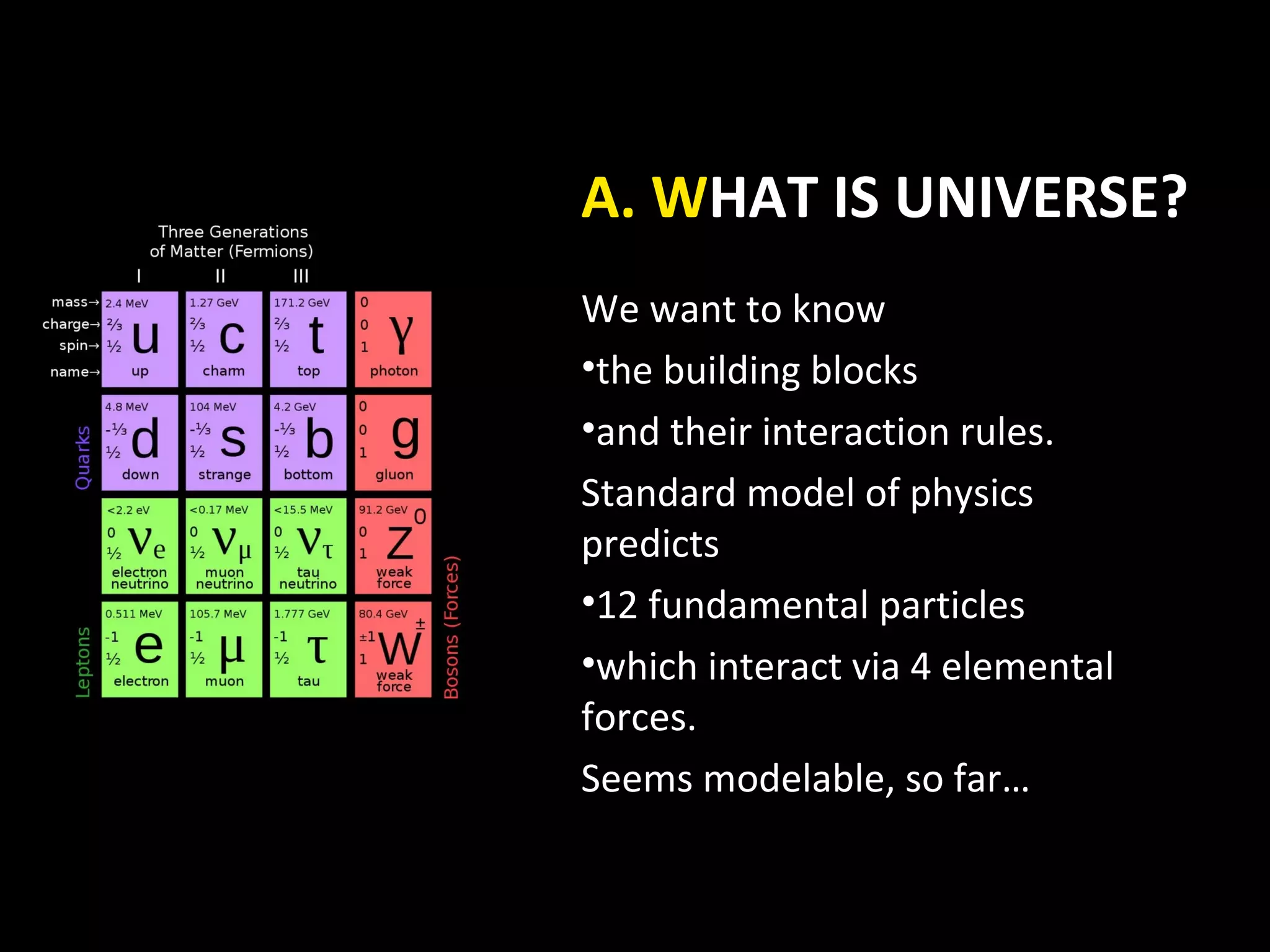
A. WHAT IS UNIVERSE?
We want to know
•the building blocks
•and their interaction rules.
Standard model of physics
predicts
•12 fundamental particles
•which interact via 4 elemental
forces.
Seems modelable, so far…
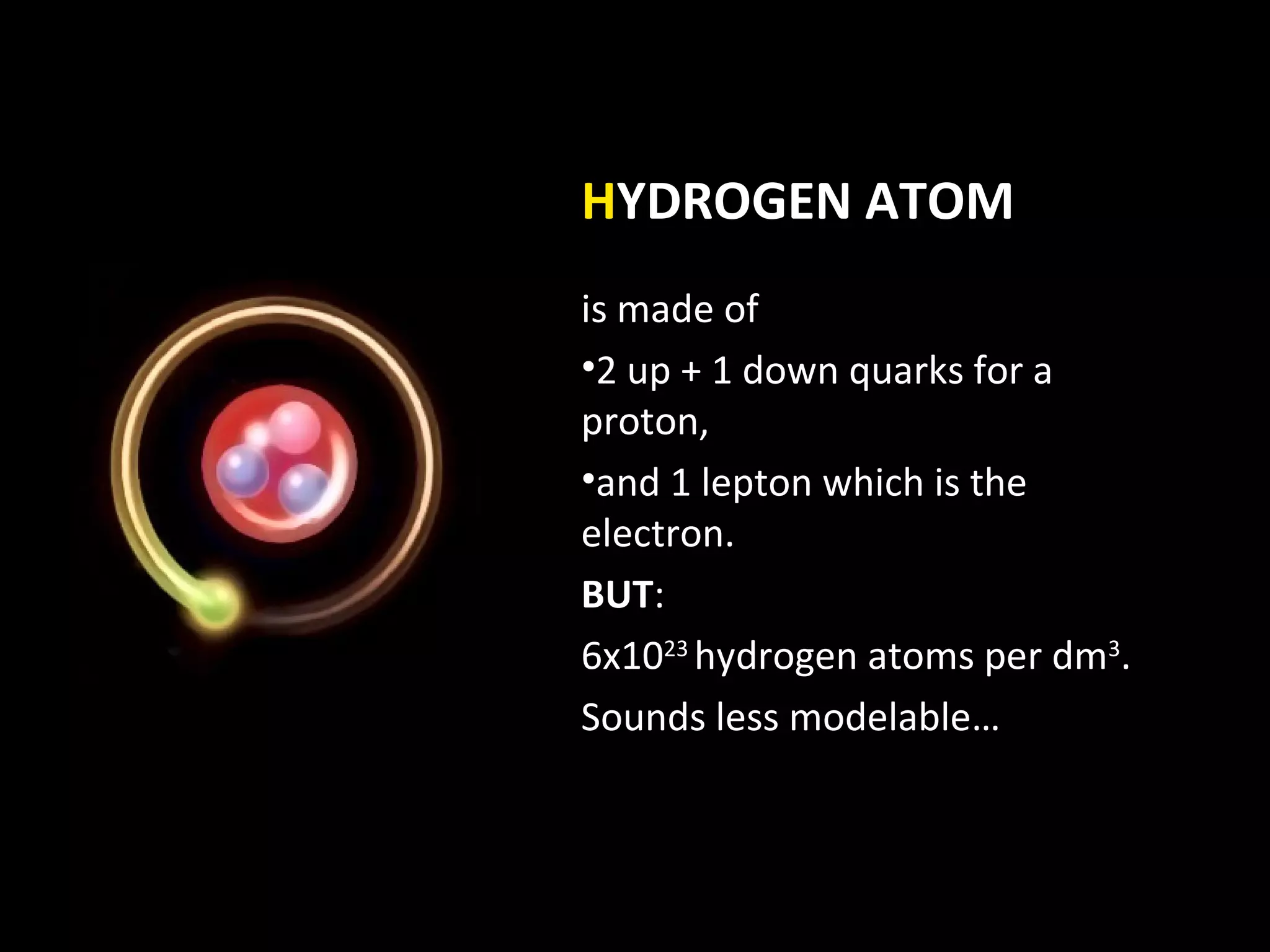
HYDROGEN ATOM
is made of
•2 up + 1 down quarks for a
proton,
•and 1 lepton which is the
electron.
BUT:
6x10²³ hydrogen atoms per dm3.
Sounds less modelable…
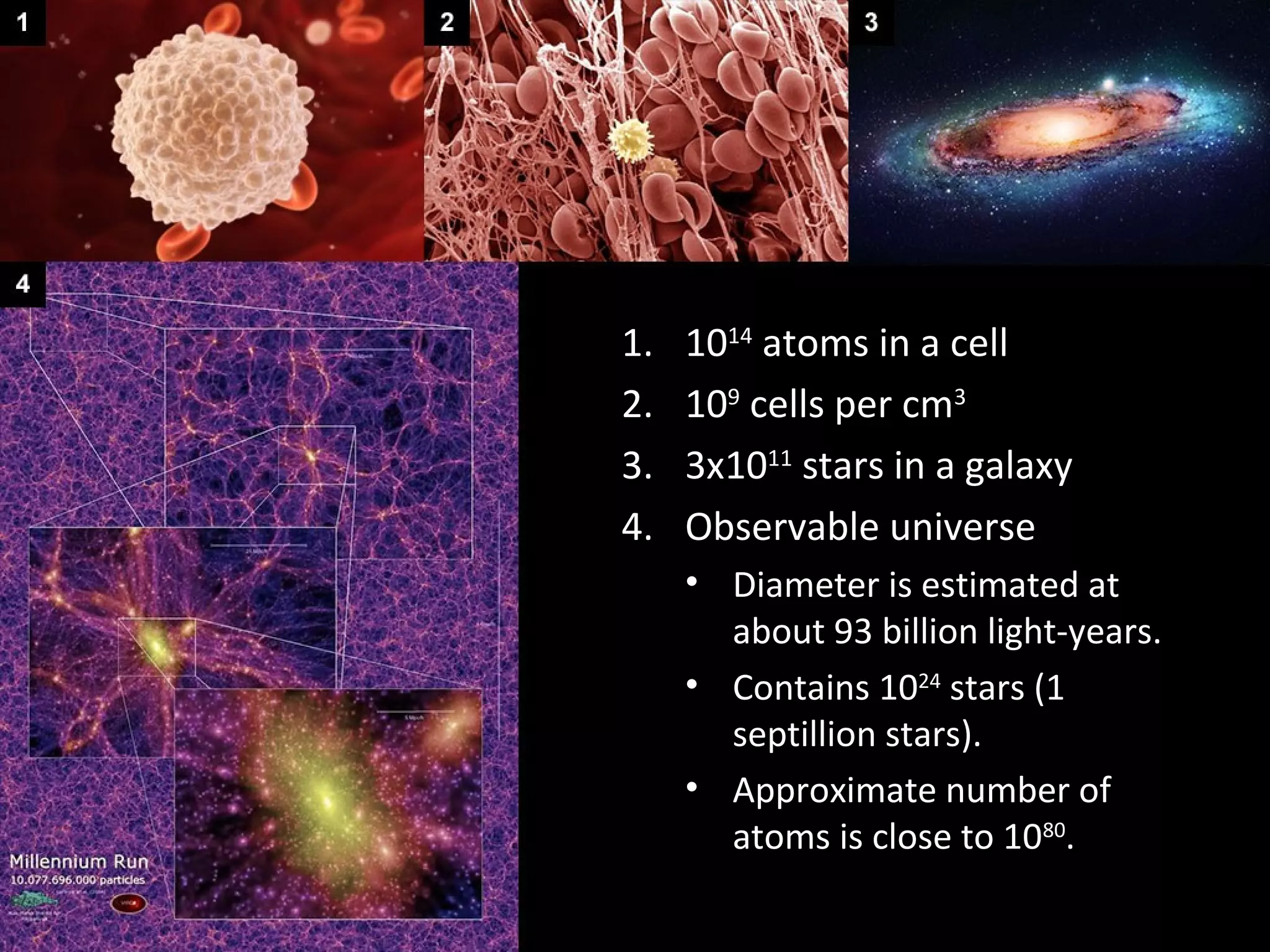
1.   1014 atoms in a cell
2.   109 cells per cm3
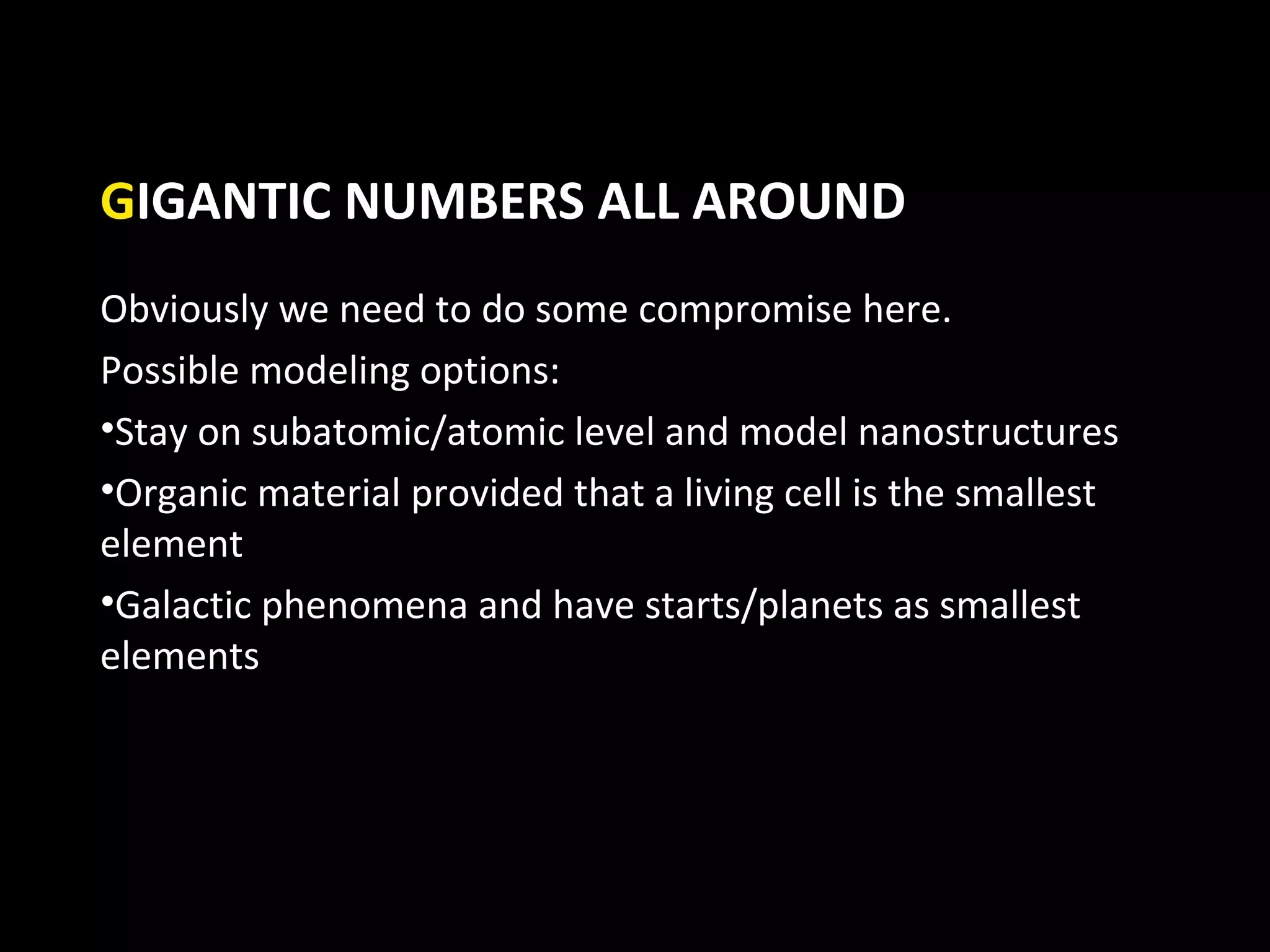
3.   3x10¹¹ stars in a galaxy
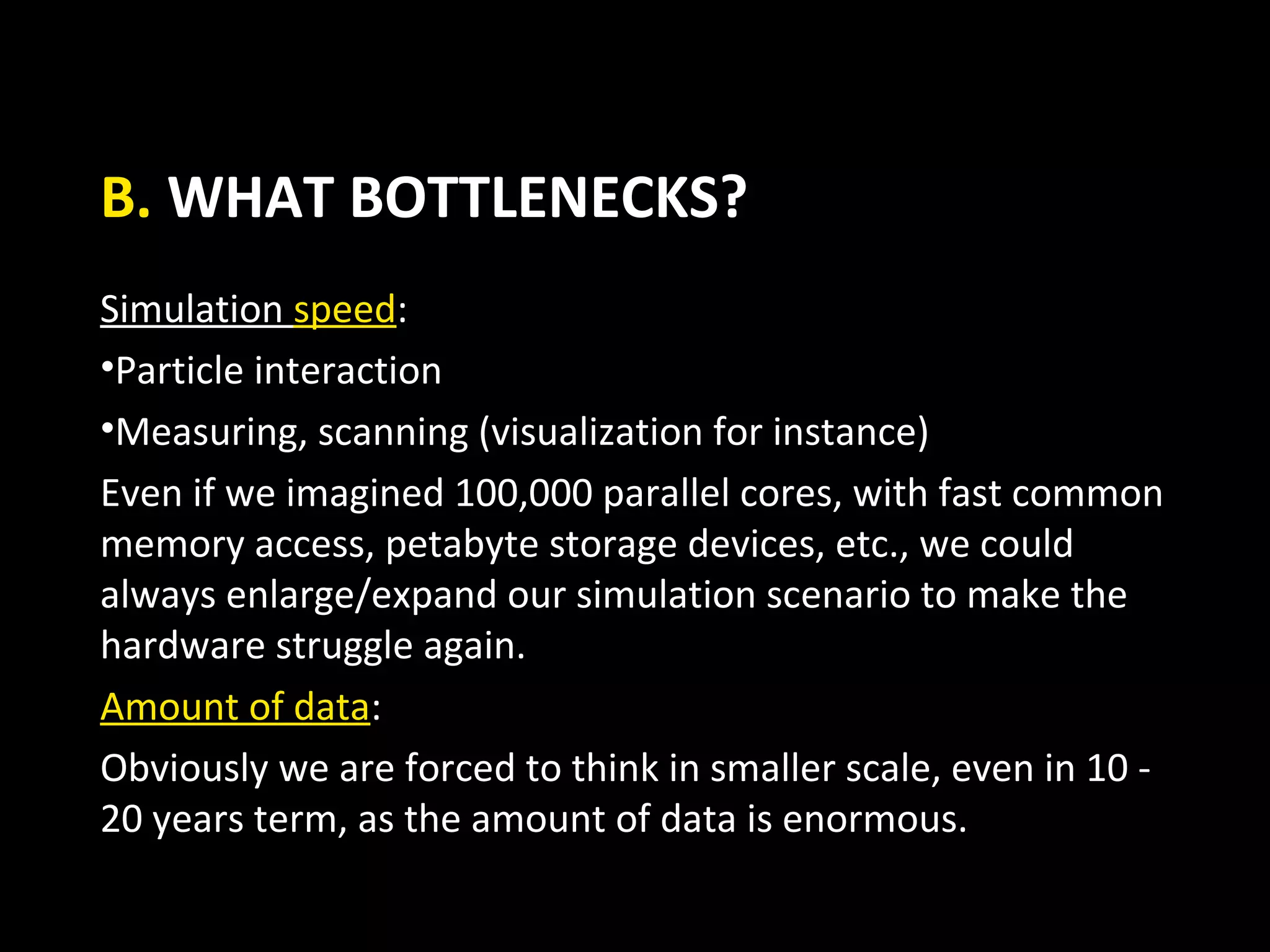
4.   Observable universe
     • Diameter is estimated at
       about 93 billion light-years.
     • Contains 1024 stars (1
       septillion stars).
     • Approximate number of
       atoms is close to 1080.
Huh!!?
GIGANTIC NUMBERS ALL AROUND
Obviously we need to do some compromise here.
Possible modeling options:
•Stay on subatomic/atomic level and model nanostructures
•Organic material provided that a living cell is the smallest
element
•Galactic phenomena and have starts/planets as smallest
elements
B. WHAT BOTTLENECKS?
Simulation speed:
•Particle interaction
•Measuring, scanning (visualization for instance)
Even if we imagined 100,000 parallel cores, with fast common
memory access, petabyte storage devices, etc., we could
always enlarge/expand our simulation scenario to make the
hardware struggle again.
Amount of data:
Obviously we are forced to think in smaller scale, even in 10 -
20 years term, as the amount of data is enormous.
C. WHAT CAN WE DO ON TODAY’S
MACHINES?
Well, probably a lot, because:
•If we designed the system scalable, we could deal with the
problem - in small scale - straight away.
•Due to the enormous task we can’t solely rely on hardware
performance growth.
We need to invent better algorithms anyway.
Let’s start!
DEFINE AREAS OF DEVELOPMENT
We split up the work to 3 major areas:
A.Scanning & visualization
B.Physics
C.Data compression, representation

In the current presentation we focus on the “Scanning &
visualization” part.
A. SCANNING & VISUALIZATION
PARTICLES IN 3D SPACE
We deal with many particles, so a raster representation may
be more feasible than working with individual points (point
clouds).


3D VOLUMETRIC TEXTURES
(similar to 2D textures + 1 extra spatial dimension)
Definitions:
•2D textures have pixels
•3D textures have voxels
Texel means a pixel in 2D, a voxel in 3D.
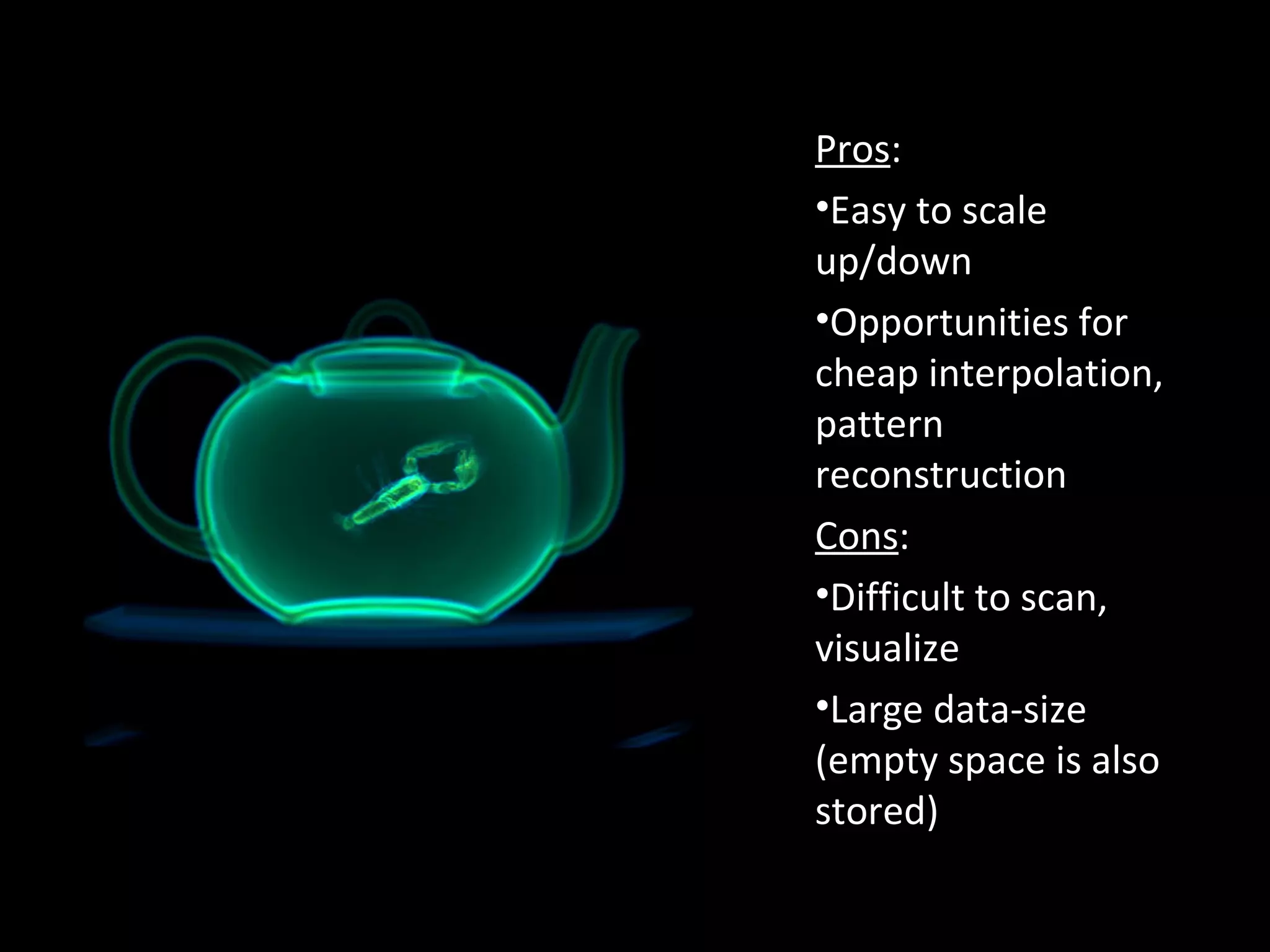
Pros:
•Easy to scale
up/down
•Opportunities for
cheap interpolation,
pattern
reconstruction
Cons:
•Difficult to scan,
visualize
•Large data-size
(empty space is also
stored)
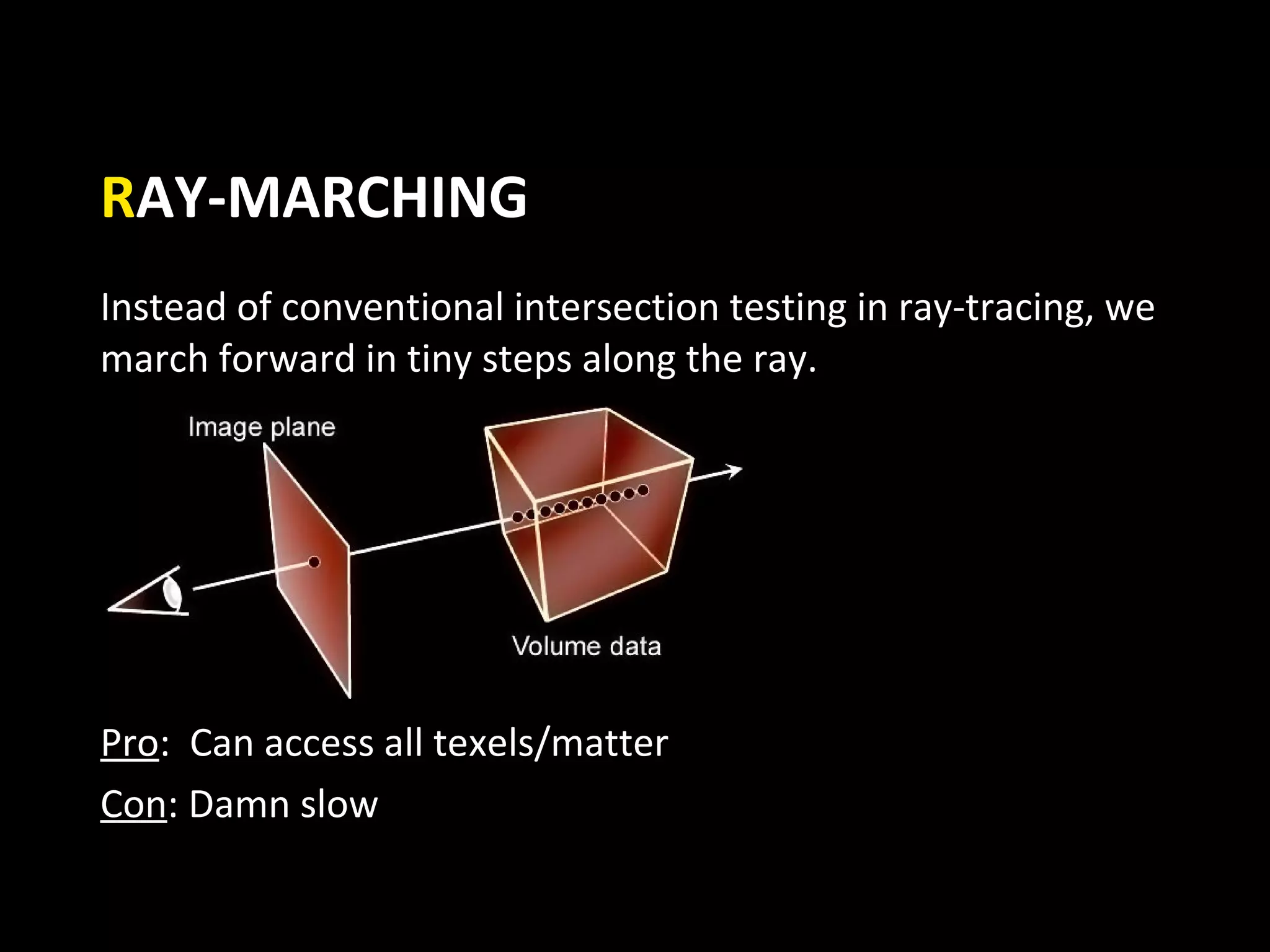
RAY-MARCHING
Instead of conventional intersection testing in ray-tracing, we
march forward in tiny steps along the ray.


Pro: Can access all texels/matter
Con: Damn slow
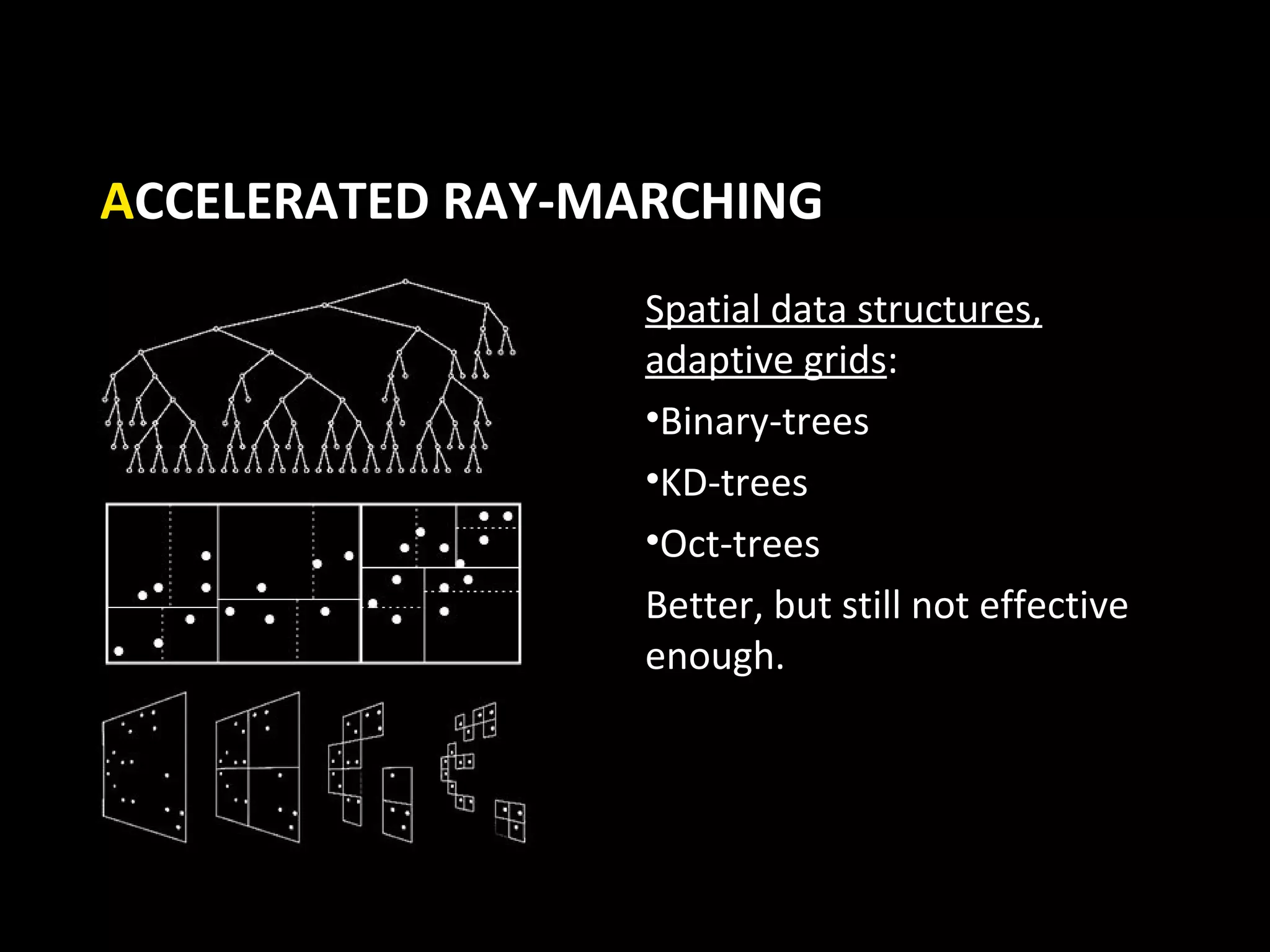
ACCELERATED RAY-MARCHING
                  Spatial data structures,
                  adaptive grids:
                  •Binary-trees
                  •KD-trees
                  •Oct-trees
                  Better, but still not effective
                  enough.
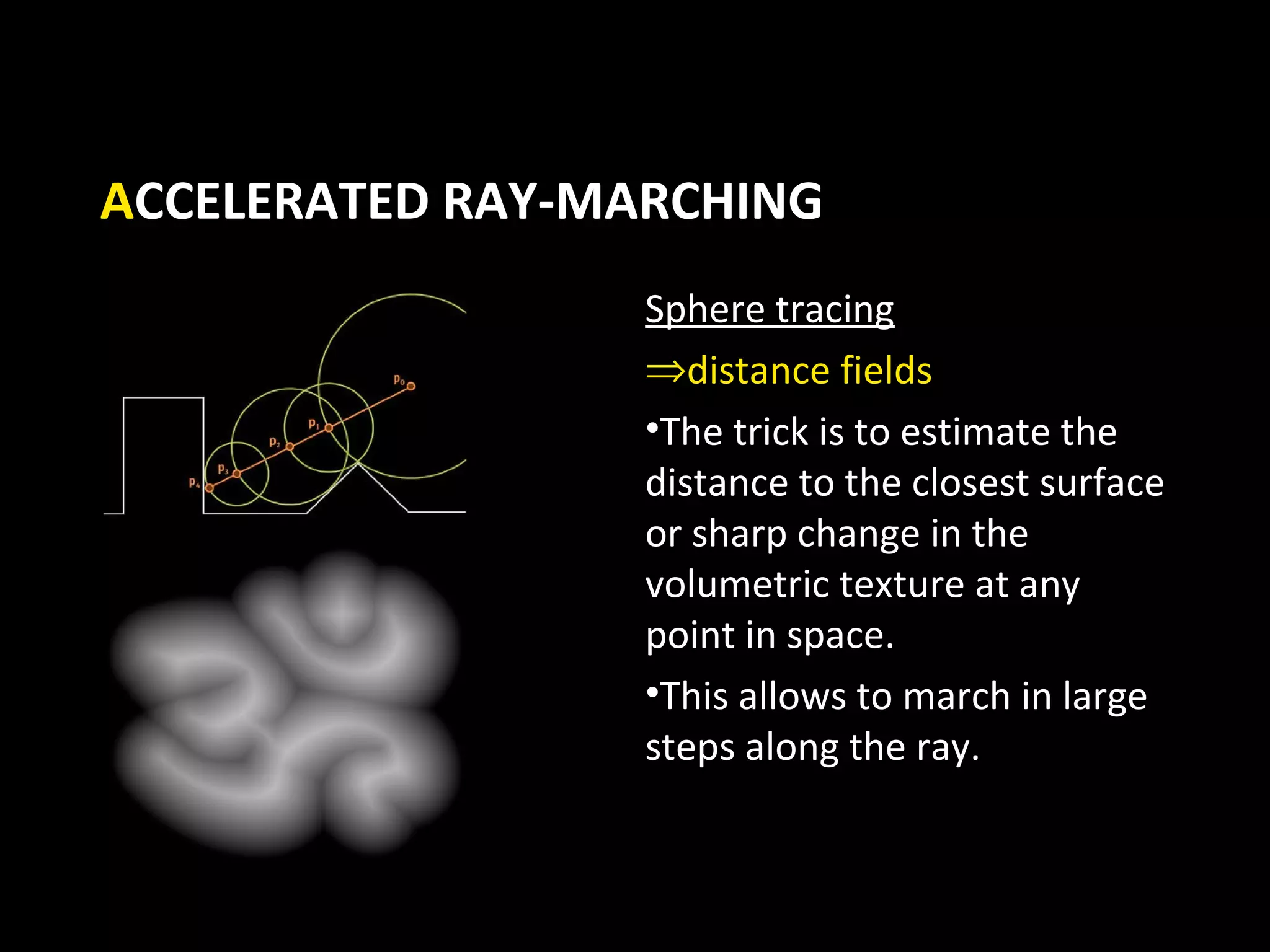
ACCELERATED RAY-MARCHING
                  Sphere tracing
                  ⇒distance fields
                  •The trick is to estimate the
                  distance to the closest surface
                  or sharp change in the
                  volumetric texture at any
                  point in space.
                  •This allows to march in large
                  steps along the ray.
INTRODUCING GRADIENT FIELDS
Possible replacement for particles?
Provided field construction vs. ray-marching speed up is a
win.
Is that possible? Yes.
We’ve been successfully deploying gradient fields, and not for
visualization purposes only, but to accelerate physics
calculations too.
Further benefits:
•Scale extremely well (down/up).
•Give lots of opportunities for guessing, interpolating.
B. PHYSICS
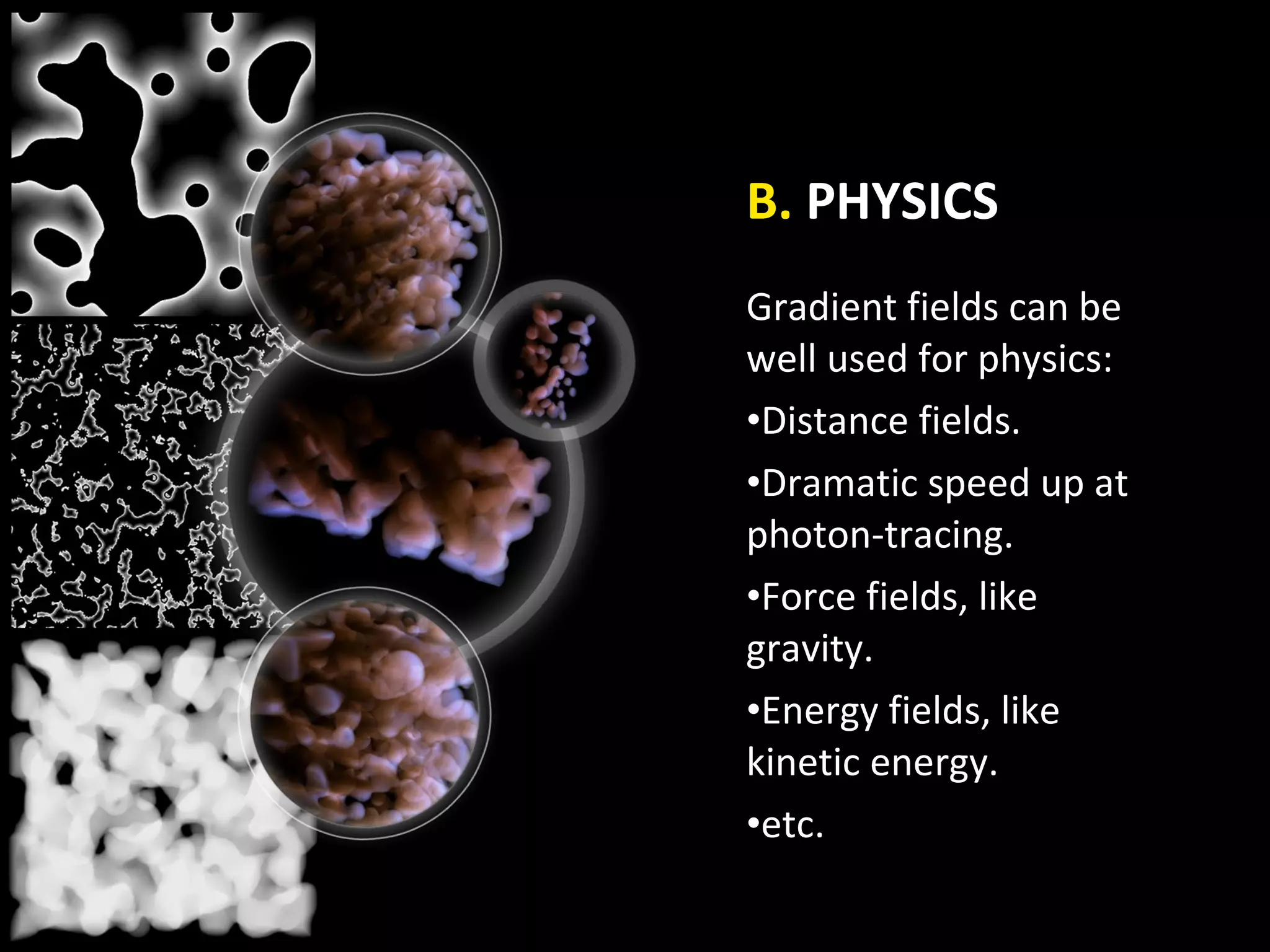
Gradient fields can be
well used for physics:
•Distance fields.
•Dramatic speed up at
photon-tracing.
•Force fields, like
gravity.
•Energy fields, like
kinetic energy.
•etc.
C. COMPRESSION
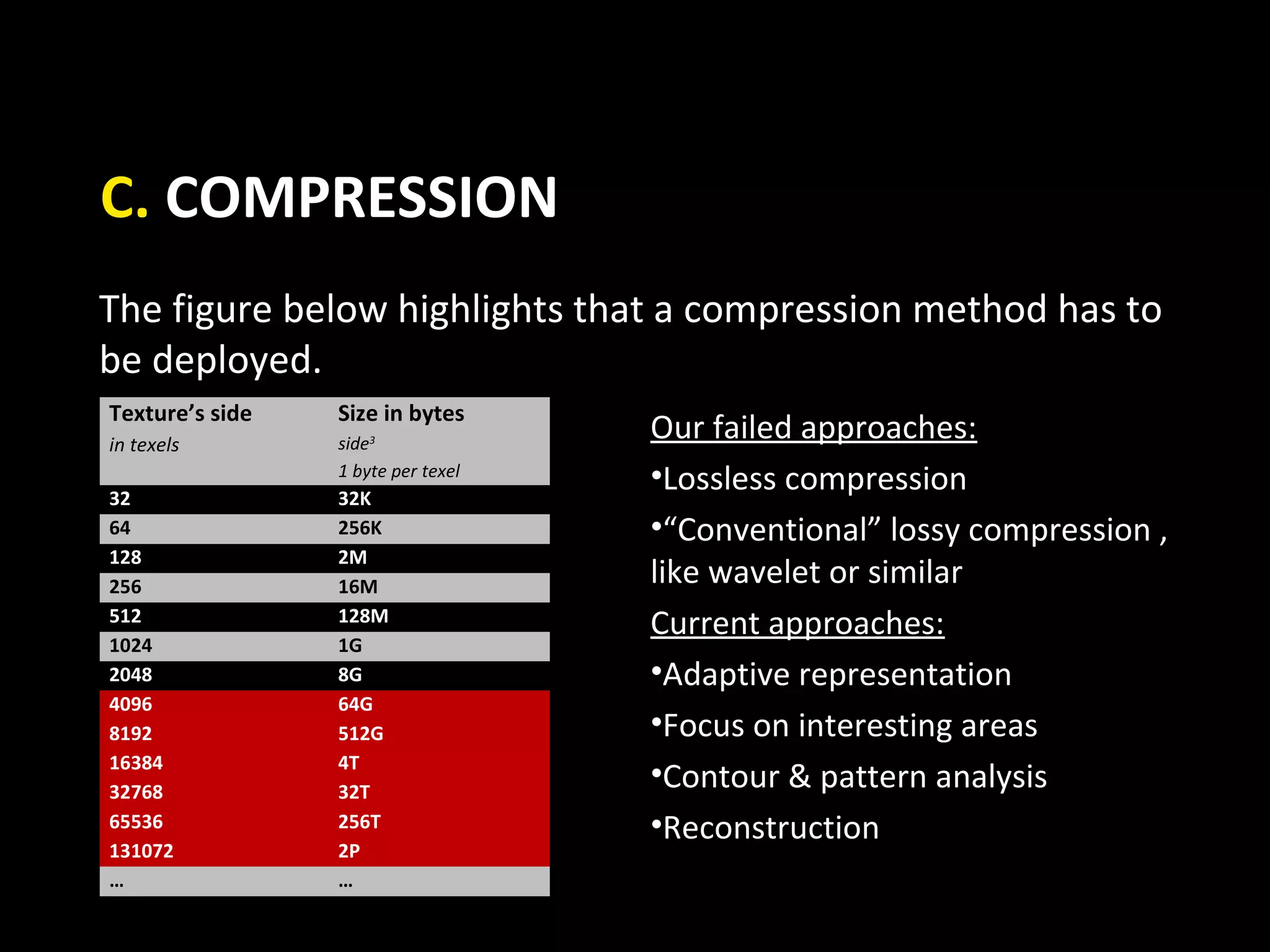
The figure below highlights that a compression method has to
be deployed.
Texture’s side   Size in bytes
in texels        side3
                                    Our failed approaches:
                 1 byte per texel
                                    •Lossless compression
32               32K
64               256K               •“Conventional” lossy compression ,
128              2M
256              16M                like wavelet or similar
512              128M
                                    Current approaches:
1024             1G
2048             8G                 •Adaptive representation
4096             64G
8192             512G               •Focus on interesting areas
16384            4T
32768            32T
                                    •Contour & pattern analysis
65536            256T               •Reconstruction
131072           2P
…                …
SUMMARY
We traversed an exciting path so far, and the next months are
going to be even more exciting for us.
We don't want to close out the possibility of 2 - 3 magnitudes
speed up comparing to brute force methods, once we get all
our theories into practice.
And we hope our friends at the hardware department won’t
rest either…
To be continued…
     Thank you!
Crocotta Research & Development Ltd
                        Suite 5, 39 Irish Town, Gibraltar

   We are a small team of international researchers with the aim of
conducting technology leaps in exciting fields of exploration like virtual
 reality, virtual synthesis of matter, artificial intelligence, and robotics.

                   www.crocotta.co.uk
                 crocotta@crocotta.co.uk
                     +44 20 3239 7007

Crocotta R&D - Virtual Universe

  • 1.
    Crocotta Research &Development Ltd “Be ambitious of climbing up to the difficult, in a manner inaccessible...”
  • 2.
    ONCE UPON ANOTHER FANTASTIC DAY IN THE UK… …we started to think about visualization, other than polygonized surface rendering, to bring us closer to reality.
  • 3.
    NEXT DAY WETURNED TO OUR “DEMON”: We quickly realized that lots of people had been dealing with the problem already*, so we had to set a more future oriented goal. What if we traveled 10 - 20 years ahead in time, and mimicked the real environment with the equipment of the future as much as possible. Neither the “demon” criticized our project, no relevant search results were found. * happens just too often
  • 4.
    VIRTUAL UNIVERSE A virtualworld solely made of particles The idea was born! BUT, there are fundamental questions: A.What is universe? B.What bottlenecks do we need to face? C.Can we do any part(s) of the experiment on today’s machines?
  • 5.
    A. WHAT ISUNIVERSE? We want to know •the building blocks •and their interaction rules. Standard model of physics predicts •12 fundamental particles •which interact via 4 elemental forces. Seems modelable, so far…
  • 6.
    HYDROGEN ATOM is madeof •2 up + 1 down quarks for a proton, •and 1 lepton which is the electron. BUT: 6x10²³ hydrogen atoms per dm3. Sounds less modelable…
  • 7.
    1. 1014 atoms in a cell 2. 109 cells per cm3 3. 3x10¹¹ stars in a galaxy 4. Observable universe • Diameter is estimated at about 93 billion light-years. • Contains 1024 stars (1 septillion stars). • Approximate number of atoms is close to 1080.
  • 8.
  • 9.
    GIGANTIC NUMBERS ALLAROUND Obviously we need to do some compromise here. Possible modeling options: •Stay on subatomic/atomic level and model nanostructures •Organic material provided that a living cell is the smallest element •Galactic phenomena and have starts/planets as smallest elements
  • 10.
    B. WHAT BOTTLENECKS? Simulationspeed: •Particle interaction •Measuring, scanning (visualization for instance) Even if we imagined 100,000 parallel cores, with fast common memory access, petabyte storage devices, etc., we could always enlarge/expand our simulation scenario to make the hardware struggle again. Amount of data: Obviously we are forced to think in smaller scale, even in 10 - 20 years term, as the amount of data is enormous.
  • 11.
    C. WHAT CANWE DO ON TODAY’S MACHINES? Well, probably a lot, because: •If we designed the system scalable, we could deal with the problem - in small scale - straight away. •Due to the enormous task we can’t solely rely on hardware performance growth. We need to invent better algorithms anyway.
  • 12.
  • 13.
    DEFINE AREAS OFDEVELOPMENT We split up the work to 3 major areas: A.Scanning & visualization B.Physics C.Data compression, representation In the current presentation we focus on the “Scanning & visualization” part.
  • 14.
    A. SCANNING &VISUALIZATION PARTICLES IN 3D SPACE We deal with many particles, so a raster representation may be more feasible than working with individual points (point clouds). 3D VOLUMETRIC TEXTURES (similar to 2D textures + 1 extra spatial dimension) Definitions: •2D textures have pixels •3D textures have voxels Texel means a pixel in 2D, a voxel in 3D.
  • 15.
    Pros: •Easy to scale up/down •Opportunitiesfor cheap interpolation, pattern reconstruction Cons: •Difficult to scan, visualize •Large data-size (empty space is also stored)
  • 16.
    RAY-MARCHING Instead of conventionalintersection testing in ray-tracing, we march forward in tiny steps along the ray. Pro: Can access all texels/matter Con: Damn slow
  • 17.
    ACCELERATED RAY-MARCHING Spatial data structures, adaptive grids: •Binary-trees •KD-trees •Oct-trees Better, but still not effective enough.
  • 18.
    ACCELERATED RAY-MARCHING Sphere tracing ⇒distance fields •The trick is to estimate the distance to the closest surface or sharp change in the volumetric texture at any point in space. •This allows to march in large steps along the ray.
  • 19.
    INTRODUCING GRADIENT FIELDS Possiblereplacement for particles? Provided field construction vs. ray-marching speed up is a win. Is that possible? Yes. We’ve been successfully deploying gradient fields, and not for visualization purposes only, but to accelerate physics calculations too. Further benefits: •Scale extremely well (down/up). •Give lots of opportunities for guessing, interpolating.
  • 20.
    B. PHYSICS Gradient fieldscan be well used for physics: •Distance fields. •Dramatic speed up at photon-tracing. •Force fields, like gravity. •Energy fields, like kinetic energy. •etc.
  • 21.
    C. COMPRESSION The figurebelow highlights that a compression method has to be deployed. Texture’s side Size in bytes in texels side3 Our failed approaches: 1 byte per texel •Lossless compression 32 32K 64 256K •“Conventional” lossy compression , 128 2M 256 16M like wavelet or similar 512 128M Current approaches: 1024 1G 2048 8G •Adaptive representation 4096 64G 8192 512G •Focus on interesting areas 16384 4T 32768 32T •Contour & pattern analysis 65536 256T •Reconstruction 131072 2P … …
  • 22.
    SUMMARY We traversed anexciting path so far, and the next months are going to be even more exciting for us. We don't want to close out the possibility of 2 - 3 magnitudes speed up comparing to brute force methods, once we get all our theories into practice. And we hope our friends at the hardware department won’t rest either…
  • 23.
  • 24.
    Crocotta Research &Development Ltd Suite 5, 39 Irish Town, Gibraltar We are a small team of international researchers with the aim of conducting technology leaps in exciting fields of exploration like virtual reality, virtual synthesis of matter, artificial intelligence, and robotics. www.crocotta.co.uk crocotta@crocotta.co.uk +44 20 3239 7007