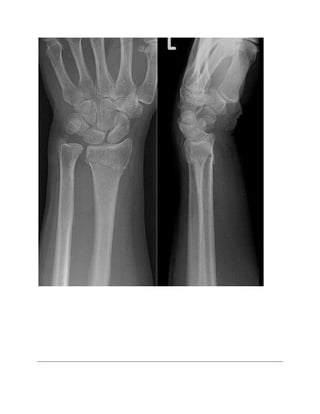
11/3/2009Colles’ fracture | dR.hArishcentercenterorthoColles’ fracture<br />Colles' fracture:<br />This is a very common injury which affects the distal end of the radius. It was first described by Abraham Colles in 1814 who reported a transverse fracture of the radius, within 1 inch of the wrist, and with dorsal displacement and dorsal angulation of the distal fragment.<br />*The fracture is most common in elderly postmenopausal osteoporotic women who give a history of a fall onto an outstretched hand.<br />1)clinical features:<br />                                 Classically, the fracture presents with a 'dinner fork' deformity of the wrist.<br />There are five components to the deformity:<br />dorsal angulation of the distal fragment.<br />dorsal displacement of the distal fragment.<br />radial deviation of the hand.<br />Supination.<br />proximal impaction.<br />2)complications: <br />                                  The complications of a Colles' fracture may be:<br />                                 A)early..<br />                                     <br />                           B)late..<br />A)Early:                       <br />  Possible early complications include:<br />swelling and pain of the fingers:<br />from an overly tight plaster<br />easily corrected by re-plastering<br />median nerve damage:<br />rare, due to carpal tunnel compression<br />may require decompression<br />Sudek's atrophy:<br />usually restricted to the fingers but may involve the shoulders<br />exercise of the limb helps to prevent it<br />B)Late:<br />                  Possible late complications include:<br />mal-union:<br />is common<br />the reduction may have been incomplete or displacement overlooked<br />disability may be minor but unsightly deformity may be more of a problem<br />surgical correction may be indicated.<br />non-union of the ulnar styloid process.<br />rupture of extensor pollicis longus:<br />due to either movement across a sharp edge of bone or if displacement is minimal, probably, ischaemia.<br />usually treated by tendon transfer using one of the extensors of the index finger.<br />stiffness:<br />from inadequate exercise and / or prolonged splintage.<br />may affect the wrist or the shoulder.<br />                  Sudeck's atrophy:<br />This is a form of reflex sympathetic dystrophy that may affect the feet or hands after an injury.<br />It is a major cause of disability with only one in five affected patients able to fully resume prior activities. The earlier a diagnosis is made and treatment is commenced the better the prognosis.<br />Aetiology:<br />             The aetiology is uncertain. The most widely accepted theory proposes the existence of an abnormal reflex arc within the sympathetic nervous system.<br />Following trauma there is a transient alteration in the vasomotor tone of the affected region - unduly sustained changes may result in permanent disturbance of the micro- circulation.<br />Local tissue ischaemia leads to acidosis and tissue dystrophy. The acid metabolites may then activate osteoclasts resulting in local osteoporosis.<br />clinical features:<br />  1) burning pain.<br />  2) local swelling, redness and warmth, which after some weeks becomes atrophic and pale.<br />  3) movements of the affected hand or foot are severely restricted.<br />           <br />
Colles fracture
Colles fracture
Colles fracture
Colles fracture
Colles fracture

Colles fracture

  • 1.
    11/3/2009Colles’ fracture |dR.hArishcentercenterorthoColles’ fracture<br />Colles' fracture:<br />This is a very common injury which affects the distal end of the radius. It was first described by Abraham Colles in 1814 who reported a transverse fracture of the radius, within 1 inch of the wrist, and with dorsal displacement and dorsal angulation of the distal fragment.<br />*The fracture is most common in elderly postmenopausal osteoporotic women who give a history of a fall onto an outstretched hand.<br />1)clinical features:<br /> Classically, the fracture presents with a 'dinner fork' deformity of the wrist.<br />There are five components to the deformity:<br />dorsal angulation of the distal fragment.<br />dorsal displacement of the distal fragment.<br />radial deviation of the hand.<br />Supination.<br />proximal impaction.<br />2)complications: <br /> The complications of a Colles' fracture may be:<br /> A)early..<br /> <br /> B)late..<br />A)Early: <br /> Possible early complications include:<br />swelling and pain of the fingers:<br />from an overly tight plaster<br />easily corrected by re-plastering<br />median nerve damage:<br />rare, due to carpal tunnel compression<br />may require decompression<br />Sudek's atrophy:<br />usually restricted to the fingers but may involve the shoulders<br />exercise of the limb helps to prevent it<br />B)Late:<br /> Possible late complications include:<br />mal-union:<br />is common<br />the reduction may have been incomplete or displacement overlooked<br />disability may be minor but unsightly deformity may be more of a problem<br />surgical correction may be indicated.<br />non-union of the ulnar styloid process.<br />rupture of extensor pollicis longus:<br />due to either movement across a sharp edge of bone or if displacement is minimal, probably, ischaemia.<br />usually treated by tendon transfer using one of the extensors of the index finger.<br />stiffness:<br />from inadequate exercise and / or prolonged splintage.<br />may affect the wrist or the shoulder.<br /> Sudeck's atrophy:<br />This is a form of reflex sympathetic dystrophy that may affect the feet or hands after an injury.<br />It is a major cause of disability with only one in five affected patients able to fully resume prior activities. The earlier a diagnosis is made and treatment is commenced the better the prognosis.<br />Aetiology:<br /> The aetiology is uncertain. The most widely accepted theory proposes the existence of an abnormal reflex arc within the sympathetic nervous system.<br />Following trauma there is a transient alteration in the vasomotor tone of the affected region - unduly sustained changes may result in permanent disturbance of the micro- circulation.<br />Local tissue ischaemia leads to acidosis and tissue dystrophy. The acid metabolites may then activate osteoclasts resulting in local osteoporosis.<br />clinical features:<br /> 1) burning pain.<br /> 2) local swelling, redness and warmth, which after some weeks becomes atrophic and pale.<br /> 3) movements of the affected hand or foot are severely restricted.<br /> <br />