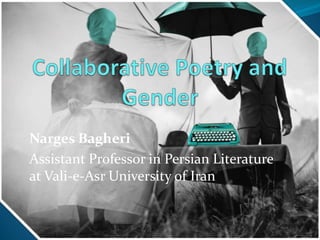
Narges Bagheri
Assistant Professor in Persian Literature
at Vali-e-Asr University of Iran
Gender has always been regarded as one of the
influential and important factors in literary
creativities. The present study aims to explore an
Iranian poetry book which is a new phenomenon
not only in the Iranian contemporary poetry but
also in the world’s poetry.“Atr Az Naam” (The
perfume from Name) is a collaborative poetry
book written by two poets, one male and the
other female.
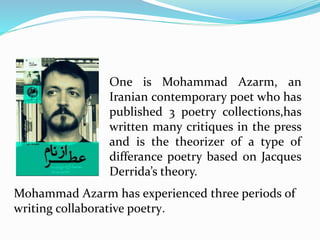
One is Mohammad Azarm, an
Iranian contemporary poet who has
published 3 poetry collections,has
written many critiques in the press
and is the theorizer of a type of
differance poetry based on Jacques
Derrida’s theory.
Mohammad Azarm has experienced three periods of
writing collaborative poetry.
Eve Lilith was an unknown lady with two names. In Atr
Az Naam. Eve Lilith is the nickname of poet. Her real
name is not disclosed in official media; it should be
noted that she has been interviewed with the same
name, which is quite new on its own.
The metaphoric nature of her name gives her a secret
power, but the semantic horizon of this name lays the
foundation of Atr Az Naam . Eve Lilith is made before
writing the book; as a matter of fact, this name was not
made for the sake of the book in question. On the
contrary, the book was inspired by this name, and in the
near future the very name could lead to the emergence
of other literary works as well.
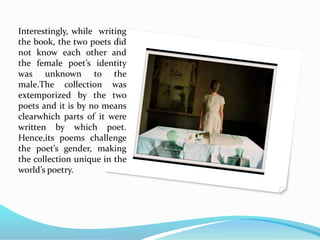
Interestingly, while writing
the book, the two poets did
not know each other and
the female poet’s identity
was unknown to the
male.The collection was
extemporized by the two
poets and it is by no means
clearwhich parts of it were
written by which poet.
Hence,its poems challenge
the poet’s gender, making
the collection unique in the
world’s poetry.
 The majority of the book’s poems deal with woman’s
status in Iran’s history, Persian poetry, religious beliefs
and ritual traditions, society and the mutual
relationships of man and woman and the woman’s
hidden voice is apparent in the poems.
In their unconscious writings, surrealists used to write
impromptu individually or collaboratively in their
ecstasy. This superior truth should be allowed to
emerge in unconscious writing. All of couple and
collaborative poetry written by surrealists are quite
considerable. They all have a psychoanalytic behavior
with delivery terms, conforming to the form of one’s
talk while hypnotism.
The most notable collaborative poems were written by
Forough Farrokhzad and Yadollah Royayi in 1966. These
poems were published posthumously in Farrokhzad’s
‘Nostalagia’ and Royayi’s ‘from I love You’. Royayi has also
collaborated with Ahmad Reza Ahmadi. The common
feature of all these works is the frequency of the complete
phrases of the poems
In these poems, the poets had possession over their lines,
and they could put the same lines in their other poems.
One of the characteristics of aroma-of-name poetry is
the complete collaboration between the two poets to
create the form of a poem. “In the book “Atr Az Naam ”,
each line might contain two or more quick lines by two
poets; in other words, even with the separation of the
lines, no one is able to guess who has written a certain
line.
-1. The creation of World narratives
 There is a poem named dummies’ in the book with elements
such as wheat, dummy, falling, nakedness, three and soil; they
remind one of descent of Adam to the Earth. The story of
Descent and the role of women in it are among the very
challenging subjects in feminism theory. In this poem, however,
we will not face structural and semantic stereotypes. More
importantly, we do not know that what the role of men and
women is in it. Overall, viewpoint of a human beings in this type
of poetry is beyond their gender.
 “Unnamed” is a poem entirely devoted to a dialogue between
man and woman in the moment of creation when two human
beings reach each other between light and darkness to form the
biggest event of all the times. The poem, revelation in pepper, is
a feminine narration of creation which happens during cooking
food process.
-2. Language and their inseparability
 Genesis is another poem of the book starting with
undiscernible sounds. Sound that reminds of the first
moments of the world. The language of the poem is under
the process of production and as the objects and things in
this world take shape, sentences are constructed little by
little. The language of this poem does not contain gender-
based stereotypes. It is not clear which poem is written by
whom. This poem is an ideal world where two human
beings have devolved into their primary state of being, thus
are constructing a new world.
3. Different directions of feminine myth
 Another challenging subject before feminists is the
creation of women on earth. In Lilith, these stories are
challenged. The audience does not know that whether this
narration is feminine or masculine. This is only a human
voice:
 No narration but human / Was awakened from this point /
There was no heaven / No big name that is untold / Waters
joined / Names conjoined / Light escaped the shade / It
dispersed the narration /Eve sat down / Lilith sat down /
But Adam was stand still (Atr Az Naam , 62-64)
4. The status of females in an imagined
history intertextually related to
historical/literary realities.
 The historical and geographical conditions created in
the book through which transgender human beings is
crossing where females sometimes show their
discontent.
5. The criticism of culture, history and
everyday life as masculine action
 In ‘the way of hatred’ poem, the poets (in this poem both of
the composers write from the viewpoint of females)
complain about the past male poets. In the history of Persia
poetry, Persian male poets always talk about the body
organs of their beloved ones rather than their thinking. In
their serenades, they worship women with fixed
stereotypes such as hair, beauty spots and their cypress-like
height. In this poem, the writer as an individual person
believes that this is not love but a kind of hatred.
Therefore, the poet points his finger at Persian sonnets. He
states that sonnet has risen to take back its real popularity.
 In “not everything starts from blockade” Or in ‘freedom’
poem, The narrators complain about the dominant
masculine discourse.
6. new sonnets
 In the poems of this book, there is no conformity to sonnet
sterotypes:
 A type from with / Poem starts with blood / To blend it with lips
from beyond / To search in my body fold / To speak in order not to
say / In a way that fish swims out of water in words (Atr Az Naam ,
81-82)
 ‘Farapachino’ is also a dialogue between an amateur female poet and
famous male poet. In this poem, an ethical-cultural issue is
challenged. The female poet approaches the male with the purpose of
getting popularity. However, the male poet intends to abuse her body.
This poem stands against such a condition with sarcasm and irony.
As could be observed, collaborative writing is way out of a
dominant discourse. Atr Az Naam is unique in that it is not
clear who has composed the different parts of the poem where
the gender of writer is obscure. In this poem, the presence of
two poets has led to a transgender world.
The poets in this book do not conform to the existing
stereotypes to create serenades. Language is another feature of
collaborative poems in this book. The language is multiple and
multidirectional.There is also polyvocality in the dialogues.
E-Mail: N.Bagheri@Vru.ac.ir

Collaborative Poetry and Gender

  • 1.
    Narges Bagheri Assistant Professorin Persian Literature at Vali-e-Asr University of Iran
  • 2.
    Gender has alwaysbeen regarded as one of the influential and important factors in literary creativities. The present study aims to explore an Iranian poetry book which is a new phenomenon not only in the Iranian contemporary poetry but also in the world’s poetry.“Atr Az Naam” (The perfume from Name) is a collaborative poetry book written by two poets, one male and the other female.
  • 3.
    One is MohammadAzarm, an Iranian contemporary poet who has published 3 poetry collections,has written many critiques in the press and is the theorizer of a type of differance poetry based on Jacques Derrida’s theory. Mohammad Azarm has experienced three periods of writing collaborative poetry.
  • 5.
    Eve Lilith wasan unknown lady with two names. In Atr Az Naam. Eve Lilith is the nickname of poet. Her real name is not disclosed in official media; it should be noted that she has been interviewed with the same name, which is quite new on its own. The metaphoric nature of her name gives her a secret power, but the semantic horizon of this name lays the foundation of Atr Az Naam . Eve Lilith is made before writing the book; as a matter of fact, this name was not made for the sake of the book in question. On the contrary, the book was inspired by this name, and in the near future the very name could lead to the emergence of other literary works as well.
  • 6.
    Interestingly, while writing thebook, the two poets did not know each other and the female poet’s identity was unknown to the male.The collection was extemporized by the two poets and it is by no means clearwhich parts of it were written by which poet. Hence,its poems challenge the poet’s gender, making the collection unique in the world’s poetry.
  • 7.
     The majorityof the book’s poems deal with woman’s status in Iran’s history, Persian poetry, religious beliefs and ritual traditions, society and the mutual relationships of man and woman and the woman’s hidden voice is apparent in the poems.
  • 8.
    In their unconsciouswritings, surrealists used to write impromptu individually or collaboratively in their ecstasy. This superior truth should be allowed to emerge in unconscious writing. All of couple and collaborative poetry written by surrealists are quite considerable. They all have a psychoanalytic behavior with delivery terms, conforming to the form of one’s talk while hypnotism.
  • 9.
    The most notablecollaborative poems were written by Forough Farrokhzad and Yadollah Royayi in 1966. These poems were published posthumously in Farrokhzad’s ‘Nostalagia’ and Royayi’s ‘from I love You’. Royayi has also collaborated with Ahmad Reza Ahmadi. The common feature of all these works is the frequency of the complete phrases of the poems In these poems, the poets had possession over their lines, and they could put the same lines in their other poems.
  • 10.
    One of thecharacteristics of aroma-of-name poetry is the complete collaboration between the two poets to create the form of a poem. “In the book “Atr Az Naam ”, each line might contain two or more quick lines by two poets; in other words, even with the separation of the lines, no one is able to guess who has written a certain line.
  • 12.
    -1. The creationof World narratives  There is a poem named dummies’ in the book with elements such as wheat, dummy, falling, nakedness, three and soil; they remind one of descent of Adam to the Earth. The story of Descent and the role of women in it are among the very challenging subjects in feminism theory. In this poem, however, we will not face structural and semantic stereotypes. More importantly, we do not know that what the role of men and women is in it. Overall, viewpoint of a human beings in this type of poetry is beyond their gender.  “Unnamed” is a poem entirely devoted to a dialogue between man and woman in the moment of creation when two human beings reach each other between light and darkness to form the biggest event of all the times. The poem, revelation in pepper, is a feminine narration of creation which happens during cooking food process.
  • 13.
    -2. Language andtheir inseparability  Genesis is another poem of the book starting with undiscernible sounds. Sound that reminds of the first moments of the world. The language of the poem is under the process of production and as the objects and things in this world take shape, sentences are constructed little by little. The language of this poem does not contain gender- based stereotypes. It is not clear which poem is written by whom. This poem is an ideal world where two human beings have devolved into their primary state of being, thus are constructing a new world.
  • 14.
    3. Different directionsof feminine myth  Another challenging subject before feminists is the creation of women on earth. In Lilith, these stories are challenged. The audience does not know that whether this narration is feminine or masculine. This is only a human voice:  No narration but human / Was awakened from this point / There was no heaven / No big name that is untold / Waters joined / Names conjoined / Light escaped the shade / It dispersed the narration /Eve sat down / Lilith sat down / But Adam was stand still (Atr Az Naam , 62-64)
  • 15.
    4. The statusof females in an imagined history intertextually related to historical/literary realities.  The historical and geographical conditions created in the book through which transgender human beings is crossing where females sometimes show their discontent.
  • 16.
    5. The criticismof culture, history and everyday life as masculine action  In ‘the way of hatred’ poem, the poets (in this poem both of the composers write from the viewpoint of females) complain about the past male poets. In the history of Persia poetry, Persian male poets always talk about the body organs of their beloved ones rather than their thinking. In their serenades, they worship women with fixed stereotypes such as hair, beauty spots and their cypress-like height. In this poem, the writer as an individual person believes that this is not love but a kind of hatred. Therefore, the poet points his finger at Persian sonnets. He states that sonnet has risen to take back its real popularity.  In “not everything starts from blockade” Or in ‘freedom’ poem, The narrators complain about the dominant masculine discourse.
  • 17.
    6. new sonnets In the poems of this book, there is no conformity to sonnet sterotypes:  A type from with / Poem starts with blood / To blend it with lips from beyond / To search in my body fold / To speak in order not to say / In a way that fish swims out of water in words (Atr Az Naam , 81-82)  ‘Farapachino’ is also a dialogue between an amateur female poet and famous male poet. In this poem, an ethical-cultural issue is challenged. The female poet approaches the male with the purpose of getting popularity. However, the male poet intends to abuse her body. This poem stands against such a condition with sarcasm and irony.
  • 18.
    As could beobserved, collaborative writing is way out of a dominant discourse. Atr Az Naam is unique in that it is not clear who has composed the different parts of the poem where the gender of writer is obscure. In this poem, the presence of two poets has led to a transgender world. The poets in this book do not conform to the existing stereotypes to create serenades. Language is another feature of collaborative poems in this book. The language is multiple and multidirectional.There is also polyvocality in the dialogues.
  • 19.