S H P Malkanthi
Faculty of Agricultural Sciences
Sabaragamuwa University of Sri Lanka
Organic foods are the food items produced through organic agriculture and they belonged
to legally regulated standards. Organic foods are grown without using conventional
pesticides, artificial fertilizers or sewage sludge, and they are processed without ionizing
radiation or food additives. Also, livestock are reared without routine uses of antibiotics
and growth hormones. At all levels, organic food is produced without using genetically
modified organisms.
Marketing of organic products is growing at a fast rate both in developed and developing
countries since people are more concerning about health and nutritional value especially
when purchasing food product. Sri Lanka as a country with full of natural resources has a
big potential to fulfill this ever-growing market demand for organic products in the world
and the Sri Lankan government turned to encourage the production of organic products for
the consumers who always seek organic food for consumption.
2
Sri Lankans are experiencing health issues and environmental issues when they
are away from traditional food habits and traditional agricultural methods. World
Health Organisation (2015) highlighted that non-communicable diseases and
unhealthy foods have been caused for 38 million deaths all around the world.
The government of Sri Lanka is turning towards organic agriculture and
encouraging farmers to practice organic agriculture. However, the value of organic
food is perceived differently by consumers. Even farmers pay attention to organic
farming, it has been difficult to find out what is the market potential for the
products with premium values. Thus, the main focus of this study was to identify
that what determines the purchase intention of organic foods by Sri Lankan
consumers.
3
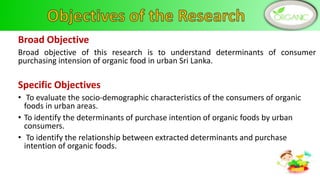
Broad Objective
Broad objective of this research is to understand determinants of consumer
purchasing intension of organic food in urban Sri Lanka.
Specific Objectives
• To evaluate the socio-demographic characteristics of the consumers of organic
foods in urban areas.
• To identify the determinants of purchase intention of organic foods by urban
consumers.
• To identify the relationship between extracted determinants and purchase
intention of organic foods.
4
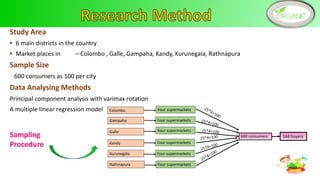
Study Area
• 6 main districts in the country
• Market places in – Colombo , Galle, Gampaha, Kandy, Kurunegala, Rathnapura
Sample Size
600 consumers as 100 per city
Data Analysing Methods
Principal component analysis with varimax rotation
A multiple linear regression model
144 buyersSampling
Procedure
5
H01 - There is no relationship between Health and environment consciousness towards purchase intention
of the organic food
H0 2- There is no relationship between Product certification of organic food towards purchase intention of
the organic food.
H03- There is no relationship between towards Market aspects of the organic food purchase intention of the
organic food.
H0 4- There is no relationship between Common attributes of organic food towards purchase intention of
organic food.
H0 5- There is no relationship between Awareness about the value of organic food towards purchase
intention of organic food.
H0 6- There is no relationship between the market availability of the product towards purchase intention of
the organic food.
6
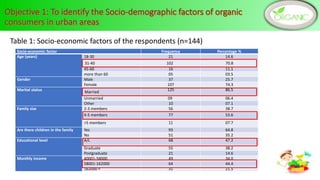
Table 1: Socio-economic factors of the respondents (n=144)
Socio-economic factor Frequency Percentage %
Age (years) 18-30 21 14.6
45-60 16 11.1
more than 60 05 03.5
Gender Male 37 25.7
Female 107 74.3
Marital status 125 86.5
Unmarried 09 06.4
Other 10 07.1
Family size 2-3 members 56 38.7
4-5 members 77 53.6
>5 members 11 07.7
Are there children in the family Yes 93 64.8
No 51 35.2
Educational level A/L 68 47.2
Graduate 55 38.2
Postgraduate 21 14.6
Monthly income 40001-58000 49 34.0
58001-162000 64 44.4
162000 < 31 21.5
31-40 102 70.8
Married
7
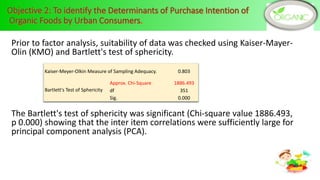
Prior to factor analysis, suitability of data was checked using Kaiser-Mayer-
Olin (KMO) and Bartlett's test of sphericity.
The Bartlett's test of sphericity was significant (Chi-square value 1886.493,
p 0.000) showing that the inter item correlations were sufficiently large for
principal component analysis (PCA).
Kaiser-Meyer-Olkin Measure of Sampling Adequacy. 0.803
Bartlett's Test of Sphericity
Approx. Chi-Square 1886.493
df 351
Sig. 0.000
8
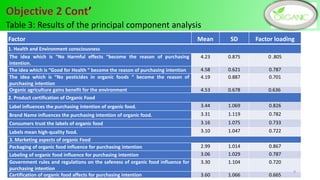
Table 3: Results of the principal component analysis
Factor Mean SD Factor loading
1. Health and Environment consciousness
The idea which is “No Harmful effects “become the reason of purchasing
intention.
4.23 0.875 0 .805
The idea which is “Good for Health “ become the reason of purchasing intention 4.58 0.621 0.787
The idea which is “No pesticides in organic foods “ become the reason of
purchasing intention
4.19 0.887 0.701
Organic agriculture gains benefit for the environment 4.53 0.678 0.636
2. Product certification of Organic Food
Label influences the purchasing intention of organic food. 3.44 1.069 0.826
Brand Name influences the purchasing intention of organic food. 3.31 1.119 0.782
Consumers trust the labels of organic food 3.16 1.075 0.733
Labels mean high-quality food. 3.10 1.047 0.722
3. Marketing aspects of organic Food
Packaging of organic food influence for purchasing intention 2.99 1.014 0.867
Labeling of organic food influence for purchasing intention 3.06 1.029 0.787
Government rules and regulations on the safeness of organic food influence for
purchasing intention
3.30 1.104 0.720
Certification of organic food affects for purchasing intention 3.60 1.066 0.665
9
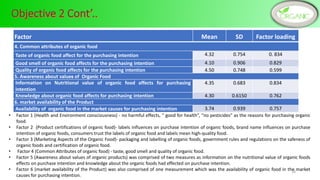
Factor Mean SD Factor loading
4. Common attributes of organic food
Taste of organic food affect for the purchasing intention 4.32 0.754 0. 834
Good smell of organic food affects for the purchasing intention 4.10 0.906 0.829
Quality of organic food affects for the purchasing intention 4.50 0.748 0.599
5. Awareness about values of Organic Food
Information on Nutritional value of organic food affects for purchasing
intention
4.35 0.683 0.834
Knowledge about organic food affects for purchasing intention 4.30 0.6150 0.762
6. market availability of the Product
Availability of organic food in the market causes for purchasing intention 3.74 0.939 0.757
• Factor 1 (Health and Environment consciousness) - no harmful effects, “ good for health”, “no pesticides” as the reasons for purchasing organic
food.
• Factor 2 (Product certifications of organic food)- labels influences on purchase intention of organic foods, brand name influences on purchase
intention of organic foods, consumers trust the labels of organic food and labels mean high-quality food.
• Factor 3 (Marketing Aspects of the Organic Food)- packaging and labelling of organic foods, government rules and regulations on the safeness of
organic foods and certification of organic food.
• Factor 4 (Common Attributes of organic food) - taste, good smell and quality of organic food.
• Factor 5 (Awareness about values of organic products) was comprised of two measures as information on the nutritional value of organic foods
effects on purchase intention and knowledge about the organic foods had effected on purchase intention.
• Factor 6 (market availability of the Product) was also comprised of one measurement which was the availability of organic food in the market
causes for purchasing intention.
10
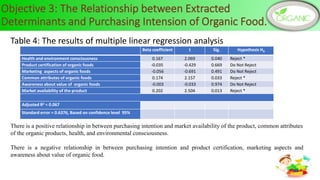
Table 4: The results of multiple linear regression analysis
Beta coefficient t Sig. Hypothesis H0
Health and environment consciousness 0.167 2.069 0.040 Reject *
Product certification of organic foods -0.035 -0.429 0.669 Do Not Reject
Marketing aspects of organic foods -0.056 -0.691 0.491 Do Not Reject
Common attributes of organic foods 0.174 2.157 0.033 Reject *
Awareness about value of organic foods -0.003 -0.033 0.974 Do Not Reject
Market availability of the product 0.202 2.504 0.013 Reject *
Adjusted R2 = 0.067
Standard error = 0.6376, Based on confidence level 95%
There is a positive relationship in between purchasing intention and market availability of the product, common attributes
of the organic products, health, and environmental consciousness.
There is a negative relationship in between purchasing intention and product certification, marketing aspects and
awareness about value of organic food.
11
• More than half of the respondents (74.3%) are female and the majority (70.8%) of the respondents are in between
31to 45 years of age category. The majority of consumers are educated up to the Advance Level (47.2 %) and 85001
– 162,000 LKR income range. Mainly six factors are influenced on the purchase intention of organic foods. Those six
factors are health and environmental consciousness, product certification, marketing aspects, common attributes,
awareness about the value of organic food and market availability of the products. There is a positive relationship
between purchase intention and market availability, common attributes and health and environmental
consciousness. The key determinant of buying organic food is the availability of the product in the market.
• Most of the consumers are aware about the value of organic foods and pay more attention about the healthiness of
food. environmental consciousness is also an important determinant. The demand for organic food can be
stimulated by increasing the awareness and accessibility for organic foods as they are major determinants of the
purchasing behaviour. This can be achieved by conducting effective product awareness programmes in trade shows,
road tours, campaigns, exhibitions, and advertising on a regular basis to introduce organic food products to the
market.
• Lack of availability of organic product at the market is one of the constraints that faced by the consumers who are
willing to buy the organic food. Small-scale production of organic food is not sufficient to fulfill the consumer
demand. If the organic products are available at the market with easy access, consumers tend to buy organic food
than other foods. Improving the marketing system is a great strength for the organic agriculture and also for all
most all the stakeholders have to participate for the development of an efficient marketing system.
12
• Policy makers need to draw special attention to improve the level of consumer
awareness and promote the health benefits of organic food
• Establish proper government certification system for organic food products to
drive the organic food market efficiently.
• Educate consumers on environmental issues caused by consuming food
containing artificial synthesized fertilizers, pesticides.
• Encourage farmers to do organic farming and provide supportive services and
new technologies. Furthermore, expanding the market conditions for easy
access for farmers to sell their products, innovation of more organic products
with quality researches.
• Marketers should work on developing strategies and designing advertising
campaigns under the theme of health and environment in urban and semi-
urban areas to expand the organic food market.
13
14

Malkanthi p

  • 1.
    S H PMalkanthi Faculty of Agricultural Sciences Sabaragamuwa University of Sri Lanka
  • 2.
    Organic foods arethe food items produced through organic agriculture and they belonged to legally regulated standards. Organic foods are grown without using conventional pesticides, artificial fertilizers or sewage sludge, and they are processed without ionizing radiation or food additives. Also, livestock are reared without routine uses of antibiotics and growth hormones. At all levels, organic food is produced without using genetically modified organisms. Marketing of organic products is growing at a fast rate both in developed and developing countries since people are more concerning about health and nutritional value especially when purchasing food product. Sri Lanka as a country with full of natural resources has a big potential to fulfill this ever-growing market demand for organic products in the world and the Sri Lankan government turned to encourage the production of organic products for the consumers who always seek organic food for consumption. 2
  • 3.
    Sri Lankans areexperiencing health issues and environmental issues when they are away from traditional food habits and traditional agricultural methods. World Health Organisation (2015) highlighted that non-communicable diseases and unhealthy foods have been caused for 38 million deaths all around the world. The government of Sri Lanka is turning towards organic agriculture and encouraging farmers to practice organic agriculture. However, the value of organic food is perceived differently by consumers. Even farmers pay attention to organic farming, it has been difficult to find out what is the market potential for the products with premium values. Thus, the main focus of this study was to identify that what determines the purchase intention of organic foods by Sri Lankan consumers. 3
  • 4.
    Broad Objective Broad objectiveof this research is to understand determinants of consumer purchasing intension of organic food in urban Sri Lanka. Specific Objectives • To evaluate the socio-demographic characteristics of the consumers of organic foods in urban areas. • To identify the determinants of purchase intention of organic foods by urban consumers. • To identify the relationship between extracted determinants and purchase intention of organic foods. 4
  • 5.
    Study Area • 6main districts in the country • Market places in – Colombo , Galle, Gampaha, Kandy, Kurunegala, Rathnapura Sample Size 600 consumers as 100 per city Data Analysing Methods Principal component analysis with varimax rotation A multiple linear regression model 144 buyersSampling Procedure 5
  • 6.
    H01 - Thereis no relationship between Health and environment consciousness towards purchase intention of the organic food H0 2- There is no relationship between Product certification of organic food towards purchase intention of the organic food. H03- There is no relationship between towards Market aspects of the organic food purchase intention of the organic food. H0 4- There is no relationship between Common attributes of organic food towards purchase intention of organic food. H0 5- There is no relationship between Awareness about the value of organic food towards purchase intention of organic food. H0 6- There is no relationship between the market availability of the product towards purchase intention of the organic food. 6
  • 7.
    Table 1: Socio-economicfactors of the respondents (n=144) Socio-economic factor Frequency Percentage % Age (years) 18-30 21 14.6 45-60 16 11.1 more than 60 05 03.5 Gender Male 37 25.7 Female 107 74.3 Marital status 125 86.5 Unmarried 09 06.4 Other 10 07.1 Family size 2-3 members 56 38.7 4-5 members 77 53.6 >5 members 11 07.7 Are there children in the family Yes 93 64.8 No 51 35.2 Educational level A/L 68 47.2 Graduate 55 38.2 Postgraduate 21 14.6 Monthly income 40001-58000 49 34.0 58001-162000 64 44.4 162000 < 31 21.5 31-40 102 70.8 Married 7
  • 8.
    Prior to factoranalysis, suitability of data was checked using Kaiser-Mayer- Olin (KMO) and Bartlett's test of sphericity. The Bartlett's test of sphericity was significant (Chi-square value 1886.493, p 0.000) showing that the inter item correlations were sufficiently large for principal component analysis (PCA). Kaiser-Meyer-Olkin Measure of Sampling Adequacy. 0.803 Bartlett's Test of Sphericity Approx. Chi-Square 1886.493 df 351 Sig. 0.000 8
  • 9.
    Table 3: Resultsof the principal component analysis Factor Mean SD Factor loading 1. Health and Environment consciousness The idea which is “No Harmful effects “become the reason of purchasing intention. 4.23 0.875 0 .805 The idea which is “Good for Health “ become the reason of purchasing intention 4.58 0.621 0.787 The idea which is “No pesticides in organic foods “ become the reason of purchasing intention 4.19 0.887 0.701 Organic agriculture gains benefit for the environment 4.53 0.678 0.636 2. Product certification of Organic Food Label influences the purchasing intention of organic food. 3.44 1.069 0.826 Brand Name influences the purchasing intention of organic food. 3.31 1.119 0.782 Consumers trust the labels of organic food 3.16 1.075 0.733 Labels mean high-quality food. 3.10 1.047 0.722 3. Marketing aspects of organic Food Packaging of organic food influence for purchasing intention 2.99 1.014 0.867 Labeling of organic food influence for purchasing intention 3.06 1.029 0.787 Government rules and regulations on the safeness of organic food influence for purchasing intention 3.30 1.104 0.720 Certification of organic food affects for purchasing intention 3.60 1.066 0.665 9
  • 10.
    Factor Mean SDFactor loading 4. Common attributes of organic food Taste of organic food affect for the purchasing intention 4.32 0.754 0. 834 Good smell of organic food affects for the purchasing intention 4.10 0.906 0.829 Quality of organic food affects for the purchasing intention 4.50 0.748 0.599 5. Awareness about values of Organic Food Information on Nutritional value of organic food affects for purchasing intention 4.35 0.683 0.834 Knowledge about organic food affects for purchasing intention 4.30 0.6150 0.762 6. market availability of the Product Availability of organic food in the market causes for purchasing intention 3.74 0.939 0.757 • Factor 1 (Health and Environment consciousness) - no harmful effects, “ good for health”, “no pesticides” as the reasons for purchasing organic food. • Factor 2 (Product certifications of organic food)- labels influences on purchase intention of organic foods, brand name influences on purchase intention of organic foods, consumers trust the labels of organic food and labels mean high-quality food. • Factor 3 (Marketing Aspects of the Organic Food)- packaging and labelling of organic foods, government rules and regulations on the safeness of organic foods and certification of organic food. • Factor 4 (Common Attributes of organic food) - taste, good smell and quality of organic food. • Factor 5 (Awareness about values of organic products) was comprised of two measures as information on the nutritional value of organic foods effects on purchase intention and knowledge about the organic foods had effected on purchase intention. • Factor 6 (market availability of the Product) was also comprised of one measurement which was the availability of organic food in the market causes for purchasing intention. 10
  • 11.
    Table 4: Theresults of multiple linear regression analysis Beta coefficient t Sig. Hypothesis H0 Health and environment consciousness 0.167 2.069 0.040 Reject * Product certification of organic foods -0.035 -0.429 0.669 Do Not Reject Marketing aspects of organic foods -0.056 -0.691 0.491 Do Not Reject Common attributes of organic foods 0.174 2.157 0.033 Reject * Awareness about value of organic foods -0.003 -0.033 0.974 Do Not Reject Market availability of the product 0.202 2.504 0.013 Reject * Adjusted R2 = 0.067 Standard error = 0.6376, Based on confidence level 95% There is a positive relationship in between purchasing intention and market availability of the product, common attributes of the organic products, health, and environmental consciousness. There is a negative relationship in between purchasing intention and product certification, marketing aspects and awareness about value of organic food. 11
  • 12.
    • More thanhalf of the respondents (74.3%) are female and the majority (70.8%) of the respondents are in between 31to 45 years of age category. The majority of consumers are educated up to the Advance Level (47.2 %) and 85001 – 162,000 LKR income range. Mainly six factors are influenced on the purchase intention of organic foods. Those six factors are health and environmental consciousness, product certification, marketing aspects, common attributes, awareness about the value of organic food and market availability of the products. There is a positive relationship between purchase intention and market availability, common attributes and health and environmental consciousness. The key determinant of buying organic food is the availability of the product in the market. • Most of the consumers are aware about the value of organic foods and pay more attention about the healthiness of food. environmental consciousness is also an important determinant. The demand for organic food can be stimulated by increasing the awareness and accessibility for organic foods as they are major determinants of the purchasing behaviour. This can be achieved by conducting effective product awareness programmes in trade shows, road tours, campaigns, exhibitions, and advertising on a regular basis to introduce organic food products to the market. • Lack of availability of organic product at the market is one of the constraints that faced by the consumers who are willing to buy the organic food. Small-scale production of organic food is not sufficient to fulfill the consumer demand. If the organic products are available at the market with easy access, consumers tend to buy organic food than other foods. Improving the marketing system is a great strength for the organic agriculture and also for all most all the stakeholders have to participate for the development of an efficient marketing system. 12
  • 13.
    • Policy makersneed to draw special attention to improve the level of consumer awareness and promote the health benefits of organic food • Establish proper government certification system for organic food products to drive the organic food market efficiently. • Educate consumers on environmental issues caused by consuming food containing artificial synthesized fertilizers, pesticides. • Encourage farmers to do organic farming and provide supportive services and new technologies. Furthermore, expanding the market conditions for easy access for farmers to sell their products, innovation of more organic products with quality researches. • Marketers should work on developing strategies and designing advertising campaigns under the theme of health and environment in urban and semi- urban areas to expand the organic food market. 13
  • 14.