ARS POETICA
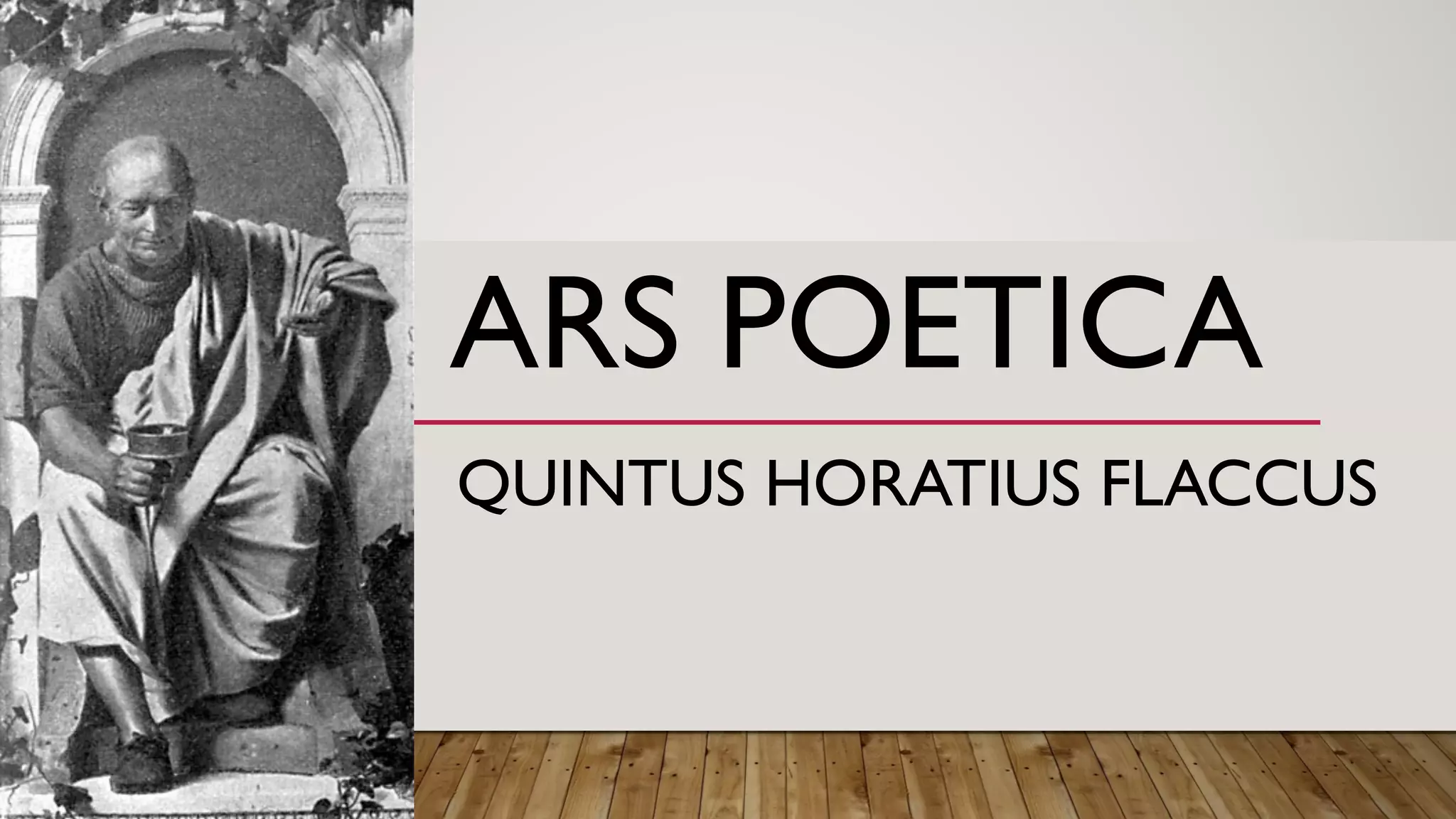
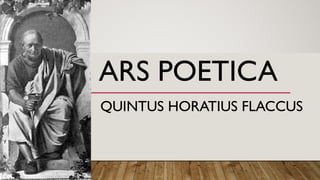
QUINTUS HORATIUS FLACCUS
Dulce et decorum est
pro patria mori
It is sweet and fitting to
die for one's country
QUINTUS HORATIUS FLACCUS
(DECEMBER 8, 65 BC – NOVEMBER 27, 8 BC)
•Horace
•leading Roman lyric poet during the time of
Augustus (also known as Octavian).
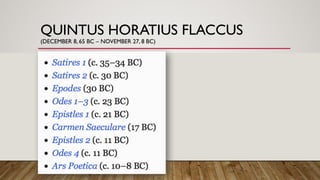
•Horace also crafted elegant hexameter verses
(Sermones and Epistles) and caustic iambic
poetry (Epodes).
QUINTUS HORATIUS FLACCUS
(DECEMBER 8, 65 BC – NOVEMBER 27, 8 BC)
QUINTUS HORATIUS FLACCUS
(DECEMBER 8, 65 BC – NOVEMBER 27, 8 BC)
QUINTUS HORATIUS FLACCUS
(DECEMBER 8, 65 BC – NOVEMBER 27, 8 BC)
QUINTUS HORATIUS FLACCUS
(DECEMBER 8, 65 BC – NOVEMBER 27, 8 BC)
ARS POETICA
QUINTUS HORATIUS FLACCUS
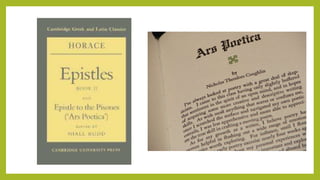
ARS POETICA
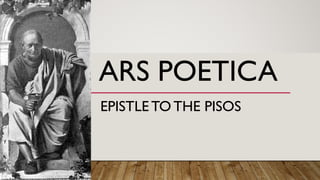
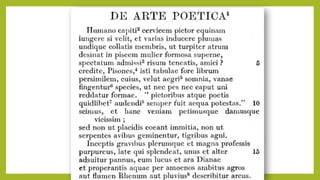
EPISTLE TO THE PISOS
GENERAL INFO ABOUT “ARS POETICA”
• Letter of advice in verse to two sons of LUCIUS
CALPURNIUS PISO (Roman Senator and Consul)
• Aimed to blend witty reminders and sage maxims in
an entertaining way: many lines of which became
“catch phrases” or proverbs
•Horace approaches poetry from a
practical standpoint.
Most important literary phrases:
•"In media res": in the middle of things.
According to Horace, this makes the audience
more hooked. Useful for the plot construction.
•"Ab ovo": From the beginning. Starting a story
from its commencement will call the attention
of the audience.
Most important literary phrases:
•"Quandoque bonus dormitat Homerus":
Sometimes, even the good poets make
mistakes.
•"Ut pictura poesis": As is painting, so is
poetry. Both could mean "imaginative
texts”.
Most important literary phrases:
•“Parturiunt montes, nascetur
ridiculus mus.”
Traditionally divided into 3 Parts:
•Lines 1 to 41 – On poesis or subect matter
•Lines 42 to 294 – On poema or technique
•Lines 295 to 476 – On poeta or the poet
1-23 – Unity and simplicity are necessary
in a poem.
24-37 – We, who would be poets, must
guard against all extremes.
38-44 – We must well consider our
powers before we write.
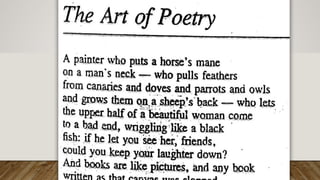
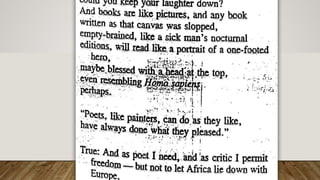
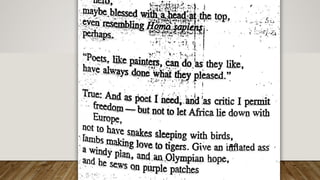
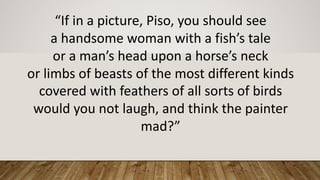
“If	in	a	picture,	Piso,	you	should	see
a	handsome	woman	with	a	fish’s	tale
or	a	man’s	head	upon	a	horse’s	neck
or	limbs	of	beasts	of	the	most	different	kinds
covered	with	feathers	of	all	sorts	of	birds
would	you	not	laugh,	and	think	the	painter	
mad?”
LITERARY MAXIMS
& CATCHPHRASES
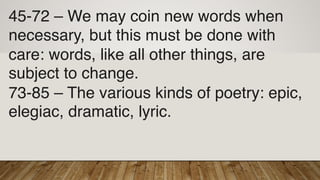
45-72 – We may coin new words when
necessary, but this must be done with
care: words, like all other things, are
subject to change.
73-85 – The various kinds of poetry: epic,
elegiac, dramatic, lyric.
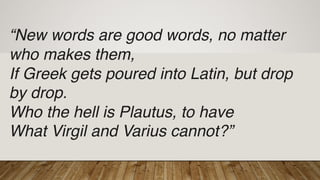
“New words are good words, no matter
who makes them,
If Greek gets poured into Latin, but drop
by drop.
Who the hell is Plautus, to have
What Virgil and Varius cannot?”
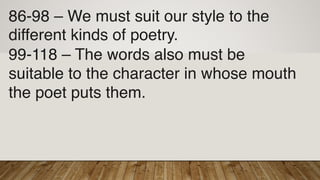
86-98 – We must suit our style to the
different kinds of poetry.
99-118 – The words also must be
suitable to the character in whose mouth
the poet puts them.
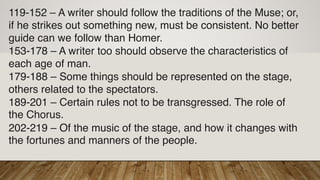
119-152 – A writer should follow the traditions of the Muse; or,
if he strikes out something new, must be consistent. No better
guide can we follow than Homer.
153-178 – A writer too should observe the characteristics of
each age of man.
179-188 – Some things should be represented on the stage,
others related to the spectators.
189-201 – Certain rules not to be transgressed. The role of
the Chorus.
202-219 – Of the music of the stage, and how it changes with
the fortunes and manners of the people.
220-250 – The Satyric drama, which accompanied the
tragedy, is not the same as comedy, and has its rules and
wholesome restraints.
251-274 – On the Iambic and Spondee. The Greek taste is to
be followed, rather than the license of the Roman poets, in
respect to meter.
275-294 – The origin of tragedy & its development. To it
succeeded the old comedy – vigorous, but scurrilous. The
Latin poets deserve some praise, but their great fault is their
careless, slovenly style.
295-308 – Genius cannot afford to dispense with the rules of
art. The critic has his place in literature.
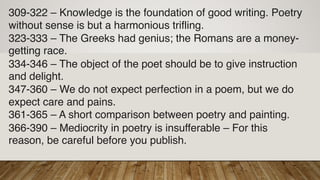
309-322 – Knowledge is the foundation of good writing. Poetry
without sense is but a harmonious trifling.
323-333 – The Greeks had genius; the Romans are a money-
getting race.
334-346 – The object of the poet should be to give instruction
and delight.
347-360 – We do not expect perfection in a poem, but we do
expect care and pains.
361-365 – A short comparison between poetry and painting.
366-390 – Mediocrity in poetry is insufferable – For this
reason, be careful before you publish.
391-407 – The origins and office of poetry in early days.
408-418 – Genius is necessary for a poet – and yet, without
art and study, genius will fail.
419-452 – Let poets avoid flatterers. Quinctilius was an
honest friend, whose mission it was to tell an author
unpleasant truths.
453-476 – A poet goes as mad as Empedocles; let all beware
of him and keep out of the way of one who will not be helped.
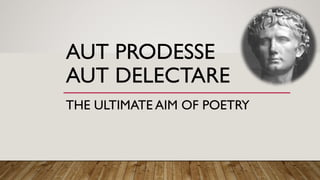
AUT PRODESSE
AUT DELECTARE
THE ULTIMATE AIM OF POETRY
Characteristics (General)
•Consistency as the highest virtue of poetry.
"A work that attempts to be one thing, now
another, is eventually being nothing at all"-
Horace
•Authors must maintain the same tone
throughout a work.
DECORUM
The Use of appropriate vocabulary and diction in
each style of writing
purple prose
PURPUREUS PANNUS
Use of flowery language inapproriately
Characteristics (General)
•Authors should not attempt subjects that
are beyond their powers.
•Each incident and word in a poem should
be chosen with care.
Drama (Characteristics)
He gives his views on drama under
three heads: Plot, Characterization,
Style
Drama (Characteristics)
•1) Plot: Borrow from familiar material in
which the author can distinguish himself. If
the poet chooses a new theme he has to
remain consistent throughout.The events
should also be consistent (Indivisible
structure).
Drama (Characteristics)
•2) Characterization: Characters must be
consistent in what they say, must preserve
their traditional traits and must fit their
ages.
Drama (Characteristics)
•3) Style: Different tones must be used for
different moods and personalities.
The middle should harmonize
with the beginning and the
end with the middle
DEUS EX MACHINA
•Horace thought the iambic meter is the
most suitable because it is the most
spoken than any other meter. In this one,
the second syllable is spoken louder so it
is audible to the audience.
•Comic themes should not be treated in a
lofty vein of tragedy and tragic themes in
the low of comedy.
•Horace takes the progress of Drama in
Greece , from the uncultivated days to
the time of great masters which were
more refined.
•The Roman drama began in 240 BC with
the plays Livius Andronicus
•No early Roman tragedies survive. From
the time of the empire the work of two
tragedians survive, one is an unknown
author while the other one is Seneca.
It	would	be	impossible	to	overestimate	the	importance	of	
Horace's	Ars Poetica for	the	subsequent	history	of	literary	
criticism.	Since	its	composition	in	the	first	century	BC,	
this	epigrammatic	and	sometimes	enigmatic	critical	
poem	has	exerted	an	almost	continual	influence	over	
poets	and	literary	critics	alike	- perhaps	because	its	dicta,	
phrased	in	verse	form,	are	so	eminently	quotable.	
Horace's	injunction	that	poetry	should	both	"instruct	and	
delight"	has	been	repeated	so	often	that	it	has	come	to	
be	known	as	the	Horatian platitude.

Report on Horace's Ars Poetica