‘Collaborative learning in ODL’
Ormond Simpson
21 November 2018
Please use the ‘Chat’ box to question and comment as we go along!
1
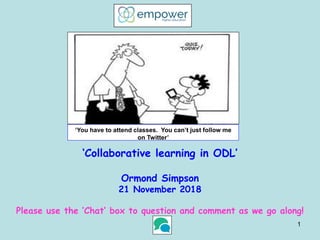
‘You have to attend classes. You can’t just follow me
on Twitter’
‘Collaborative learning in ODL’
1. Why should distance students collaborate?
2. What's the best way to help students collaborate?
3. Do students like it? – peer collaboration problems
4. Most importantly! - does it work?
5. Your questions? – comment in the chat room
1. Why should distance students collaborate?
 to improve learning?
 to develop team working skills?
 to save money on tutors?
 Something else?
If all or some of the above, should collaborative
learning be compulsory?
2. Ways to help students collaborate?
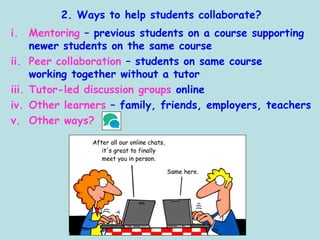
i. Mentoring – previous students on a course supporting
newer students on the same course
ii. Peer collaboration – students on same course
working together without a tutor
iii. Tutor-led discussion groups online
iv. Other learners – family, friends, employers, teachers
v. Other ways?
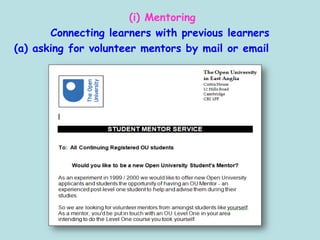
(i) Mentoring
Connecting learners with previous learners
(a) asking for volunteer mentors by mail or email
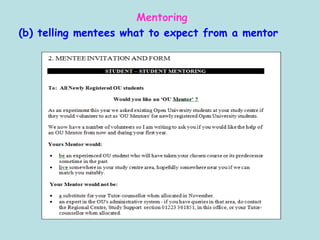
Mentoring
(b) telling mentees what to expect from a mentor
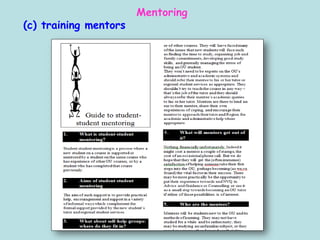
Mentoring
(c) training mentors
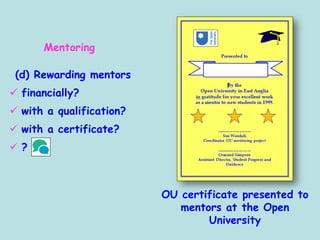
(d) Rewarding mentors
 financially?
 with a qualification?
 with a certificate?
 ?
OU certificate presented to
mentors at the Open
University
Mentoring
Mentoring
(e) does mentoring work?
International study of mentoring (UK, New Zealand and S. Korea)
Increases in retention 35% over a non-mentored control group
Cost benefit ratio of >200%
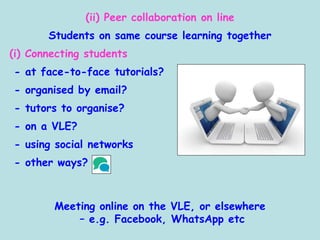
(ii) Peer collaboration on line
Students on same course learning together
(i) Connecting students
- at face-to-face tutorials?
- organised by email?
- tutors to organise?
- on a VLE?
- using social networks
- other ways?
Meeting online on the VLE, or elsewhere
– e.g. Facebook, WhatsApp etc
11
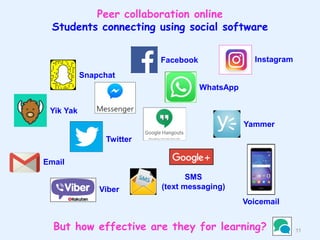
Facebook
Yammer
WhatsApp
Snapchat
Yik Yak
Twitter
Email
Viber
SMS
(text messaging)
Peer collaboration online
Students connecting using social software
Voicemail
But how effective are they for learning?
Instagram
12
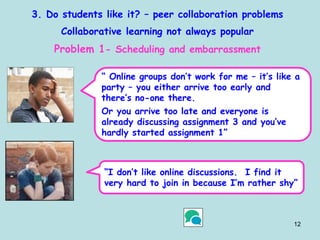
3. Do students like it? – peer collaboration problems
Collaborative learning not always popular
Problem 1- Scheduling and embarrassment
“ Online groups don’t work for me – it’s like a
party – you either arrive too early and
there’s no-one there.
Or you arrive too late and everyone is
already discussing assignment 3 and you’ve
hardly started assignment 1”
“I don’t like online discussions. I find it
very hard to join in because I’m rather shy”
13
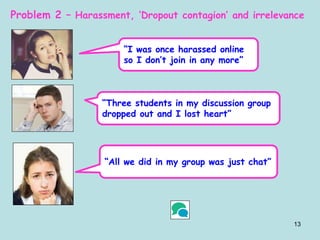
Problem 2 – Harassment, ‘Dropout contagion’ and irrelevance
“I was once harassed online
so I don’t join in any more”
“Three students in my discussion group
dropped out and I lost heart”
“All we did in my group was just chat”
Peer collaboration problems
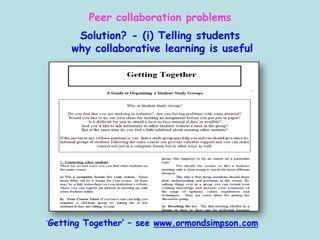
Solution? - (i) Telling students
why collaborative learning is useful
‘Getting Together’ – see www.ormondsimpson.com
15
Peer collaboration problems
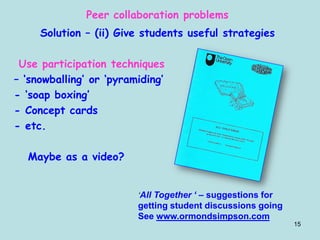
Solution – (ii) Give students useful strategies
Use participation techniques
– ‘snowballing’ or ‘pyramiding’
- ‘soap boxing’
- Concept cards
- etc.
Maybe as a video?
‘All Together ‘ – suggestions for
getting student discussions going
See www.ormondsimpson.com
Peer collaboration problems
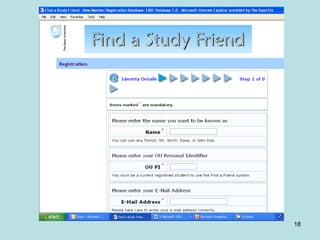
Solution? - (iii) ‘Study Dating’
Give students control over who they collaborate with
1717
17
18
19
Would this work?
20
Peer collaboration problems
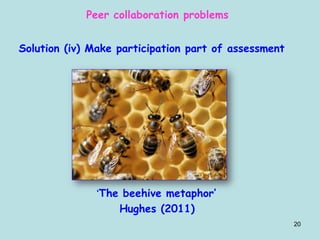
Solution (iv) Make participation part of assessment
‘The beehive metaphor’
Hughes (2011)
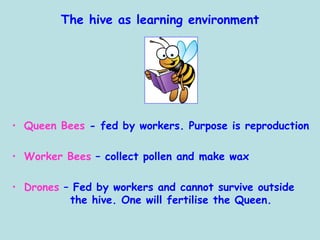
The hive as learning environment
• Queen Bees - fed by workers. Purpose is reproduction
• Worker Bees – collect pollen and make wax
• Drones – Fed by workers and cannot survive outside
the hive. One will fertilise the Queen.
The hive as learning environment
• Queens - leaders of an online discussion who produce
a product or joint assignment
• Workers – gather and contribute knowledge to the
discussion
• Drones – largely absent from the discussion although
occasionally provide a new idea often late in the day
Is this fair?
Hughes, G. (2011) ‘Queen bees, workers and drones: gender
performance in virtual learning groups’
In Kirkup (Ed) Gender issues in learning and working with IT
To modify the hive behaviour?
• Compulsory contribution - all are workers or
queens
• But students may have good reasons not to
participate: busy lives, illness, feel excluded by
others, arrived late to the discussion, do not know
what is going on etc.
“There was a ‘sell by date’ to the
contributions …
As much as I appreciated I could go to
the discussion board at any time, it
appeared late entrants rarely got any
feedback…”
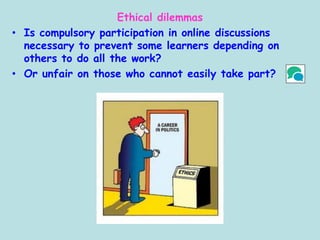
Ethical dilemmas
• Is compulsory participation in online discussions
necessary to prevent some learners depending on
others to do all the work?
• Or unfair on those who cannot easily take part?
‘Collaborative learning in ODL’
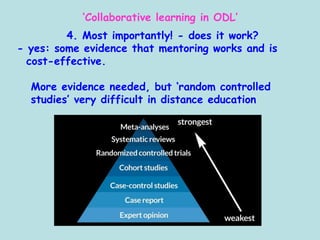
4. Most importantly! - does it work?
- yes: some evidence that mentoring works and is
cost-effective.
More evidence needed, but ‘random controlled
studies’ very difficult in distance education
‘Collaborative learning in ODL’
1. Why should distance students collaborate?
2. What's the best way to help students collaborate?
3. Do students like it? – peer collaboration problems
4. Most importantly! - does it work?
5. Your questions? – comment in the chat room
Comments, criticisms and discussion
always very welcome!
Email: ormond.simpson@gmail.com
Website Supporting Students for Success
www.ormondsimpson.com

Collaborative Learning in ODL

  • 1.
    ‘Collaborative learning inODL’ Ormond Simpson 21 November 2018 Please use the ‘Chat’ box to question and comment as we go along! 1 ‘You have to attend classes. You can’t just follow me on Twitter’
  • 2.
    ‘Collaborative learning inODL’ 1. Why should distance students collaborate? 2. What's the best way to help students collaborate? 3. Do students like it? – peer collaboration problems 4. Most importantly! - does it work? 5. Your questions? – comment in the chat room
  • 3.
    1. Why shoulddistance students collaborate?  to improve learning?  to develop team working skills?  to save money on tutors?  Something else? If all or some of the above, should collaborative learning be compulsory?
  • 4.
    2. Ways tohelp students collaborate? i. Mentoring – previous students on a course supporting newer students on the same course ii. Peer collaboration – students on same course working together without a tutor iii. Tutor-led discussion groups online iv. Other learners – family, friends, employers, teachers v. Other ways?
  • 5.
    (i) Mentoring Connecting learnerswith previous learners (a) asking for volunteer mentors by mail or email
  • 6.
    Mentoring (b) telling menteeswhat to expect from a mentor
  • 7.
  • 8.
    (d) Rewarding mentors financially?  with a qualification?  with a certificate?  ? OU certificate presented to mentors at the Open University Mentoring
  • 9.
    Mentoring (e) does mentoringwork? International study of mentoring (UK, New Zealand and S. Korea) Increases in retention 35% over a non-mentored control group Cost benefit ratio of >200%
  • 10.
    (ii) Peer collaborationon line Students on same course learning together (i) Connecting students - at face-to-face tutorials? - organised by email? - tutors to organise? - on a VLE? - using social networks - other ways? Meeting online on the VLE, or elsewhere – e.g. Facebook, WhatsApp etc
  • 11.
    11 Facebook Yammer WhatsApp Snapchat Yik Yak Twitter Email Viber SMS (text messaging) Peercollaboration online Students connecting using social software Voicemail But how effective are they for learning? Instagram
  • 12.
    12 3. Do studentslike it? – peer collaboration problems Collaborative learning not always popular Problem 1- Scheduling and embarrassment “ Online groups don’t work for me – it’s like a party – you either arrive too early and there’s no-one there. Or you arrive too late and everyone is already discussing assignment 3 and you’ve hardly started assignment 1” “I don’t like online discussions. I find it very hard to join in because I’m rather shy”
  • 13.
    13 Problem 2 –Harassment, ‘Dropout contagion’ and irrelevance “I was once harassed online so I don’t join in any more” “Three students in my discussion group dropped out and I lost heart” “All we did in my group was just chat”
  • 14.
    Peer collaboration problems Solution?- (i) Telling students why collaborative learning is useful ‘Getting Together’ – see www.ormondsimpson.com
  • 15.
    15 Peer collaboration problems Solution– (ii) Give students useful strategies Use participation techniques – ‘snowballing’ or ‘pyramiding’ - ‘soap boxing’ - Concept cards - etc. Maybe as a video? ‘All Together ‘ – suggestions for getting student discussions going See www.ormondsimpson.com
  • 16.
    Peer collaboration problems Solution?- (iii) ‘Study Dating’ Give students control over who they collaborate with
  • 17.
  • 18.
  • 19.
  • 20.
    20 Peer collaboration problems Solution(iv) Make participation part of assessment ‘The beehive metaphor’ Hughes (2011)
  • 21.
    The hive aslearning environment • Queen Bees - fed by workers. Purpose is reproduction • Worker Bees – collect pollen and make wax • Drones – Fed by workers and cannot survive outside the hive. One will fertilise the Queen.
  • 22.
    The hive aslearning environment • Queens - leaders of an online discussion who produce a product or joint assignment • Workers – gather and contribute knowledge to the discussion • Drones – largely absent from the discussion although occasionally provide a new idea often late in the day Is this fair? Hughes, G. (2011) ‘Queen bees, workers and drones: gender performance in virtual learning groups’ In Kirkup (Ed) Gender issues in learning and working with IT
  • 23.
    To modify thehive behaviour? • Compulsory contribution - all are workers or queens • But students may have good reasons not to participate: busy lives, illness, feel excluded by others, arrived late to the discussion, do not know what is going on etc.
  • 24.
    “There was a‘sell by date’ to the contributions … As much as I appreciated I could go to the discussion board at any time, it appeared late entrants rarely got any feedback…”
  • 25.
    Ethical dilemmas • Iscompulsory participation in online discussions necessary to prevent some learners depending on others to do all the work? • Or unfair on those who cannot easily take part?
  • 26.
    ‘Collaborative learning inODL’ 4. Most importantly! - does it work? - yes: some evidence that mentoring works and is cost-effective. More evidence needed, but ‘random controlled studies’ very difficult in distance education
  • 27.
    ‘Collaborative learning inODL’ 1. Why should distance students collaborate? 2. What's the best way to help students collaborate? 3. Do students like it? – peer collaboration problems 4. Most importantly! - does it work? 5. Your questions? – comment in the chat room
  • 28.
    Comments, criticisms anddiscussion always very welcome! Email: ormond.simpson@gmail.com Website Supporting Students for Success www.ormondsimpson.com