Presented By: Cynthia V. Anderson M.A. ~ Caitlin Crossman B.S. 
EDTC 5840 Designing an Online Curriculum 
Group 4 - Elements of Online 
Curriculum & Programs: 
What Can Go Wrong 
In A Government Setting
Your Face-to Face 
Facility & Manual 
Moving To An Online 
Environment 
Can Be Problematic 
Instructor Readiness 
Static Online Curriculum 
Copyright © 2014 Anderson & Crossman 
2
~Stay Calm~ 
Addressing The Problem of Instructor 
Readiness/ Static Online Curriculum 
Overview of Presentation 
• Presenter Credentials & Message 
• Stay Calm ~ Teacher Hesitancy in Embracing Online 
Learning Presenter: Caitlin Crossman 
• Stay Calm ~ Transforming your current static curriculum 
to interactive experiences. It’s easier than you think! 
Presenter: Cynthia V. Anderson 
• Works Cited 
3 
Copyright © 2014 Anderson & Crossman
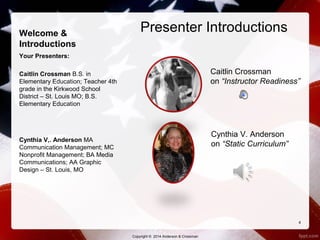
Welcome & 
Introductions 
Your Presenters: 
Caitlin Crossman B.S. in 
Elementary Education; Teacher 4th 
grade in the Kirkwood School 
District – St. Louis MO; B.S. 
Elementary Education 
Cynthia V,. Anderson MA 
Communication Management; MC 
Nonprofit Management; BA Media 
Communications; AA Graphic 
Design – St. Louis, MO 
Presenter Introductions 
Caitlin Crossman 
on “Instructor Readiness” 
Cynthia V. Anderson 
on “Static Curriculum” 
4 
Copyright © 2014 Anderson & Crossman
Switching Focus On Web-based Interactions From Face-to-face 
Can Be Problematic. 
What Can Go Wrong: A Hesitant Instructor 
Factors of Success in ANY Learning Environment 
Human factors 
• Instructor’s knowledge of 
course materials 
• Instructor’s prompt 
communication with students 
• Instructor’s constructive 
feedback on student work 
• Instructor’s timely feedback on 
student work 
Design factors 
•Course content based on 
learning outcomes 
•Useful learning materials 
•Clear guidelines and rubrics 
•Assignment examples 
9 
Copyright © 2014 Anderson & Crossman
Switching Focus On Web-based Interactions From Face-to-face 
Can Be Problematic. 
What Can Go Wrong: A Hesitant Instructor 
Factors of Success in an Online Learning Environment 
Technical factors 
• Online distribution of materials 
• Useful multimedia 
• Discussion board feature 
• Timely technical 
assistance/support 
• User-friendly course delivery 
system 
6 
Copyright © 2014 Anderson & Crossman
Switching Focus On Web-based Interactions From Face-to-face 
Can Be Problematic. 
Solution: Follow Current Best Practices and Tackle 
New Practices in Steps 
Embracing the Technical Aspects- Step 1: Assessing 
Available Technologies 
• Seek out training 
• Consider functionality 
• Consider accessibility 
• Determine the Level of 
Lowest Common 
Technology 
Copyright © 2014 Anderson & Crossman 
7
Switching Focus On Web-based Interactions From Face-to-face 
Can Be Problematic. 
Solution: Follow Current Best Practices and Tackle 
New Practices in Steps 
Embracing the Technical Aspects- Step 2: Determine 
Learning Outcomes 
• Develop rubrics 
• Collect past student 
submissions for exemplars 
• Consider transforming old 
class content 
8 
Copyright © 2014 Anderson & Crossman
Switching Focus On Web-based Interactions From 
Face-to-face Can Be Problematic. 
What Can Go Wrong: A Static Online Curriculum 
Solution: Interactivity 
• Has a major impact on the 
quality of online distance 
learning programs 
(Muirhead, 2001) 
• The Most Difficult Aspect = 
Building In Interaction 
• The Most Important Aspect 
= Building In Interaction 
 Builds a sense of 
community 
 Exposes students to a 
variety of learning resources 
 Students are more actively 
engaged in the learning 
process (Brown, 2001). 
9 
Copyright © 2014 Anderson & Crossman
Stay Calm ~ Transforming your Static Curriculum to 
Interactive Experiences. It’s easier than you think! 
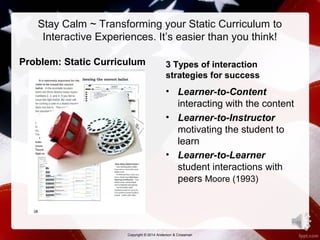
Problem: Static Curriculum 3 Types of interaction 
strategies for success 
• Learner-to-Content 
interacting with the content 
• Learner-to-Instructor 
motivating the student to 
learn 
• Learner-to-Learner 
student interactions with 
peers Moore (1993) 
10 
Copyright © 2014 Anderson & Crossman
Learner - Content Interaction 
Intellectually Interacting 
With Content = 
Changes in the learner 
mind (Worcester Polytechnic Institute) 
•Understandings 
•Perspectives 
•Cognitive Structure 
Benefit To The Student 
•1 format does not meet 
all learning styles 
•A variety of formats 
eliminates monotony 
11 
Copyright © 2014 Anderson & Crossman
Learner - Content Interaction 
Intellectually Interacting 
With Content = 
Changes in the learner 
mind 
•Understandings 
•Perspectives 
•Cognitive Structure 
Provide Resource Links 
to online resources 
Benefit To The Student 
Allows students to explore 
the topic in more depth 
12 
Copyright © 2014 Anderson & Crossman
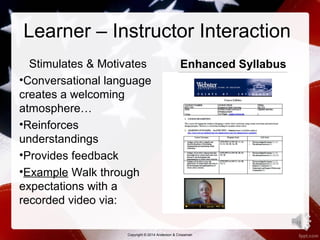
Learner – Instructor Interaction 
Stimulates & Motivates 
Enhanced Syllabus 
•Conversational language 
creates a welcoming 
atmosphere… 
•Reinforces 
understandings 
•Provides feedback 
•Example Walk through 
expectations with a 
recorded video via: 
13 
Copyright © 2014 Anderson & Crossman
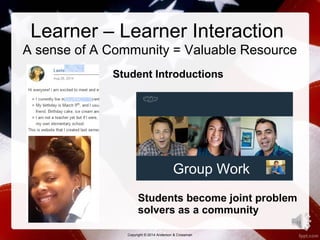
Learner – Learner Interaction 
A sense of A Community = Valuable Resource 
Student Introductions 
Group Work 
Students become joint problem 
solvers as a community 
14 
Copyright © 2014 Anderson & Crossman
Our Hope, is that through our joint efforts 
we have presented information that will 
lead to student: 
Satisfaction 
Retention 
 Increased Learning 
~ A quote from Dr. Michael Simonson ~ 
15 
Thank You! 
Copyright © 2014 Anderson & Crossman
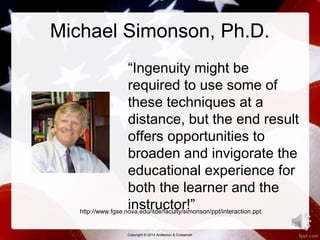
Michael Simonson, Ph.D. 
“Ingenuity might be 
required to use some of 
these techniques at a 
distance, but the end result 
offers opportunities to 
broaden and invigorate the 
educational experience for 
both the learner and the 
instructor!” 
Copyright © 2014 Anderson & Crossman 
16 
http://www.fgse.nova.edu/itde/faculty/simonson/ppt/interaction.ppt
Works Cited 
Baghdadi, Ziad D. (2011). Best practices in online education: Online instructors, courses, and administrators. Turksih 
Online Journal of Distance Education, 12, 109-117. 
Brown, R. E. (2001, September). The process of community-building in distance learning courses. Journal of 
Asynchronous Learning Networks, 5(2). Retrieved October, 2014. 
Lee, Joohi. (2014). An exploratory study of effective online learning: Assessing satisfaction levels of graduate students 
of mathematics education associated with human and design factors of an online course. International Review of 
Research in Open and Distance Learning, 15, 111-132. 
Moore, M. G. (1993). Three types of interaction. In K. Harry, M. John & D. Keegan (Eds.), Distance education: New 
perspectives (pp. 12-24). London: Routlege. 
Muirhead, B. (2001). Interactivity research studies. Educational Technology & Society, 4(3). Retrieved June 20, 2005. 
Simonson, M. (2012). Teaching and learning at a distance: Foundations of distance education. Boston: Pearson 
Education, Inc 
Worcester Polytechnic Institute. (n.d.). Incorporating Interaction Into Your Distance Learning Course. Retrieved 
October 2014, from Academic Technology Center: 
http://www.wpi.edu/Academics/ATC/Collaboratory/Teaching/interaction.html 
17 
Copyright © 2014 Anderson & Crossman
Image Credits 
http://amhistory.si.edu/polio/images/http://pmg-sb. 
halfoffdeals.com/im 
ages/secondary/13341 
5.jpg 
Copyright © 2014 Anderson & Crossman 
18 
http://www.pinterest.com/ 
pin/17634414163192322 
0/ 
http://www.iconarchiv 
e.com/show/mega-pack- 
2-icons-by-ncrow/ 
Format- 
Factory-icon.html 
Complements 
of CVA 
https://worldclassroom.webst 
er.edu/courses/1183154/pag 
es/introductory-video-what-to- 
expect? 
module_item_id=10115209 
& photo complements of cva 
(http://blogs.skype.com/2 
014/04/28/skype-loves-bringing- 
groups-together-with- 
free-group-video-calling 
Permission 
granted for 
presentation use 
http://www.nova.edu/~simsmi 
ch/index.htm
Presenters: Cynthia Anderson & Jessica Crossman 
EDTC 5840 Designing an Online Curriculum 
Thank You & Well Wishes 
from Group 4!

Final group 4 government edtc 5840

  • 1.
    Presented By: CynthiaV. Anderson M.A. ~ Caitlin Crossman B.S. EDTC 5840 Designing an Online Curriculum Group 4 - Elements of Online Curriculum & Programs: What Can Go Wrong In A Government Setting
  • 2.
    Your Face-to Face Facility & Manual Moving To An Online Environment Can Be Problematic Instructor Readiness Static Online Curriculum Copyright © 2014 Anderson & Crossman 2
  • 3.
    ~Stay Calm~ AddressingThe Problem of Instructor Readiness/ Static Online Curriculum Overview of Presentation • Presenter Credentials & Message • Stay Calm ~ Teacher Hesitancy in Embracing Online Learning Presenter: Caitlin Crossman • Stay Calm ~ Transforming your current static curriculum to interactive experiences. It’s easier than you think! Presenter: Cynthia V. Anderson • Works Cited 3 Copyright © 2014 Anderson & Crossman
  • 4.
    Welcome & Introductions Your Presenters: Caitlin Crossman B.S. in Elementary Education; Teacher 4th grade in the Kirkwood School District – St. Louis MO; B.S. Elementary Education Cynthia V,. Anderson MA Communication Management; MC Nonprofit Management; BA Media Communications; AA Graphic Design – St. Louis, MO Presenter Introductions Caitlin Crossman on “Instructor Readiness” Cynthia V. Anderson on “Static Curriculum” 4 Copyright © 2014 Anderson & Crossman
  • 5.
    Switching Focus OnWeb-based Interactions From Face-to-face Can Be Problematic. What Can Go Wrong: A Hesitant Instructor Factors of Success in ANY Learning Environment Human factors • Instructor’s knowledge of course materials • Instructor’s prompt communication with students • Instructor’s constructive feedback on student work • Instructor’s timely feedback on student work Design factors •Course content based on learning outcomes •Useful learning materials •Clear guidelines and rubrics •Assignment examples 9 Copyright © 2014 Anderson & Crossman
  • 6.
    Switching Focus OnWeb-based Interactions From Face-to-face Can Be Problematic. What Can Go Wrong: A Hesitant Instructor Factors of Success in an Online Learning Environment Technical factors • Online distribution of materials • Useful multimedia • Discussion board feature • Timely technical assistance/support • User-friendly course delivery system 6 Copyright © 2014 Anderson & Crossman
  • 7.
    Switching Focus OnWeb-based Interactions From Face-to-face Can Be Problematic. Solution: Follow Current Best Practices and Tackle New Practices in Steps Embracing the Technical Aspects- Step 1: Assessing Available Technologies • Seek out training • Consider functionality • Consider accessibility • Determine the Level of Lowest Common Technology Copyright © 2014 Anderson & Crossman 7
  • 8.
    Switching Focus OnWeb-based Interactions From Face-to-face Can Be Problematic. Solution: Follow Current Best Practices and Tackle New Practices in Steps Embracing the Technical Aspects- Step 2: Determine Learning Outcomes • Develop rubrics • Collect past student submissions for exemplars • Consider transforming old class content 8 Copyright © 2014 Anderson & Crossman
  • 9.
    Switching Focus OnWeb-based Interactions From Face-to-face Can Be Problematic. What Can Go Wrong: A Static Online Curriculum Solution: Interactivity • Has a major impact on the quality of online distance learning programs (Muirhead, 2001) • The Most Difficult Aspect = Building In Interaction • The Most Important Aspect = Building In Interaction  Builds a sense of community  Exposes students to a variety of learning resources  Students are more actively engaged in the learning process (Brown, 2001). 9 Copyright © 2014 Anderson & Crossman
  • 10.
    Stay Calm ~Transforming your Static Curriculum to Interactive Experiences. It’s easier than you think! Problem: Static Curriculum 3 Types of interaction strategies for success • Learner-to-Content interacting with the content • Learner-to-Instructor motivating the student to learn • Learner-to-Learner student interactions with peers Moore (1993) 10 Copyright © 2014 Anderson & Crossman
  • 11.
    Learner - ContentInteraction Intellectually Interacting With Content = Changes in the learner mind (Worcester Polytechnic Institute) •Understandings •Perspectives •Cognitive Structure Benefit To The Student •1 format does not meet all learning styles •A variety of formats eliminates monotony 11 Copyright © 2014 Anderson & Crossman
  • 12.
    Learner - ContentInteraction Intellectually Interacting With Content = Changes in the learner mind •Understandings •Perspectives •Cognitive Structure Provide Resource Links to online resources Benefit To The Student Allows students to explore the topic in more depth 12 Copyright © 2014 Anderson & Crossman
  • 13.
    Learner – InstructorInteraction Stimulates & Motivates Enhanced Syllabus •Conversational language creates a welcoming atmosphere… •Reinforces understandings •Provides feedback •Example Walk through expectations with a recorded video via: 13 Copyright © 2014 Anderson & Crossman
  • 14.
    Learner – LearnerInteraction A sense of A Community = Valuable Resource Student Introductions Group Work Students become joint problem solvers as a community 14 Copyright © 2014 Anderson & Crossman
  • 15.
    Our Hope, isthat through our joint efforts we have presented information that will lead to student: Satisfaction Retention  Increased Learning ~ A quote from Dr. Michael Simonson ~ 15 Thank You! Copyright © 2014 Anderson & Crossman
  • 16.
    Michael Simonson, Ph.D. “Ingenuity might be required to use some of these techniques at a distance, but the end result offers opportunities to broaden and invigorate the educational experience for both the learner and the instructor!” Copyright © 2014 Anderson & Crossman 16 http://www.fgse.nova.edu/itde/faculty/simonson/ppt/interaction.ppt
  • 17.
    Works Cited Baghdadi,Ziad D. (2011). Best practices in online education: Online instructors, courses, and administrators. Turksih Online Journal of Distance Education, 12, 109-117. Brown, R. E. (2001, September). The process of community-building in distance learning courses. Journal of Asynchronous Learning Networks, 5(2). Retrieved October, 2014. Lee, Joohi. (2014). An exploratory study of effective online learning: Assessing satisfaction levels of graduate students of mathematics education associated with human and design factors of an online course. International Review of Research in Open and Distance Learning, 15, 111-132. Moore, M. G. (1993). Three types of interaction. In K. Harry, M. John & D. Keegan (Eds.), Distance education: New perspectives (pp. 12-24). London: Routlege. Muirhead, B. (2001). Interactivity research studies. Educational Technology & Society, 4(3). Retrieved June 20, 2005. Simonson, M. (2012). Teaching and learning at a distance: Foundations of distance education. Boston: Pearson Education, Inc Worcester Polytechnic Institute. (n.d.). Incorporating Interaction Into Your Distance Learning Course. Retrieved October 2014, from Academic Technology Center: http://www.wpi.edu/Academics/ATC/Collaboratory/Teaching/interaction.html 17 Copyright © 2014 Anderson & Crossman
  • 18.
    Image Credits http://amhistory.si.edu/polio/images/http://pmg-sb. halfoffdeals.com/im ages/secondary/13341 5.jpg Copyright © 2014 Anderson & Crossman 18 http://www.pinterest.com/ pin/17634414163192322 0/ http://www.iconarchiv e.com/show/mega-pack- 2-icons-by-ncrow/ Format- Factory-icon.html Complements of CVA https://worldclassroom.webst er.edu/courses/1183154/pag es/introductory-video-what-to- expect? module_item_id=10115209 & photo complements of cva (http://blogs.skype.com/2 014/04/28/skype-loves-bringing- groups-together-with- free-group-video-calling Permission granted for presentation use http://www.nova.edu/~simsmi ch/index.htm
  • 19.
    Presenters: Cynthia Anderson& Jessica Crossman EDTC 5840 Designing an Online Curriculum Thank You & Well Wishes from Group 4!

Editor's Notes

  • #2 Hello & Welcome to our presentation of Elements of Online Curriculum & programs… What Can Go Wrong This Presentation is designed to help your Government educational departments transition with the help of 2 Professionals! A group project for Webster University’s EDTC 5840 Designing an online Curriculum coursework. Click
  • #3 CLICK You have been informed that your face-to-face training site CLICK and Training Manual CLICK is moving to an online learning environment. CLICK This can be very problematic CLICK when it comes to Instructor CLICK Readiness & winding up with static curriculum. Let’s take a look at how we will be covering these problems with solutions!
  • #5 SCRIPT: I’m Cynthia V. Anderson, with a masters in Communication Management, I will be guiding you through transforming your static Curriculum to interactive experiences. Lets Get Started With Caitlin’s Presentation!
  • #6 .
  • #10 Script: What can go Wrong? – A Static Online Curriculum. – The Solution is adding interactivity!“ CLICK According to Muirhead, “Interaction has a major impact on the quality of online learning CLICK is one of the most difficult aspects of education to build into an online class, CLICK but it is also one of the most important.” According to (Brown, 2001). CLICK Interaction builds a sense of community among the students, CLICK Interaction exposes students to a variety of learning resources, including content materials and experiences shared by other students. CLICK Interaction makes students become more actively engaged in the learning process, leading to higher levels of learning. CLICK
  • #11 Cynthia’s Script Your Problem: A Static Curriculum – Boring & Monotonous This problem CLICK is what I CLICK call, THE VIEW MASTER EXPERIENCE. Click Moore (1993) identified three types of interaction inherent in effective online courses: CLICK * Read & Click Research studies on interactivity show that students have a real need to make connections with other students and with their instructors. Lets get started implementing strategies for each interaction category in your online distance learning course. Click (1993). Three types of interaction. In K. Harry, M. John, & D. Keegan (Eds.), Distance education theory (pp. 19–24). New York: Routledge. Moore, M. G. (1991). Distance education theory [Electronic Version]. The American Journal of Distance Education, 5(3). Moore, M. G. (1993). Three types of interaction. In K. Harry, M. John & D. Keegan (Eds.), Distance education: New perspectives (pp. 12-24). London: Routlege.    
  • #12 My Script: Learner- Learner interaction results from students examining the course content and participating in class activities. According to the Worchster Poly-Tek-Nic Institute, Learner-content interaction is the process of intellectually interacting with the content resulting in Changes In the Learners Mind. These changes CLICK include understanding, CLICK perspectives, and CLICK cognitive structures of a learner’s mind.” As your student actively progresses through your curriculum one must Avoid 1 Type of Format Content CLICK (don’t read benefit) Click Content that is presented primarily in one format, requires many students to learn in a format that does not meet their learning style. CLICK Provide a mixture of delivery formats to meet multiple learning styles, such as combining text lectures with video clips. Delivering content in multiple formats provides variety and eliminates monotony. CLICK
  • #13 My Script: One Example of learner- Content Interaction CLICK Is to Provide Resource Links to Online Resources CLICK – CLICK As your student progresses through the course, Resource Links CLICK Allows the Students to Explore the Topic more in Depth!
  • #14 My Script: “Learner-instructor interaction is highly desirable as the instructor seeks to stimulate, or at least maintain, student interest in what is to be taught and to motivate the student to learn.” CLICK By Using Conversational language, You are creating welcoming atmosphere. This type of interaction is CLICK intended to reinforce student understanding of course materials CLICK and provide the student with feedback. CLICK An example of this type interaction is to WALK the Students Through your Syllabus with a Recorded Video . CLICK An Accompanying video with your syllabus is a tool that builds a relationship between you as the instructor and the student while explaining expectations found in a Syllabus. CLICK
  • #15 My Script: “Learner-learner interaction is an extremely valuable resource for learning, and Moore (1993) emphasized the importance of students’ interaction with their peers in his work. It Builds a strong sence of Community between the students Which proves them with a valuable resource- EACH Other! CLICK One Example is Student Introductions. CLICK Like This One! Developing a participant introduction for their online course, This interaction will help students find others with similar backgrounds and interests and leads to the building of a sense of community in the course. A second example of Student – Student interaction between two students or between several students is through CLICK Group work. … CLICK Students become Joint Problem Solvers as a community. Image Credit: Permission granted by Student Laela Weems, Webster University Student. 2014. Example: A “Group Project” Benefit to student: They become joint problem solvers as a community THANK YOU: leads to student satisfaction, retention, and increased learning
  • #16 Both Catlin & I Would like to thank you 4 your attention READ We will leave you with a QUOTE from Dr. Michael SIMINSON CLICK
  • #17 Dr. Michael Simonson puts it this way, ‘Ingenuity might be required to use some of these techniques at a distance, but the end result offers opportunities to broaden and invigorate the educational experience for both the learner and the instructor!’” http://www.fgse.nova.edu/itde/faculty/simonson/ppt/interaction.ppt