Harvard Business Case Study
History
● In 1806, William Colgate established starch, soap, and candle factory under the name
“William Colgate & Company”
● IN 1873, the firm introduced its first aromatic colgate toothpaste sold in jars
● In 1928, Palmolive-Peet bought the Colgate company to create
Colgate-Palmolive-Peet however Peet was later dropped from the title
● CP is now an American company focused on
○ Production
○ Distribution
○ Provision
Of household, healthcare and personal care products
Colgate-Palmolive in 1991
● With an annual sale of $6.06 billion and gross profit o $2.76 million CP was a global
leader in household and personal care products
● Company’s five year plan for 1991-1995 focused on new product launched and
geographical expansion along with improved efficiencies
● In August 1992, CP was poised to launch new toothbrush in the US tentatively
named, Colgate Precision
US Toothbrush Market
● Until late 1970s, consumers viewed toothbrushes as a commodity
● New product launches added product performance as purchasing criteria
● U.S. Oral Care market was $ 2.9 billion in retail sales in 1991
● Dollar sales of toothbrush had increased by 21% due to 47 new product launches
● The trade responded to new product launch by increasing in-store promotional
support and advertising features
● Introduction of new product segment : Super-Premium
Product Segments
Value Professional Super-Premium
Price $ 1.29 $ 1.59 - $ 2.09 < $ 2
Volume Share 24% 41% 35%
Dollar Sales
Share
12% 42% 46%
Brand Product
Placement
Colgate-Palmolive
Johnsons & Johnsons
Oral-B,
Procter & Gamble
Smithkline Beecham
Consumer Behaviour
● Consumers made brand choice is based on features, comfort and professional
recommendation
● Consumers born between 1940s-1960s were concerned about their gums as opposed
to cavity prevention
● Willingness to pay more for new products addressing gum issues
● Consumers agreed that toothbrushes were as important as toothpastes to effective oral
hygiene
Therapeutic Brushers
Aim to avoid oral care
problems
Cosmetic Brushers
Emphasize preventing
bad breath
Uninvolved Brushers
Adjust behavior when
confronted by oral
hygiene problems
Competition
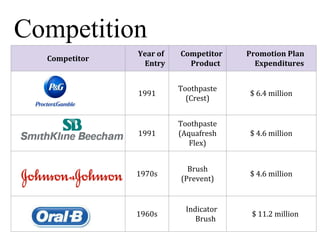
Competitor
Year of
Entry
Competitor
Product
Promotion Plan
Expenditures
1991
Toothpaste
(Crest)
$ 6.4 million
1991
Toothpaste
(Aquafresh
Flex)
$ 4.6 million
1970s
Brush
(Prevent)
$ 4.6 million
1960s
Indicator
Brush
$ 11.2 million
Advertising & Promotions
● CP toothbrush line held 25% - 40% of the category shelf space in
stores
● Colgate toothbrush combined with colgate toothpaste increased the
toothbrush sales by 170%
● Growing competition increased the frequency & value of consumer
promotion events
● Toothbrush display increased sales by 90% over normal shelf facing
● To maximize retail sale, salespeople located Colgate line in middle
of shelf space between Reach and Oral-B products
● Growing competition increased the frequency & value of consumer
promotion events
Distribution
● By 1992, oral care products consisted of 43% toothbrush and 47% of the toothpaste
sales
● Mass merchandisers gained share due to in-store promotional support
● Toothbrushes provided retailers with an average margin twice that of toothpastes
Product Design & Testing
● CP aimed to develop a superior, technical and plaque-removing device
● Product usage methods by customer were studied
● Product was designed to offer maximum plaque-removal efficacy
● Tested different designs for between-tooth access
● Through consumer research, determined acceptance of new product
Positioning
Dilemma of positioning strategies : Niche & Mainstream
Niche Positioning Mainstream Positioning
Market selling point Target gum issues
Appeal of most effective brush in
market
Market volume share
in year 1
1% 10%
Market volume share in
year 2
5% 14.7%
Price of the product $ 2.13 $ 1.85
Drawbacks Lesser categories of stores
Cannibalization of other products
Inadequate supply of product
Branding
● The product name was deemed appropriate by 49% of concept acceptors and
appealing by 31%
● Debated brush names : Colgate Precision & Precision by Colgate
● Use of “Precision” as opposed to Colgate was argued to limit cannibalization
● If Colgate brand named was used, 20% cannibalization was expected in any
positioning strategy
● However, corporate strategy was to build Colgate brand equity
Communications
● 55% consumers found Precision better than other toothbrushes
● 77% claimed Precision was much effective than other toothbrushes
● More the consumers knew about Precision, more was their enthusiasm
● Debates arose for expenditures in promotion plan whether it should be a ratio of sales
or the sufficient amount
● Consumer promotions were planned to induce trial
● Entire promotion of Precision was estimated to cost about $ 4 million
Strengths
● Strong financial planning and profits
● Innovation in product technology
● Research in product design
Weakness
● Product looked unusual and created mixed
impressions in minds of consumers
● Plaque-removal as a message was difficult to
translate to broad consumers since few were
concerned about gum disease
Opportunities
● Technological advancements
● Growing population
Threat
● Entry of new products from competitor private label
● Increasing prices
Thank you !
Disclaimer
This presentation was made by Shruti Madavi, IIT
Bombay under the guidance of Prof. Sameer Mathur,
IIM Lucknow

Colgate-Palmolive Case Study

  • 1.
  • 2.
    History ● In 1806,William Colgate established starch, soap, and candle factory under the name “William Colgate & Company” ● IN 1873, the firm introduced its first aromatic colgate toothpaste sold in jars ● In 1928, Palmolive-Peet bought the Colgate company to create Colgate-Palmolive-Peet however Peet was later dropped from the title ● CP is now an American company focused on ○ Production ○ Distribution ○ Provision Of household, healthcare and personal care products
  • 3.
    Colgate-Palmolive in 1991 ●With an annual sale of $6.06 billion and gross profit o $2.76 million CP was a global leader in household and personal care products ● Company’s five year plan for 1991-1995 focused on new product launched and geographical expansion along with improved efficiencies ● In August 1992, CP was poised to launch new toothbrush in the US tentatively named, Colgate Precision
  • 4.
    US Toothbrush Market ●Until late 1970s, consumers viewed toothbrushes as a commodity ● New product launches added product performance as purchasing criteria ● U.S. Oral Care market was $ 2.9 billion in retail sales in 1991 ● Dollar sales of toothbrush had increased by 21% due to 47 new product launches ● The trade responded to new product launch by increasing in-store promotional support and advertising features ● Introduction of new product segment : Super-Premium
  • 5.
    Product Segments Value ProfessionalSuper-Premium Price $ 1.29 $ 1.59 - $ 2.09 < $ 2 Volume Share 24% 41% 35% Dollar Sales Share 12% 42% 46% Brand Product Placement Colgate-Palmolive Johnsons & Johnsons Oral-B, Procter & Gamble Smithkline Beecham
  • 6.
    Consumer Behaviour ● Consumersmade brand choice is based on features, comfort and professional recommendation ● Consumers born between 1940s-1960s were concerned about their gums as opposed to cavity prevention ● Willingness to pay more for new products addressing gum issues ● Consumers agreed that toothbrushes were as important as toothpastes to effective oral hygiene Therapeutic Brushers Aim to avoid oral care problems Cosmetic Brushers Emphasize preventing bad breath Uninvolved Brushers Adjust behavior when confronted by oral hygiene problems
  • 7.
    Competition Competitor Year of Entry Competitor Product Promotion Plan Expenditures 1991 Toothpaste (Crest) $6.4 million 1991 Toothpaste (Aquafresh Flex) $ 4.6 million 1970s Brush (Prevent) $ 4.6 million 1960s Indicator Brush $ 11.2 million
  • 8.
    Advertising & Promotions ●CP toothbrush line held 25% - 40% of the category shelf space in stores ● Colgate toothbrush combined with colgate toothpaste increased the toothbrush sales by 170% ● Growing competition increased the frequency & value of consumer promotion events ● Toothbrush display increased sales by 90% over normal shelf facing ● To maximize retail sale, salespeople located Colgate line in middle of shelf space between Reach and Oral-B products ● Growing competition increased the frequency & value of consumer promotion events
  • 9.
    Distribution ● By 1992,oral care products consisted of 43% toothbrush and 47% of the toothpaste sales ● Mass merchandisers gained share due to in-store promotional support ● Toothbrushes provided retailers with an average margin twice that of toothpastes
  • 11.
    Product Design &Testing ● CP aimed to develop a superior, technical and plaque-removing device ● Product usage methods by customer were studied ● Product was designed to offer maximum plaque-removal efficacy ● Tested different designs for between-tooth access ● Through consumer research, determined acceptance of new product
  • 12.
    Positioning Dilemma of positioningstrategies : Niche & Mainstream Niche Positioning Mainstream Positioning Market selling point Target gum issues Appeal of most effective brush in market Market volume share in year 1 1% 10% Market volume share in year 2 5% 14.7% Price of the product $ 2.13 $ 1.85 Drawbacks Lesser categories of stores Cannibalization of other products Inadequate supply of product
  • 13.
    Branding ● The productname was deemed appropriate by 49% of concept acceptors and appealing by 31% ● Debated brush names : Colgate Precision & Precision by Colgate ● Use of “Precision” as opposed to Colgate was argued to limit cannibalization ● If Colgate brand named was used, 20% cannibalization was expected in any positioning strategy ● However, corporate strategy was to build Colgate brand equity
  • 14.
    Communications ● 55% consumersfound Precision better than other toothbrushes ● 77% claimed Precision was much effective than other toothbrushes ● More the consumers knew about Precision, more was their enthusiasm ● Debates arose for expenditures in promotion plan whether it should be a ratio of sales or the sufficient amount ● Consumer promotions were planned to induce trial ● Entire promotion of Precision was estimated to cost about $ 4 million
  • 16.
    Strengths ● Strong financialplanning and profits ● Innovation in product technology ● Research in product design
  • 17.
    Weakness ● Product lookedunusual and created mixed impressions in minds of consumers ● Plaque-removal as a message was difficult to translate to broad consumers since few were concerned about gum disease
  • 18.
  • 19.
    Threat ● Entry ofnew products from competitor private label ● Increasing prices
  • 20.
  • 21.
    Disclaimer This presentation wasmade by Shruti Madavi, IIT Bombay under the guidance of Prof. Sameer Mathur, IIM Lucknow