Colgate-Palmolive
Company:
The Precision
Toothbrush
1/4About Colgate-Palmolive…(In 1991)
Total sales: $6.06 billion
Gross profit: $2.76 billion
Operating profit: 13% of net sales (Exhibit 1)
Total worldwide R&D expenditures: $114 million
Media advertising expenditures: $428 million
2/4About Colgate-Palmolive…(In 1991)
Emphasized new product launches and entry into
new geographic markets, along with improved
efficiencies in manufacturing and distribution and a
continuing focus on core consumer products.
• $243 million was spent to upgrade 25 of
CP’s 91 manufacturing plants
• 275 new products were introduced
worldwide
3/4About Colgate-Palmolive…(In 1991)
CP held :
1. 43% of the world toothpaste market
2. 16% of the world toothbrush market.
3. The number one position in the U.S. retail
toothbrush market with a 23.3% volume share.
4/4About Colgate-Palmolive…(In 1991)
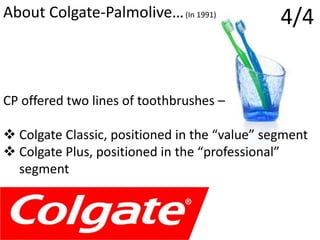
CP offered two lines of toothbrushes –
 Colgate Classic, positioned in the “value” segment
 Colgate Plus, positioned in the “professional”
segment
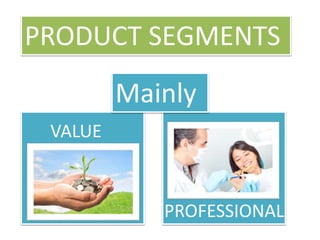
PRODUCT SEGMENTS
VALUE
PROFESSIONAL
Mainly
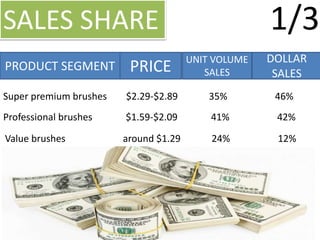
SALES SHARE
PRODUCT SEGMENT PRICE
DOLLAR
SALES
UNIT VOLUME
SALES
Super premium brushes $2.29-$2.89 35% 46%
Professional brushes $1.59-$2.09 41% 42%
Value brushes around $1.29 24% 12%
1/3
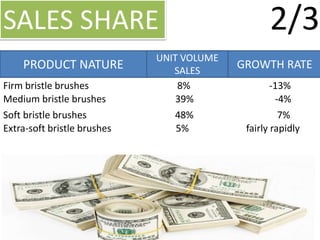
SALES SHARE
PRODUCT NATURE GROWTH RATE
UNIT VOLUME
SALES
Firm bristle brushes 8% -13%
Medium bristle brushes 39% -4%
Soft bristle brushes 48% 7%
Extra-soft bristle brushes 5% fairly rapidly
2/3
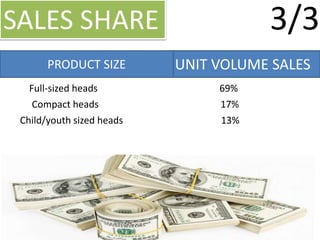
SALES SHARE
UNIT VOLUME SALES
Full-sized heads 69%
PRODUCT SIZE
Compact heads 17%
Child/youth sized heads 13%
3/3
PRECISION was scheduled to
be launched early in 1993…
It faced a major challenge of positioning
itself as better than those whose had
been launched recently….
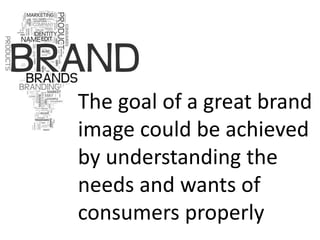
The goal of a great brand
image could be achieved
by understanding the
needs and wants of
consumers properly
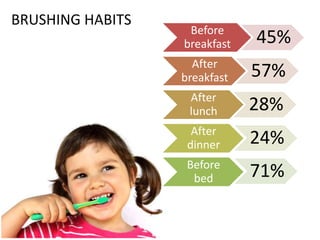
Before
breakfast 45%
After
breakfast 57%
After
lunch 28%
24%
71%
After
dinner
Before
bed
BRUSHING HABITS
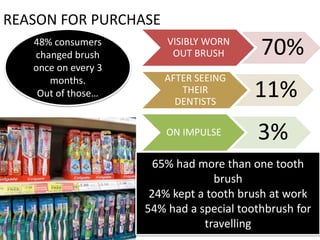
VISIBLY WORN
OUT BRUSH 70%
AFTER SEEING
THEIR
DENTISTS
11%
ON IMPULSE 3%
REASON FOR PURCHASE
48% consumers
changed brush
once on every 3
months.
Out of those…
65% had more than one tooth
brush
24% kept a tooth brush at work
54% had a special toothbrush for
travelling
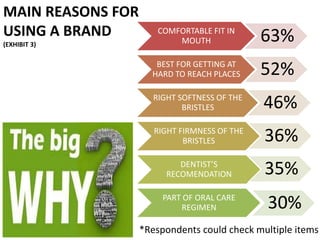
COMFORTABLE FIT IN
MOUTH 63%
BEST FOR GETTING AT
HARD TO REACH PLACES 52%
RIGHT SOFTNESS OF THE
BRISTLES 46%
36%
35%
30%
RIGHT FIRMNESS OF THE
BRISTLES
DENTIST’S
RECOMENDATION
PART OF ORAL CARE
REGIMEN
MAIN REASONS FOR
USING A BRAND
(EXHIBIT 3)
*Respondents could check multiple items
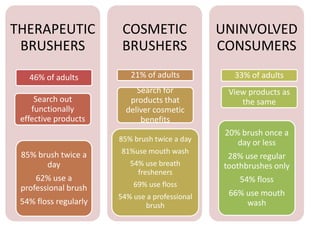
THERAPEUTIC
BRUSHERS
46% of adults
Search out
functionally
effective products
85% brush twice a
day
62% use a
professional brush
54% floss regularly
COSMETIC
BRUSHERS
21% of adults
Search for
products that
deliver cosmetic
benefits
85% brush twice a day
81%use mouth wash
54% use breath
fresheners
69% use floss
54% use a professional
brush
UNINVOLVED
CONSUMERS
33% of adults
View products as
the same
20% brush once a
day or less
28% use regular
toothbrushes only
54% floss
66% use mouth
wash
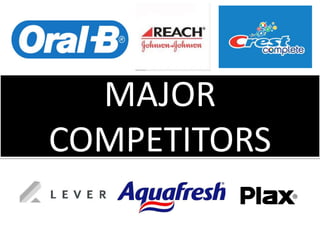
MAJOR
COMPETITORS
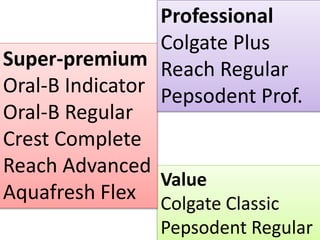
Value
Colgate Classic
Pepsodent Regular
Super-premium
Oral-B Indicator
Oral-B Regular
Crest Complete
Reach Advanced
Aquafresh Flex
Professional
Colgate Plus
Reach Regular
Pepsodent Prof.
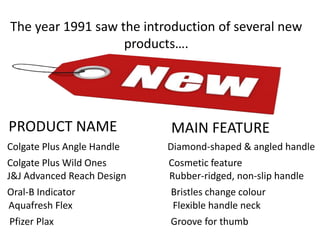
The year 1991 saw the introduction of several new
products….
Colgate Plus Angle Handle Diamond-shaped & angled handle
Colgate Plus Wild Ones Cosmetic feature
J&J Advanced Reach Design Rubber-ridged, non-slip handle
Oral-B Indicator Bristles change colour
Aquafresh Flex Flexible handle neck
Pfizer Plax Groove for thumb
PRODUCT NAME MAIN FEATURE
In the year 1991, Colgate had
spent a total of $20,334,000 for
advertising and promotion
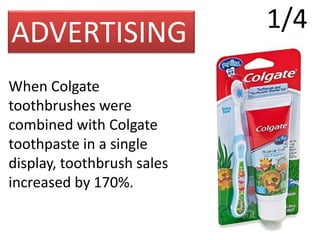
ADVERTISING
When Colgate
toothbrushes were
combined with Colgate
toothpaste in a single
display, toothbrush sales
increased by 170%.
1/4
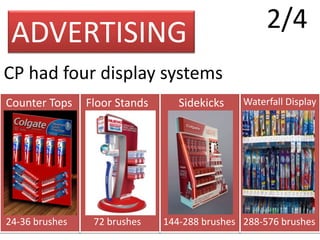
CP had four display systems
ADVERTISING 2/4
Counter Tops
24-36 brushes
Floor Stands
72 brushes
Sidekicks
144-288 brushes
Waterfall Display
288-576 brushes
ADVERTISING 3/4
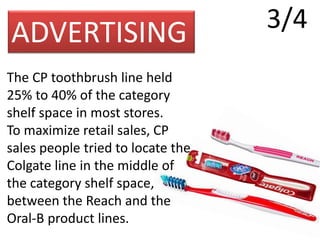
The CP toothbrush line held
25% to 40% of the category
shelf space in most stores.
To maximize retail sales, CP
sales people tried to locate the
Colgate line in the middle of
the category shelf space,
between the Reach and the
Oral-B product lines.
ADVERTISING 4/4
The number of coupon events for
toothbrushes increased from 10 in 1990 to
33 in 1992. In the same period, the average
toothbrush coupon value increased from
$0.25 to $0.75.
Partly in response and
partly because of the
increasing number of
SKUs, food stores began
to expand shelf space
devoted to oral care
products.
DISTRIBUTION
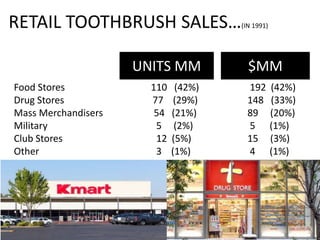
RETAIL TOOTHBRUSH SALES…(IN 1991)
$MMUNITS MM
Food Stores 110 (42%) 192 (42%)
Drug Stores 77 (29%) 148 (33%)
Mass Merchandisers 54 (21%) 89 (20%)
Military 5 (2%) 5 (1%)
Club Stores 12 (5%) 15 (3%)
Other 3 (1%) 4 (1%)
The Precision Marketing Mix
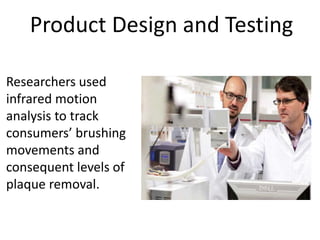
Product Design and Testing
Researchers used
infrared motion
analysis to track
consumers’ brushing
movements and
consequent levels of
plaque removal.
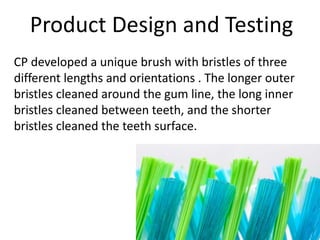
Product Design and Testing
CP developed a unique brush with bristles of three
different lengths and orientations . The longer outer
bristles cleaned around the gum line, the long inner
bristles cleaned between teeth, and the shorter
bristles cleaned the teeth surface.
Product Design and Testing
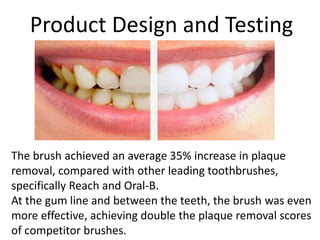
The brush achieved an average 35% increase in plaque
removal, compared with other leading toothbrushes,
specifically Reach and Oral-B.
At the gum line and between the teeth, the brush was even


more effective, achieving double the plaque removal scores
of competitor brushes.
The problem
highlighted in this
case is defining the
market strategy for
the toothbrush
(positioning, branding
and communication
strategy)
POSITIONING
NICHE
POSITIONING
or
MAINSTREAM
POSITIONING
Investment Cost Annual Capacity Depreciation time
Tufters $500,000 3 MM units 15 years
Handle Molds $300,000 7 MM units 5 years
Packaging $150,000 40 MM units 5 years
Capacity and Investment Costs
NICHE
POSITIONING
STRATEGY
MAINSTREAM
POSITIONING
STRATEGY
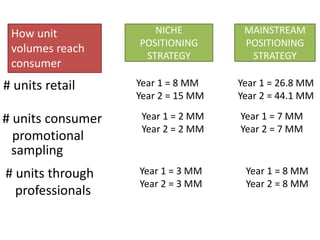
# units retail Year 1 = 8 MM
Year 2 = 15 MM
Year 1 = 26.8 MM
Year 2 = 44.1 MM
# units consumer
promotional
Year 1 = 2 MM
Year 2 = 2 MM
Year 1 = 7 MM
Year 2 = 7 MM
sampling
# units through
professionals
Year 1 = 3 MM
Year 2 = 3 MM
Year 1 = 8 MM
Year 2 = 8 MM
How unit
volumes reach
consumer
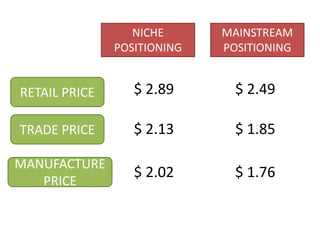
RETAIL PRICE
TRADE PRICE
MANUFACTURE
PRICE
NICHE
POSITIONING
MAINSTREAM
POSITIONING
$ 2.89 $ 2.49
$ 2.13 $ 1.85
$ 2.02 $ 1.76
Niche : estimated net profit
over two years is $12,527,333
Mainstream : estimated net
profit is $9,515,333
A financial analysis indicates a
profit for both market positions
Alternative names which
were considered for the
toothbrush included Colgate
Precision, Colgate System III,
Colgate Advantage, Colgate
1.2.3, Colgate Contour,
Colgate Sensation, and
Colgate Probe. The Colgate
Precision name was
consistently viewed more
favourably—it was deemed
appropriate by 49% of
concept acceptors and
appealing by 31%
The relative prominence of
the Precision and Colgate
names on the package and in
advertising also had to be
decided
Colgate
Precision
Precision
by Colgate
or
CP’s stated corporate
strategy was to build on the
Colgate brand equity
Colgate Precision
Stressing Precision as opposed to Colgate would limit the
extent of cannibalization of Colgate Plus. It was
estimated that cannibalization figures for Colgate Plus
would increase by 20% if the Colgate brand name was
stressed but remain unchanged if the Precision brand
name was stressed
Precision by Colgate
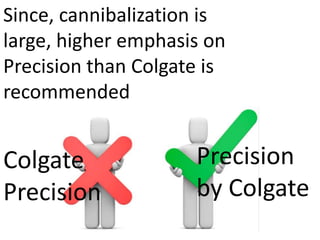
Since, cannibalization is
large, higher emphasis on
Precision than Colgate is
recommended
Colgate
Precision
Precision
by Colgate
COMMUNICATION
AND PROMOTION
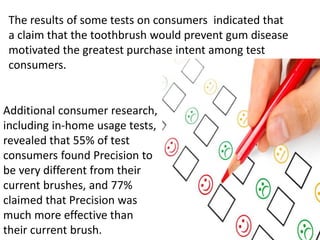
Additional consumer research,
including in-home usage tests,
revealed that 55% of test
consumers found Precision to
be very different from their
current brushes, and 77%
claimed that Precision was
much more effective than
their current brush.
The results of some tests on consumers indicated that
a claim that the toothbrush would prevent gum disease
motivated the greatest purchase intent among test
consumers.
Once tried, consumer
intent to purchase rose
dramatically… Therefore sampling
would be critical to
Precision’s success.
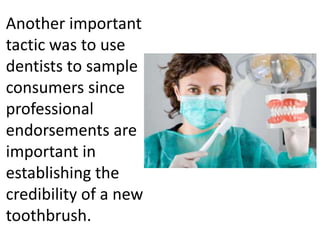
Another important
tactic was to use
dentists to sample
consumers since
professional
endorsements are
important in
establishing the
credibility of a new
toothbrush.
1.The brush looked unusual and test participants
sometimes had mixed first impressions.
2.The benefit of reduced gum disease from extra
plaque removal was difficult to translate into a
message with broad consumer appeal, since few
consumers acknowledged that they might have
gum disease.
This presentation has been
created by Akriti Sarswat, IIT
Kanpur, during a marketing
internship under the
guidance of Prof. Sameer
Mathur, IIM Lucknow.
Colgate

Colgate

  • 1.
  • 3.
    1/4About Colgate-Palmolive…(In 1991) Totalsales: $6.06 billion Gross profit: $2.76 billion Operating profit: 13% of net sales (Exhibit 1) Total worldwide R&D expenditures: $114 million Media advertising expenditures: $428 million
  • 4.
    2/4About Colgate-Palmolive…(In 1991) Emphasizednew product launches and entry into new geographic markets, along with improved efficiencies in manufacturing and distribution and a continuing focus on core consumer products. • $243 million was spent to upgrade 25 of CP’s 91 manufacturing plants • 275 new products were introduced worldwide
  • 5.
    3/4About Colgate-Palmolive…(In 1991) CPheld : 1. 43% of the world toothpaste market 2. 16% of the world toothbrush market. 3. The number one position in the U.S. retail toothbrush market with a 23.3% volume share.
  • 6.
    4/4About Colgate-Palmolive…(In 1991) CPoffered two lines of toothbrushes –  Colgate Classic, positioned in the “value” segment  Colgate Plus, positioned in the “professional” segment
  • 7.
  • 8.
    SALES SHARE PRODUCT SEGMENTPRICE DOLLAR SALES UNIT VOLUME SALES Super premium brushes $2.29-$2.89 35% 46% Professional brushes $1.59-$2.09 41% 42% Value brushes around $1.29 24% 12% 1/3
  • 9.
    SALES SHARE PRODUCT NATUREGROWTH RATE UNIT VOLUME SALES Firm bristle brushes 8% -13% Medium bristle brushes 39% -4% Soft bristle brushes 48% 7% Extra-soft bristle brushes 5% fairly rapidly 2/3
  • 10.
    SALES SHARE UNIT VOLUMESALES Full-sized heads 69% PRODUCT SIZE Compact heads 17% Child/youth sized heads 13% 3/3
  • 11.
    PRECISION was scheduledto be launched early in 1993… It faced a major challenge of positioning itself as better than those whose had been launched recently….
  • 12.
    The goal ofa great brand image could be achieved by understanding the needs and wants of consumers properly
  • 13.
    Before breakfast 45% After breakfast 57% After lunch28% 24% 71% After dinner Before bed BRUSHING HABITS
  • 14.
    VISIBLY WORN OUT BRUSH70% AFTER SEEING THEIR DENTISTS 11% ON IMPULSE 3% REASON FOR PURCHASE 48% consumers changed brush once on every 3 months. Out of those… 65% had more than one tooth brush 24% kept a tooth brush at work 54% had a special toothbrush for travelling
  • 15.
    COMFORTABLE FIT IN MOUTH63% BEST FOR GETTING AT HARD TO REACH PLACES 52% RIGHT SOFTNESS OF THE BRISTLES 46% 36% 35% 30% RIGHT FIRMNESS OF THE BRISTLES DENTIST’S RECOMENDATION PART OF ORAL CARE REGIMEN MAIN REASONS FOR USING A BRAND (EXHIBIT 3) *Respondents could check multiple items
  • 16.
    THERAPEUTIC BRUSHERS 46% of adults Searchout functionally effective products 85% brush twice a day 62% use a professional brush 54% floss regularly COSMETIC BRUSHERS 21% of adults Search for products that deliver cosmetic benefits 85% brush twice a day 81%use mouth wash 54% use breath fresheners 69% use floss 54% use a professional brush UNINVOLVED CONSUMERS 33% of adults View products as the same 20% brush once a day or less 28% use regular toothbrushes only 54% floss 66% use mouth wash
  • 17.
  • 18.
    Value Colgate Classic Pepsodent Regular Super-premium Oral-BIndicator Oral-B Regular Crest Complete Reach Advanced Aquafresh Flex Professional Colgate Plus Reach Regular Pepsodent Prof.
  • 19.
    The year 1991saw the introduction of several new products…. Colgate Plus Angle Handle Diamond-shaped & angled handle Colgate Plus Wild Ones Cosmetic feature J&J Advanced Reach Design Rubber-ridged, non-slip handle Oral-B Indicator Bristles change colour Aquafresh Flex Flexible handle neck Pfizer Plax Groove for thumb PRODUCT NAME MAIN FEATURE
  • 20.
    In the year1991, Colgate had spent a total of $20,334,000 for advertising and promotion
  • 21.
    ADVERTISING When Colgate toothbrushes were combinedwith Colgate toothpaste in a single display, toothbrush sales increased by 170%. 1/4
  • 22.
    CP had fourdisplay systems ADVERTISING 2/4 Counter Tops 24-36 brushes Floor Stands 72 brushes Sidekicks 144-288 brushes Waterfall Display 288-576 brushes
  • 23.
    ADVERTISING 3/4 The CPtoothbrush line held 25% to 40% of the category shelf space in most stores. To maximize retail sales, CP sales people tried to locate the Colgate line in the middle of the category shelf space, between the Reach and the Oral-B product lines.
  • 24.
    ADVERTISING 4/4 The numberof coupon events for toothbrushes increased from 10 in 1990 to 33 in 1992. In the same period, the average toothbrush coupon value increased from $0.25 to $0.75.
  • 25.
    Partly in responseand partly because of the increasing number of SKUs, food stores began to expand shelf space devoted to oral care products. DISTRIBUTION
  • 26.
    RETAIL TOOTHBRUSH SALES…(IN1991) $MMUNITS MM Food Stores 110 (42%) 192 (42%) Drug Stores 77 (29%) 148 (33%) Mass Merchandisers 54 (21%) 89 (20%) Military 5 (2%) 5 (1%) Club Stores 12 (5%) 15 (3%) Other 3 (1%) 4 (1%)
  • 27.
  • 28.
    Product Design andTesting Researchers used infrared motion analysis to track consumers’ brushing movements and consequent levels of plaque removal.
  • 29.
    Product Design andTesting CP developed a unique brush with bristles of three different lengths and orientations . The longer outer bristles cleaned around the gum line, the long inner bristles cleaned between teeth, and the shorter bristles cleaned the teeth surface.
  • 30.
    Product Design andTesting The brush achieved an average 35% increase in plaque removal, compared with other leading toothbrushes, specifically Reach and Oral-B. At the gum line and between the teeth, the brush was even more effective, achieving double the plaque removal scores of competitor brushes.
  • 31.
    The problem highlighted inthis case is defining the market strategy for the toothbrush (positioning, branding and communication strategy)
  • 32.
  • 33.
  • 34.
    Investment Cost AnnualCapacity Depreciation time Tufters $500,000 3 MM units 15 years Handle Molds $300,000 7 MM units 5 years Packaging $150,000 40 MM units 5 years Capacity and Investment Costs
  • 35.
    NICHE POSITIONING STRATEGY MAINSTREAM POSITIONING STRATEGY # units retailYear 1 = 8 MM Year 2 = 15 MM Year 1 = 26.8 MM Year 2 = 44.1 MM # units consumer promotional Year 1 = 2 MM Year 2 = 2 MM Year 1 = 7 MM Year 2 = 7 MM sampling # units through professionals Year 1 = 3 MM Year 2 = 3 MM Year 1 = 8 MM Year 2 = 8 MM How unit volumes reach consumer
  • 36.
  • 37.
    Niche : estimatednet profit over two years is $12,527,333 Mainstream : estimated net profit is $9,515,333 A financial analysis indicates a profit for both market positions
  • 39.
    Alternative names which wereconsidered for the toothbrush included Colgate Precision, Colgate System III, Colgate Advantage, Colgate 1.2.3, Colgate Contour, Colgate Sensation, and Colgate Probe. The Colgate Precision name was consistently viewed more favourably—it was deemed appropriate by 49% of concept acceptors and appealing by 31%
  • 40.
    The relative prominenceof the Precision and Colgate names on the package and in advertising also had to be decided Colgate Precision Precision by Colgate or
  • 41.
    CP’s stated corporate strategywas to build on the Colgate brand equity Colgate Precision
  • 42.
    Stressing Precision asopposed to Colgate would limit the extent of cannibalization of Colgate Plus. It was estimated that cannibalization figures for Colgate Plus would increase by 20% if the Colgate brand name was stressed but remain unchanged if the Precision brand name was stressed Precision by Colgate
  • 43.
    Since, cannibalization is large,higher emphasis on Precision than Colgate is recommended Colgate Precision Precision by Colgate
  • 44.
  • 45.
    Additional consumer research, includingin-home usage tests, revealed that 55% of test consumers found Precision to be very different from their current brushes, and 77% claimed that Precision was much more effective than their current brush. The results of some tests on consumers indicated that a claim that the toothbrush would prevent gum disease motivated the greatest purchase intent among test consumers.
  • 46.
    Once tried, consumer intentto purchase rose dramatically… Therefore sampling would be critical to Precision’s success.
  • 47.
    Another important tactic wasto use dentists to sample consumers since professional endorsements are important in establishing the credibility of a new toothbrush.
  • 48.
    1.The brush lookedunusual and test participants sometimes had mixed first impressions. 2.The benefit of reduced gum disease from extra plaque removal was difficult to translate into a message with broad consumer appeal, since few consumers acknowledged that they might have gum disease.
  • 49.
    This presentation hasbeen created by Akriti Sarswat, IIT Kanpur, during a marketing internship under the guidance of Prof. Sameer Mathur, IIM Lucknow.