by Ayan Ghosh
Colgate-Palmolive Precision Toothbrush
A Harvard Case Study
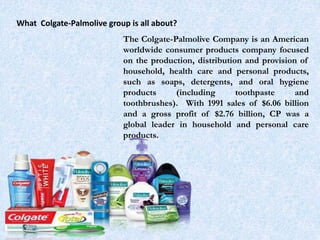
What Colgate-Palmolive group is all about?
The Colgate-Palmolive Company is an American
worldwide consumer products company focused
on the production, distribution and provision of
household, health care and personal products,
such as soaps, detergents, and oral hygiene
products (including toothpaste and
toothbrushes). With 1991 sales of $6.06 billion
and a gross profit of $2.76 billion, CP was a
global leader in household and personal care
products.
So..? Why study this case?
The Situation is…
In August 1992, Colgate-Palmolive (CP) was poised to launch a new
toothbrush in the United States, tentatively named Colgate Precision.
CP’s Oral Care Division had been developing this technologically superior
toothbrush for over three years but now faced a highly competitive market
with substantial new product activity.
Objective is
1/4 - To study the market competition faced
by the Colgate Precision Toothbrush.
2/4- To study the “consumer behavior”
3/4 - To study the strategies that can be used to “position”
the Precision toothbrush
4/4 - To analyze the “profits” gained by adopting the given
strategies.
3 Key Players in the case-
1. Susan Steinberg - Precision Product Manager
2. Nigel Burton - Division General Manager
3. Ruben Mark - CP’s C.E.O.
Lets move on by going a bit backwards..
In 1991, the U.S. Oral Care market was $2.9 billion in retail
sales and had grown at an annual rate of 6.1% since 1986.
Dollar sales of toothbrushes had grown at an average rate of
9.3% per annum since 1987, but, in 1992 they increased by 21%
in value and 18% in volume, due to the introduction of 47 new
products and line extensions during 1991-1992.
Unit sales growth in 1993, however, was projected to be slower
due to a build-up in household inventories of toothbrushes in
1992 as a result of increased sampling of free brushes through
dentists and an abnormally high number of “two-for-one”
consumer promotions.
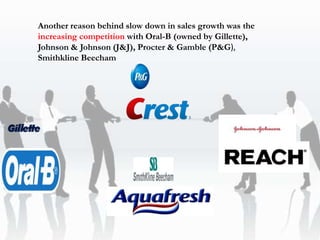
Another reason behind slow down in sales growth was the
increasing competition with Oral-B (owned by Gillette),
Johnson & Johnson (J&J), Procter & Gamble (P&G),
Smithkline Beecham
Product Segmentation- In the 1980s, industry
executives divided the toothbrush category into mainly
two segments: value and professional. More or less all the
market giants had come with their respective products to
cater every segment.
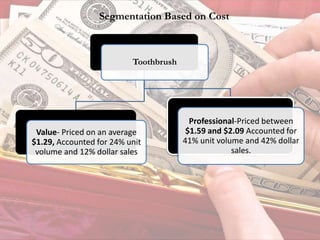
Segmentation Based on Cost
Toothbrush
Value- Priced on an average
$1.29, Accounted for 24% unit
volume and 12% dollar sales
Professional-Priced between
$1.59 and $2.09 Accounted for
41% unit volume and 42% dollar
sales.
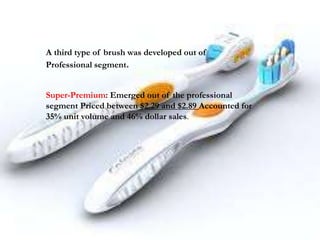
A third type of brush was developed out of
Professional segment.
Super-Premium: Emerged out of the professional
segment Priced between $2.29 and $2.89 Accounted for
35% unit volume and 46% dollar sales.
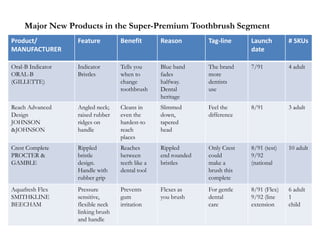
Product/
MANUFACTURER
Feature Benefit Reason Tag-line Launch
date
# SKUs
Oral-B Indicator
ORAL-B
(GILLETTE)
Indicator
Bristles
Tells you
when to
change
toothbrush
Blue band
fades
halfway.
Dental
heritage
The brand
more
dentists
use
7/91 4 adult
Reach Advanced
Design
JOHNSON
&JOHNSON
Angled neck;
raised rubber
ridges on
handle
Cleans in
even the
hardest-to
reach
places
Slimmed
down,
tapered
head
Feel the
difference
8/91 3 adult
Crest Complete
PROCTER &
GAMBLE
Rippled
bristle
design.
Handle with
rubber grip
Reaches
between
teeth like a
dental tool
Rippled
end rounded
bristles
Only Crest
could
make a
brush this
complete
8/91 (test)
9/92
(national
10 adult
Aquafresh Flex
SMITHKLINE
BEECHAM
Pressure
sensitive,
flexible neck
linking brush
and handle
Prevents
gum
irritation
Flexes as
you brush
For gentle
dental
care
8/91 (Flex)
9/92 (line
extension
6 adult
1
child
Major New Products in the Super-Premium Toothbrush Segment
Consumer behavior
CP’s consumer research indicated that consumers of the baby boom
generation (adults born in the 1940s, 1950s and early 1960s) were
becoming more concerned about the health of their gums as opposed
to cavity prevention and were willing to pay a premium for new
products addressing this Issue. Brand choice was based on features,
comfort and professional recommendations.
INVOLVED ORAL HEALTH
CONSUMERS - THERAPEUTIC
BRUSHERS (46% of adults)
INVOLVED ORAL HEALTH
CONSUMERS - COSMETIC
BRUSHERS (21% of adults)
UNINVOLVED ORAL HEALTH
CONSUMERS (33% of adults)
Differentiate among products.
Search out functionally effective
products
Search for products that
effectively deliver cosmetic
benefits
View products as the same. Lack
of
interest in product category
Buy and use products for
themselves
Buy and use products for
themselves
Buy and use products for all
family
members
85% brush at least twice a day,
62% use a professional brush
and 54% floss regularly
85% brush twice a day,
81% use mouthwash,
54% use breath fresheners,
69% floss,
54% use a professional brush
20% brush once a day or less,
28% use only regular
toothbrushes
54% floss
66% use mouthwash
Major toothbrush brands used
are Oral-B Angle and Oral-B
Regular followed by Colgate Plus
and Reach.
Major toothbrush brands used
are Colgate Classic and Oral-B
Regular followed by Colgate
Plus and Oral-B Angle
Major toothbrush brands used are
Colgate Classic and Oral-B
Regular
followed by Colgate Plus and
Reach
Consumer segmentation of Toothbrush users
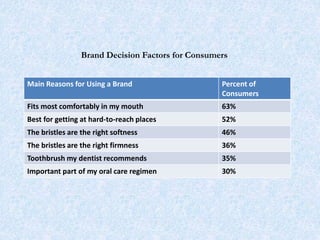
Main Reasons for Using a Brand Percent of
Consumers
Fits most comfortably in my mouth 63%
Best for getting at hard-to-reach places 52%
The bristles are the right softness 46%
The bristles are the right firmness 36%
Toothbrush my dentist recommends 35%
Important part of my oral care regimen 30%
Brand Decision Factors for Consumers
The Precision Marketing Mix
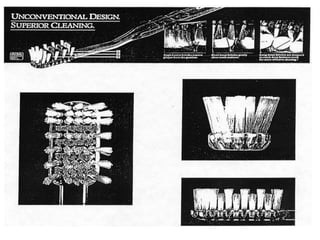
The Precision toothbrush was a technical innovation. In laboratory
experiments, researchers used infrared motion analysis to track
consumers’ brushing movements and consequent levels of plaque
removal. With this knowledge and through computer aided design, CP
developed a unique brush with bristles of three different lengths and
orientations
1. Product - Design and Testing
In 1989, CP had established a task force comprising executives from
R&D and Marketing, dental professionals, and outside consultants. Its
mission was to “develop a superior, technical, plaque removing device.
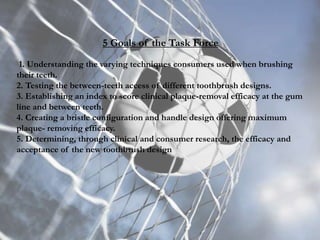
5 Goals of the Task Force
1. Understanding the varying techniques consumers used when brushing
their teeth.
2. Testing the between-teeth access of different toothbrush designs.
3. Establishing an index to score clinical plaque-removal efficacy at the gum
line and between teeth.
4. Creating a bristle configuration and handle design offering maximum
plaque- removing efficacy.
5. Determining, through clinical and consumer research, the efficacy and
acceptance of the new toothbrush design
Conclusions by the Task Force
Researchers concluded that brushing usually did a good job of removing plaque from
teeth surfaces but was often ineffective at removing plaque from the gum line and
between the teeth. The tests revealed that CP’s new design was superior to both Oral-B
and Reach in accessing front and back teeth, using either horizontal or vertical brushing.
2. Promotion
A typical CP toothbrush display increased sales by 90% over a normal shelf
facing. When Colgate toothbrushes were combined with Colgate toothpaste in a
single display, toothbrush sales increased by 170%.
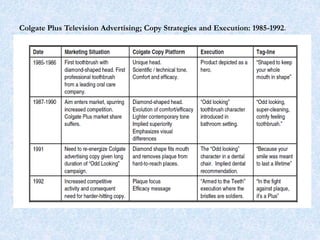
Colgate Plus Television Advertising; Copy Strategies and Execution: 1985-1992.
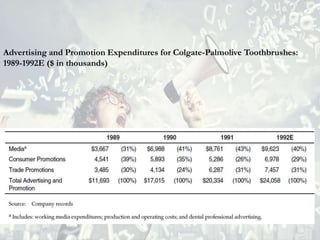
Advertising and Promotion Expenditures for Colgate-Palmolive Toothbrushes:
1989-1992E ($ in thousands)
Positioning Precision
was developed with the objective of creating the best brush possible and as
such, becoming a top-of-the range, super-premium product. It could be
positioned as a niche product to be targeted at consumers concerned about
gum disease. Alternatively, Precision could be positioned as a mainstream
brush, with the broader appeal of being the most effective brush available on
the market.
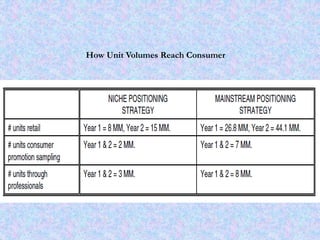
Steinberg believed that with a niche positioning, Precision retail
sales would represent 3% volume share of the toothbrush market
in year 1 and 5% in year 2. With a mainstream positioning, these
volume shares would be 10% in year 1 and 14.7% in year 2. Total
category unit volumes were estimated at 268 million in 1993 and
300 million in 1994.
How Unit Volumes Reach Consumer
3. Pricing
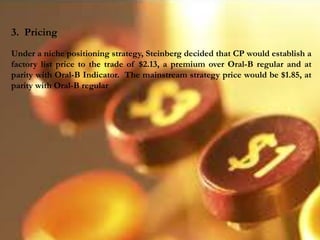
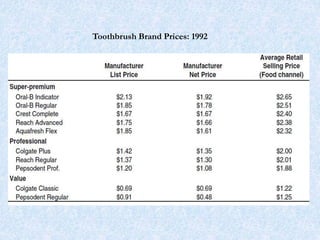
Under a niche positioning strategy, Steinberg decided that CP would establish a
factory list price to the trade of $2.13, a premium over Oral-B regular and at
parity with Oral-B Indicator. The mainstream strategy price would be $1.85, at
parity with Oral-B regular
Toothbrush Brand Prices: 1992
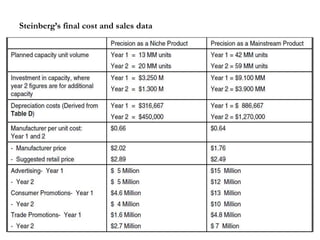
Steinberg’s final cost and sales data
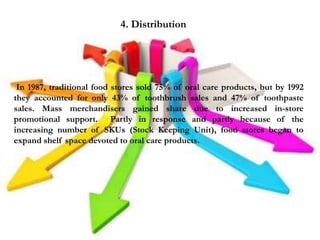
4. Distribution
In 1987, traditional food stores sold 75% of oral care products, but by 1992
they accounted for only 43% of toothbrush sales and 47% of toothpaste
sales. Mass merchandisers gained share due to increased in-store
promotional support. Partly in response and partly because of the
increasing number of SKUs (Stock Keeping Unit), food stores began to
expand shelf space devoted to oral care products.
Branding
Alternative names tested included Colgate Precision, Colgate System III, Colgate
Advantage, Colgate 1.2.3, Colgate Contour, Colgate Sensation, and Colgate Probe.
The Colgate Precision name was consistently viewed more favorably—it was deemed
appropriate by 49% of concept acceptors and appealing by 31%.
It was estimated, both under the mainstream and niche positioning scenarios, that
cannibalization figures for Colgate Plus would increase by 20% if the Colgate brand
name was stressed but remain unchanged if the Precision brand name was stressed.
Communication and Promotion
Once the basic product design was established, four concept tests, conducted
among 400 adult professional brush users (Colgate Plus, Reach, and Oral-B
users) 18 to 54 years of age, were run during 1990-1991. Consumers were
exposed to various product claims in prototype print advertisements and then
asked about the likelihood that they would purchase the product.
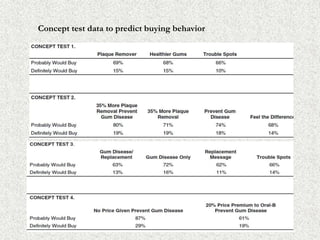
Concept test data to predict buying behavior
Analysis of the Concept Tests
• Results indicate that a claim that the toothbrush would prevent gum disease
motivated the greatest purchase intent among test consumers.
• Additional consumer research, including in-home usage tests, revealed that
55% of test consumers found Precision to be very different from their current
toothbrushes, and 77% claimed that Precision was much more effective than
their current toothbrush.
•Consumer research revealed that the more test consumers were told about
Precision and how it worked, the greater their enthusiasm for the product.
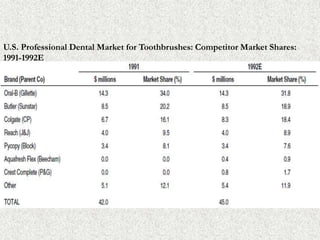
U.S. Professional Dental Market for Toothbrushes: Competitor Market Shares:
1991-1992E
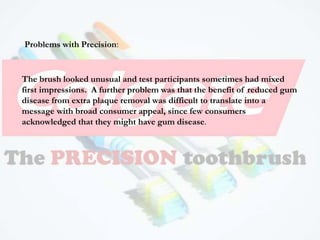
The brush looked unusual and test participants sometimes had mixed
first impressions. A further problem was that the benefit of reduced gum
disease from extra plaque removal was difficult to translate into a
message with broad consumer appeal, since few consumers
acknowledged that they might have gum disease.
Problems with Precision:
However..
Steinberg believed that Precision was the best brush for
people who cared about what they put in their mouths
but was still searching for the right superiority claim.
Once tried, consumer intent to purchase rose
dramatically. Steinberg therefore concluded that
sampling would be critical to Precision’s success.
Case Conclusions 1.
Launching the Precision Toothbrush as a Niche market product
is a better choice than launching it as a mainstream market
product. Initial niche positioning, which could later be broadened
to a mainstream positioning as additional capacity came on line,
may prove as a better alternative.
Case Conclusions 2.
Branding is another issue that needs to be resolved. CP Executives debated
whether the brush should be known as “Colgate Precision” or as “Precision
by Colgate.” The brush should be given a unique identity and “Precision”
brand name should be emphasized.
Case Conclusions 3.
Communication and Promotion plays an important role in defining the
success of a product. It was claimed that Precision toothbrush removes
plaque better than any other toothbrush. It was also claimed that Precision
toothbrush reduces gum diseases that may arise due to excess plaque. CP
should make sure that it is delivering the promises that it made during the
promotions and remove those that are exaggerated or are lies. This will
earn customers’ loyalty and will promote the brand name.
Case Conclusions 4.
Since, launching Precision tooth brush as a niche market
product seems to yield more benefits, hence it should also be
priced accordingly. Initially, it should be priced at par with
Oral-B’s Indicator toothbrush. Considering the claims that the
company makes for the Precision toothbrush and also that it
falls in the super-premium segment, this pricing is optimal
Created by Ayan Ghosh, Assistant Engineer –UNI Seven Engineering and Infra.
Pvt. Ltd. Kolkata, During summer internship under the guidance of Professor
Sameer Mathur, IIM-Lucknow.

Colgate palmolive precision toothbrush, a harvard case study by ayan ghosh

  • 1.
    by Ayan Ghosh Colgate-PalmolivePrecision Toothbrush A Harvard Case Study
  • 2.
    What Colgate-Palmolive groupis all about? The Colgate-Palmolive Company is an American worldwide consumer products company focused on the production, distribution and provision of household, health care and personal products, such as soaps, detergents, and oral hygiene products (including toothpaste and toothbrushes). With 1991 sales of $6.06 billion and a gross profit of $2.76 billion, CP was a global leader in household and personal care products.
  • 3.
    So..? Why studythis case?
  • 4.
    The Situation is… InAugust 1992, Colgate-Palmolive (CP) was poised to launch a new toothbrush in the United States, tentatively named Colgate Precision. CP’s Oral Care Division had been developing this technologically superior toothbrush for over three years but now faced a highly competitive market with substantial new product activity.
  • 5.
    Objective is 1/4 -To study the market competition faced by the Colgate Precision Toothbrush.
  • 6.
    2/4- To studythe “consumer behavior”
  • 7.
    3/4 - Tostudy the strategies that can be used to “position” the Precision toothbrush
  • 8.
    4/4 - Toanalyze the “profits” gained by adopting the given strategies.
  • 9.
    3 Key Playersin the case- 1. Susan Steinberg - Precision Product Manager 2. Nigel Burton - Division General Manager 3. Ruben Mark - CP’s C.E.O.
  • 10.
    Lets move onby going a bit backwards.. In 1991, the U.S. Oral Care market was $2.9 billion in retail sales and had grown at an annual rate of 6.1% since 1986. Dollar sales of toothbrushes had grown at an average rate of 9.3% per annum since 1987, but, in 1992 they increased by 21% in value and 18% in volume, due to the introduction of 47 new products and line extensions during 1991-1992.
  • 11.
    Unit sales growthin 1993, however, was projected to be slower due to a build-up in household inventories of toothbrushes in 1992 as a result of increased sampling of free brushes through dentists and an abnormally high number of “two-for-one” consumer promotions.
  • 12.
    Another reason behindslow down in sales growth was the increasing competition with Oral-B (owned by Gillette), Johnson & Johnson (J&J), Procter & Gamble (P&G), Smithkline Beecham
  • 13.
    Product Segmentation- Inthe 1980s, industry executives divided the toothbrush category into mainly two segments: value and professional. More or less all the market giants had come with their respective products to cater every segment.
  • 14.
    Segmentation Based onCost Toothbrush Value- Priced on an average $1.29, Accounted for 24% unit volume and 12% dollar sales Professional-Priced between $1.59 and $2.09 Accounted for 41% unit volume and 42% dollar sales.
  • 15.
    A third typeof brush was developed out of Professional segment. Super-Premium: Emerged out of the professional segment Priced between $2.29 and $2.89 Accounted for 35% unit volume and 46% dollar sales.
  • 16.
    Product/ MANUFACTURER Feature Benefit ReasonTag-line Launch date # SKUs Oral-B Indicator ORAL-B (GILLETTE) Indicator Bristles Tells you when to change toothbrush Blue band fades halfway. Dental heritage The brand more dentists use 7/91 4 adult Reach Advanced Design JOHNSON &JOHNSON Angled neck; raised rubber ridges on handle Cleans in even the hardest-to reach places Slimmed down, tapered head Feel the difference 8/91 3 adult Crest Complete PROCTER & GAMBLE Rippled bristle design. Handle with rubber grip Reaches between teeth like a dental tool Rippled end rounded bristles Only Crest could make a brush this complete 8/91 (test) 9/92 (national 10 adult Aquafresh Flex SMITHKLINE BEECHAM Pressure sensitive, flexible neck linking brush and handle Prevents gum irritation Flexes as you brush For gentle dental care 8/91 (Flex) 9/92 (line extension 6 adult 1 child Major New Products in the Super-Premium Toothbrush Segment
  • 17.
    Consumer behavior CP’s consumerresearch indicated that consumers of the baby boom generation (adults born in the 1940s, 1950s and early 1960s) were becoming more concerned about the health of their gums as opposed to cavity prevention and were willing to pay a premium for new products addressing this Issue. Brand choice was based on features, comfort and professional recommendations.
  • 18.
    INVOLVED ORAL HEALTH CONSUMERS- THERAPEUTIC BRUSHERS (46% of adults) INVOLVED ORAL HEALTH CONSUMERS - COSMETIC BRUSHERS (21% of adults) UNINVOLVED ORAL HEALTH CONSUMERS (33% of adults) Differentiate among products. Search out functionally effective products Search for products that effectively deliver cosmetic benefits View products as the same. Lack of interest in product category Buy and use products for themselves Buy and use products for themselves Buy and use products for all family members 85% brush at least twice a day, 62% use a professional brush and 54% floss regularly 85% brush twice a day, 81% use mouthwash, 54% use breath fresheners, 69% floss, 54% use a professional brush 20% brush once a day or less, 28% use only regular toothbrushes 54% floss 66% use mouthwash Major toothbrush brands used are Oral-B Angle and Oral-B Regular followed by Colgate Plus and Reach. Major toothbrush brands used are Colgate Classic and Oral-B Regular followed by Colgate Plus and Oral-B Angle Major toothbrush brands used are Colgate Classic and Oral-B Regular followed by Colgate Plus and Reach Consumer segmentation of Toothbrush users
  • 19.
    Main Reasons forUsing a Brand Percent of Consumers Fits most comfortably in my mouth 63% Best for getting at hard-to-reach places 52% The bristles are the right softness 46% The bristles are the right firmness 36% Toothbrush my dentist recommends 35% Important part of my oral care regimen 30% Brand Decision Factors for Consumers
  • 20.
  • 21.
    The Precision toothbrushwas a technical innovation. In laboratory experiments, researchers used infrared motion analysis to track consumers’ brushing movements and consequent levels of plaque removal. With this knowledge and through computer aided design, CP developed a unique brush with bristles of three different lengths and orientations 1. Product - Design and Testing
  • 23.
    In 1989, CPhad established a task force comprising executives from R&D and Marketing, dental professionals, and outside consultants. Its mission was to “develop a superior, technical, plaque removing device.
  • 24.
    5 Goals ofthe Task Force 1. Understanding the varying techniques consumers used when brushing their teeth. 2. Testing the between-teeth access of different toothbrush designs. 3. Establishing an index to score clinical plaque-removal efficacy at the gum line and between teeth. 4. Creating a bristle configuration and handle design offering maximum plaque- removing efficacy. 5. Determining, through clinical and consumer research, the efficacy and acceptance of the new toothbrush design
  • 25.
    Conclusions by theTask Force Researchers concluded that brushing usually did a good job of removing plaque from teeth surfaces but was often ineffective at removing plaque from the gum line and between the teeth. The tests revealed that CP’s new design was superior to both Oral-B and Reach in accessing front and back teeth, using either horizontal or vertical brushing.
  • 26.
    2. Promotion A typicalCP toothbrush display increased sales by 90% over a normal shelf facing. When Colgate toothbrushes were combined with Colgate toothpaste in a single display, toothbrush sales increased by 170%.
  • 27.
    Colgate Plus TelevisionAdvertising; Copy Strategies and Execution: 1985-1992.
  • 28.
    Advertising and PromotionExpenditures for Colgate-Palmolive Toothbrushes: 1989-1992E ($ in thousands)
  • 29.
    Positioning Precision was developedwith the objective of creating the best brush possible and as such, becoming a top-of-the range, super-premium product. It could be positioned as a niche product to be targeted at consumers concerned about gum disease. Alternatively, Precision could be positioned as a mainstream brush, with the broader appeal of being the most effective brush available on the market.
  • 30.
    Steinberg believed thatwith a niche positioning, Precision retail sales would represent 3% volume share of the toothbrush market in year 1 and 5% in year 2. With a mainstream positioning, these volume shares would be 10% in year 1 and 14.7% in year 2. Total category unit volumes were estimated at 268 million in 1993 and 300 million in 1994.
  • 31.
    How Unit VolumesReach Consumer
  • 32.
    3. Pricing Under aniche positioning strategy, Steinberg decided that CP would establish a factory list price to the trade of $2.13, a premium over Oral-B regular and at parity with Oral-B Indicator. The mainstream strategy price would be $1.85, at parity with Oral-B regular
  • 33.
  • 34.
  • 35.
    4. Distribution In 1987,traditional food stores sold 75% of oral care products, but by 1992 they accounted for only 43% of toothbrush sales and 47% of toothpaste sales. Mass merchandisers gained share due to increased in-store promotional support. Partly in response and partly because of the increasing number of SKUs (Stock Keeping Unit), food stores began to expand shelf space devoted to oral care products.
  • 36.
    Branding Alternative names testedincluded Colgate Precision, Colgate System III, Colgate Advantage, Colgate 1.2.3, Colgate Contour, Colgate Sensation, and Colgate Probe. The Colgate Precision name was consistently viewed more favorably—it was deemed appropriate by 49% of concept acceptors and appealing by 31%. It was estimated, both under the mainstream and niche positioning scenarios, that cannibalization figures for Colgate Plus would increase by 20% if the Colgate brand name was stressed but remain unchanged if the Precision brand name was stressed.
  • 37.
    Communication and Promotion Oncethe basic product design was established, four concept tests, conducted among 400 adult professional brush users (Colgate Plus, Reach, and Oral-B users) 18 to 54 years of age, were run during 1990-1991. Consumers were exposed to various product claims in prototype print advertisements and then asked about the likelihood that they would purchase the product.
  • 38.
    Concept test datato predict buying behavior
  • 39.
    Analysis of theConcept Tests • Results indicate that a claim that the toothbrush would prevent gum disease motivated the greatest purchase intent among test consumers. • Additional consumer research, including in-home usage tests, revealed that 55% of test consumers found Precision to be very different from their current toothbrushes, and 77% claimed that Precision was much more effective than their current toothbrush. •Consumer research revealed that the more test consumers were told about Precision and how it worked, the greater their enthusiasm for the product.
  • 40.
    U.S. Professional DentalMarket for Toothbrushes: Competitor Market Shares: 1991-1992E
  • 41.
    The brush lookedunusual and test participants sometimes had mixed first impressions. A further problem was that the benefit of reduced gum disease from extra plaque removal was difficult to translate into a message with broad consumer appeal, since few consumers acknowledged that they might have gum disease. Problems with Precision:
  • 42.
    However.. Steinberg believed thatPrecision was the best brush for people who cared about what they put in their mouths but was still searching for the right superiority claim. Once tried, consumer intent to purchase rose dramatically. Steinberg therefore concluded that sampling would be critical to Precision’s success.
  • 43.
    Case Conclusions 1. Launchingthe Precision Toothbrush as a Niche market product is a better choice than launching it as a mainstream market product. Initial niche positioning, which could later be broadened to a mainstream positioning as additional capacity came on line, may prove as a better alternative.
  • 44.
    Case Conclusions 2. Brandingis another issue that needs to be resolved. CP Executives debated whether the brush should be known as “Colgate Precision” or as “Precision by Colgate.” The brush should be given a unique identity and “Precision” brand name should be emphasized.
  • 45.
    Case Conclusions 3. Communicationand Promotion plays an important role in defining the success of a product. It was claimed that Precision toothbrush removes plaque better than any other toothbrush. It was also claimed that Precision toothbrush reduces gum diseases that may arise due to excess plaque. CP should make sure that it is delivering the promises that it made during the promotions and remove those that are exaggerated or are lies. This will earn customers’ loyalty and will promote the brand name.
  • 46.
    Case Conclusions 4. Since,launching Precision tooth brush as a niche market product seems to yield more benefits, hence it should also be priced accordingly. Initially, it should be priced at par with Oral-B’s Indicator toothbrush. Considering the claims that the company makes for the Precision toothbrush and also that it falls in the super-premium segment, this pricing is optimal
  • 48.
    Created by AyanGhosh, Assistant Engineer –UNI Seven Engineering and Infra. Pvt. Ltd. Kolkata, During summer internship under the guidance of Professor Sameer Mathur, IIM-Lucknow.