

















HAVARD BUSINESS CASE:
COLGATE-PALMOLIVE
COMPANY: THE
PRECISION TOOTHBRUSH
WHAT ARE THE
BASIC
CONTENTS?
COMPANY’S
BACKGROUND
COMPANY’S BACKGROUND
CP is the global leader in household and personal care products.
In 1991, CP held 43% of the world’s toothpaste market and 16%
of the world’s toothbrush market.
In 1991 the company had a sales of $6.06billion and a gross
profit of $2.76billion.
In August 1992 Colgate- Palmolive(CP) was poised to launch a
new toothbrush in the United States named as Colgate
Precision.
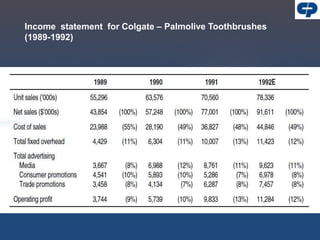
Income statement for Colgate – Palmolive Toothbrushes
(1989-1992)
OBJECTIVES
CP’s five-year plan
for 1991 to 1995 emphasized new
product launches and entry into
new geographic markets, along
with improved efficiencies in
manufacturing and distribution and
a continuing focus on core
consumer products.
PEOPLE WHO
MADE IT
SUCCESSFUL
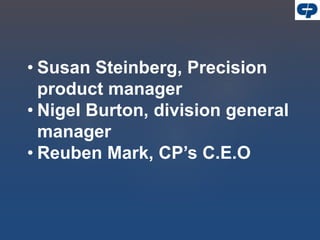
• Susan Steinberg, Precision
product manager
• Nigel Burton, division general
manager
• Reuben Mark, CP’s C.E.O
The
U.S.
Market
In 1991, new products launched
in the U.S. market included
Colgate Baking Soda toothpaste
and the Colgate Angle and Wild
Ones toothbrushes.
A major design advance
occurred in 1938 with the
launch of Dr. West’s Miracle
Tuft Toothbrush, the first nylon-
bristle brush.
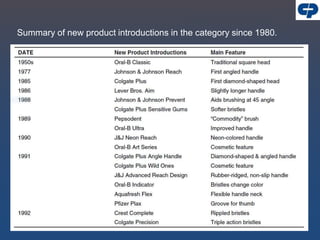
Summary of new product introductions in the category since 1980.
PRODUCT SEGMENTATION
In the 1980s, industry executives divided
the toothbrush category into two
segments: value and professional.
The late 1980s saw the emergence of
super-premium brushes.
In 1992, three players dominated the U.S.
toothbrush market overall: Colgate-Palmolive
and Johnson & Johnson, whose brushes were
positioned in the professional segment;
and Oral-B, whose brushes were positioned in
the super-premium segment.
Procter & Gamble and Smithkline Beecham;
both had positioned their new product launches
in the super-premium segment.
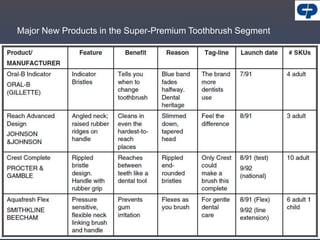
Major New Products in the Super-Premium Toothbrush Segment
CONSUMER BEHAIVIOUR
CP’s consumer research indicated that consumers of the baby boom
generation were becoming more concerned about the health of their
gums as opposed to cavity prevention and were willing to pay a
premium for new products.
They replaced their brushes on average only once every 7.5
months in 1991 versus 8.6 months in 1990.
48% of consumers claimed to change their brushes at least every
three months.
11% decided to switch to a new brush after seeing their dentists.
3% admitted to purchasing on impulse.
65% of consumers had more than one toothbrush.
24% kept a toothbrush at work.
54% had a special toothbrush for traveling.
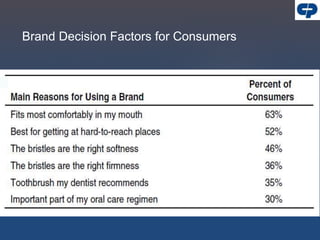
Brand Decision Factors for Consumers
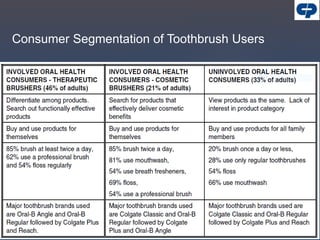
Consumer Segmentation of Toothbrush Users
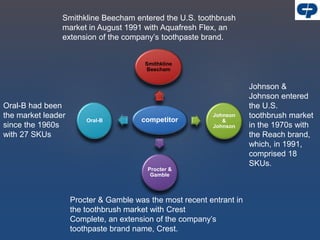
competitor
Smithkline
Beecham
Johnson
&
Johnson
Procter &
Gamble
Oral-B
Oral-B had been
the market leader
since the 1960s
with 27 SKUs
Johnson &
Johnson entered
the U.S.
toothbrush market
in the 1970s with
the Reach brand,
which, in 1991,
comprised 18
SKUs.
Procter & Gamble was the most recent entrant in
the toothbrush market with Crest
Complete, an extension of the company’s
toothpaste brand name, Crest.
Smithkline Beecham entered the U.S. toothbrush
market in August 1991 with Aquafresh Flex, an
extension of the company’s toothpaste brand.
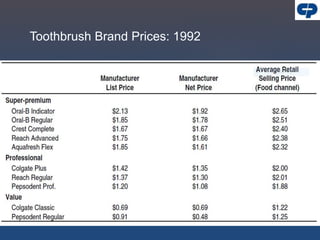
Toothbrush Brand Prices: 1992
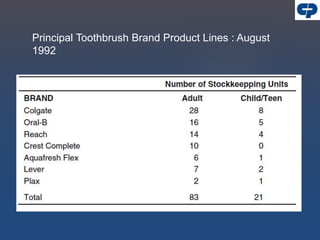
Principal Toothbrush Brand Product Lines : August
1992
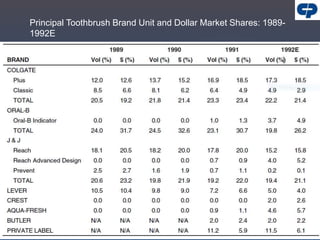
Principal Toothbrush Brand Unit and Dollar Market Shares: 1989-
1992E
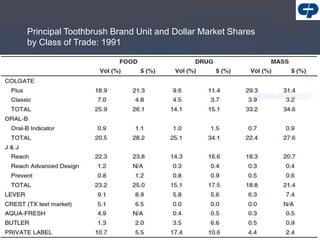
Principal Toothbrush Brand Unit and Dollar Market Shares
by Class of Trade: 1991
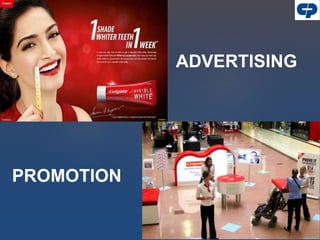
ADVERTISING
PROMOTION
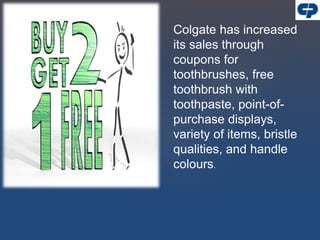
Colgate has increased
its sales through
coupons for
toothbrushes, free
toothbrush with
toothpaste, point-of-
purchase displays,
variety of items, bristle
qualities, and handle
colours.
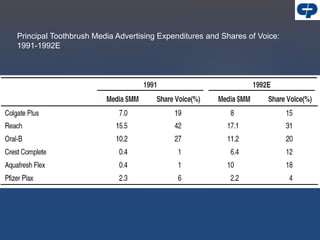
Principal Toothbrush Media Advertising Expenditures and Shares of Voice:
1991-1992E
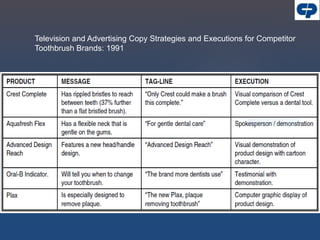
Television and Advertising Copy Strategies and Executions for Competitor
Toothbrush Brands: 1991
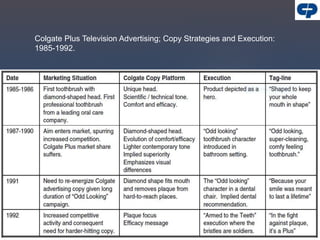
Colgate Plus Television Advertising; Copy Strategies and Execution:
1985-1992.
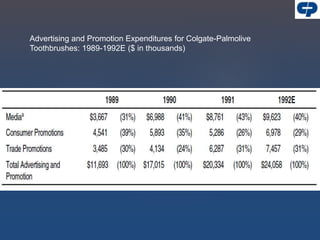
Advertising and Promotion Expenditures for Colgate-Palmolive
Toothbrushes: 1989-1992E ($ in thousands)
PRODUCT
DISTRIBUTION
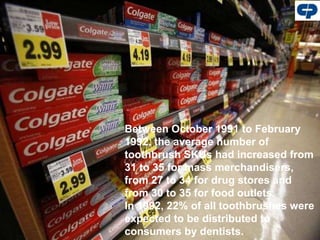
Between October 1991 to February
1992, the average number of
toothbrush SKUs had increased from
31 to 35 for mass merchandisers,
from 27 to 34 for drug stores and
from 30 to 35 for food outlets.
In 1992, 22% of all toothbrushes were
expected to be distributed to
consumers by dentists.
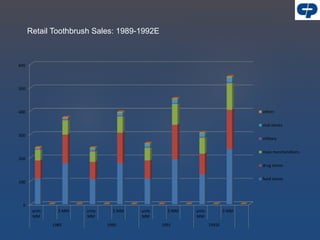
Retail Toothbrush Sales: 1989-1992E
0
100
200
300
400
500
600
units
MM
$ MM units
MM
$ MM units
MM
$ MM units
MM
$ MM
1989 1990 1991 1992E
others
club stores
military
mass merchandisers
drug stores
food stores
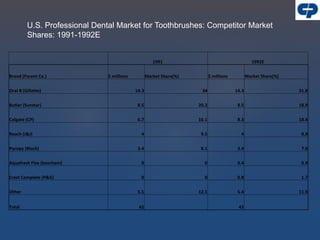
U.S. Professional Dental Market for Toothbrushes: Competitor Market
Shares: 1991-1992E
1991 1992E
Brand (Parent Co.) $ millions Market Share(%) $ millions Market Share(%)
Oral B (Gillette) 14.3 34 14.3 31.8
Butler (Sunstar) 8.5 20.2 8.5 18.9
Colgate (CP) 6.7 16.1 8.3 18.4
Reach (J&J) 4 9.5 4 8.9
Pycopy (Block) 3.4 8.1 3.4 7.6
Aquafresh Flex (beecham) 0 0 0.4 0.9
Crest Complete (P&G) 0 0 0.8 1.7
Other 5.1 12.1 5.4 11.9
Total 42 45
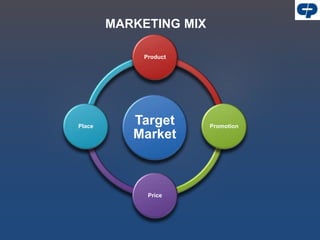
Target
Market
Product
Promotion
Price
Place
MARKETING MIX
PRODUCT
DESIGN
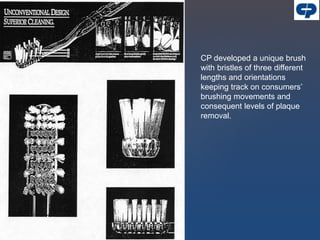
CP developed a unique brush
with bristles of three different
lengths and orientations
keeping track on consumers’
brushing movements and
consequent levels of plaque
removal.
In 1989, CP had established a task
force comprising executives from R&D
and Marketing, dental
professionals, and outside
consultants.
The task force had five goals:
Goal: Understanding the varying
techniques consumers used
when brushing their teeth.
Conclusion: Brushing was often
ineffective at removing plaque
from the gum line and between
the teeth.
Goal: Testing the between-teeth
access of different toothbrush
designs.
Conclusion: CP’s new design
was superior to both Oral-B and
Reach in accessing front and
back teeth, using either
horizontal or vertical brushing.
Goal: Establishing an index to
score clinical plaque-removal
efficacy at the gum line and
between teeth.
Conclusion: measured
presence of plague on each of
the nine tooth area.
Goal: Creating a bristle
configuration and handle design
offering maximum plaque-
removing efficacy.
Conclusion: Clinical trials
established that the new product
removed an average 35% more
plaque than other leading brushes
and therefore helped to reduce the
probability of gum disease.
Goal: Determining, through
clinical and consumer research,
the efficacy and acceptance of
the new
toothbrush design.
Conclusion: All test product design and
characteristics, marketing concept, and
competitive strengths were tested.
POSITIONING
Steinberg believed that:
• Positioned as niche product, Precision
would be able to capture 3% of the U.S.
toothbrush market and would represent 3%
volume share of the toothbrush market in
year 1 and 5% in year 2..
• Positioned as mainstream product,
Precision would be able to capture 10% of
the market and would represent 10%
volume share of toothbrush market in year 1
and 14.7% in year 2.
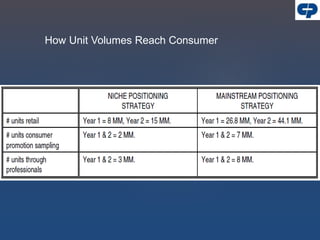
How Unit Volumes Reach Consumer
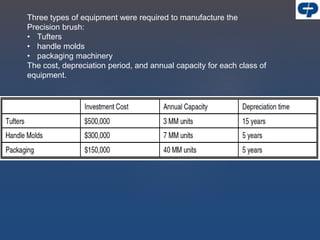
Three types of equipment were required to manufacture the
Precision brush:
• Tufters
• handle molds
• packaging machinery
The cost, depreciation period, and annual capacity for each class of
equipment.
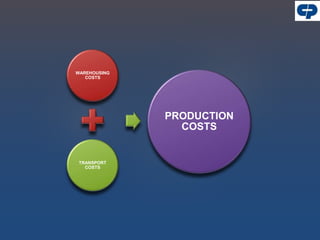
PRODUCT
COST AND
PRICING
WAREHOUSING
COSTS
TRANSPORT
COSTS
PRODUCTION
COSTS
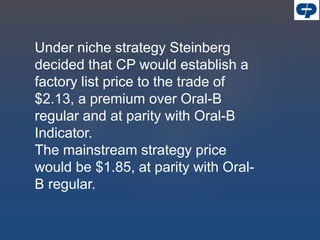
Under niche strategy Steinberg
decided that CP would establish a
factory list price to the trade of
$2.13, a premium over Oral-B
regular and at parity with Oral-B
Indicator.
The mainstream strategy price
would be $1.85, at parity with Oral-
B regular.
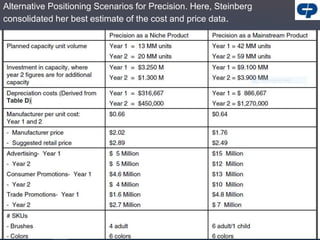
Alternative Positioning Scenarios for Precision. Here, Steinberg
consolidated her best estimate of the cost and price data.
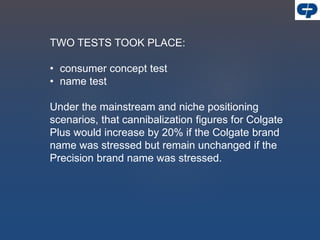
TWO TESTS TOOK PLACE:
• consumer concept test
• name test
Under the mainstream and niche positioning
scenarios, that cannibalization figures for Colgate
Plus would increase by 20% if the Colgate brand
name was stressed but remain unchanged if the
Precision brand name was stressed.
COMMUNICATION AND
PROMOTION
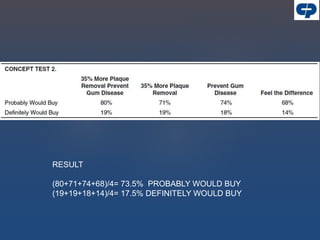
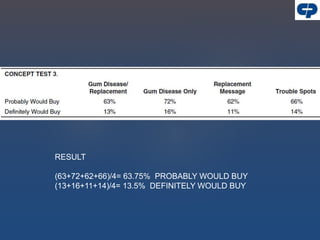
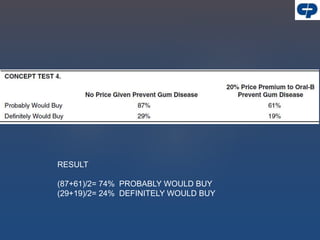
Four concept tests,
conducted among 400 adult
professional brush users
(Colgate Plus, Reach, and
Oral-B users) 18 to 54 years
of age.
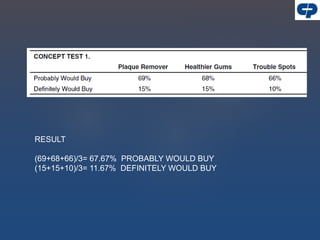
RESULT
(69+68+66)/3= 67.67% PROBABLY WOULD BUY
(15+15+10)/3= 11.67% DEFINITELY WOULD BUY
RESULT
(80+71+74+68)/4= 73.5% PROBABLY WOULD BUY
(19+19+18+14)/4= 17.5% DEFINITELY WOULD BUY
RESULT
(63+72+62+66)/4= 63.75% PROBABLY WOULD BUY
(13+16+11+14)/4= 13.5% DEFINITELY WOULD BUY
RESULT
(87+61)/2= 74% PROBABLY WOULD BUY
(29+19)/2= 24% DEFINITELY WOULD BUY
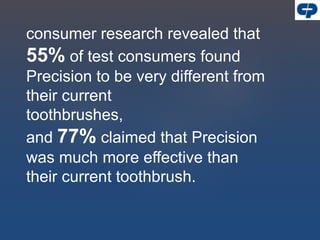
consumer research revealed that
55% of test consumers found
Precision to be very different from
their current
toothbrushes,
and 77% claimed that Precision
was much more effective than
their current toothbrush.
Steinberg consumer promotions to back the launch:
• a free 5 oz. tube of Colgate toothpaste (retail value of $1.89)
with the purchase of a Precision brush.
• a 50%-off offer on any size of Colgate toothpaste (up to a
value of $1.00) along with a 50Ā¢ coupon on the Precision
brush.
The cost of this promotion was
estimated at $4 million
Precision was more than a niche product or
simple line extension which was represented a
technological breakthrough.
Steinberg had to develop a marketing mix and
profit-and-loss pro forma that would enable
Precision to reach its full potential
And it should also be acceptable to Burton and
her colleagues, particularly the Colgate Plus
product
manager.
Created by Sutapa Nandy KIAMS Pune during marketing
internship by Prof. Sameer Mathur, IIM Lucknow.
Colgate palmolive

Colgate palmolive

  • 1.
  • 2.
  • 3.
  • 4.
    COMPANY’S BACKGROUND CP isthe global leader in household and personal care products. In 1991, CP held 43% of the world’s toothpaste market and 16% of the world’s toothbrush market. In 1991 the company had a sales of $6.06billion and a gross profit of $2.76billion. In August 1992 Colgate- Palmolive(CP) was poised to launch a new toothbrush in the United States named as Colgate Precision.
  • 5.
    Income statement forColgate – Palmolive Toothbrushes (1989-1992)
  • 6.
  • 7.
    CP’s five-year plan for1991 to 1995 emphasized new product launches and entry into new geographic markets, along with improved efficiencies in manufacturing and distribution and a continuing focus on core consumer products.
  • 8.
  • 9.
    • Susan Steinberg,Precision product manager • Nigel Burton, division general manager • Reuben Mark, CP’s C.E.O
  • 10.
  • 11.
    In 1991, newproducts launched in the U.S. market included Colgate Baking Soda toothpaste and the Colgate Angle and Wild Ones toothbrushes.
  • 12.
    A major designadvance occurred in 1938 with the launch of Dr. West’s Miracle Tuft Toothbrush, the first nylon- bristle brush.
  • 13.
    Summary of newproduct introductions in the category since 1980.
  • 14.
  • 15.
    In the 1980s,industry executives divided the toothbrush category into two segments: value and professional. The late 1980s saw the emergence of super-premium brushes.
  • 16.
    In 1992, threeplayers dominated the U.S. toothbrush market overall: Colgate-Palmolive and Johnson & Johnson, whose brushes were positioned in the professional segment; and Oral-B, whose brushes were positioned in the super-premium segment. Procter & Gamble and Smithkline Beecham; both had positioned their new product launches in the super-premium segment.
  • 17.
    Major New Productsin the Super-Premium Toothbrush Segment
  • 18.
  • 19.
    CP’s consumer researchindicated that consumers of the baby boom generation were becoming more concerned about the health of their gums as opposed to cavity prevention and were willing to pay a premium for new products. They replaced their brushes on average only once every 7.5 months in 1991 versus 8.6 months in 1990. 48% of consumers claimed to change their brushes at least every three months. 11% decided to switch to a new brush after seeing their dentists. 3% admitted to purchasing on impulse. 65% of consumers had more than one toothbrush. 24% kept a toothbrush at work. 54% had a special toothbrush for traveling.
  • 20.
  • 21.
    Consumer Segmentation ofToothbrush Users
  • 23.
    competitor Smithkline Beecham Johnson & Johnson Procter & Gamble Oral-B Oral-B hadbeen the market leader since the 1960s with 27 SKUs Johnson & Johnson entered the U.S. toothbrush market in the 1970s with the Reach brand, which, in 1991, comprised 18 SKUs. Procter & Gamble was the most recent entrant in the toothbrush market with Crest Complete, an extension of the company’s toothpaste brand name, Crest. Smithkline Beecham entered the U.S. toothbrush market in August 1991 with Aquafresh Flex, an extension of the company’s toothpaste brand.
  • 24.
  • 25.
    Principal Toothbrush BrandProduct Lines : August 1992
  • 26.
    Principal Toothbrush BrandUnit and Dollar Market Shares: 1989- 1992E
  • 27.
    Principal Toothbrush BrandUnit and Dollar Market Shares by Class of Trade: 1991
  • 28.
  • 29.
    Colgate has increased itssales through coupons for toothbrushes, free toothbrush with toothpaste, point-of- purchase displays, variety of items, bristle qualities, and handle colours.
  • 30.
    Principal Toothbrush MediaAdvertising Expenditures and Shares of Voice: 1991-1992E
  • 31.
    Television and AdvertisingCopy Strategies and Executions for Competitor Toothbrush Brands: 1991
  • 32.
    Colgate Plus TelevisionAdvertising; Copy Strategies and Execution: 1985-1992.
  • 33.
    Advertising and PromotionExpenditures for Colgate-Palmolive Toothbrushes: 1989-1992E ($ in thousands)
  • 34.
  • 35.
    Between October 1991to February 1992, the average number of toothbrush SKUs had increased from 31 to 35 for mass merchandisers, from 27 to 34 for drug stores and from 30 to 35 for food outlets. In 1992, 22% of all toothbrushes were expected to be distributed to consumers by dentists.
  • 36.
    Retail Toothbrush Sales:1989-1992E 0 100 200 300 400 500 600 units MM $ MM units MM $ MM units MM $ MM units MM $ MM 1989 1990 1991 1992E others club stores military mass merchandisers drug stores food stores
  • 37.
    U.S. Professional DentalMarket for Toothbrushes: Competitor Market Shares: 1991-1992E 1991 1992E Brand (Parent Co.) $ millions Market Share(%) $ millions Market Share(%) Oral B (Gillette) 14.3 34 14.3 31.8 Butler (Sunstar) 8.5 20.2 8.5 18.9 Colgate (CP) 6.7 16.1 8.3 18.4 Reach (J&J) 4 9.5 4 8.9 Pycopy (Block) 3.4 8.1 3.4 7.6 Aquafresh Flex (beecham) 0 0 0.4 0.9 Crest Complete (P&G) 0 0 0.8 1.7 Other 5.1 12.1 5.4 11.9 Total 42 45
  • 38.
  • 39.
  • 40.
    CP developed aunique brush with bristles of three different lengths and orientations keeping track on consumers’ brushing movements and consequent levels of plaque removal.
  • 41.
    In 1989, CPhad established a task force comprising executives from R&D and Marketing, dental professionals, and outside consultants. The task force had five goals:
  • 42.
    Goal: Understanding thevarying techniques consumers used when brushing their teeth. Conclusion: Brushing was often ineffective at removing plaque from the gum line and between the teeth.
  • 43.
    Goal: Testing thebetween-teeth access of different toothbrush designs. Conclusion: CP’s new design was superior to both Oral-B and Reach in accessing front and back teeth, using either horizontal or vertical brushing.
  • 44.
    Goal: Establishing anindex to score clinical plaque-removal efficacy at the gum line and between teeth. Conclusion: measured presence of plague on each of the nine tooth area.
  • 45.
    Goal: Creating abristle configuration and handle design offering maximum plaque- removing efficacy. Conclusion: Clinical trials established that the new product removed an average 35% more plaque than other leading brushes and therefore helped to reduce the probability of gum disease.
  • 46.
    Goal: Determining, through clinicaland consumer research, the efficacy and acceptance of the new toothbrush design. Conclusion: All test product design and characteristics, marketing concept, and competitive strengths were tested.
  • 47.
  • 48.
    Steinberg believed that: •Positioned as niche product, Precision would be able to capture 3% of the U.S. toothbrush market and would represent 3% volume share of the toothbrush market in year 1 and 5% in year 2.. • Positioned as mainstream product, Precision would be able to capture 10% of the market and would represent 10% volume share of toothbrush market in year 1 and 14.7% in year 2.
  • 49.
    How Unit VolumesReach Consumer
  • 50.
    Three types ofequipment were required to manufacture the Precision brush: • Tufters • handle molds • packaging machinery The cost, depreciation period, and annual capacity for each class of equipment.
  • 51.
  • 52.
  • 53.
    Under niche strategySteinberg decided that CP would establish a factory list price to the trade of $2.13, a premium over Oral-B regular and at parity with Oral-B Indicator. The mainstream strategy price would be $1.85, at parity with Oral- B regular.
  • 54.
    Alternative Positioning Scenariosfor Precision. Here, Steinberg consolidated her best estimate of the cost and price data.
  • 56.
    TWO TESTS TOOKPLACE: • consumer concept test • name test Under the mainstream and niche positioning scenarios, that cannibalization figures for Colgate Plus would increase by 20% if the Colgate brand name was stressed but remain unchanged if the Precision brand name was stressed.
  • 57.
  • 58.
    Four concept tests, conductedamong 400 adult professional brush users (Colgate Plus, Reach, and Oral-B users) 18 to 54 years of age.
  • 59.
    RESULT (69+68+66)/3= 67.67% PROBABLYWOULD BUY (15+15+10)/3= 11.67% DEFINITELY WOULD BUY
  • 60.
    RESULT (80+71+74+68)/4= 73.5% PROBABLYWOULD BUY (19+19+18+14)/4= 17.5% DEFINITELY WOULD BUY
  • 61.
    RESULT (63+72+62+66)/4= 63.75% PROBABLYWOULD BUY (13+16+11+14)/4= 13.5% DEFINITELY WOULD BUY
  • 62.
    RESULT (87+61)/2= 74% PROBABLYWOULD BUY (29+19)/2= 24% DEFINITELY WOULD BUY
  • 63.
    consumer research revealedthat 55% of test consumers found Precision to be very different from their current toothbrushes, and 77% claimed that Precision was much more effective than their current toothbrush.
  • 64.
    Steinberg consumer promotionsto back the launch: • a free 5 oz. tube of Colgate toothpaste (retail value of $1.89) with the purchase of a Precision brush. • a 50%-off offer on any size of Colgate toothpaste (up to a value of $1.00) along with a 50Ā¢ coupon on the Precision brush. The cost of this promotion was estimated at $4 million
  • 66.
    Precision was morethan a niche product or simple line extension which was represented a technological breakthrough. Steinberg had to develop a marketing mix and profit-and-loss pro forma that would enable Precision to reach its full potential And it should also be acceptable to Burton and her colleagues, particularly the Colgate Plus product manager.
  • 67.
    Created by SutapaNandy KIAMS Pune during marketing internship by Prof. Sameer Mathur, IIM Lucknow.