Appendix A: Heap Bottomup Construction
Course: Algorithm Analysis and Design

1
Heap bottom up construction
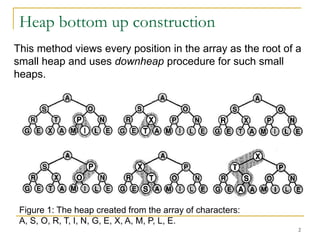
This method views every position in the array as the root of a
small heap and uses downheap procedure for such small
heaps.

Figure 1: The heap created from the array of characters:
A, S, O, R, T, I, N, G, E, X, A, M, P, L, E.
2
Heap bottom-up construction procedure
procedure build_heap;
begin
for k:= M div 2 downto 1 do
downheap(k);
end
M: the number of elements in the heap.
The keys in a[ (M div 2)+1 .. M] each form heaps of one
element, so they satisfy the heap condition and don’t
need to be checked.

3
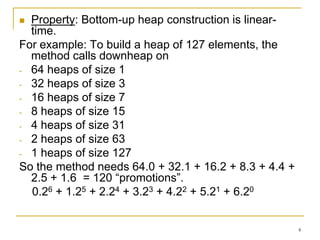
Property: Bottom-up heap construction is lineartime.
For example: To build a heap of 127 elements, the
method calls downheap on
- 64 heaps of size 1
- 32 heaps of size 3
- 16 heaps of size 7
- 8 heaps of size 15
- 4 heaps of size 31
- 2 heaps of size 63
- 1 heaps of size 127
So the method needs 64.0 + 32.1 + 16.2 + 8.3 + 4.4 +
2.5 + 1.6 = 120 “promotions”.
0.26 + 1.25 + 2.24 + 3.23 + 4.22 + 5.21 + 6.20


4
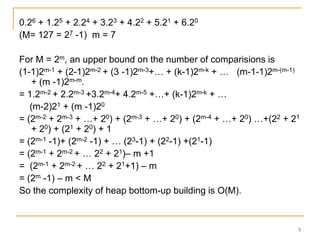
0.26 + 1.25 + 2.24 + 3.23 + 4.22 + 5.21 + 6.20
(M= 127 = 27 -1) m = 7
For M = 2m, an upper bound on the number of comparisions is
(1-1)2m-1 + (2-1)2m-2 + (3 -1)2m-3+… + (k-1)2m-k + … (m-1-1)2m-(m-1)
+ (m -1)2m-m.
= 1.2m-2 + 2.2m-3 +3.2m-4+ 4.2m-5 +…+ (k-1)2m-k + …
(m-2)21 + (m -1)20
= (2m-2 + 2m-3 + …+ 20) + (2m-3 + …+ 20) + (2m-4 + …+ 20) …+(22 + 21
+ 20) + (21 + 20) + 1
= (2m-1 -1)+ (2m-2 -1) + … (23-1) + (22-1) +(21-1)
= (2m-1 + 2m-2 + … 22 + 21)– m +1
= (2m-1 + 2m-2 + … 22 + 21+1) – m
= (2m -1) – m < M
So the complexity of heap bottom-up building is O(M).

5

Appendix a 2

  • 1.
    Appendix A: HeapBottomup Construction Course: Algorithm Analysis and Design 1
  • 2.
    Heap bottom upconstruction This method views every position in the array as the root of a small heap and uses downheap procedure for such small heaps. Figure 1: The heap created from the array of characters: A, S, O, R, T, I, N, G, E, X, A, M, P, L, E. 2
  • 3.
    Heap bottom-up constructionprocedure procedure build_heap; begin for k:= M div 2 downto 1 do downheap(k); end M: the number of elements in the heap. The keys in a[ (M div 2)+1 .. M] each form heaps of one element, so they satisfy the heap condition and don’t need to be checked. 3
  • 4.
    Property: Bottom-up heapconstruction is lineartime. For example: To build a heap of 127 elements, the method calls downheap on - 64 heaps of size 1 - 32 heaps of size 3 - 16 heaps of size 7 - 8 heaps of size 15 - 4 heaps of size 31 - 2 heaps of size 63 - 1 heaps of size 127 So the method needs 64.0 + 32.1 + 16.2 + 8.3 + 4.4 + 2.5 + 1.6 = 120 “promotions”. 0.26 + 1.25 + 2.24 + 3.23 + 4.22 + 5.21 + 6.20  4
  • 5.
    0.26 + 1.25+ 2.24 + 3.23 + 4.22 + 5.21 + 6.20 (M= 127 = 27 -1) m = 7 For M = 2m, an upper bound on the number of comparisions is (1-1)2m-1 + (2-1)2m-2 + (3 -1)2m-3+… + (k-1)2m-k + … (m-1-1)2m-(m-1) + (m -1)2m-m. = 1.2m-2 + 2.2m-3 +3.2m-4+ 4.2m-5 +…+ (k-1)2m-k + … (m-2)21 + (m -1)20 = (2m-2 + 2m-3 + …+ 20) + (2m-3 + …+ 20) + (2m-4 + …+ 20) …+(22 + 21 + 20) + (21 + 20) + 1 = (2m-1 -1)+ (2m-2 -1) + … (23-1) + (22-1) +(21-1) = (2m-1 + 2m-2 + … 22 + 21)– m +1 = (2m-1 + 2m-2 + … 22 + 21+1) – m = (2m -1) – m < M So the complexity of heap bottom-up building is O(M). 5