CHAPTER II
LINGUISTIC ELEMENTSIN
DISCOURSE
Cohesion
Cohesive devices: Reference; Substitution;
Ellipsis; Conjunction; Lexical cohesion
Coherence
Information structure: Given & new
information; Theme & rheme
Genres
2.
COHESION
Cohesion is thegrammatical & lexical
linking (cohesive ties/connections)
within a text or sentence that holds a
text together & gives it meaning.
3.
Without cohesion:
“Mary arrived.She sat down. It rained. John
was late.”
With cohesion:
“When Mary arrived, she sat down because it
was raining, and John was late.”
4.
2. TYPES OFCOHESION
- Grammatical cohesion, which is based on
structural content
- Lexical cohesion, which is based on lexical
content & background knowledge.
* A cohesive text is created in many different ways.
* Five general categories of cohesive devices that
create coherence in texts: Reference , Ellipsis (word
omission/), Substitution (word/phrase replacement),
Lexical cohesion (lexical items) & Conjunction
/connectors.
5.
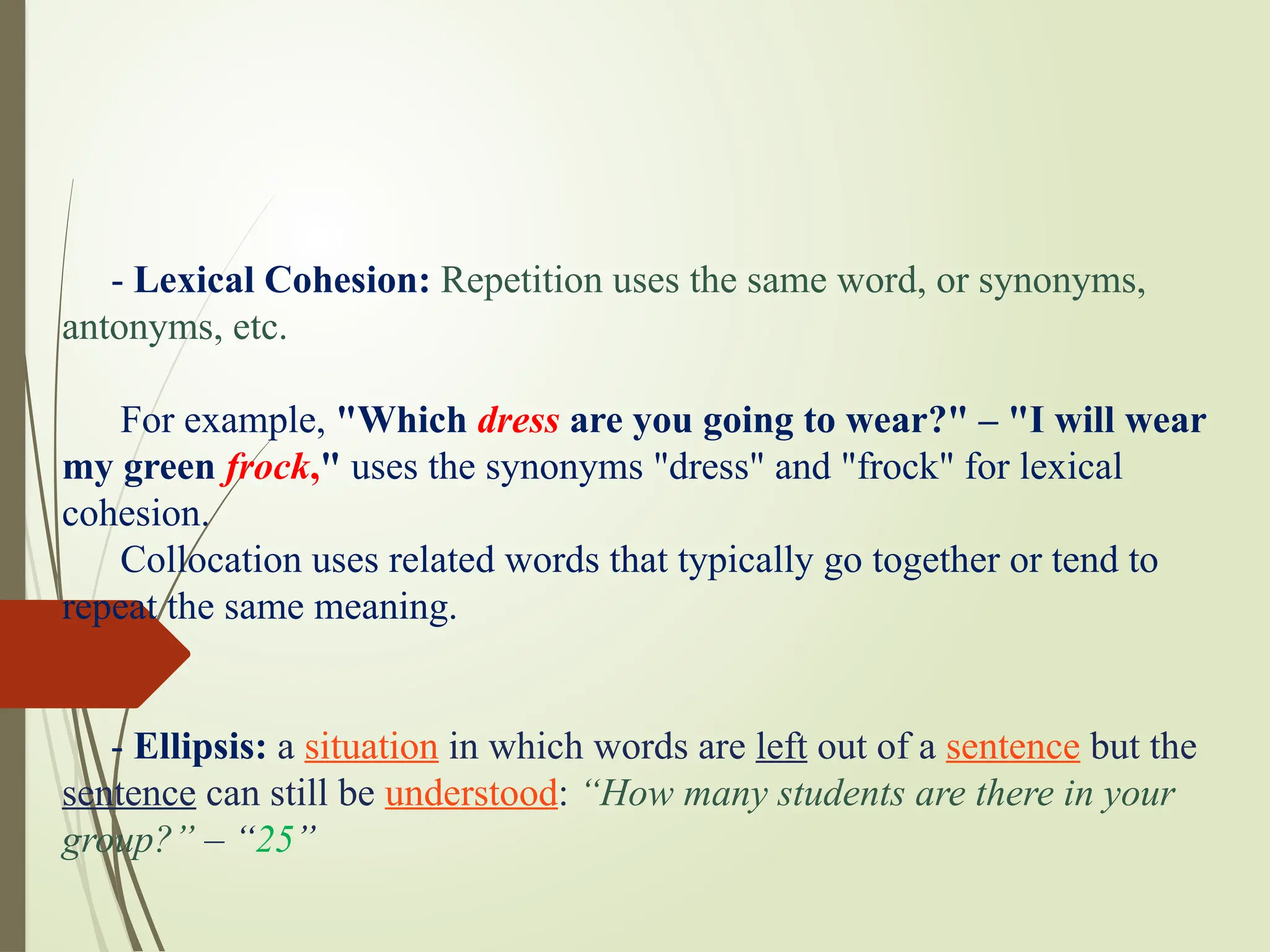
- Lexical Cohesion:Repetition uses the same word, or synonyms,
antonyms, etc.
For example, "Which dress are you going to wear?" – "I will wear
my green frock," uses the synonyms "dress" and "frock" for lexical
cohesion.
Collocation uses related words that typically go together or tend to
repeat the same meaning.
- Ellipsis: a situation in which words are left out of a sentence but the
sentence can still be understood: “How many students are there in your
group?” – “25”
6.
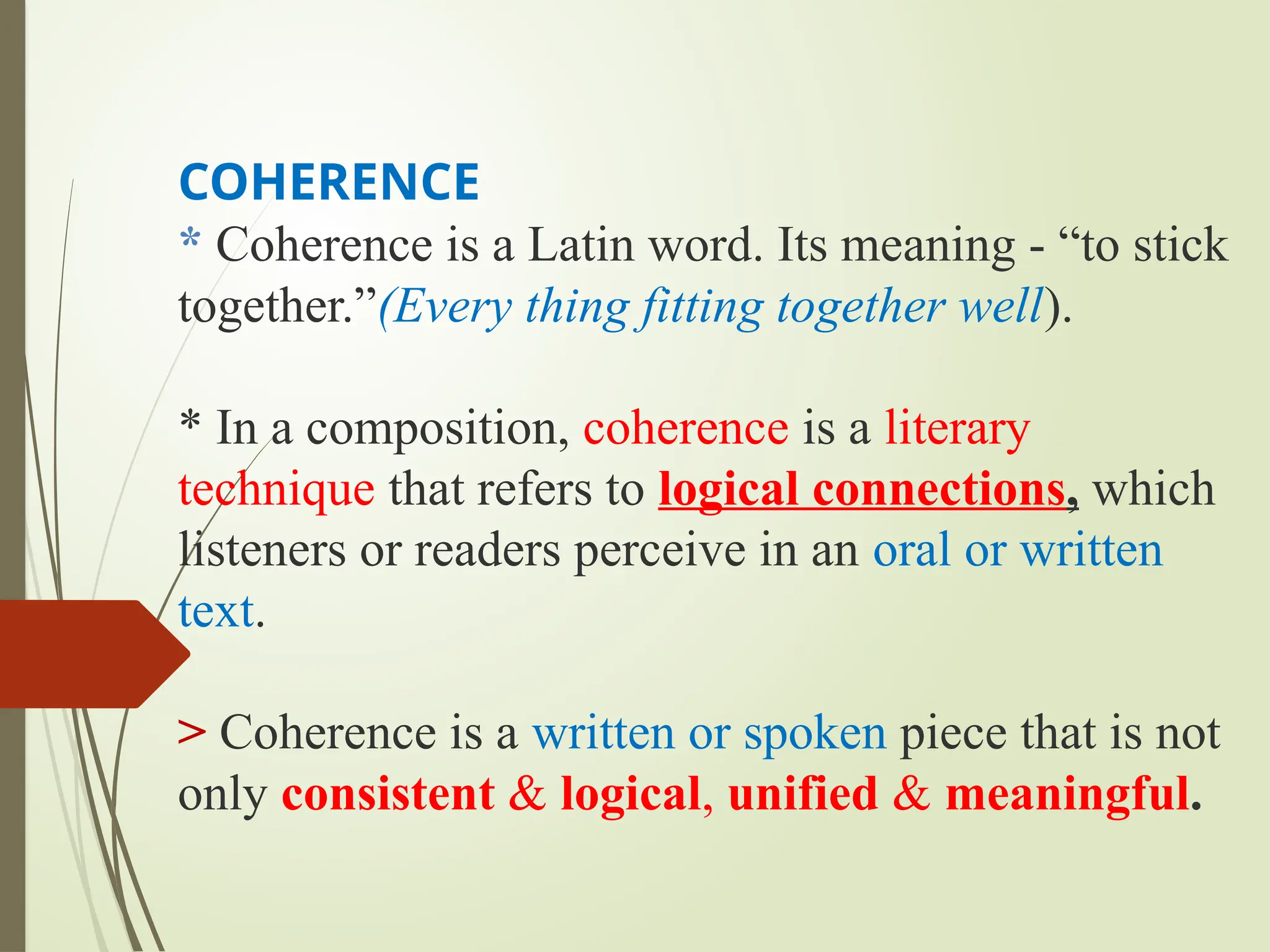
COHERENCE
* Coherence isa Latin word. Its meaning - “to stick
together.”(Every thing fitting together well).
* In a composition, coherence is a literary
technique that refers to logical connections, which
listeners or readers perceive in an oral or written
text.
> Coherence is a written or spoken piece that is not
only consistent & logical, unified & meaningful.
7.
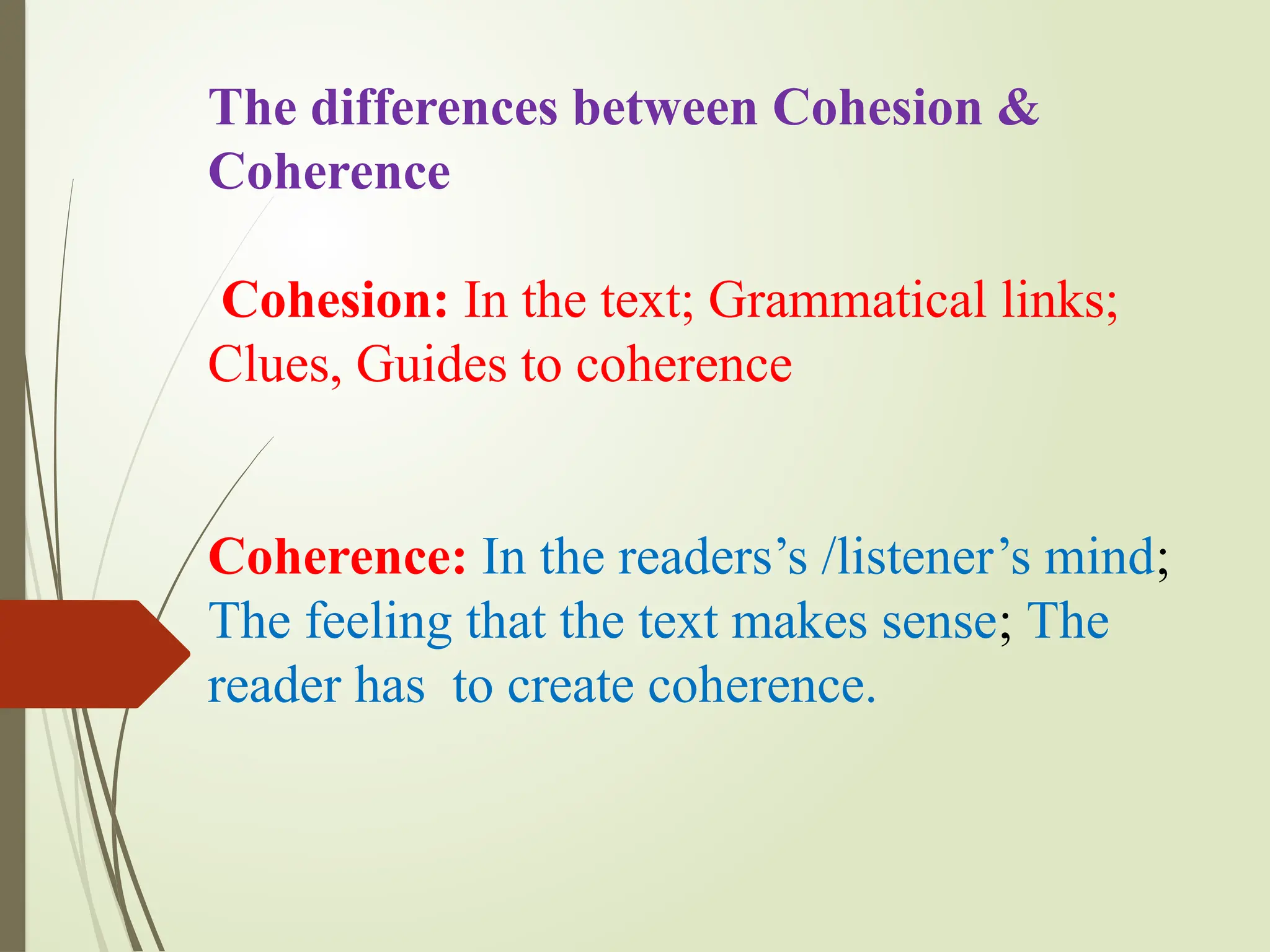
The differences betweenCohesion &
Coherence
Cohesion: In the text; Grammatical links;
Clues, Guides to coherence
Coherence: In the readers’s /listener’s mind;
The feeling that the text makes sense; The
reader has to create coherence.
8.
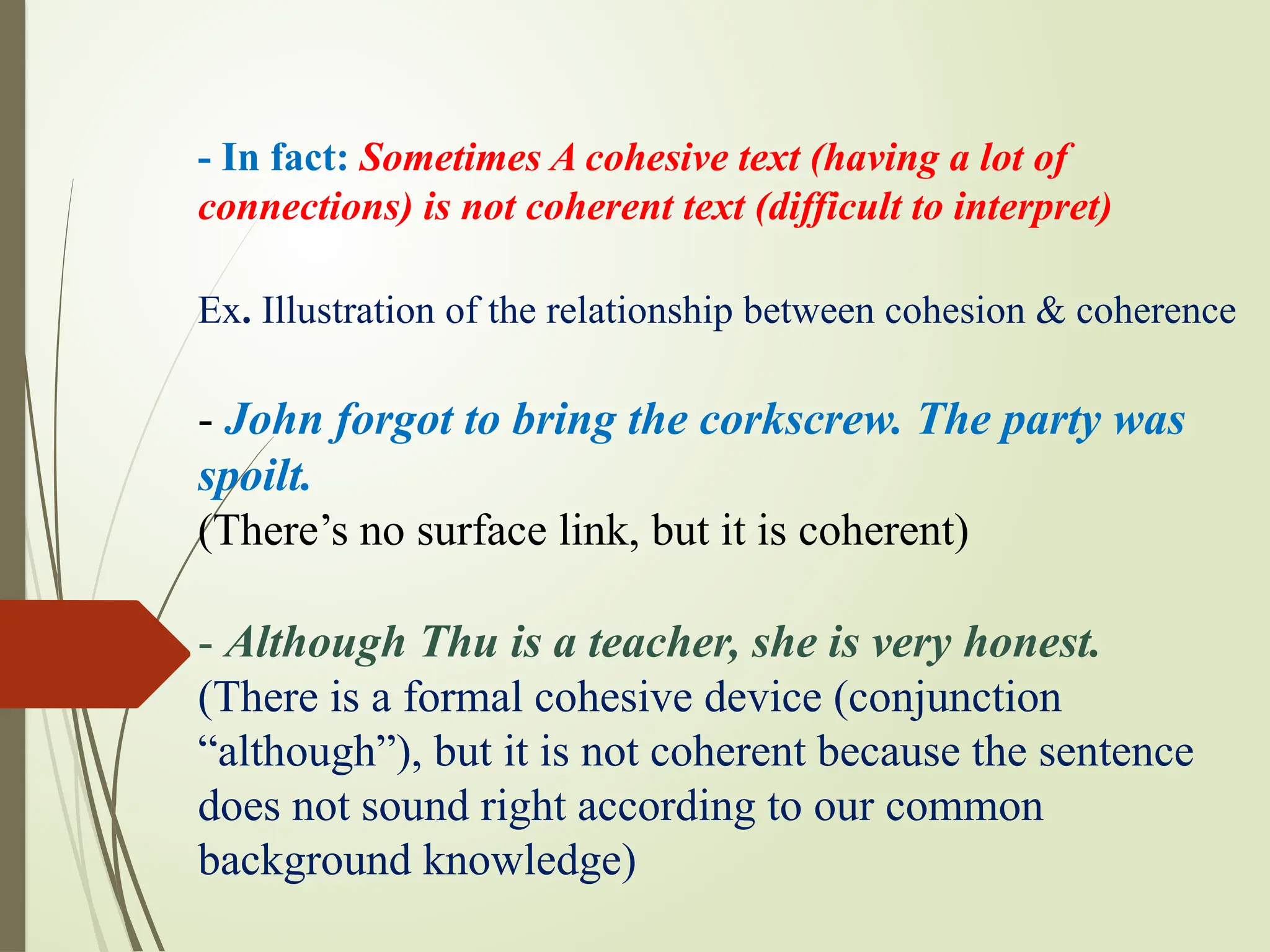
- In fact:Sometimes A cohesive text (having a lot of
connections) is not coherent text (difficult to interpret)
Ex. Illustration of the relationship between cohesion & coherence
- John forgot to bring the corkscrew. The party was
spoilt.
(There’s no surface link, but it is coherent)
- Although Thu is a teacher, she is very honest.
(There is a formal cohesive device (conjunction
“although”), but it is not coherent because the sentence
does not sound right according to our common
background knowledge)
9.
Grammatical cohesion
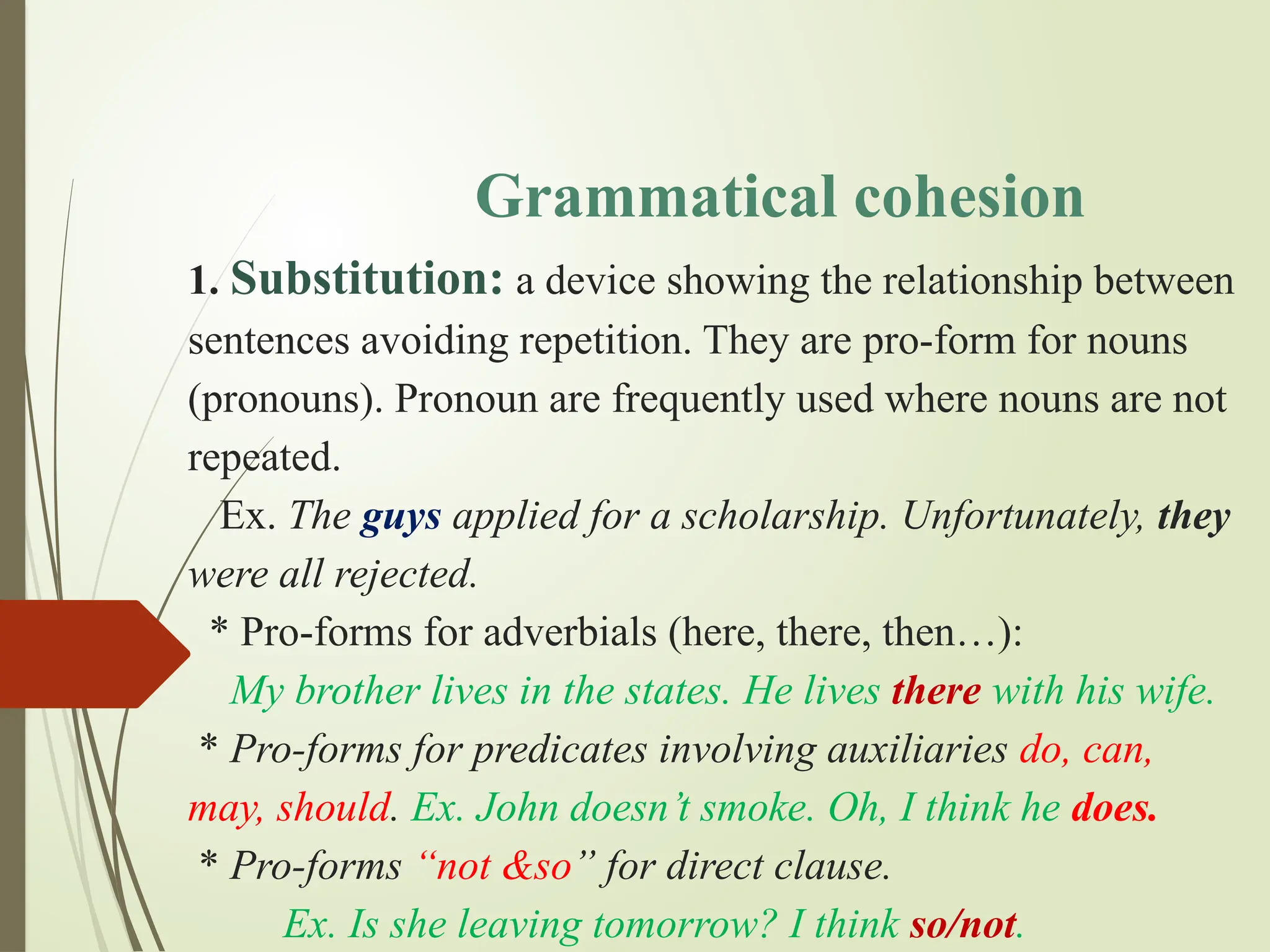
1. Substitution:a device showing the relationship between
sentences avoiding repetition. They are pro-form for nouns
(pronouns). Pronoun are frequently used where nouns are not
repeated.
Ex. The guys applied for a scholarship. Unfortunately, they
were all rejected.
* Pro-forms for adverbials (here, there, then…):
My brother lives in the states. He lives there with his wife.
* Pro-forms for predicates involving auxiliaries do, can,
may, should. Ex. John doesn’t smoke. Oh, I think he does.
* Pro-forms “not &so” for direct clause.
Ex. Is she leaving tomorrow? I think so/not.
10.
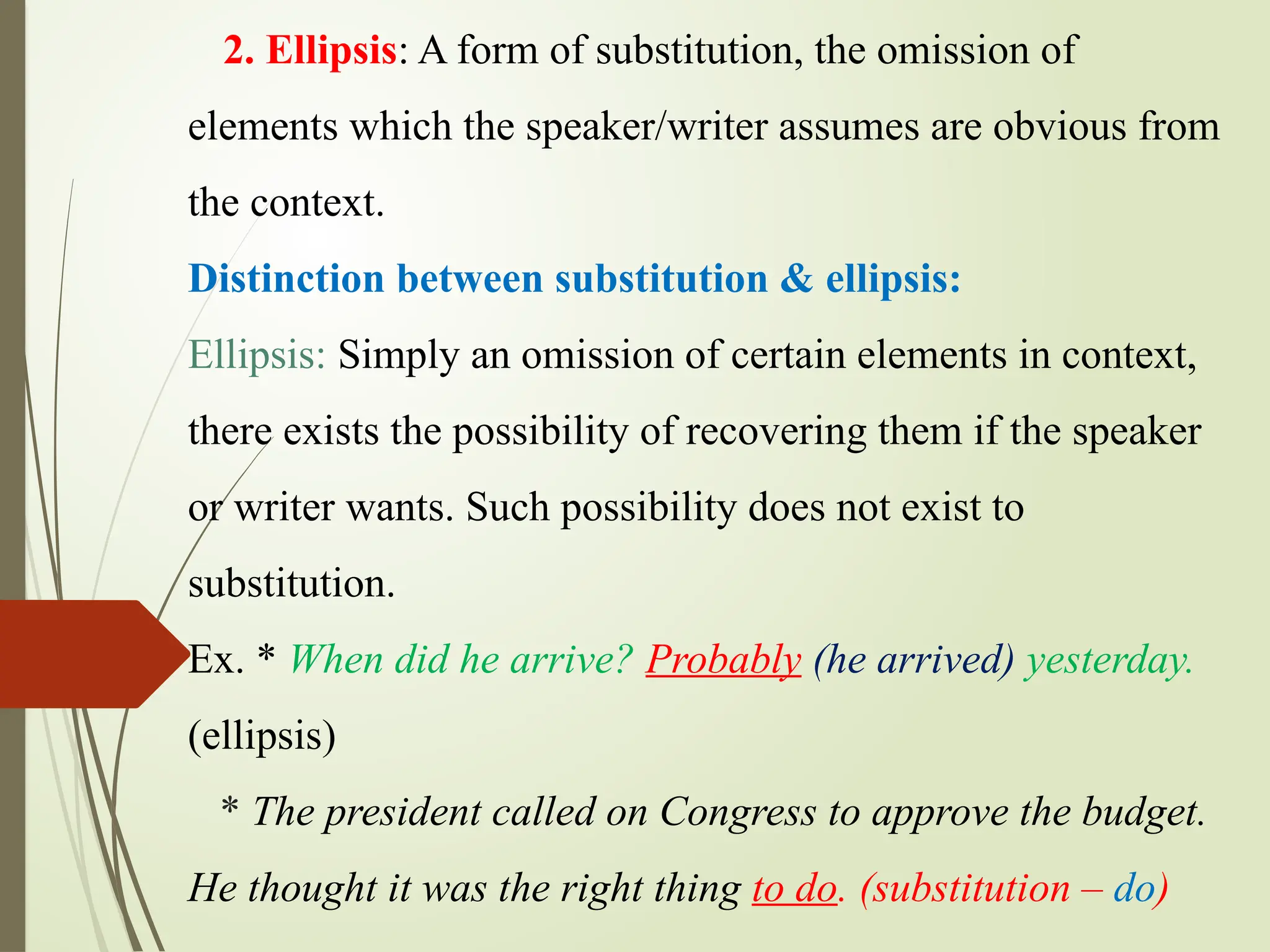
2. Ellipsis: Aform of substitution, the omission of
elements which the speaker/writer assumes are obvious from
the context.
Distinction between substitution & ellipsis:
Ellipsis: Simply an omission of certain elements in context,
there exists the possibility of recovering them if the speaker
or writer wants. Such possibility does not exist to
substitution.
Ex. * When did he arrive? Probably (he arrived) yesterday.
(ellipsis)
* The president called on Congress to approve the budget.
He thought it was the right thing to do. (substitution – do)
11.
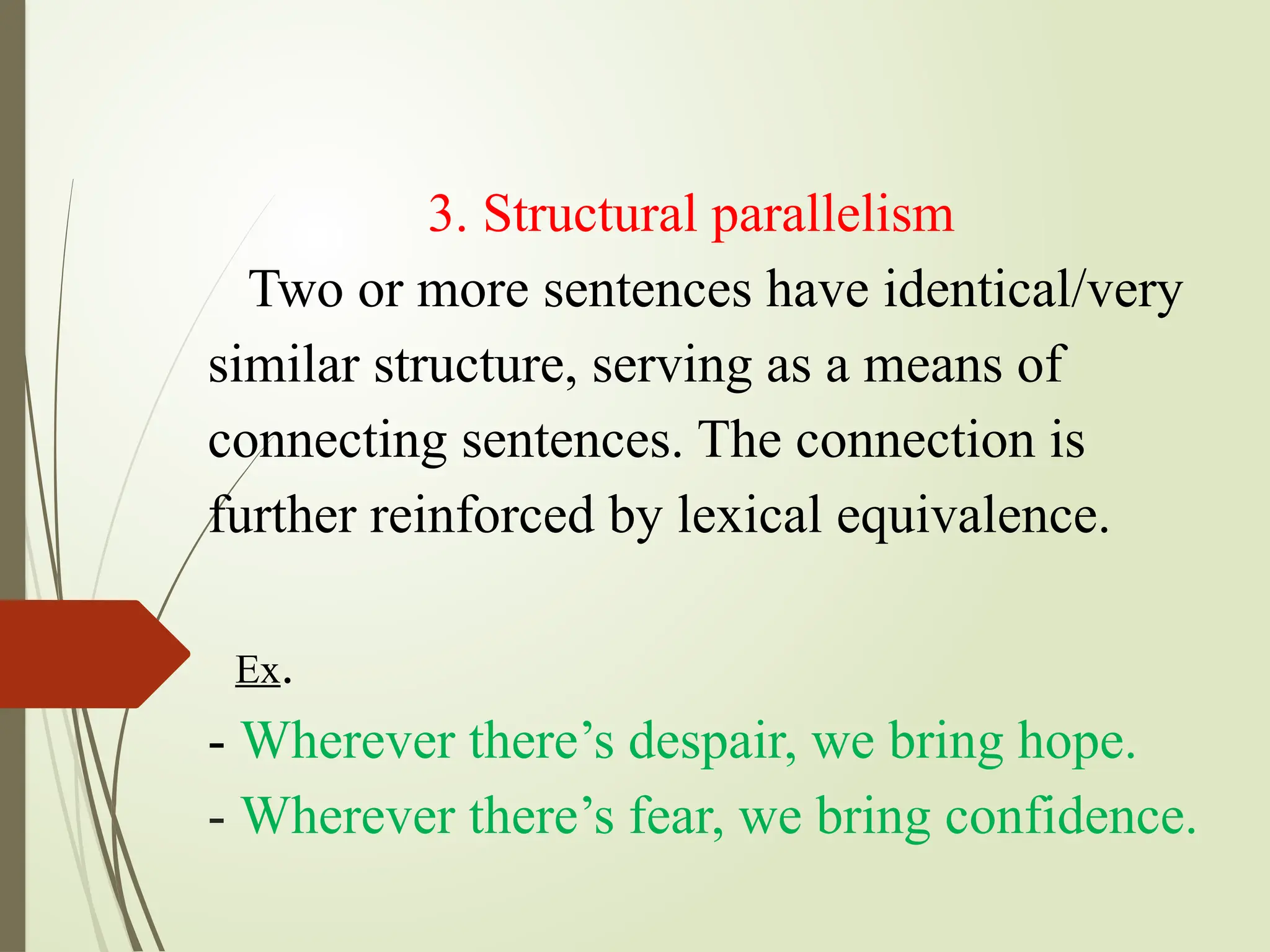
3. Structural parallelism
Twoor more sentences have identical/very
similar structure, serving as a means of
connecting sentences. The connection is
further reinforced by lexical equivalence.
Ex.
- Wherever there’s despair, we bring hope.
- Wherever there’s fear, we bring confidence.
12.
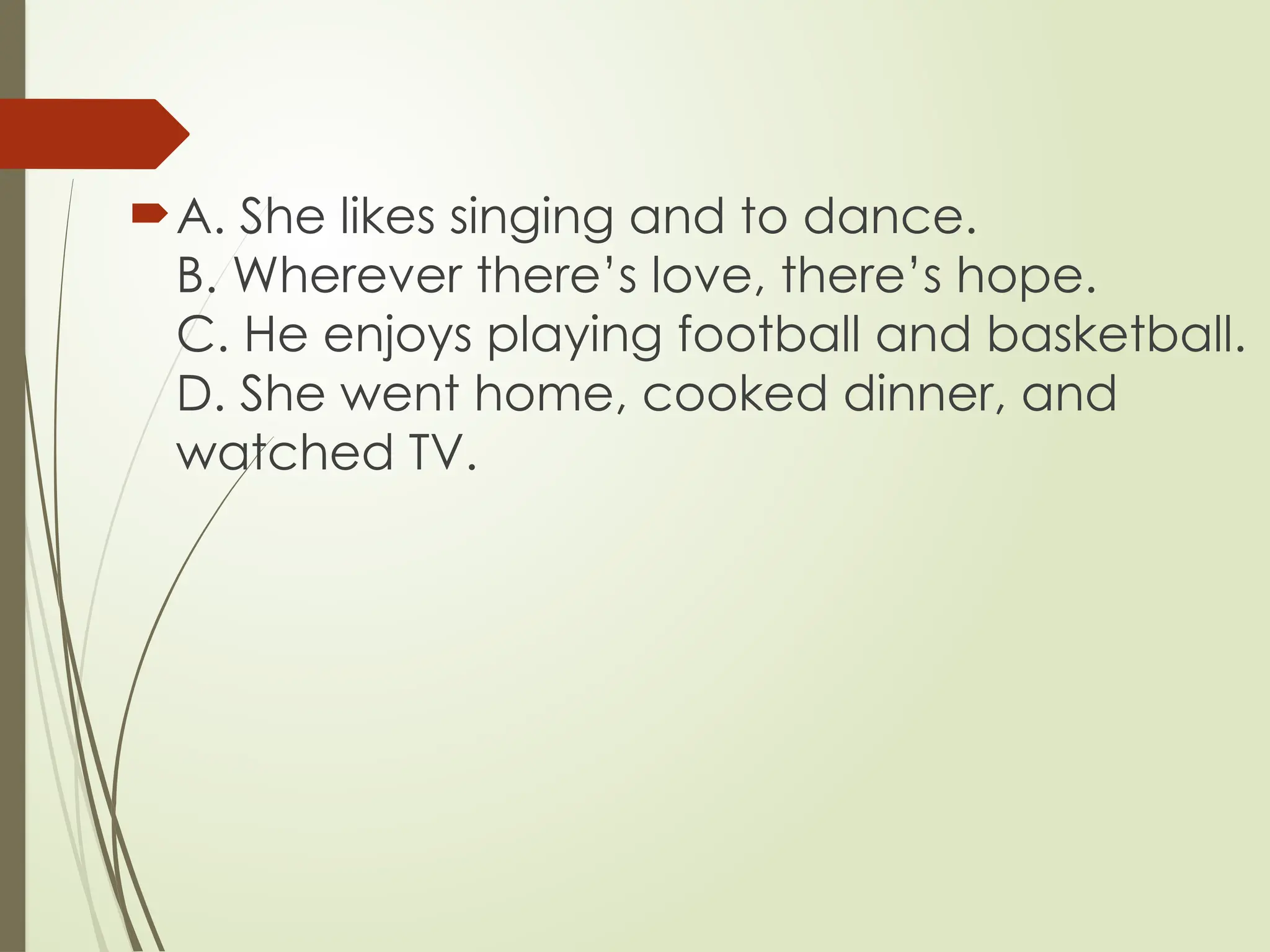
A. She likessinging and to dance.
B. Wherever there’s love, there’s hope.
C. He enjoys playing football and basketball.
D. She went home, cooked dinner, and
watched TV.
13.
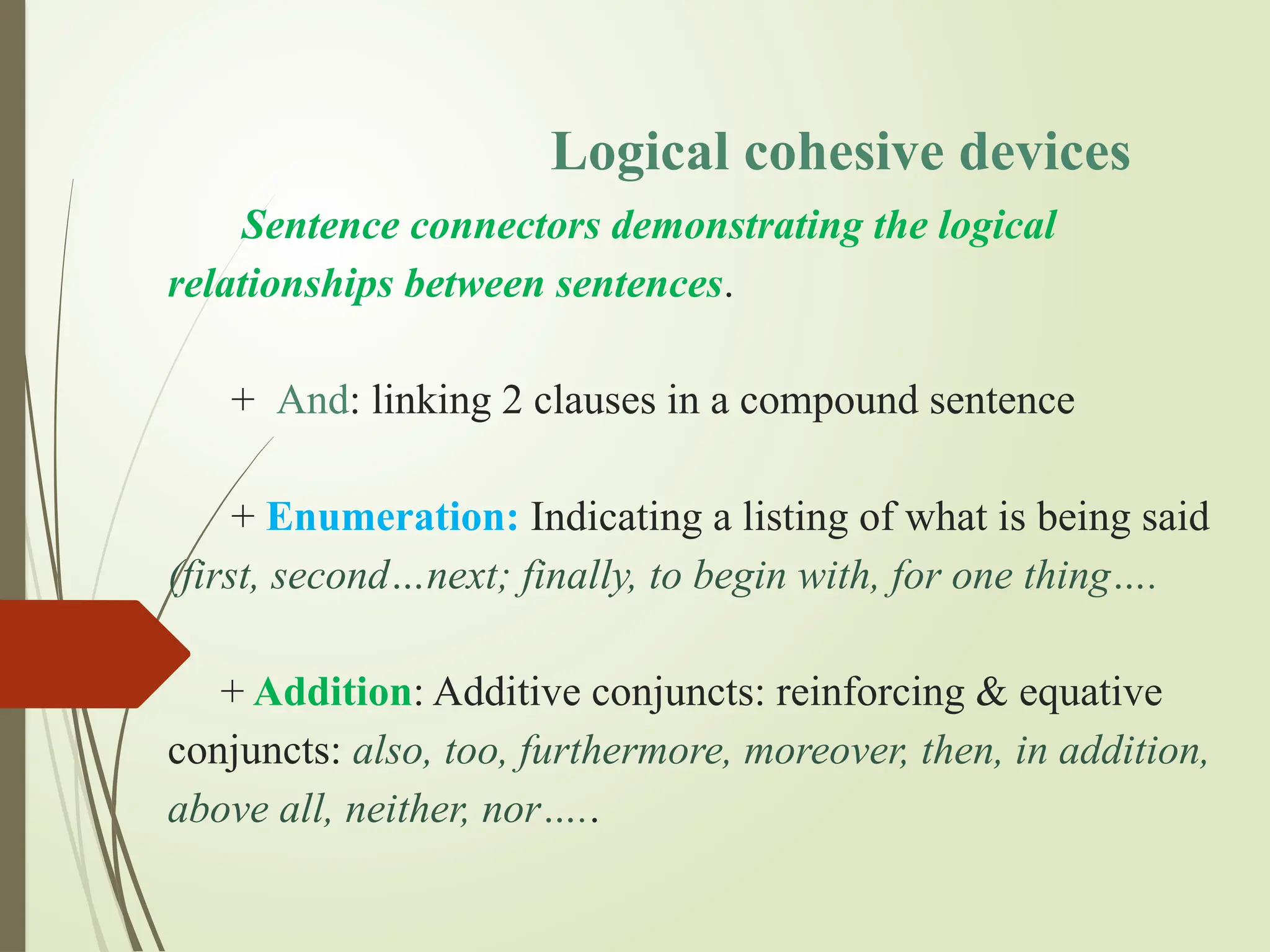
Logical cohesive devices
Sentenceconnectors demonstrating the logical
relationships between sentences.
+ And: linking 2 clauses in a compound sentence
+ Enumeration: Indicating a listing of what is being said
(first, second…next; finally, to begin with, for one thing….
+ Addition: Additive conjuncts: reinforcing & equative
conjuncts: also, too, furthermore, moreover, then, in addition,
above all, neither, nor…..
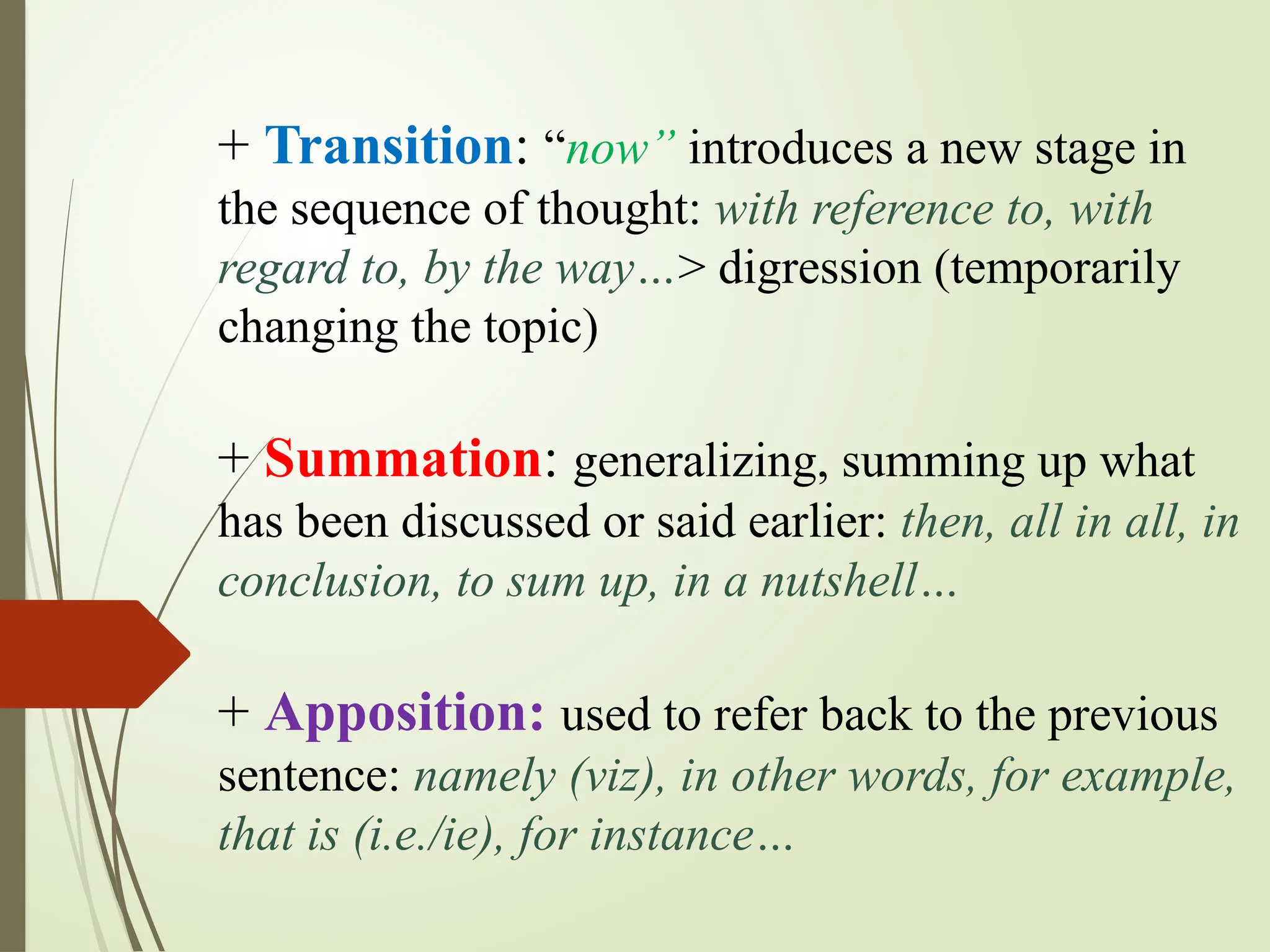
14.
+ Transition: “now”introduces a new stage in
the sequence of thought: with reference to, with
regard to, by the way…> digression (temporarily
changing the topic)
+ Summation: generalizing, summing up what
has been discussed or said earlier: then, all in all, in
conclusion, to sum up, in a nutshell…
+ Apposition: used to refer back to the previous
sentence: namely (viz), in other words, for example,
that is (i.e./ie), for instance…
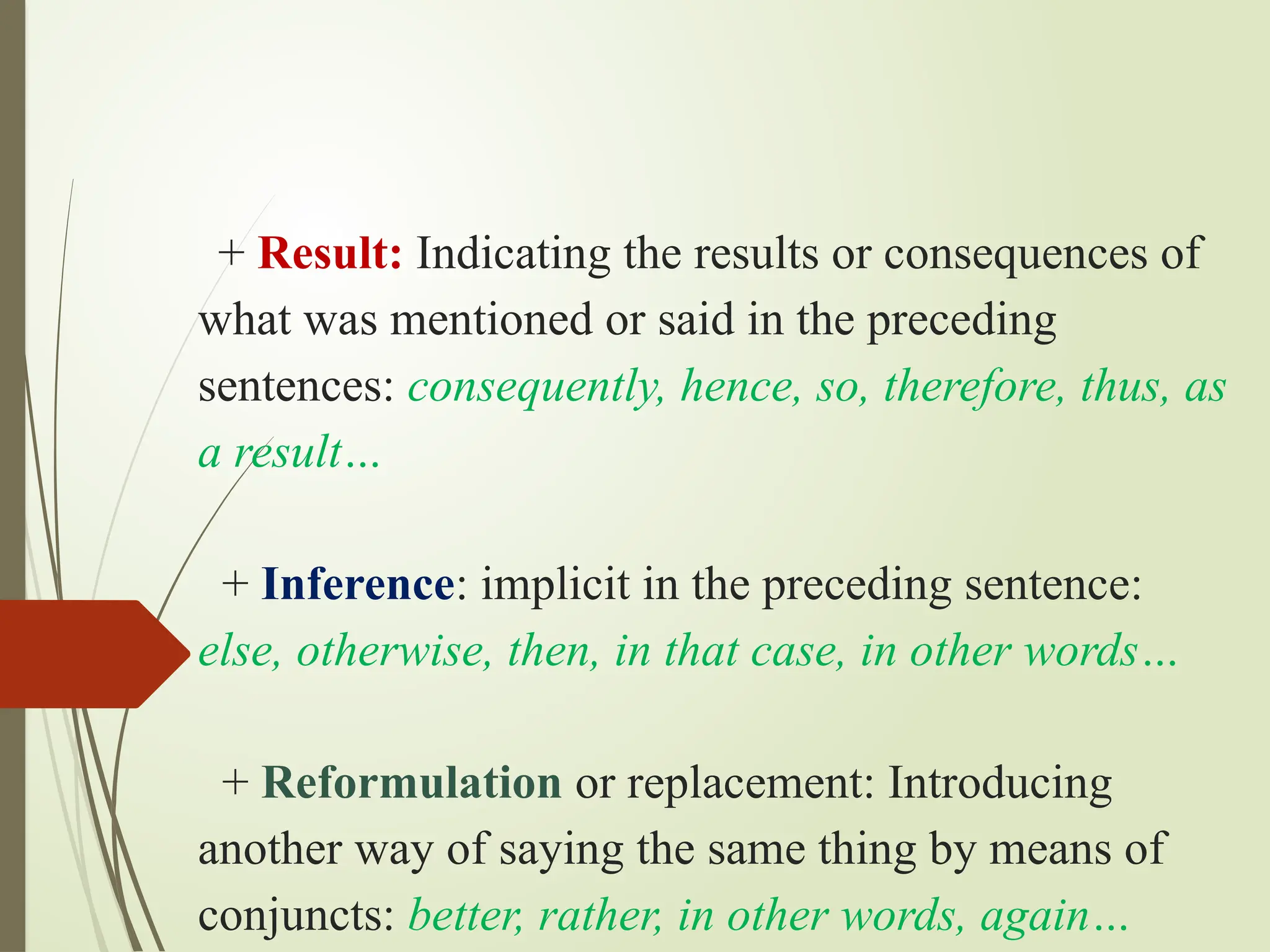
15.
+ Result: Indicatingthe results or consequences of
what was mentioned or said in the preceding
sentences: consequently, hence, so, therefore, thus, as
a result…
+ Inference: implicit in the preceding sentence:
else, otherwise, then, in that case, in other words…
+ Reformulation or replacement: Introducing
another way of saying the same thing by means of
conjuncts: better, rather, in other words, again…
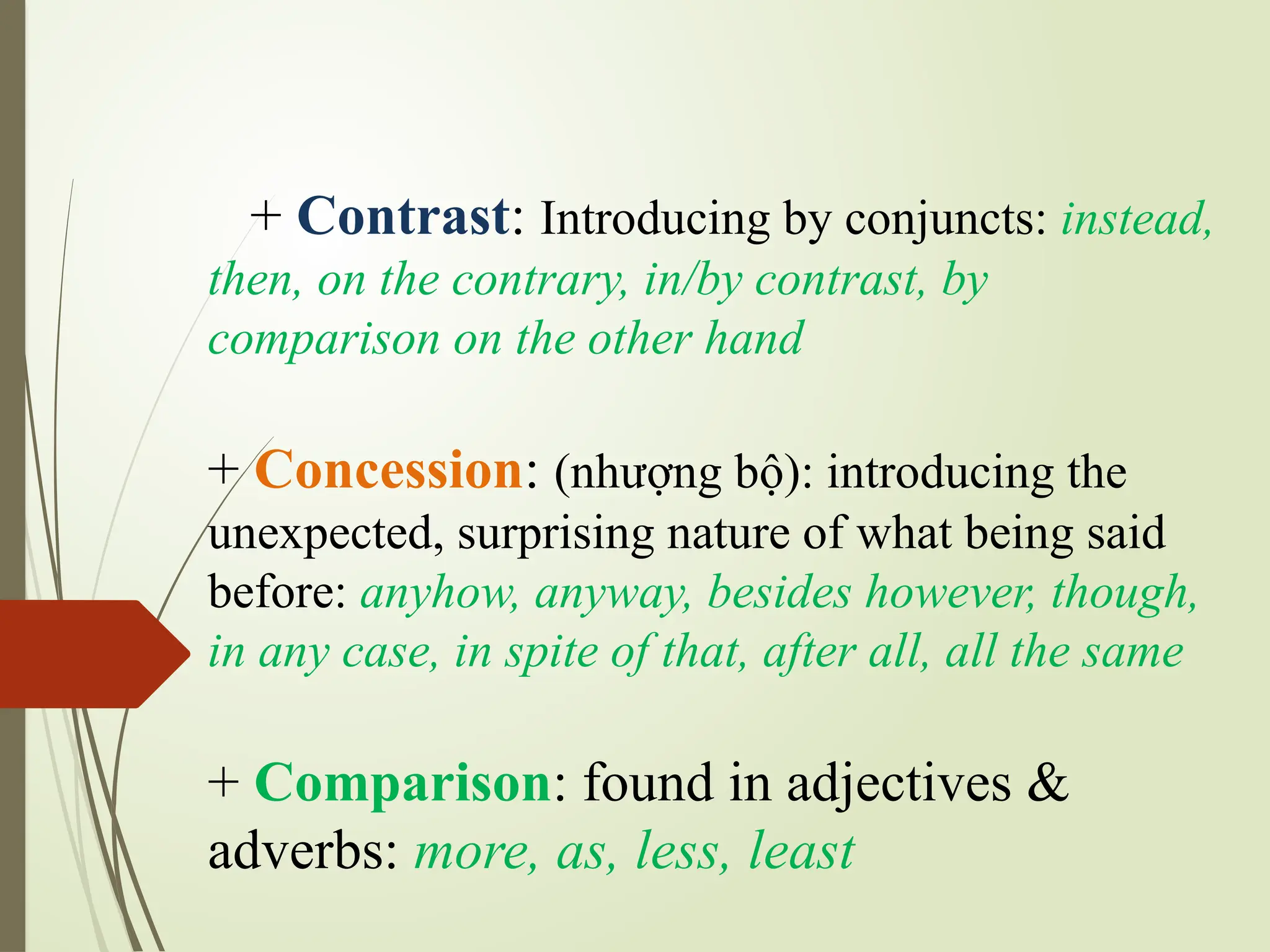
16.
+ Contrast: Introducingby conjuncts: instead,
then, on the contrary, in/by contrast, by
comparison on the other hand
+ Concession: (nhượng bộ): introducing the
unexpected, surprising nature of what being said
before: anyhow, anyway, besides however, though,
in any case, in spite of that, after all, all the same
+ Comparison: found in adjectives &
adverbs: more, as, less, least
17.
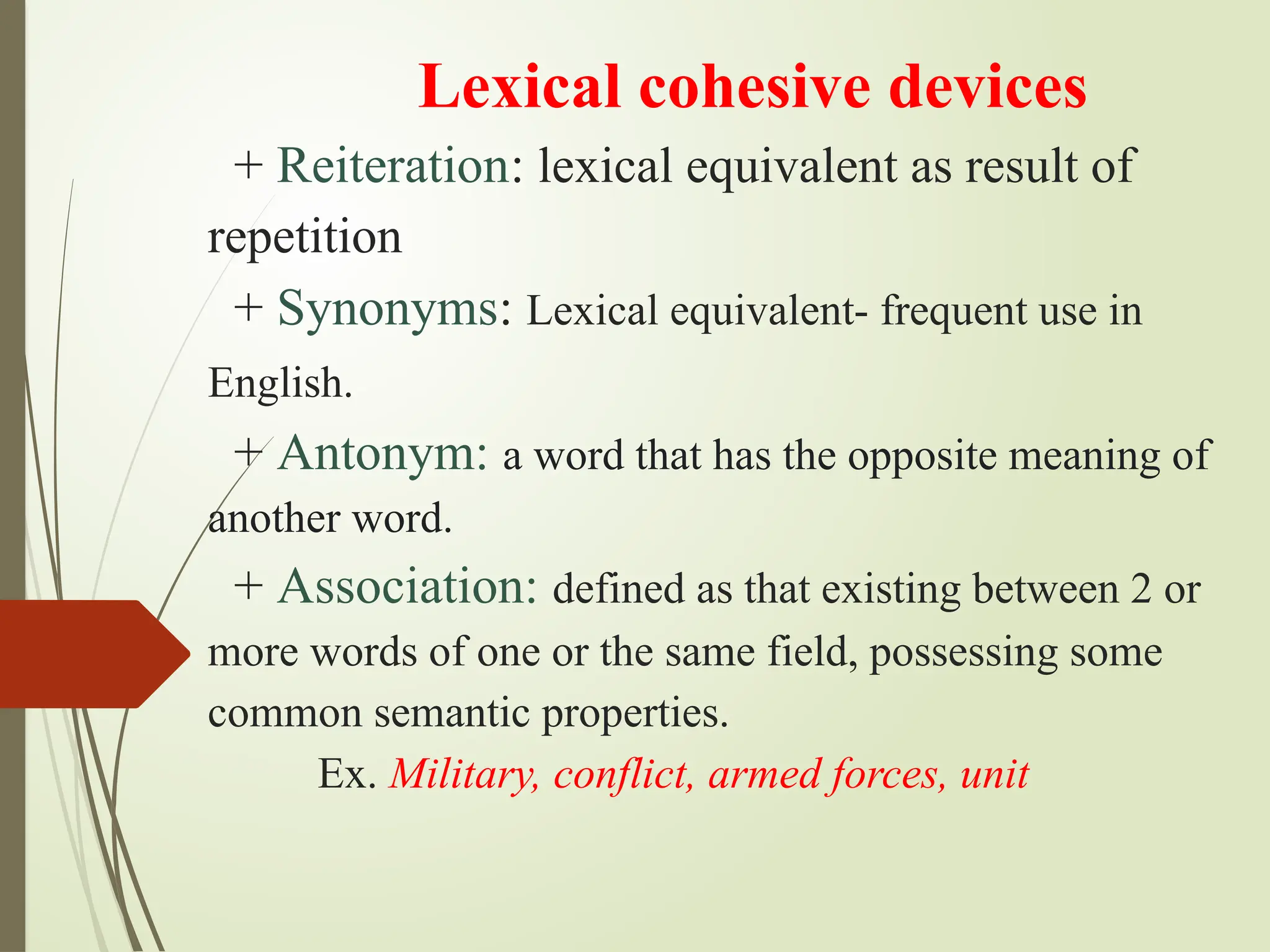
Lexical cohesive devices
+Reiteration: lexical equivalent as result of
repetition
+ Synonyms: Lexical equivalent- frequent use in
English.
+ Antonym: a word that has the opposite meaning of
another word.
+ Association: defined as that existing between 2 or
more words of one or the same field, possessing some
common semantic properties.
Ex. Military, conflict, armed forces, unit
18.
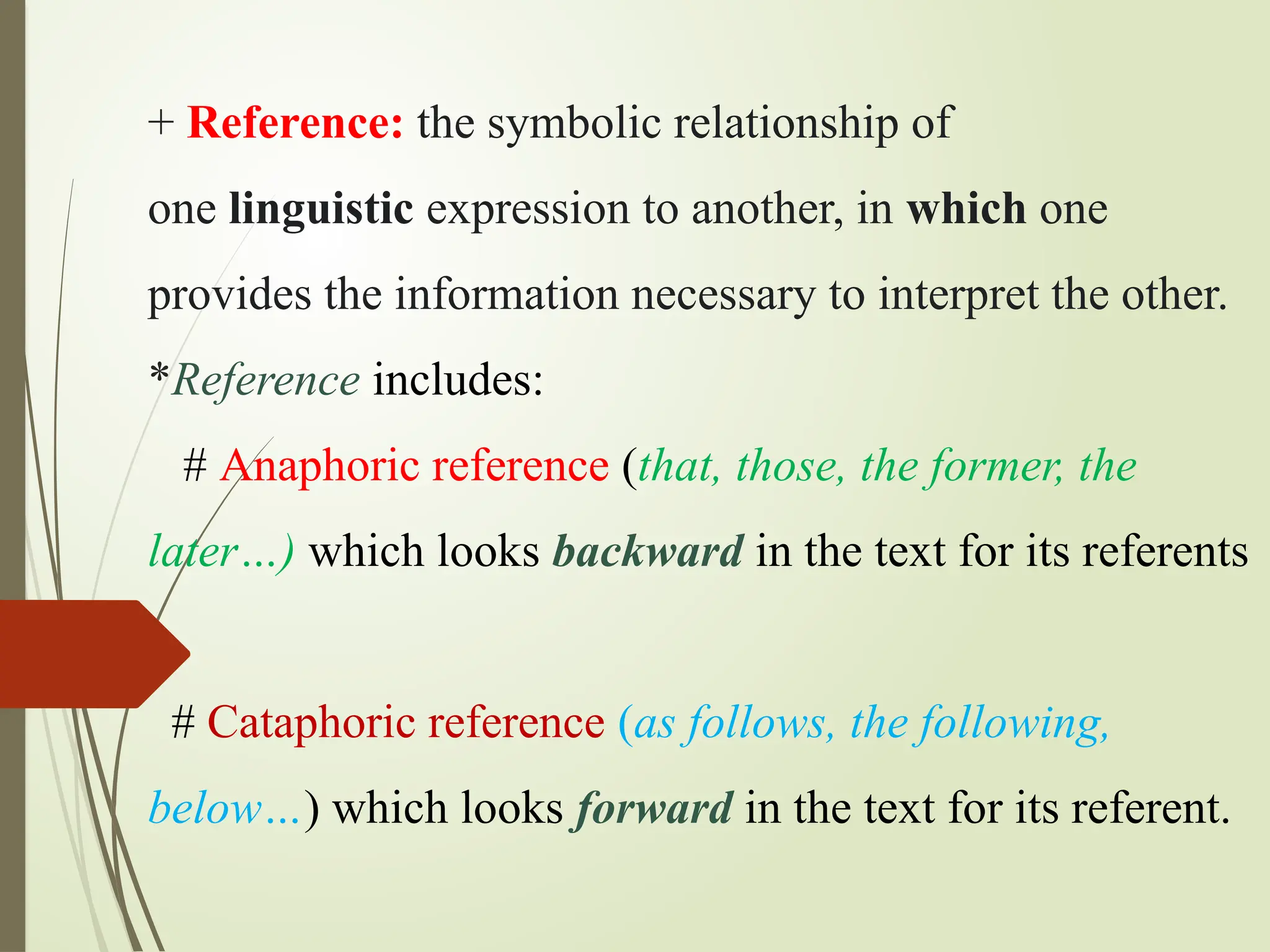
+ Reference: thesymbolic relationship of
one linguistic expression to another, in which one
provides the information necessary to interpret the other.
*Reference includes:
# Anaphoric reference (that, those, the former, the
later…) which looks backward in the text for its referents
# Cataphoric reference (as follows, the following,
below…) which looks forward in the text for its referent.
19.
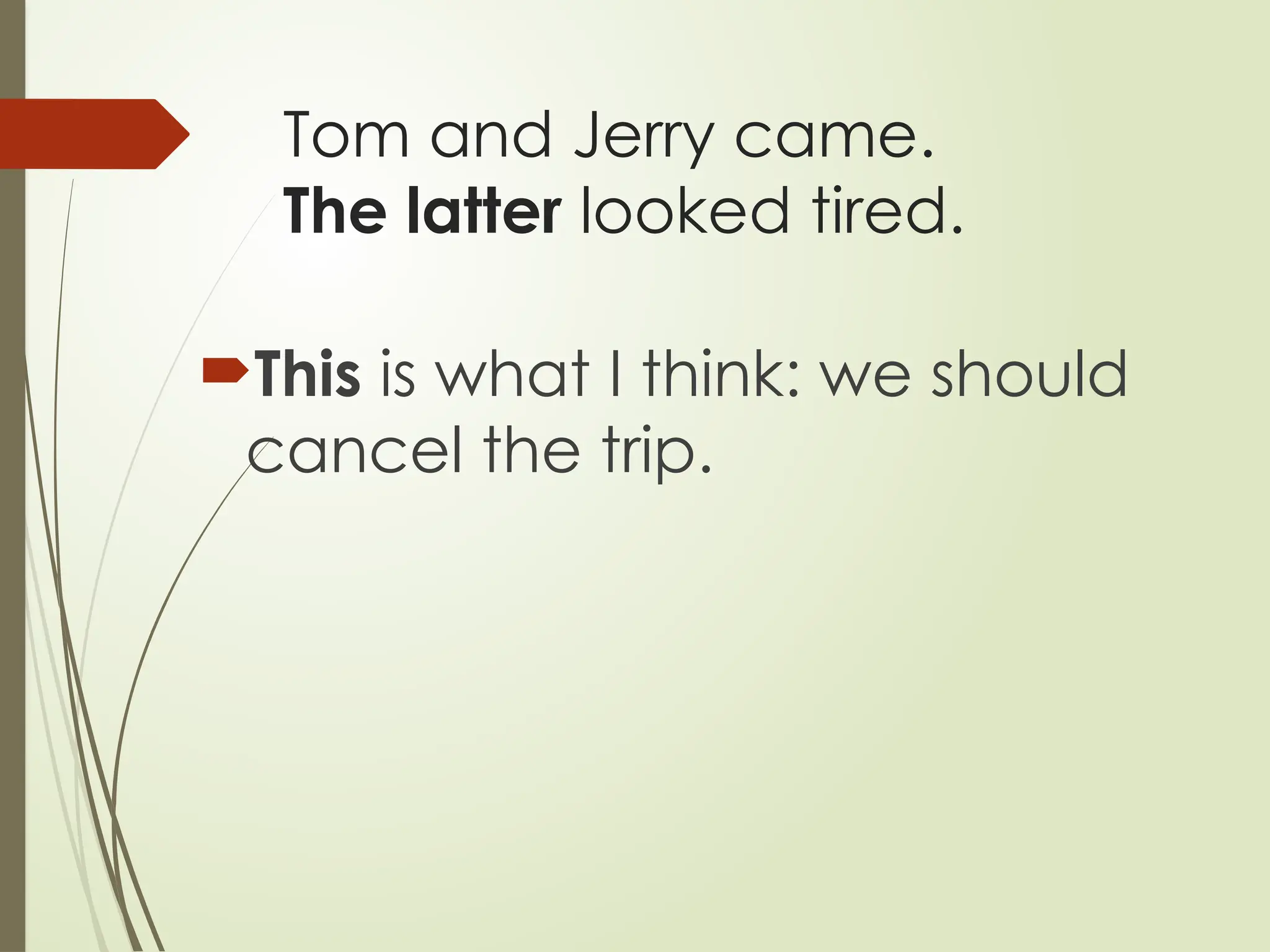
Tom and Jerrycame.
The latter looked tired.
This is what I think: we should
cancel the trip.
20.
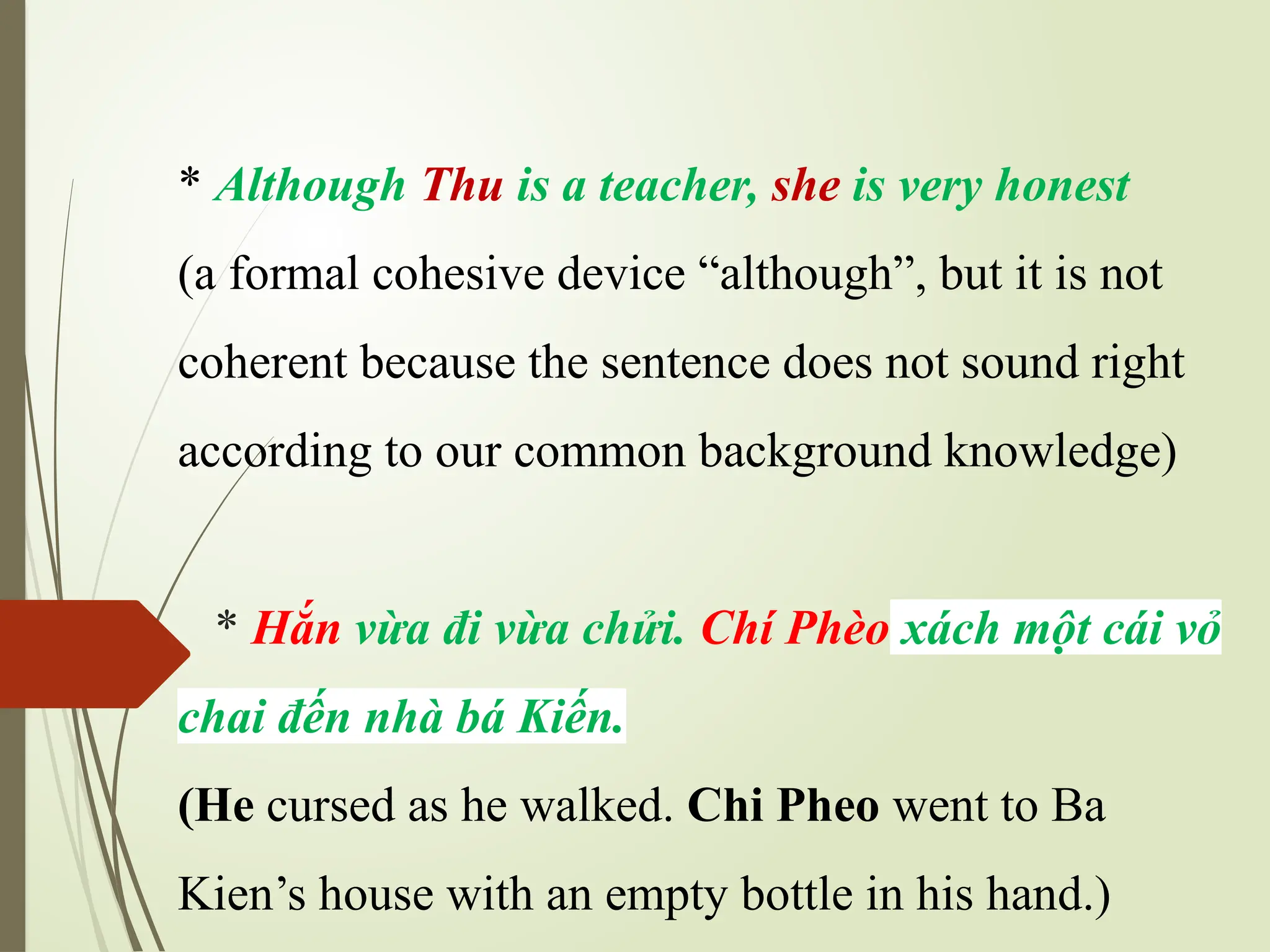
* Although Thuis a teacher, she is very honest
(a formal cohesive device “although”, but it is not
coherent because the sentence does not sound right
according to our common background knowledge)
* Hắn vừa đi vừa chửi. Chí Phèo xách một cái vỏ
chai đến nhà bá Kiến.
(He cursed as he walked. Chi Pheo went to Ba
Kien’s house with an empty bottle in his hand.)
21.
SUMMARY
* Chapter IImentions about the distinction
between cohesion and coherence.
* Cohesion is formal links which exist
between sentences; Cohesion has 3 types:
grammatical, logical & lexical
* Coherence is the semantic ties in
discourse.
22.
Information structure
The informationstructure refers to the interface
between the structure & meaning of linguistic
utterances; the interlocutors' mental representations
of information, discourse referents, and the overall
universe of discourse, on the other.
Thu t ng c u trúc thông tin đ c p đ n giao
ậ ữ ấ ề ậ ế
di n gi a c u trúc và ý nghĩa c a l i nói ngôn
ệ ữ ấ ủ ờ
ngữ; là các bi u
ể đ t
ạ tinh th n c a ng i đ i tho i
ầ ủ ườ ố ạ
v thông tin, tham chi u di n ngôn và t ng th
ề ế ễ ổ ể
vấn đề chung c a di n ngôn.
ủ ễ
23.
Theme & Rheme
*Amessage consists of two main parts: Theme &
Rheme.
*Based on Prague School of linguistics: Information
structure of a sentence consists of 2 parts: New
information & given (old) information
The theme - the topic/main character/Topic entity
The rheme - the comment
Ex. Marry was late again.(Marry: NI)
> The Theme is the element which serves as the
point of departure of the message.
> The remainder of the message, the part in which
the theme is developed, is called the Rheme.
24.
In other words,
*Theme is left-most constituent of
the sentence –subject; It is starting
point of the utterance.
* Rheme is something what the
speaker says later.
25.
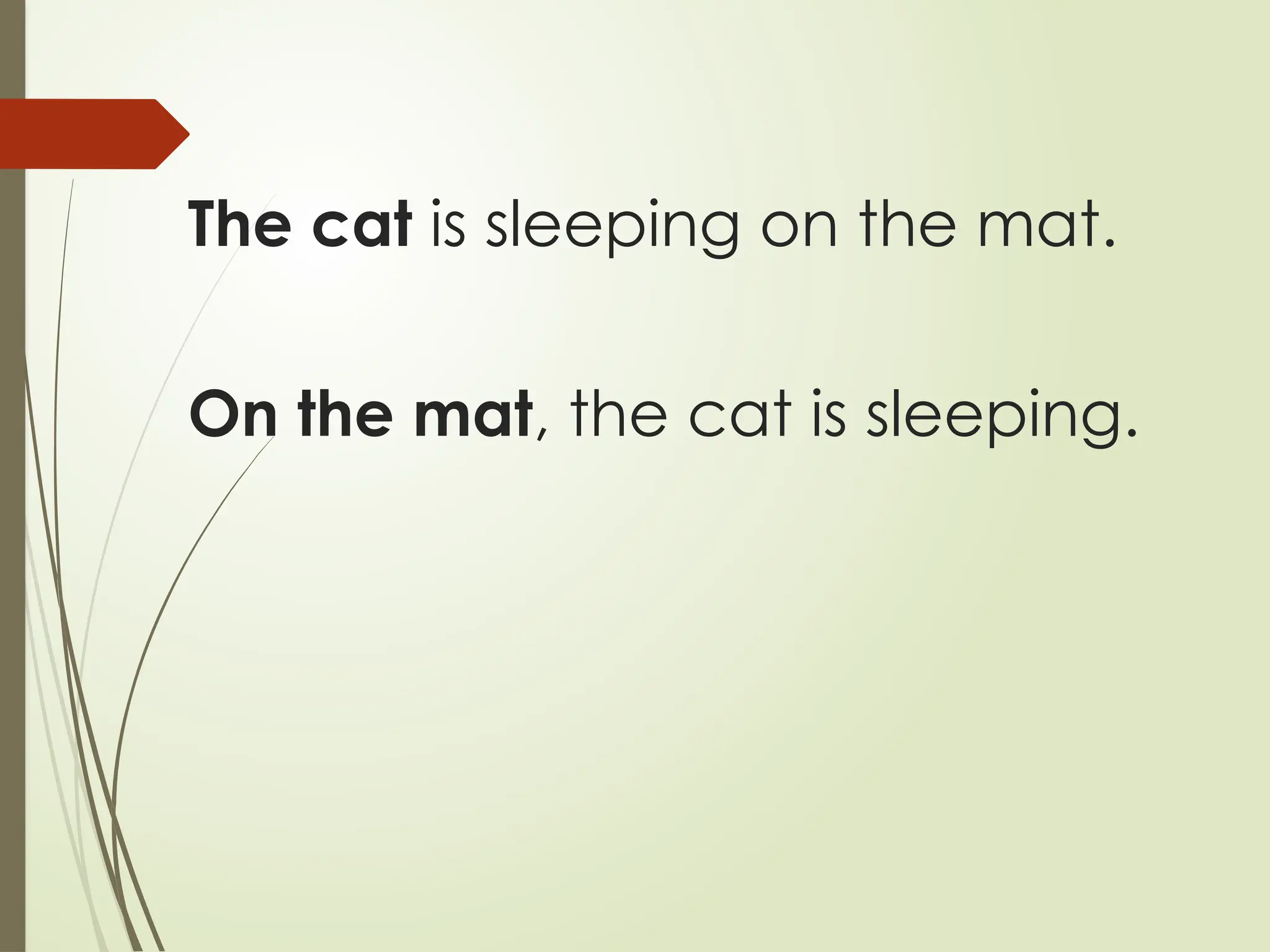
The cat issleeping on the mat.
On the mat, the cat is sleeping.
26.
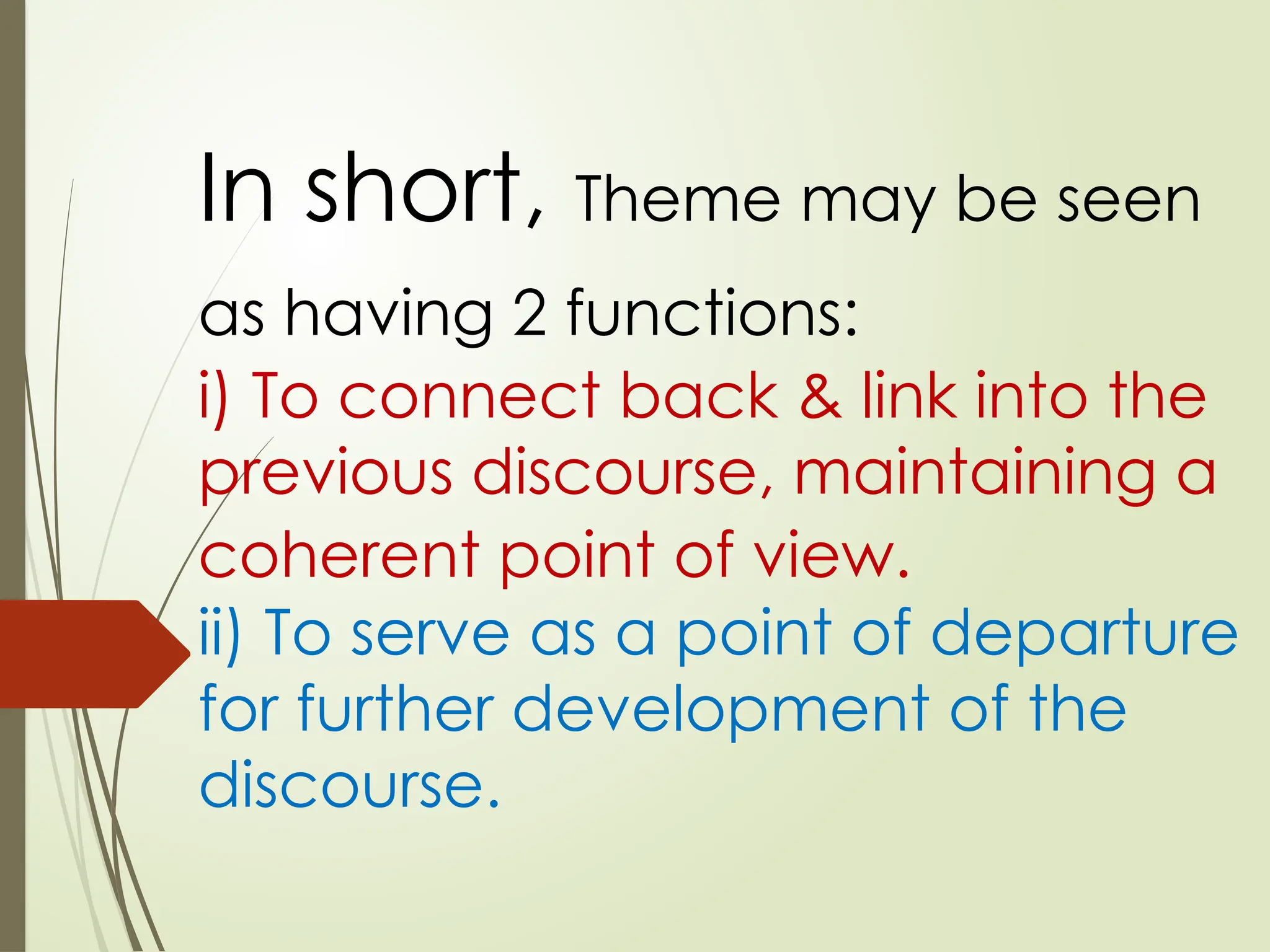
In short, Thememay be seen
as having 2 functions:
i) To connect back & link into the
previous discourse, maintaining a
coherent point of view.
ii) To serve as a point of departure
for further development of the
discourse.
27.
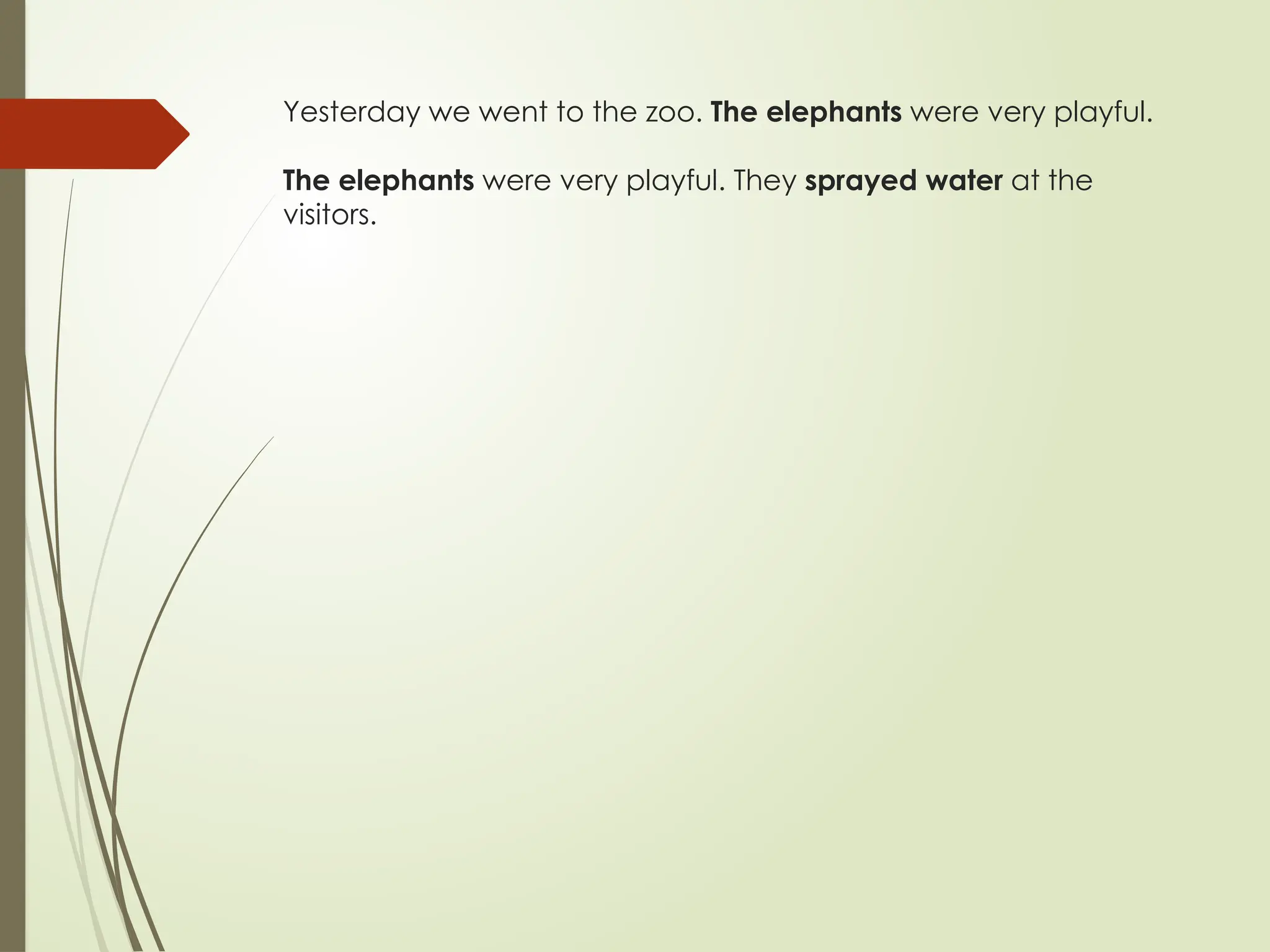
Yesterday we wentto the zoo. The elephants were very playful.
The elephants were very playful. They sprayed water at the
visitors.
28.
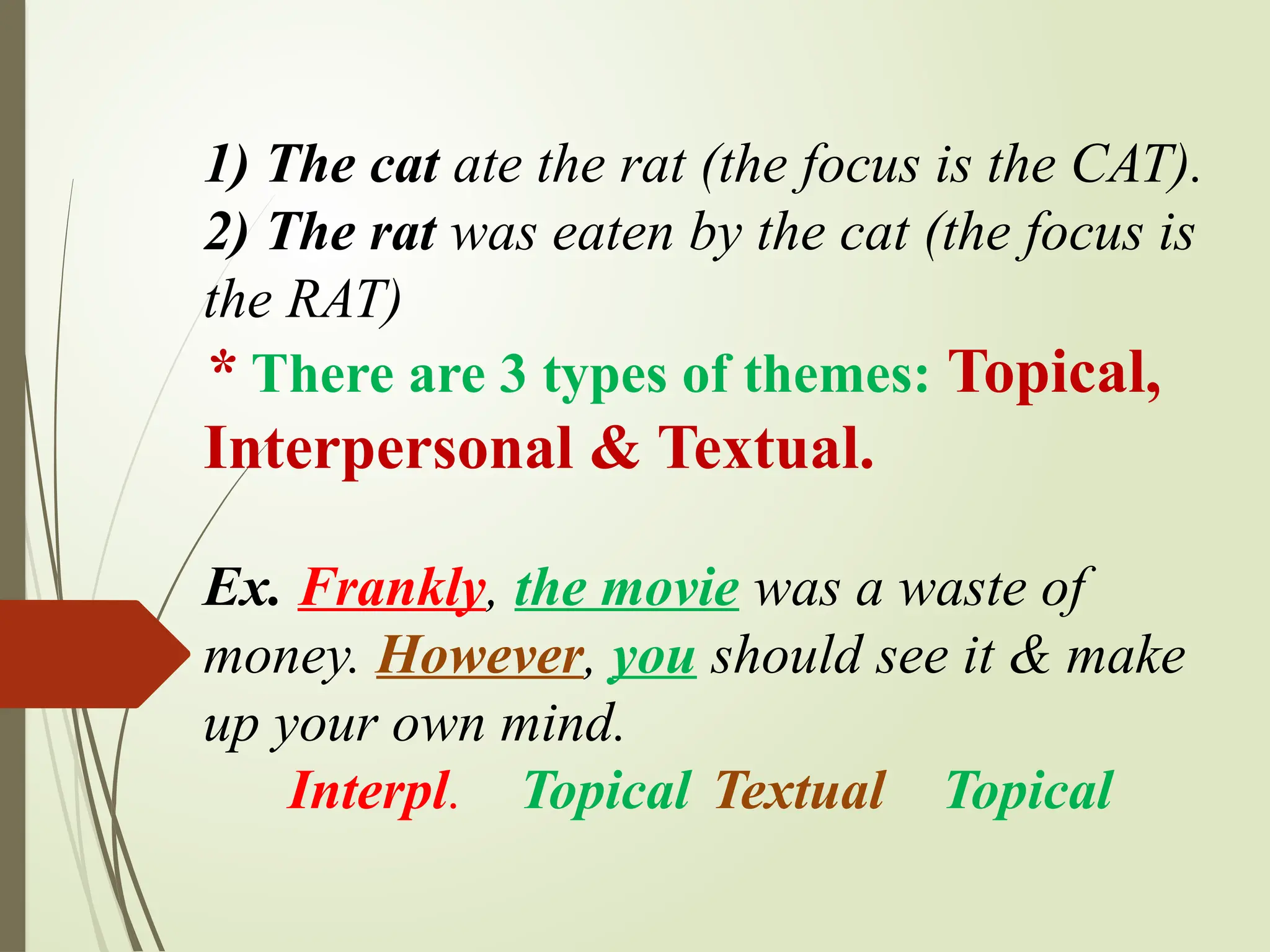
1) The catate the rat (the focus is the CAT).
2) The rat was eaten by the cat (the focus is
the RAT)
* There are 3 types of themes: Topical,
Interpersonal & Textual.
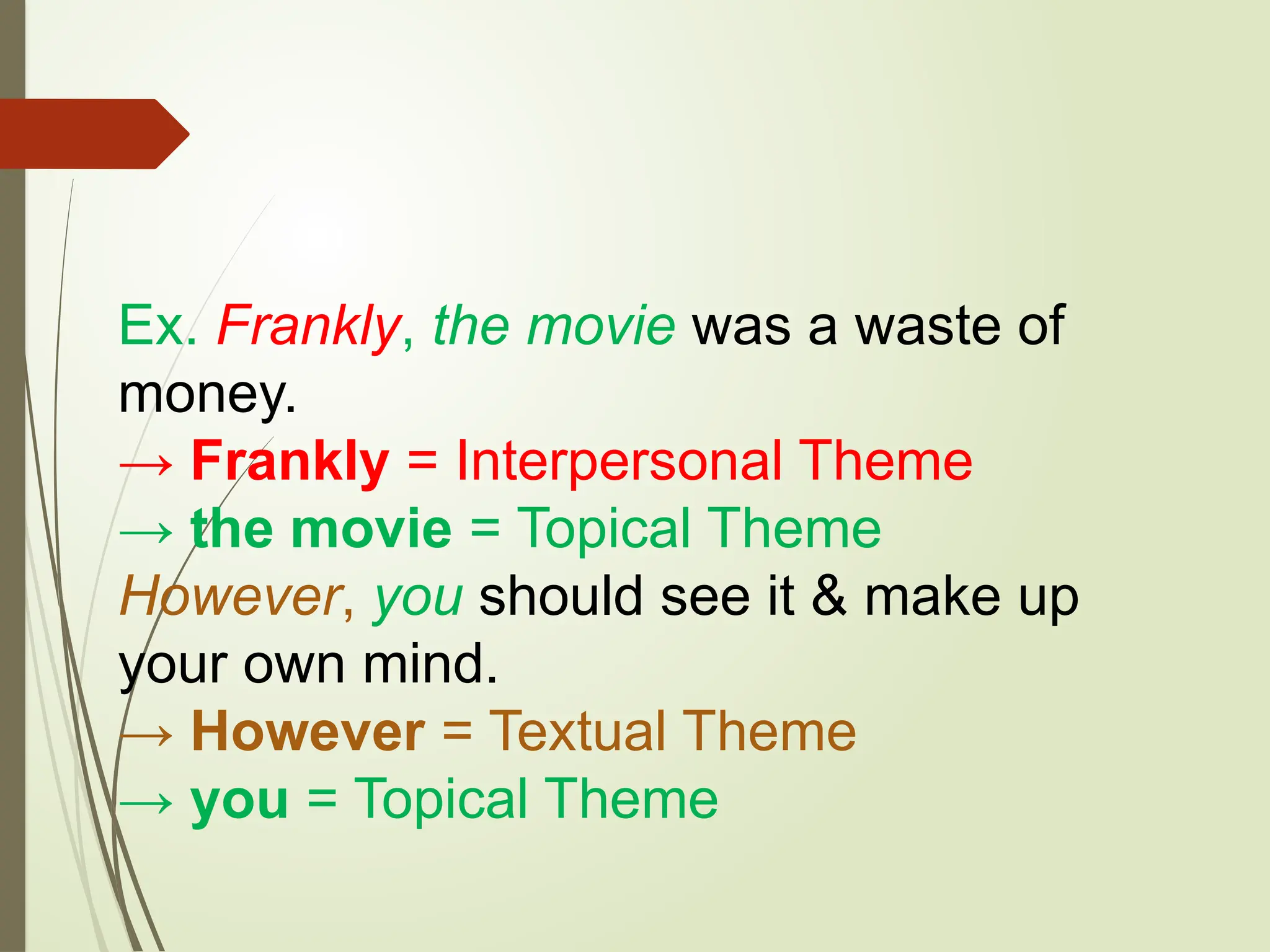
Ex. Frankly, the movie was a waste of
money. However, you should see it & make
up your own mind.
Interpl. Topical Textual Topical
29.
Ex. Frankly, themovie was a waste of
money.
→ Frankly = Interpersonal Theme
→ the movie = Topical Theme
However, you should see it & make up
your own mind.
→ However = Textual Theme
→ you = Topical Theme
30.
DISCOURSE STRUCTURE- GENRE
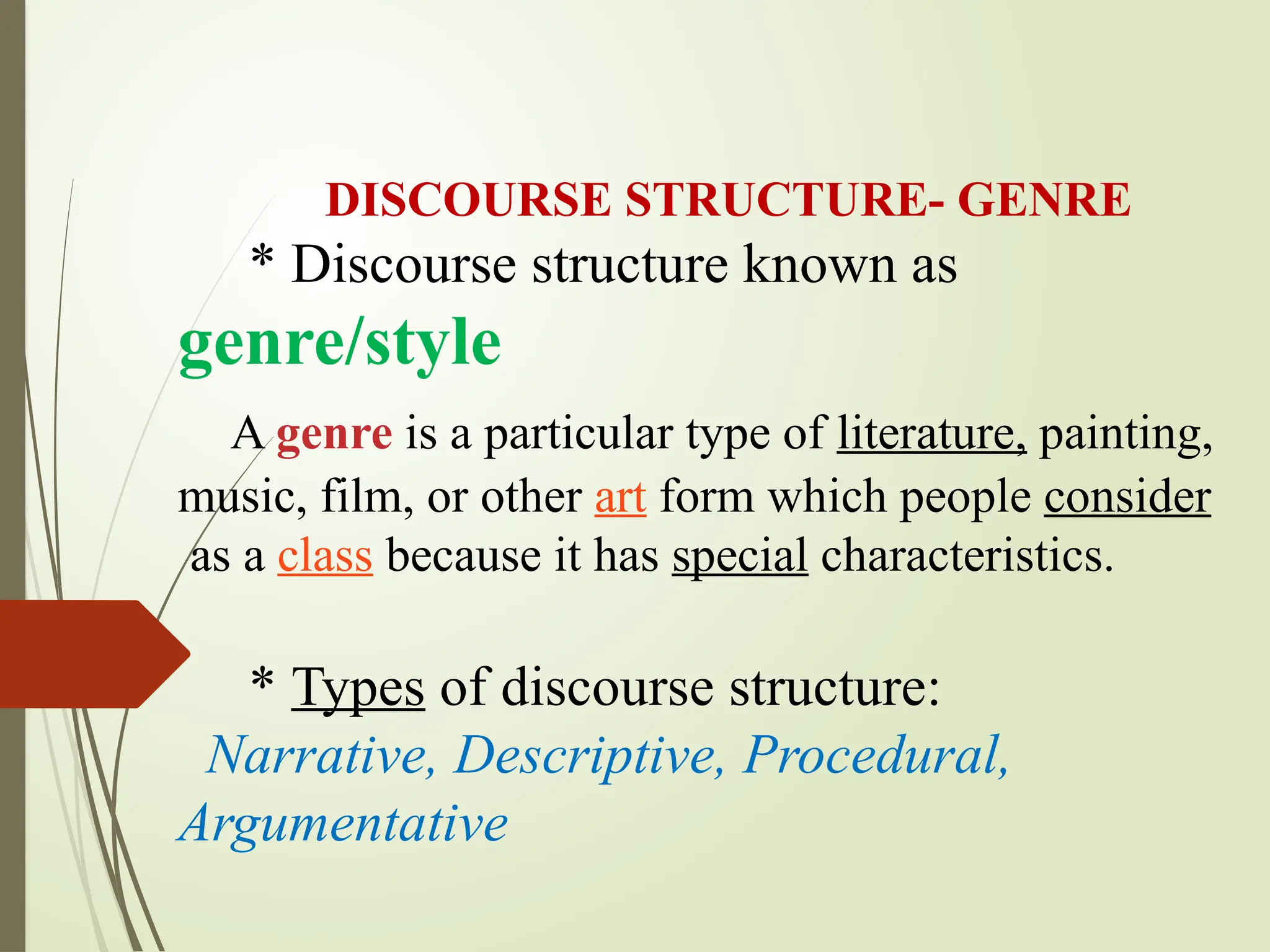
*Discourse structure known as
genre/style
A genre is a particular type of literature, painting,
music, film, or other art form which people consider
as a class because it has special characteristics.
* Types of discourse structure:
Narrative, Descriptive, Procedural,
Argumentative
31.
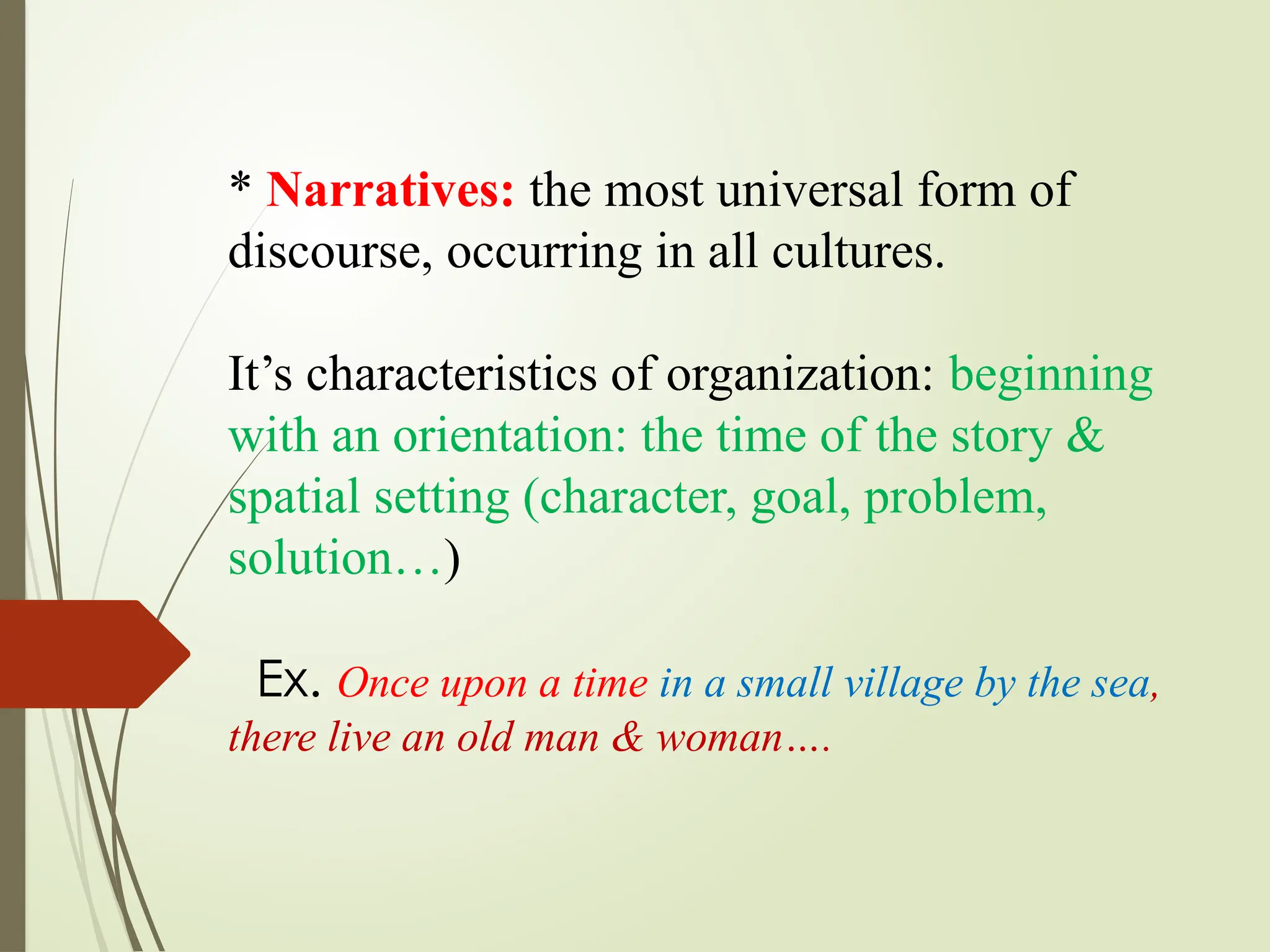
* Narratives: themost universal form of
discourse, occurring in all cultures.
It’s characteristics of organization: beginning
with an orientation: the time of the story &
spatial setting (character, goal, problem,
solution…)
Ex. Once upon a time in a small village by the sea,
there live an old man & woman….
32.
* Descriptive
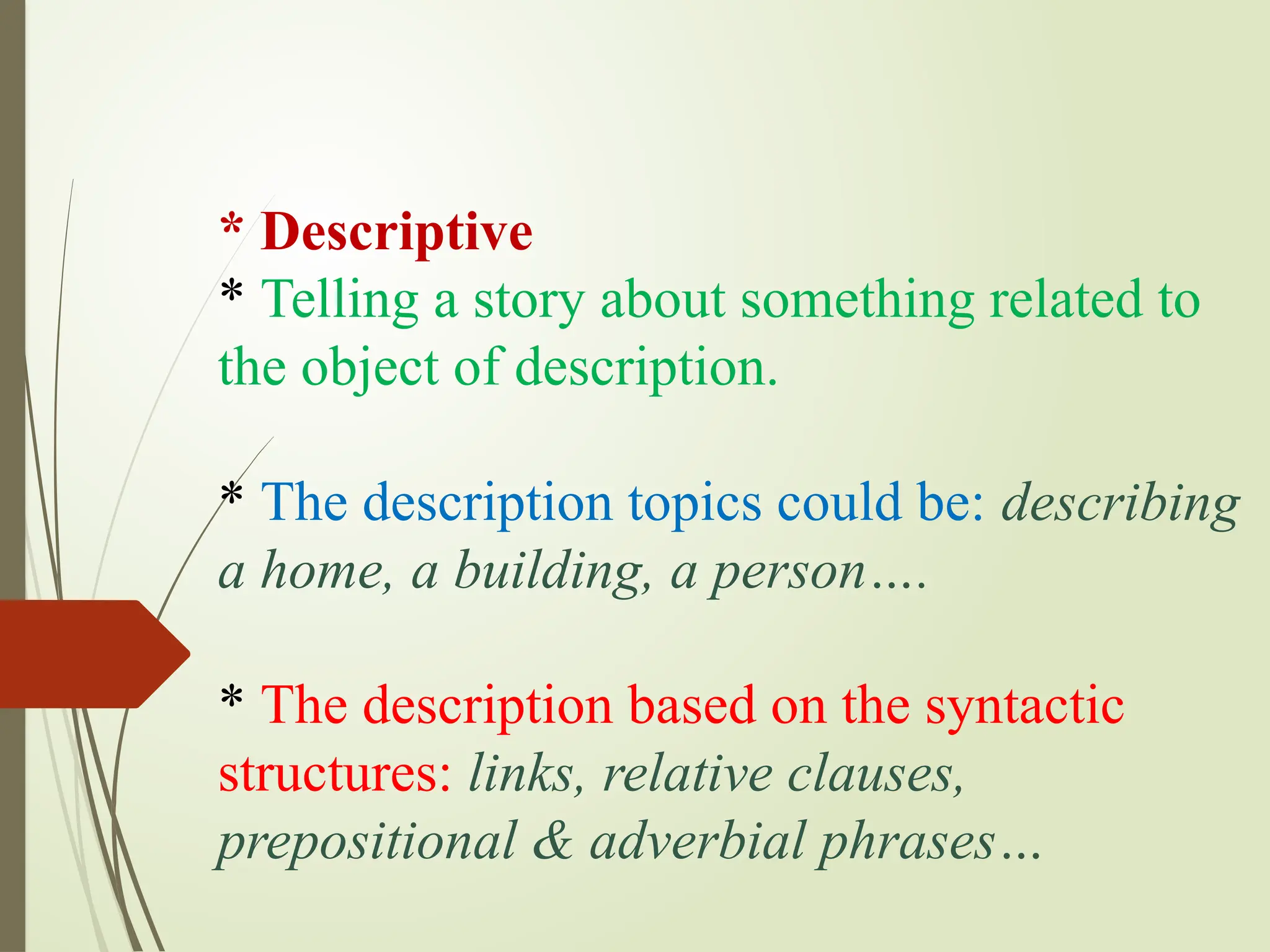
* Tellinga story about something related to
the object of description.
* The description topics could be: describing
a home, a building, a person….
* The description based on the syntactic
structures: links, relative clauses,
prepositional & adverbial phrases…
33.
* Procedural/process
Called “Howto” discourse because
primary purpose is to explain how to
accomplish or to do a task.
Ex. how to set up a computer set, how to
get to airport…
34.
* Argumentative
* Oftendescribing the process of
supporting or weakening another
statement whose validity is open to
question to doubt.
* Classical organization: an introduction,
explanation of the case or problem, outline
of argument, proof, refutation & conclusion.
35.
Identify the old(given) & new in the
example.
Good evening & welcome to “this is your
life”. This is Terry Donovan speaking. We’re
waiting for the subject of tonight’s
programme. He’s one of the world’s leading
actors, & he thinks he’s coming here to take
part in a discussion programme…I can hear
him now…yes, here he is! Jason Douglas…
This is your life!
36.
Revision
1. What areCohesion & Coherence? Their types. The
difference between Cohesion & Coherence.
2. Cohesive devices: Lexical & Grammatical devices.
3.What are Theme & Rheme. Illustrate through examples.
4. What is genre? Its types.
5. Write a short paragraph that demonstrates cohesion &
coherence.