

CONTEXT and KNOWLEDGECONTEXT and KNOWLEDGE
Summary
 Context
 Knowledge
 Human brain
 Human brain vs. computer
 Can computers be considered intelligent?
 Positive examples
DeepBlue
MYCIN
 Negative examples
 Expressing knowledge through language
Context
Definition
 Several definitions
– Discourse that surrounds a language unit and
helps to determine its interpretation
– The set of facts or circumstances that
surround a situation or an event
Context
Some context related properties
 Contexts increase inferential power
 Learning (new information) occurs in specific
context
 Knowledge can be generalised from specific
contexts to more general ones
 Contexts themselves can be objects of inference
 Different contexts can be selected depending on
previous contexts
 Whether something acts as a context or not could
itself be context dependent
Knowledge
Definition
 The act or state of knowing; clear
perception of fact, truth or duty; cognition
 The psychological result of perception of
learning and reasoning
 Knowledge is information that has been
pared, shaped, interpreted, selected and
transformed (Ray Kurzweil)
! Facts alone do not constitute knowledge
Knowledge
Human vs. Computer
 Human intelligence
– Remarkable ability of creating links between
ideas
– Weak at storing information on which
knowledge is based
 The natural strengths of computers are roughly
the opposite powerful allies of the human
intellect
Human Knowledge
 Abstract concepts
 When we come in contact with a new concept we add new
links
 Knowledge structures are not affected by the failure of the
hardware (50000 neurons die each day in an adult brain,
but our concepts and ideas do not necessary deteriorate)
 We are capable of storing apparently contradictory ideas
 Unless a new idea is reinforced it will eventually die out
 Strong links between our emotions and our knowledge
 Our knowledge is closely tied to our pattern-recognition
capabilities
 We are able to change our minds change our internal
networks of knowledge
Computer Knowledge
Propaedia
 A section of the 15th edition of Encyclopaedia
Britannica (1980)
 An ambitious attempt to organize all human
knowledge in a single hierarchy
 Allows multiple classifications
 Takes time to understand but it is successful in view of
the vast scope of the material it covers
Such data structures provide a formal
methodology for representing a broad class of
knowledge easily stored and manipulated by
the computer
Human brain and
knowledge
 Human brain
Highly parallel early vision circuits
Visual cortex neuron clusters
Auditory cortex circuits
The hippocampus
The amygdala
Human Brain
 Human brain  on the order of 100 billion
neurons
 One neuron  thousands of synaptic connections
 There is a speculation that certain long-term
memories are chemically coded in neuron cell
bodies
 The capacity of each neuron  1000 bits  the
brain has the capacity of 1014
bits
 If we assume an average redundancy factor of
104
, that gives us 1010
bits per concept 10 6
concepts per human brain
Human Brain
 It has been estimated that a “master” of
a particular domain of knowledge has
mastered about 50000 concepts, which
is about 5 percent of the total capacity,
according to the above estimate
Human Brain vs.
Computer
 The human brain uses a type of circuitry
that is very slow
 For tasks as vision, language or motor
control, the brain is more powerful than
1000 super computers
 For certain tasks simple tasks such as
multiplying digital numbers it is less
powerful that the 4-bit microprocessor
found in a ten dollar calculator
Computer Learning vs.
Biological Learning
 The brain is wired to learn in interaction with the world,
re-programming themselves over time
 Computers don’t learn easy by experience
 A human child
– Starts out listening to and understanding spoken
language
– Learns to speak
– Learns written language
 Computer
– Starts with the ability to generate written languge
– Learning to understand it
– Speak with synthetic voices
– Understand continuous human speech (recently)
Deep Blue
 Its predecessor Deep Thought appeared at
Carnegie Mellon University. In 1989 it was
beaten by Kasparov in 41 moves
 Project continued at IBM’s T.J. Watson
Research centre
 Improvements every year: now it has 30 Power
Two Super Chip Processors
 Is capable of 200 million positions / second
(Kasparov of 3 positions / second)
 Almost no use of psychology
Deep Blue
 Its strenghts are the strenghts of a machine: it
has a database of opening games played by
grandmasters over the last 100 years
 It does not think, it reacts
 Only one specific job
 It considers before deciding on a move 4
parameters: material, position (control of the
centre), King safety and tempo (losing tempo=
wasting time by indecision, and the opponent
making productive moves)
MYCIN
 Created in mid 1970’s by E.H. Shortliffe at
Standford University
 Medical diagnosis tool (attempts to identify the
cause of infection)
 Suggests a course of medication
 It uses 500 rules
 Each rule has assigned a number its users
can assess the validity of it’s conclusion
(WHY)
 Can recognise approximate 100 causes of
bacterial infection
MYCIN
Uses rules like:
MYCIN Rule …
IF …
THEN …
AUTHORS …
JUSTIFICATION…
LITERATURE…
MYCIN
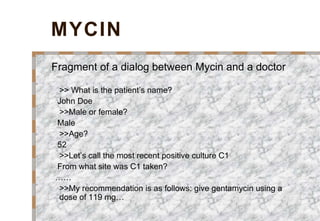
Fragment of a dialog between Mycin and a doctor
>> What is the patient’s name?
John Doe
>>Male or female?
Male
>>Age?
52
>>Let’s call the most recent positive culture C1
From what site was C1 taken?
……
>>My recommendation is as follows: give gentamycin using a
dose of 119 mg…
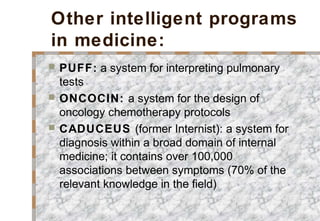
Other intelligent programs
in medicine:
 PUFF: a system for interpreting pulmonary
tests
 ONCOCIN: a system for the design of
oncology chemotherapy protocols
 CADUCEUS (former Internist): a system for
diagnosis within a broad domain of internal
medicine; it contains over 100,000
associations between symptoms (70% of the
relevant knowledge in the field)
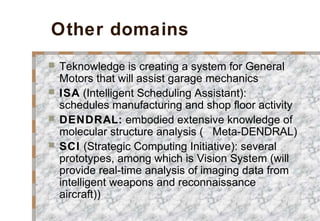
Other domains
 Teknowledge is creating a system for General
Motors that will assist garage mechanics
 ISA (Intelligent Scheduling Assistant):
schedules manufacturing and shop floor activity
 DENDRAL: embodied extensive knowledge of
molecular structure analysis ( Meta-DENDRAL)
 SCI (Strategic Computing Initiative): several
prototypes, among which is Vision System (will
provide real-time analysis of imaging data from
intelligent weapons and reconnaissance
aircraft))
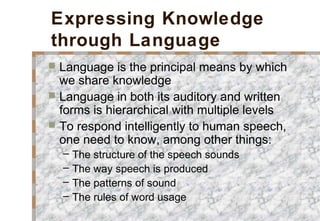
Expressing Knowledge
through Language
 Language is the principal means by which
we share knowledge
 Language in both its auditory and written
forms is hierarchical with multiple levels
 To respond intelligently to human speech,
one need to know, among other things:
– The structure of the speech sounds
– The way speech is produced
– The patterns of sound
– The rules of word usage
Expressing Knowledge
through Language
 Computers sentence-parsing systems
can do good jobs at analysing sentences
that confuses humans:
“This is the cheese that the rat that the cat
that the dog chased bit ate”
Expressing Knowledge
through Language
 But with other types of sentences it
has difficulties:
“Time flies like an arrow”
or
“Squad Helps Dog Bite Victim”
 The difficulties appear when a word has
several meanings or are used idiomatic
expressions
Expressing Knowledge
through Language
 Explanation to the first sentence:
For the computer this sentence it might mean:
The time passes as quickly as an arrow passes,
Or maybe it is a command telling us to time flies
the same way that an arrow flies - Time flies like an
arrow would
Or it could be a command telling us to time only
those flies that are similar to arrows - Time flies that
are like an arrow
Or perhaps it means that the type of flies known
as time flies have a fondness for arrows - Time flies
like (that is cherish) an arrow.
Expressing Knowledge
through Language
 The ambiguity of language is far grater
than may appear.
At MIT Speech Lab, a researcher found
a sentence published in a technical
journal with over 1,000,000 syntactically
correct interpretations!!!!!!!!
Expressing Knowledge
through Language
 TRANSLATION:
one of the challenges in developing
computerized translation system
 Each pair of languages represents a
different translation problem
 Best solution known was given by a
Dutch firm named DLT
Expressing Knowledge
through Language
 Solution found by DLT:
– Developed translators for six languages to and
from a standard root language (ESPERANTO)
– A translation from English to German would be
accomplished in 2 steps: from English to
Esperanto and from Esperanto to German
– Esperanto was selected because it is
particularly good at representing concepts in an
unambiguous way
– Translating among 6 different languages would
ordinarily require 30 different translators, but
with the DLT approach only 12 are required
R2D2
 Robot in Star Wars
 Designed to operate in deep space, interfacing
with fighter craft and computer systems to
augment the capabilities of ships and their pilots
 Monitors flight performance, well-versed in star
ship repair, a.s.o.
 Converses in a dense electronic language
(beeps, chirps, whistles)
 Can understand most forms of human speech,
but must have his own communication
interpreted by other computers

Brain vs Computer

  • 1.
  • 2.
    Summary  Context  Knowledge Human brain  Human brain vs. computer  Can computers be considered intelligent?  Positive examples DeepBlue MYCIN  Negative examples  Expressing knowledge through language
  • 3.
    Context Definition  Several definitions –Discourse that surrounds a language unit and helps to determine its interpretation – The set of facts or circumstances that surround a situation or an event
  • 4.
    Context Some context relatedproperties  Contexts increase inferential power  Learning (new information) occurs in specific context  Knowledge can be generalised from specific contexts to more general ones  Contexts themselves can be objects of inference  Different contexts can be selected depending on previous contexts  Whether something acts as a context or not could itself be context dependent
  • 5.
    Knowledge Definition  The actor state of knowing; clear perception of fact, truth or duty; cognition  The psychological result of perception of learning and reasoning  Knowledge is information that has been pared, shaped, interpreted, selected and transformed (Ray Kurzweil) ! Facts alone do not constitute knowledge
  • 6.
    Knowledge Human vs. Computer Human intelligence – Remarkable ability of creating links between ideas – Weak at storing information on which knowledge is based  The natural strengths of computers are roughly the opposite powerful allies of the human intellect
  • 7.
    Human Knowledge  Abstractconcepts  When we come in contact with a new concept we add new links  Knowledge structures are not affected by the failure of the hardware (50000 neurons die each day in an adult brain, but our concepts and ideas do not necessary deteriorate)  We are capable of storing apparently contradictory ideas  Unless a new idea is reinforced it will eventually die out  Strong links between our emotions and our knowledge  Our knowledge is closely tied to our pattern-recognition capabilities  We are able to change our minds change our internal networks of knowledge
  • 8.
    Computer Knowledge Propaedia  Asection of the 15th edition of Encyclopaedia Britannica (1980)  An ambitious attempt to organize all human knowledge in a single hierarchy  Allows multiple classifications  Takes time to understand but it is successful in view of the vast scope of the material it covers Such data structures provide a formal methodology for representing a broad class of knowledge easily stored and manipulated by the computer
  • 9.
    Human brain and knowledge Human brain Highly parallel early vision circuits Visual cortex neuron clusters Auditory cortex circuits The hippocampus The amygdala
  • 10.
    Human Brain  Humanbrain  on the order of 100 billion neurons  One neuron  thousands of synaptic connections  There is a speculation that certain long-term memories are chemically coded in neuron cell bodies  The capacity of each neuron  1000 bits  the brain has the capacity of 1014 bits  If we assume an average redundancy factor of 104 , that gives us 1010 bits per concept 10 6 concepts per human brain
  • 11.
    Human Brain  Ithas been estimated that a “master” of a particular domain of knowledge has mastered about 50000 concepts, which is about 5 percent of the total capacity, according to the above estimate
  • 12.
    Human Brain vs. Computer The human brain uses a type of circuitry that is very slow  For tasks as vision, language or motor control, the brain is more powerful than 1000 super computers  For certain tasks simple tasks such as multiplying digital numbers it is less powerful that the 4-bit microprocessor found in a ten dollar calculator
  • 13.
    Computer Learning vs. BiologicalLearning  The brain is wired to learn in interaction with the world, re-programming themselves over time  Computers don’t learn easy by experience  A human child – Starts out listening to and understanding spoken language – Learns to speak – Learns written language  Computer – Starts with the ability to generate written languge – Learning to understand it – Speak with synthetic voices – Understand continuous human speech (recently)
  • 14.
    Deep Blue  Itspredecessor Deep Thought appeared at Carnegie Mellon University. In 1989 it was beaten by Kasparov in 41 moves  Project continued at IBM’s T.J. Watson Research centre  Improvements every year: now it has 30 Power Two Super Chip Processors  Is capable of 200 million positions / second (Kasparov of 3 positions / second)  Almost no use of psychology
  • 15.
    Deep Blue  Itsstrenghts are the strenghts of a machine: it has a database of opening games played by grandmasters over the last 100 years  It does not think, it reacts  Only one specific job  It considers before deciding on a move 4 parameters: material, position (control of the centre), King safety and tempo (losing tempo= wasting time by indecision, and the opponent making productive moves)
  • 16.
    MYCIN  Created inmid 1970’s by E.H. Shortliffe at Standford University  Medical diagnosis tool (attempts to identify the cause of infection)  Suggests a course of medication  It uses 500 rules  Each rule has assigned a number its users can assess the validity of it’s conclusion (WHY)  Can recognise approximate 100 causes of bacterial infection
  • 17.
    MYCIN Uses rules like: MYCINRule … IF … THEN … AUTHORS … JUSTIFICATION… LITERATURE…
  • 18.
    MYCIN Fragment of adialog between Mycin and a doctor >> What is the patient’s name? John Doe >>Male or female? Male >>Age? 52 >>Let’s call the most recent positive culture C1 From what site was C1 taken? …… >>My recommendation is as follows: give gentamycin using a dose of 119 mg…
  • 19.
    Other intelligent programs inmedicine:  PUFF: a system for interpreting pulmonary tests  ONCOCIN: a system for the design of oncology chemotherapy protocols  CADUCEUS (former Internist): a system for diagnosis within a broad domain of internal medicine; it contains over 100,000 associations between symptoms (70% of the relevant knowledge in the field)
  • 20.
    Other domains  Teknowledgeis creating a system for General Motors that will assist garage mechanics  ISA (Intelligent Scheduling Assistant): schedules manufacturing and shop floor activity  DENDRAL: embodied extensive knowledge of molecular structure analysis ( Meta-DENDRAL)  SCI (Strategic Computing Initiative): several prototypes, among which is Vision System (will provide real-time analysis of imaging data from intelligent weapons and reconnaissance aircraft))
  • 21.
    Expressing Knowledge through Language Language is the principal means by which we share knowledge  Language in both its auditory and written forms is hierarchical with multiple levels  To respond intelligently to human speech, one need to know, among other things: – The structure of the speech sounds – The way speech is produced – The patterns of sound – The rules of word usage
  • 22.
    Expressing Knowledge through Language Computers sentence-parsing systems can do good jobs at analysing sentences that confuses humans: “This is the cheese that the rat that the cat that the dog chased bit ate”
  • 23.
    Expressing Knowledge through Language But with other types of sentences it has difficulties: “Time flies like an arrow” or “Squad Helps Dog Bite Victim”  The difficulties appear when a word has several meanings or are used idiomatic expressions
  • 24.
    Expressing Knowledge through Language Explanation to the first sentence: For the computer this sentence it might mean: The time passes as quickly as an arrow passes, Or maybe it is a command telling us to time flies the same way that an arrow flies - Time flies like an arrow would Or it could be a command telling us to time only those flies that are similar to arrows - Time flies that are like an arrow Or perhaps it means that the type of flies known as time flies have a fondness for arrows - Time flies like (that is cherish) an arrow.
  • 25.
    Expressing Knowledge through Language The ambiguity of language is far grater than may appear. At MIT Speech Lab, a researcher found a sentence published in a technical journal with over 1,000,000 syntactically correct interpretations!!!!!!!!
  • 26.
    Expressing Knowledge through Language TRANSLATION: one of the challenges in developing computerized translation system  Each pair of languages represents a different translation problem  Best solution known was given by a Dutch firm named DLT
  • 27.
    Expressing Knowledge through Language Solution found by DLT: – Developed translators for six languages to and from a standard root language (ESPERANTO) – A translation from English to German would be accomplished in 2 steps: from English to Esperanto and from Esperanto to German – Esperanto was selected because it is particularly good at representing concepts in an unambiguous way – Translating among 6 different languages would ordinarily require 30 different translators, but with the DLT approach only 12 are required
  • 28.
    R2D2  Robot inStar Wars  Designed to operate in deep space, interfacing with fighter craft and computer systems to augment the capabilities of ships and their pilots  Monitors flight performance, well-versed in star ship repair, a.s.o.  Converses in a dense electronic language (beeps, chirps, whistles)  Can understand most forms of human speech, but must have his own communication interpreted by other computers