Bruner’s Constructivist Theory
Module 13
Presented by:
Gerlie Cabalag
Felicite Banog
Describe the development of the childs ability to represent
knowledge.
Explain how the spiral curriculum works.
Objectives:
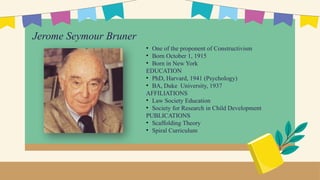
Jerome Seymour Bruner
• One of the proponent of Constructivism
• Born October 1, 1915
• Born in New York
EDUCATION
• PhD, Harvard, 1941 (Psychology)
• BA, Duke University, 1937
AFFILIATIONS
• Law Society Education
• Society for Research in Child Development
PUBLICATIONS
• Scaffolding Theory
• Spiral Curriculum
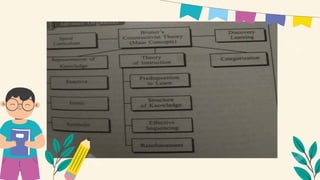
A. Representation of knowledge
1. Enactive
2. Iconic
3. Symbolic
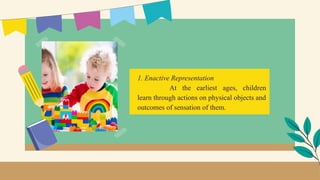
1. Enactive Representation
At the earliest ages, children
learn through actions on physical objects and
outcomes of sensation of them.
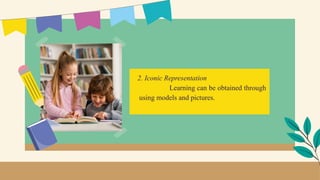
2. Iconic Representation
Learning can be obtained through
using models and pictures.
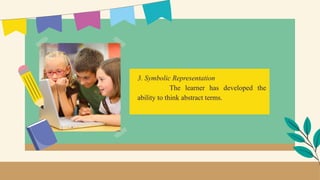
3. Symbolic Representation
The learner has developed the
ability to think abstract terms.
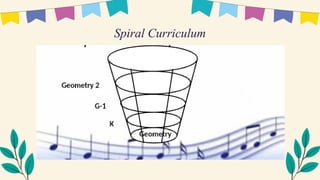
Bruner’s stressed that
curriculum should be organized in a
spiral manner so that the student
continually builds upon they have
already learned.
B. Spiral curriculum
Spiral Curriculum
Students learn new knowledge
relevant to the domains and such general
problem-solving skills as formulating rules,
testing and gathering information.
C. Discovery Learning
1. Predisposition to learn
2. Structure of knowledge
3. Effective Sequencing
4. Reinforcement
D. Theory of Instructions
1. Predisposition to learn
Bruner’s believed that any
subject could be taught at any stage of
development in way that fits the child
cognitive abilities.
2. Structure of Knowledge
This refers to the ways in which a
body of knowledge can be structured so that it
can be most readily grasped by the learner.
3. Effective Sequencing
Lesson can be presented in increasing
difficulty. Sequencing can make learning easier
or more difficult.
4. Reinforcement
Rewards and punishments should be
selected and paced appropriately. He felt that
ideally, interest in the subject matter Is the best
stimulus for learning.
E. Categorization
1. Identity Categories
2. Equivalent Catwgories
3. Coding System
1. Identity Categories
Categories include objects
based on their attributes or features.
2. Equivalent Categories
Provide rules for combining
categories.
3. Coding System
are categories that serve to
recognize sensory input.
Thank youu!!

BRUNER MODULE 13.pptx presentation fck 1