




A SEMANTICS-BASED APPROACH
TO MACHINE PERCEPTION
Cory Andrew Henson
August 27, 2013
1
Committee:
Amit Sheth (advisor)
Krishnaprasad Thirunarayan
John Gallagher
Payam Barnaghi
Satya Sahoo
Ph.D. Dissertation Defense
Wright State University
Dept. of Computer Science and Engineering
2
3
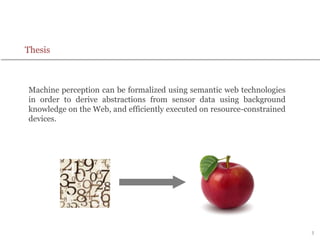
Thesis
Machine perception can be formalized using semantic web technologies
in order to derive abstractions from sensor data using background
knowledge on the Web, and efficiently executed on resource-constrained
devices.
4
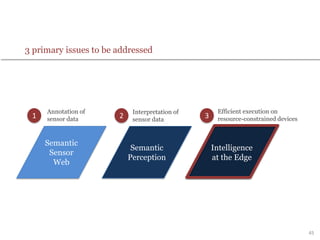
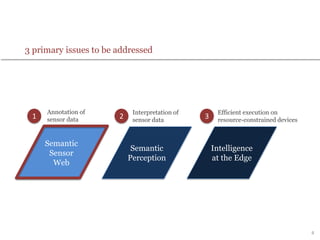
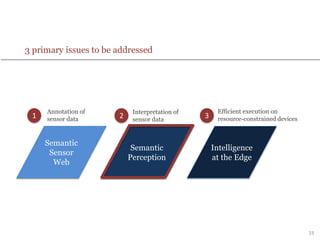
3 primary issues to be addressed
Annotation of
sensor data
Semantic
Sensor
Web
Semantic
Perception
Intelligence
at the Edge
Interpretation of
sensor data
Efficient execution on
resource-constrained devices
1 2 3
5
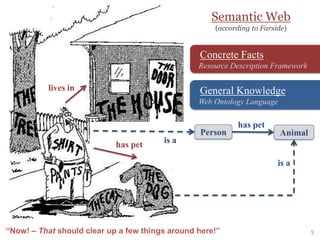
lives in
has pet
is ahas pet
Person Animal
Concrete Facts
Resource Description Framework
Semantic Web
(according to Farside)
General Knowledge
Web Ontology Language
“Now! – That should clear up a few things around here!”
is a
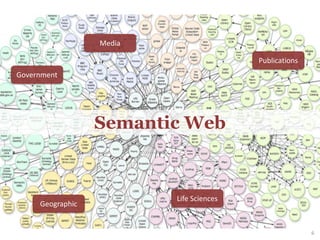
Government
Media
Publications
Life Sciences
Geographic
Semantic Web
6
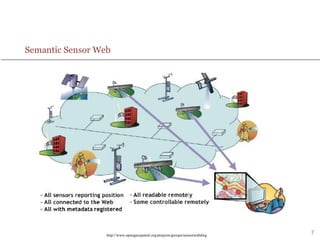
7http://www.opengeospatial.org/projects/groups/sensorwebdwg
Semantic Sensor Web
8
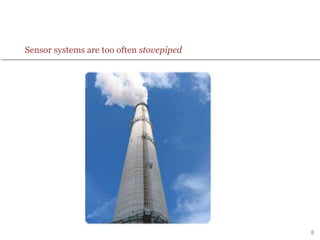
Sensor systems are too often stovepiped
9
With freedom comes responsibility
1. discovery, access, and search
2. integration and interpretation
We want to set this data free
10
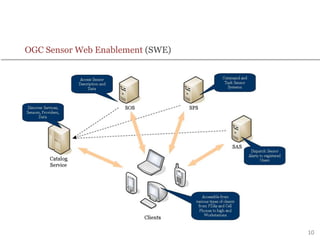
OGC Sensor Web Enablement (SWE)
11
With freedom comes responsibility
1. discovery, access, and search
2. integration and interpretation
We want to set this data free
12
RDF OWL
How are machines supposed to integrate and interpret sensor data?
Semantic Sensor Networks (SSN)
13
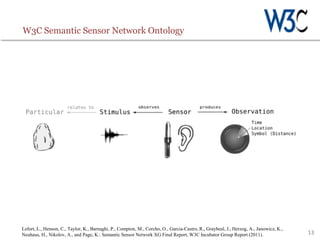
W3C Semantic Sensor Network Ontology
Lefort, L., Henson, C., Taylor, K., Barnaghi, P., Compton, M., Corcho, O., Garcia-Castro, R., Graybeal, J., Herzog, A., Janowicz, K.,
Neuhaus, H., Nikolov, A., and Page, K.: Semantic Sensor Network XG Final Report, W3C Incubator Group Report (2011).
14
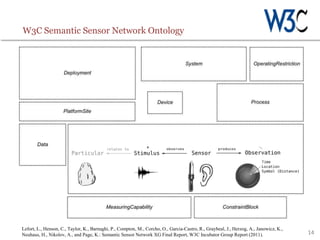
W3C Semantic Sensor Network Ontology
Lefort, L., Henson, C., Taylor, K., Barnaghi, P., Compton, M., Corcho, O., Garcia-Castro, R., Graybeal, J., Herzog, A., Janowicz, K.,
Neuhaus, H., Nikolov, A., and Page, K.: Semantic Sensor Network XG Final Report, W3C Incubator Group Report (2011).
15
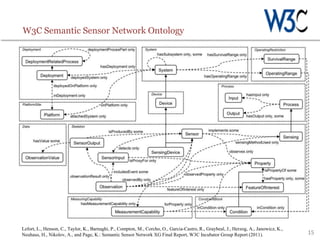
W3C Semantic Sensor Network Ontology
Lefort, L., Henson, C., Taylor, K., Barnaghi, P., Compton, M., Corcho, O., Garcia-Castro, R., Graybeal, J., Herzog, A., Janowicz, K.,
Neuhaus, H., Nikolov, A., and Page, K.: Semantic Sensor Network XG Final Report, W3C Incubator Group Report (2011).
16
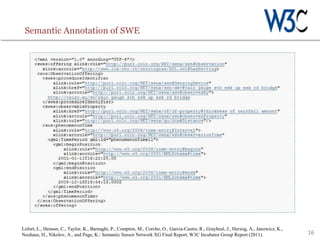
Semantic Annotation of SWE
Lefort, L., Henson, C., Taylor, K., Barnaghi, P., Compton, M., Corcho, O., Garcia-Castro, R., Graybeal, J., Herzog, A., Janowicz, K.,
Neuhaus, H., Nikolov, A., and Page, K.: Semantic Sensor Network XG Final Report, W3C Incubator Group Report (2011).
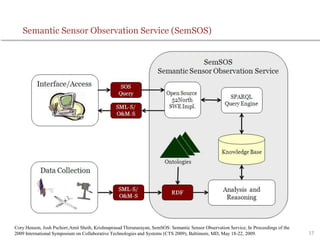
Semantic Sensor Observation Service (SemSOS)
Cory Henson, Josh Pschorr,Amit Sheth, Krishnaprasad Thirunarayan, SemSOS: Semantic Sensor Observation Service, In Proceedings of the
2009 International Symposium on Collaborative Technologies and Systems (CTS 2009), Baltimore, MD, May 18-22, 2009. 17
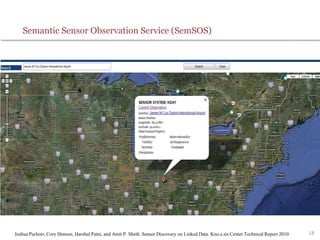
Semantic Sensor Observation Service (SemSOS)
Joshua Pschorr, Cory Henson, Harshal Patni, and Amit P. Sheth. Sensor Discovery on Linked Data. Kno.e.sis Center Technical Report 2010. 18
19
3 primary issues to be addressed
Annotation of
sensor data
Semantic
Sensor
Web
Semantic
Perception
Intelligence
at the Edge
Interpretation of
sensor data
Efficient execution on
resource-constrained devices1 2 3
20
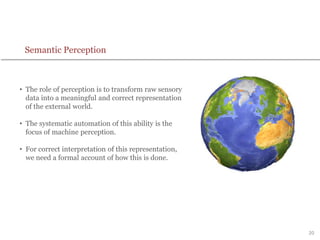
Semantic Perception
• The role of perception is to transform raw sensory
data into a meaningful and correct representation
of the external world.
• The systematic automation of this ability is the
focus of machine perception.
• For correct interpretation of this representation,
we need a formal account of how this is done.
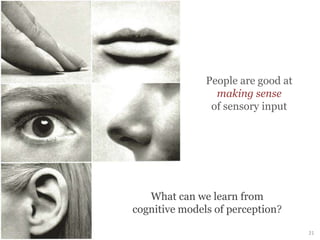
21
What can we learn from
cognitive models of perception?
People are good at
making sense
of sensory input
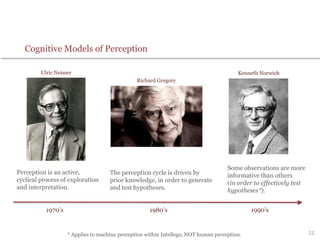
22
Perception is an active,
cyclical process of exploration
and interpretation.
The perception cycle is driven by
prior knowledge, in order to generate
and test hypotheses.
Some observations are more
informative than others
(in order to effectively test
hypotheses*).
Ulric Neisser
Richard Gregory
Kenneth Norwich
1970’s 1980’s 1990’s
Cognitive Models of Perception
* Applies to machine perception within Intellego, NOT human perception.
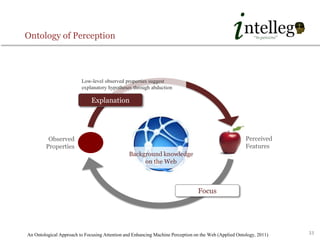
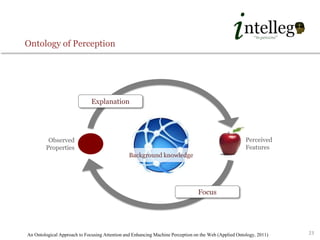
Observed
Properties
Perceived
Features
23
Background knowledge
Explanation
Ontology of Perception
Focus
An Ontological Approach to Focusing Attention and Enhancing Machine Perception on the Web (Applied Ontology, 2011)
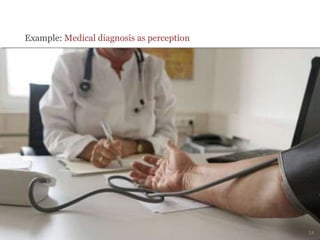
Example: Medical diagnosis as perception
24
Proactive,
Preventative
Healthcare
25
The Patient of the Future
MIT Technology Review, 2012
26http://www.technologyreview.com/featuredstory/426968/the-patient-of-the-future/
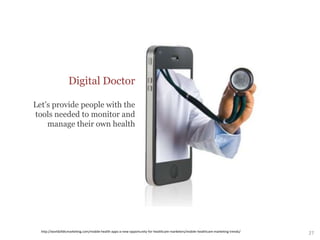
Digital Doctor
Let’s provide people with the
tools needed to monitor and
manage their own health
http://worldofdtcmarketing.com/mobile-health-apps-a-new-opportunity-for-healthcare-marketers/mobile-healthcare-marketing-trends/
27
Medical/healthcare expert systems have been around for a long time
28
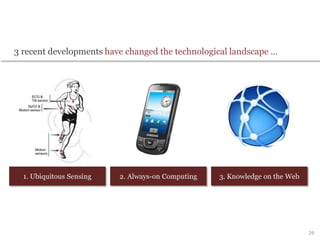
1. Ubiquitous Sensing 2. Always-on Computing 3. Knowledge on the Web
3 recent developments have changed the technological landscape …
29
30
Making sense of sensor data with
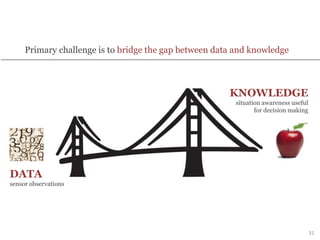
DATA
sensor observations
KNOWLEDGE
situation awareness useful
for decision making
Primary challenge is to bridge the gap between data and knowledge
31
SSN
Ontology
2 Interpreted data
(deductive)
[in OWL]
e.g., threshold
1 Annotated Data
[in RDF]
e.g., label
0 Raw Data
[in TEXT]
e.g., number
Levels of Abstraction
3 Interpreted data
(abductive)
[in OWL]
e.g., diagnosis
Intellego
―150‖
Systolic blood pressure of 150 mmHg
Elevated
Blood
Pressure
Hyperthyroidism
……
32
Observed
Properties
Perceived
Features
33
Background knowledge
on the Web
Low-level observed properties suggest
explanatory hypotheses through abduction
Explanation
Focus
Ontology of Perception
An Ontological Approach to Focusing Attention and Enhancing Machine Perception on the Web (Applied Ontology, 2011)
34
Semantics of Explanation
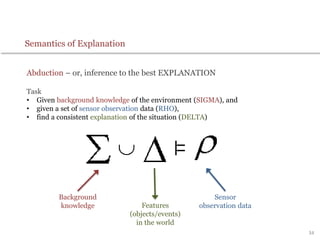
Abduction – or, inference to the best EXPLANATION
Task
• Given background knowledge of the environment (SIGMA), and
• given a set of sensor observation data (RHO),
• find a consistent explanation of the situation (DELTA)
Background
knowledge Features
(objects/events)
in the world
Sensor
observation data
35
Semantics of Explanation
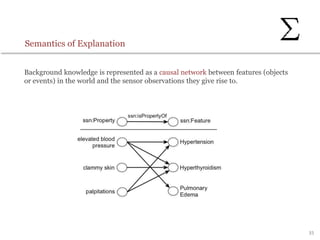
Background knowledge is represented as a causal network between features (objects
or events) in the world and the sensor observations they give rise to.
36
Semantics of Explanation
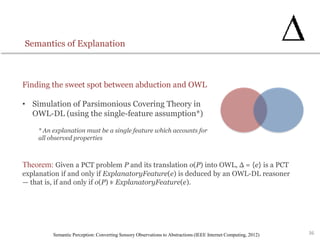
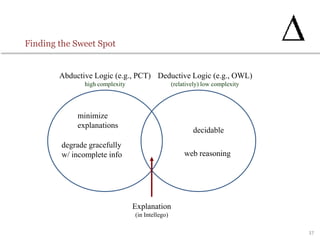
Finding the sweet spot between abduction and OWL
• Simulation of Parsimonious Covering Theory in
OWL-DL (using the single-feature assumption*)
* An explanation must be a single feature which accounts for
all observed properties
Semantic Perception: Converting Sensory Observations to Abstractions (IEEE Internet Computing, 2012)
Theorem: Given a PCT problem P and its translation o(P) into OWL, Δ = {e} is a PCT
explanation if and only if ExplanatoryFeature(e) is deduced by an OWL-DL reasoner
— that is, if and only if o(P) ⊧ ExplanatoryFeature(e).
37
Finding the Sweet Spot
minimize
explanations
degrade gracefully
w/ incomplete info
decidable
web reasoning
Abductive Logic (e.g., PCT)
high complexity
Deductive Logic (e.g., OWL)
(relatively) low complexity
Explanation
(in Intellego)
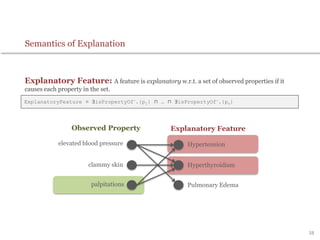
Explanatory Feature: A feature is explanatory w.r.t. a set of observed properties if it
causes each property in the set.
ExplanatoryFeature ≡ ∃isPropertyOf—.{p1} ⊓ … ⊓ ∃isPropertyOf—.{pn}
elevated blood pressure
clammy skin
palpitations
Hypertension
Hyperthyroidism
Pulmonary Edema
Observed Property Explanatory Feature
38
Semantics of Explanation
Observed
Properties
Perceived
Features
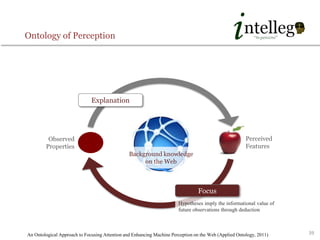
39
Background knowledge
on the Web
Hypotheses imply the informational value of
future observations through deduction
Explanation
Focus
Ontology of Perception
An Ontological Approach to Focusing Attention and Enhancing Machine Perception on the Web (Applied Ontology, 2011)
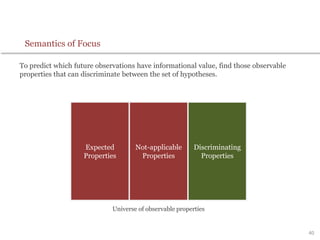
Universe of observable properties
40
Semantics of Focus
To predict which future observations have informational value, find those observable
properties that can discriminate between the set of hypotheses.
Expected
Properties
Not-applicable
Properties
Discriminating
Properties
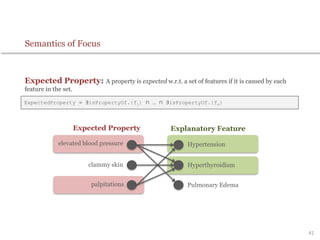
Expected Property: A property is expected w.r.t. a set of features if it is caused by each
feature in the set.
ExpectedProperty ≡ ∃isPropertyOf.{f1} ⊓ … ⊓ ∃isPropertyOf.{fn}
elevated blood pressure
clammy skin
palpitations
Hypertension
Hyperthyroidism
Pulmonary Edema
Expected Property Explanatory Feature
41
Semantics of Focus
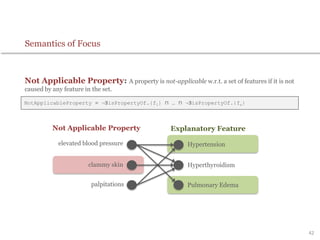
Not Applicable Property: A property is not-applicable w.r.t. a set of features if it is not
caused by any feature in the set.
NotApplicableProperty ≡ ¬∃isPropertyOf.{f1} ⊓ … ⊓ ¬∃isPropertyOf.{fn}
elevated blood pressure
clammy skin
palpitations
Hypertension
Hyperthyroidism
Pulmonary Edema
Not Applicable Property Explanatory Feature
42
Semantics of Focus
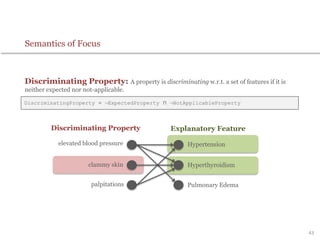
Discriminating Property: A property is discriminating w.r.t. a set of features if it is
neither expected nor not-applicable.
DiscriminatingProperty ≡ ¬ExpectedProperty ⊓ ¬NotApplicableProperty
elevated blood pressure
clammy skin
palpitations
Hypertension
Hyperthyroidism
Pulmonary Edema
Discriminating Property Explanatory Feature
43
Semantics of Focus
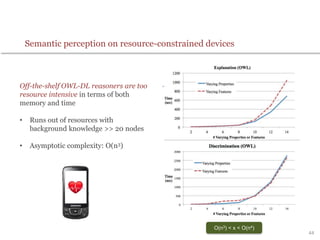
Off-the-shelf OWL-DL reasoners are too
resource intensive in terms of both
memory and time
• Runs out of resources with
background knowledge >> 20 nodes
• Asymptotic complexity: O(n3)
44
O(n3) < x < O(n4)
Semantic perception on resource-constrained devices
45
3 primary issues to be addressed
Annotation of
sensor data
Semantic
Sensor
Web
Semantic
Perception
Intelligence
at the Edge
Interpretation of
sensor data
Efficient execution on
resource-constrained devices1 2 3
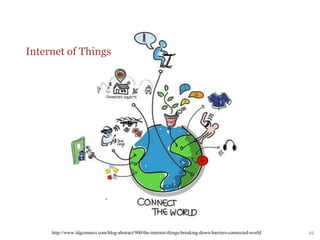
Internet of Things
46http://www.idgconnect.com/blog-abstract/900/the-internet-things-breaking-down-barriers-connected-world
47http://share.cisco.com/internet-of-things.html
48
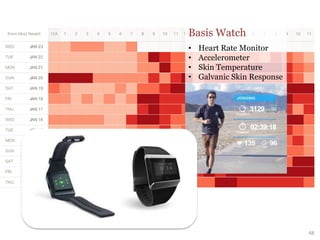
Basis Watch
• Heart Rate Monitor
• Accelerometer
• Skin Temperature
• Galvanic Skin Response
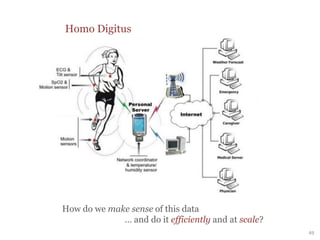
Homo Digitus
49
How do we make sense of this data
… and do it efficiently and at scale?
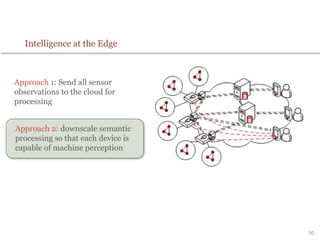
Approach 1: Send all sensor
observations to the cloud for
processing
50
Approach 2: downscale semantic
processing so that each device is
capable of machine perception
Intelligence at the Edge
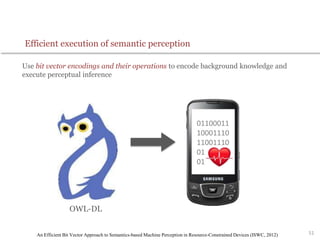
Use bit vector encodings and their operations to encode background knowledge and
execute perceptual inference
51
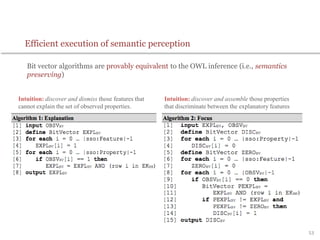
Efficient execution of semantic perception
01100011
10001110
11001110
01010110
01110101
OWL-DL
An Efficient Bit Vector Approach to Semantics-based Machine Perception in Resource-Constrained Devices (ISWC, 2012)
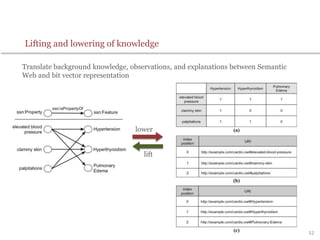
lift
lower
Translate background knowledge, observations, and explanations between Semantic
Web and bit vector representation
52
Lifting and lowering of knowledge
53
Efficient execution of semantic perception
Bit vector algorithms are provably equivalent to the OWL inference (i.e., semantics
preserving)
Intuition: discover and dismiss those features that
cannot explain the set of observed properties.
Intuition: discover and assemble those properties
that discriminate between the explanatory features
bp 1
cs 0
pa 1
HN HM PE
bp 1 1 1
cs 0 1 0
pa 1 1 0
HN HM PE
1 1 1
HN HM PE
1 1 1
1 1 0
AND =>
AND
1 1 1
Observed
Property Prior Knowledge
Previous
Explanatory Feature
Current
Explanatory Feature
=>
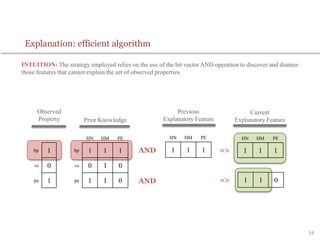
INTUITION: The strategy employed relies on the use of the bit vector AND operation to discover and dismiss
those features that cannot explain the set of observed properties.
54
Explanation: efficient algorithm
bp 1
cs 0
pa 1
HN HM PE
bp 0 1 1
cs 0 1 0
pa 1 1 0
HN HM PE
1 1 0
HN HM PE
0 1 0AND => 0 1 0
Observed
Property Prior Knowledge
Previous
Explanatory Feature
Current
Explanatory Feature
=
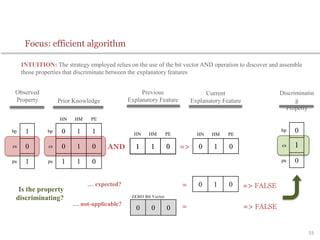
INTUITION: The strategy employed relies on the use of the bit vector AND operation to discover and assemble
those properties that discriminate between the explanatory features
bp 0
cs 0
pa 0
Discriminatin
g
Property
1 1 0
… expected?
0 0 0
… not-applicable?
ZERO Bit Vector
0 1 0
=
=> FALSE
=> FALSE
1
Is the property
discriminating?
55
Focus: efficient algorithm
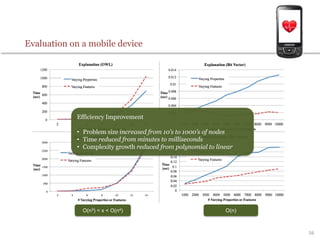
O(n3) < x < O(n4) O(n)
56
Evaluation on a mobile device
Efficiency Improvement
• Problem size increased from 10’s to 1000’s of nodes
• Time reduced from minutes to milliseconds
• Complexity growth reduced from polynomial to linear
57
Technical contributions in a nutshell
1. Semantic Sensor Web: Developed technologies for the semantic annotation
of sensor data on the Web
- Semantic Sensor Web (IEEE Internet Computing, 2008) – 276 citations (as of Aug. 2013)
- SemSOS: Semantic Sensor Observation Service (International Symposium on Collaborative Technologies and Systems, 2009)
- Semantic Sensor Network XG Final Report (W3C Incubator Group Report, 2011)
2. Semantic Perception: Designed a declarative specification of perception,
capable of utilizing an off-the-shelf OWL-DL reasoner
- An Ontological Approach to Focusing Attention and Enhancing Machine Perception on the Web (Applied Ontology Journal,
2011)
- Semantic Perception: Converting Sensory Observations to Abstractions (IEEE Internet Computing: Special Issue on Context-
Aware Computing, 2012) – most downloaded paid paper in IEEE-IC 2012
3. Intelligence at the Edge: Implemented efficient algorithms for executing
perceptual inference on resource-constrained devices
- An Efficient Bit Vector Approach to Semantics-based Machine Perception in Resource-Constrained Devices (International
Semantic Web Conference, 2012)
58
W3C Reports
1. Semantic Sensor Network XG Final Report (W3C Incubator Group Report, 2011)
Journal Publications
1. Physical-Cyber-Social Computing: An Early 21st Century Approach (IEEE Intelligent Systems, 2013)
2. Semantic Perception: Converting Sensory Observations to Abstractions (IEEE Internet Computing, 2012)
3. Semantics for the Internet of Things: Early Progress and Back to the Future (International Journal on Semantic Web and Information Systems, 2012)
4. The SSN ontology of the W3C semantic sensor network incubator group (Web Semantics: Science, Services and Agents on the World Wide Web, 2012)
5. An Ontological Approach to Focusing Attention and Enhancing Machine Perception on the Web (Applied Ontology, 2011)
6. Semantic Sensor Web (IEEE Internet Computing, 2008)
Conference Publications
1. An Efficient Bit Vector Approach to Semantics-based Machine Perception in Resource-Constrained Devices (International Semantic Web Conference,
2012)
2. Computing Perception from Sensor Data (IEEE Sensors Conference, 2012)
3. SemSOS: Semantic Sensor Observation Service (International Symposium on Collaborative Technologies and Systems, 2009)
4. Situation Awareness via Abductive Reasoning for Semantic Sensor Data: A Preliminary Report (International Symposium on Collaborative
Technologies and Systems, 2009).
Workshop Publications
1. SECURE: Semantics Empowered Rescue Environment (International Workshop on Semantic Sensor Networks, 2011)
2. Representation of Parsimonious Covering Theory in OWL-DL (International Workshop on OWL: Experiences and Directions, 2011)
3. Provenance Aware Linked Sensor Data (Workshop on Trust and Privacy on the Social and Semantic Web, 2010)
4. Linked Sensor Data (International Symposium on Collaborative Technologies and Systems, 2010)
5. A Survey of the Semantic Specification of Sensors (International Workshop on Semantic Sensor Networks, 2009)
6. An Ontological Representation of Time Series Observations on the Semantic Sensor Web (International Workshop on the Semantic Sensor Web)
7. Video on the Semantic Sensor Web (W3C Video on the Web Workshop, 2007)
Relevant Publications
59
Application
Proactive,
preventative
healthcare
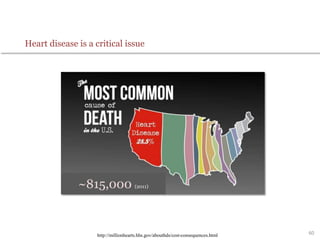
Heart disease is a critical issue
~815,000 (2011)
http://millionhearts.hhs.gov/abouthds/cost-consequences.html 60
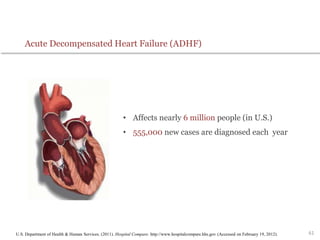
Acute Decompensated Heart Failure (ADHF)
• Affects nearly 6 million people (in U.S.)
• 555,000 new cases are diagnosed each year
61U.S. Department of Health & Human Services. (2011). Hospital Compare. http://www.hospitalcompare.hhs.gov (Accessed on February 19, 2012).
• 4.8 million hospitalizations per year
• 50% are readmitted within 6 months
• 25% are readmitted within 30 days
• 70% due to worsening conditions
• Costing $17 billion per year
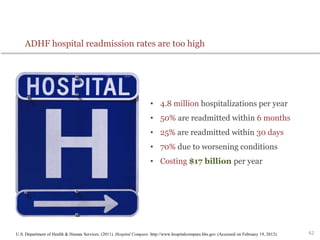
ADHF hospital readmission rates are too high
62U.S. Department of Health & Human Services. (2011). Hospital Compare. http://www.hospitalcompare.hhs.gov (Accessed on February 19, 2012).
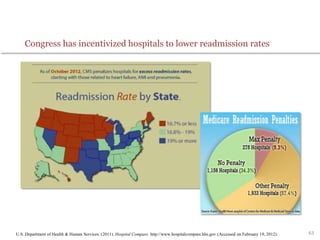
Congress has incentivized hospitals to lower readmission rates
63U.S. Department of Health & Human Services. (2011). Hospital Compare. http://www.hospitalcompare.hhs.gov (Accessed on February 19, 2012).
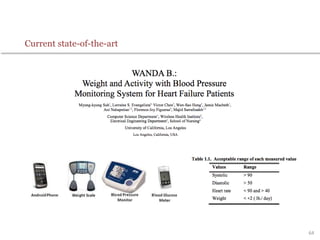
Current state-of-the-art
64
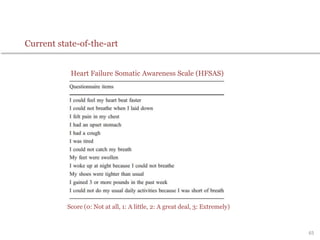
Score (0: Not at all, 1: A little, 2: A great deal, 3: Extremely)
Heart Failure Somatic Awareness Scale (HFSAS)
Current state-of-the-art
65
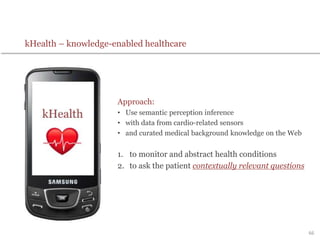
kHealth – knowledge-enabled healthcare
Approach:
• Use semantic perception inference
• with data from cardio-related sensors
• and curated medical background knowledge on the Web
1. to monitor and abstract health conditions
2. to ask the patient contextually relevant questions
66
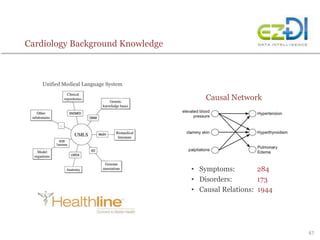
Cardiology Background Knowledge
• Symptoms: 284
• Disorders: 173
• Causal Relations: 1944
Unified Medical Language System
Causal Network
67
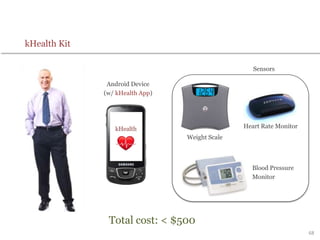
kHealth Kit
Weight Scale
Heart Rate Monitor
Blood Pressure
Monitor
68
Sensors
Android Device
(w/ kHealth App)
Total cost: < $500
69
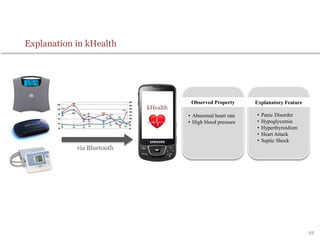
Explanation in kHealth
• Abnormal heart rate
• High blood pressure
• Panic Disorder
• Hypoglycemia
• Hyperthyroidism
• Heart Attack
• Septic Shock
Observed Property Explanatory Feature
via Bluetooth
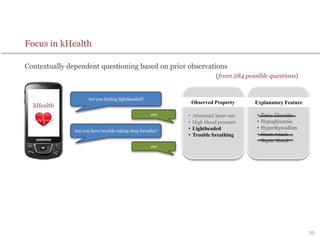
70
Focus in kHealth
Are you feeling lightheaded?
Are you have trouble taking deep breaths?
yes
yes
• Abnormal heart rate
• High blood pressure
• Lightheaded
• Trouble breathing
• Panic Disorder
• Hypoglycemia
• Hyperthyroidism
• Heart Attack
• Septic Shock
Contextually dependent questioning based on prior observations
(from 284 possible questions)
Observed Property Explanatory Feature
71
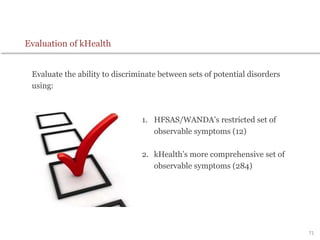
Evaluation of kHealth
Evaluate the ability to discriminate between sets of potential disorders
using:
1. HFSAS/WANDA’s restricted set of
observable symptoms (12)
2. kHealth’s more comprehensive set of
observable symptoms (284)
72
Evaluation of kHealth
Evaluation Metrics:
1. Efficiency: How many observations (or questions) required to minimize the
set of explanations?
2. Specificity: How specific is the resulting minimum set of explanations (i.e.,
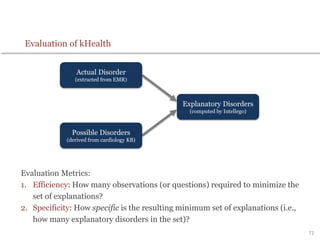
how many explanatory disorders in the set)?
Explanatory Disorders
(computed by Intellego)
Actual Disorder
(extracted from EMR)
Possible Disorders
(derived from cardiology KB)
73
Evaluation of kHealth – Early Results
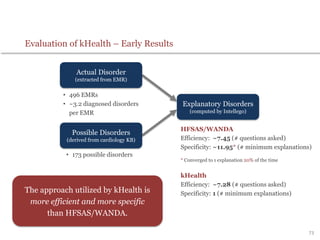
HFSAS/WANDA
Efficiency: ~7.45 (# questions asked)
Specificity: ~11.95* (# minimum explanations)
* Converged to 1 explanation 20% of the time
• 496 EMRs
• ~3.2 diagnosed disorders
per EMR
• 173 possible disorders
The approach utilized by kHealth is
more efficient and more specific
than HFSAS/WANDA.
kHealth
Efficiency: ~7.28 (# questions asked)
Specificity: 1 (# minimum explanations)
Explanatory Disorders
(computed by Intellego)
Actual Disorder
(extracted from EMR)
Possible Disorders
(derived from cardiology KB)
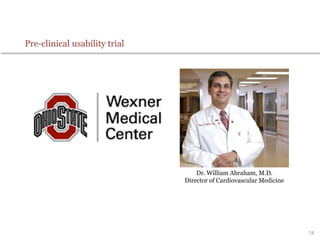
Pre-clinical usability trial
Dr. William Abraham, M.D.
Director of Cardiovascular Medicine
74
Sensing
and
Perception
Health
Care
Academic
Standards
Org.
Industry Government
Research
Collaborators
by Research Topic
and Organization Type
75
Special Thanks to AFRL and DAGSI
76
AFRL/DAGSI Research Topic SN08-8:
Architectures for Secure Semantic Sensor Networks for
Multi-Layered Sensing
77
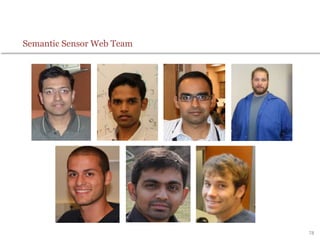
Semantic Sensor Web Team
78
A SEMANTICS-BASED APPROACH
TO MACHINE PERCEPTION
Cory Andrew Henson
August 27, 2013
79
Thank you.
For additional information visit:
http://knoesis.org/researchers/cory

A Semantics-based Approach to Machine Perception

  • 1.
    A SEMANTICS-BASED APPROACH TOMACHINE PERCEPTION Cory Andrew Henson August 27, 2013 1 Committee: Amit Sheth (advisor) Krishnaprasad Thirunarayan John Gallagher Payam Barnaghi Satya Sahoo Ph.D. Dissertation Defense Wright State University Dept. of Computer Science and Engineering
  • 2.
  • 3.
    3 Thesis Machine perception canbe formalized using semantic web technologies in order to derive abstractions from sensor data using background knowledge on the Web, and efficiently executed on resource-constrained devices.
  • 4.
    4 3 primary issuesto be addressed Annotation of sensor data Semantic Sensor Web Semantic Perception Intelligence at the Edge Interpretation of sensor data Efficient execution on resource-constrained devices 1 2 3
  • 5.
    5 lives in has pet isahas pet Person Animal Concrete Facts Resource Description Framework Semantic Web (according to Farside) General Knowledge Web Ontology Language “Now! – That should clear up a few things around here!” is a
  • 6.
  • 7.
  • 8.
    8 Sensor systems aretoo often stovepiped
  • 9.
    9 With freedom comesresponsibility 1. discovery, access, and search 2. integration and interpretation We want to set this data free
  • 10.
    10 OGC Sensor WebEnablement (SWE)
  • 11.
    11 With freedom comesresponsibility 1. discovery, access, and search 2. integration and interpretation We want to set this data free
  • 12.
    12 RDF OWL How aremachines supposed to integrate and interpret sensor data? Semantic Sensor Networks (SSN)
  • 13.
    13 W3C Semantic SensorNetwork Ontology Lefort, L., Henson, C., Taylor, K., Barnaghi, P., Compton, M., Corcho, O., Garcia-Castro, R., Graybeal, J., Herzog, A., Janowicz, K., Neuhaus, H., Nikolov, A., and Page, K.: Semantic Sensor Network XG Final Report, W3C Incubator Group Report (2011).
  • 14.
    14 W3C Semantic SensorNetwork Ontology Lefort, L., Henson, C., Taylor, K., Barnaghi, P., Compton, M., Corcho, O., Garcia-Castro, R., Graybeal, J., Herzog, A., Janowicz, K., Neuhaus, H., Nikolov, A., and Page, K.: Semantic Sensor Network XG Final Report, W3C Incubator Group Report (2011).
  • 15.
    15 W3C Semantic SensorNetwork Ontology Lefort, L., Henson, C., Taylor, K., Barnaghi, P., Compton, M., Corcho, O., Garcia-Castro, R., Graybeal, J., Herzog, A., Janowicz, K., Neuhaus, H., Nikolov, A., and Page, K.: Semantic Sensor Network XG Final Report, W3C Incubator Group Report (2011).
  • 16.
    16 Semantic Annotation ofSWE Lefort, L., Henson, C., Taylor, K., Barnaghi, P., Compton, M., Corcho, O., Garcia-Castro, R., Graybeal, J., Herzog, A., Janowicz, K., Neuhaus, H., Nikolov, A., and Page, K.: Semantic Sensor Network XG Final Report, W3C Incubator Group Report (2011).
  • 17.
    Semantic Sensor ObservationService (SemSOS) Cory Henson, Josh Pschorr,Amit Sheth, Krishnaprasad Thirunarayan, SemSOS: Semantic Sensor Observation Service, In Proceedings of the 2009 International Symposium on Collaborative Technologies and Systems (CTS 2009), Baltimore, MD, May 18-22, 2009. 17
  • 18.
    Semantic Sensor ObservationService (SemSOS) Joshua Pschorr, Cory Henson, Harshal Patni, and Amit P. Sheth. Sensor Discovery on Linked Data. Kno.e.sis Center Technical Report 2010. 18
  • 19.
    19 3 primary issuesto be addressed Annotation of sensor data Semantic Sensor Web Semantic Perception Intelligence at the Edge Interpretation of sensor data Efficient execution on resource-constrained devices1 2 3
  • 20.
    20 Semantic Perception • Therole of perception is to transform raw sensory data into a meaningful and correct representation of the external world. • The systematic automation of this ability is the focus of machine perception. • For correct interpretation of this representation, we need a formal account of how this is done.
  • 21.
    21 What can welearn from cognitive models of perception? People are good at making sense of sensory input
  • 22.
    22 Perception is anactive, cyclical process of exploration and interpretation. The perception cycle is driven by prior knowledge, in order to generate and test hypotheses. Some observations are more informative than others (in order to effectively test hypotheses*). Ulric Neisser Richard Gregory Kenneth Norwich 1970’s 1980’s 1990’s Cognitive Models of Perception * Applies to machine perception within Intellego, NOT human perception.
  • 23.
    Observed Properties Perceived Features 23 Background knowledge Explanation Ontology ofPerception Focus An Ontological Approach to Focusing Attention and Enhancing Machine Perception on the Web (Applied Ontology, 2011)
  • 24.
  • 25.
  • 26.
    The Patient ofthe Future MIT Technology Review, 2012 26http://www.technologyreview.com/featuredstory/426968/the-patient-of-the-future/
  • 27.
    Digital Doctor Let’s providepeople with the tools needed to monitor and manage their own health http://worldofdtcmarketing.com/mobile-health-apps-a-new-opportunity-for-healthcare-marketers/mobile-healthcare-marketing-trends/ 27
  • 28.
    Medical/healthcare expert systemshave been around for a long time 28
  • 29.
    1. Ubiquitous Sensing2. Always-on Computing 3. Knowledge on the Web 3 recent developments have changed the technological landscape … 29
  • 30.
    30 Making sense ofsensor data with
  • 31.
    DATA sensor observations KNOWLEDGE situation awarenessuseful for decision making Primary challenge is to bridge the gap between data and knowledge 31
  • 32.
    SSN Ontology 2 Interpreted data (deductive) [inOWL] e.g., threshold 1 Annotated Data [in RDF] e.g., label 0 Raw Data [in TEXT] e.g., number Levels of Abstraction 3 Interpreted data (abductive) [in OWL] e.g., diagnosis Intellego ―150‖ Systolic blood pressure of 150 mmHg Elevated Blood Pressure Hyperthyroidism …… 32
  • 33.
    Observed Properties Perceived Features 33 Background knowledge on theWeb Low-level observed properties suggest explanatory hypotheses through abduction Explanation Focus Ontology of Perception An Ontological Approach to Focusing Attention and Enhancing Machine Perception on the Web (Applied Ontology, 2011)
  • 34.
    34 Semantics of Explanation Abduction– or, inference to the best EXPLANATION Task • Given background knowledge of the environment (SIGMA), and • given a set of sensor observation data (RHO), • find a consistent explanation of the situation (DELTA) Background knowledge Features (objects/events) in the world Sensor observation data
  • 35.
    35 Semantics of Explanation Backgroundknowledge is represented as a causal network between features (objects or events) in the world and the sensor observations they give rise to.
  • 36.
    36 Semantics of Explanation Findingthe sweet spot between abduction and OWL • Simulation of Parsimonious Covering Theory in OWL-DL (using the single-feature assumption*) * An explanation must be a single feature which accounts for all observed properties Semantic Perception: Converting Sensory Observations to Abstractions (IEEE Internet Computing, 2012) Theorem: Given a PCT problem P and its translation o(P) into OWL, Δ = {e} is a PCT explanation if and only if ExplanatoryFeature(e) is deduced by an OWL-DL reasoner — that is, if and only if o(P) ⊧ ExplanatoryFeature(e).
  • 37.
    37 Finding the SweetSpot minimize explanations degrade gracefully w/ incomplete info decidable web reasoning Abductive Logic (e.g., PCT) high complexity Deductive Logic (e.g., OWL) (relatively) low complexity Explanation (in Intellego)
  • 38.
    Explanatory Feature: Afeature is explanatory w.r.t. a set of observed properties if it causes each property in the set. ExplanatoryFeature ≡ ∃isPropertyOf—.{p1} ⊓ … ⊓ ∃isPropertyOf—.{pn} elevated blood pressure clammy skin palpitations Hypertension Hyperthyroidism Pulmonary Edema Observed Property Explanatory Feature 38 Semantics of Explanation
  • 39.
    Observed Properties Perceived Features 39 Background knowledge on theWeb Hypotheses imply the informational value of future observations through deduction Explanation Focus Ontology of Perception An Ontological Approach to Focusing Attention and Enhancing Machine Perception on the Web (Applied Ontology, 2011)
  • 40.
    Universe of observableproperties 40 Semantics of Focus To predict which future observations have informational value, find those observable properties that can discriminate between the set of hypotheses. Expected Properties Not-applicable Properties Discriminating Properties
  • 41.
    Expected Property: Aproperty is expected w.r.t. a set of features if it is caused by each feature in the set. ExpectedProperty ≡ ∃isPropertyOf.{f1} ⊓ … ⊓ ∃isPropertyOf.{fn} elevated blood pressure clammy skin palpitations Hypertension Hyperthyroidism Pulmonary Edema Expected Property Explanatory Feature 41 Semantics of Focus
  • 42.
    Not Applicable Property:A property is not-applicable w.r.t. a set of features if it is not caused by any feature in the set. NotApplicableProperty ≡ ¬∃isPropertyOf.{f1} ⊓ … ⊓ ¬∃isPropertyOf.{fn} elevated blood pressure clammy skin palpitations Hypertension Hyperthyroidism Pulmonary Edema Not Applicable Property Explanatory Feature 42 Semantics of Focus
  • 43.
    Discriminating Property: Aproperty is discriminating w.r.t. a set of features if it is neither expected nor not-applicable. DiscriminatingProperty ≡ ¬ExpectedProperty ⊓ ¬NotApplicableProperty elevated blood pressure clammy skin palpitations Hypertension Hyperthyroidism Pulmonary Edema Discriminating Property Explanatory Feature 43 Semantics of Focus
  • 44.
    Off-the-shelf OWL-DL reasonersare too resource intensive in terms of both memory and time • Runs out of resources with background knowledge >> 20 nodes • Asymptotic complexity: O(n3) 44 O(n3) < x < O(n4) Semantic perception on resource-constrained devices
  • 45.
    45 3 primary issuesto be addressed Annotation of sensor data Semantic Sensor Web Semantic Perception Intelligence at the Edge Interpretation of sensor data Efficient execution on resource-constrained devices1 2 3
  • 46.
  • 47.
  • 48.
    48 Basis Watch • HeartRate Monitor • Accelerometer • Skin Temperature • Galvanic Skin Response
  • 49.
    Homo Digitus 49 How dowe make sense of this data … and do it efficiently and at scale?
  • 50.
    Approach 1: Sendall sensor observations to the cloud for processing 50 Approach 2: downscale semantic processing so that each device is capable of machine perception Intelligence at the Edge
  • 51.
    Use bit vectorencodings and their operations to encode background knowledge and execute perceptual inference 51 Efficient execution of semantic perception 01100011 10001110 11001110 01010110 01110101 OWL-DL An Efficient Bit Vector Approach to Semantics-based Machine Perception in Resource-Constrained Devices (ISWC, 2012)
  • 52.
    lift lower Translate background knowledge,observations, and explanations between Semantic Web and bit vector representation 52 Lifting and lowering of knowledge
  • 53.
    53 Efficient execution ofsemantic perception Bit vector algorithms are provably equivalent to the OWL inference (i.e., semantics preserving) Intuition: discover and dismiss those features that cannot explain the set of observed properties. Intuition: discover and assemble those properties that discriminate between the explanatory features
  • 54.
    bp 1 cs 0 pa1 HN HM PE bp 1 1 1 cs 0 1 0 pa 1 1 0 HN HM PE 1 1 1 HN HM PE 1 1 1 1 1 0 AND => AND 1 1 1 Observed Property Prior Knowledge Previous Explanatory Feature Current Explanatory Feature => INTUITION: The strategy employed relies on the use of the bit vector AND operation to discover and dismiss those features that cannot explain the set of observed properties. 54 Explanation: efficient algorithm
  • 55.
    bp 1 cs 0 pa1 HN HM PE bp 0 1 1 cs 0 1 0 pa 1 1 0 HN HM PE 1 1 0 HN HM PE 0 1 0AND => 0 1 0 Observed Property Prior Knowledge Previous Explanatory Feature Current Explanatory Feature = INTUITION: The strategy employed relies on the use of the bit vector AND operation to discover and assemble those properties that discriminate between the explanatory features bp 0 cs 0 pa 0 Discriminatin g Property 1 1 0 … expected? 0 0 0 … not-applicable? ZERO Bit Vector 0 1 0 = => FALSE => FALSE 1 Is the property discriminating? 55 Focus: efficient algorithm
  • 56.
    O(n3) < x< O(n4) O(n) 56 Evaluation on a mobile device Efficiency Improvement • Problem size increased from 10’s to 1000’s of nodes • Time reduced from minutes to milliseconds • Complexity growth reduced from polynomial to linear
  • 57.
    57 Technical contributions ina nutshell 1. Semantic Sensor Web: Developed technologies for the semantic annotation of sensor data on the Web - Semantic Sensor Web (IEEE Internet Computing, 2008) – 276 citations (as of Aug. 2013) - SemSOS: Semantic Sensor Observation Service (International Symposium on Collaborative Technologies and Systems, 2009) - Semantic Sensor Network XG Final Report (W3C Incubator Group Report, 2011) 2. Semantic Perception: Designed a declarative specification of perception, capable of utilizing an off-the-shelf OWL-DL reasoner - An Ontological Approach to Focusing Attention and Enhancing Machine Perception on the Web (Applied Ontology Journal, 2011) - Semantic Perception: Converting Sensory Observations to Abstractions (IEEE Internet Computing: Special Issue on Context- Aware Computing, 2012) – most downloaded paid paper in IEEE-IC 2012 3. Intelligence at the Edge: Implemented efficient algorithms for executing perceptual inference on resource-constrained devices - An Efficient Bit Vector Approach to Semantics-based Machine Perception in Resource-Constrained Devices (International Semantic Web Conference, 2012)
  • 58.
    58 W3C Reports 1. SemanticSensor Network XG Final Report (W3C Incubator Group Report, 2011) Journal Publications 1. Physical-Cyber-Social Computing: An Early 21st Century Approach (IEEE Intelligent Systems, 2013) 2. Semantic Perception: Converting Sensory Observations to Abstractions (IEEE Internet Computing, 2012) 3. Semantics for the Internet of Things: Early Progress and Back to the Future (International Journal on Semantic Web and Information Systems, 2012) 4. The SSN ontology of the W3C semantic sensor network incubator group (Web Semantics: Science, Services and Agents on the World Wide Web, 2012) 5. An Ontological Approach to Focusing Attention and Enhancing Machine Perception on the Web (Applied Ontology, 2011) 6. Semantic Sensor Web (IEEE Internet Computing, 2008) Conference Publications 1. An Efficient Bit Vector Approach to Semantics-based Machine Perception in Resource-Constrained Devices (International Semantic Web Conference, 2012) 2. Computing Perception from Sensor Data (IEEE Sensors Conference, 2012) 3. SemSOS: Semantic Sensor Observation Service (International Symposium on Collaborative Technologies and Systems, 2009) 4. Situation Awareness via Abductive Reasoning for Semantic Sensor Data: A Preliminary Report (International Symposium on Collaborative Technologies and Systems, 2009). Workshop Publications 1. SECURE: Semantics Empowered Rescue Environment (International Workshop on Semantic Sensor Networks, 2011) 2. Representation of Parsimonious Covering Theory in OWL-DL (International Workshop on OWL: Experiences and Directions, 2011) 3. Provenance Aware Linked Sensor Data (Workshop on Trust and Privacy on the Social and Semantic Web, 2010) 4. Linked Sensor Data (International Symposium on Collaborative Technologies and Systems, 2010) 5. A Survey of the Semantic Specification of Sensors (International Workshop on Semantic Sensor Networks, 2009) 6. An Ontological Representation of Time Series Observations on the Semantic Sensor Web (International Workshop on the Semantic Sensor Web) 7. Video on the Semantic Sensor Web (W3C Video on the Web Workshop, 2007) Relevant Publications
  • 59.
  • 60.
    Heart disease isa critical issue ~815,000 (2011) http://millionhearts.hhs.gov/abouthds/cost-consequences.html 60
  • 61.
    Acute Decompensated HeartFailure (ADHF) • Affects nearly 6 million people (in U.S.) • 555,000 new cases are diagnosed each year 61U.S. Department of Health & Human Services. (2011). Hospital Compare. http://www.hospitalcompare.hhs.gov (Accessed on February 19, 2012).
  • 62.
    • 4.8 millionhospitalizations per year • 50% are readmitted within 6 months • 25% are readmitted within 30 days • 70% due to worsening conditions • Costing $17 billion per year ADHF hospital readmission rates are too high 62U.S. Department of Health & Human Services. (2011). Hospital Compare. http://www.hospitalcompare.hhs.gov (Accessed on February 19, 2012).
  • 63.
    Congress has incentivizedhospitals to lower readmission rates 63U.S. Department of Health & Human Services. (2011). Hospital Compare. http://www.hospitalcompare.hhs.gov (Accessed on February 19, 2012).
  • 64.
  • 65.
    Score (0: Notat all, 1: A little, 2: A great deal, 3: Extremely) Heart Failure Somatic Awareness Scale (HFSAS) Current state-of-the-art 65
  • 66.
    kHealth – knowledge-enabledhealthcare Approach: • Use semantic perception inference • with data from cardio-related sensors • and curated medical background knowledge on the Web 1. to monitor and abstract health conditions 2. to ask the patient contextually relevant questions 66
  • 67.
    Cardiology Background Knowledge •Symptoms: 284 • Disorders: 173 • Causal Relations: 1944 Unified Medical Language System Causal Network 67
  • 68.
    kHealth Kit Weight Scale HeartRate Monitor Blood Pressure Monitor 68 Sensors Android Device (w/ kHealth App) Total cost: < $500
  • 69.
    69 Explanation in kHealth •Abnormal heart rate • High blood pressure • Panic Disorder • Hypoglycemia • Hyperthyroidism • Heart Attack • Septic Shock Observed Property Explanatory Feature via Bluetooth
  • 70.
    70 Focus in kHealth Areyou feeling lightheaded? Are you have trouble taking deep breaths? yes yes • Abnormal heart rate • High blood pressure • Lightheaded • Trouble breathing • Panic Disorder • Hypoglycemia • Hyperthyroidism • Heart Attack • Septic Shock Contextually dependent questioning based on prior observations (from 284 possible questions) Observed Property Explanatory Feature
  • 71.
    71 Evaluation of kHealth Evaluatethe ability to discriminate between sets of potential disorders using: 1. HFSAS/WANDA’s restricted set of observable symptoms (12) 2. kHealth’s more comprehensive set of observable symptoms (284)
  • 72.
    72 Evaluation of kHealth EvaluationMetrics: 1. Efficiency: How many observations (or questions) required to minimize the set of explanations? 2. Specificity: How specific is the resulting minimum set of explanations (i.e., how many explanatory disorders in the set)? Explanatory Disorders (computed by Intellego) Actual Disorder (extracted from EMR) Possible Disorders (derived from cardiology KB)
  • 73.
    73 Evaluation of kHealth– Early Results HFSAS/WANDA Efficiency: ~7.45 (# questions asked) Specificity: ~11.95* (# minimum explanations) * Converged to 1 explanation 20% of the time • 496 EMRs • ~3.2 diagnosed disorders per EMR • 173 possible disorders The approach utilized by kHealth is more efficient and more specific than HFSAS/WANDA. kHealth Efficiency: ~7.28 (# questions asked) Specificity: 1 (# minimum explanations) Explanatory Disorders (computed by Intellego) Actual Disorder (extracted from EMR) Possible Disorders (derived from cardiology KB)
  • 74.
    Pre-clinical usability trial Dr.William Abraham, M.D. Director of Cardiovascular Medicine 74
  • 75.
  • 76.
    Special Thanks toAFRL and DAGSI 76 AFRL/DAGSI Research Topic SN08-8: Architectures for Secure Semantic Sensor Networks for Multi-Layered Sensing
  • 77.
  • 78.
  • 79.
    A SEMANTICS-BASED APPROACH TOMACHINE PERCEPTION Cory Andrew Henson August 27, 2013 79 Thank you. For additional information visit: http://knoesis.org/researchers/cory

Editor's Notes

  • #27 - Larry Smarr is a professor at the University of California, San DiegoAnd he was diagnosed with Chrones DiseaseWhat’s interesting about this case is that Larry diagnosed himselfHe is a pioneer in the area of Quantified-Self, which uses sensors to monitor physiological symptomsThrough this process he discovered inflamation, which led him to discovery of Chrones DiseaseThis type of self-tracking is becoming more and more common
  • #49 My qs story