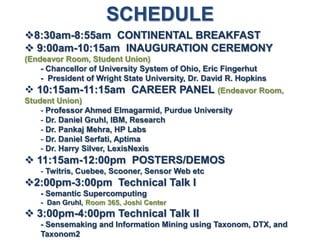


SCHEDULE8:30am-8:55am  CONTINENTAL BREAKFAST
9:00am-10:15am  INAUGURATION CEREMONY(Endeavor Room, Student Union)- Chancellor of University System of Ohio, Eric FingerhutPresident of Wright State University, Dr. David R. Hopkins
Techincal Introduction of Knoesis (Dr.AmitSheth– Director, and the team)
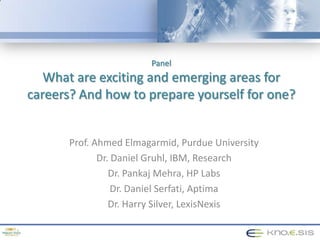
10:15am-11:15am  CAREER PANEL (Endeavor Room, Student Union)
 Professor Ahmed Elmagarmid, Purdue University
Dr. Daniel Gruhl, IBM, Research
Dr. PankajMehra, HP Labs
Dr. Daniel Serfati, Aptima
Dr. Harry Silver, LexisNexis
 11:15am-12:00pm  POSTERS/DEMOS
Twitris, Cuebee, Scooner, Sensor Web etc
2:00pm-3:00pm  Technical Talk I- Semantic SupercomputingDan Gruhl, Room 365, Joshi CenterOhio Center of Excellence on Knowledge-Enabled Computing (Kno.e.sis)Amit  Sheth, Director
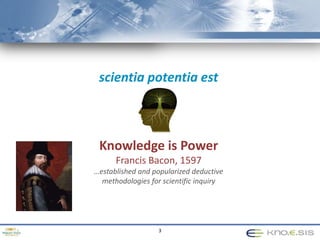
Ohio Center of Excellence on Knowledge-Enabled Computing (Kno.e.sis)scientiapotentiaestKnowledge is Power Francis Bacon, 1597…established and popularized deductive methodologies for scientific inquiry3
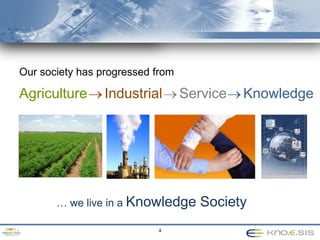
Ohio Center of ExcellenceKnowledge-Enabled Computing (Kno.e.sis)Ohio Center of Excellence on Knowledge-Enabled Computing (Kno.e.sis)Our society has progressed from Agriculture IndustrialServiceKnowledge… we live in a Knowledge Society4
Knowledge EconomyAs the economies have transformed ….… new era … where the principal component of value creation, productivity and economic growth is knowledge.    Florida & Kenny 915
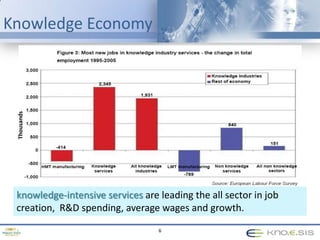
Knowledge EconomyThousandsknowledge-intensive services are leading the all sector in job creation,  R&D spending, average wages and growth.6
Knowledge EconomyExploitation of Knowledge for improving human experience/effectiveness, social and economic gainsComputer + Human Knowledge (knowledge discovery, insight)Computer + Collective Action Collective Intelligence (Knowledge)Computer (IR,ML,NLP) + Knowledge = (better extraction, next gen search) learning, insightHumanknowledge + Computer Representation = Situated CognitionComputer + Human + Knowledge(better) Interaction, (improved) Human Experience, (higher) Productivity7
Knowledge ServicesCreation and exploitation of Knowledge for improving human experience/effectiveness, social and economic gainsComputer + Human Knowledge (knowledge discovery, insight)Computer + Collective Action  Collective IntelligenceComputer (IR,ML,NLP) + Knowledge = (better) learning (extraction, search…)Humanknowledge+ Computer Representation = Situated CognitionComputer + Human + Knowledge (better) Interaction, (improved) Human Experience, (higher) Productivity8
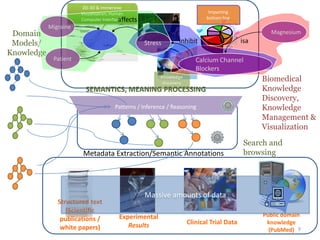
affectsMigraineMagnesiumStressisainhibitKnowledge discoveryPatientCalcium Channel Blockers2D-3D & Immersive Visualization, Human Computer InterfacesImpacting bottom lineDomain Models/KnowledgeStructured text (Scientific publications / white papers)Biomedical Knowledge Discovery,Knowledge Management & VisualizationSEMANTICS, MEANING PROCESSINGPatterns / Inference / ReasoningMeta data / Semantic AnnotationsSearch and browsingMetadata Extraction/Semantic AnnotationsMassive amounts of dataClinical Trial DataExperimental ResultsPublic domain knowledge (PubMed)9
Kno.e.sis’ leadership in semantic processing will contribute to basic theory about  computation and cognitive systems, and address pressing  practical problems associated with productive thinking in the face of an explosion of data.Kno.e.sis intends to lead a march from information age to meaning age.Kno.e.sis Vision10
Why Kno.e.sis?We have exciting vision built on cutting edge research and technology
We incorporate synergy to carry out exceptional vision
We are world class – and recognized as such
Our track record shows we can succeed
We target the growth aspect of economy and regional/state needs11
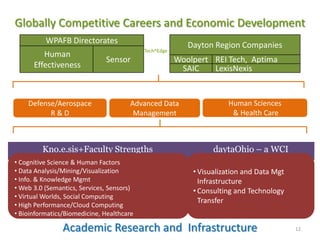
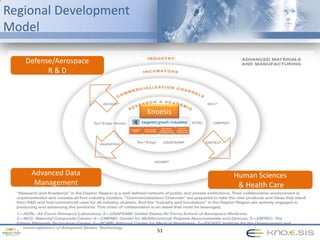
Globally Competitive Careers and Economic DevelopmentDayton Region CompaniesWPAFB DirectoratesHuman EffectivenessSensorWoolpertREI Tech,  AptimaTech^EdgeSAICLexisNexisKnowledge Workers, Products, Services and ApplicationsHuman Sciences & Health CareAdvanced Data ManagementDefense/Aerospace R & DApplication to Regional Industry ClusterdaytaOhio – a WCIKno.e.sis+Faculty StrengthsVisualization and Data Mgt Infrastructure
Consulting and Technology  Transfer
 Cognitive Science & Human Factors
 Data Analysis/Mining/Visualization
 Info. & Knowledge Mgmt
 Web 3.0 (Semantics, Services, Sensors)
 Virtual Worlds, Social Computing
 High Performance/Cloud Computing
 Bioinformatics/Biomedicine, HealthcareAcademic Research and  Infrastructure12
13
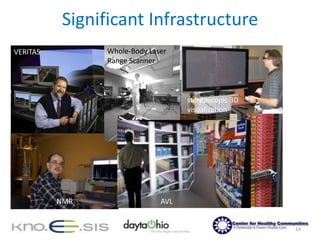
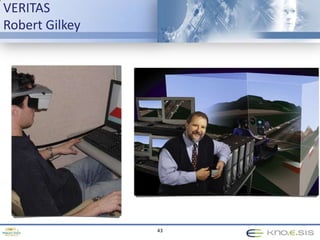
Significant InfrastructureWhole-Body Laser Range ScannerVERITASstereoscopic 3D visualizationNMRAVL14
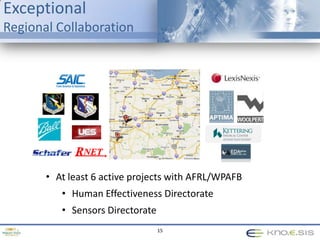
ExceptionalRegional CollaborationAt least 6 active projects with AFRL/WPAFB
Human Effectiveness Directorate
Sensors Directorate 15
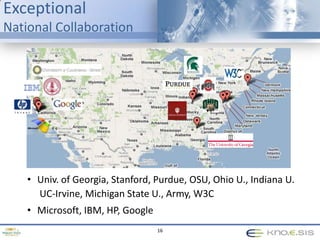
ExceptionalNational CollaborationUniv. of Georgia, Stanford, Purdue, OSU, Ohio U., Indiana U. UC-Irvine, Michigan State U., Army, W3C
Microsoft, IBM, HP, Google16
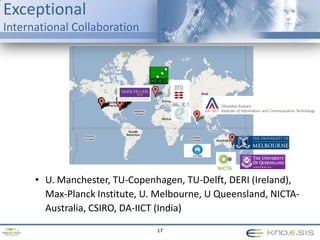
ExceptionalInternational CollaborationU. Manchester, TU-Copenhagen, TU-Delft, DERI (Ireland), Max-Planck Institute, U. Melbourne, U Queensland, NICTA-Australia,CSIRO, DA-IICT (India)17
Ohio Center of Excellence on Knowledge-Enabled Computing (Kno.e.sis)Knowledge & Next Generation of the WebWeb has become the core infrastructure for the knowledge economyWeb 1.0: Web of Documents and MediaWeb 2.0: Web of PeopleWeb 3.0: Web of MeaningMeenaNagarajanAdvanced Data Management
KNOWLEDGE EXTRACTION“Human Cognition” AND Psychology AND Neuroscience?19
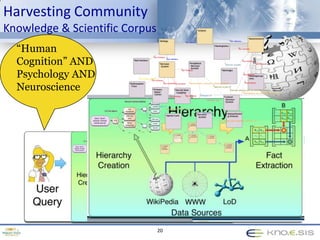
Harvesting Community Knowledge & Scientific Corpus“Human Cognition” AND Psychology AND Neuroscience20
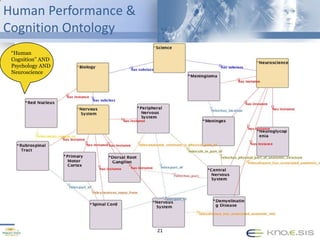
Human Performance &Cognition Ontology“Human Cognition” AND Psychology AND Neuroscience21
INSIGHTS &KNOWLEDGE DISCOVERY
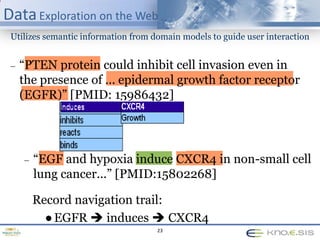
DataExploration on the WebUtilizes semantic information from domain models to guide user interaction “PTEN protein could inhibit cell invasion even in the presence of ... epidermal growth factor receptor (EGFR)” [PMID: 15986432]
“EGF and hypoxia induce CXCR4 in non-small cell lung cancer...” [PMID:15802268]Record navigation trail: EGFR  induces  CXCR423
The Memex Vision [Vannevar Bush]Of now the human brain navigates an information space …“It operates by association. With one item in its grasp, it snaps instantly to the next that is suggested by the association of thoughts, in accordance with some intricate web of trails carried by the cells of the brain.”24
Cuebee and ScoonerShared as open source, with demos online.25
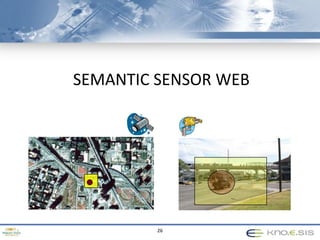
Ohio Center of Excellence Knowledge-Enabled Computing SEMANTIC SENSOR WEB26
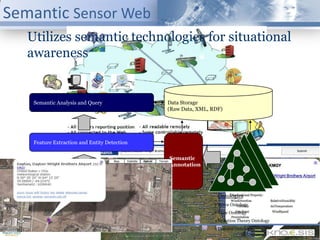
\Semantic Sensor WebUtilizes semantic technologies for situational awarenessData Storage(Raw Data, XML, RDF)Semantic Analysis and QueryFeature Extraction and Entity DetectionSemanticAnnotationSensor Data CollectionOntologies Space Ontology
 Time Ontology
 Situation Theory Ontology
 Domain Ontology 27
Ohio Center of Excellence Knowledge-Enabled Computing (Kno.e.sis)SEMANTIC SOCIAL WEB
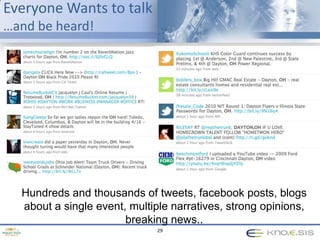
Everyone Wants to talk …and be heard!Hundreds and thousands of tweets, facebook posts, blogs  about a single event, multiple narratives, strong opinions, breaking news..29
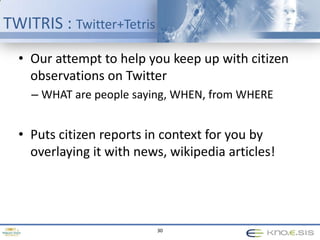
TWITRIS : Twitter+TetrisOur attempt to help you keep up with citizen observations on TwitterWHAT are people saying, WHEN, from WHEREPuts citizen reports in context for you by overlaying it with news, wikipedia articles!30
31
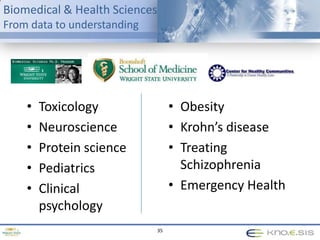
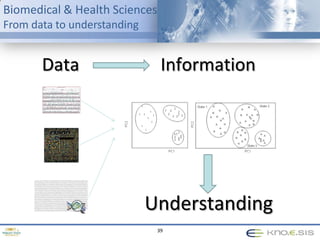
Ohio Center of Excellence on Knowledge-Enabled Computing (Kno.e.sis)Biomedical & Health SciencesFrom data to understandingMike RaymerMany biomedical collaborations: Nick Reo, Toxicology;  Tim Cope, Neuroscience;Jerry Alter, Protein Science; Oleg Paliey, Microbiolgy and healthMany health care collaborations: Kate Cauley, Center for Healthy Communities; UC-Irvine – Emergency health, Sonia Michail, obesity & intestinal health; Bradley Jacobs, human healthHuman Sciences & Health Care

Inauguration Function - Ohio Center of Excellence in Knowledge-Enabled Computing at Wright State (Kno.e.sis)

  • 1.
  • 2.
    9:00am-10:15am INAUGURATIONCEREMONY(Endeavor Room, Student Union)- Chancellor of University System of Ohio, Eric FingerhutPresident of Wright State University, Dr. David R. Hopkins
  • 3.
    Techincal Introduction ofKnoesis (Dr.AmitSheth– Director, and the team)
  • 4.
    10:15am-11:15am CAREERPANEL (Endeavor Room, Student Union)
  • 5.
    Professor AhmedElmagarmid, Purdue University
  • 6.
    Dr. Daniel Gruhl,IBM, Research
  • 7.
  • 8.
  • 9.
  • 10.
    11:15am-12:00pm POSTERS/DEMOS
  • 11.
  • 12.
    2:00pm-3:00pm TechnicalTalk I- Semantic SupercomputingDan Gruhl, Room 365, Joshi CenterOhio Center of Excellence on Knowledge-Enabled Computing (Kno.e.sis)Amit Sheth, Director
  • 13.
    Ohio Center ofExcellence on Knowledge-Enabled Computing (Kno.e.sis)scientiapotentiaestKnowledge is Power Francis Bacon, 1597…established and popularized deductive methodologies for scientific inquiry3
  • 14.
    Ohio Center ofExcellenceKnowledge-Enabled Computing (Kno.e.sis)Ohio Center of Excellence on Knowledge-Enabled Computing (Kno.e.sis)Our society has progressed from Agriculture IndustrialServiceKnowledge… we live in a Knowledge Society4
  • 15.
    Knowledge EconomyAs theeconomies have transformed ….… new era … where the principal component of value creation, productivity and economic growth is knowledge. Florida & Kenny 915
  • 16.
    Knowledge EconomyThousandsknowledge-intensive servicesare leading the all sector in job creation, R&D spending, average wages and growth.6
  • 17.
    Knowledge EconomyExploitation ofKnowledge for improving human experience/effectiveness, social and economic gainsComputer + Human Knowledge (knowledge discovery, insight)Computer + Collective Action Collective Intelligence (Knowledge)Computer (IR,ML,NLP) + Knowledge = (better extraction, next gen search) learning, insightHumanknowledge + Computer Representation = Situated CognitionComputer + Human + Knowledge(better) Interaction, (improved) Human Experience, (higher) Productivity7
  • 18.
    Knowledge ServicesCreation andexploitation of Knowledge for improving human experience/effectiveness, social and economic gainsComputer + Human Knowledge (knowledge discovery, insight)Computer + Collective Action  Collective IntelligenceComputer (IR,ML,NLP) + Knowledge = (better) learning (extraction, search…)Humanknowledge+ Computer Representation = Situated CognitionComputer + Human + Knowledge (better) Interaction, (improved) Human Experience, (higher) Productivity8
  • 19.
    affectsMigraineMagnesiumStressisainhibitKnowledge discoveryPatientCalcium ChannelBlockers2D-3D & Immersive Visualization, Human Computer InterfacesImpacting bottom lineDomain Models/KnowledgeStructured text (Scientific publications / white papers)Biomedical Knowledge Discovery,Knowledge Management & VisualizationSEMANTICS, MEANING PROCESSINGPatterns / Inference / ReasoningMeta data / Semantic AnnotationsSearch and browsingMetadata Extraction/Semantic AnnotationsMassive amounts of dataClinical Trial DataExperimental ResultsPublic domain knowledge (PubMed)9
  • 20.
    Kno.e.sis’ leadership insemantic processing will contribute to basic theory about computation and cognitive systems, and address pressing practical problems associated with productive thinking in the face of an explosion of data.Kno.e.sis intends to lead a march from information age to meaning age.Kno.e.sis Vision10
  • 21.
    Why Kno.e.sis?We haveexciting vision built on cutting edge research and technology
  • 22.
    We incorporate synergyto carry out exceptional vision
  • 23.
    We are worldclass – and recognized as such
  • 24.
    Our track recordshows we can succeed
  • 25.
    We target thegrowth aspect of economy and regional/state needs11
  • 26.
    Globally Competitive Careersand Economic DevelopmentDayton Region CompaniesWPAFB DirectoratesHuman EffectivenessSensorWoolpertREI Tech, AptimaTech^EdgeSAICLexisNexisKnowledge Workers, Products, Services and ApplicationsHuman Sciences & Health CareAdvanced Data ManagementDefense/Aerospace R & DApplication to Regional Industry ClusterdaytaOhio – a WCIKno.e.sis+Faculty StrengthsVisualization and Data Mgt Infrastructure
  • 27.
  • 28.
    Cognitive Science& Human Factors
  • 29.
  • 30.
    Info. &Knowledge Mgmt
  • 31.
    Web 3.0(Semantics, Services, Sensors)
  • 32.
    Virtual Worlds,Social Computing
  • 33.
  • 34.
  • 35.
  • 36.
    Significant InfrastructureWhole-Body LaserRange ScannerVERITASstereoscopic 3D visualizationNMRAVL14
  • 37.
    ExceptionalRegional CollaborationAt least6 active projects with AFRL/WPAFB
  • 38.
  • 39.
  • 40.
    ExceptionalNational CollaborationUniv. ofGeorgia, Stanford, Purdue, OSU, Ohio U., Indiana U. UC-Irvine, Michigan State U., Army, W3C
  • 41.
  • 42.
    ExceptionalInternational CollaborationU. Manchester,TU-Copenhagen, TU-Delft, DERI (Ireland), Max-Planck Institute, U. Melbourne, U Queensland, NICTA-Australia,CSIRO, DA-IICT (India)17
  • 43.
    Ohio Center ofExcellence on Knowledge-Enabled Computing (Kno.e.sis)Knowledge & Next Generation of the WebWeb has become the core infrastructure for the knowledge economyWeb 1.0: Web of Documents and MediaWeb 2.0: Web of PeopleWeb 3.0: Web of MeaningMeenaNagarajanAdvanced Data Management
  • 44.
    KNOWLEDGE EXTRACTION“Human Cognition”AND Psychology AND Neuroscience?19
  • 45.
    Harvesting Community Knowledge& Scientific Corpus“Human Cognition” AND Psychology AND Neuroscience20
  • 46.
    Human Performance &CognitionOntology“Human Cognition” AND Psychology AND Neuroscience21
  • 47.
  • 48.
    DataExploration on theWebUtilizes semantic information from domain models to guide user interaction “PTEN protein could inhibit cell invasion even in the presence of ... epidermal growth factor receptor (EGFR)” [PMID: 15986432]
  • 49.
    “EGF and hypoxiainduce CXCR4 in non-small cell lung cancer...” [PMID:15802268]Record navigation trail: EGFR  induces  CXCR423
  • 50.
    The Memex Vision[Vannevar Bush]Of now the human brain navigates an information space …“It operates by association. With one item in its grasp, it snaps instantly to the next that is suggested by the association of thoughts, in accordance with some intricate web of trails carried by the cells of the brain.”24
  • 51.
    Cuebee and ScoonerSharedas open source, with demos online.25
  • 52.
    Ohio Center ofExcellence Knowledge-Enabled Computing SEMANTIC SENSOR WEB26
  • 53.
    \Semantic Sensor WebUtilizessemantic technologies for situational awarenessData Storage(Raw Data, XML, RDF)Semantic Analysis and QueryFeature Extraction and Entity DetectionSemanticAnnotationSensor Data CollectionOntologies Space Ontology
  • 54.
  • 55.
  • 56.
  • 57.
    Ohio Center ofExcellence Knowledge-Enabled Computing (Kno.e.sis)SEMANTIC SOCIAL WEB
  • 58.
    Everyone Wants totalk …and be heard!Hundreds and thousands of tweets, facebook posts, blogs about a single event, multiple narratives, strong opinions, breaking news..29
  • 59.
    TWITRIS : Twitter+TetrisOurattempt to help you keep up with citizen observations on TwitterWHAT are people saying, WHEN, from WHEREPuts citizen reports in context for you by overlaying it with news, wikipedia articles!30
  • 60.
  • 61.
    Ohio Center ofExcellence on Knowledge-Enabled Computing (Kno.e.sis)Biomedical & Health SciencesFrom data to understandingMike RaymerMany biomedical collaborations: Nick Reo, Toxicology; Tim Cope, Neuroscience;Jerry Alter, Protein Science; Oleg Paliey, Microbiolgy and healthMany health care collaborations: Kate Cauley, Center for Healthy Communities; UC-Irvine – Emergency health, Sonia Michail, obesity & intestinal health; Bradley Jacobs, human healthHuman Sciences & Health Care

Editor's Notes

  • #3 Let me start by offering my appreciation for our Chancellor Dr. Fingerhut’s visionary leadership in establishing the Ohio Center of Excellence program that identifies Centers and program that generate world-class research and help draw talent and investment to the state. I would be remiss if I did not call out tremendous leadership that our President Dr. Hopkins and his entire leadership team has shown in regards to identifying and promoting these centers– my tanks to Dr. Angle, Dr. Bantle. Dr. Jang, and Dr. Sudkamp– thanks for your early and steadfast support for Kno.e.sis.
  • #4 In the 16th Century, Francis Bacon—an Englishphilosopher, statesman, scientist, lawyer, jurist and author established deductive methodologies for scientific enquiry… and he said something that is more true than ever– Knowledge is Power
  • #7 A study of OECD countries over a decade showed that as much as 75% of the economic growth and most new jobs was due to knowledge-intensive services- and the importance of these services was not only limited only high-tech or IT areas, but pervaded all sectors of economy
  • #10 Let me give a technological introduction to what our center is about: we all face a fire hose of data-- Pubmed adds 2000 to 4000 citations per day, it is usual to add about 5 gig from a single run of a scientific experiment -- and just imagine how much data created by all the cameras and 40 billion mobile sensors in the world! But even with all the search and browsing tools we have, we face huge information glut. How do we make sense from the data? Just as humans apply their knowledge and experience to understand what they see– we apply domain model or knowledge to attach meaningful labels to these data. Then we can apply computational techniques to visualize, provide situational awareness, discovery nuggets of knowledge of information and insight. For example, from all that biomedical data, what a scientist may be looking for is– how can we treat Migraine? What has Magnesium to do with Migraine? Why does Magnesium deficiency cause Migraine? What is the process by which Magnesium affects Migraine?
  • #11 So what is Kno.e.sis about– it is about stepping away from the concerns of storing and searching data, to that of improving human experience, human effectiveness, human performance, human productivity.
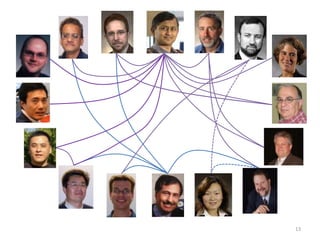
  • #14 Our 15 faculty from 4 colleges are already engaged in multiple jointly funded grants, pending proposals, serving on interdisciplinary programs like Biomedical Sciences PhD program and on committees of students of colleagues.
  • #20 One of the hallmarks of the knowledge enabled computinginfrasturucture is Enabling machines to understand the data that they are processing. At the core of this vision also shared by the Semantic Web is having a formal representation of a domain or what we call ‘domain knowledge’ –the entities involved in a domain and how are they related to each other..Where do we get some domain knowledge from – one could look to domain experts to categorize world knowledge in that domain, borrow from legacy systems or in many cases tap into the knowledge that is already present in documents ..
  • #21 One of our projects in this space looks into scalable harvesting of community knowledge that exists about a domain in collaborative sources such as Wikipedia and scientific corpus to construct formal models of a domain
  • #22 Here is an example of a Human performance n cognition Ontology developed by us using this technique and which is being used by human effectiveness directorate at the AFRLSeveral part of this work were conducted in collaboration with Hewlett Packard research labs who currently conduct beta testing of a commercial version called Taxonom.com
  • #23 One application of building domain models is knowledge discovery or deriving informational nuggets present in data sources by using facts that you already know about a domain
  • #24 One of our efforts in this direction uses existing domain models such as the UMLS or those built from wikipedia to guide browsing of concepts in documents and use the browse trails to formulate hypotheses to discover knowledge that we did not know previously existed in the data.
  • #25 This work that envisions our information space as a web of relationships to connect diferent document or web resources represents in many ways the beginnings of the realization of the expansive memex vision and trailblazing that Dr Vanevar Bush outlined in 1945… As he was speaking to how our human brain navigates the information space… using an association of thoughts that link one item to the next
  • #26 Several tools that we built in this space are available online and also shared as an open source project with the community
  • #27 A second area where we extensively employ domain knowledge is in interpreting various forms of sensor data in order to achieve meaningful situational awareness..Today there are more than 40 billion mobile sensors on the groundAnd nearly 4 million people carrying mobile phones taking pictruesWith so many sensors around there is a lot of information available at hand surrounding any eventHow do u know that they all relate to the same event and lend an understanding for how event evolves?
  • #28 The knowledge enabled techniques we develop enable a fusion of Sensor data – lending understanding from the stages of identifying sensors, to gathering processing and using this data for situational awareness and sense makingSome of our work in this space is being supported by the sensor directorate at the AFRL next door.
  • #29 The last representative work we’d like to share with you is our work on making sense of social data, like those from Twitter and facebookaround news worthy events that are of interest to a populace.The goal is to offer an understanding of what people are talking about and paying attention to
  • #30 What the social perceptions behind the data might be, the multiple narratives
  • #31 Twitris is our effort in this direction to help users keep up with observations made around news-worthy events.. Before I hand over the microphone to Dr. Mike Raymer, I’d like to leave you with a short demo of the deployed web application.
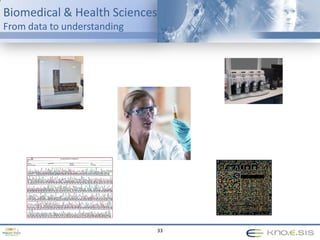
  • #34 No where is it more important to enable the path from data to understanding than in the medical and life sciences!The barriers to interdisciplinary collaboration are high – natural scientists and computer scientists speak different languages.More new words in their first biology class than an entire year of a foreign language.We have demonstrated success in breaking down those barriers.Cross-disciplinary scientists (we make it our job) & cross disciplinary students.
  • #35 No where is it more important to enable the path from data to understanding than in the medical and life sciences!The barriers to interdisciplinary collaboration are high – natural scientists and computer scientists speak different languages.More new words in their first biology class than an entire year of a foreign language.We have demonstrated success in breaking down those barriers.Cross-disciplinary scientists (we make it our job) & cross disciplinary students.
  • #36 No where is it more important to enable the path from data to understanding than in the medical and life sciences!The barriers to interdisciplinary collaboration are high – natural scientists and computer scientists speak different languages.More new words in their first biology class than an entire year of a foreign language.We have demonstrated success in breaking down those barriers.Cross-disciplinary scientists (we make it our job) & cross disciplinary students.
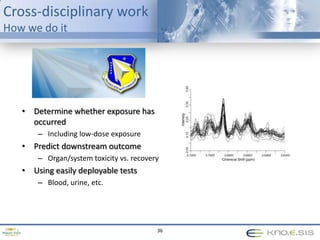
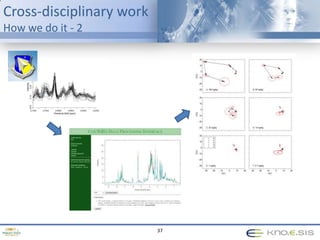
  • #37 Example – AFRL problem – collaboration with Dr. Nick Reo, School of MedicineDr. Reo – Nuclear Magnetic ResonanceProblem – highly complex data sets – many noisy results from each experiment
  • #38 Example – AFRL problem – collaboration with Dr. Nick Reo, School of MedicineDr. Reo – Nuclear Magnetic ResonanceProblem – highly complex data sets – many noisy results from each experiment
  • #40 No where is it more important to enable the path from data to understanding than in the medical and life sciences!The barriers to interdisciplinary collaboration are high – natural scientists and computer scientists speak different languages.More new words in their first biology class than an entire year of a foreign language.We have demonstrated success in breaking down those barriers.Cross-disciplinary scientists (we make it our job) & cross disciplinary students.