

Building Cogeneration Planning
and Scheduling
Applications using IBM ODME
and iMPress
DecisionBrain & Industrial Algorithms LLC.
7/19/2013
Copyright, DB & IAL
Agenda
• What is ODME?
• What are Industrial Modeling Frameworks?
• What is iMPress?
• ODME-iMPress Implementation
• Benefits
• Proof of Concept
2
3
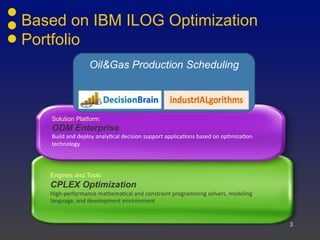
Based on IBM ILOG Optimization
Portfolio
Engines and Tools
CPLEX Optimization
High-performance mathematical and constraint programming solvers, modeling
language, and development environment
Solution Platform
ODM Enterprise
Build and deploy analytical decision support applications based on optimization
technology
Oil&Gas Production Scheduling
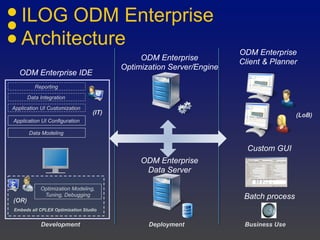
ILOG ODM Enterprise
Architecture
(OR)
(IT)
Embeds all CPLEX Optimization Studio
Reporting
Data Integration
Data Modeling
ODM Enterprise IDE
ODM Enterprise
Optimization Server/Engine
ODM Enterprise
Client & Planner
Optimization Modeling,
Tuning, Debugging
Application UI Configuration
(LoB)
Development Deployment
Application UI Customization
Business Use
Custom GUI
Batch process
ODM Enterprise
Data Server
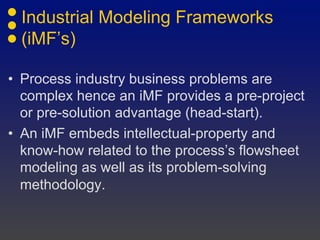
Industrial Modeling Frameworks
(iMF’s)
• Process industry business problems are
complex hence an iMF provides a pre-project
or pre-solution advantage (head-start).
• An iMF embeds intellectual-property and
know-how related to the process’s flowsheet
modeling as well as its problem-solving
methodology.
iMPress
• iMPress stands for “Industrial Modeling &
PRE-Solving System” and is our proprietary
platform for discrete and nonlinear modeling.
• iMPress can “interface”, “interact”, “model”
and “solve” any production-chain, supply-
chain, demand-chain and/or value-chain
optimization problem.
6
Cogenerartion Scheduling
Application Types
• Off-Line Environments:
– Usually « dynamic » optimization with discrete
(logic) & linear variables using Mixed Integer
Linear Programming not including feedback
(feedforward only).
• On-Line Environments:
– Usually « steady-state » optimization with
continuous & nonlinear variables using NLP
including feedback (and feedforward).
– Usually includes steady-state detection, data
reconciliation and regression (« moving horizon
estimation ») with diagnostics for monitoring.
Off-Line Optimization
• Sometimes called « load shedding, shifting &
scheduling ».
– Determines steam and power production subject to
supply availability and demand requirements.
– Respects transition (sequence-dependent)
management of producing units such as boilers and
turbogenerators i.e., understands resting (standby),
ramping (startup/shutdown) and running (setup)
which IAL calls « Phasing ».
– Similar to a « product wheel » found in specialty batch
& fast moving consumer goods industries.
Off-Line Optimization –
« Phasing »
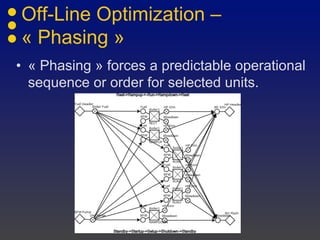
• « Phasing » forces a predictable operational
sequence or order for selected units.
Off-Line Optimization –
« Phasing »
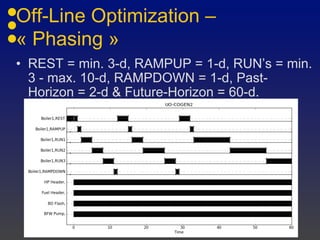
• REST = min. 3-d, RAMPUP = 1-d, RUN’s =
min. 3 - max. 10-d, RAMPDOWN = 1-d, Past-
Horizon = 2-d & Future-Horizon = 60-d.
On-Line Optimization
• Typically assumes discrete/logic variables are
fixed – IAL calls this « phenomenological
decomposition ».
• If plant is at « steady-state* » then optimize
process or operating conditions using NLP
(IPOPT, KNITRO, XPRESS-SLP, IAL-
SLPQPE).
• Apply nonlinear data reconciliation &
parameter estimation to provide gross-
error/outlier detection & calibrate model.
* Kelly & Hedengren, « A steady-state detection algorithm to detect non-stationary drifts in processes », Journal of Process Control,
23, 2013.
On-Line Optimization
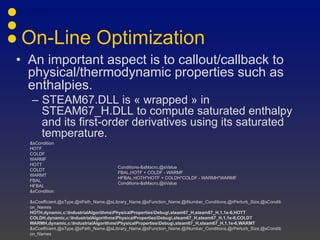
• An important aspect is to callout/callback to
physical/thermodynamic properties such as
enthalpies.
– STEAM67.DLL is « wrapped » in
STEAM67_H.DLL to compute saturated enthalpy
and its first-order derivatives using its saturated
temperature.
&sCondition
HOTF
COLDF
WARMF
HOTT
COLDT
WARMT
FBAL
HFBAL
&sCondition
&sCoefficient,@sType,@sPath_Name,@sLibrary_Name,@sFunction_Name,@iNumber_Conditions,@rPerturb_Size,@sConditi
on_Names
HOTH,dynamic,c:IndustrialAlgorithmsPhysicalPropertiesDebug,steam67_H,steam67_H,1,1e-6,HOTT
COLDH,dynamic,c:IndustrialAlgorithmsPhysicalPropertiesDebug,steam67_H,steam67_H,1,1e-6,COLDT
WARMH,dynamic,c:IndustrialAlgorithmsPhysicalPropertiesDebug,steam67_H,steam67_H,1,1e-6,WARMT
&sCoefficient,@sType,@sPath_Name,@sLibrary_Name,@sFunction_Name,@iNumber_Conditions,@rPerturb_Size,@sConditi
on_Names
Conditions-&sMacro,@sValue
FBAL,HOTF + COLDF - WARMF
HFBAL,HOTH*HOTF + COLDH*COLDF - WARMH*WARMF
Conditions-&sMacro,@sValue
Cogeneration (Steam/Power) iMf
7/19/2013
Copyright, Industrial Algorithms LLC
• Time Horizon: 168 time-periods w/ hour
periods.
• Continuous Variables = 5,000
• Binary Variables = 1,000
• Constraints = 7,500
• Time to First Good Solution = 5 to 30-
seconds
• Time to Provably Optimal = 5 to 15-minutes
Cogeneration (Steam/Power) iMf
Water
Pump
• Time Horizon: 168 time-periods w/ hour
periods.
• Continuous Variables = 5,000
• Binary Variables = 1,000
• Constraints = 7,500
• Time to First Good Solution = 5 to 30-seconds
• Time to Provably Optimal = 5 to 15-minutes.
• Solver: CPLEX
7/19/2013Copyright, Industrial Algorithms LLC
Cogeneration (Steam/Power) iMf
ODME-iMPress-CPLEX
System Architecture
ODME-iMPress-CPLEX
System Architecture
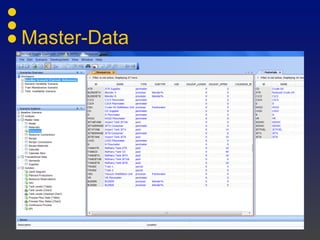
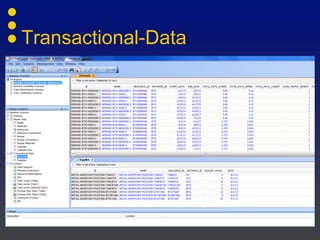
• A domain-specific data model was created in
ODME using the usual master-data and
transactional-data partitions.
• A mapping between iMPress’ data model and
ODME’s data model was established.
• Java code was written to export iMPress’ IML
file (Industrial Modeling Language).
• SWIG Java was used to create a Java Native
Inerface (JNI) to iMPress.
ODME-IMPRESS-CPLEX
System Architecture
• Java code was written to call iMPress-CPLEX
using its API’s.
• Java code was written to access the solution(s)
from iMPress-CPLEX using its API’s and to
populate the ODME solution-data partition.
ODME Screen Shots
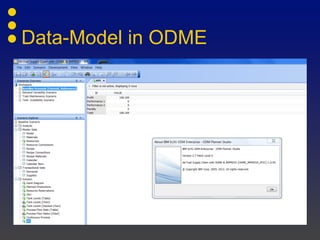
Data-Model in ODME
Master-Data
Transactional-Data
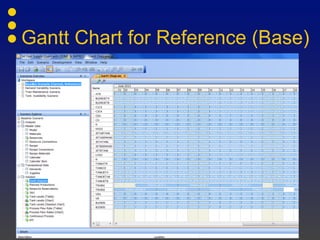
Gantt Chart for Reference (Base)
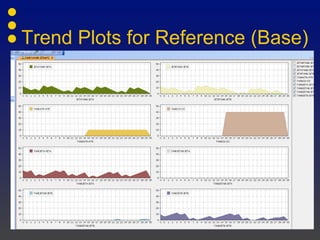
Trend Plots for Reference (Base)
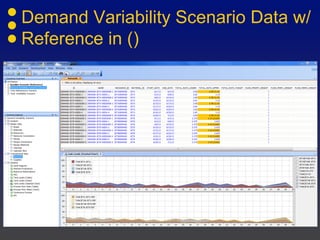
Demand Variability Scenario Data w/
Reference in ()
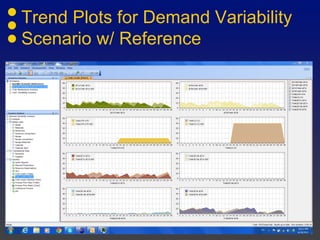
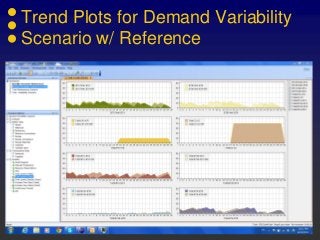
Trend Plots for Demand Variability
Scenario w/ Reference
Benefits
• Perfectly fit your business model and decision processes
• Sophisticated optimization capabilities able to tackle complex,
non-linear and large-scale problems
• A solution that can be quickly adapted to new production
processes
• A user-friendly GUI to help planners driving refinery operational
excellence and analyzing refinery behavior
• What-if scenario analysis for confident decision-making
• See all your data and options in one place with drill-downs and
graphics
• Collaborate with other planners
• Powered by IBM ILOG CPLEX Optimizers
Proof-of-Concept (POC)
• Select plant type, size and complexity.
• Determine if off-line or on-line
application.
• Configure plant model.
• Integrate data sources.
• Solve plant model with plant data.
• Tune plant model (for accuracy &
tractability).

Building Cogeneration Planning Scheduling Systems using IBM ILOG ODME, CPLEX and impress

  • 1.
    Building Cogeneration Planning andScheduling Applications using IBM ODME and iMPress DecisionBrain & Industrial Algorithms LLC. 7/19/2013 Copyright, DB & IAL
  • 2.
    Agenda • What isODME? • What are Industrial Modeling Frameworks? • What is iMPress? • ODME-iMPress Implementation • Benefits • Proof of Concept 2
  • 3.
    3 Based on IBMILOG Optimization Portfolio Engines and Tools CPLEX Optimization High-performance mathematical and constraint programming solvers, modeling language, and development environment Solution Platform ODM Enterprise Build and deploy analytical decision support applications based on optimization technology Oil&Gas Production Scheduling
  • 4.
    ILOG ODM Enterprise Architecture (OR) (IT) Embedsall CPLEX Optimization Studio Reporting Data Integration Data Modeling ODM Enterprise IDE ODM Enterprise Optimization Server/Engine ODM Enterprise Client & Planner Optimization Modeling, Tuning, Debugging Application UI Configuration (LoB) Development Deployment Application UI Customization Business Use Custom GUI Batch process ODM Enterprise Data Server
  • 5.
    Industrial Modeling Frameworks (iMF’s) •Process industry business problems are complex hence an iMF provides a pre-project or pre-solution advantage (head-start). • An iMF embeds intellectual-property and know-how related to the process’s flowsheet modeling as well as its problem-solving methodology.
  • 6.
    iMPress • iMPress standsfor “Industrial Modeling & PRE-Solving System” and is our proprietary platform for discrete and nonlinear modeling. • iMPress can “interface”, “interact”, “model” and “solve” any production-chain, supply- chain, demand-chain and/or value-chain optimization problem. 6
  • 7.
    Cogenerartion Scheduling Application Types •Off-Line Environments: – Usually « dynamic » optimization with discrete (logic) & linear variables using Mixed Integer Linear Programming not including feedback (feedforward only). • On-Line Environments: – Usually « steady-state » optimization with continuous & nonlinear variables using NLP including feedback (and feedforward). – Usually includes steady-state detection, data reconciliation and regression (« moving horizon estimation ») with diagnostics for monitoring.
  • 8.
    Off-Line Optimization • Sometimescalled « load shedding, shifting & scheduling ». – Determines steam and power production subject to supply availability and demand requirements. – Respects transition (sequence-dependent) management of producing units such as boilers and turbogenerators i.e., understands resting (standby), ramping (startup/shutdown) and running (setup) which IAL calls « Phasing ». – Similar to a « product wheel » found in specialty batch & fast moving consumer goods industries.
  • 9.
    Off-Line Optimization – «Phasing » • « Phasing » forces a predictable operational sequence or order for selected units.
  • 10.
    Off-Line Optimization – «Phasing » • REST = min. 3-d, RAMPUP = 1-d, RUN’s = min. 3 - max. 10-d, RAMPDOWN = 1-d, Past- Horizon = 2-d & Future-Horizon = 60-d.
  • 11.
    On-Line Optimization • Typicallyassumes discrete/logic variables are fixed – IAL calls this « phenomenological decomposition ». • If plant is at « steady-state* » then optimize process or operating conditions using NLP (IPOPT, KNITRO, XPRESS-SLP, IAL- SLPQPE). • Apply nonlinear data reconciliation & parameter estimation to provide gross- error/outlier detection & calibrate model. * Kelly & Hedengren, « A steady-state detection algorithm to detect non-stationary drifts in processes », Journal of Process Control, 23, 2013.
  • 12.
    On-Line Optimization • Animportant aspect is to callout/callback to physical/thermodynamic properties such as enthalpies. – STEAM67.DLL is « wrapped » in STEAM67_H.DLL to compute saturated enthalpy and its first-order derivatives using its saturated temperature. &sCondition HOTF COLDF WARMF HOTT COLDT WARMT FBAL HFBAL &sCondition &sCoefficient,@sType,@sPath_Name,@sLibrary_Name,@sFunction_Name,@iNumber_Conditions,@rPerturb_Size,@sConditi on_Names HOTH,dynamic,c:IndustrialAlgorithmsPhysicalPropertiesDebug,steam67_H,steam67_H,1,1e-6,HOTT COLDH,dynamic,c:IndustrialAlgorithmsPhysicalPropertiesDebug,steam67_H,steam67_H,1,1e-6,COLDT WARMH,dynamic,c:IndustrialAlgorithmsPhysicalPropertiesDebug,steam67_H,steam67_H,1,1e-6,WARMT &sCoefficient,@sType,@sPath_Name,@sLibrary_Name,@sFunction_Name,@iNumber_Conditions,@rPerturb_Size,@sConditi on_Names Conditions-&sMacro,@sValue FBAL,HOTF + COLDF - WARMF HFBAL,HOTH*HOTF + COLDH*COLDF - WARMH*WARMF Conditions-&sMacro,@sValue
  • 13.
    Cogeneration (Steam/Power) iMf 7/19/2013 Copyright,Industrial Algorithms LLC • Time Horizon: 168 time-periods w/ hour periods. • Continuous Variables = 5,000 • Binary Variables = 1,000 • Constraints = 7,500 • Time to First Good Solution = 5 to 30- seconds • Time to Provably Optimal = 5 to 15-minutes
  • 14.
  • 15.
    • Time Horizon:168 time-periods w/ hour periods. • Continuous Variables = 5,000 • Binary Variables = 1,000 • Constraints = 7,500 • Time to First Good Solution = 5 to 30-seconds • Time to Provably Optimal = 5 to 15-minutes. • Solver: CPLEX 7/19/2013Copyright, Industrial Algorithms LLC Cogeneration (Steam/Power) iMf
  • 16.
  • 17.
    ODME-iMPress-CPLEX System Architecture • Adomain-specific data model was created in ODME using the usual master-data and transactional-data partitions. • A mapping between iMPress’ data model and ODME’s data model was established. • Java code was written to export iMPress’ IML file (Industrial Modeling Language). • SWIG Java was used to create a Java Native Inerface (JNI) to iMPress.
  • 18.
    ODME-IMPRESS-CPLEX System Architecture • Javacode was written to call iMPress-CPLEX using its API’s. • Java code was written to access the solution(s) from iMPress-CPLEX using its API’s and to populate the ODME solution-data partition.
  • 19.
  • 20.
  • 21.
  • 22.
  • 23.
    Gantt Chart forReference (Base)
  • 24.
    Trend Plots forReference (Base)
  • 25.
    Demand Variability ScenarioData w/ Reference in ()
  • 26.
    Trend Plots forDemand Variability Scenario w/ Reference
  • 27.
    Benefits • Perfectly fityour business model and decision processes • Sophisticated optimization capabilities able to tackle complex, non-linear and large-scale problems • A solution that can be quickly adapted to new production processes • A user-friendly GUI to help planners driving refinery operational excellence and analyzing refinery behavior • What-if scenario analysis for confident decision-making • See all your data and options in one place with drill-downs and graphics • Collaborate with other planners • Powered by IBM ILOG CPLEX Optimizers
  • 28.
    Proof-of-Concept (POC) • Selectplant type, size and complexity. • Determine if off-line or on-line application. • Configure plant model. • Integrate data sources. • Solve plant model with plant data. • Tune plant model (for accuracy & tractability).