Jet Fuel Supply Chain Design
using IMPRESS
Industrial Algorithms LLC.
Jeff Kelly & Alkis Vazacopoulos
March 24 2013


                                       3/23/2013
Copyright, Industrial Algorithms LLC
Agenda

• IAL Introduction.
• What is IMPRESS?
• Jet Fuel Supply Chain & Why is it
  Complex?
• Scenario Generation.


                                      2
Our Mission Statement
• To provide advanced modeling and solving
  tools for developing industrial applications in
  the decision-making and data-mining areas.
• Our targets are:
  – Operating companies in the process industries.
  – Consulting service providers.
  – Application software providers.
Our Focus
• IAL develops and markets IMPRESS, the
  world’s leading software product for flowsheet
  optimization in both off and on-line
  environments.
• IAL provides in-house training for customers
  along with complete software support and
  consulting.
• IAL provides Industrial Modeling Frameworks
  (IMF’s) for several problem types.
                                           4
Our Industrial Modeling
Frameworks (IMF’s)

• Process industry business problems are
  complex hence an IMF provides a pre-
  project or pre-problem advantage.
• An IMF embeds intellectual-property
  related to the process’s flowsheet
  modeling as well as its problem-solving
  methodology.
Our Modeling Environment
IMPRESS
• IMPRESS stands for “Industrial Modeling & PRE-
  Solving System” and is our proprietary platform.
• You can “interface”, “interact”, “model” and
  “solve” any production-chain, supply-chain,
  demand-chain and/or value-chain optimization
  problem.
• IMPRESS so far has been applied to:
  –   Production Planning
  –   Process Scheduling
  –   Pipeline & Marine Shipping
  –   Energy Management
                                                6
Academic Collaboration &
Partnership

•   Carnegie Mellon University
•   University of Wisconsin
•   Stevens Institute of Technology
•   Fairleigh Dickinson University
•   George Washington University
Why are we unique?
• IMPRESS is flowsheet-based (i.e., a
  figurative language).
  – This means that the modeling is inherently
    network or superstructure “aware” with
    equipment-to-equipment, resource-to-
    resource, activity-to-activity, etc. as explicit
    language constructs or objects.
Why are we unique?
• It also means that all the effort of generating
  the sparse A matrix in the LP, QP, MILP and
  NLP is done automatically by automating the
  generation of sets, lists, parameters,
  variables, constraints & derivatives when
  the model is configured using our
  proprietary and comprehensive library of
  sub-models.

                                             9
Why are we unique?
• IMPRESS is “shape/sheet-based” which
  is different from other modeling systems:
  – Algebraic modeling languages like GAMS,
    AIMMS, AMPL, etc. are “set-based”.
  – Applied engineering modeling languages like
    ACM, gPROMS, APMonitor, NOVA-MS,
    Modelica, etc. are “structure-based”.
  – Array manipulation modeling languages like
    Matlab, Mathematica, Octave, etc. are
    “scalar-based”.
                                            10
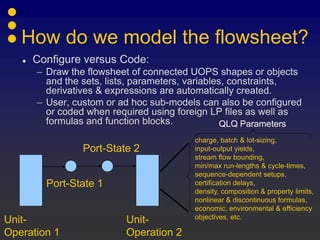
How do we model the flowsheet?
      Configure versus Code:
        Draw the flowsheet of connected UOPS shapes or objects
         and the sets, lists, parameters, variables, constraints,
         derivatives & expressions are automatically created.
        User, custom or ad hoc sub-models can also be configured
         or coded when required using foreign LP files as well as
         formulas and function blocks.             QLQ Parameters
                                         charge, batch & lot-sizing,
                 Port-State 2            input-output yields,
                                         stream flow bounding,
                                         min/max run-lengths & cycle-times,
                                         sequence-dependent setups,
         Port-State 1                    certification delays,
                                         density, composition & property limits,
                                         nonlinear & discontinuous formulas,
                                         economic, environmental & efficiency
                                         objectives, etc.
Unit-                     Unit-
Operation 1               Operation 2
How do we configure problems?
• Problems are configured using “sheets” for
  each “shape” either by:
  – Interfacing with our flat-file Industrial Modeling
    Language (IML) or
  – Interactively with our Industrial Programming
    Language (IPL) using a computer programming
    language such as C, C++, C#, Java, Python, etc.
What is our system architecture?
• IMPRESS has six system components
  called SIIMPLE:
  – Server, Interfacer (IML), Interacter (IPL),
    Modeler, Presolver DLL’s and an
    Executable (coded in most computer
    programming language) .
  – Interfacer, Interacter and Modeler are
    domain-specific whereas the Server,
    Presolver and Executable are not i.e., they
    are domain-inspecific or generic for any type
    of optimization problem.
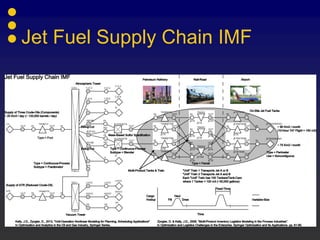
Jet Fuel Supply Chain IMF
Oil-Refinery Site
• Three crude-oils of equal compositions.
• A CDU (fractionator) with 8 compounds
  (macro-cuts) with a charge of 20 Km3/day
  +/- 5% and 2 swing-cuts with 2 blenders.
• A VDU (fractionator) with 3 compounds and
  a possible import of reduced crude-oil.
• Jet Fuels A and B are blended with sulfur
  specifications of 0.125 & 0.250 wt%.
• Two dedicated tanks for Jet Fuel A and B of
                                          15
  size 16 Km3 each.
Rail-Road Site
• Two “unit” trains with 100 tankers holding
  120 m3 each (12 Km3 ~ 72,000 Barrels).
• Train1 can haul either Jet A or B but not
  both with travel times of 4-days for both
  trains.
• Train2 can haul both Jet A and B in equal
  amounts.
• Partial loading of trains is allowed (> 90%).
• Only one train can load/unload at a time. 16
Airport Site

• Two dedicated tanks for Jet A and B of
  size 14 Km3 each with an unused swing
  (multi-product) tank.
• Demand for Jet A is 3.0 +/- 5% Km3/day
  and for Jet B is 2.5 +/- 5% Km3/day.


                                       17
Why is this problem complex?
• This is an MINLP problem involving quantity,
  logic & quality phenomenological variables &
  constraints i.e.,
  – Closed-shop lot-sizing or inventory management
    especially cargo-sizing of trains.
  – Round-trip travel time of trains.
  – Pooling with swing-cut blending of density and
    sulfur properties (both volume and mass
    blending).
                                            18
How do we solve the problem?
• We perform a “phenomenological
  decomposition” or “polylithic” modeling:
  – Solve a MILP logistics sub-problem
    (quantity*logic) in succession with a NLP
    quality sub-problem (quantity*quality).
  – Logic variables are fixed in the NLP and
    quality variables are proxyed using fixed
    yields (transfer-coefficients, intensities,
    recipes, etc.) in the MILP.

                                                  19
What 3rd party solvers do we use?
• For MILP we have bindings to:
  – COINMP, GLPK, LPSOLVE, SCIP, CPLEX,
    GUROBI & XPRESS.
• For NLP we have bindings to:
  – CONOPT, IPOPT, KNITRO, XPRESS-SLP as
    well as our “home-grown” SLPQPE.
  – SLPQPE can use all previously mentioned LP’s
    as its sub-solver. If the objective function has
    quadratic terms then a QP is called at each
    major iteration (for nonlinear control problems).
                                                20
How do we manage the data?
• All lower, upper (hard) and target (soft)
  bounds are time-varying (temporal) for all
  quantity, logic & quality variables.
  – Data are entered in continuous-time or event-
    based and digitized into time-periods.
  – Data for over-lapping time-periods are
    accumulated i.e., added or summed together.
  – Data are provided for both past/present and
    future time-horizons (allowing us to perform
    data reconciliation and parameter estimation
    using the same model with different data). 21
How do we model the data?
  • All data are contained in “frames” (sheets)
    with a header & trailer “feature” and multiple
    feeder features with multiple “fields”.
  • For dynamic data such as orders,
    transactions, events, commands, etc. we
    have the following format:
&sUnit,&sOperation,&sPort,&sState,@rQLQP_Lower,@rQLQP_Upper,@rQLQP_Target,@rBegin_Time,@rEnd_Time
UnitName,OperationName,PortName,StateName, lower bound , upper bound , target , begin-time , end-time
…
&sUnit,&sOperation,&sPort,&sState,@rQLQP_Lower,@rQLQP_Upper,@rQLQP_Target,@rBegin_Time,@rEnd_Time


Note: The symbol & indicates an address or key and @ indicates an attribute or value. In
addition, all number fields (‘i’ or ‘r’ prefix) can be entered as a mathematical expression.     22
Scenario Generation
• We explore three types of ad hoc scenarios:
  – Demand Variability
  – Tank Availability
  – Train Reliability
• One “base-case” IML file required with 3
  “delta-case” incremental IML files for each
  scenario which “over-loads” the parameters.
• Goal of each delta-case scenario is to
  maintain “global feasibility” of logistics
  sub-problem given disturbance/disruption. 23
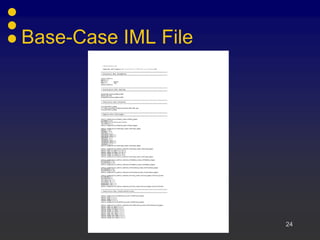
Base-Case IML File


                     24
Base-Case Yields (from NLP)
• A quality sub-problem was run as a
  nonlinear planning problem with one time-
  period respecting the jet fuel sulfur bounds
  with fixed crude-oil composition.
  – Yields computed by the quality sub-problem and
    fixed in the logistics sub-problem are:
      &sUnit,&sOperation,&sPort,&sState,@rYield_Lower,@rYield_Upper,@rYield_Target,@rBegin_Time,@rEnd_Time
      CDU,FUELS,ATR,, 0.4511653090E+000 ,0.4511653090E+000,,BEGIN,END
      CDU,FUELS,C1C2,, 0.1863222333E-002 ,0.1863222333E-002,,BEGIN,END
      CDU,FUELS,C3C4,, 0.9754549000E-002 ,0.9754549000E-002,,BEGIN,END
      CDU,FUELS,D,, 0.2477161380E+000 ,0.2477161380E+000,,BEGIN,END
      CDU,FUELS,JDSWC,, 0.7863132167E-001,0.7863132167E-001,,BEGIN,END
      CDU,FUELS,JETFUEL,, 0.1219626240E+000 ,0.1219626240E+000,,BEGIN,END
      CDU,FUELS,N,, 0.5201427922E-001 ,0.5201427922E-001,,BEGIN,END
      CDU,FUELS,NJSWC,, 0.3689255833E-001,0.3689255833E-001,,BEGIN,END
      VDU,FUELS,HVGO,, 0.1213959870E+000 ,0.1213959870E+000,,BEGIN,END
      VDU,FUELS,LVGO,, 0.5672360119E+000 ,0.5672360119E+000,,BEGIN,END
      VDU,FUELS,VR,, 0.3113679995E+000 ,0.3113679995E+000,,BEGIN,END
      BLENDJETA,,IN,, 0.2703321691E+000 ,0.2703321691E+000,,BEGIN,END
      BLENDJETA,,IN2,, 0.7296678309E+000 ,0.7296678309E+000,,BEGIN,END
      BLENDJETB,,IN,, 0.2215899306E+000 ,0.2215899306E+000,,BEGIN,END                                        25
      BLENDJETB,,IN2,, 0.7784100694E+000 ,0.7784100694E+000,,BEGIN,END
      &sUnit,&sOperation,&sPort,&sState,@rYield_Lower,@rYield_Upper,@rYield_Target,@rBegin_Time,@rEnd_Time
Base-Case Statistics
• Using thirty 1-day time-periods, the MILP
  has circa 2225 variables, 3100 constraints,
  10500 non-zeros and 750 binaries
• The objective function is $169.2 by
  arbitrarily maximizing the demand flow of
  Jet A and B equally i.e., prices = $1 per
  Km3.
• Using SCIP as the MILP solver, this takes
  27-seconds.
                                         26
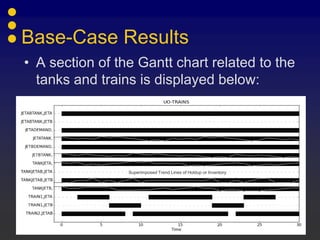
Base-Case Results
• A section of the Gantt chart related to the
  tanks and trains is displayed below:


                 Superimposed Trend Lines of Holdup or Inventory


                                                                   27
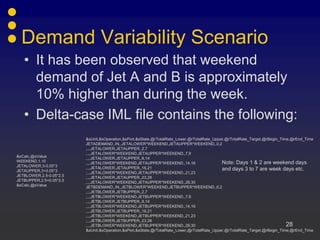
Demand Variability Scenario
   • It has been observed that weekend
     demand of Jet A and B is approximately
     10% higher than during the week.
   • Delta-case IML file contains the following:
                         &sUnit,&sOperation,&sPort,&sState,@rTotalRate_Lower,@rTotalRate_Upper,@rTotalRate_Target,@rBegin_Time,@rEnd_Time
                         JETADEMAND,,IN,,JETALOWER*WEEKEND,JETAUPPER*WEEKEND,,0,2
                         ,,,,JETALOWER,JETAUPPER,,2,7
                         ,,,,JETALOWER*WEEKEND,JETAUPPER*WEEKEND,,7,9
&sCalc,@sValue           ,,,,JETALOWER,JETAUPPER,,9,14
WEEKEND,1.10             ,,,,JETALOWER*WEEKEND,JETAUPPER*WEEKEND,,14,16                      Note: Days 1 & 2 are weekend days
JETALOWER,3-0.05*3       ,,,,JETALOWER,JETAUPPER,,16,21
JETAUPPER,3+0.05*3                                                                           and days 3 to 7 are week days etc.
                         ,,,,JETALOWER*WEEKEND,JETAUPPER*WEEKEND,,21,23
JETBLOWER,2.5-0.05*2.5   ,,,,JETALOWER,JETAUPPER,,23,28
JETBUPPER,2.5+0.05*2.5   ,,,,JETALOWER*WEEKEND,JETAUPPER*WEEKEND,,28,30
&sCalc,@sValue           JETBDEMAND,,IN,,JETBLOWER*WEEKEND,JETBUPPER*WEEKEND,,0,2
                         ,,,,JETBLOWER,JETBUPPER,,2,7
                         ,,,,JETBLOWER*WEEKEND,JETBUPPER*WEEKEND,,7,9
                         ,,,,JETBLOWER,JETBUPPER,,9,14
                         ,,,,JETBLOWER*WEEKEND,JETBUPPER*WEEKEND,,14,16
                         ,,,,JETBLOWER,JETBUPPER,,16,21
                         ,,,,JETBLOWER*WEEKEND,JETBUPPER*WEEKEND,,21,23
                         ,,,,JETBLOWER,JETBUPPER,,23,28
                         ,,,,JETBLOWER*WEEKEND,JETBUPPER*WEEKEND,,28,30                                                      28
                         &sUnit,&sOperation,&sPort,&sState,@rTotalRate_Lower,@rTotalRate_Upper,@rTotalRate_Target,@rBegin_Time,@rEnd_Time
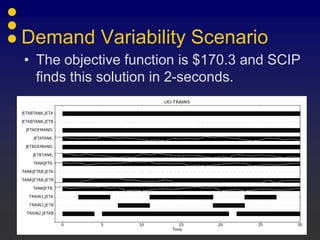
Demand Variability Scenario
• The objective function is $170.3 and SCIP
  finds this solution in 2-seconds.


                                        29
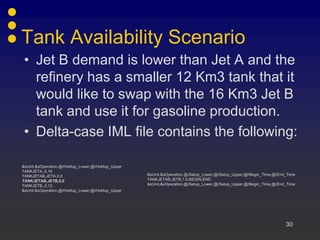
Tank Availability Scenario
 • Jet B demand is lower than Jet A and the
   refinery has a smaller 12 Km3 tank that it
   would like to swap with the 16 Km3 Jet B
   tank and use it for gasoline production.
 • Delta-case IML file contains the following:

&sUnit,&sOperation,@rHoldup_Lower,@rHoldup_Upper
TANKJETA,,0,16
TANKJETAB,JETA,0,0                                 &sUnit,&sOperation,@rSetup_Lower,@rSetup_Upper,@rBegin_Time,@rEnd_Time
TANKJETAB,JETB,0,0                                 TANKJETAB,JETB,1,0,BEGIN,END
TANKJETB,,0,12                                     &sUnit,&sOperation,@rSetup_Lower,@rSetup_Upper,@rBegin_Time,@rEnd_Time
&sUnit,&sOperation,@rHoldup_Lower,@rHoldup_Upper


                                                                                                                    30
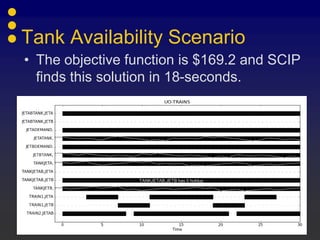
Tank Availability Scenario
• The objective function is $169.2 and SCIP
  finds this solution in 18-seconds.


                 TANKJETAB,JETB has 0 holdup


                                               31
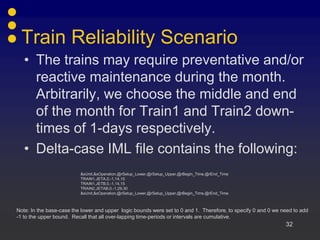
Train Reliability Scenario
   • The trains may require preventative and/or
     reactive maintenance during the month.
     Arbitrarily, we choose the middle and end
     of the month for Train1 and Train2 down-
     times of 1-days respectively.
   • Delta-case IML file contains the following:
                          &sUnit,&sOperation,@rSetup_Lower,@rSetup_Upper,@rBegin_Time,@rEnd_Time
                          TRAIN1,JETA,0,-1,14,15
                          TRAIN1,JETB,0,-1,14,15
                          TRAIN2,JETAB,0,-1,29,30
                          &sUnit,&sOperation,@rSetup_Lower,@rSetup_Upper,@rBegin_Time,@rEnd_Time


Note: In the base-case the lower and upper logic bounds were set to 0 and 1. Therefore, to specify 0 and 0 we need to add
-1 to the upper bound. Recall that all over-lapping time-periods or intervals are cumulative.
                                                                                                               32
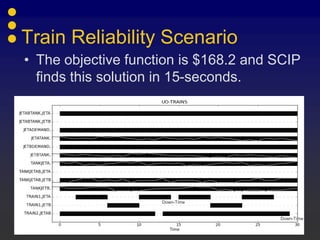
Train Reliability Scenario
• The objective function is $168.2 and SCIP
  finds this solution in 15-seconds.


                     Down-Time


                                       Down-Time
                                         33
How do we compare solutions
of multiple scenarios?
• By defining aggregations or key-performance
  indicators (KPI’s) and computing them in a
  computer programming language (Python).
• By displaying multiple solutions in the same
  Gantt chart, trend plot, etc. i.e., OLAP, IBM’s
  ILOG ODM or FICO’s Xpress-Insights.
• By data-mining the solutions using
  compressing & clustering techniques such
  as PCA, PLS, K-Means Centering, FCMC,
  etc.                                       34
For a demonstration of our IMFs
35
     & IMPRESS, please Contact

     •   Alkis Vazacopoulos
     •   Industrial Algorithms LLC
     •   Mobile: 201-256-7323
     •   alkis@industrialgorithms.com


     Copyright, Industrial Algorithms LLC   3/23/2013
Questions

• Thank You!


               36

Jet fuelsupplychaindesign

  • 1.
    Jet Fuel SupplyChain Design using IMPRESS Industrial Algorithms LLC. Jeff Kelly & Alkis Vazacopoulos March 24 2013 3/23/2013 Copyright, Industrial Algorithms LLC
  • 2.
    Agenda • IAL Introduction. •What is IMPRESS? • Jet Fuel Supply Chain & Why is it Complex? • Scenario Generation. 2
  • 3.
    Our Mission Statement •To provide advanced modeling and solving tools for developing industrial applications in the decision-making and data-mining areas. • Our targets are: – Operating companies in the process industries. – Consulting service providers. – Application software providers.
  • 4.
    Our Focus • IALdevelops and markets IMPRESS, the world’s leading software product for flowsheet optimization in both off and on-line environments. • IAL provides in-house training for customers along with complete software support and consulting. • IAL provides Industrial Modeling Frameworks (IMF’s) for several problem types. 4
  • 5.
    Our Industrial Modeling Frameworks(IMF’s) • Process industry business problems are complex hence an IMF provides a pre- project or pre-problem advantage. • An IMF embeds intellectual-property related to the process’s flowsheet modeling as well as its problem-solving methodology.
  • 6.
    Our Modeling Environment IMPRESS •IMPRESS stands for “Industrial Modeling & PRE- Solving System” and is our proprietary platform. • You can “interface”, “interact”, “model” and “solve” any production-chain, supply-chain, demand-chain and/or value-chain optimization problem. • IMPRESS so far has been applied to: – Production Planning – Process Scheduling – Pipeline & Marine Shipping – Energy Management 6
  • 7.
    Academic Collaboration & Partnership • Carnegie Mellon University • University of Wisconsin • Stevens Institute of Technology • Fairleigh Dickinson University • George Washington University
  • 8.
    Why are weunique? • IMPRESS is flowsheet-based (i.e., a figurative language). – This means that the modeling is inherently network or superstructure “aware” with equipment-to-equipment, resource-to- resource, activity-to-activity, etc. as explicit language constructs or objects.
  • 9.
    Why are weunique? • It also means that all the effort of generating the sparse A matrix in the LP, QP, MILP and NLP is done automatically by automating the generation of sets, lists, parameters, variables, constraints & derivatives when the model is configured using our proprietary and comprehensive library of sub-models. 9
  • 10.
    Why are weunique? • IMPRESS is “shape/sheet-based” which is different from other modeling systems: – Algebraic modeling languages like GAMS, AIMMS, AMPL, etc. are “set-based”. – Applied engineering modeling languages like ACM, gPROMS, APMonitor, NOVA-MS, Modelica, etc. are “structure-based”. – Array manipulation modeling languages like Matlab, Mathematica, Octave, etc. are “scalar-based”. 10
  • 11.
    How do wemodel the flowsheet?  Configure versus Code:  Draw the flowsheet of connected UOPS shapes or objects and the sets, lists, parameters, variables, constraints, derivatives & expressions are automatically created.  User, custom or ad hoc sub-models can also be configured or coded when required using foreign LP files as well as formulas and function blocks. QLQ Parameters charge, batch & lot-sizing, Port-State 2 input-output yields, stream flow bounding, min/max run-lengths & cycle-times, sequence-dependent setups, Port-State 1 certification delays, density, composition & property limits, nonlinear & discontinuous formulas, economic, environmental & efficiency objectives, etc. Unit- Unit- Operation 1 Operation 2
  • 12.
    How do weconfigure problems? • Problems are configured using “sheets” for each “shape” either by: – Interfacing with our flat-file Industrial Modeling Language (IML) or – Interactively with our Industrial Programming Language (IPL) using a computer programming language such as C, C++, C#, Java, Python, etc.
  • 13.
    What is oursystem architecture? • IMPRESS has six system components called SIIMPLE: – Server, Interfacer (IML), Interacter (IPL), Modeler, Presolver DLL’s and an Executable (coded in most computer programming language) . – Interfacer, Interacter and Modeler are domain-specific whereas the Server, Presolver and Executable are not i.e., they are domain-inspecific or generic for any type of optimization problem.
  • 14.
    Jet Fuel SupplyChain IMF
  • 15.
    Oil-Refinery Site • Threecrude-oils of equal compositions. • A CDU (fractionator) with 8 compounds (macro-cuts) with a charge of 20 Km3/day +/- 5% and 2 swing-cuts with 2 blenders. • A VDU (fractionator) with 3 compounds and a possible import of reduced crude-oil. • Jet Fuels A and B are blended with sulfur specifications of 0.125 & 0.250 wt%. • Two dedicated tanks for Jet Fuel A and B of 15 size 16 Km3 each.
  • 16.
    Rail-Road Site • Two“unit” trains with 100 tankers holding 120 m3 each (12 Km3 ~ 72,000 Barrels). • Train1 can haul either Jet A or B but not both with travel times of 4-days for both trains. • Train2 can haul both Jet A and B in equal amounts. • Partial loading of trains is allowed (> 90%). • Only one train can load/unload at a time. 16
  • 17.
    Airport Site • Twodedicated tanks for Jet A and B of size 14 Km3 each with an unused swing (multi-product) tank. • Demand for Jet A is 3.0 +/- 5% Km3/day and for Jet B is 2.5 +/- 5% Km3/day. 17
  • 18.
    Why is thisproblem complex? • This is an MINLP problem involving quantity, logic & quality phenomenological variables & constraints i.e., – Closed-shop lot-sizing or inventory management especially cargo-sizing of trains. – Round-trip travel time of trains. – Pooling with swing-cut blending of density and sulfur properties (both volume and mass blending). 18
  • 19.
    How do wesolve the problem? • We perform a “phenomenological decomposition” or “polylithic” modeling: – Solve a MILP logistics sub-problem (quantity*logic) in succession with a NLP quality sub-problem (quantity*quality). – Logic variables are fixed in the NLP and quality variables are proxyed using fixed yields (transfer-coefficients, intensities, recipes, etc.) in the MILP. 19
  • 20.
    What 3rd partysolvers do we use? • For MILP we have bindings to: – COINMP, GLPK, LPSOLVE, SCIP, CPLEX, GUROBI & XPRESS. • For NLP we have bindings to: – CONOPT, IPOPT, KNITRO, XPRESS-SLP as well as our “home-grown” SLPQPE. – SLPQPE can use all previously mentioned LP’s as its sub-solver. If the objective function has quadratic terms then a QP is called at each major iteration (for nonlinear control problems). 20
  • 21.
    How do wemanage the data? • All lower, upper (hard) and target (soft) bounds are time-varying (temporal) for all quantity, logic & quality variables. – Data are entered in continuous-time or event- based and digitized into time-periods. – Data for over-lapping time-periods are accumulated i.e., added or summed together. – Data are provided for both past/present and future time-horizons (allowing us to perform data reconciliation and parameter estimation using the same model with different data). 21
  • 22.
    How do wemodel the data? • All data are contained in “frames” (sheets) with a header & trailer “feature” and multiple feeder features with multiple “fields”. • For dynamic data such as orders, transactions, events, commands, etc. we have the following format: &sUnit,&sOperation,&sPort,&sState,@rQLQP_Lower,@rQLQP_Upper,@rQLQP_Target,@rBegin_Time,@rEnd_Time UnitName,OperationName,PortName,StateName, lower bound , upper bound , target , begin-time , end-time … &sUnit,&sOperation,&sPort,&sState,@rQLQP_Lower,@rQLQP_Upper,@rQLQP_Target,@rBegin_Time,@rEnd_Time Note: The symbol & indicates an address or key and @ indicates an attribute or value. In addition, all number fields (‘i’ or ‘r’ prefix) can be entered as a mathematical expression. 22
  • 23.
    Scenario Generation • Weexplore three types of ad hoc scenarios: – Demand Variability – Tank Availability – Train Reliability • One “base-case” IML file required with 3 “delta-case” incremental IML files for each scenario which “over-loads” the parameters. • Goal of each delta-case scenario is to maintain “global feasibility” of logistics sub-problem given disturbance/disruption. 23
  • 24.
  • 25.
    Base-Case Yields (fromNLP) • A quality sub-problem was run as a nonlinear planning problem with one time- period respecting the jet fuel sulfur bounds with fixed crude-oil composition. – Yields computed by the quality sub-problem and fixed in the logistics sub-problem are: &sUnit,&sOperation,&sPort,&sState,@rYield_Lower,@rYield_Upper,@rYield_Target,@rBegin_Time,@rEnd_Time CDU,FUELS,ATR,, 0.4511653090E+000 ,0.4511653090E+000,,BEGIN,END CDU,FUELS,C1C2,, 0.1863222333E-002 ,0.1863222333E-002,,BEGIN,END CDU,FUELS,C3C4,, 0.9754549000E-002 ,0.9754549000E-002,,BEGIN,END CDU,FUELS,D,, 0.2477161380E+000 ,0.2477161380E+000,,BEGIN,END CDU,FUELS,JDSWC,, 0.7863132167E-001,0.7863132167E-001,,BEGIN,END CDU,FUELS,JETFUEL,, 0.1219626240E+000 ,0.1219626240E+000,,BEGIN,END CDU,FUELS,N,, 0.5201427922E-001 ,0.5201427922E-001,,BEGIN,END CDU,FUELS,NJSWC,, 0.3689255833E-001,0.3689255833E-001,,BEGIN,END VDU,FUELS,HVGO,, 0.1213959870E+000 ,0.1213959870E+000,,BEGIN,END VDU,FUELS,LVGO,, 0.5672360119E+000 ,0.5672360119E+000,,BEGIN,END VDU,FUELS,VR,, 0.3113679995E+000 ,0.3113679995E+000,,BEGIN,END BLENDJETA,,IN,, 0.2703321691E+000 ,0.2703321691E+000,,BEGIN,END BLENDJETA,,IN2,, 0.7296678309E+000 ,0.7296678309E+000,,BEGIN,END BLENDJETB,,IN,, 0.2215899306E+000 ,0.2215899306E+000,,BEGIN,END 25 BLENDJETB,,IN2,, 0.7784100694E+000 ,0.7784100694E+000,,BEGIN,END &sUnit,&sOperation,&sPort,&sState,@rYield_Lower,@rYield_Upper,@rYield_Target,@rBegin_Time,@rEnd_Time
  • 26.
    Base-Case Statistics • Usingthirty 1-day time-periods, the MILP has circa 2225 variables, 3100 constraints, 10500 non-zeros and 750 binaries • The objective function is $169.2 by arbitrarily maximizing the demand flow of Jet A and B equally i.e., prices = $1 per Km3. • Using SCIP as the MILP solver, this takes 27-seconds. 26
  • 27.
    Base-Case Results • Asection of the Gantt chart related to the tanks and trains is displayed below: Superimposed Trend Lines of Holdup or Inventory 27
  • 28.
    Demand Variability Scenario • It has been observed that weekend demand of Jet A and B is approximately 10% higher than during the week. • Delta-case IML file contains the following: &sUnit,&sOperation,&sPort,&sState,@rTotalRate_Lower,@rTotalRate_Upper,@rTotalRate_Target,@rBegin_Time,@rEnd_Time JETADEMAND,,IN,,JETALOWER*WEEKEND,JETAUPPER*WEEKEND,,0,2 ,,,,JETALOWER,JETAUPPER,,2,7 ,,,,JETALOWER*WEEKEND,JETAUPPER*WEEKEND,,7,9 &sCalc,@sValue ,,,,JETALOWER,JETAUPPER,,9,14 WEEKEND,1.10 ,,,,JETALOWER*WEEKEND,JETAUPPER*WEEKEND,,14,16 Note: Days 1 & 2 are weekend days JETALOWER,3-0.05*3 ,,,,JETALOWER,JETAUPPER,,16,21 JETAUPPER,3+0.05*3 and days 3 to 7 are week days etc. ,,,,JETALOWER*WEEKEND,JETAUPPER*WEEKEND,,21,23 JETBLOWER,2.5-0.05*2.5 ,,,,JETALOWER,JETAUPPER,,23,28 JETBUPPER,2.5+0.05*2.5 ,,,,JETALOWER*WEEKEND,JETAUPPER*WEEKEND,,28,30 &sCalc,@sValue JETBDEMAND,,IN,,JETBLOWER*WEEKEND,JETBUPPER*WEEKEND,,0,2 ,,,,JETBLOWER,JETBUPPER,,2,7 ,,,,JETBLOWER*WEEKEND,JETBUPPER*WEEKEND,,7,9 ,,,,JETBLOWER,JETBUPPER,,9,14 ,,,,JETBLOWER*WEEKEND,JETBUPPER*WEEKEND,,14,16 ,,,,JETBLOWER,JETBUPPER,,16,21 ,,,,JETBLOWER*WEEKEND,JETBUPPER*WEEKEND,,21,23 ,,,,JETBLOWER,JETBUPPER,,23,28 ,,,,JETBLOWER*WEEKEND,JETBUPPER*WEEKEND,,28,30 28 &sUnit,&sOperation,&sPort,&sState,@rTotalRate_Lower,@rTotalRate_Upper,@rTotalRate_Target,@rBegin_Time,@rEnd_Time
  • 29.
    Demand Variability Scenario •The objective function is $170.3 and SCIP finds this solution in 2-seconds. 29
  • 30.
    Tank Availability Scenario • Jet B demand is lower than Jet A and the refinery has a smaller 12 Km3 tank that it would like to swap with the 16 Km3 Jet B tank and use it for gasoline production. • Delta-case IML file contains the following: &sUnit,&sOperation,@rHoldup_Lower,@rHoldup_Upper TANKJETA,,0,16 TANKJETAB,JETA,0,0 &sUnit,&sOperation,@rSetup_Lower,@rSetup_Upper,@rBegin_Time,@rEnd_Time TANKJETAB,JETB,0,0 TANKJETAB,JETB,1,0,BEGIN,END TANKJETB,,0,12 &sUnit,&sOperation,@rSetup_Lower,@rSetup_Upper,@rBegin_Time,@rEnd_Time &sUnit,&sOperation,@rHoldup_Lower,@rHoldup_Upper 30
  • 31.
    Tank Availability Scenario •The objective function is $169.2 and SCIP finds this solution in 18-seconds. TANKJETAB,JETB has 0 holdup 31
  • 32.
    Train Reliability Scenario • The trains may require preventative and/or reactive maintenance during the month. Arbitrarily, we choose the middle and end of the month for Train1 and Train2 down- times of 1-days respectively. • Delta-case IML file contains the following: &sUnit,&sOperation,@rSetup_Lower,@rSetup_Upper,@rBegin_Time,@rEnd_Time TRAIN1,JETA,0,-1,14,15 TRAIN1,JETB,0,-1,14,15 TRAIN2,JETAB,0,-1,29,30 &sUnit,&sOperation,@rSetup_Lower,@rSetup_Upper,@rBegin_Time,@rEnd_Time Note: In the base-case the lower and upper logic bounds were set to 0 and 1. Therefore, to specify 0 and 0 we need to add -1 to the upper bound. Recall that all over-lapping time-periods or intervals are cumulative. 32
  • 33.
    Train Reliability Scenario •The objective function is $168.2 and SCIP finds this solution in 15-seconds. Down-Time Down-Time 33
  • 34.
    How do wecompare solutions of multiple scenarios? • By defining aggregations or key-performance indicators (KPI’s) and computing them in a computer programming language (Python). • By displaying multiple solutions in the same Gantt chart, trend plot, etc. i.e., OLAP, IBM’s ILOG ODM or FICO’s Xpress-Insights. • By data-mining the solutions using compressing & clustering techniques such as PCA, PLS, K-Means Centering, FCMC, etc. 34
  • 35.
    For a demonstrationof our IMFs 35 & IMPRESS, please Contact • Alkis Vazacopoulos • Industrial Algorithms LLC • Mobile: 201-256-7323 • alkis@industrialgorithms.com Copyright, Industrial Algorithms LLC 3/23/2013
  • 36.