Coffee and elderly


                     1
Introduction
   The health effects of coffee have been
    studied to determine how coffee drinking
    affects humans.
   The coffee bean itself contains caffeine which
    are mild psychotropics for humans
   These chemicals are toxic in large doses, or
    even in their normal amount when consumed
    by many creatures which may otherwise have
    side effects.
   caffeine stimulates the production
    of cortisone and adrenaline
   two stimulating hormones -caffeine
    dependency and withdrawal symptoms             2
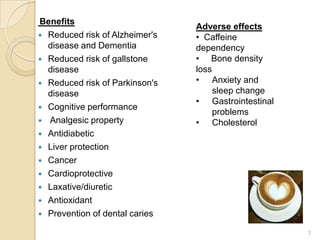
Benefits
                                Adverse effects
 Reduced risk of Alzheimer's   • Caffeine
  disease and Dementia          dependency
 Reduced risk of gallstone     • Bone density
  disease                       loss
 Reduced risk of Parkinson's   • Anxiety and
  disease                            sleep change
                                • Gastrointestinal
 Cognitive performance
                                     problems
 Analgesic property            • Cholesterol
 Antidiabetic
 Liver protection
 Cancer
 Cardioprotective
 Laxative/diuretic
 Antioxidant
 Prevention of dental caries

                                                     3
Beneficial effects


                     4
Reduced risk of Alzheimer's
disease and Dementia
    Several studies comparing moderate coffee drinkers (defined
     as 3–5 cups per day) with light coffee drinkers (defined as 0–
     2 cups per day) found that those who drank more coffee were
     significantly less likely to develop Alzheimer's disease later in
     life.
     -caffeine significantly decreased abnormal levels of the
     protein (beta amyloid protein ) linked to Alzheimer's disease
    A longitudinal study in 2009 found that moderate coffee
     drinkers had reduced risk of developing dementia in addition
     to Alzheimer's disease
    Caffeine consumers did not seem to have lower rates of
     dementia.
     -it might be that caffeine could slow the dementia process
     rather than preventing it


1. Caffeine Reverses Cognitive Impairment and Decreases Brain Amyloid-β Levels in Aged Alzheimer's Disease Mice; Gary W Arendash,
       Takashi Mori, Chuanhai Cao, Malgorzata Mamcarz, Melissa Runfeldt, Alexander Dickson, Kavon Rezai-Zadeh, Jun Tan, Bruce A Citron,
       Xiaoyang Lin, Valentina Echeverria, and Huntington Potter; Journal of Alzheimer's Disease, Volume 17:3 (July 2009).
2. Caffeine Suppresses Amyloid-β Levels in Plasma and Brain of Alzheimer's Disease Transgenic Mice; Chuanhai Cao, John R Cirrito,
       Xiaoyang Lin, Lilly Wang, Deborah K Verges, Alexander Dickson, Malgorzata Mamcarz, Chi Zhang, Takashi Mori, Gary W Arendash,
       David M Holzman, and Huntington Potter; Journal of Alzheimer's Disease, Volume 17:3 (July 2009).
                                                                                                                                      5
Reduced risk of gallstone
disease
   Drinking caffeinated coffee has been
    correlated with a lower incidence
    of gallstones and gallbladder disease
    in both men and women in two studies
    performed by the Harvard School of
    Public Health


                                            6
Reduced risk of Parkinson's
disease
 A study comparing heavy coffee
  drinkers (3.5 cups a day) with non-
  drinkers found that the coffee drinkers
  were significantly less likely to
  develop Parkinson‘s disease later in
  life
 Likewise, a second study found an
  inverse relationship between the
  amount of coffee regularly drank and
  the likelihood of developing
  Parkinson's disease                       7
Cognitive performance
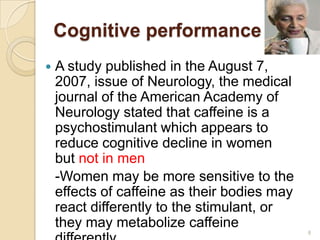
   A study published in the August 7,
    2007, issue of Neurology, the medical
    journal of the American Academy of
    Neurology stated that caffeine is a
    psychostimulant which appears to
    reduce cognitive decline in women
    but not in men
    -Women may be more sensitive to the
    effects of caffeine as their bodies may
    react differently to the stimulant, or
    they may metabolize caffeine
                                              8
Liver protection
 Coffee can also reduce the incidence
  of cirrhosis of the liver and has been
  linked to a reduced risk of hepatocellular
  carcinoma
 caffeine have potent anti-fibrotic that
  able to antagonize the Smad pathway (by
    Gressner and colleagues report published in the Journal of Hepatology)

   This preventative effect was only seen in
    people at higher risk for liver disease due
    to heavy alcohol intake, being
    overweight or having diabetes or iron
    overload.
                                                                             9
Cancer
   Coffee consumption is also correlated in Africa to a reduced
    risk of oral, esophageal, and pharyngeal cancer
   In ovarian cancer, no benefit was found.
   In the Nurses‘ Health Study, a modest reduction in breast
    cancer was observed in postmenopausal women only, which
    was not confirmed in decaffeinated coffee, and a reduction
    in endometrial cancer was observed in people who drank
    either caffeinated or decaffeinated coffee.
   According to one study, coffee protects the liver cancer.
   Another preliminary study found a correlation between coffee
    consumption and a lower risk of aggressive prostate cancer
    -coffee has effects on insulin and glucose metabolism as well
    as sex hormone levels, all of which play a role in prostate
    cancer.


                                                                    10
Cardioprotective
 Coffee moderately reduces the incidence
  of dying from cardiovascular disease,
  according to a large prospective cohort
  study published in 2008.
 A 2009 prospective study in Japan
  following nearly 77,000 individuals aged
  40 to 79 found that coffee consumption,
  along with caffeine intake, was
  associated with a reduced risk of dying
  from cardiovascular disease.
1.     Dórea, J.G. and da Costa, T.H.M. 2005. Review article: Is coffee a functional food? Brit. J.
       Nutr. 93: 773-782.
2.   Higdon, J.V. and Frei, B. 2006. Coffee and health: A review of recent human research. Crit.
     Rev. Food Sci. Nutr. 46(2): 101-123
                                                                                                      11
Laxative/diuretic

 Coffee is also a powerful stimulant
  for peristalsis and is sometimes
  considered to prevent constipation.
  -However, coffee can also cause
  excessively loose bowel movements
 Caffeine does not act as a diuretic when
  consumed in moderation
  -does not lead to dehydration or to
  a water-electrolyte imbalance

                                             12
Antioxidant
 Coffee contains the anticancer
  compound methylpyridinium.
  -Methylpyridinium is not present in raw coffee
  beans but is formed during the roasting process
  from trigonelline, which is common in raw coffee
  beans.
  -It is present in both caffeinated and
  decaffeinated coffee, and even in instant coffee.
 Research funded by Kraft shows that roast
  coffee contains more lipophilic antioxidants
  and chlorogenic acid lactones that is more
  protective against hydrogen peroxide-induced
  cell death in primary neuronal cells

                                                      13
Prevention of dental caries

 The tannins in coffee may reduce the
  cariogenic potential of foods.
 In vitro experiments have shown that
  these polyphenolic compounds may
  interfere with glucosyltransferase
  activity of mutans streptococci, which
  may reduce plaque formation


                                           14
Adverse effects

                  15
Loss of bone density
 According to a study on osteoporosis,
  Rupuri et. al found that that women with
  homozygous vitamin D receptor taking
  high caffeine has significantly higher
  rates of bone loss at spine
 However, an editorlial by Linda Massey
  in the American Journal of clinical
  nutrition recommend that moderate
  caffeine intake in elderly women is
  normal as the VDR genotype theory is
  not practical to be put in every elderly
                                             16
Anxiety and sleep changes
 elderly with excessive coffee
  consumption may develop anxiety
  and irritability as well as withdrawal
  symptom.
 Coffee can also cause insomnia
  others than causing narcolepsy


                                           17
Gastrointestinal problems
 Coffee can damage the lining of the
  gastrointestinal organs, causing
  gastritis and ulcers.
 The consumption of coffee is therefore
  not recommended for people with
  gastritis, colitis, and ulcers


                                       18
Cholesterol
 A 2007 study by the Baylor College of
  Medicine indicates
  that cafestol and kahweol, found only
  in coffee beans, may raise levels
  of low-density lipoprotein or LDL in
  humans.
 This increase in LDL levels is an
  indicator that coffee raises cholesterol
  in the body.

                                             19
Conclusions
 Coffee drinkers gain more benefits
 Moderate coffee intake is useful for
  elderly in term of reducing risk of
  Alzheimer disease, dementia,
  gallstone and preventing cancer.


                                         20
Thank you


            21

Coffee and elderly

  • 1.
  • 2.
    Introduction  The health effects of coffee have been studied to determine how coffee drinking affects humans.  The coffee bean itself contains caffeine which are mild psychotropics for humans  These chemicals are toxic in large doses, or even in their normal amount when consumed by many creatures which may otherwise have side effects.  caffeine stimulates the production of cortisone and adrenaline  two stimulating hormones -caffeine dependency and withdrawal symptoms 2
  • 3.
    Benefits Adverse effects  Reduced risk of Alzheimer's • Caffeine disease and Dementia dependency  Reduced risk of gallstone • Bone density disease loss  Reduced risk of Parkinson's • Anxiety and disease sleep change • Gastrointestinal  Cognitive performance problems  Analgesic property • Cholesterol  Antidiabetic  Liver protection  Cancer  Cardioprotective  Laxative/diuretic  Antioxidant  Prevention of dental caries 3
  • 4.
  • 5.
    Reduced risk ofAlzheimer's disease and Dementia  Several studies comparing moderate coffee drinkers (defined as 3–5 cups per day) with light coffee drinkers (defined as 0– 2 cups per day) found that those who drank more coffee were significantly less likely to develop Alzheimer's disease later in life. -caffeine significantly decreased abnormal levels of the protein (beta amyloid protein ) linked to Alzheimer's disease  A longitudinal study in 2009 found that moderate coffee drinkers had reduced risk of developing dementia in addition to Alzheimer's disease  Caffeine consumers did not seem to have lower rates of dementia. -it might be that caffeine could slow the dementia process rather than preventing it 1. Caffeine Reverses Cognitive Impairment and Decreases Brain Amyloid-β Levels in Aged Alzheimer's Disease Mice; Gary W Arendash, Takashi Mori, Chuanhai Cao, Malgorzata Mamcarz, Melissa Runfeldt, Alexander Dickson, Kavon Rezai-Zadeh, Jun Tan, Bruce A Citron, Xiaoyang Lin, Valentina Echeverria, and Huntington Potter; Journal of Alzheimer's Disease, Volume 17:3 (July 2009). 2. Caffeine Suppresses Amyloid-β Levels in Plasma and Brain of Alzheimer's Disease Transgenic Mice; Chuanhai Cao, John R Cirrito, Xiaoyang Lin, Lilly Wang, Deborah K Verges, Alexander Dickson, Malgorzata Mamcarz, Chi Zhang, Takashi Mori, Gary W Arendash, David M Holzman, and Huntington Potter; Journal of Alzheimer's Disease, Volume 17:3 (July 2009). 5
  • 6.
    Reduced risk ofgallstone disease  Drinking caffeinated coffee has been correlated with a lower incidence of gallstones and gallbladder disease in both men and women in two studies performed by the Harvard School of Public Health 6
  • 7.
    Reduced risk ofParkinson's disease  A study comparing heavy coffee drinkers (3.5 cups a day) with non- drinkers found that the coffee drinkers were significantly less likely to develop Parkinson‘s disease later in life  Likewise, a second study found an inverse relationship between the amount of coffee regularly drank and the likelihood of developing Parkinson's disease 7
  • 8.
    Cognitive performance  A study published in the August 7, 2007, issue of Neurology, the medical journal of the American Academy of Neurology stated that caffeine is a psychostimulant which appears to reduce cognitive decline in women but not in men -Women may be more sensitive to the effects of caffeine as their bodies may react differently to the stimulant, or they may metabolize caffeine 8
  • 9.
    Liver protection  Coffeecan also reduce the incidence of cirrhosis of the liver and has been linked to a reduced risk of hepatocellular carcinoma  caffeine have potent anti-fibrotic that able to antagonize the Smad pathway (by Gressner and colleagues report published in the Journal of Hepatology)  This preventative effect was only seen in people at higher risk for liver disease due to heavy alcohol intake, being overweight or having diabetes or iron overload. 9
  • 10.
    Cancer  Coffee consumption is also correlated in Africa to a reduced risk of oral, esophageal, and pharyngeal cancer  In ovarian cancer, no benefit was found.  In the Nurses‘ Health Study, a modest reduction in breast cancer was observed in postmenopausal women only, which was not confirmed in decaffeinated coffee, and a reduction in endometrial cancer was observed in people who drank either caffeinated or decaffeinated coffee.  According to one study, coffee protects the liver cancer.  Another preliminary study found a correlation between coffee consumption and a lower risk of aggressive prostate cancer -coffee has effects on insulin and glucose metabolism as well as sex hormone levels, all of which play a role in prostate cancer. 10
  • 11.
    Cardioprotective  Coffee moderatelyreduces the incidence of dying from cardiovascular disease, according to a large prospective cohort study published in 2008.  A 2009 prospective study in Japan following nearly 77,000 individuals aged 40 to 79 found that coffee consumption, along with caffeine intake, was associated with a reduced risk of dying from cardiovascular disease. 1. Dórea, J.G. and da Costa, T.H.M. 2005. Review article: Is coffee a functional food? Brit. J. Nutr. 93: 773-782. 2. Higdon, J.V. and Frei, B. 2006. Coffee and health: A review of recent human research. Crit. Rev. Food Sci. Nutr. 46(2): 101-123 11
  • 12.
    Laxative/diuretic  Coffee isalso a powerful stimulant for peristalsis and is sometimes considered to prevent constipation. -However, coffee can also cause excessively loose bowel movements  Caffeine does not act as a diuretic when consumed in moderation -does not lead to dehydration or to a water-electrolyte imbalance 12
  • 13.
    Antioxidant  Coffee containsthe anticancer compound methylpyridinium. -Methylpyridinium is not present in raw coffee beans but is formed during the roasting process from trigonelline, which is common in raw coffee beans. -It is present in both caffeinated and decaffeinated coffee, and even in instant coffee.  Research funded by Kraft shows that roast coffee contains more lipophilic antioxidants and chlorogenic acid lactones that is more protective against hydrogen peroxide-induced cell death in primary neuronal cells 13
  • 14.
    Prevention of dentalcaries  The tannins in coffee may reduce the cariogenic potential of foods.  In vitro experiments have shown that these polyphenolic compounds may interfere with glucosyltransferase activity of mutans streptococci, which may reduce plaque formation 14
  • 15.
  • 16.
    Loss of bonedensity  According to a study on osteoporosis, Rupuri et. al found that that women with homozygous vitamin D receptor taking high caffeine has significantly higher rates of bone loss at spine  However, an editorlial by Linda Massey in the American Journal of clinical nutrition recommend that moderate caffeine intake in elderly women is normal as the VDR genotype theory is not practical to be put in every elderly 16
  • 17.
    Anxiety and sleepchanges  elderly with excessive coffee consumption may develop anxiety and irritability as well as withdrawal symptom.  Coffee can also cause insomnia others than causing narcolepsy 17
  • 18.
    Gastrointestinal problems  Coffeecan damage the lining of the gastrointestinal organs, causing gastritis and ulcers.  The consumption of coffee is therefore not recommended for people with gastritis, colitis, and ulcers 18
  • 19.
    Cholesterol  A 2007study by the Baylor College of Medicine indicates that cafestol and kahweol, found only in coffee beans, may raise levels of low-density lipoprotein or LDL in humans.  This increase in LDL levels is an indicator that coffee raises cholesterol in the body. 19
  • 20.
    Conclusions  Coffee drinkersgain more benefits  Moderate coffee intake is useful for elderly in term of reducing risk of Alzheimer disease, dementia, gallstone and preventing cancer. 20
  • 21.

Editor's Notes

  • #3 Coffee contains several compounds which are known to affect human body chemistry.
  • #4 Senior citizens, many who said in a survey that they had rather give up sex than coffee, can find new support for their cherished drink in a report saying that 30 years of research indicates moderate drinking of this beverage is shown to have generally positive and even protective effects against a host of ills, including diabetes, Alzheimer’s disease, kidney stones, depression, cancer and more.
  • #10 The cytokine transforming growth factor (TGF) beta has long been recognized for promoting fibrosis ability acting through the Smad family of transcription factors.