FLOOD-TRACKING CHART, FLINT RIVER BASIN, GEORGIA
Brian L. Cochran1
, Brian E. McCallum2
, Timothy C. Stamey3
, and Caryl J. Wipperfurth4
AUTHORS: 1
Civil Engineer, 2
Assistant District Chief, 3
Hydrologist, 4
Cartographer, U.S. Geological Survey, 3039 Amwiler Road, Suite 130,
Peachtree Business Center, Atlanta, Georgia 30360-2824.
REFERENCE: Proceedings of the 2003 Georgia Water Resources Conference, held April 23–24, 2003, at the University of Georgia. Kathryn J.
Hatcher, editor, Institute of Ecology, The University of Georgia, Athens, Georgia.
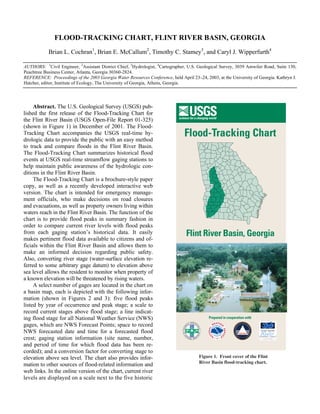
Abstract. The U.S. Geological Survey (USGS) pub-
lished the first release of the Flood-Tracking Chart for
the Flint River Basin (USGS Open-File Report 01-325)
(shown in Figure 1) in December of 2001. The Flood-
Tracking Chart accompanies the USGS real-time hy-
drologic data to provide the public with an easy method
to track and compare floods in the Flint River Basin.
The Flood-Tracking Chart summarizes historical flood
events at USGS real-time streamflow gaging stations to
help maintain public awareness of the hydrologic con-
ditions in the Flint River Basin.
The Flood-Tracking Chart is a brochure-style paper
copy, as well as a recently developed interactive web
version. The chart is intended for emergency manage-
ment officials, who make decisions on road closures
and evacuations, as well as property owners living within
waters reach in the Flint River Basin. The function of the
chart is to provide flood peaks in summary fashion in
order to compare current river levels with flood peaks
from each gaging station’s historical data. It easily
makes pertinent flood data available to citizens and of-
ficials within the Flint River Basin and allows them to
make an informed decision regarding public safety.
Also, converting river stage (water-surface elevation re-
ferred to some arbitrary gage datum) to elevation above
sea level allows the resident to monitor when property of
a known elevation will be threatened by rising waters.
A select number of gages are located in the chart on
a basin map, each is depicted with the following infor-
mation (shown in Figures 2 and 3): five flood peaks
listed by year of occurrence and peak stage; a scale to
record current stages above flood stage; a line indicat-
ing flood stage for all National Weather Service (NWS)
gages, which are NWS Forecast Points; space to record
NWS forecasted date and time for a forecasted flood
crest; gaging station information (site name, number,
and period of time for which flood data has been re-
corded); and a conversion factor for converting stage to
elevation above sea level. The chart also provides infor-
mation to other sources of flood-related information and
web links. In the online version of the chart, current river
levels are displayed on a scale next to the five historic
Flood-Tracking Chart
Flint River Basin, Georgia
Prepared in cooperation with
Figure 1. Front cover of the Flint
River Basin flood-tracking chart.
peaks of record; this scale is based on the current
hydrologic conditions, which is updated on the Internet
every 4 hours in most cases. Other graphical annual
flood data is included for each of the gages selected for
use in the chart in the online version. Because of online
capabilities, this version of the chart proves to be more
detailed in providing more specific gaging station
information, along with its updated stage data for
comparison with historical floods.
GEORGIA
0
0
10
10
20
20
30 MILES
30 KILOMETERS
N
Base from U.S. Geological Survey
1:100,000-scale digital data
85
75
82
19
84
02349500
FlintR
iver
Real-time river
stage station
Flint River Basin
EXPLANATION
Figure 2. Flint River Basin map.
The USGS—in cooperation with other Federal,
State, and local agencies—operates the Flood Monitor-
ing System, aimed at making flood data accessible to the
public. The chart is a tool organized to provide sources
of emergency flood data for comparison and basic
information relating to rising waters and the threat of
danger to life and property within the Flint River Basin.
32
30
28
26
24
22
18
27.40
25.20
26.00 26.05
34.11
1949
1994
1929
1897
1990
Flint River at Montezuma (02349500) 1897, 1905–2000
STAGE,INFEET
Add 255.83 to
stage to convert
to elevation
above sea level
Predicted
flood crest:
Predicted
date and time:*20
Figure 3. Gaging station depiction (see Figure 2 for location).

Cochran_5.2.1

  • 1.
    FLOOD-TRACKING CHART, FLINTRIVER BASIN, GEORGIA Brian L. Cochran1 , Brian E. McCallum2 , Timothy C. Stamey3 , and Caryl J. Wipperfurth4 AUTHORS: 1 Civil Engineer, 2 Assistant District Chief, 3 Hydrologist, 4 Cartographer, U.S. Geological Survey, 3039 Amwiler Road, Suite 130, Peachtree Business Center, Atlanta, Georgia 30360-2824. REFERENCE: Proceedings of the 2003 Georgia Water Resources Conference, held April 23–24, 2003, at the University of Georgia. Kathryn J. Hatcher, editor, Institute of Ecology, The University of Georgia, Athens, Georgia. Abstract. The U.S. Geological Survey (USGS) pub- lished the first release of the Flood-Tracking Chart for the Flint River Basin (USGS Open-File Report 01-325) (shown in Figure 1) in December of 2001. The Flood- Tracking Chart accompanies the USGS real-time hy- drologic data to provide the public with an easy method to track and compare floods in the Flint River Basin. The Flood-Tracking Chart summarizes historical flood events at USGS real-time streamflow gaging stations to help maintain public awareness of the hydrologic con- ditions in the Flint River Basin. The Flood-Tracking Chart is a brochure-style paper copy, as well as a recently developed interactive web version. The chart is intended for emergency manage- ment officials, who make decisions on road closures and evacuations, as well as property owners living within waters reach in the Flint River Basin. The function of the chart is to provide flood peaks in summary fashion in order to compare current river levels with flood peaks from each gaging station’s historical data. It easily makes pertinent flood data available to citizens and of- ficials within the Flint River Basin and allows them to make an informed decision regarding public safety. Also, converting river stage (water-surface elevation re- ferred to some arbitrary gage datum) to elevation above sea level allows the resident to monitor when property of a known elevation will be threatened by rising waters. A select number of gages are located in the chart on a basin map, each is depicted with the following infor- mation (shown in Figures 2 and 3): five flood peaks listed by year of occurrence and peak stage; a scale to record current stages above flood stage; a line indicat- ing flood stage for all National Weather Service (NWS) gages, which are NWS Forecast Points; space to record NWS forecasted date and time for a forecasted flood crest; gaging station information (site name, number, and period of time for which flood data has been re- corded); and a conversion factor for converting stage to elevation above sea level. The chart also provides infor- mation to other sources of flood-related information and web links. In the online version of the chart, current river levels are displayed on a scale next to the five historic Flood-Tracking Chart Flint River Basin, Georgia Prepared in cooperation with Figure 1. Front cover of the Flint River Basin flood-tracking chart.
  • 2.
    peaks of record;this scale is based on the current hydrologic conditions, which is updated on the Internet every 4 hours in most cases. Other graphical annual flood data is included for each of the gages selected for use in the chart in the online version. Because of online capabilities, this version of the chart proves to be more detailed in providing more specific gaging station information, along with its updated stage data for comparison with historical floods. GEORGIA 0 0 10 10 20 20 30 MILES 30 KILOMETERS N Base from U.S. Geological Survey 1:100,000-scale digital data 85 75 82 19 84 02349500 FlintR iver Real-time river stage station Flint River Basin EXPLANATION Figure 2. Flint River Basin map. The USGS—in cooperation with other Federal, State, and local agencies—operates the Flood Monitor- ing System, aimed at making flood data accessible to the public. The chart is a tool organized to provide sources of emergency flood data for comparison and basic information relating to rising waters and the threat of danger to life and property within the Flint River Basin. 32 30 28 26 24 22 18 27.40 25.20 26.00 26.05 34.11 1949 1994 1929 1897 1990 Flint River at Montezuma (02349500) 1897, 1905–2000 STAGE,INFEET Add 255.83 to stage to convert to elevation above sea level Predicted flood crest: Predicted date and time:*20 Figure 3. Gaging station depiction (see Figure 2 for location).