International Journal of Civil Engineering and Technology (IJCIET), ISSN 0976 – 6308
INTERNATIONAL JOURNAL OF CIVIL ENGINEERING AND
(Print), ISSN 0976 – 6316(Online) Volume 4, Issue 6, November – December (2013), © IAEME

TECHNOLOGY (IJCIET)

ISSN 0976 – 6308 (Print)
ISSN 0976 – 6316(Online)
Volume 4, Issue 6, November – December, pp. 208-213
© IAEME: www.iaeme.com/ijciet.asp
Journal Impact Factor (2013): 5.3277 (Calculated by GISI)
www.jifactor.com

IJCIET
©IAEME

EVALUATION OF RUNOFF DEPTH FOR AL-ADEEM RIVER BASIN BY
USING REMOTE SENSING TECHNIQUE AND GIS INTEGRATION
Dr. GhassanAl-adeem AL-Dulaimi*
*Institute of TechnologyBaghdad

ABSTRACT
The aim of this study is to determine runoff depth for Al-adeem river basin in north eastern
part of Iraq by using remote sensing and Geographic information system (GIS) integration.
Various data sets were used such as Landsat7-ETM satellite image, 1:25000 standard
topographic map and soil map data. The basin area and physical characteristics of the studied area
such as slope and aspect maps were determined with the help of DEM (Digital Elevation Model)by
using Global Mapper 11 software. Supervised classification process was used in this research to
drive the land cover map by using ERDAS 8.4 program. A hydrological model US Soil Conservation
Service method or (SCS) method was used to determine curve numbers and runoff depth distribution
on the entire studied basin.
Results obtained from this research coincide with varying morphology of studied basin. High runoff
depth obtained in the middle parts of the basin that consist mainly from soil with low infiltration
rate(clayey soil) and pasture land cover that has an ability of high retention. Low runoff depth
obtained in the north parts of the basin that consist mainly from soil with high infiltration rate(course
sand and gravel soils) and shrub land cover that has an ability of low retention.
Keyword: Runoff depth, ERDAS, SCS Model
2.

INTRODUCTION

For the last years, engineers and planners have been working on the modeling of
environmental system. An accurate modeling of basin will require determination of the spatial and
temporal distribution of hydrological parameters. Remote sensing and Geographic Information
system within creasing the advancement of the computer technology have been applying to extract
land surface properties at spatial and temporal scales which are very useful input data for
hydrological model.
Land use and land cover have several impacts on the hydrological cycle such as floods,
droughts, runoff, water-quality. Rainfall-Runoff model play an important role to understand
hydrological condition of basin area and predict their behavior over time.
208
International Journal of Civil Engineering and Technology (IJCIET), ISSN 0976 – 6308
(Print), ISSN 0976 – 6316(Online) Volume 4, Issue 6, November – December (2013), © IAEME
Conventional hydrological model, to estimate runoff model input parameters have to be determined
through ground truth measurements which still need huge economic and time labor consuming.
Therefore remote sensing can also provide information about runoff input data most cost-effective
cost
and large-land coverage.
Direct measurement of runoff is the accurate way of measurement but in most it is not
possible at desired time and location, thus use of hydrological model for estimating run depth has
runoff
become increasingly popular.
Al-adeem River basin lies in the Iraqi land. It originates at mountainous parts in north eastern
adeem
of Iraq, from the southern foots of (Karadagh), (Skermahdagh), (Tasslugga) and (Shwan) mountains
in Sulaymania governorate. The height of these mountains varies from 1400 to 1800m above sea
rnorate.
level. Studied area is about 13000km²; Al-adeem River is considered one of the main Tigris
Al adeem
tributaries. It occupies most of Kirkuk governorate area and discharges in Tigris River south of
so
Ballad city .The basin extends between the two basins of Lesser Zab River at the north and Diyala
River at the south in the region located between the latitudes 340 and 350 34’nourh and the
longitudes 43030’ and 450 30’ east . The important valleys that the river originates from (Khassa
Chai), (Tawok Chai),and (Quri Chai).
The area of this region is about (11000km2) which forms (85%) from the whole basin area.
The basin has an erodible and weak top soil which is easily washed out towards the stream after rain
strea
storms, thus causing an increase of sediments loads in River water. So, Al-adeem River peak flow
Al adeem
badly influences domestic water at Baghdad city, especially when Tigris has low levels because of
the difficulties of purifying the water from fine sediments [1].
fin
All Iraqi rivers are considered as mixing river where they are fed by rain, ice and ground water,
except Al-adeem River which is classified as a rain–fed river due to its main dependence on rainfall
adeem
rain fed
in feeding its basin [2].
3.

MATERIALS AND METHOD

A Satellite image of Landsat7 ETM corrected was used in this research as shown in Fig. (1)
Landsat7-ETM
The satellite data was visually interoperated and accuracy was checked on the ground. Digital
Elevation Model (DEM) was created using Global Mapper.11 Fig. (2).

Fig. (1) Satellite image Landsat 7-ETM
7
for studied basin

Fig (2) Digital elevation model (DEM)
for studied basin Global Mapper 11
209
International Journal of Civil Engineering and Technology (IJCIET), ISSN 0976 – 6308
(Print), ISSN 0976 – 6316(Online) Volume 4, Issue 6, November – December (2013), © IAEME
The DEM map used for drive slope map for the catchment area by using the same software
(Global Mapper .11), Fig.(3) shows the slope map for the studied catchment area.

Fig. (3) Slope map for studied basin Global Mapper 11.1
ERDAS 8.4 software used for produce supervised classification map[3] depending on the
produce
Hydraulic Soil Group map (HSG) for the catchment area that constructed by using Arc Veiw GIS 3.3
software depending on the soil data for the catchment area as shown in Fig.(4) and Fig.(5). The basin
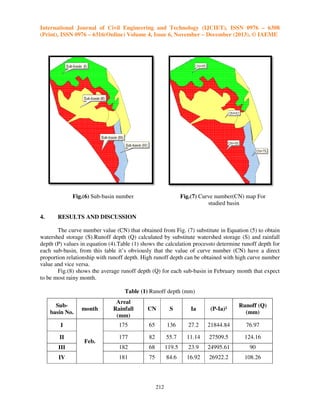
dived into four sub-basins according to the variety in soil type, land cover and divide flow Fig.(6).
basins

Fig.(4) Hydraulic soil group (HSG)
map for studied basin ArcVeiw GIS 3.3

Fig.(5) Supervised classification map
for studied basin ERDAS 8.4

210
International Journal of Civil Engineering and Technology (IJCIET), ISSN 0976 – 6308
(Print), ISSN 0976 – 6316(Online) Volume 4, Issue 6, November – December (2013), © IAEME
The Soil Conservation Model (SCS)[4]was used in this research as a hydrological model to
drive the runoff depth in catchment area, the main input data in this model is the rainfall data which
collected from Kirkuk metrological station. Average rainfall data found by using Isohyetal method.
The soil conservation model (SCS) developed by United states Department of Agriculture (USDA)
computes direct runoff through an empirical equation that requires the rainfall and a watershed
coefficient as inputs. The SCS has developed an index, which is called the runoff curve number
(CN), to represent the combined hydrologic effect of soil, land use, agricultural, land treatment class
hydrologic condition, and antecedent soil moisture condition.
General equation for the SCS curve number method is as follows [5]:

F
Q
ൌ
… … … . . ሺ1ሻ
S PെI
Where P: rainfall depth (mm), F: actual retention (mm), S: watershed storage (mm), Q: actual direct
runoff (mm), I: initial abstraction.
From the continuity principle:

F ൌ ሺP െ Iሻ െ Q … … … ሺ2ሻ
The SCS method defined the value of initial abstraction (I) to be approximately equal to 20% of
watershed storage (S).

‫ ܫ‬ൌ 0.2 ൈ S … … … … … … … . ሺ3ሻ
Solving equation (1) and (2)
simultaneously:

ܳൌ

ሺܲ െ 0.2ܵሻଶ
ܲ ൅ 0.8ܵ

… … . . ሺ4ሻ

The watershed storage S and curve number CN are related

ܵൌ

25400
െ 254 … … … ሺ5ሻ
‫ܰܥ‬

The parameter CN, having a range of value between 0 and 100, called the curve number. In
this method a curve number (CN) assigned to each watershed or portion of watershed based on soil
type, land use and treatment .Fig.(7) shows curve number (CN) value for each sub-basin depending
on soil type and land cover by using SCS tables.

211
International Journal of Civil Engineering and Technology (IJCIET), ISSN 0976 – 6308
(Print), ISSN 0976 – 6316(Online) Volume 4, Issue 6, November – December (2013), © IAEME

Fig.(7) Curve number(CN) map For
studied basin

basin
Fig.(6) Sub-basin number

4.

RESULTS AND DISCUSSION

The curve number value (CN) that obtained from Fig. (7) substitute in Equation (5) to obtain
watershed storage (S).Runoff depth (Q) calculated by substitute watershed storage (S) and rainfall
depth (P) values in equation (4).Table (1) shows the calculation process determine runoff depth for
processto
each sub-basin, from this table it’s obviously that the value of curve number (CN) have a direct
basin,
proportion relationship with runoff depth. High runoff depth can be obtained with high curve number
value and vice versa.
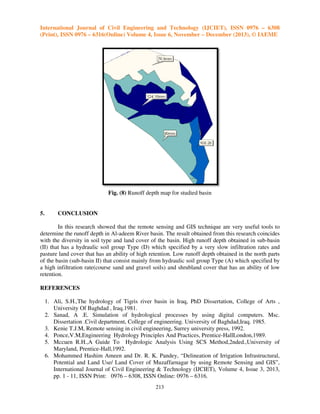
Fig.(8) shows the average runoff depth (Q) for each sub-basin in February month that expect
sub basin
to be most rainy month.
Table (1) Runoff depth (mm)
Areal
Rainfall
(mm)

CN

S

Ia

(P-Ia)²

Runoff (Q)
(mm)

175

65

136

27.2

21844.84

76.97

177

82

55.7

11.14

27509.5

124.16

III

182

68

119.5

23.9

24995.61

90

IV

181

75

84.6

16.92

26922.2

108.26

Subbasin No.

month

I
II

Feb.

212
International Journal of Civil Engineering and Technology (IJCIET), ISSN 0976 – 6308
(Print), ISSN 0976 – 6316(Online) Volume 4, Issue 6, November – December (2013), © IAEME

Fig. (8) Runoff depth map for studied basin

5.

CONCLUSION

In this research showed that the remote sensing and GIS technique are very useful tools to
determine the runoff depth in Al-adeem River basin. The result obtained from this research coincides
adeem
with the diversity in soil type and land cover of the basin. High runoff depth obtained in sub
sub-basin
(II) that has a hydraulic soil group Type (D) which specified by a very slow infiltration rates and
pasture land cover that has an ability of high retention. Low runoff depth obtained in the north parts
of the basin (sub-basin II) that consist mainly from hydraulic soil group Type (A) which specified by
a high infiltration rate(course sand and gravel soils) and shrubland cover that has an ability of low
retention.
REFERENCES
1. Ali, S.H.,The hydrology of Tigris river basin in Iraq, PhD Dissertation, College of Arts ,
University Of Baghdad , Iraq.1981.
ersity
2. Sanad, A .E. Simulation of hydrological processes by using digital computers. Msc.
Dissertation .Civil department, College of engineering. University of Baghdad,Iraq. 1985.
3. Kenie T.J.M, Remote sensing in civil engineering, Surrey university press, 1992.
engin
4. Ponce,V.M,Engineering Hydrology Principles And Practices, Prentice-HallLondon,1989.
Prentice HallLondon,1989.
5. Mccuen R.H.,A Guide To Hydrologic Analysis Using SCS Method,2nded.,University of
Maryland, Prentice-Hall,1992.
6. Mohammed Hashim Ameen a Dr. R. K. Pandey, “Delineation of Irrigation Infrastructural,
and
f
Potential and Land Use/ Land Cover of Muzaffarnagar by using Remote Sensing and GIS”,
nd
sing
International Journal of Civil Engineering & Technology (IJCIET), Volume 4, Issue 3, 2013,
pp. 1 - 11, ISSN Print: 0976 – 6308, ISSN Online: 0976 – 6316.
213

20320130406021 2-3

  • 1.
    International Journal ofCivil Engineering and Technology (IJCIET), ISSN 0976 – 6308 INTERNATIONAL JOURNAL OF CIVIL ENGINEERING AND (Print), ISSN 0976 – 6316(Online) Volume 4, Issue 6, November – December (2013), © IAEME TECHNOLOGY (IJCIET) ISSN 0976 – 6308 (Print) ISSN 0976 – 6316(Online) Volume 4, Issue 6, November – December, pp. 208-213 © IAEME: www.iaeme.com/ijciet.asp Journal Impact Factor (2013): 5.3277 (Calculated by GISI) www.jifactor.com IJCIET ©IAEME EVALUATION OF RUNOFF DEPTH FOR AL-ADEEM RIVER BASIN BY USING REMOTE SENSING TECHNIQUE AND GIS INTEGRATION Dr. GhassanAl-adeem AL-Dulaimi* *Institute of TechnologyBaghdad ABSTRACT The aim of this study is to determine runoff depth for Al-adeem river basin in north eastern part of Iraq by using remote sensing and Geographic information system (GIS) integration. Various data sets were used such as Landsat7-ETM satellite image, 1:25000 standard topographic map and soil map data. The basin area and physical characteristics of the studied area such as slope and aspect maps were determined with the help of DEM (Digital Elevation Model)by using Global Mapper 11 software. Supervised classification process was used in this research to drive the land cover map by using ERDAS 8.4 program. A hydrological model US Soil Conservation Service method or (SCS) method was used to determine curve numbers and runoff depth distribution on the entire studied basin. Results obtained from this research coincide with varying morphology of studied basin. High runoff depth obtained in the middle parts of the basin that consist mainly from soil with low infiltration rate(clayey soil) and pasture land cover that has an ability of high retention. Low runoff depth obtained in the north parts of the basin that consist mainly from soil with high infiltration rate(course sand and gravel soils) and shrub land cover that has an ability of low retention. Keyword: Runoff depth, ERDAS, SCS Model 2. INTRODUCTION For the last years, engineers and planners have been working on the modeling of environmental system. An accurate modeling of basin will require determination of the spatial and temporal distribution of hydrological parameters. Remote sensing and Geographic Information system within creasing the advancement of the computer technology have been applying to extract land surface properties at spatial and temporal scales which are very useful input data for hydrological model. Land use and land cover have several impacts on the hydrological cycle such as floods, droughts, runoff, water-quality. Rainfall-Runoff model play an important role to understand hydrological condition of basin area and predict their behavior over time. 208
  • 2.
    International Journal ofCivil Engineering and Technology (IJCIET), ISSN 0976 – 6308 (Print), ISSN 0976 – 6316(Online) Volume 4, Issue 6, November – December (2013), © IAEME Conventional hydrological model, to estimate runoff model input parameters have to be determined through ground truth measurements which still need huge economic and time labor consuming. Therefore remote sensing can also provide information about runoff input data most cost-effective cost and large-land coverage. Direct measurement of runoff is the accurate way of measurement but in most it is not possible at desired time and location, thus use of hydrological model for estimating run depth has runoff become increasingly popular. Al-adeem River basin lies in the Iraqi land. It originates at mountainous parts in north eastern adeem of Iraq, from the southern foots of (Karadagh), (Skermahdagh), (Tasslugga) and (Shwan) mountains in Sulaymania governorate. The height of these mountains varies from 1400 to 1800m above sea rnorate. level. Studied area is about 13000km²; Al-adeem River is considered one of the main Tigris Al adeem tributaries. It occupies most of Kirkuk governorate area and discharges in Tigris River south of so Ballad city .The basin extends between the two basins of Lesser Zab River at the north and Diyala River at the south in the region located between the latitudes 340 and 350 34’nourh and the longitudes 43030’ and 450 30’ east . The important valleys that the river originates from (Khassa Chai), (Tawok Chai),and (Quri Chai). The area of this region is about (11000km2) which forms (85%) from the whole basin area. The basin has an erodible and weak top soil which is easily washed out towards the stream after rain strea storms, thus causing an increase of sediments loads in River water. So, Al-adeem River peak flow Al adeem badly influences domestic water at Baghdad city, especially when Tigris has low levels because of the difficulties of purifying the water from fine sediments [1]. fin All Iraqi rivers are considered as mixing river where they are fed by rain, ice and ground water, except Al-adeem River which is classified as a rain–fed river due to its main dependence on rainfall adeem rain fed in feeding its basin [2]. 3. MATERIALS AND METHOD A Satellite image of Landsat7 ETM corrected was used in this research as shown in Fig. (1) Landsat7-ETM The satellite data was visually interoperated and accuracy was checked on the ground. Digital Elevation Model (DEM) was created using Global Mapper.11 Fig. (2). Fig. (1) Satellite image Landsat 7-ETM 7 for studied basin Fig (2) Digital elevation model (DEM) for studied basin Global Mapper 11 209
  • 3.
    International Journal ofCivil Engineering and Technology (IJCIET), ISSN 0976 – 6308 (Print), ISSN 0976 – 6316(Online) Volume 4, Issue 6, November – December (2013), © IAEME The DEM map used for drive slope map for the catchment area by using the same software (Global Mapper .11), Fig.(3) shows the slope map for the studied catchment area. Fig. (3) Slope map for studied basin Global Mapper 11.1 ERDAS 8.4 software used for produce supervised classification map[3] depending on the produce Hydraulic Soil Group map (HSG) for the catchment area that constructed by using Arc Veiw GIS 3.3 software depending on the soil data for the catchment area as shown in Fig.(4) and Fig.(5). The basin dived into four sub-basins according to the variety in soil type, land cover and divide flow Fig.(6). basins Fig.(4) Hydraulic soil group (HSG) map for studied basin ArcVeiw GIS 3.3 Fig.(5) Supervised classification map for studied basin ERDAS 8.4 210
  • 4.
    International Journal ofCivil Engineering and Technology (IJCIET), ISSN 0976 – 6308 (Print), ISSN 0976 – 6316(Online) Volume 4, Issue 6, November – December (2013), © IAEME The Soil Conservation Model (SCS)[4]was used in this research as a hydrological model to drive the runoff depth in catchment area, the main input data in this model is the rainfall data which collected from Kirkuk metrological station. Average rainfall data found by using Isohyetal method. The soil conservation model (SCS) developed by United states Department of Agriculture (USDA) computes direct runoff through an empirical equation that requires the rainfall and a watershed coefficient as inputs. The SCS has developed an index, which is called the runoff curve number (CN), to represent the combined hydrologic effect of soil, land use, agricultural, land treatment class hydrologic condition, and antecedent soil moisture condition. General equation for the SCS curve number method is as follows [5]: F Q ൌ … … … . . ሺ1ሻ S PെI Where P: rainfall depth (mm), F: actual retention (mm), S: watershed storage (mm), Q: actual direct runoff (mm), I: initial abstraction. From the continuity principle: F ൌ ሺP െ Iሻ െ Q … … … ሺ2ሻ The SCS method defined the value of initial abstraction (I) to be approximately equal to 20% of watershed storage (S). ‫ ܫ‬ൌ 0.2 ൈ S … … … … … … … . ሺ3ሻ Solving equation (1) and (2) simultaneously: ܳൌ ሺܲ െ 0.2ܵሻଶ ܲ ൅ 0.8ܵ … … . . ሺ4ሻ The watershed storage S and curve number CN are related ܵൌ 25400 െ 254 … … … ሺ5ሻ ‫ܰܥ‬ The parameter CN, having a range of value between 0 and 100, called the curve number. In this method a curve number (CN) assigned to each watershed or portion of watershed based on soil type, land use and treatment .Fig.(7) shows curve number (CN) value for each sub-basin depending on soil type and land cover by using SCS tables. 211
  • 5.
    International Journal ofCivil Engineering and Technology (IJCIET), ISSN 0976 – 6308 (Print), ISSN 0976 – 6316(Online) Volume 4, Issue 6, November – December (2013), © IAEME Fig.(7) Curve number(CN) map For studied basin basin Fig.(6) Sub-basin number 4. RESULTS AND DISCUSSION The curve number value (CN) that obtained from Fig. (7) substitute in Equation (5) to obtain watershed storage (S).Runoff depth (Q) calculated by substitute watershed storage (S) and rainfall depth (P) values in equation (4).Table (1) shows the calculation process determine runoff depth for processto each sub-basin, from this table it’s obviously that the value of curve number (CN) have a direct basin, proportion relationship with runoff depth. High runoff depth can be obtained with high curve number value and vice versa. Fig.(8) shows the average runoff depth (Q) for each sub-basin in February month that expect sub basin to be most rainy month. Table (1) Runoff depth (mm) Areal Rainfall (mm) CN S Ia (P-Ia)² Runoff (Q) (mm) 175 65 136 27.2 21844.84 76.97 177 82 55.7 11.14 27509.5 124.16 III 182 68 119.5 23.9 24995.61 90 IV 181 75 84.6 16.92 26922.2 108.26 Subbasin No. month I II Feb. 212
  • 6.
    International Journal ofCivil Engineering and Technology (IJCIET), ISSN 0976 – 6308 (Print), ISSN 0976 – 6316(Online) Volume 4, Issue 6, November – December (2013), © IAEME Fig. (8) Runoff depth map for studied basin 5. CONCLUSION In this research showed that the remote sensing and GIS technique are very useful tools to determine the runoff depth in Al-adeem River basin. The result obtained from this research coincides adeem with the diversity in soil type and land cover of the basin. High runoff depth obtained in sub sub-basin (II) that has a hydraulic soil group Type (D) which specified by a very slow infiltration rates and pasture land cover that has an ability of high retention. Low runoff depth obtained in the north parts of the basin (sub-basin II) that consist mainly from hydraulic soil group Type (A) which specified by a high infiltration rate(course sand and gravel soils) and shrubland cover that has an ability of low retention. REFERENCES 1. Ali, S.H.,The hydrology of Tigris river basin in Iraq, PhD Dissertation, College of Arts , University Of Baghdad , Iraq.1981. ersity 2. Sanad, A .E. Simulation of hydrological processes by using digital computers. Msc. Dissertation .Civil department, College of engineering. University of Baghdad,Iraq. 1985. 3. Kenie T.J.M, Remote sensing in civil engineering, Surrey university press, 1992. engin 4. Ponce,V.M,Engineering Hydrology Principles And Practices, Prentice-HallLondon,1989. Prentice HallLondon,1989. 5. Mccuen R.H.,A Guide To Hydrologic Analysis Using SCS Method,2nded.,University of Maryland, Prentice-Hall,1992. 6. Mohammed Hashim Ameen a Dr. R. K. Pandey, “Delineation of Irrigation Infrastructural, and f Potential and Land Use/ Land Cover of Muzaffarnagar by using Remote Sensing and GIS”, nd sing International Journal of Civil Engineering & Technology (IJCIET), Volume 4, Issue 3, 2013, pp. 1 - 11, ISSN Print: 0976 – 6308, ISSN Online: 0976 – 6316. 213