2015 National
information Day on
Horizon 2020 SC5
Flash Presentation Session 2b: Nature-Based Solutions
Karin Dubsky, Coastwatch
Civil and Environmental Engineering, TCD, Dublin 2
My Focus: Coastal Nature
– most of our cities are coastal•
• High value nature in urban areas
• Designations - Dublin bay biosphere and Natura 2000 sites
• Social - who knows it and who values it? What is it? We have an infill
and discharge to the sea history.
• Decision to protect and manage is political
e.g. dog versus hare on Bull island
So to protect nature and to get human well being benefits, we need a
solid knowledge and emotional connection foundation
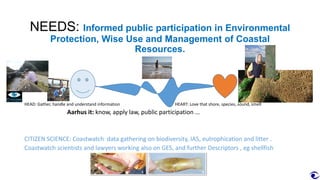
NEEDS: Informed public participation in Environmental
Protection, Wise Use and Management of Coastal
Resources.
HEAD: Gather, handle and understand information HEART: Love that shore, species, sound, smell
Aarhus it: know, apply law, public participation …
CITIZEN SCIENCE: Coastwatch data gathering on biodiversity, IAS, eutrophication and litter .
Coastwatch scientists and lawyers working also on GES, and further Descriptors , eg shellfish
Many Citizen science ways …
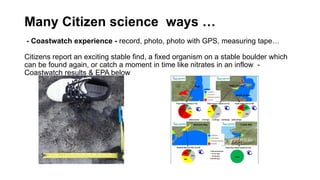
- Coastwatch experience - record, photo, photo with GPS, measuring tape…
Citizens report an exciting stable find, a fixed organism on a stable boulder which
can be found again, or catch a moment in time like nitrates in an inflow -
Coastwatch results & EPA below
8%
51%
33%
8%
Tolka Estuary inflows (n=51)
20%
36%
25%
19%
South Dublin Bay (n=36)
Rush
7%
13%
13%
27%
40%
Rush inflows tested (n=15)
8%
31%
38%
23%
Bannow Bay inf. test. (n=13)
100%
Tralee Bay Inflows tesded (n=22)
South Dublin
Bannow Bay Tralee Bay
Tolka Estuary
Coastwatch Horizon 2020 ideas:
1 Social – attitude, knowledge
• establish urban coastal site status combining official data and a
citizen science update to produce an agreed status report
• research public feeling about status before baseline, after baseline
and after some engagement to make things better or clearer.
• Produce advice to maximize social buy in to restoring and protecting
coastal nature/biodiversity.
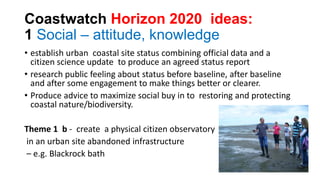
Theme 1 b - create a physical citizen observatory
in an urban site abandoned infrastructure
– e.g. Blackrock bath
Theme 2: Urban Habitat Restoration
the fragile coastal rim.
The quality of the coastal rim – edge of land - splashzone and intertidal
have nursery functions for many species
But urban shores tend to be either hard concrete, rock armour, wall or
if sandy then mechanically cleaned and full of disturbance as people
enjoy this space, so biodiversity is squeezed.
Some simple modifications - adding soft coast nodules, bands with
nursery wetland elements can significantly increase biodiversity,
produce wave buffers and be welcomed by people if they are involved.
This project seeks to audit the shores of 3 coastal cities with citizens
and draft a ‘bio-diversification’ plan with citizens and start
implementing sections of it.
Theme 3: Species protection, monitoring
and potentially restoration
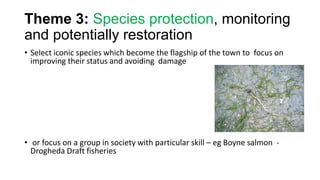
• Select iconic species which become the flagship of the town to focus on
improving their status and avoiding damage
• or focus on a group in society with particular skill – eg Boyne salmon -
Drogheda Draft fisheries
Boyne Estuary Salmon
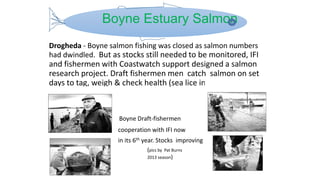
Drogheda - Boyne salmon fishing was closed as salmon numbers
had dwindled. But as stocks still needed to be monitored, IFI
and fishermen with Coastwatch support designed a salmon
research project. Draft fishermen men catch salmon on set
days to tag, weigh & check health (sea lice infestation) of
returning fish.
Boyne Draft-fishermen
cooperation with IFI now
in its 6th year. Stocks improving
(pics by Pat Burns
2013 season)
A citizen science initiative
for the sea and us,
Karin Dubsky
Coastwatch
Civil and Env. Eng. Trinity College Dublin, Dublin 2
kdubsky@coastwatch.org and kdubsky@tcd.ie Mob 086 8111 684

Coastwatch – Karin Dubsky

  • 1.
    2015 National information Dayon Horizon 2020 SC5 Flash Presentation Session 2b: Nature-Based Solutions Karin Dubsky, Coastwatch Civil and Environmental Engineering, TCD, Dublin 2
  • 2.
    My Focus: CoastalNature – most of our cities are coastal• • High value nature in urban areas • Designations - Dublin bay biosphere and Natura 2000 sites • Social - who knows it and who values it? What is it? We have an infill and discharge to the sea history. • Decision to protect and manage is political e.g. dog versus hare on Bull island So to protect nature and to get human well being benefits, we need a solid knowledge and emotional connection foundation
  • 3.
    NEEDS: Informed publicparticipation in Environmental Protection, Wise Use and Management of Coastal Resources. HEAD: Gather, handle and understand information HEART: Love that shore, species, sound, smell Aarhus it: know, apply law, public participation … CITIZEN SCIENCE: Coastwatch data gathering on biodiversity, IAS, eutrophication and litter . Coastwatch scientists and lawyers working also on GES, and further Descriptors , eg shellfish
  • 4.
    Many Citizen scienceways … - Coastwatch experience - record, photo, photo with GPS, measuring tape… Citizens report an exciting stable find, a fixed organism on a stable boulder which can be found again, or catch a moment in time like nitrates in an inflow - Coastwatch results & EPA below 8% 51% 33% 8% Tolka Estuary inflows (n=51) 20% 36% 25% 19% South Dublin Bay (n=36) Rush 7% 13% 13% 27% 40% Rush inflows tested (n=15) 8% 31% 38% 23% Bannow Bay inf. test. (n=13) 100% Tralee Bay Inflows tesded (n=22) South Dublin Bannow Bay Tralee Bay Tolka Estuary
  • 5.
    Coastwatch Horizon 2020ideas: 1 Social – attitude, knowledge • establish urban coastal site status combining official data and a citizen science update to produce an agreed status report • research public feeling about status before baseline, after baseline and after some engagement to make things better or clearer. • Produce advice to maximize social buy in to restoring and protecting coastal nature/biodiversity. Theme 1 b - create a physical citizen observatory in an urban site abandoned infrastructure – e.g. Blackrock bath
  • 6.
    Theme 2: UrbanHabitat Restoration the fragile coastal rim. The quality of the coastal rim – edge of land - splashzone and intertidal have nursery functions for many species But urban shores tend to be either hard concrete, rock armour, wall or if sandy then mechanically cleaned and full of disturbance as people enjoy this space, so biodiversity is squeezed. Some simple modifications - adding soft coast nodules, bands with nursery wetland elements can significantly increase biodiversity, produce wave buffers and be welcomed by people if they are involved. This project seeks to audit the shores of 3 coastal cities with citizens and draft a ‘bio-diversification’ plan with citizens and start implementing sections of it.
  • 7.
    Theme 3: Speciesprotection, monitoring and potentially restoration • Select iconic species which become the flagship of the town to focus on improving their status and avoiding damage • or focus on a group in society with particular skill – eg Boyne salmon - Drogheda Draft fisheries
  • 8.
    Boyne Estuary Salmon Drogheda- Boyne salmon fishing was closed as salmon numbers had dwindled. But as stocks still needed to be monitored, IFI and fishermen with Coastwatch support designed a salmon research project. Draft fishermen men catch salmon on set days to tag, weigh & check health (sea lice infestation) of returning fish. Boyne Draft-fishermen cooperation with IFI now in its 6th year. Stocks improving (pics by Pat Burns 2013 season)
  • 9.
    A citizen scienceinitiative for the sea and us, Karin Dubsky Coastwatch Civil and Env. Eng. Trinity College Dublin, Dublin 2 kdubsky@coastwatch.org and kdubsky@tcd.ie Mob 086 8111 684