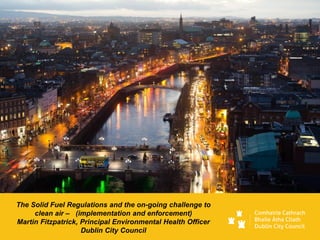
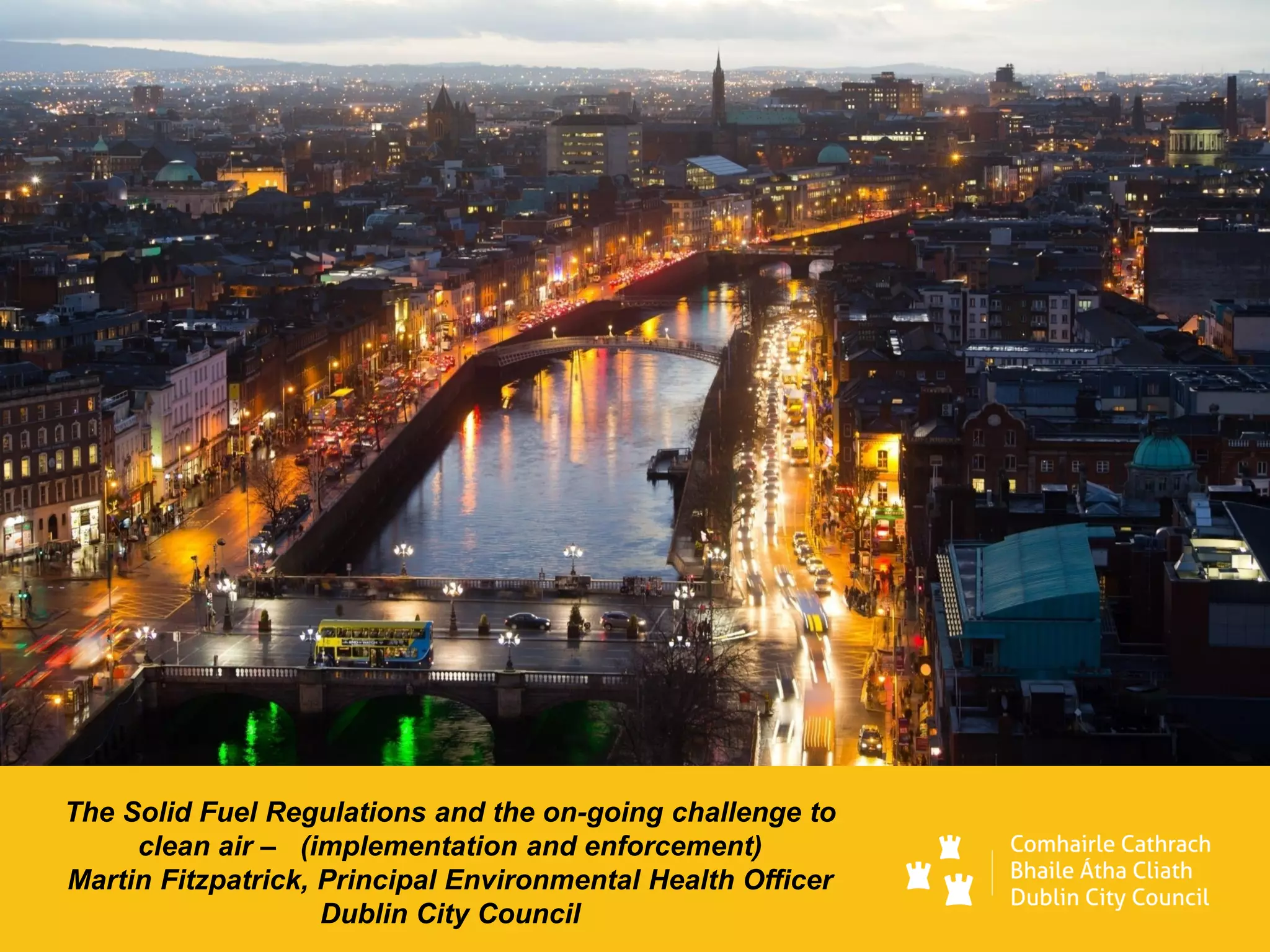
The Solid Fuel Regulations and the on-going challenge to
clean air – (implementation and enforcement)
Martin Fitzpatrick, Principal Environmental Health Officer
Dublin City Council
Scope of presentation
• Historical background
• Overview of the main aspects of
solid fuel regulation
• Initial approaches and successes
• The changing landscape
• Ongoing challenges
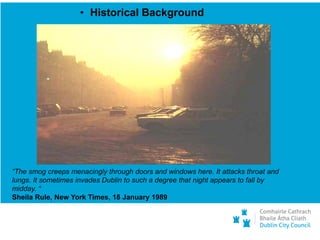
“The smog creeps menacingly through doors and windows here. It attacks throat and
lungs. It sometimes invades Dublin to such a degree that night appears to fall by
midday. “
Sheila Rule, New York Times, 18 January 1989
• Historical Background
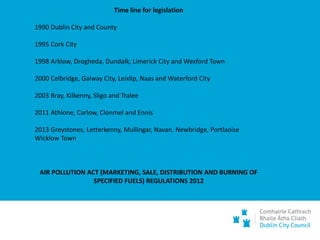
Time line for legislation
1990 Dublin City and County
1995 Cork City
1998 Arklow, Drogheda, Dundalk, Limerick City and Wexford Town
2000 Celbridge, Galway City, Leixlip, Naas and Waterford City
2003 Bray, Kilkenny, Sligo and Tralee
2011 Athlone, Carlow, Clonmel and Ennis
2013 Greystones, Letterkenny, Mullingar, Navan. Newbridge, Portlaoise
Wicklow Town
AIR POLLUTION ACT (MARKETING, SALE, DISTRIBUTION AND BURNING OF
SPECIFIED FUELS) REGULATIONS 2012
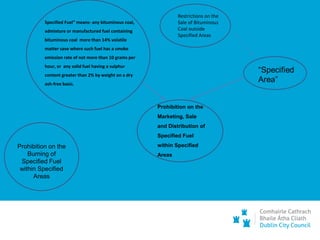
Specified Fuel” means- any bituminous coal,
admixture or manufactured fuel containing
bituminous coal more than 14% volatile
matter save where such fuel has a smoke
emission rate of not more than 10 grams per
hour, or any solid fuel having a sulphur
content greater than 2% by weight on a dry
ash-free basis.
Prohibition on the
Burning of
Specified Fuel
within Specified
Areas
Prohibition on the
Marketing, Sale
and Distribution of
Specified Fuel
within Specified
Areas
Restrictions on the
Sale of Bituminous
Coal outside
Specified Areas
Initial approaches and successes
•Public perception versus on the ground reality –
“legislation passed, pollution levels down - job done”
Building up a working relationship with the compliant operators
Heating season inspections (October to March)
Visibility and unpredictability
Intelligence lead inspections
The changing landscape
Where and How?
The new realties of cyberspace marketing and sales
Customer mobility
Who?
New players in the market , multiples, new entrants, building and hardware suppliers
What?
New and evolving products - blends, convenience packs, novel products
do we know what we are looking at?
When?
Weekend trade, markets etc.
Health and Safety of our teams – the online threats
Ongoing Challenges
1. The large population/small geographical area approach to designating “specified areas” requires
reconsideration – A national ban on bituminous coal should be considered and there is substantial
support for that approach.
2. The all island dimension to the solid fuel trade is THE elephant in the room
3. A coherent multi- agency approach is required – e.g. Revenue Commissioners, Consumer Protection
4. Public information campaign- creating consumer pressure for a legitimate product
5. Analytical laboratory resources – fuel sampling programme
6. Dealing with both sides of the legal transaction- purchasing and ordering
7. Our increasing knowledge of the health effects of air pollutants - ”business as usual” is not an option
The Solid Fuel Regulations and the on-going challenge to clean air

The Solid Fuel Regulations and the on-going challenge to clean air

  • 1.
    The Solid FuelRegulations and the on-going challenge to clean air – (implementation and enforcement) Martin Fitzpatrick, Principal Environmental Health Officer Dublin City Council
  • 2.
    Scope of presentation •Historical background • Overview of the main aspects of solid fuel regulation • Initial approaches and successes • The changing landscape • Ongoing challenges
  • 3.
    “The smog creepsmenacingly through doors and windows here. It attacks throat and lungs. It sometimes invades Dublin to such a degree that night appears to fall by midday. “ Sheila Rule, New York Times, 18 January 1989 • Historical Background
  • 4.
    Time line forlegislation 1990 Dublin City and County 1995 Cork City 1998 Arklow, Drogheda, Dundalk, Limerick City and Wexford Town 2000 Celbridge, Galway City, Leixlip, Naas and Waterford City 2003 Bray, Kilkenny, Sligo and Tralee 2011 Athlone, Carlow, Clonmel and Ennis 2013 Greystones, Letterkenny, Mullingar, Navan. Newbridge, Portlaoise Wicklow Town AIR POLLUTION ACT (MARKETING, SALE, DISTRIBUTION AND BURNING OF SPECIFIED FUELS) REGULATIONS 2012
  • 5.
    Specified Fuel” means-any bituminous coal, admixture or manufactured fuel containing bituminous coal more than 14% volatile matter save where such fuel has a smoke emission rate of not more than 10 grams per hour, or any solid fuel having a sulphur content greater than 2% by weight on a dry ash-free basis. Prohibition on the Burning of Specified Fuel within Specified Areas Prohibition on the Marketing, Sale and Distribution of Specified Fuel within Specified Areas Restrictions on the Sale of Bituminous Coal outside Specified Areas
  • 6.
    Initial approaches andsuccesses •Public perception versus on the ground reality – “legislation passed, pollution levels down - job done” Building up a working relationship with the compliant operators Heating season inspections (October to March) Visibility and unpredictability Intelligence lead inspections
  • 7.
    The changing landscape Whereand How? The new realties of cyberspace marketing and sales Customer mobility Who? New players in the market , multiples, new entrants, building and hardware suppliers What? New and evolving products - blends, convenience packs, novel products do we know what we are looking at? When? Weekend trade, markets etc. Health and Safety of our teams – the online threats
  • 8.
    Ongoing Challenges 1. Thelarge population/small geographical area approach to designating “specified areas” requires reconsideration – A national ban on bituminous coal should be considered and there is substantial support for that approach. 2. The all island dimension to the solid fuel trade is THE elephant in the room 3. A coherent multi- agency approach is required – e.g. Revenue Commissioners, Consumer Protection 4. Public information campaign- creating consumer pressure for a legitimate product 5. Analytical laboratory resources – fuel sampling programme 6. Dealing with both sides of the legal transaction- purchasing and ordering 7. Our increasing knowledge of the health effects of air pollutants - ”business as usual” is not an option