Water Treatment
Prepared by Ginger A. Amonoy BSCE-3C
Coagulation
 It is used to remove turbidity, color, and
bacteria from drinking waters.
 The goal of coagulation is to change the
surface charge on the particles so they can stick
together to form larger particles that will settle
by gravity.
Colloid Stability & Destabilization
 Colloid is a substance
microscopically dispersed
evenly throughout another
one.
 In natural waters, colloids are
stable because the surface
charge of these particles are
like-charged, and they,
therefore, repel one another.
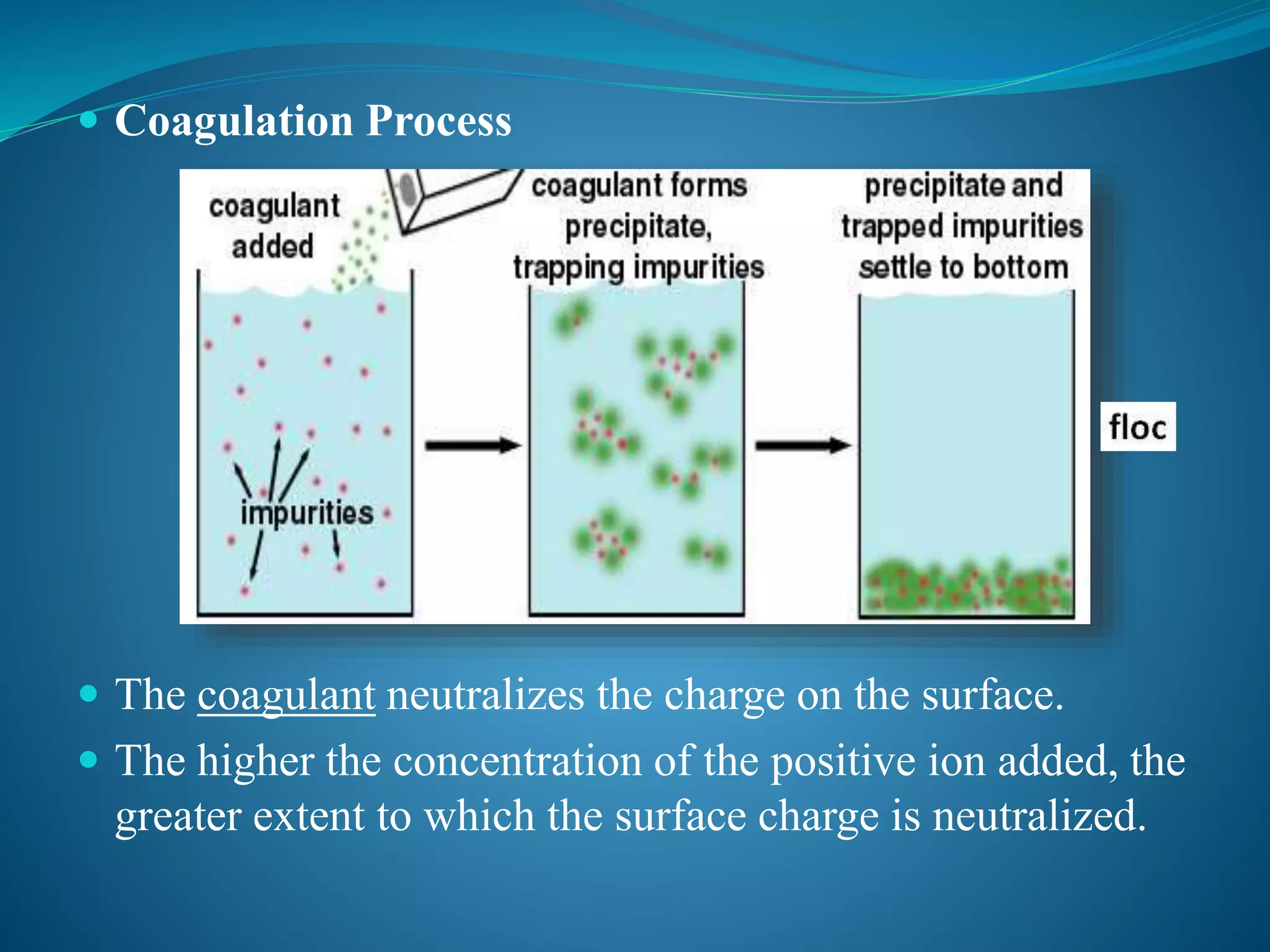
 Coagulation Process
 The coagulant neutralizes the charge on the surface.
 The higher the concentration of the positive ion added, the
greater extent to which the surface charge is neutralized.
Coagulants
 It is a chemical added to the water to cause particles to
coagulate.
 3 key properties:
1. Trivalent cation (e.g. sodium & calcium)
2. Non-toxic
3. Insoluble in the neutral pH range
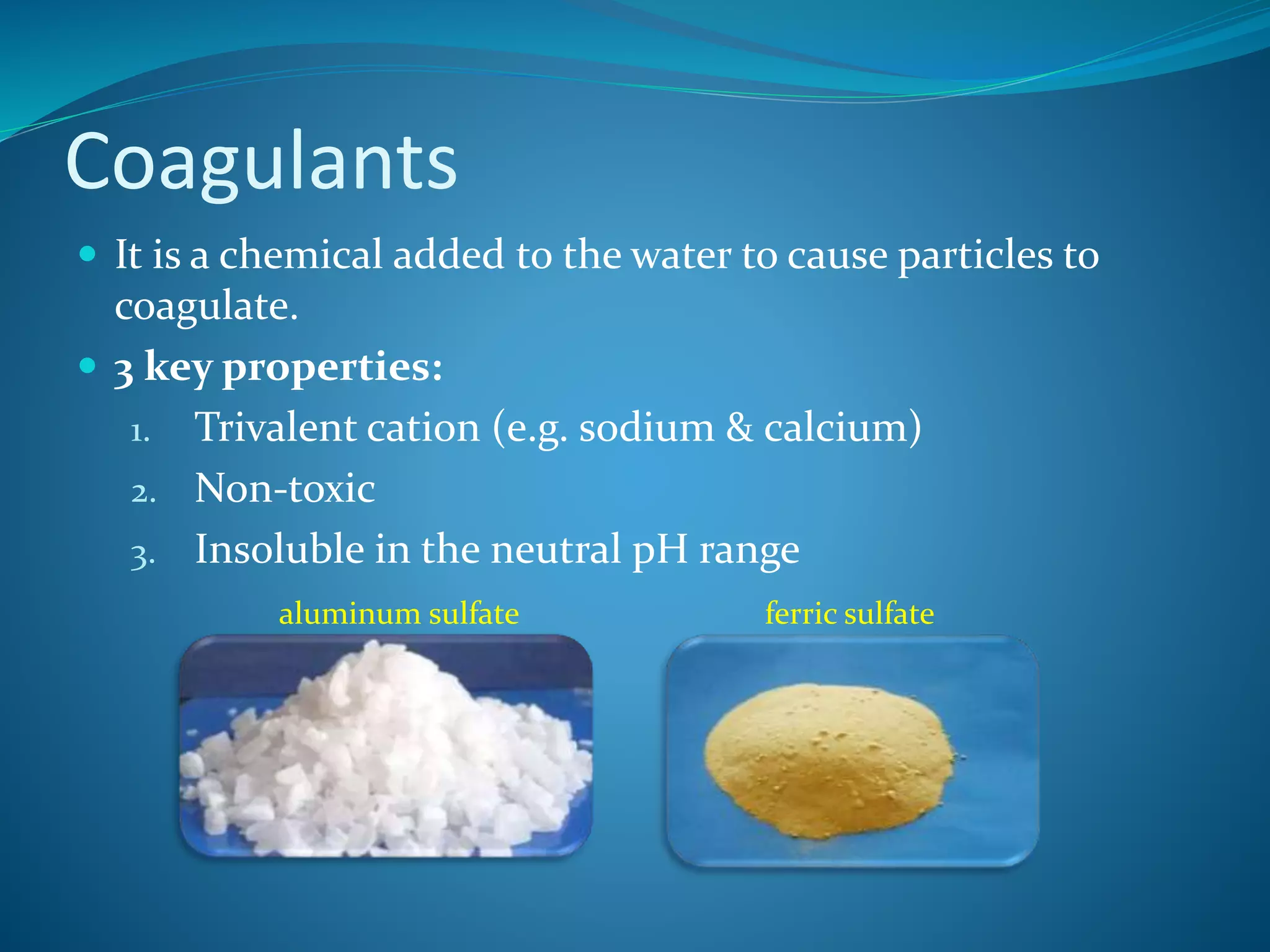
aluminum sulfate ferric sulfate
Aluminum Sulfate
 It can be dry or liquid alum ( Al2(SO4)3· 14H2O ).
 Using alkalinity to neutralize acid;
liquid alum alkalinity
Al2(SO4)3 · 14H2O + 6HCO3 == 2Al(OH) 3(s) + 6CO2 + 14H2O + 3SO
 No-presence of alkalinity;
liquid alum sulfuric acid
Al2(SO4)3 · 14H2O == 2Al(OH) 3(s) + 3H2SO4 + 8H2O
 pH range for alum – 5-8
Iron
 Ferric cations can be supplied by adding ferric sulfate
(Fe2(SO4)3 · 7H2O) or ferric chloride (FeCl3 · 7H2O).
 FeCl3 in the presence of alkalinity;
ferric chloride alkalinity
FeCl3 · 7H2O + 3HCO3 == Fe(OH)3(s) + 3CO2 + 3Cl¯ + 7H2O
 Without alkalinity;
ferric chloride
FeCl3 + 3H2O == Fe(OH)3(s) + 3H⁺ + Cl⁻
 pH range for iron – 4-9
Coagulant Aids
 It add density to slow-settling flocs and add toughness to
the flocs so that they will not break up during the mixing
and settling processes.
 3 basic types:
1. Activated Silica - is sodium silicate that has been
activated with sulfuric acid, alum, CO2, or chlorine.
2. Clay
3. Polymers - are man-made organic compounds made
up of a long chain of smaller molecules. Polymers can
be either cationic, anionic, or nonionic.

Coagulation

  • 1.
    Water Treatment Prepared byGinger A. Amonoy BSCE-3C
  • 2.
    Coagulation  It isused to remove turbidity, color, and bacteria from drinking waters.  The goal of coagulation is to change the surface charge on the particles so they can stick together to form larger particles that will settle by gravity.
  • 3.
    Colloid Stability &Destabilization  Colloid is a substance microscopically dispersed evenly throughout another one.  In natural waters, colloids are stable because the surface charge of these particles are like-charged, and they, therefore, repel one another.
  • 4.
     Coagulation Process The coagulant neutralizes the charge on the surface.  The higher the concentration of the positive ion added, the greater extent to which the surface charge is neutralized.
  • 5.
    Coagulants  It isa chemical added to the water to cause particles to coagulate.  3 key properties: 1. Trivalent cation (e.g. sodium & calcium) 2. Non-toxic 3. Insoluble in the neutral pH range aluminum sulfate ferric sulfate
  • 6.
    Aluminum Sulfate  Itcan be dry or liquid alum ( Al2(SO4)3· 14H2O ).  Using alkalinity to neutralize acid; liquid alum alkalinity Al2(SO4)3 · 14H2O + 6HCO3 == 2Al(OH) 3(s) + 6CO2 + 14H2O + 3SO  No-presence of alkalinity; liquid alum sulfuric acid Al2(SO4)3 · 14H2O == 2Al(OH) 3(s) + 3H2SO4 + 8H2O  pH range for alum – 5-8
  • 7.
    Iron  Ferric cationscan be supplied by adding ferric sulfate (Fe2(SO4)3 · 7H2O) or ferric chloride (FeCl3 · 7H2O).  FeCl3 in the presence of alkalinity; ferric chloride alkalinity FeCl3 · 7H2O + 3HCO3 == Fe(OH)3(s) + 3CO2 + 3Cl¯ + 7H2O  Without alkalinity; ferric chloride FeCl3 + 3H2O == Fe(OH)3(s) + 3H⁺ + Cl⁻  pH range for iron – 4-9
  • 8.
    Coagulant Aids  Itadd density to slow-settling flocs and add toughness to the flocs so that they will not break up during the mixing and settling processes.  3 basic types: 1. Activated Silica - is sodium silicate that has been activated with sulfuric acid, alum, CO2, or chlorine. 2. Clay 3. Polymers - are man-made organic compounds made up of a long chain of smaller molecules. Polymers can be either cationic, anionic, or nonionic.

Editor's Notes

  • #2 reported by: Amonoy, Ginger A. BSCE 3-C