Compiledby:
AsithaGoonewardena
Achieving life fulfillment by effective
Coaching
&
Mentoring
Reference :Coaching & Mentoring HBR
Press 2004
COACHING
It is all about
guiding a person
to achieve job
related goals.
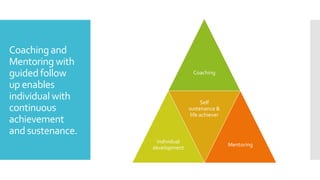
Coaching and
Mentoring with
guided follow
up enables
individualwith
continuous
achievement
and sustenance.
Coaching
Individual
development
Self
sustenance &
life achiever
Mentoring
WhyCoaching ?
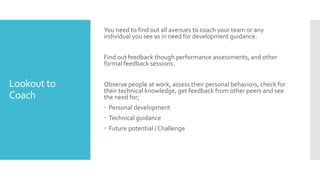
Coaching is necessary as a manager to enhance your capacity and to
perform your job more effectively. It’s about team work. So see when
/where you can coach them.
 Help / guide to improve individual performances
 Improve technical / soft skills of your team members
 Help team members to work smart with better job know how.
 Ensure career progressions of your team members, help them to
grow themselves.
 Create retention culture, where individuals believe in you creating
individual bond, improved job satisfaction and learning
 Nurture achievement oriented working culture
 Help team to believe you as a leader and you supports them to
become leaders as well.
Lookout to
Coach
You need to find out all avenues to coach your team or any
individual you see as in need for development guidance.
Find out feedback though performance assessments, and other
formal feedback sessions.
Observe people at work, assess their personal behaviors, check for
their technical knowledge, get feedback from other peers and see
the need for;
 Personal development
 Technical guidance
 Future potential / Challenge
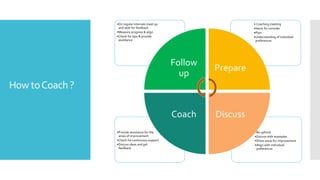
How toCoach ?
•Be upfront
•Discuss with examples
•Show areas for improvement
•Align with individual
preferences
•Provide assistance for the
areas of improvement
•Check for continuous support
•Discuss ideas and get
feedback.
• Coaching meeting
•Items for consider
•Plan
•Understanding of individual
preferences
•On regular intervals meet up
and seek for feedback
•Measure progress & align.
•Check for laps & provide
assistance .
Follow
up
Prepare
DiscussCoach
Mentoring
Is Mentoring differ from
Coaching … ?
Yes.
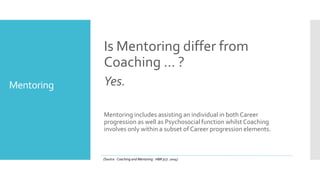
Mentoring includes assisting an individual in both Career
progression as well as Psychosocial function whilst Coaching
involves only within a subset of Career progression elements.
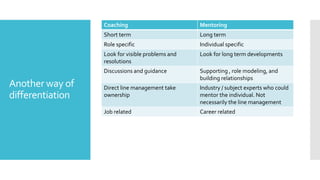
(Source : Coaching and Mentoring : HBR p77. 2004)
Another way of
differentiation
Coaching Mentoring
Short term Long term
Role specific Individual specific
Look for visible problems and
resolutions
Look for long term developments
Discussions and guidance Supporting , role modeling, and
building relationships
Direct line management take
ownership
Industry / subject experts who could
mentor the individual. Not
necessarily the line management
Job related Career related
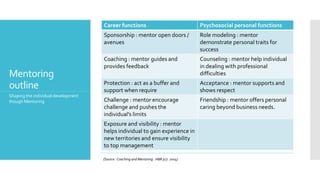
Mentoring
outline
Shaping the individual development
though Mentoring
Career functions Psychosocial personal functions
Sponsorship : mentor open doors /
avenues
Role modeling : mentor
demonstrate personal traits for
success
Coaching : mentor guides and
provides feedback
Counseling : mentor help individual
in dealing with professional
difficulties
Protection : act as a buffer and
support when require
Acceptance : mentor supports and
shows respect
Challenge : mentor encourage
challenge and pushes the
individual’s limits
Friendship : mentor offers personal
caring beyond business needs.
Exposure and visibility : mentor
helps individual to gain experience in
new territories and ensure visibility
to top management
(Source : Coaching and Mentoring : HBR p77. 2004)
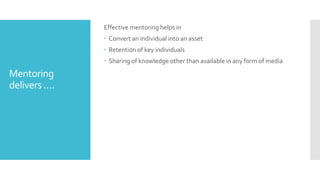
Mentoring
delivers ….
Effective mentoring helps in
 Convert an individual into an asset
 Retention of key individuals
 Sharing of knowledge other than available in any form of media
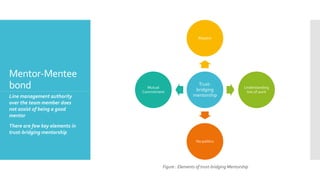
Mentor-Mentee
bond
Figure : Elements of trust-bridging Mentorship
Line management authority
over the team member does
not assist of being a good
mentor
There are few key elements in
trust-bridging mentorship
Trust-
bridging
mentorship
Respect
Understanding
line of work
No politics
Mutual
Commitment
Becoming an
effective
Mentor
Key elements portrayed by effective mentors are;
 Setting standards : You need to set high achievable standards
 Availability : Mentor is always available for mentee for any
support. Mentor is ready and prepared to invest time and effort in
mentees developments
 Learning from mentors experience: Mentor shares his
experiences to mentee to learn and perhaps mentor helps to
mentee to experience the same with similar career roles
 Mentor state: Mentor is a role model and respected by the
employees
 Reputed IPR skills : Mentor is reputed for good interpersonal
relationship and known for development of people
“good mentors walk the talk”
Coaching &
Mentoring way
forward
There are many avenues that enables effective coaching and
mentoring to go beyond the line manager’s preview and
organizational scope. Individual has options to choose the match-
making individual(s) as Coach/Mentor their social reputation and
respect
 There are many social networks that host subject matter experts
to gain informal yet multi-dimensional assistance for individual to
follow.
 Expert forums enabling mentoring and coaching across other
businesses enabling higher synergy and collaboration
Highly empowered social networks
enables and open doors for
countless number of options
coaching and mentoring.
Expected that diverse learning and
view points stimulate exponential
growth of individuals life
expectations.

Achieving life performance through effective coaching & mentoring

  • 1.
    Compiledby: AsithaGoonewardena Achieving life fulfillmentby effective Coaching & Mentoring Reference :Coaching & Mentoring HBR Press 2004
  • 2.
    COACHING It is allabout guiding a person to achieve job related goals.
  • 3.
    Coaching and Mentoring with guidedfollow up enables individualwith continuous achievement and sustenance. Coaching Individual development Self sustenance & life achiever Mentoring
  • 4.
    WhyCoaching ? Coaching isnecessary as a manager to enhance your capacity and to perform your job more effectively. It’s about team work. So see when /where you can coach them.  Help / guide to improve individual performances  Improve technical / soft skills of your team members  Help team members to work smart with better job know how.  Ensure career progressions of your team members, help them to grow themselves.  Create retention culture, where individuals believe in you creating individual bond, improved job satisfaction and learning  Nurture achievement oriented working culture  Help team to believe you as a leader and you supports them to become leaders as well.
  • 5.
    Lookout to Coach You needto find out all avenues to coach your team or any individual you see as in need for development guidance. Find out feedback though performance assessments, and other formal feedback sessions. Observe people at work, assess their personal behaviors, check for their technical knowledge, get feedback from other peers and see the need for;  Personal development  Technical guidance  Future potential / Challenge
  • 6.
    How toCoach ? •Beupfront •Discuss with examples •Show areas for improvement •Align with individual preferences •Provide assistance for the areas of improvement •Check for continuous support •Discuss ideas and get feedback. • Coaching meeting •Items for consider •Plan •Understanding of individual preferences •On regular intervals meet up and seek for feedback •Measure progress & align. •Check for laps & provide assistance . Follow up Prepare DiscussCoach
  • 7.
    Mentoring Is Mentoring differfrom Coaching … ? Yes. Mentoring includes assisting an individual in both Career progression as well as Psychosocial function whilst Coaching involves only within a subset of Career progression elements. (Source : Coaching and Mentoring : HBR p77. 2004)
  • 8.
    Another way of differentiation CoachingMentoring Short term Long term Role specific Individual specific Look for visible problems and resolutions Look for long term developments Discussions and guidance Supporting , role modeling, and building relationships Direct line management take ownership Industry / subject experts who could mentor the individual. Not necessarily the line management Job related Career related
  • 9.
    Mentoring outline Shaping the individualdevelopment though Mentoring Career functions Psychosocial personal functions Sponsorship : mentor open doors / avenues Role modeling : mentor demonstrate personal traits for success Coaching : mentor guides and provides feedback Counseling : mentor help individual in dealing with professional difficulties Protection : act as a buffer and support when require Acceptance : mentor supports and shows respect Challenge : mentor encourage challenge and pushes the individual’s limits Friendship : mentor offers personal caring beyond business needs. Exposure and visibility : mentor helps individual to gain experience in new territories and ensure visibility to top management (Source : Coaching and Mentoring : HBR p77. 2004)
  • 10.
    Mentoring delivers …. Effective mentoringhelps in  Convert an individual into an asset  Retention of key individuals  Sharing of knowledge other than available in any form of media
  • 11.
    Mentor-Mentee bond Figure : Elementsof trust-bridging Mentorship Line management authority over the team member does not assist of being a good mentor There are few key elements in trust-bridging mentorship Trust- bridging mentorship Respect Understanding line of work No politics Mutual Commitment
  • 12.
    Becoming an effective Mentor Key elementsportrayed by effective mentors are;  Setting standards : You need to set high achievable standards  Availability : Mentor is always available for mentee for any support. Mentor is ready and prepared to invest time and effort in mentees developments  Learning from mentors experience: Mentor shares his experiences to mentee to learn and perhaps mentor helps to mentee to experience the same with similar career roles  Mentor state: Mentor is a role model and respected by the employees  Reputed IPR skills : Mentor is reputed for good interpersonal relationship and known for development of people “good mentors walk the talk”
  • 13.
    Coaching & Mentoring way forward Thereare many avenues that enables effective coaching and mentoring to go beyond the line manager’s preview and organizational scope. Individual has options to choose the match- making individual(s) as Coach/Mentor their social reputation and respect  There are many social networks that host subject matter experts to gain informal yet multi-dimensional assistance for individual to follow.  Expert forums enabling mentoring and coaching across other businesses enabling higher synergy and collaboration Highly empowered social networks enables and open doors for countless number of options coaching and mentoring. Expected that diverse learning and view points stimulate exponential growth of individuals life expectations.