



Sage NA
Coaching for
Optimal
PerformanceMargieKensil,FirmSolutions,LLC
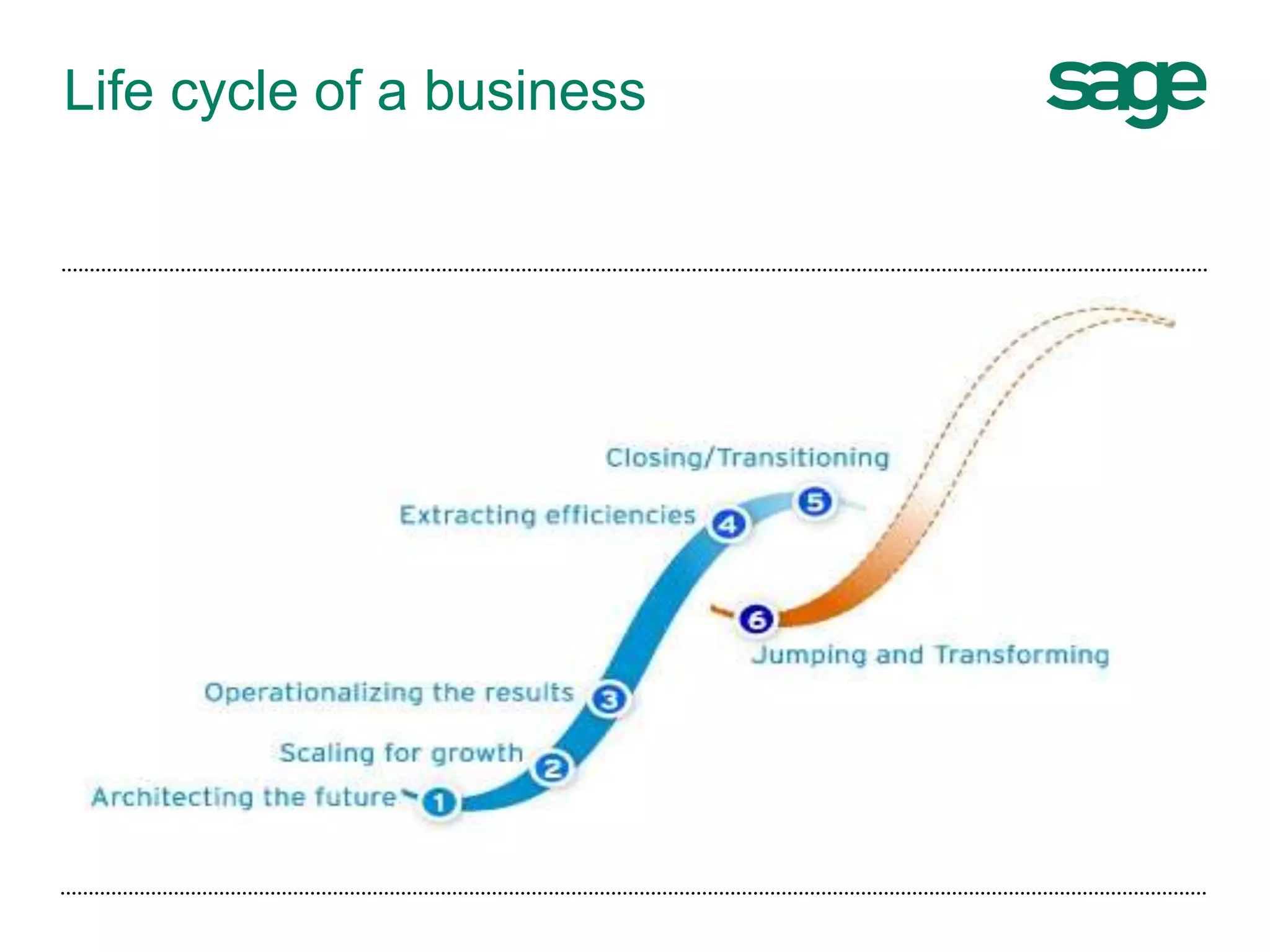
Life cycle of a business
Session purposes
To reinforce, remind, learn:
• A coaching model/framework for driving dialogue, colleague development, and
organizational change
To ignite Sage’s vision in every colleague:
• Heighten colleague engagement
• Foster greater motivation, commitment, and 100% discretionary effort
Agenda
1. The case for change
2. Driving excellence in everything we do
3. What is coaching?
4. What do I coach to?
The performance pyramid
5. How do I coach?
The coaching model
6. The triumvirate of coaching skills
Creating dialogue
Balancing feedback
Planning for action
7. Handling resistance
8. Practicing for improved execution
9. Wrap-up and commitments
Introductions
Why am I here?
What’s important to me/what do I want to accomplish here at Sage?
What do I want to accomplish during our time together?
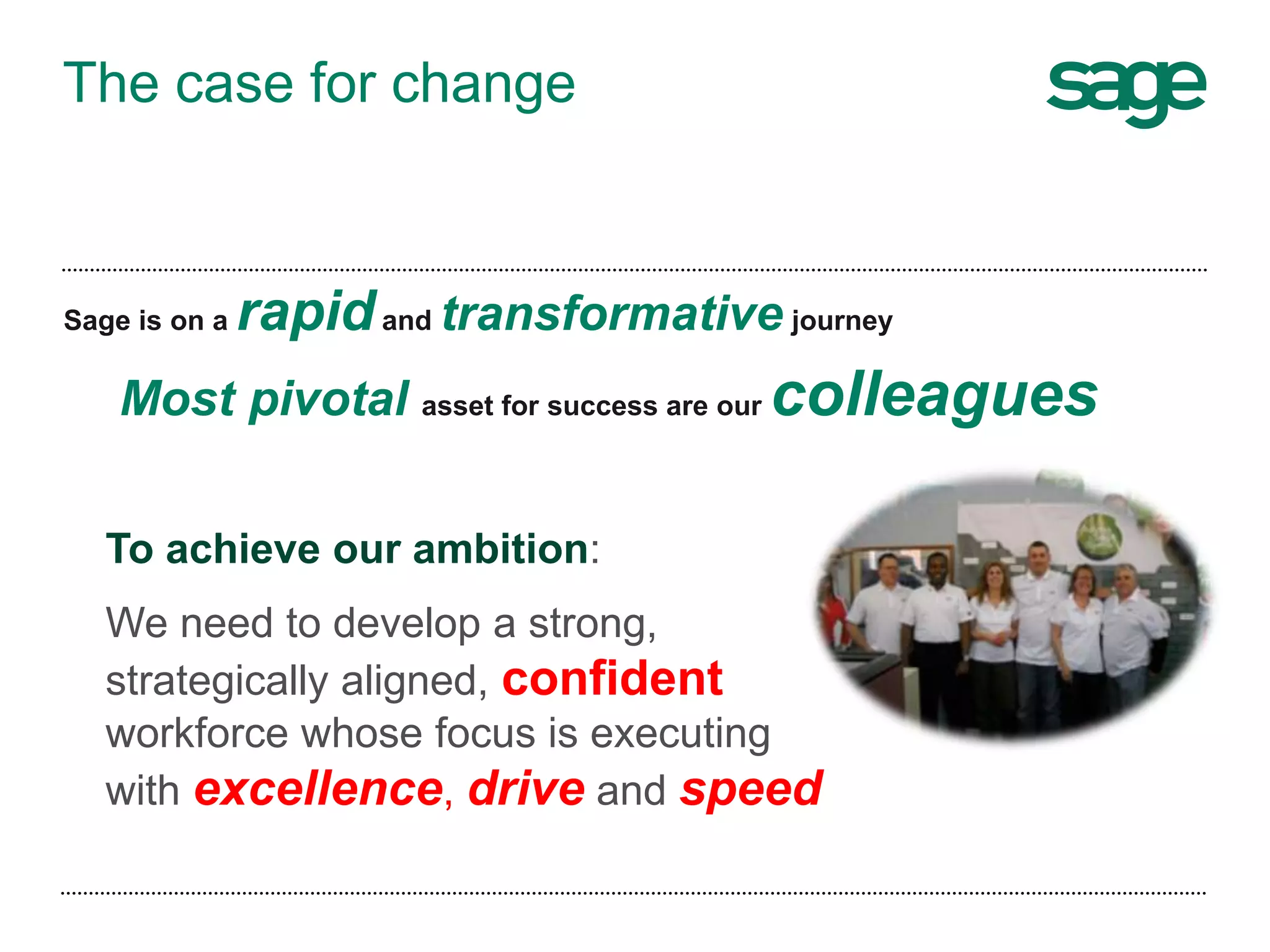
The case for change
Sage is on a rapidand transformative journey
Most pivotal asset for success are our colleagues
To achieve our ambition:
We need to develop a strong,
strategically aligned, confident
workforce whose focus is executing
with excellence, drive and speed
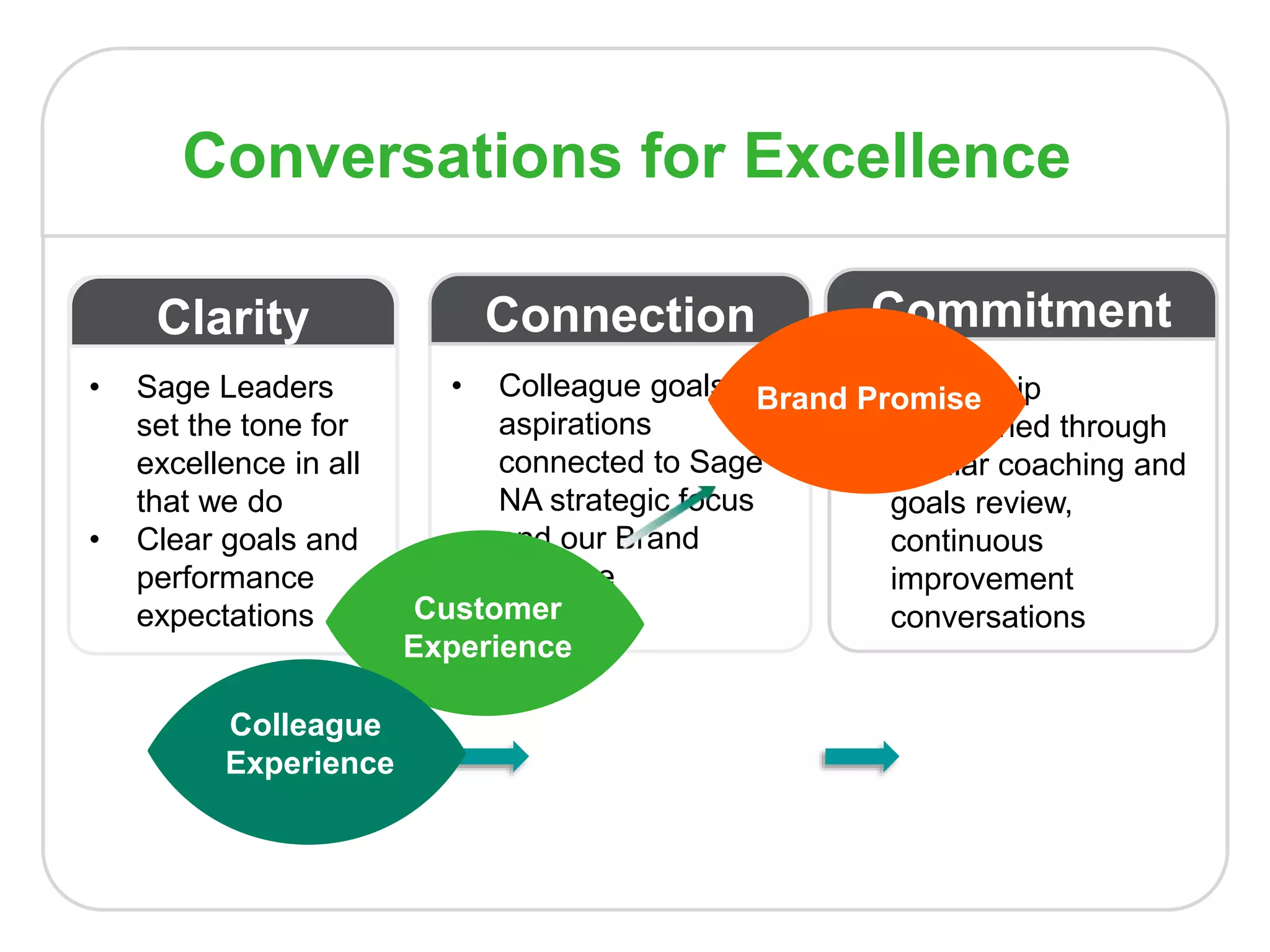
• Sage Leaders
set the tone for
excellence in all
that we do
• Clear goals and
performance
expectations
Clarity
• Ownership
established through
regular coaching and
goals review,
continuous
improvement
conversations
Commitment
• Colleague goals and
aspirations
connected to Sage
NA strategic focus
and our Brand
Promise
Connection
Brand Promise
Conversations for Excellence
Customer
Experience
Colleague
Experience
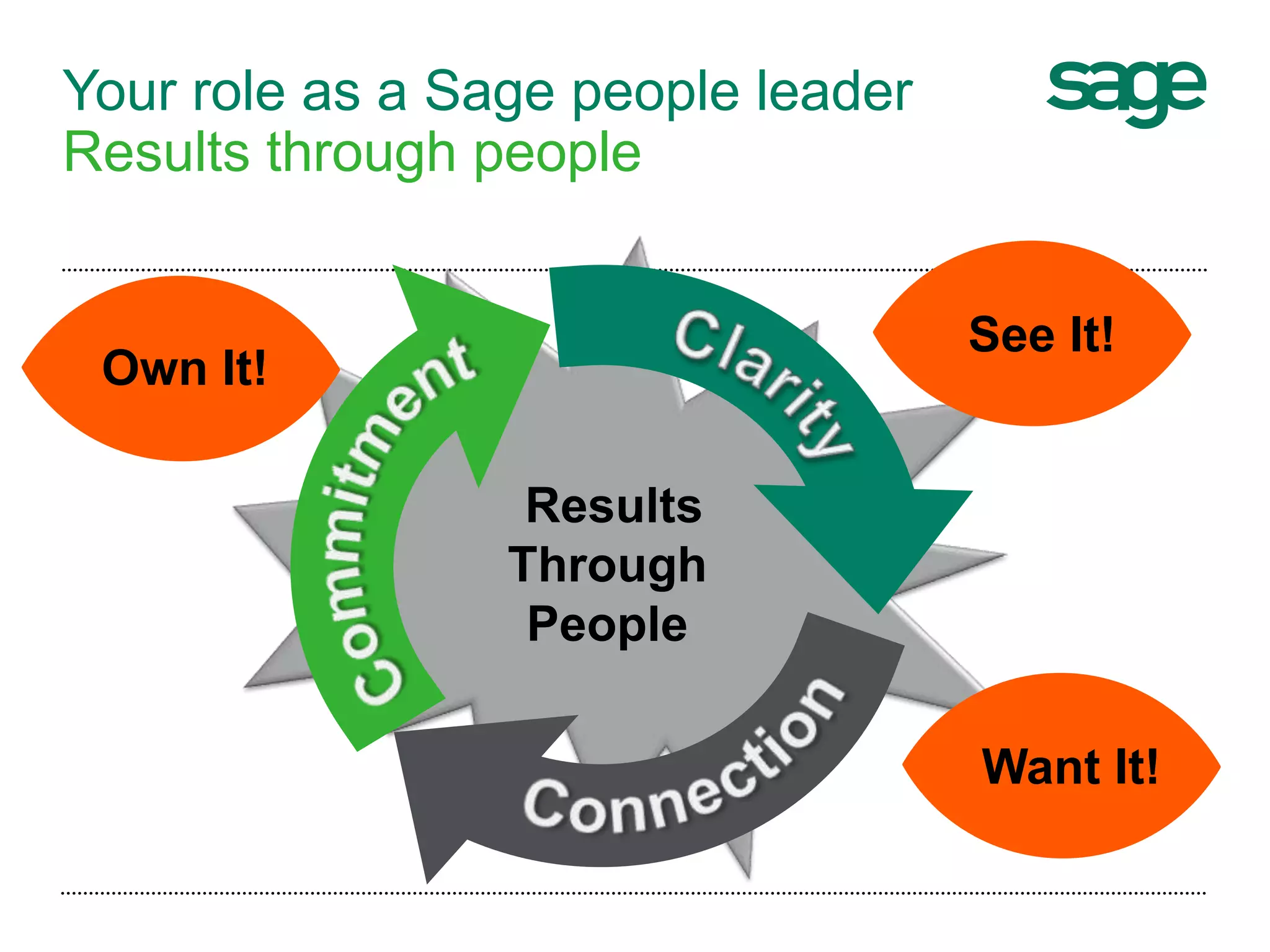
Results
Through
People
Your role as a Sage people leader
Results through people
See It!
Want It!
Own It!
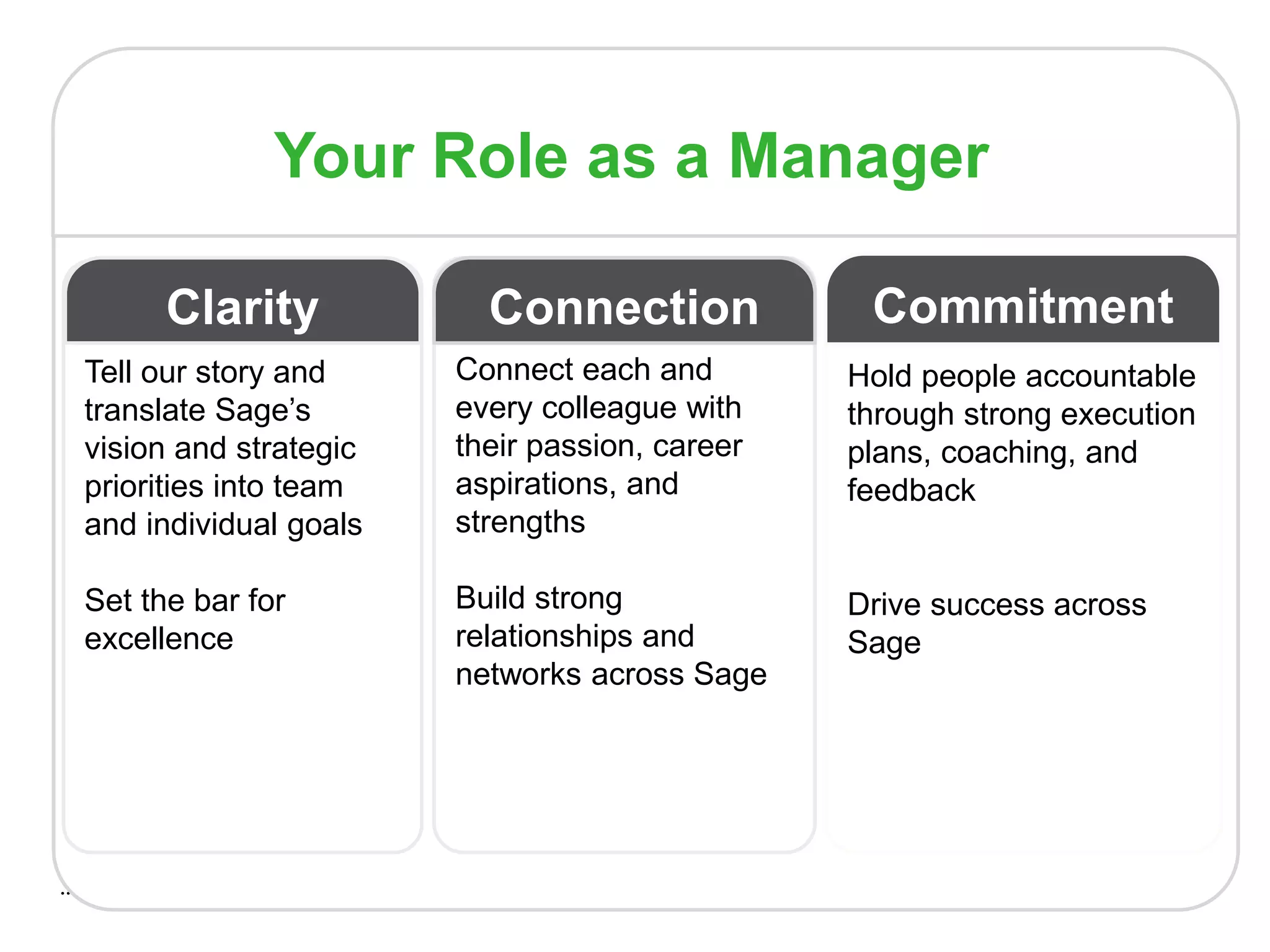
Tell our story and
translate Sage’s
vision and strategic
priorities into team
and individual goals
Set the bar for
excellence
Clarity
Hold people accountable
through strong execution
plans, coaching, and
feedback
Drive success across
Sage
Commitment
Connect each and
every colleague with
their passion, career
aspirations, and
strengths
Build strong
relationships and
networks across Sage
Connection
Your Role as a Manager
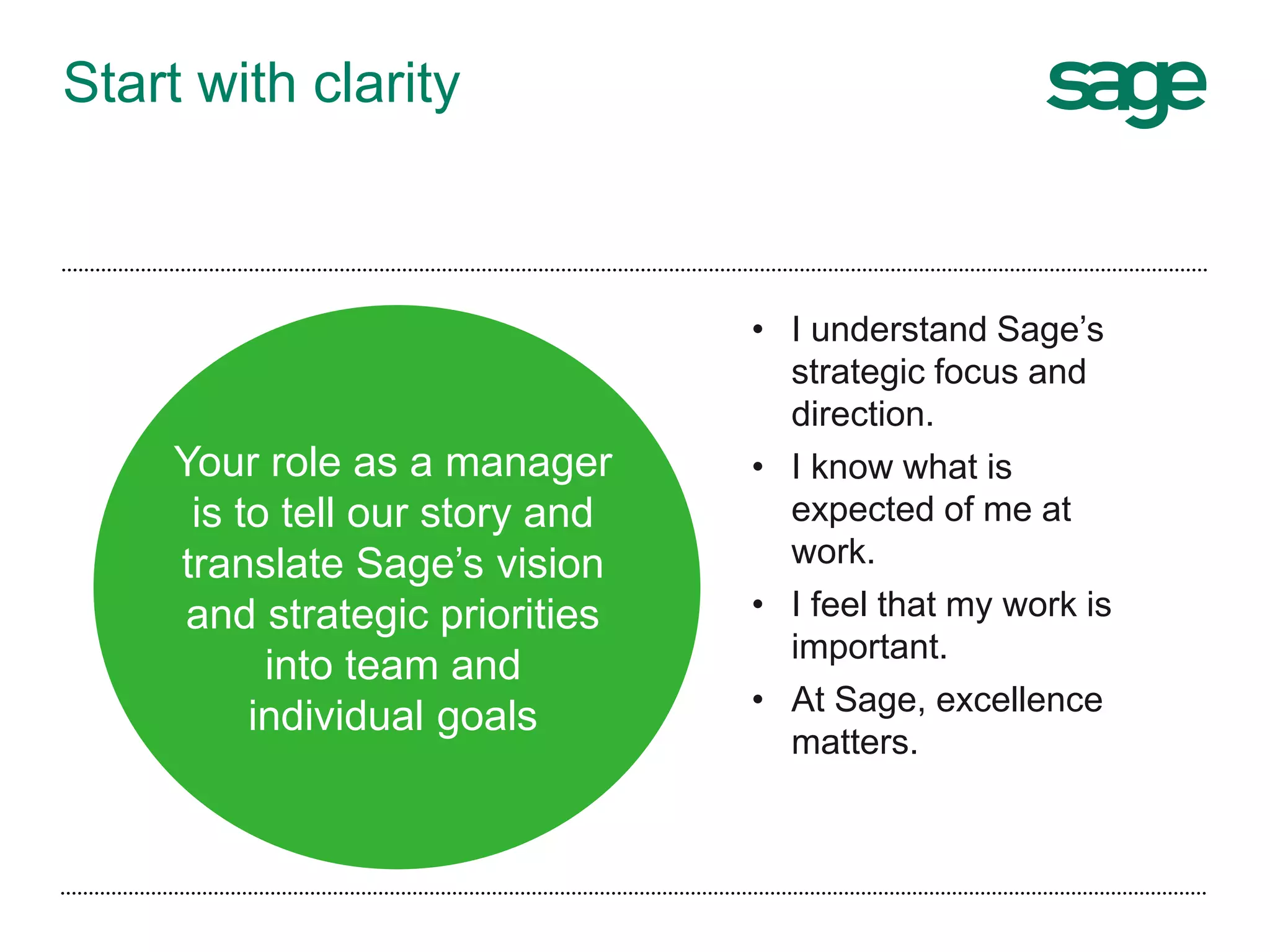
Start with clarity
• I understand Sage’s
strategic focus and
direction.
• I know what is
expected of me at
work.
• I feel that my work is
important.
• At Sage, excellence
matters.
Your role as a manager
is to tell our story and
translate Sage’s vision
and strategic priorities
into team and
individual goals
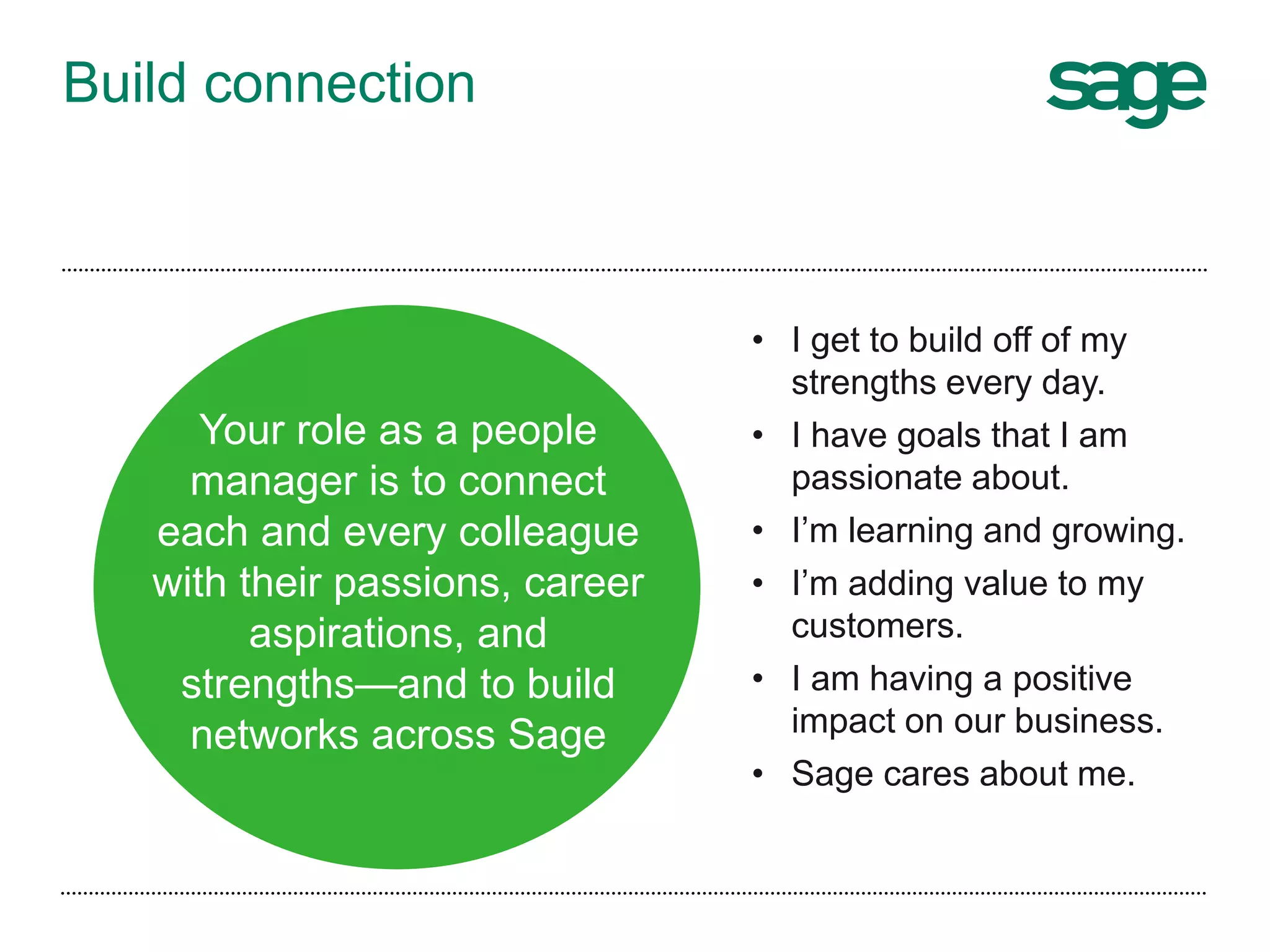
Build connection
• I get to build off of my
strengths every day.
• I have goals that I am
passionate about.
• I’m learning and growing.
• I’m adding value to my
customers.
• I am having a positive
impact on our business.
• Sage cares about me.
Your role as a people
manager is to connect
each and every colleague
with their passions, career
aspirations, and
strengths—and to build
networks across Sage
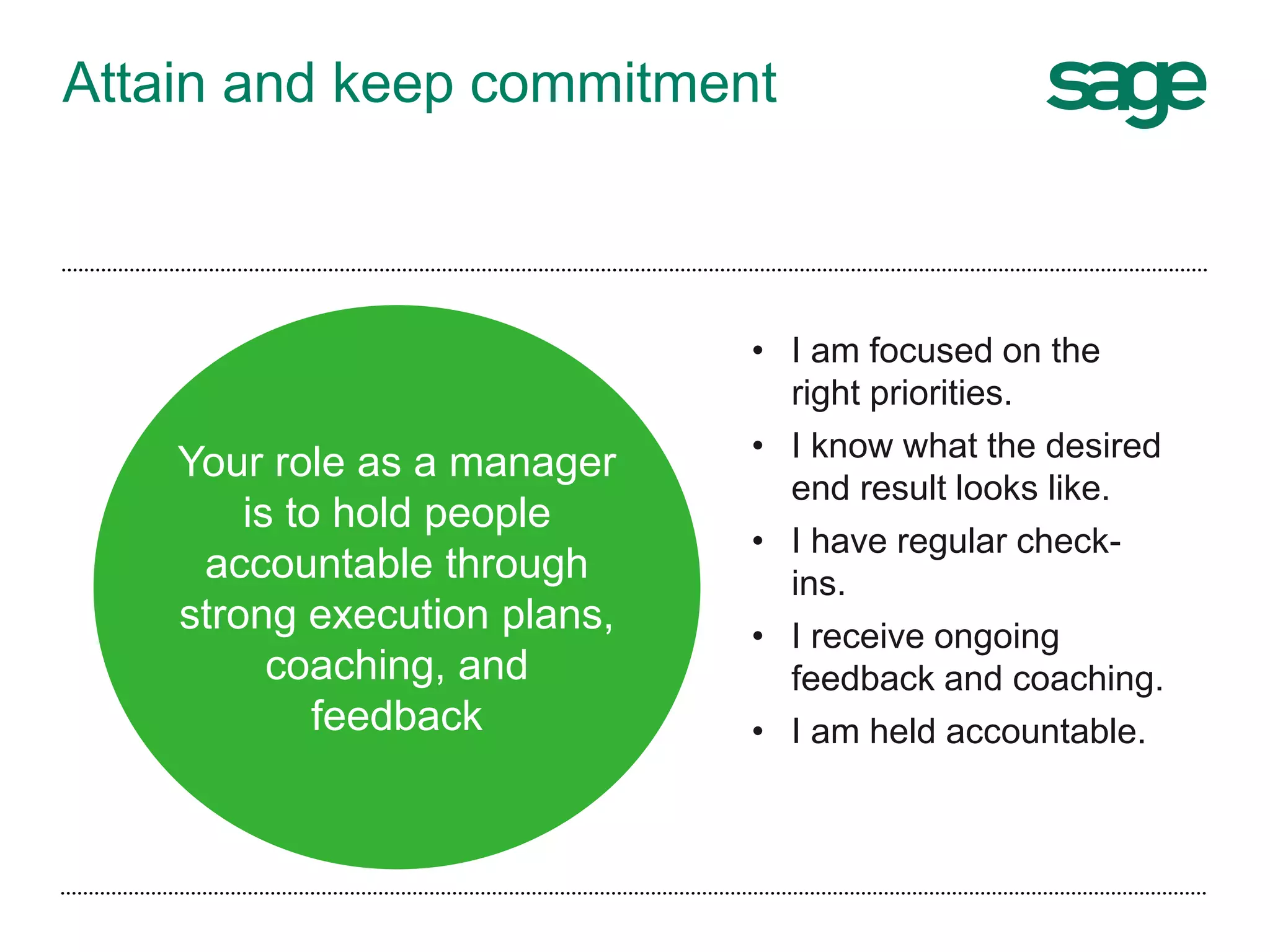
Attain and keep commitment
• I am focused on the
right priorities.
• I know what the desired
end result looks like.
• I have regular check-
ins.
• I receive ongoing
feedback and coaching.
• I am held accountable.
Your role as a manager
is to hold people
accountable through
strong execution plans,
coaching, and
feedback
13
Development through
coaching
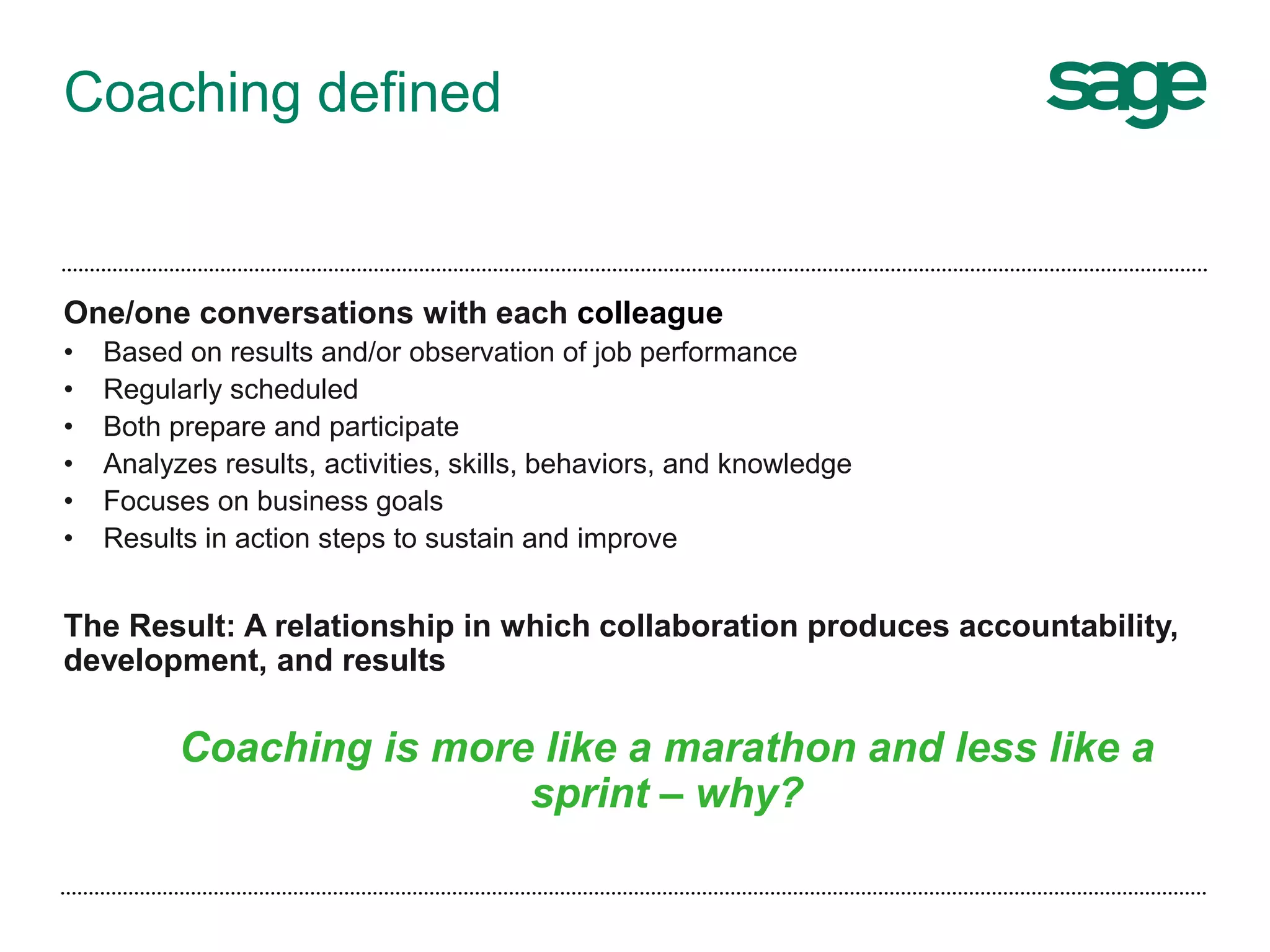
Coaching defined
One/one conversations with each colleague
• Based on results and/or observation of job performance
• Regularly scheduled
• Both prepare and participate
• Analyzes results, activities, skills, behaviors, and knowledge
• Focuses on business goals
• Results in action steps to sustain and improve
The Result: A relationship in which collaboration produces accountability,
development, and results
Coaching is more like a marathon and less like a
sprint – why?
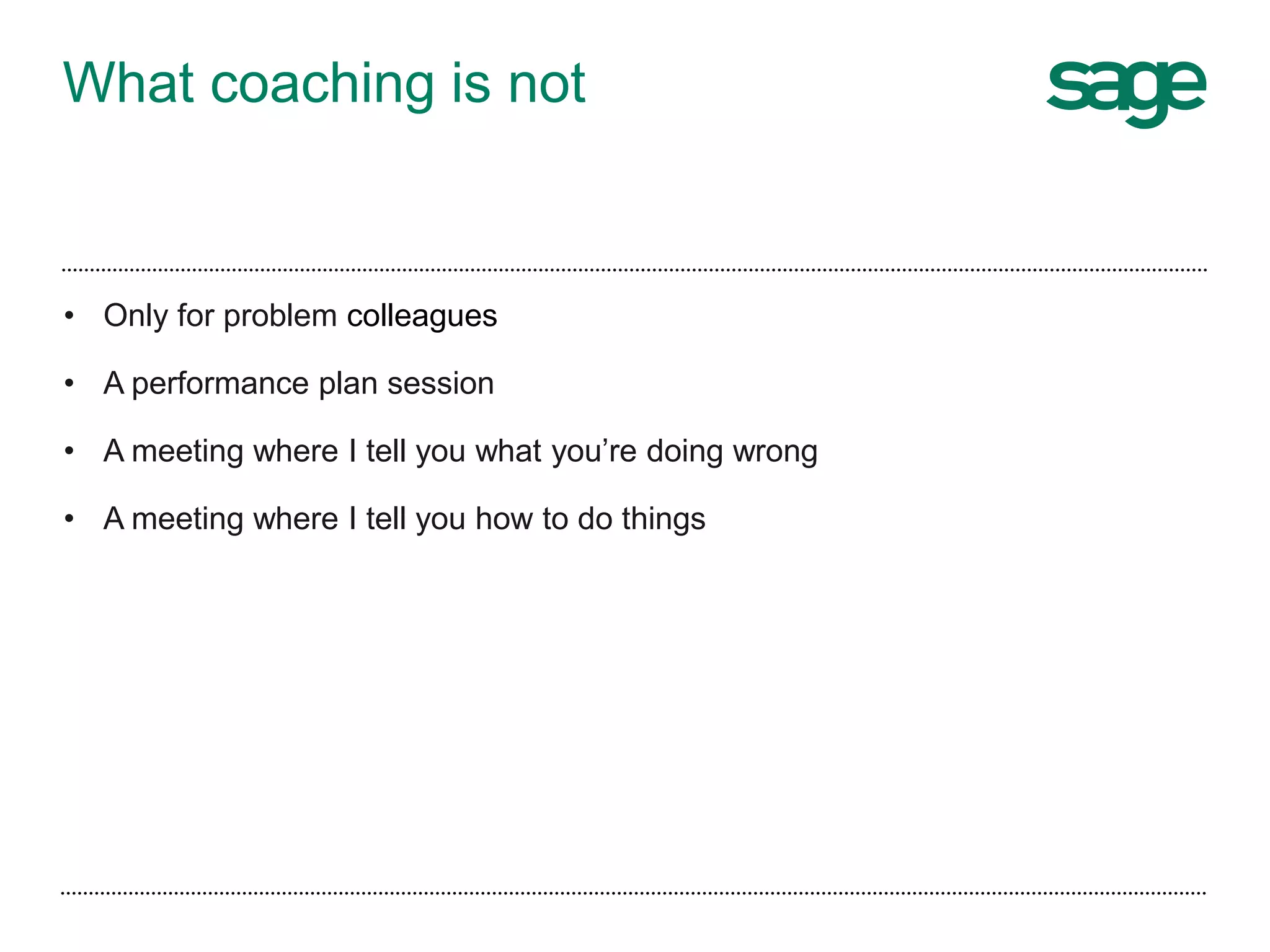
What coaching is not
• Only for problem colleagues
• A performance plan session
• A meeting where I tell you what you’re doing wrong
• A meeting where I tell you how to do things
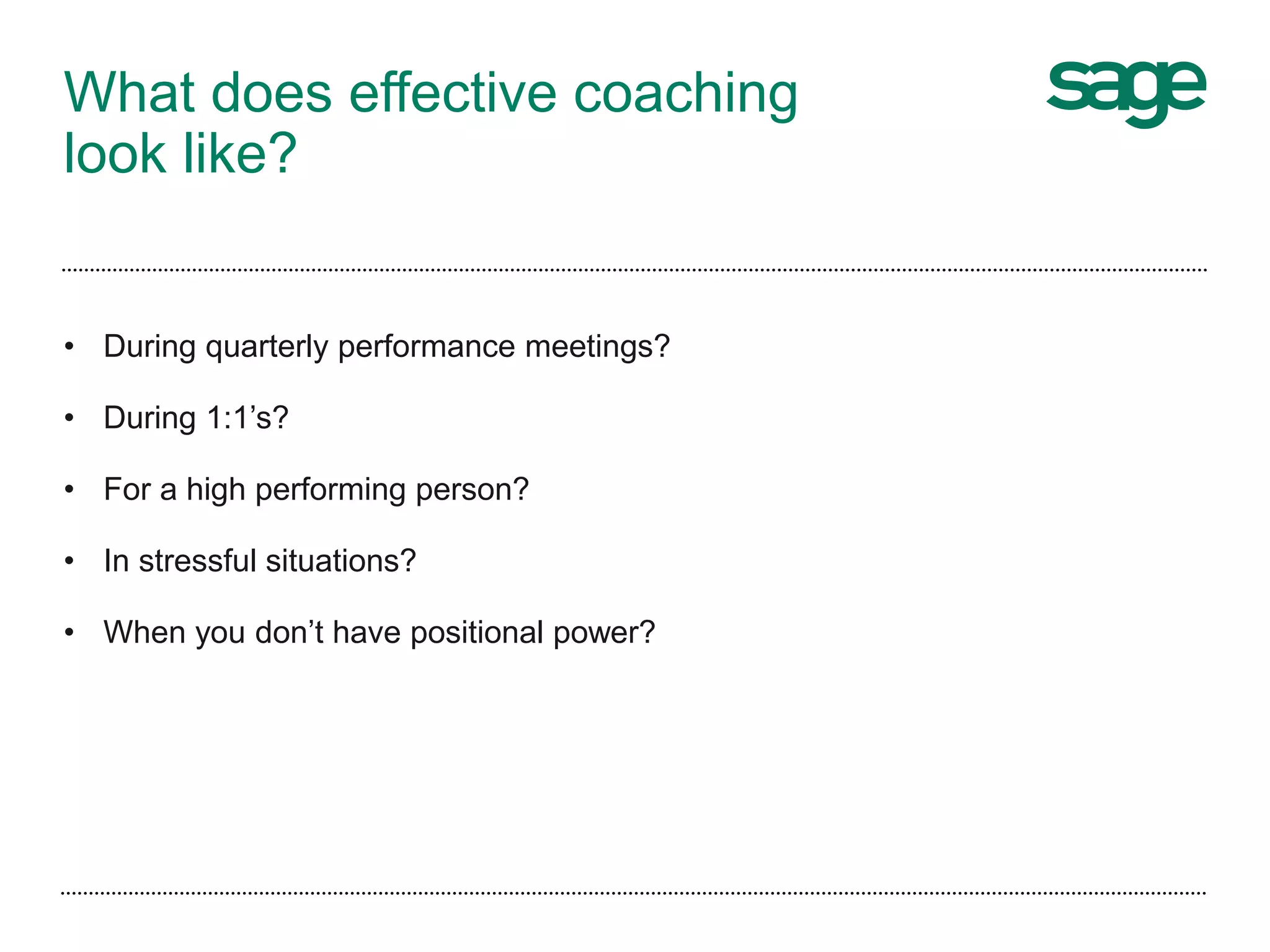
What does effective coaching
look like?
• During quarterly performance meetings?
• During 1:1’s?
• For a high performing person?
• In stressful situations?
• When you don’t have positional power?
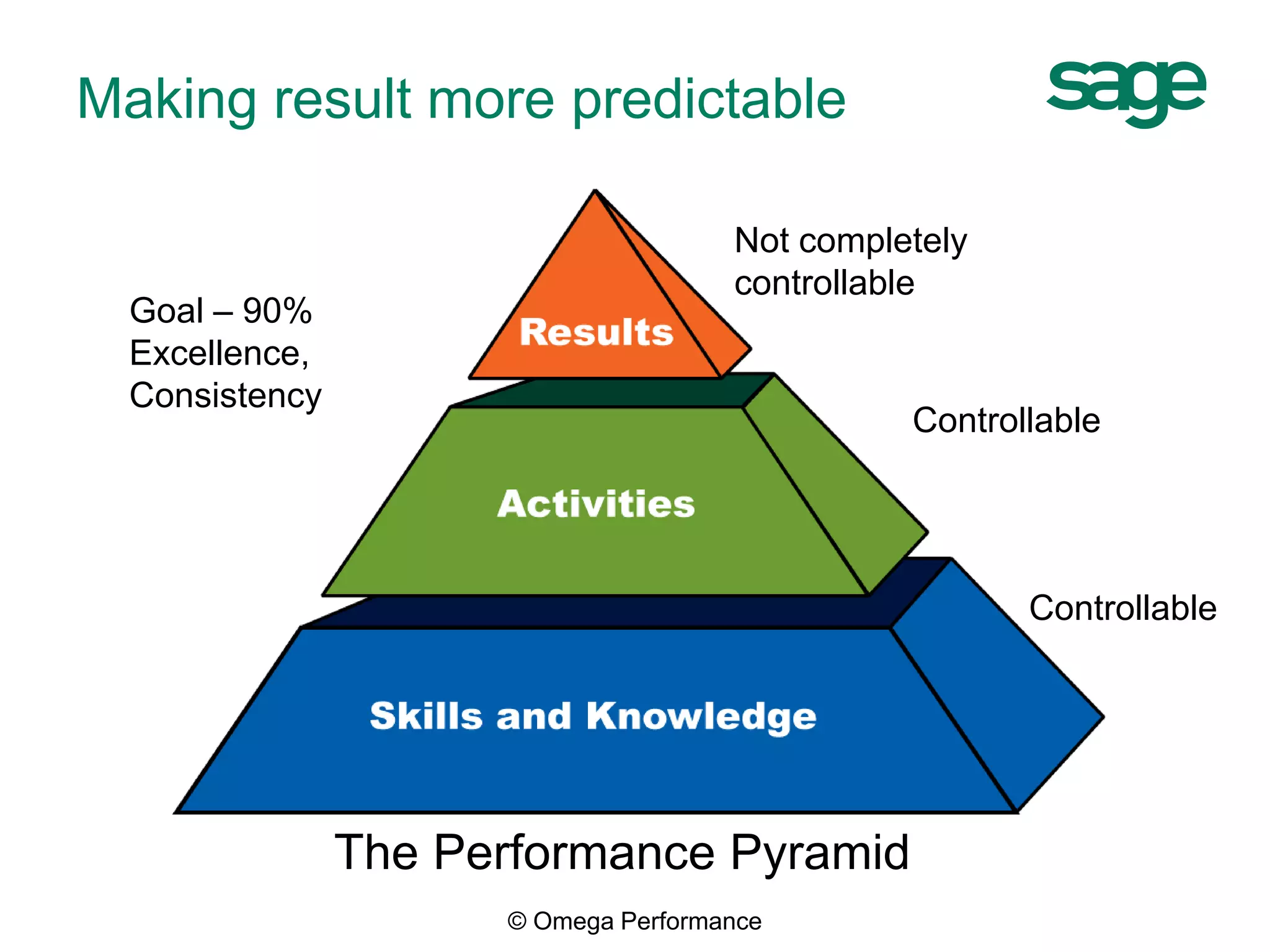
Goal – 90%
Excellence,
Consistency
The Performance Pyramid
Not completely
controllable
Controllable
Controllable
© Omega Performance
Making result more predictable
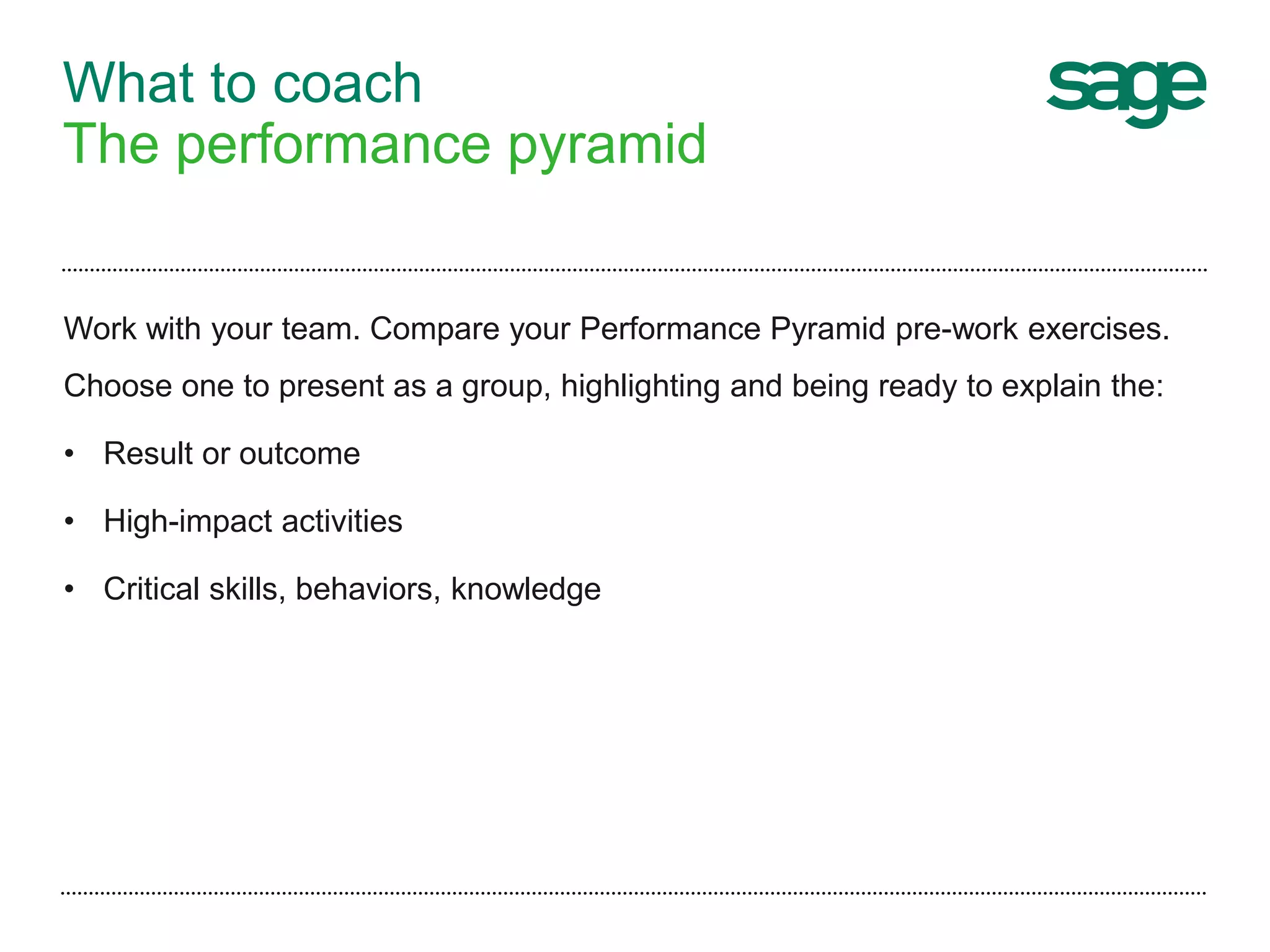
What to coach
The performance pyramid
Work with your team. Compare your Performance Pyramid pre-work exercises.
Choose one to present as a group, highlighting and being ready to explain the:
• Result or outcome
• High-impact activities
• Critical skills, behaviors, knowledge
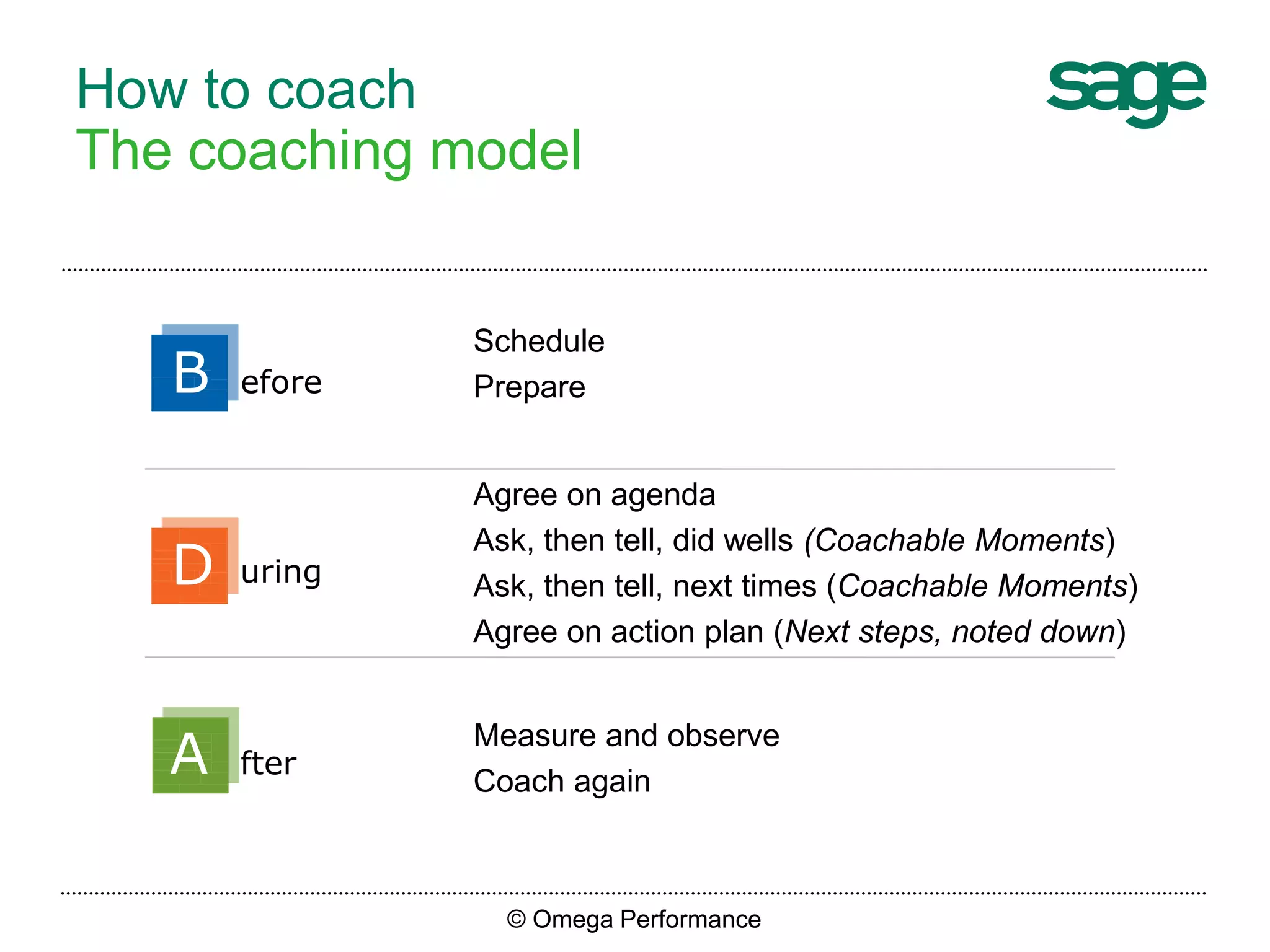
Measure and observe
Coach again
Agree on agenda
Ask, then tell, did wells (Coachable Moments)
Ask, then tell, next times (Coachable Moments)
Agree on action plan (Next steps, noted down)
Schedule
PrepareB efore
D uring
A fter
© Omega Performance
How to coach
The coaching model
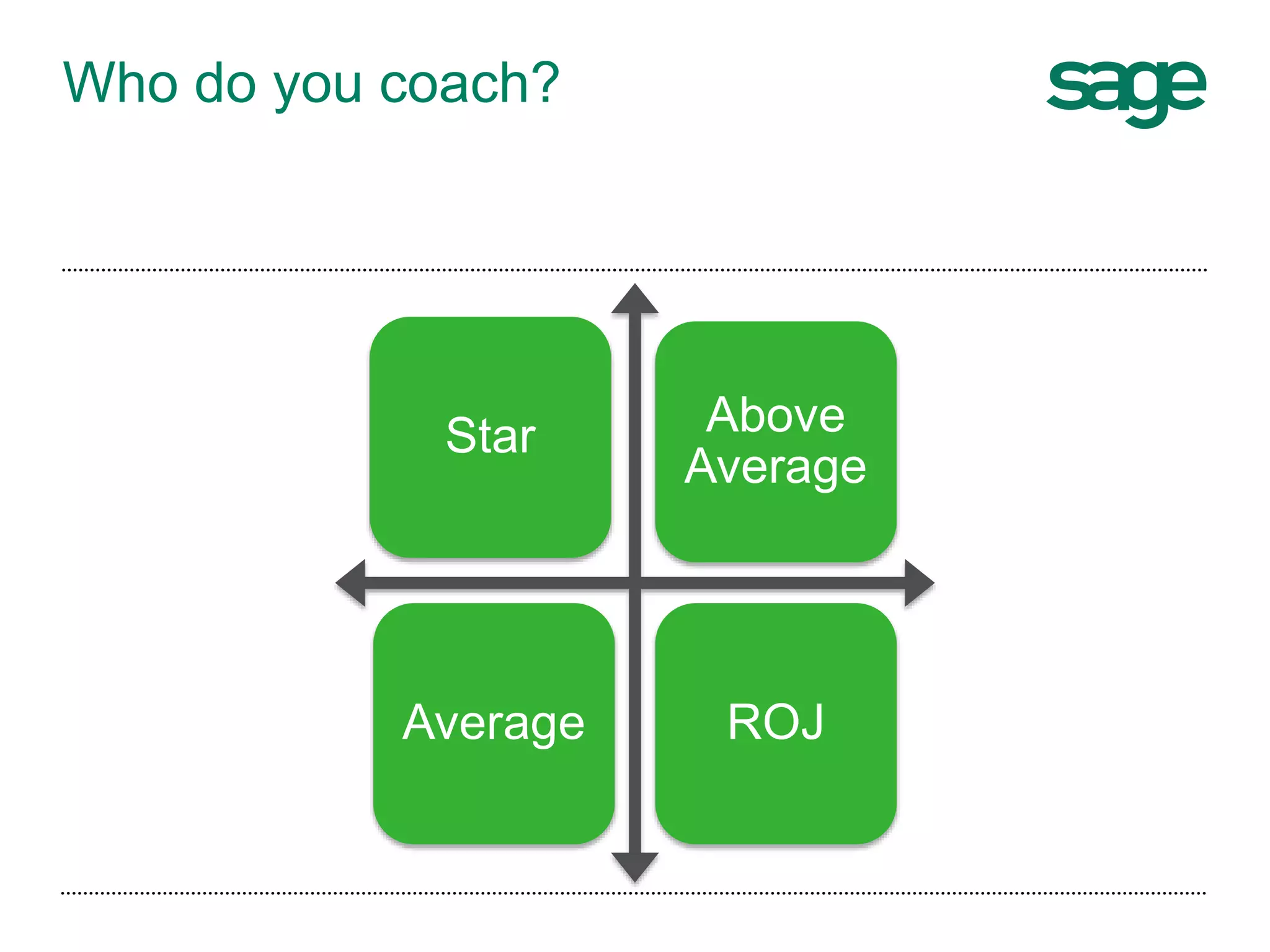
Who do you coach?
Star Above
Average
Average ROJ
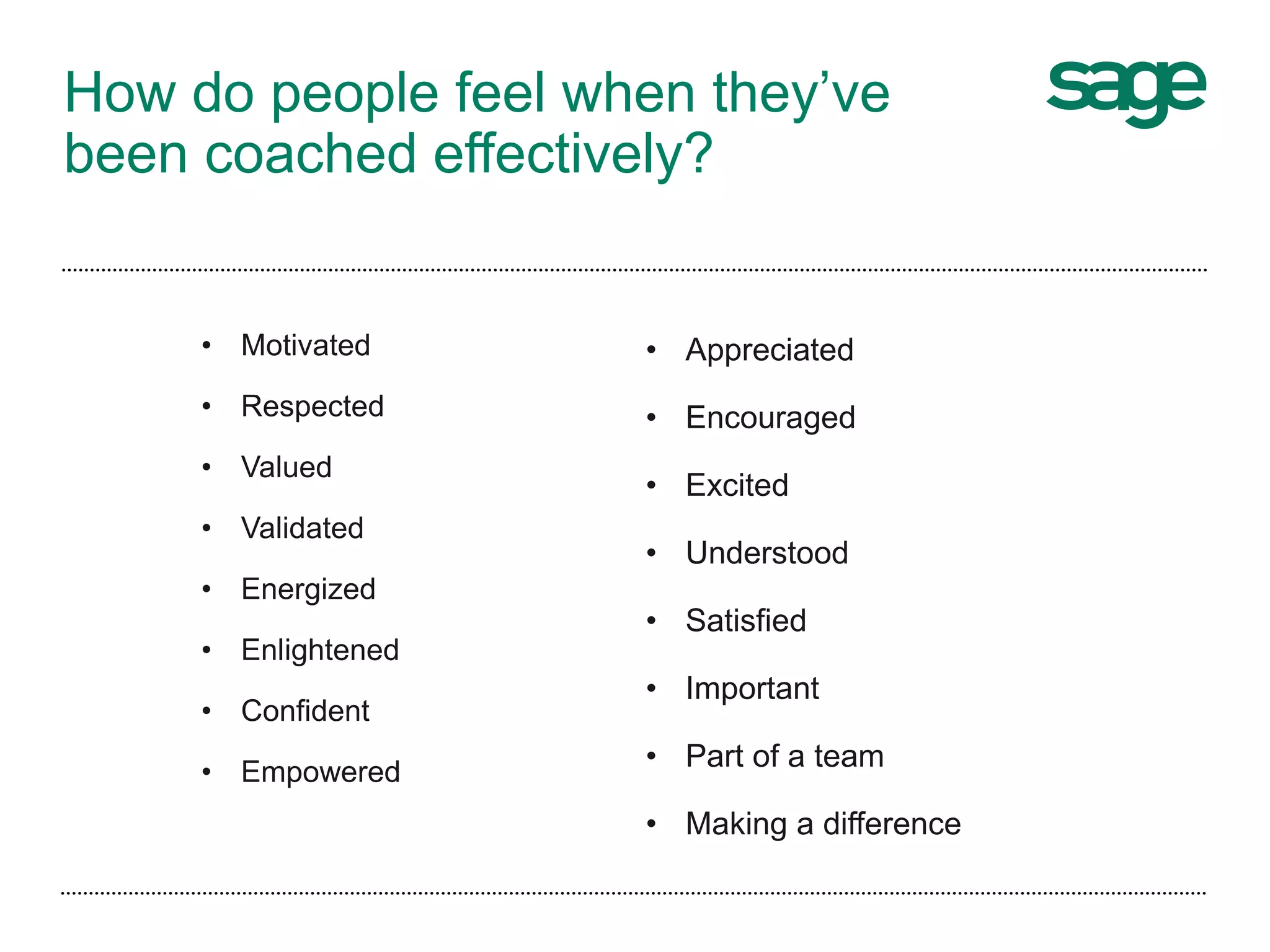
How do people feel when they’ve
been coached effectively?
• Motivated
• Respected
• Valued
• Validated
• Energized
• Enlightened
• Confident
• Empowered
• Appreciated
• Encouraged
• Excited
• Understood
• Satisfied
• Important
• Part of a team
• Making a difference
Coaching big rocks
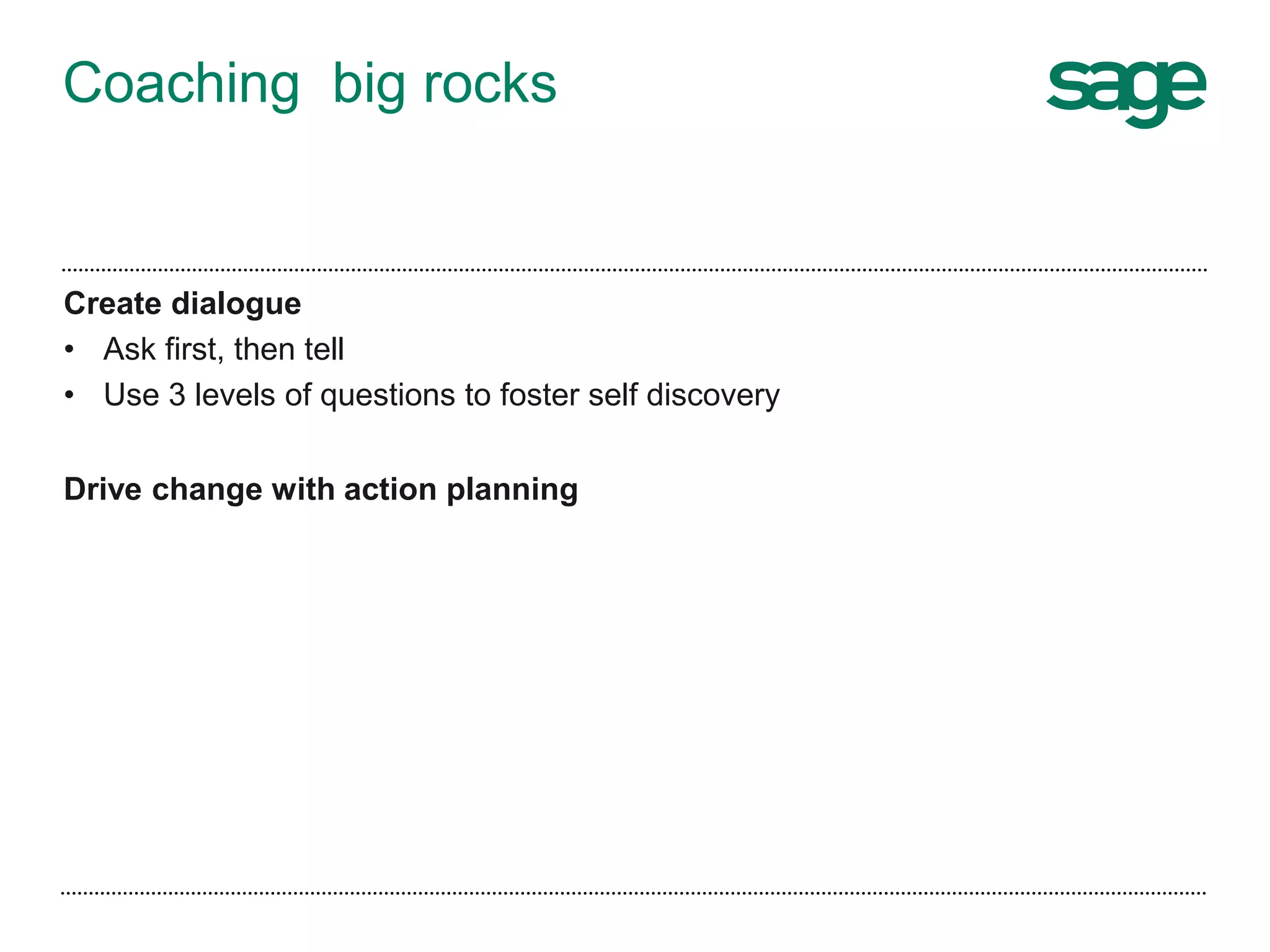
Create dialogue
• Ask first, then tell
• Use 3 levels of questions to foster self discovery
Drive change with action planning
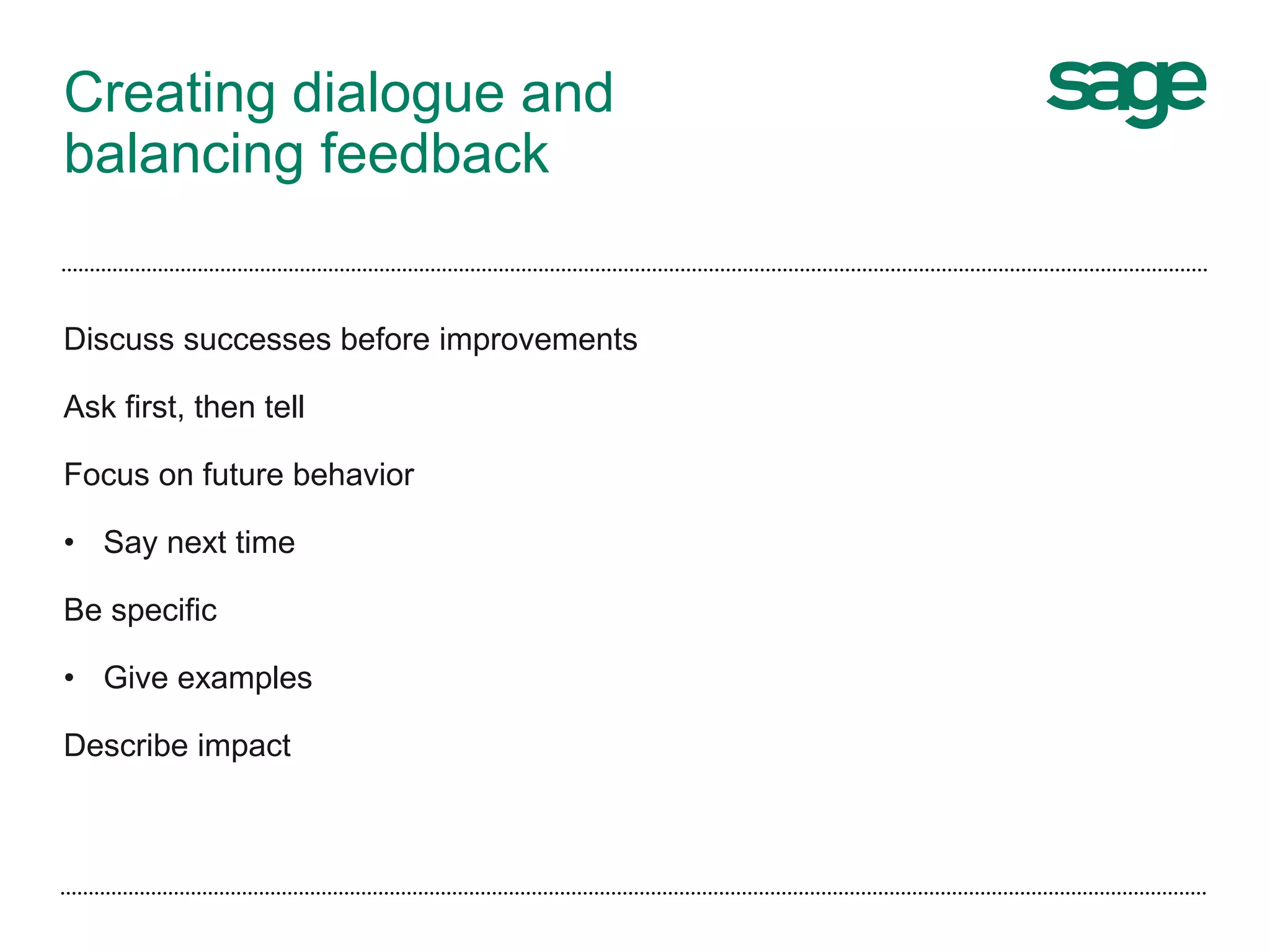
Creating dialogue and
balancing feedback
Discuss successes before improvements
Ask first, then tell
Focus on future behavior
• Say next time
Be specific
• Give examples
Describe impact
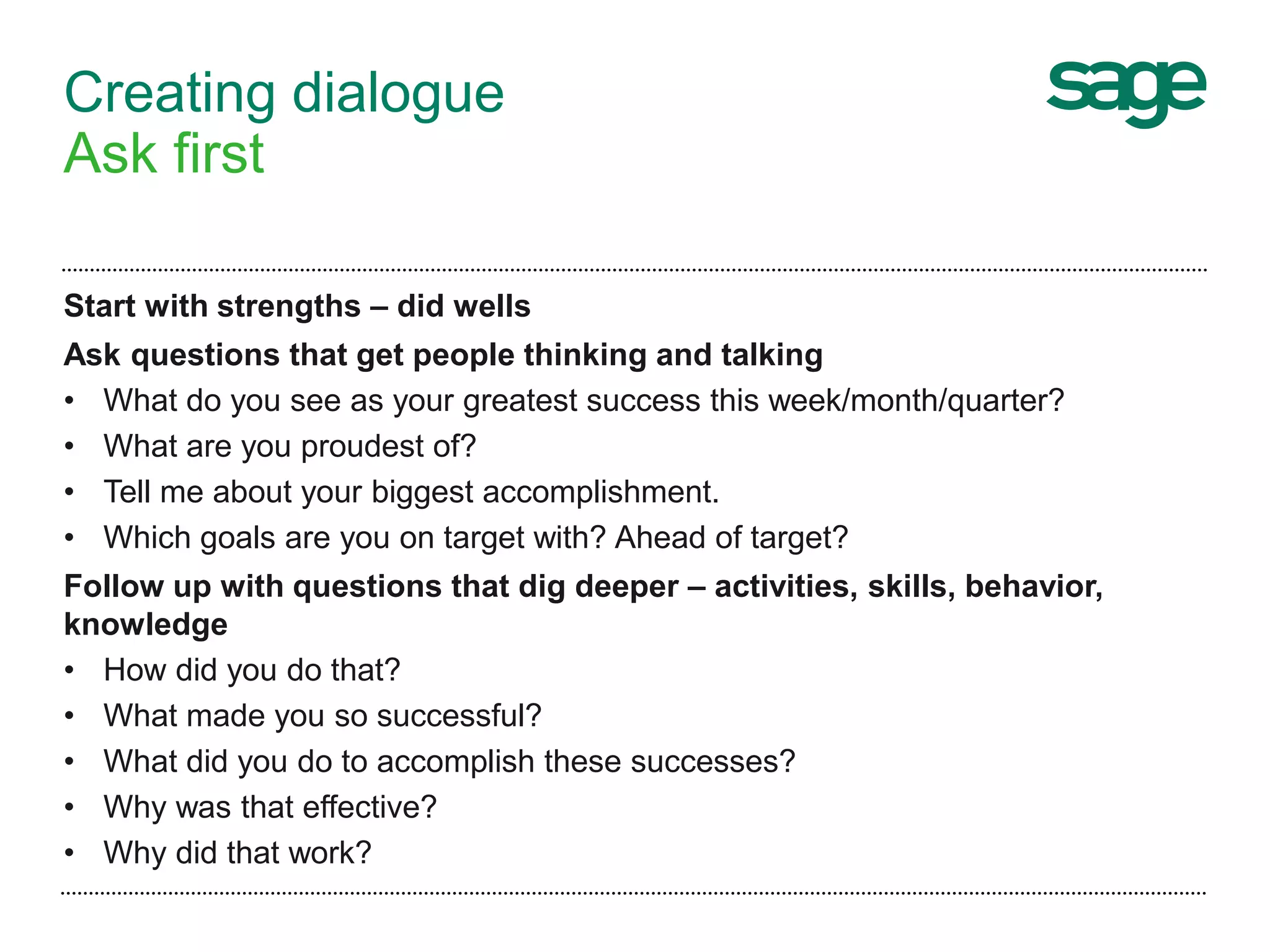
Creating dialogue
Ask first
Start with strengths – did wells
Ask questions that get people thinking and talking
• What do you see as your greatest success this week/month/quarter?
• What are you proudest of?
• Tell me about your biggest accomplishment.
• Which goals are you on target with? Ahead of target?
Follow up with questions that dig deeper – activities, skills, behavior,
knowledge
• How did you do that?
• What made you so successful?
• What did you do to accomplish these successes?
• Why was that effective?
• Why did that work?
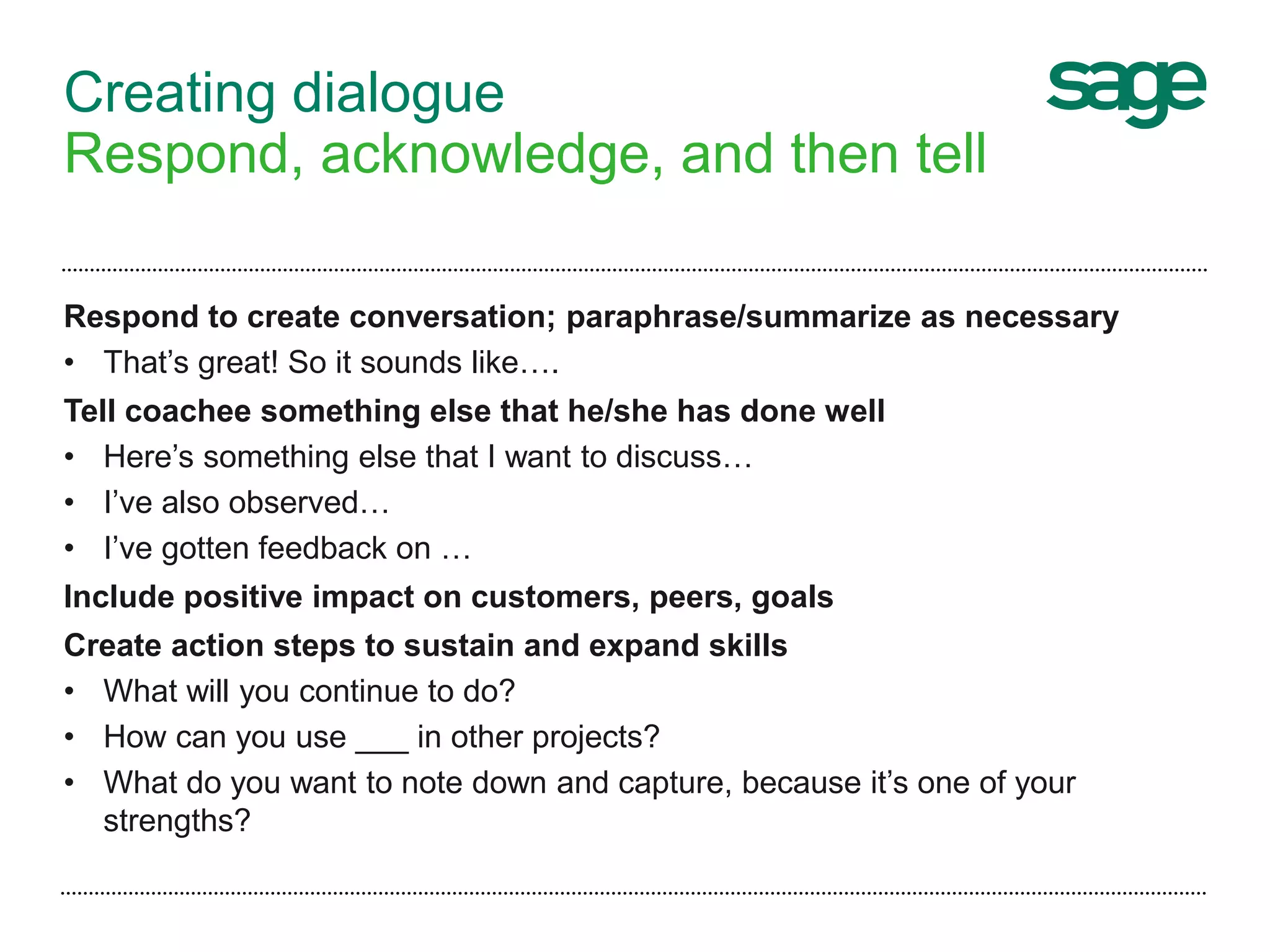
Creating dialogue
Respond, acknowledge, and then tell
Respond to create conversation; paraphrase/summarize as necessary
• That’s great! So it sounds like….
Tell coachee something else that he/she has done well
• Here’s something else that I want to discuss…
• I’ve also observed…
• I’ve gotten feedback on …
Include positive impact on customers, peers, goals
Create action steps to sustain and expand skills
• What will you continue to do?
• How can you use ___ in other projects?
• What do you want to note down and capture, because it’s one of your
strengths?
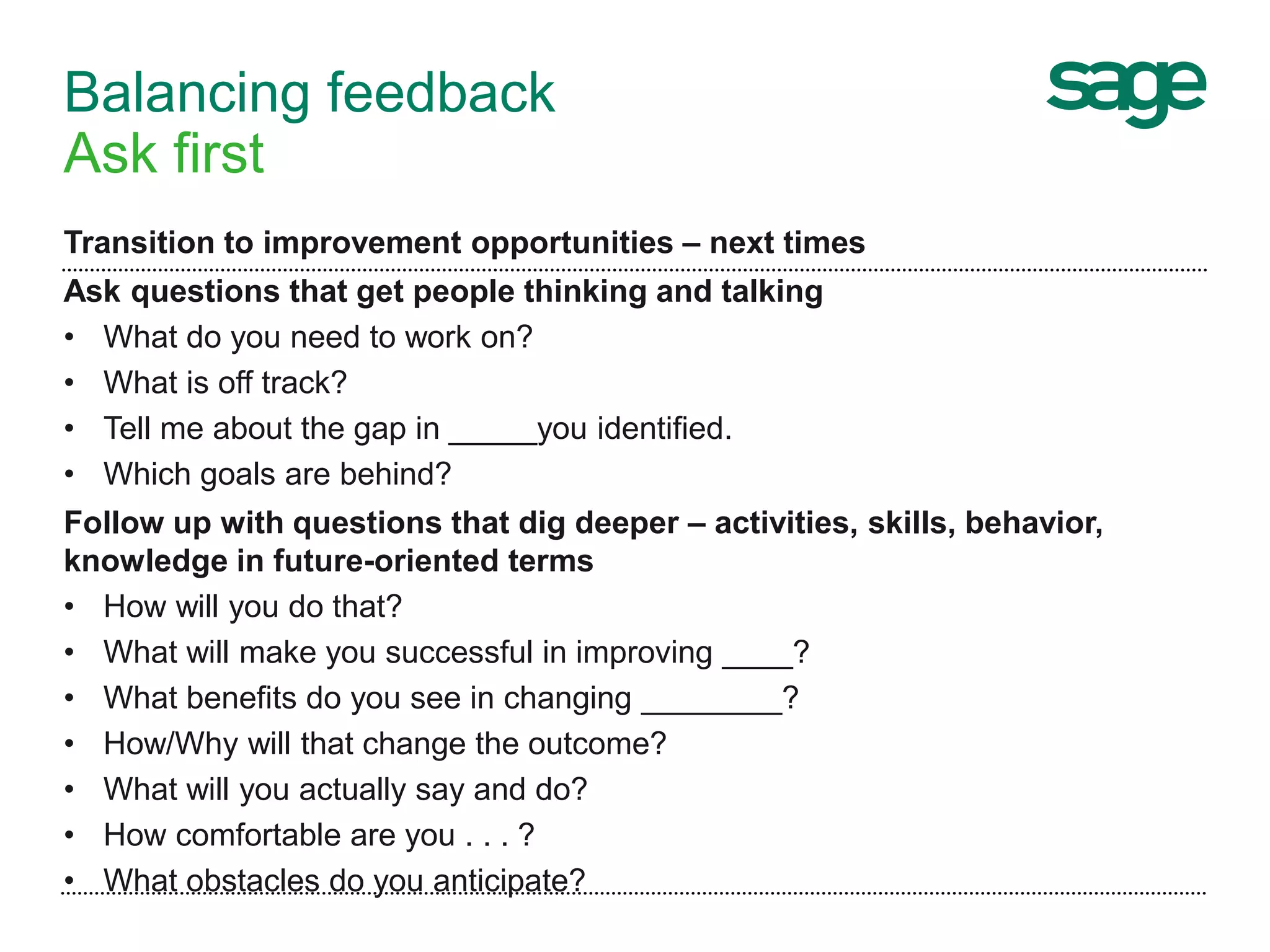
Balancing feedback
Ask first
Transition to improvement opportunities – next times
Ask questions that get people thinking and talking
• What do you need to work on?
• What is off track?
• Tell me about the gap in _____you identified.
• Which goals are behind?
Follow up with questions that dig deeper – activities, skills, behavior,
knowledge in future-oriented terms
• How will you do that?
• What will make you successful in improving ____?
• What benefits do you see in changing ________?
• How/Why will that change the outcome?
• What will you actually say and do?
• How comfortable are you . . . ?
• What obstacles do you anticipate?
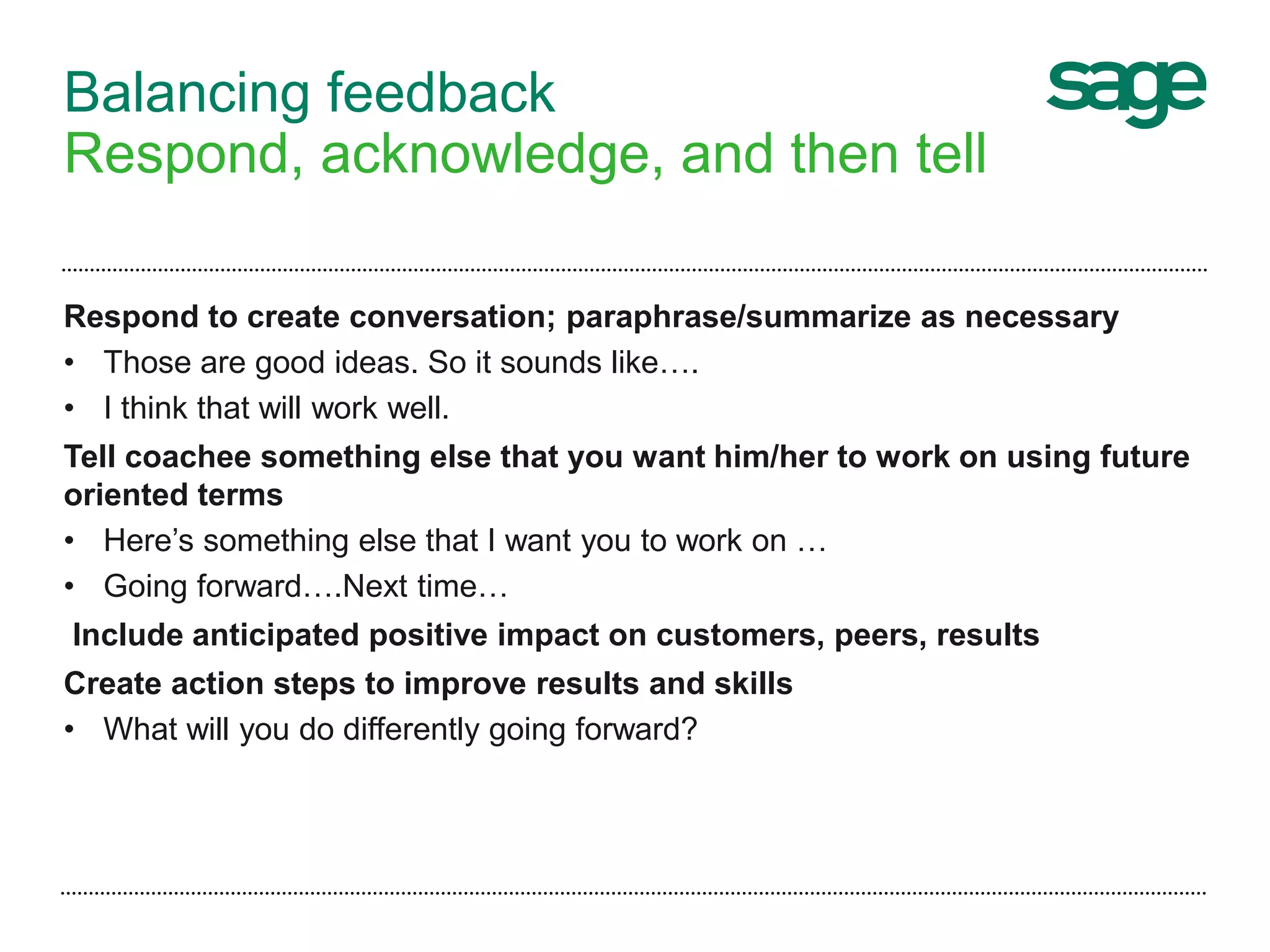
Balancing feedback
Respond, acknowledge, and then tell
Respond to create conversation; paraphrase/summarize as necessary
• Those are good ideas. So it sounds like….
• I think that will work well.
Tell coachee something else that you want him/her to work on using future
oriented terms
• Here’s something else that I want you to work on …
• Going forward….Next time…
Include anticipated positive impact on customers, peers, results
Create action steps to improve results and skills
• What will you do differently going forward?
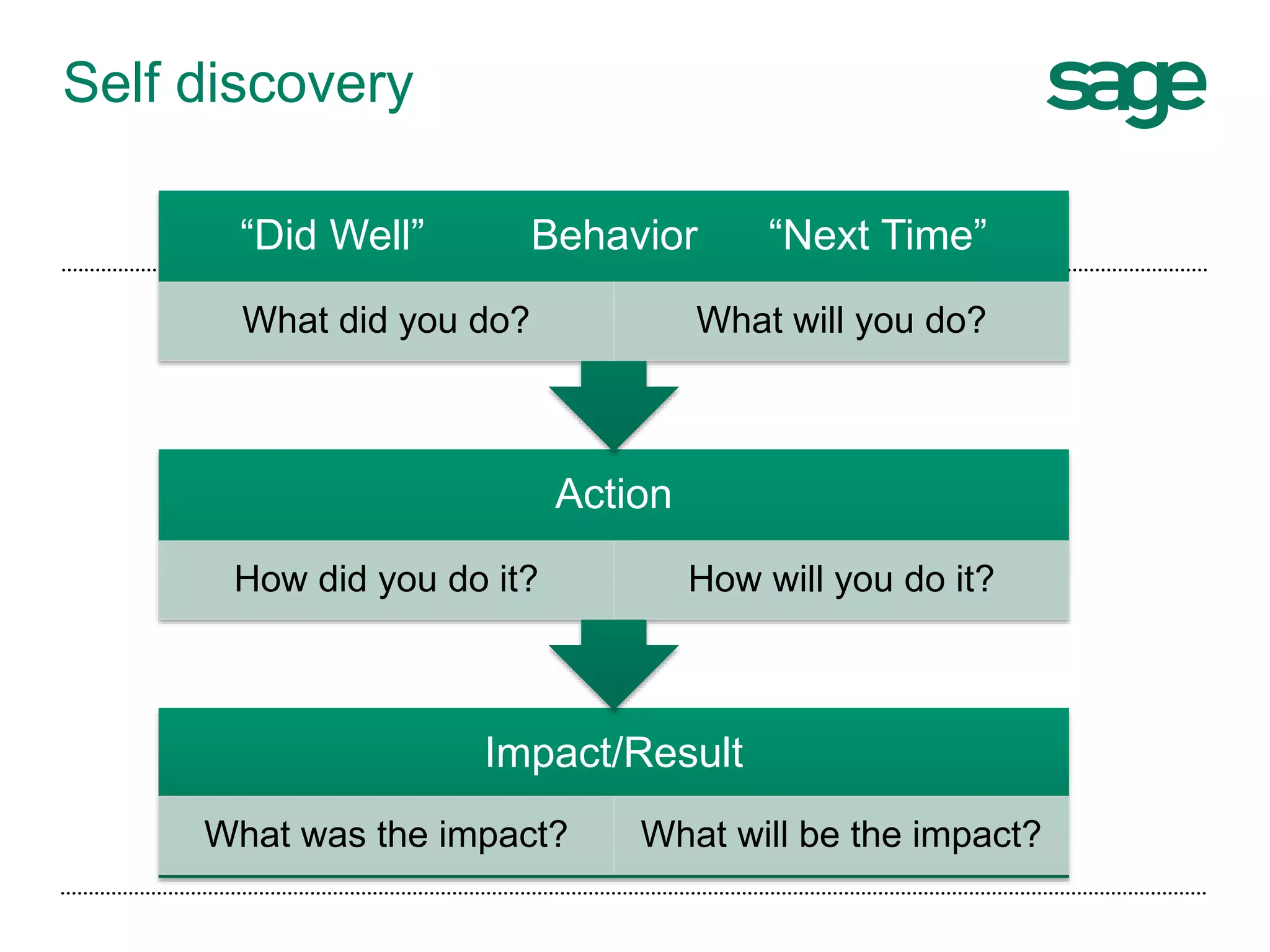
Self discovery
Impact/Result
What was the impact? What will be the impact?
Action
How did you do it? How will you do it?
“Did Well” Behavior “Next Time”
What did you do? What will you do?
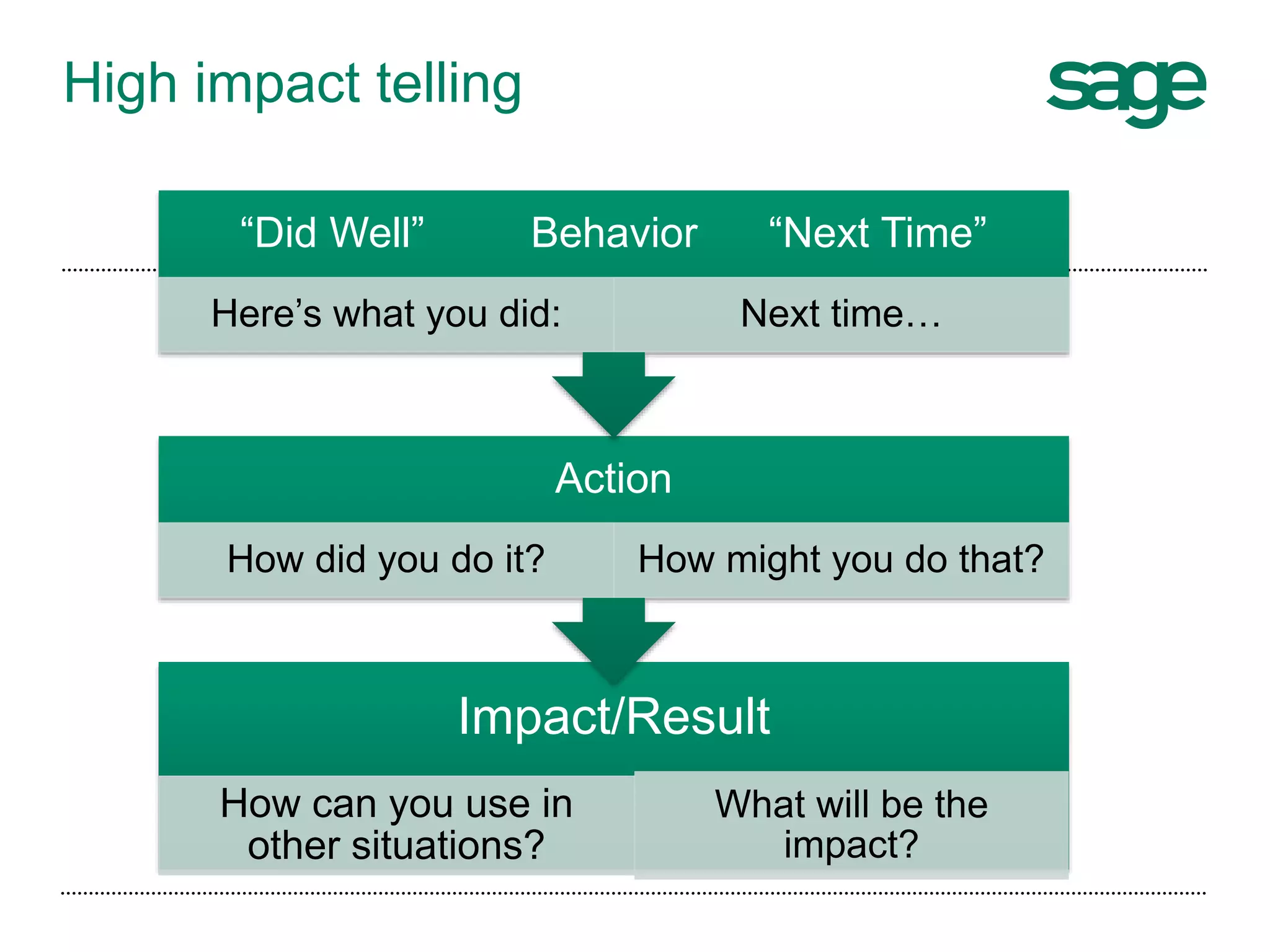
High impact telling
Impact/Result
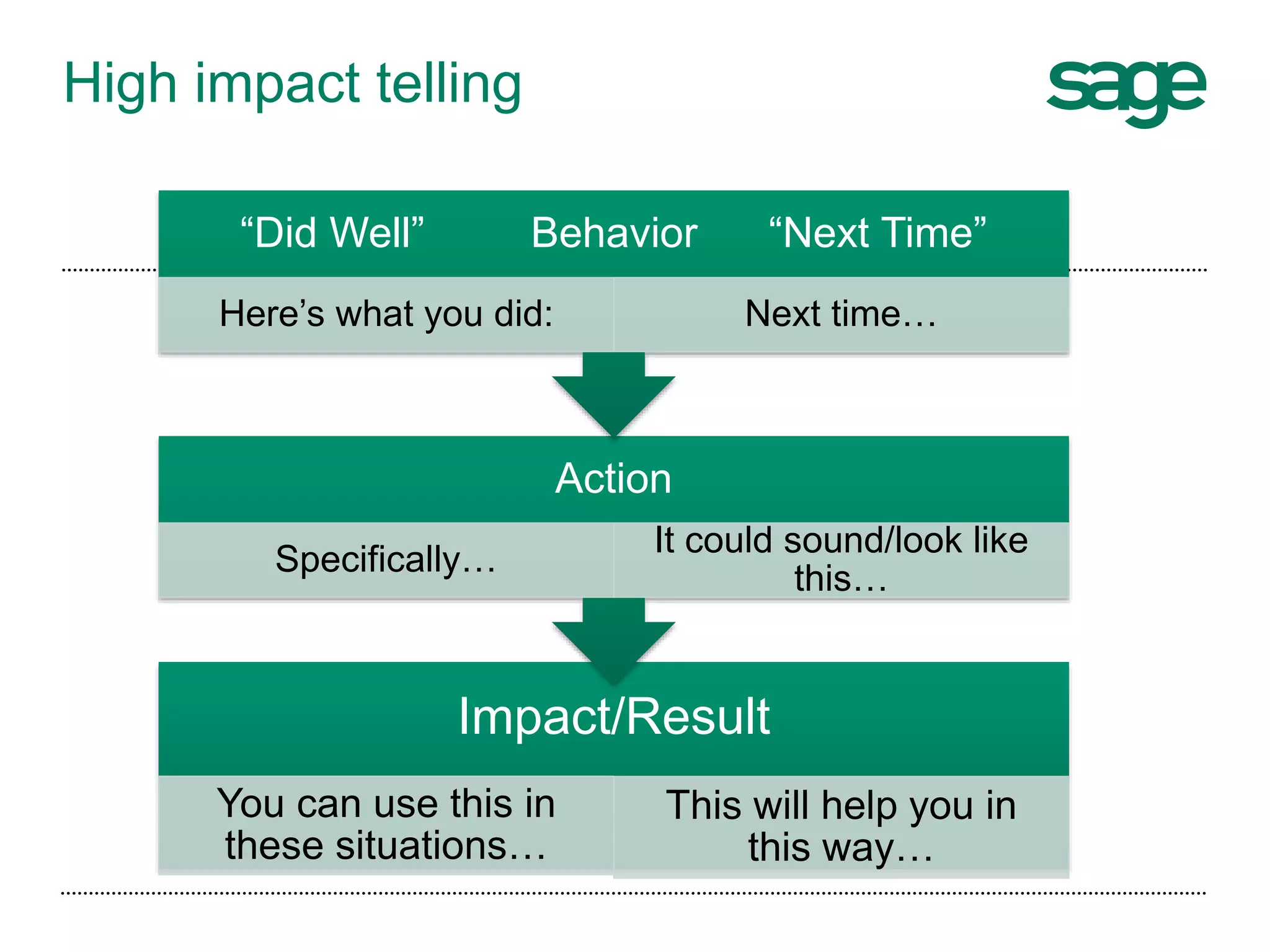
How can you use in
other situations?
What will be the
impact?
Action
How did you do it? How might you do that?
“Did Well” Behavior “Next Time”
Here’s what you did: Next time…
High impact telling
Impact/Result
You can use this in
these situations…
This will help you in
this way…
Action
Specifically…
It could sound/look like
this…
“Did Well” Behavior “Next Time”
Here’s what you did: Next time…
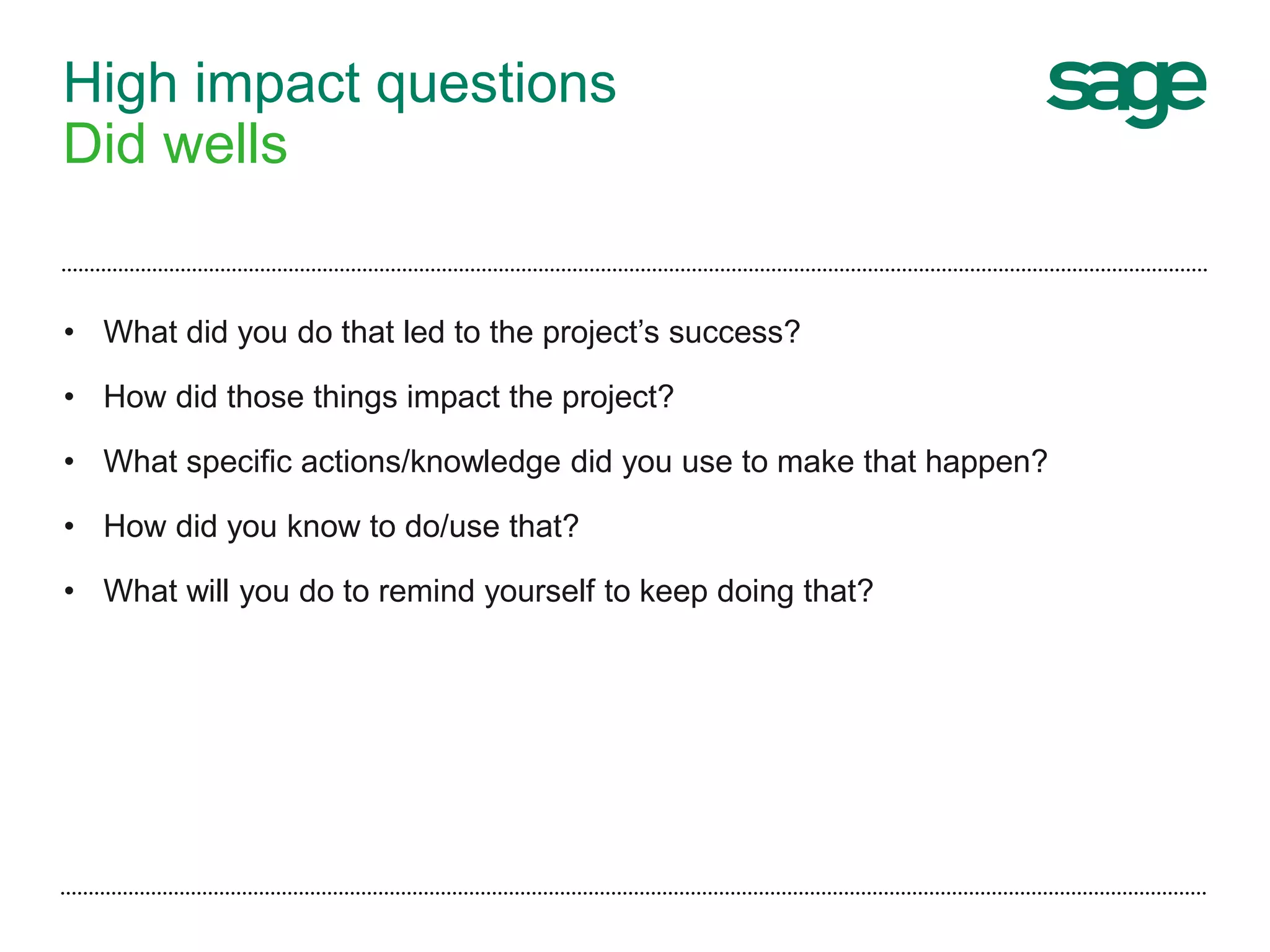
High impact questions
Did wells
• What did you do that led to the project’s success?
• How did those things impact the project?
• What specific actions/knowledge did you use to make that happen?
• How did you know to do/use that?
• What will you do to remind yourself to keep doing that?
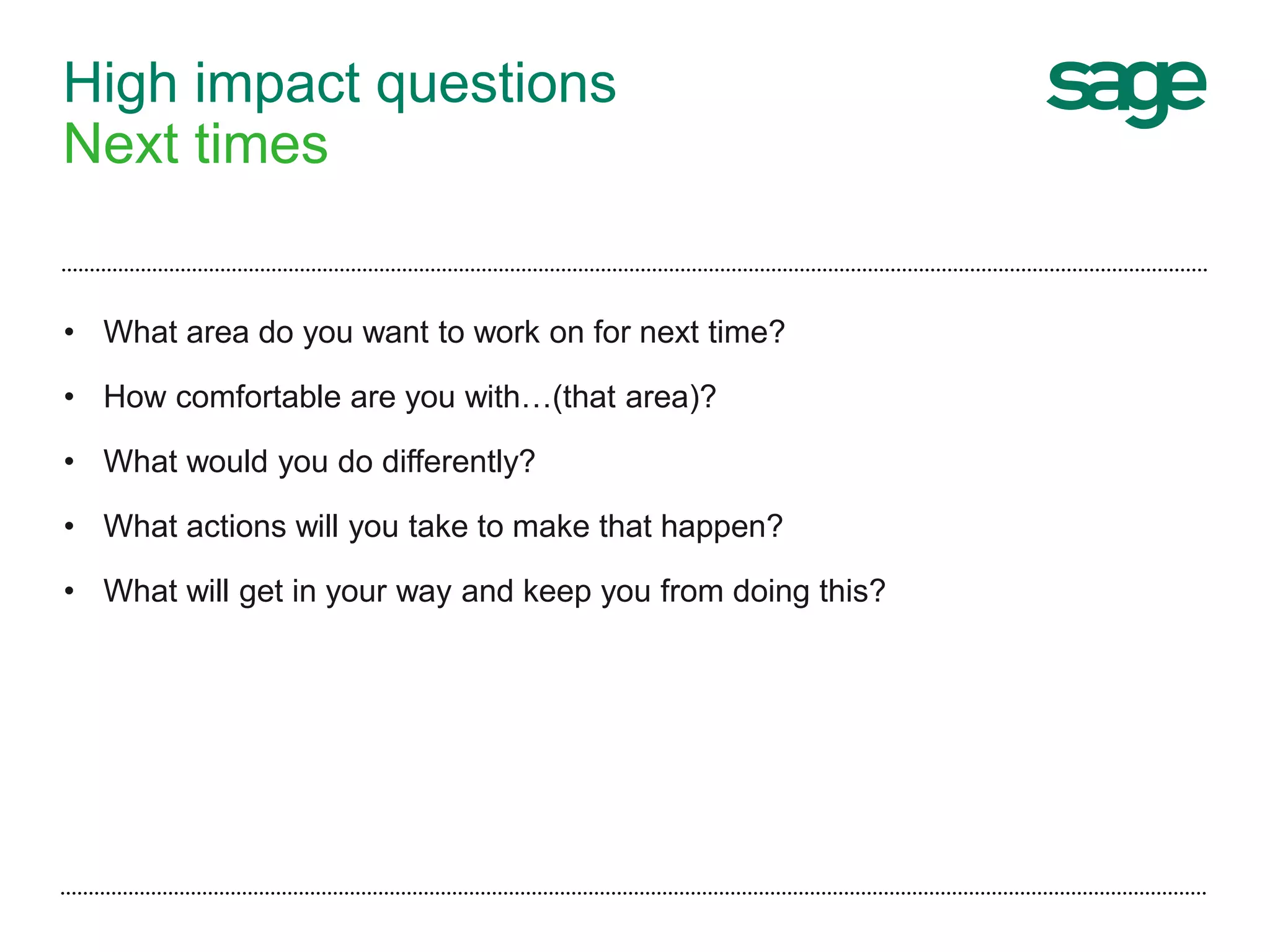
High impact questions
Next times
• What area do you want to work on for next time?
• How comfortable are you with…(that area)?
• What would you do differently?
• What actions will you take to make that happen?
• What will get in your way and keep you from doing this?
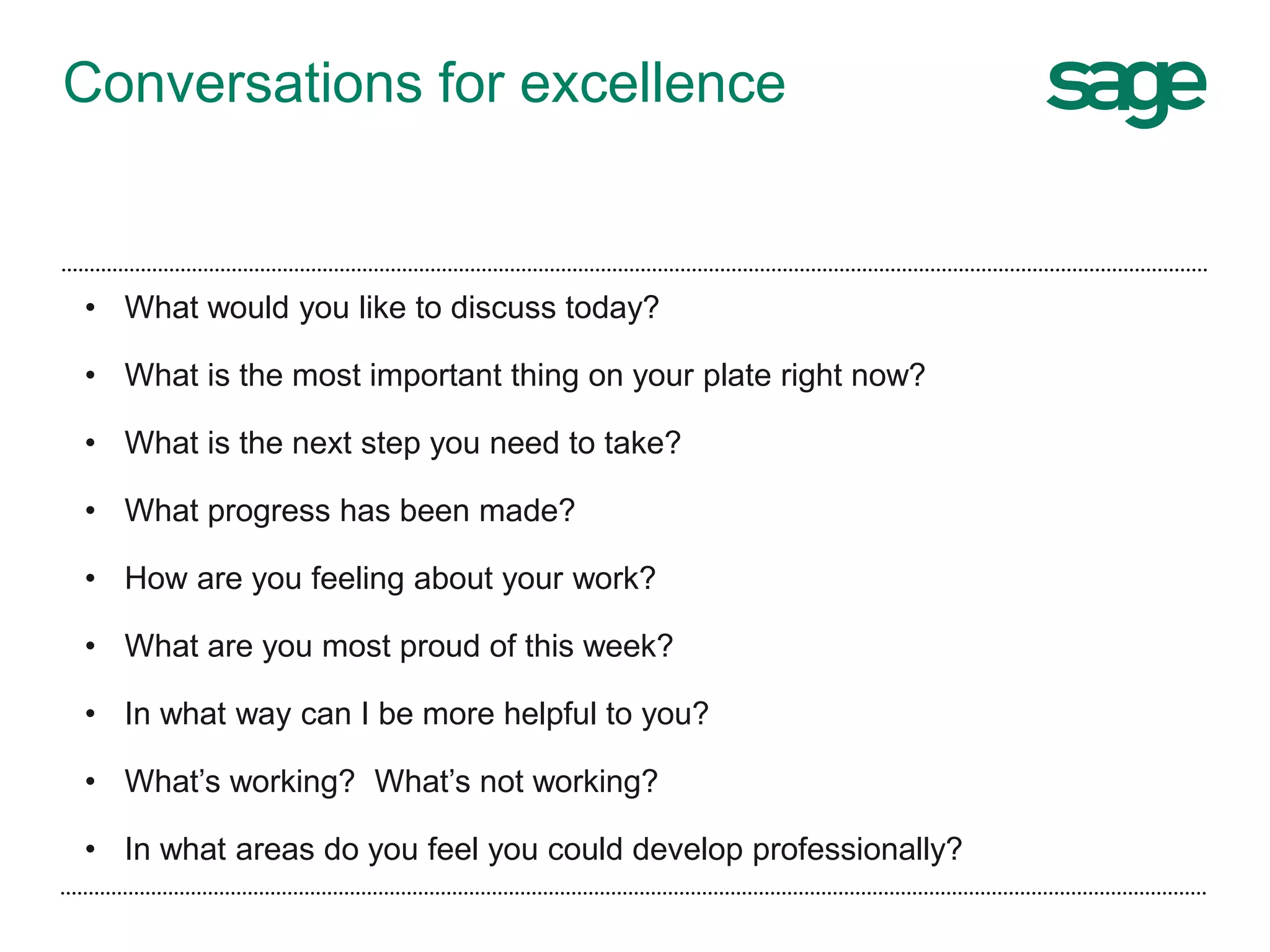
• What would you like to discuss today?
• What is the most important thing on your plate right now?
• What is the next step you need to take?
• What progress has been made?
• How are you feeling about your work?
• What are you most proud of this week?
• In what way can I be more helpful to you?
• What’s working? What’s not working?
• In what areas do you feel you could develop professionally?
Conversations for excellence
Ask first
Step 1
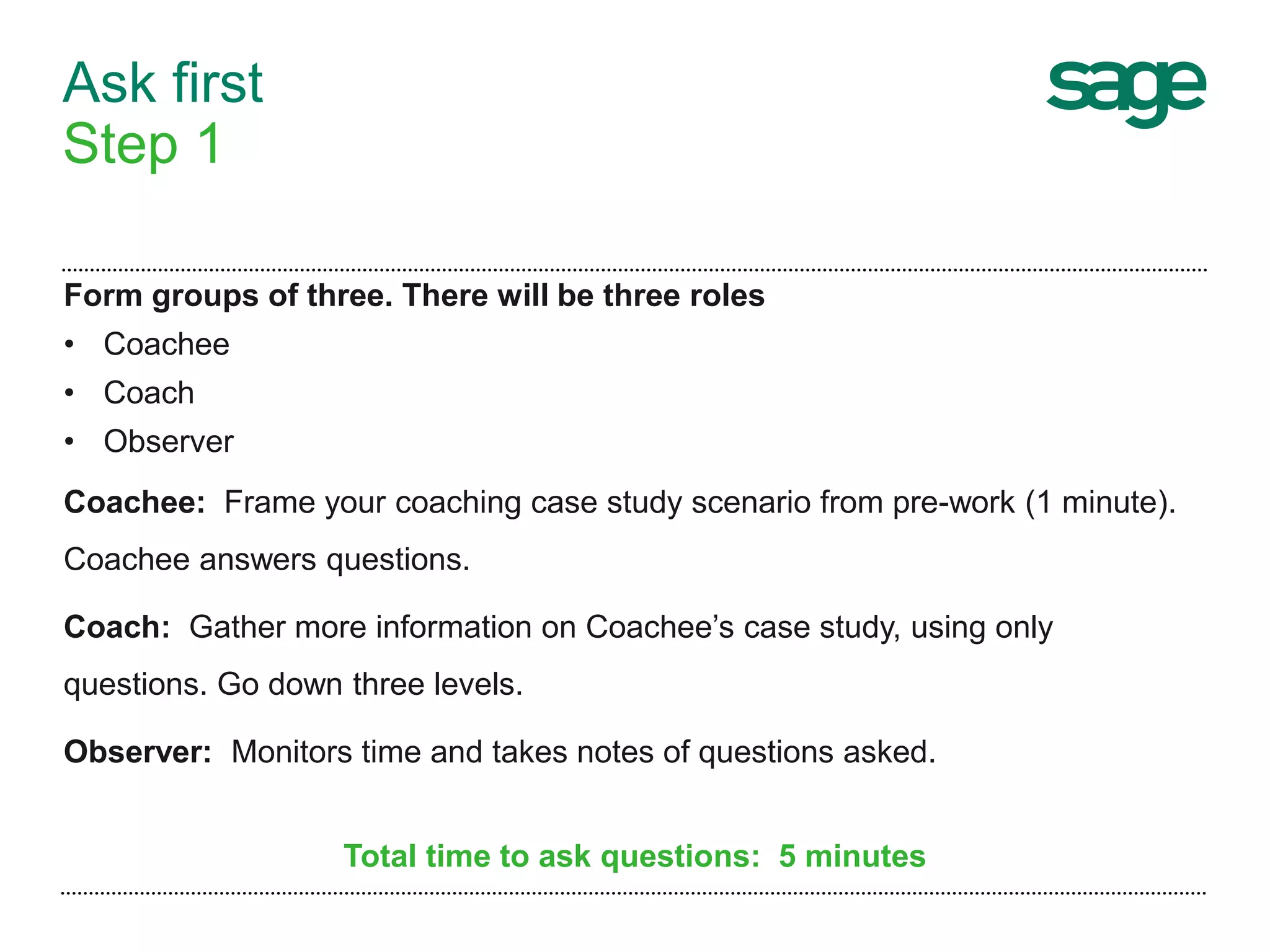
Form groups of three. There will be three roles
• Coachee
• Coach
• Observer
Coachee: Frame your coaching case study scenario from pre-work (1 minute).
Coachee answers questions.
Coach: Gather more information on Coachee’s case study, using only
questions. Go down three levels.
Observer: Monitors time and takes notes of questions asked.
Total time to ask questions: 5 minutes
Then tell
Step 2
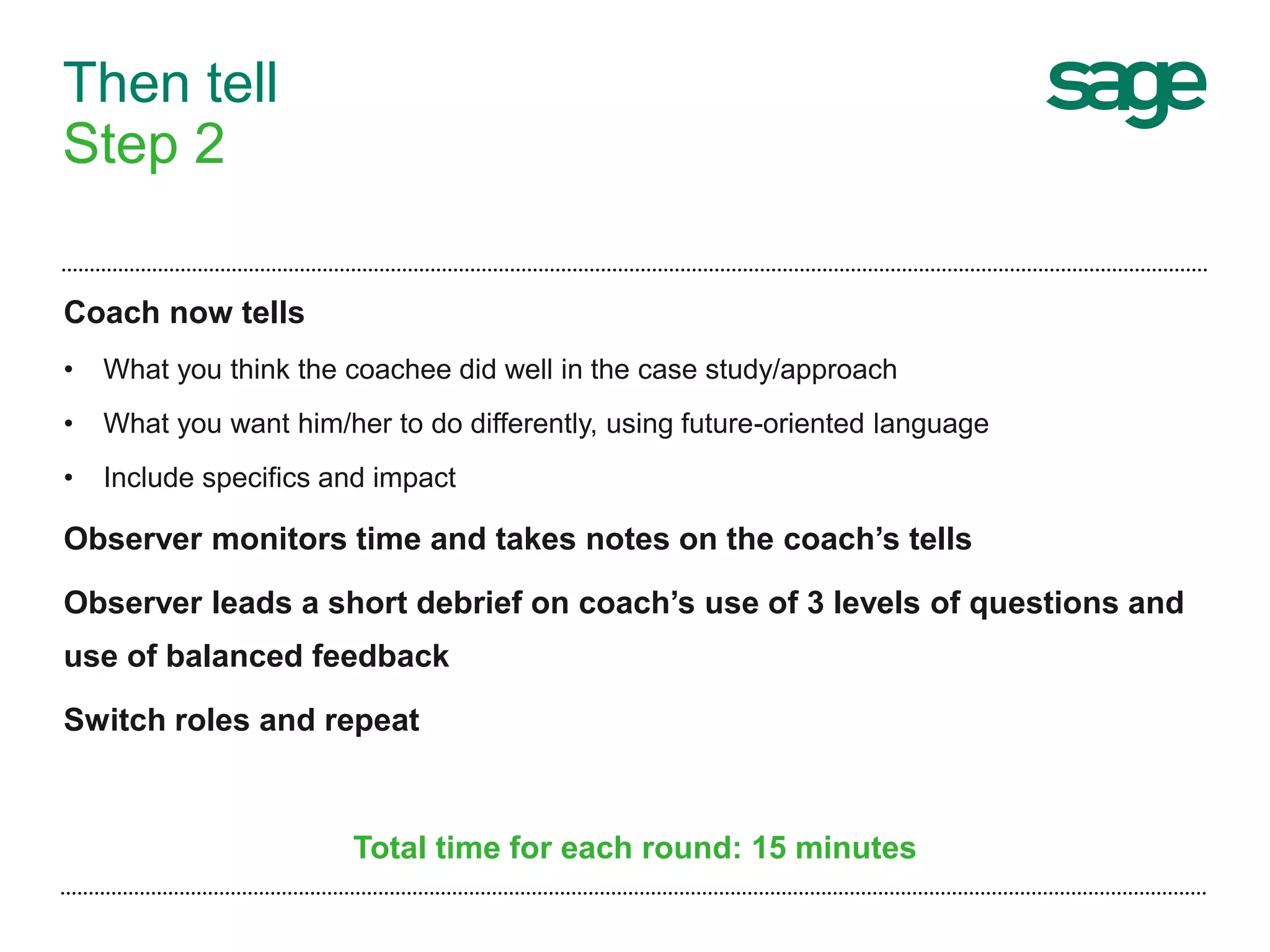
Coach now tells
• What you think the coachee did well in the case study/approach
• What you want him/her to do differently, using future-oriented language
• Include specifics and impact
Observer monitors time and takes notes on the coach’s tells
Observer leads a short debrief on coach’s use of 3 levels of questions and
use of balanced feedback
Switch roles and repeat
Total time for each round: 15 minutes
Agree on action plan
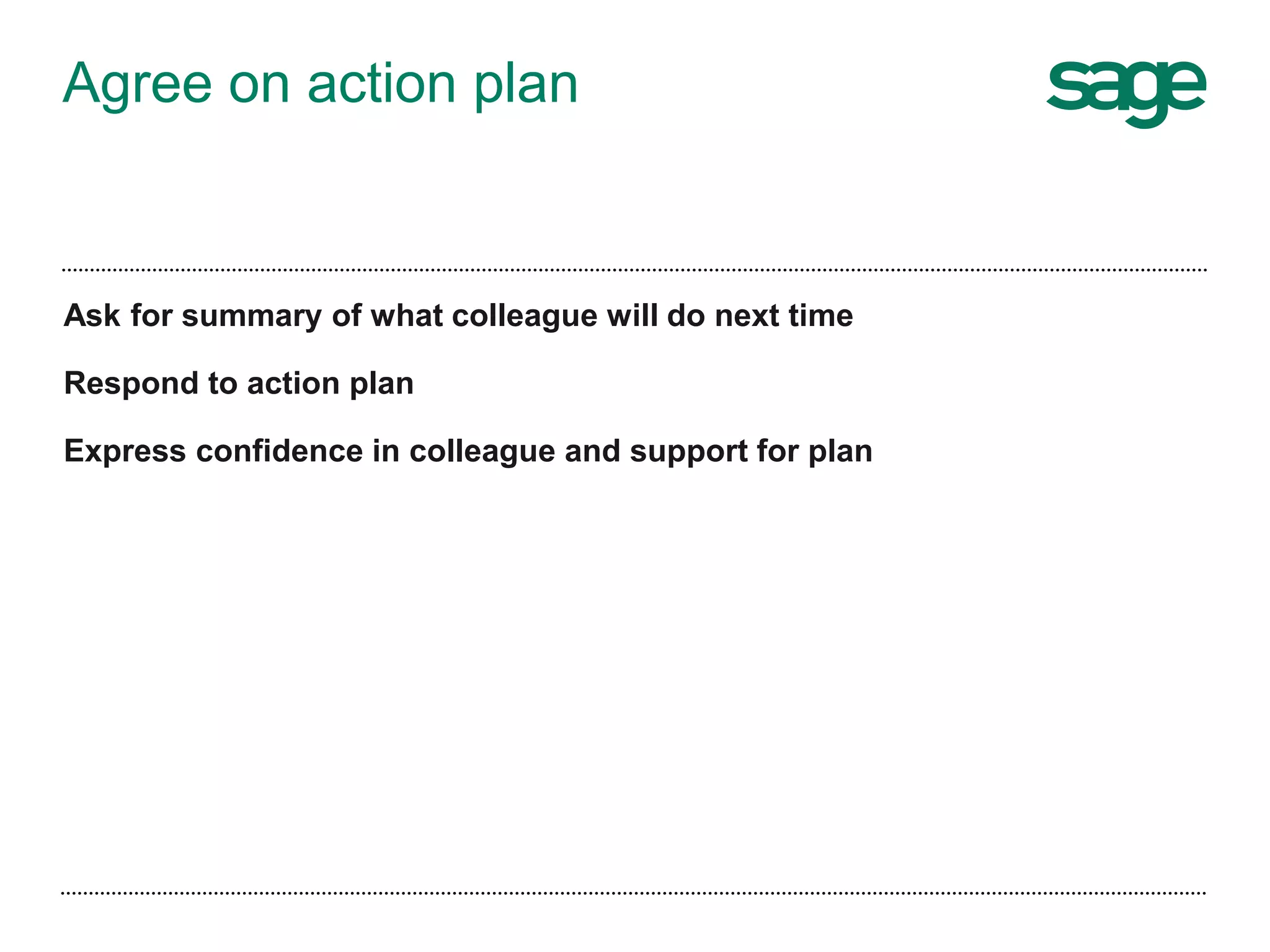
Ask for summary of what colleague will do next time
Respond to action plan
Express confidence in colleague and support for plan
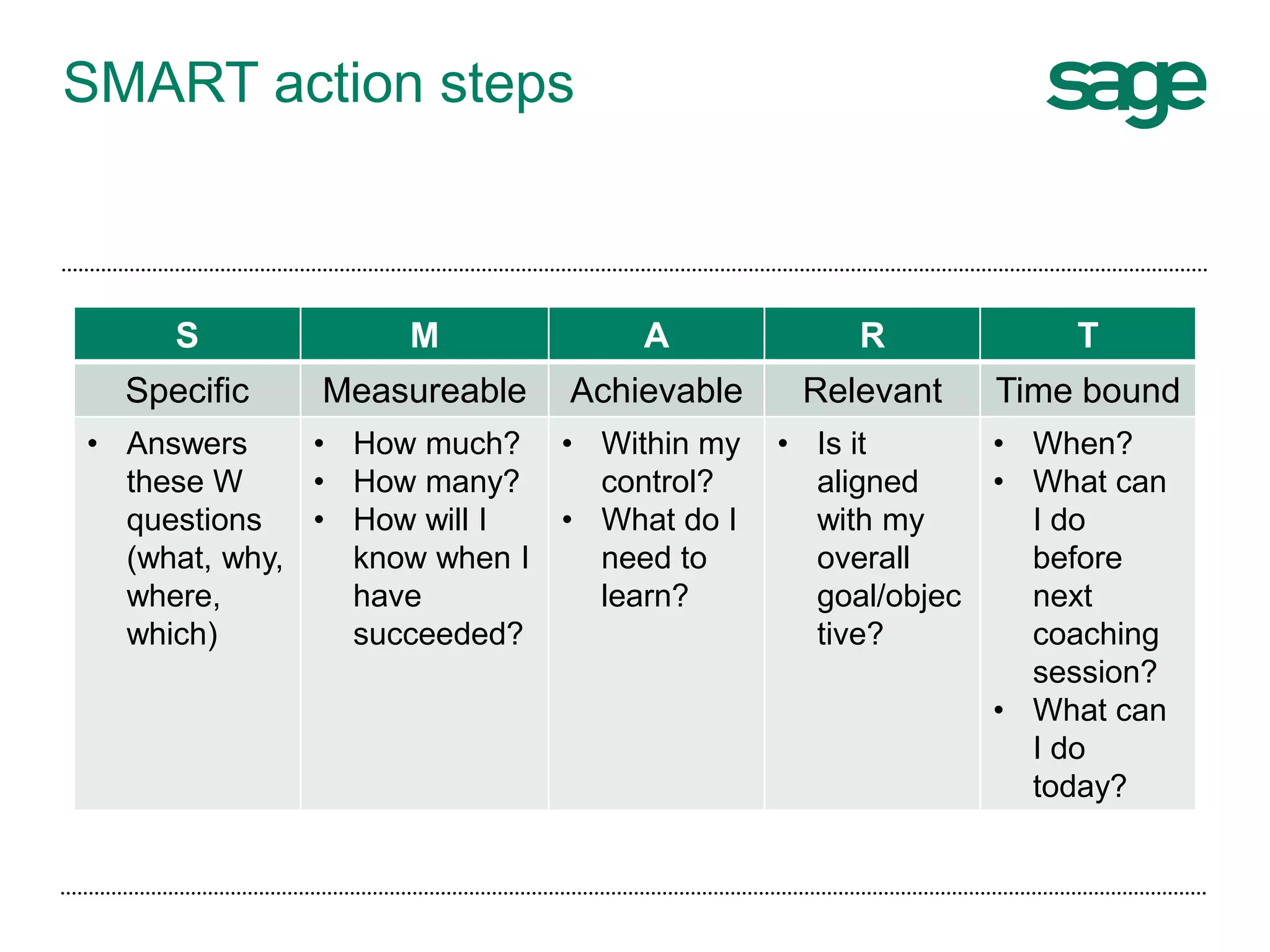
SMART action steps
S M A R T
Specific Measureable Achievable Relevant Time bound
• Answers
these W
questions
(what, why,
where,
which)
• How much?
• How many?
• How will I
know when I
have
succeeded?
• Within my
control?
• What do I
need to
learn?
• Is it
aligned
with my
overall
goal/objec
tive?
• When?
• What can
I do
before
next
coaching
session?
• What can
I do
today?
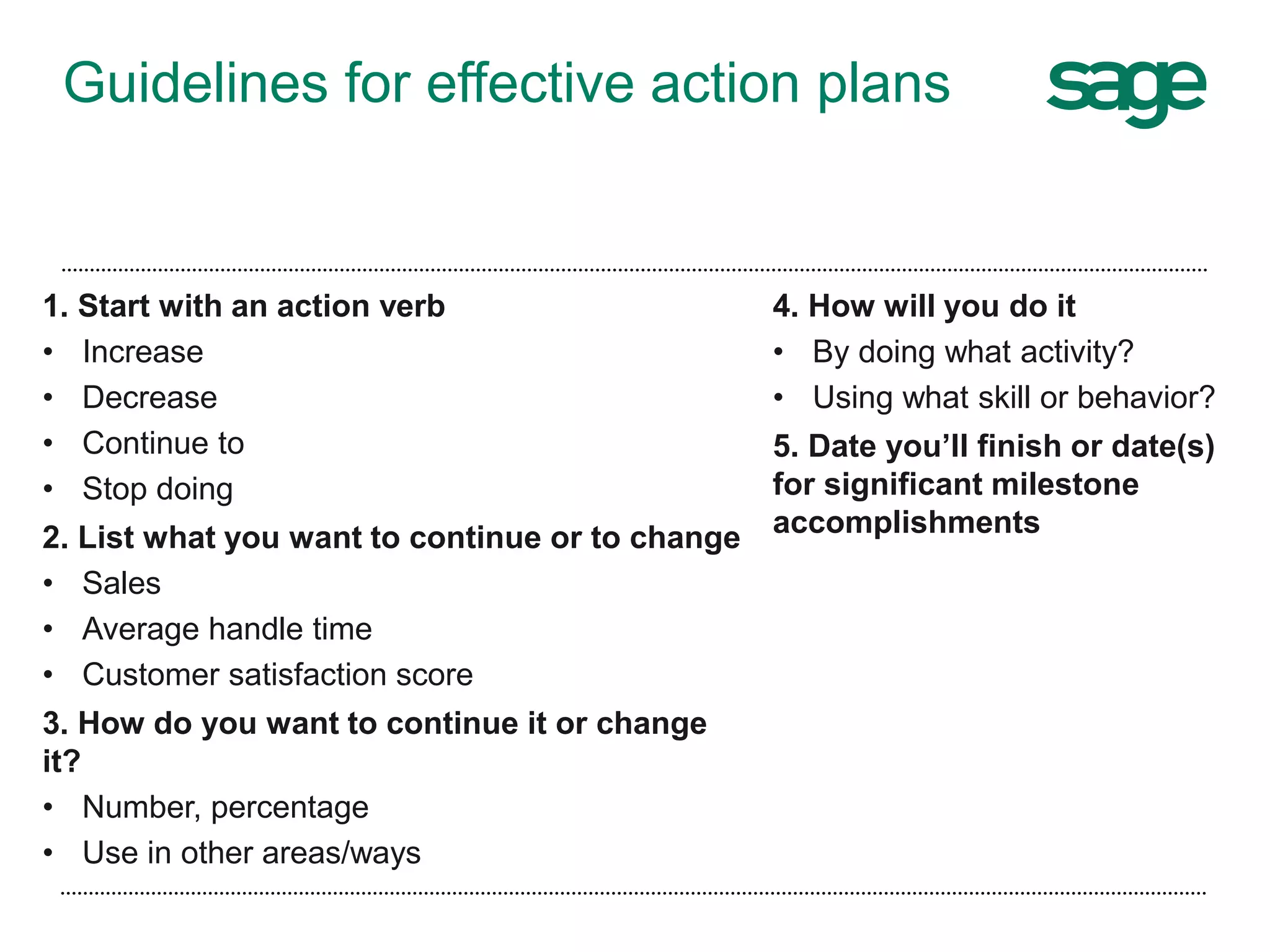
Guidelines for effective action plans
1. Start with an action verb
• Increase
• Decrease
• Continue to
• Stop doing
2. List what you want to continue or to change
• Sales
• Average handle time
• Customer satisfaction score
3. How do you want to continue it or change
it?
• Number, percentage
• Use in other areas/ways
4. How will you do it
• By doing what activity?
• Using what skill or behavior?
5. Date you’ll finish or date(s)
for significant milestone
accomplishments
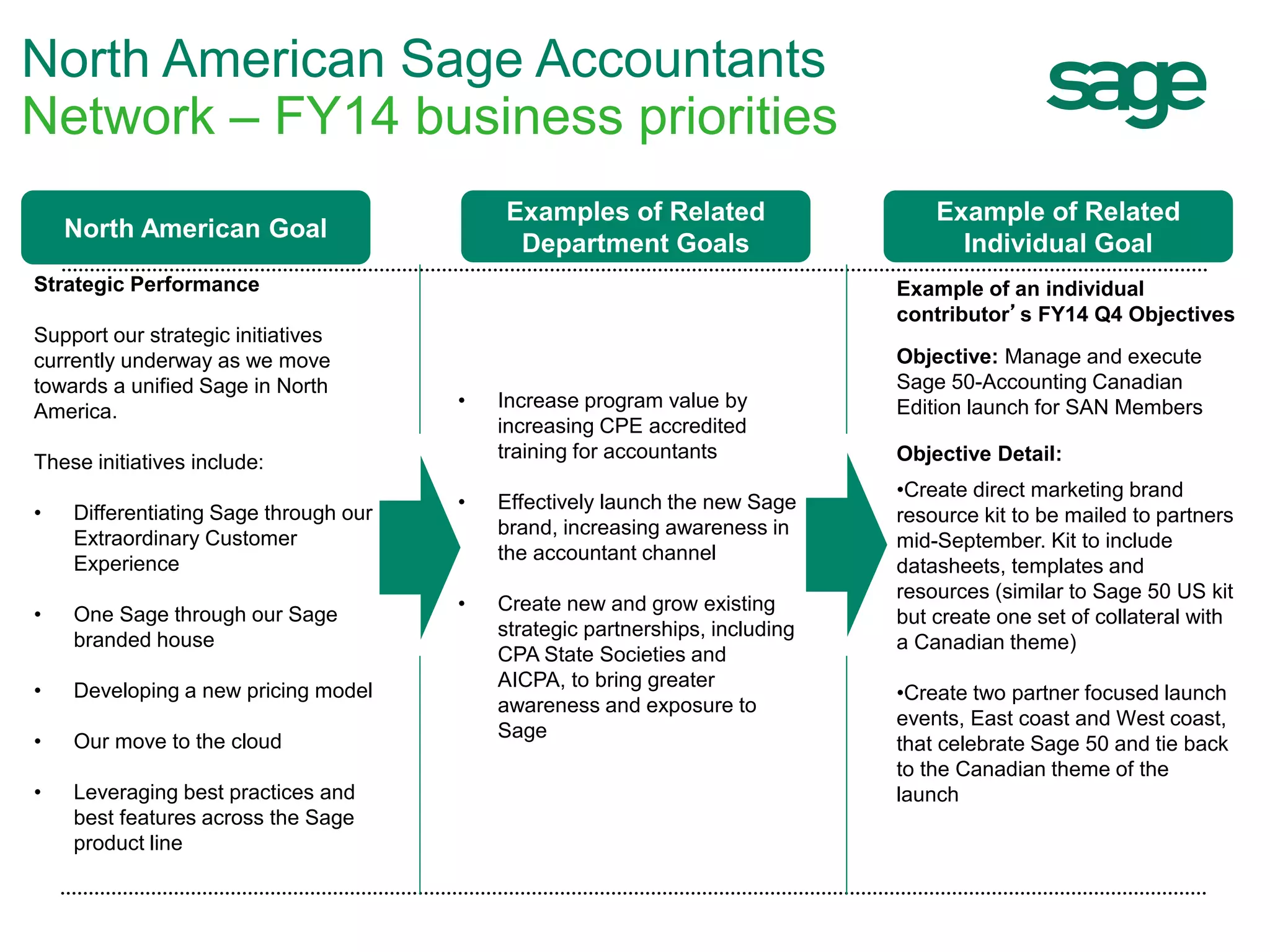
Example of an individual
contributor’s FY14 Q4 Objectives
Objective: Manage and execute
Sage 50-Accounting Canadian
Edition launch for SAN Members
Objective Detail:
•Create direct marketing brand
resource kit to be mailed to partners
mid-September. Kit to include
datasheets, templates and
resources (similar to Sage 50 US kit
but create one set of collateral with
a Canadian theme)
•Create two partner focused launch
events, East coast and West coast,
that celebrate Sage 50 and tie back
to the Canadian theme of the
launch
North American Sage Accountants
Network – FY14 business priorities
Strategic Performance
Support our strategic initiatives
currently underway as we move
towards a unified Sage in North
America.
These initiatives include:
• Differentiating Sage through our
Extraordinary Customer
Experience
• One Sage through our Sage
branded house
• Developing a new pricing model
• Our move to the cloud
• Leveraging best practices and
best features across the Sage
product line
North American Goal
Examples of Related
Department Goals
• Increase program value by
increasing CPE accredited
training for accountants
• Effectively launch the new Sage
brand, increasing awareness in
the accountant channel
• Create new and grow existing
strategic partnerships, including
CPA State Societies and
AICPA, to bring greater
awareness and exposure to
Sage
Example of Related
Individual Goal
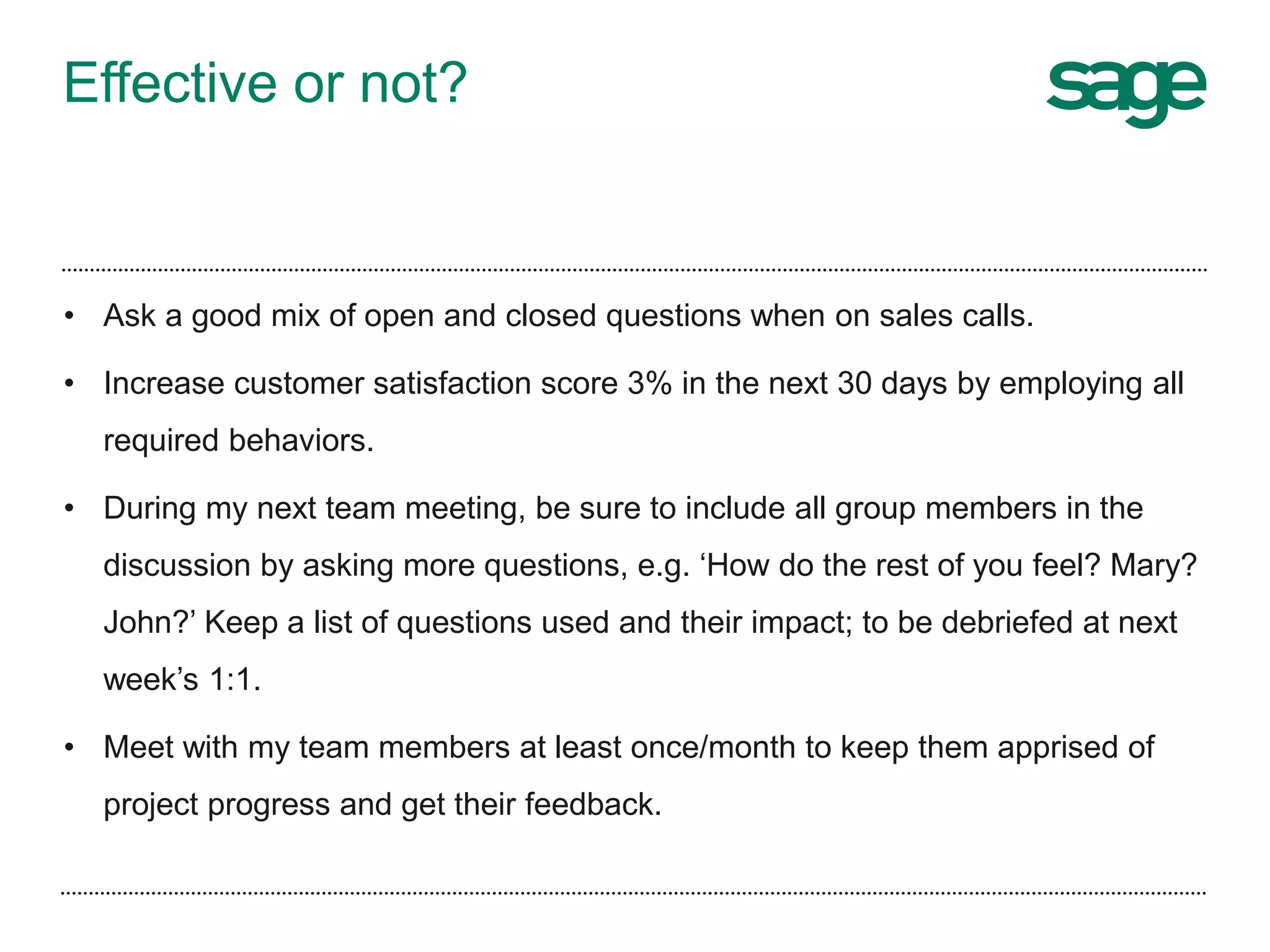
Effective or not?
• Ask a good mix of open and closed questions when on sales calls.
• Increase customer satisfaction score 3% in the next 30 days by employing all
required behaviors.
• During my next team meeting, be sure to include all group members in the
discussion by asking more questions, e.g. ‘How do the rest of you feel? Mary?
John?’ Keep a list of questions used and their impact; to be debriefed at next
week’s 1:1.
• Meet with my team members at least once/month to keep them apprised of
project progress and get their feedback.
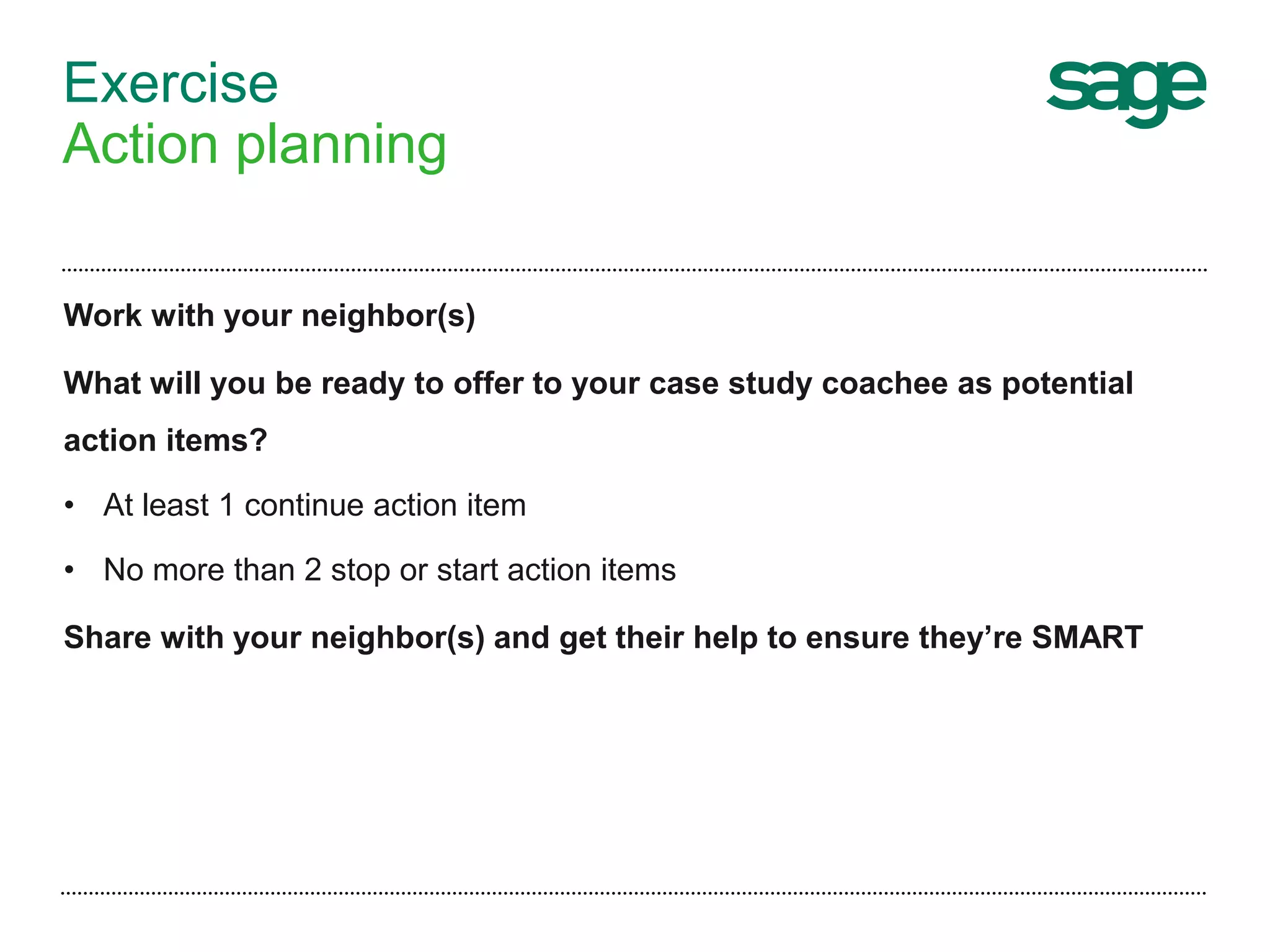
Exercise
Action planning
Work with your neighbor(s)
What will you be ready to offer to your case study coachee as potential
action items?
• At least 1 continue action item
• No more than 2 stop or start action items
Share with your neighbor(s) and get their help to ensure they’re SMART
When colleagues push back and
resist
What do they say?
What do they do?
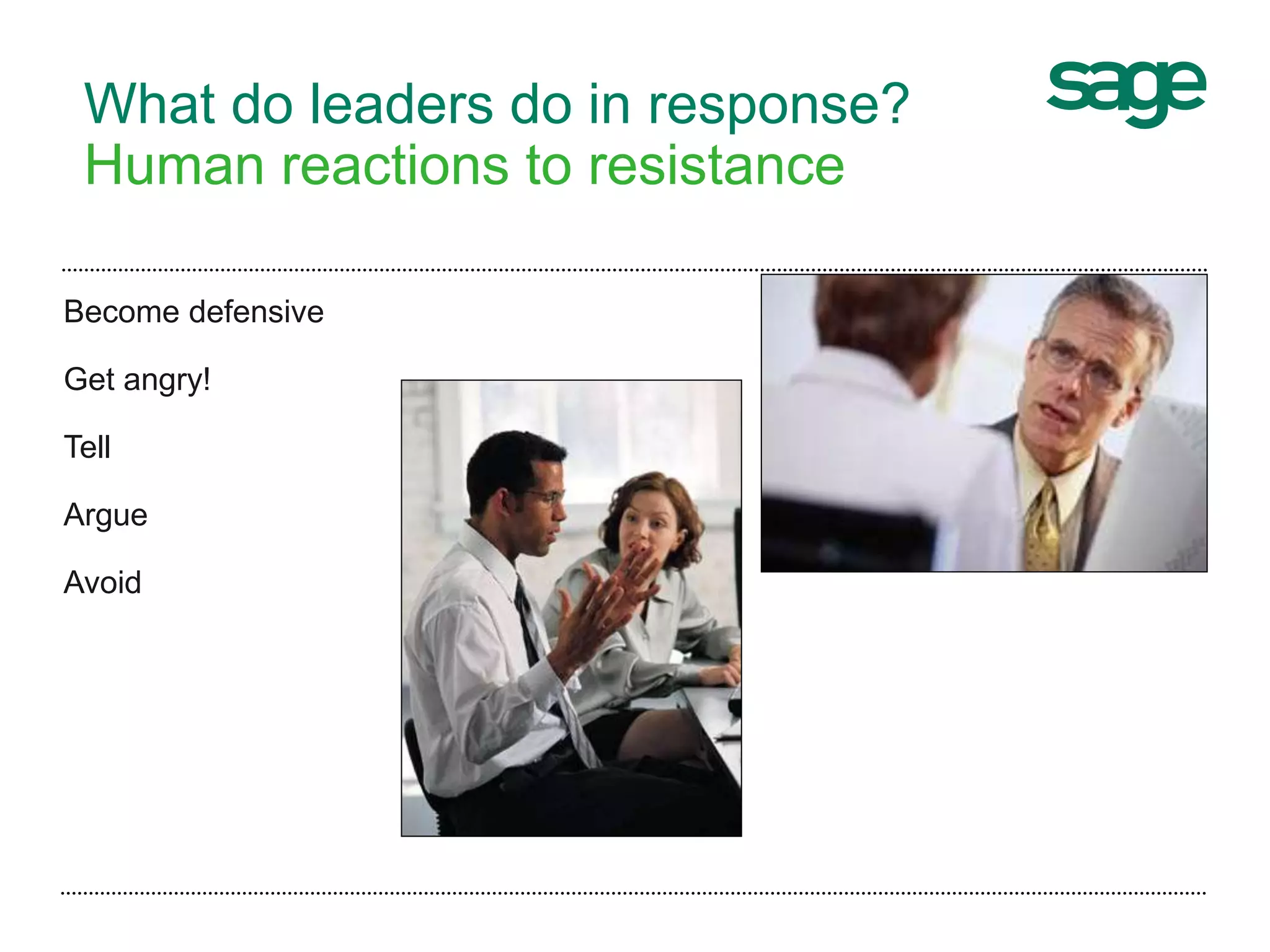
Become defensive
Get angry!
Tell
Argue
Avoid
What do leaders do in response?
Human reactions to resistance
Before it ever happens
Preparing for resistance
Imagine it happening – worst case scenario
Then picture yourself being successful in handling it
• What will you say?
• How will you act?
Ask questions to get colleague involved throughout the conversation
Specifically ask about obstacles—get them on the table early
Directly address a likely concern before the colleague even brings it up
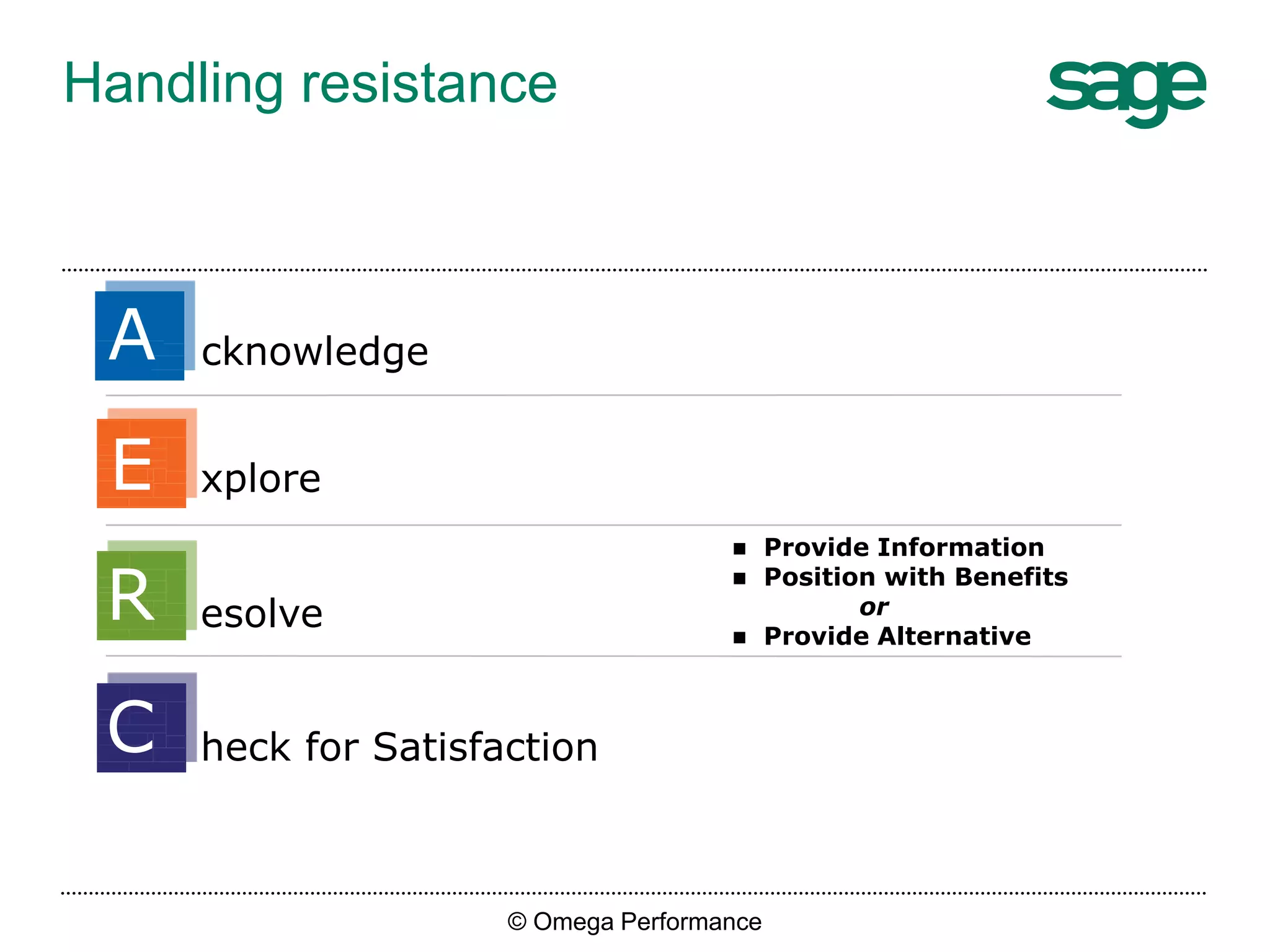
Handling resistance
 Provide Information
 Position with Benefits
or
 Provide Alternative
C
R
E
A cknowledge
xplore
esolve
heck for Satisfaction
© Omega Performance
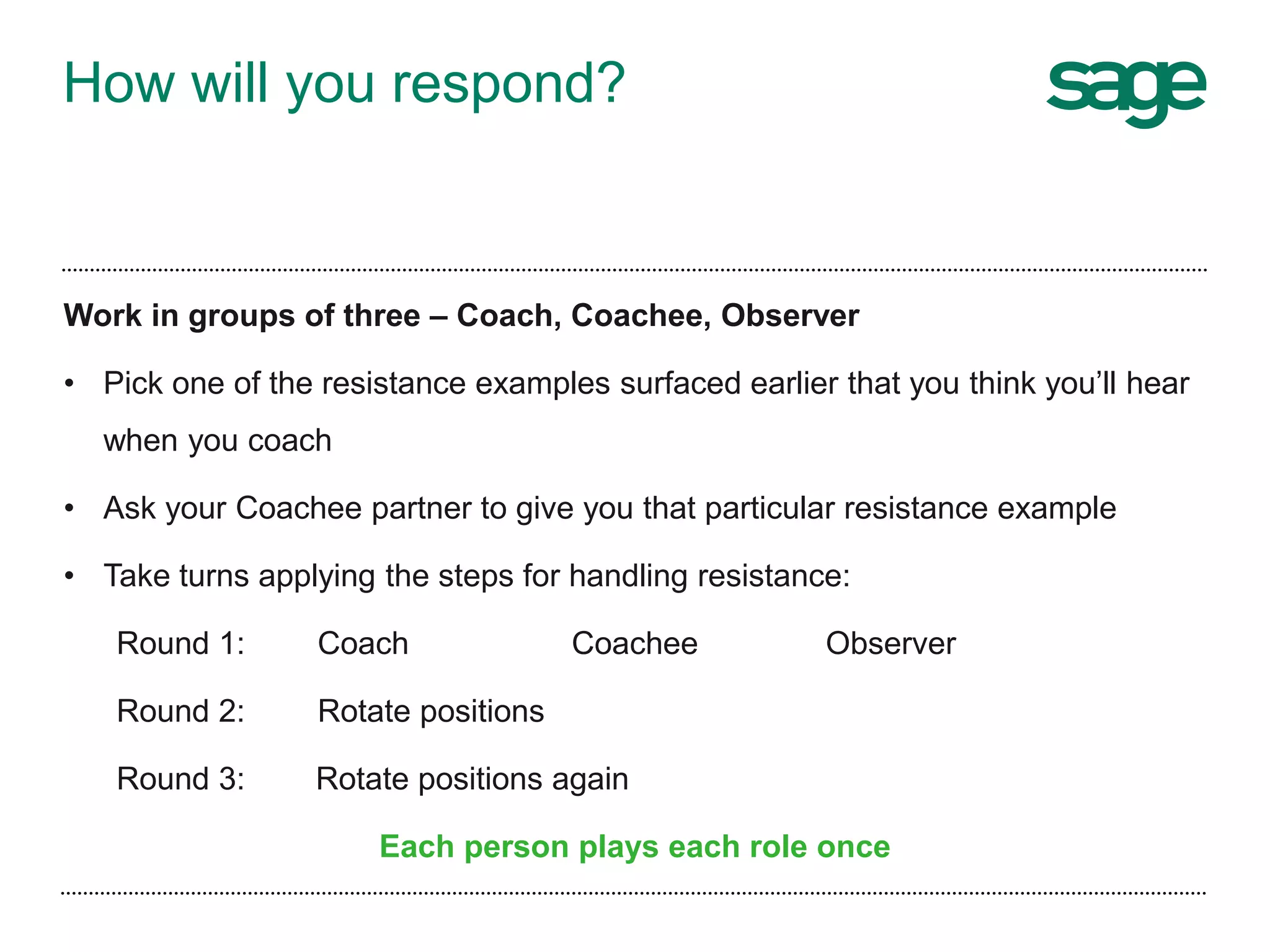
How will you respond?
Work in groups of three – Coach, Coachee, Observer
• Pick one of the resistance examples surfaced earlier that you think you’ll hear
when you coach
• Ask your Coachee partner to give you that particular resistance example
• Take turns applying the steps for handling resistance:
Round 1: Coach Coachee Observer
Round 2: Rotate positions
Round 3: Rotate positions again
Each person plays each role once
Now you try it…
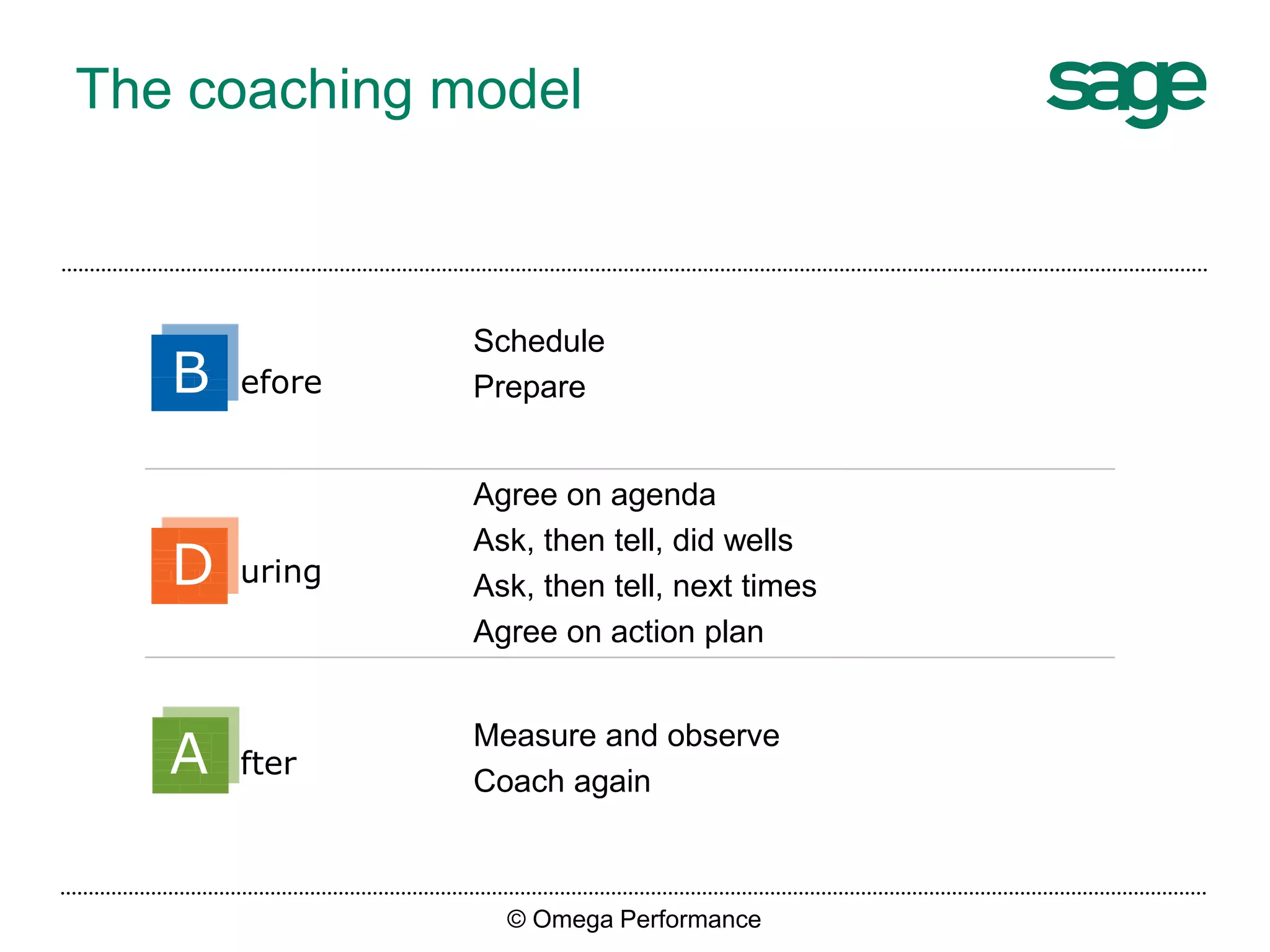
Measure and observe
Coach again
Agree on agenda
Ask, then tell, did wells
Ask, then tell, next times
Agree on action plan
Schedule
PrepareB efore
D uring
A fter
© Omega Performance
The coaching model
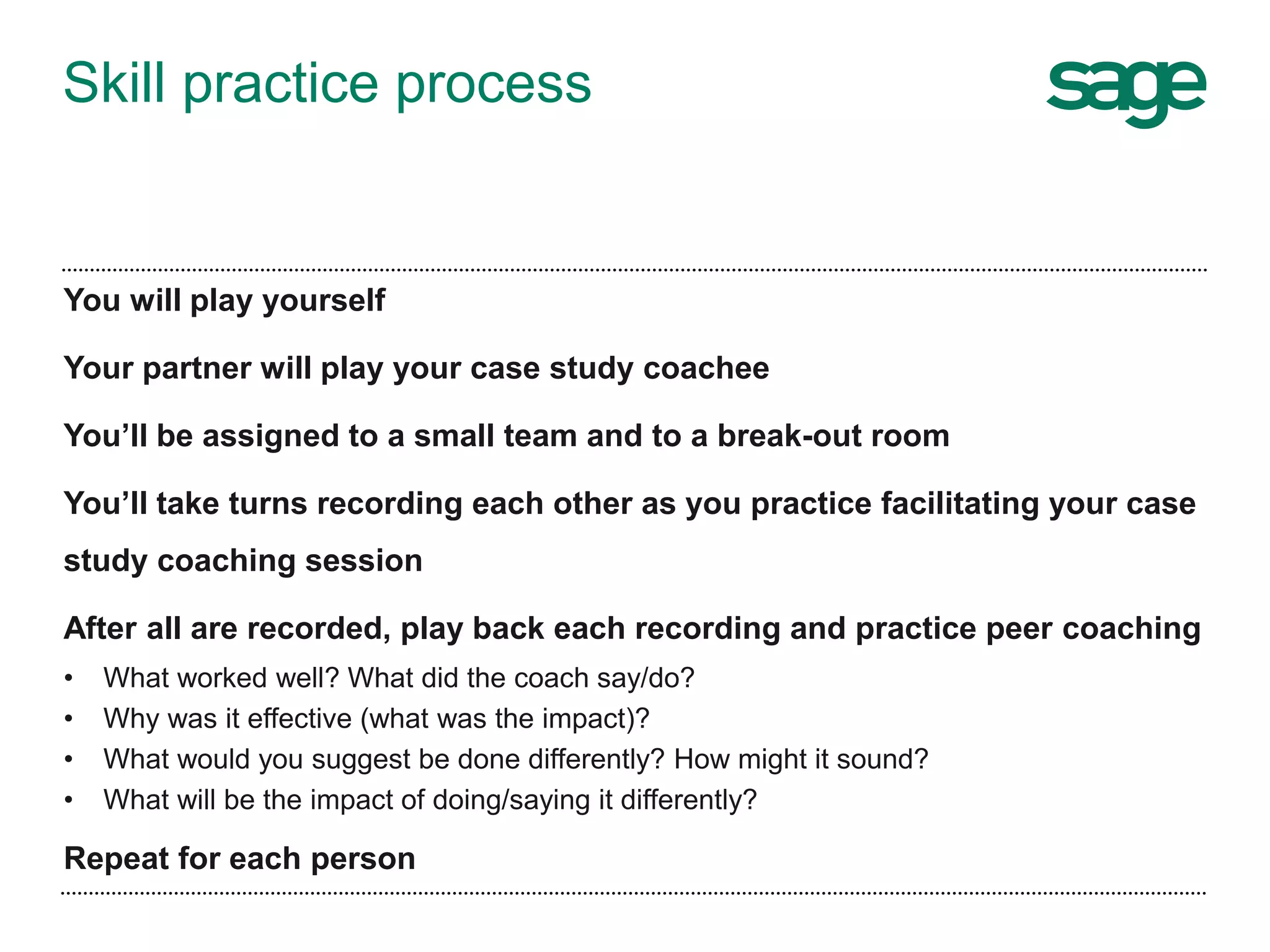
Skill practice process
You will play yourself
Your partner will play your case study coachee
You’ll be assigned to a small team and to a break-out room
You’ll take turns recording each other as you practice facilitating your case
study coaching session
After all are recorded, play back each recording and practice peer coaching
• What worked well? What did the coach say/do?
• Why was it effective (what was the impact)?
• What would you suggest be done differently? How might it sound?
• What will be the impact of doing/saying it differently?
Repeat for each person
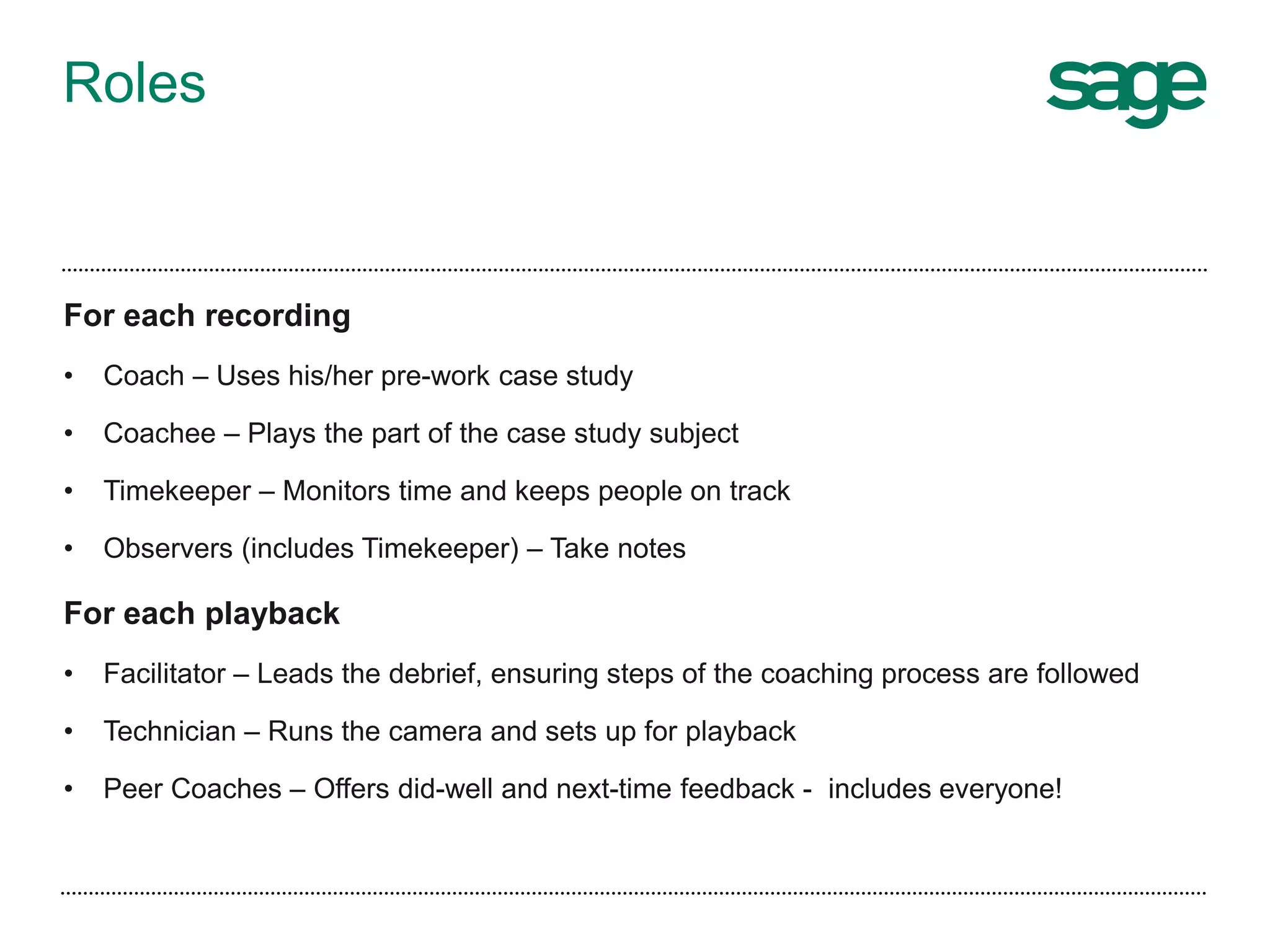
Roles
For each recording
• Coach – Uses his/her pre-work case study
• Coachee – Plays the part of the case study subject
• Timekeeper – Monitors time and keeps people on track
• Observers (includes Timekeeper) – Take notes
For each playback
• Facilitator – Leads the debrief, ensuring steps of the coaching process are followed
• Technician – Runs the camera and sets up for playback
• Peer Coaches – Offers did-well and next-time feedback - includes everyone!
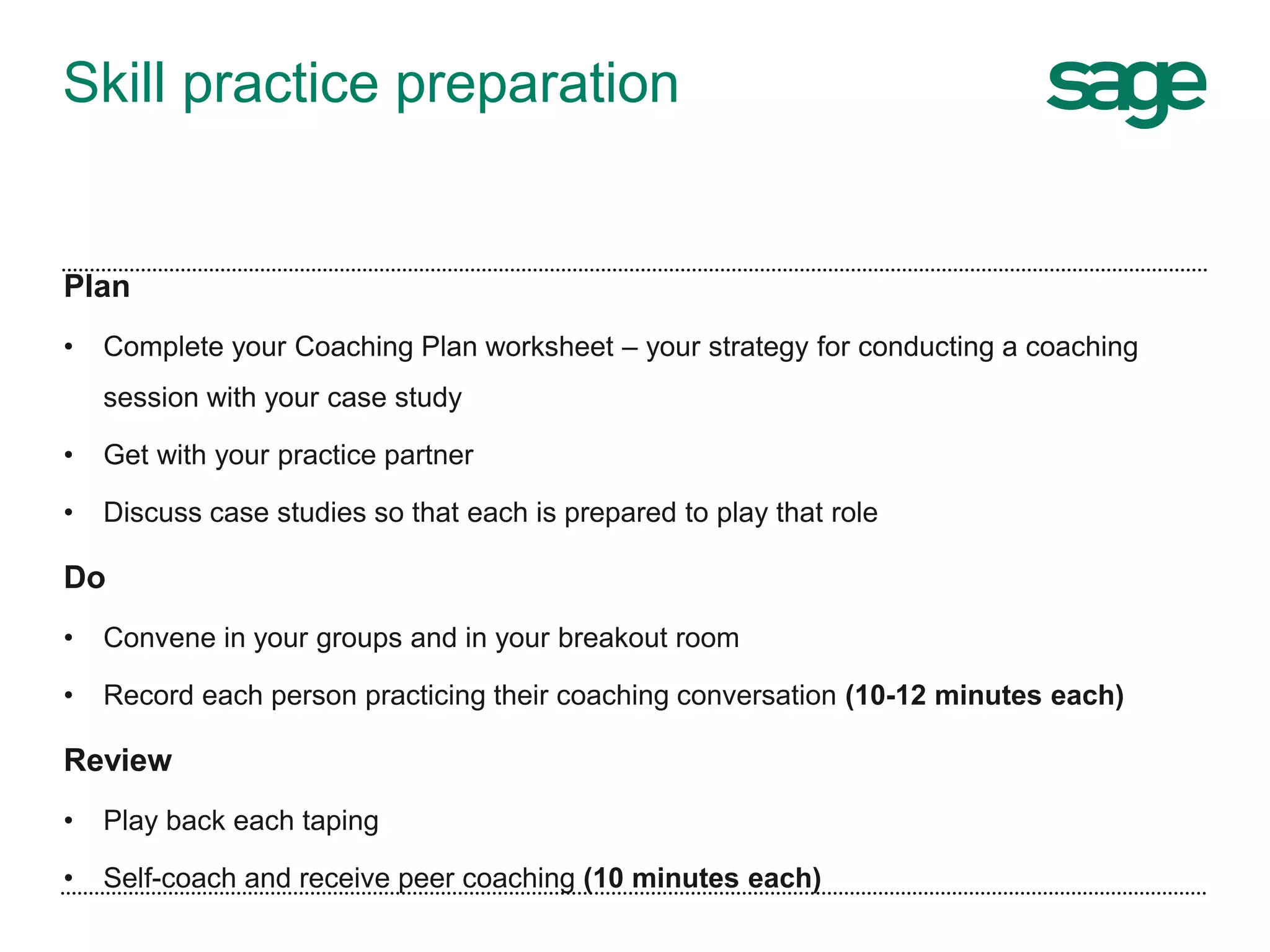
Skill practice preparation
Plan
• Complete your Coaching Plan worksheet – your strategy for conducting a coaching
session with your case study
• Get with your practice partner
• Discuss case studies so that each is prepared to play that role
Do
• Convene in your groups and in your breakout room
• Record each person practicing their coaching conversation (10-12 minutes each)
Review
• Play back each taping
• Self-coach and receive peer coaching (10 minutes each)
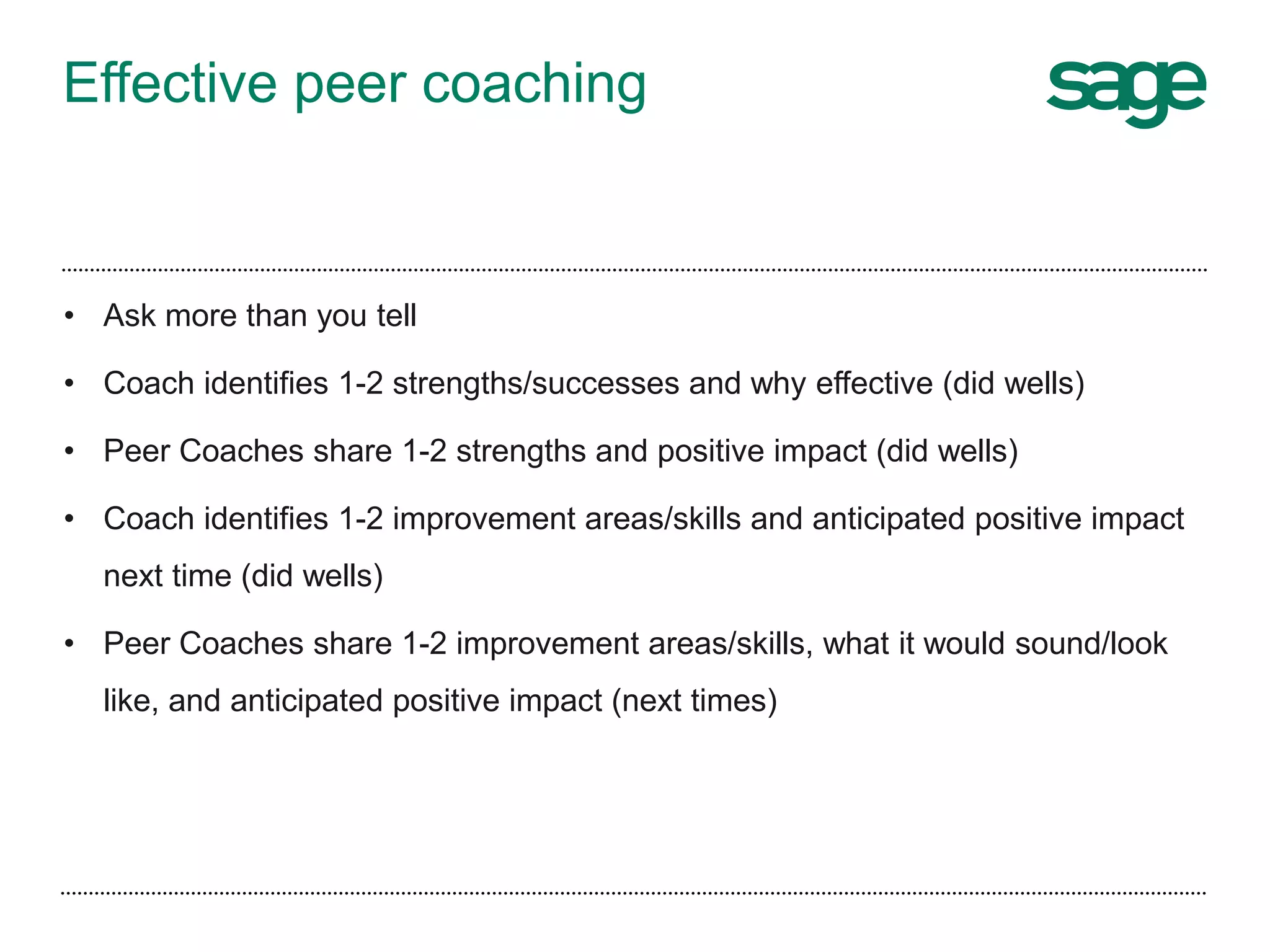
Effective peer coaching
• Ask more than you tell
• Coach identifies 1-2 strengths/successes and why effective (did wells)
• Peer Coaches share 1-2 strengths and positive impact (did wells)
• Coach identifies 1-2 improvement areas/skills and anticipated positive impact
next time (did wells)
• Peer Coaches share 1-2 improvement areas/skills, what it would sound/look
like, and anticipated positive impact (next times)
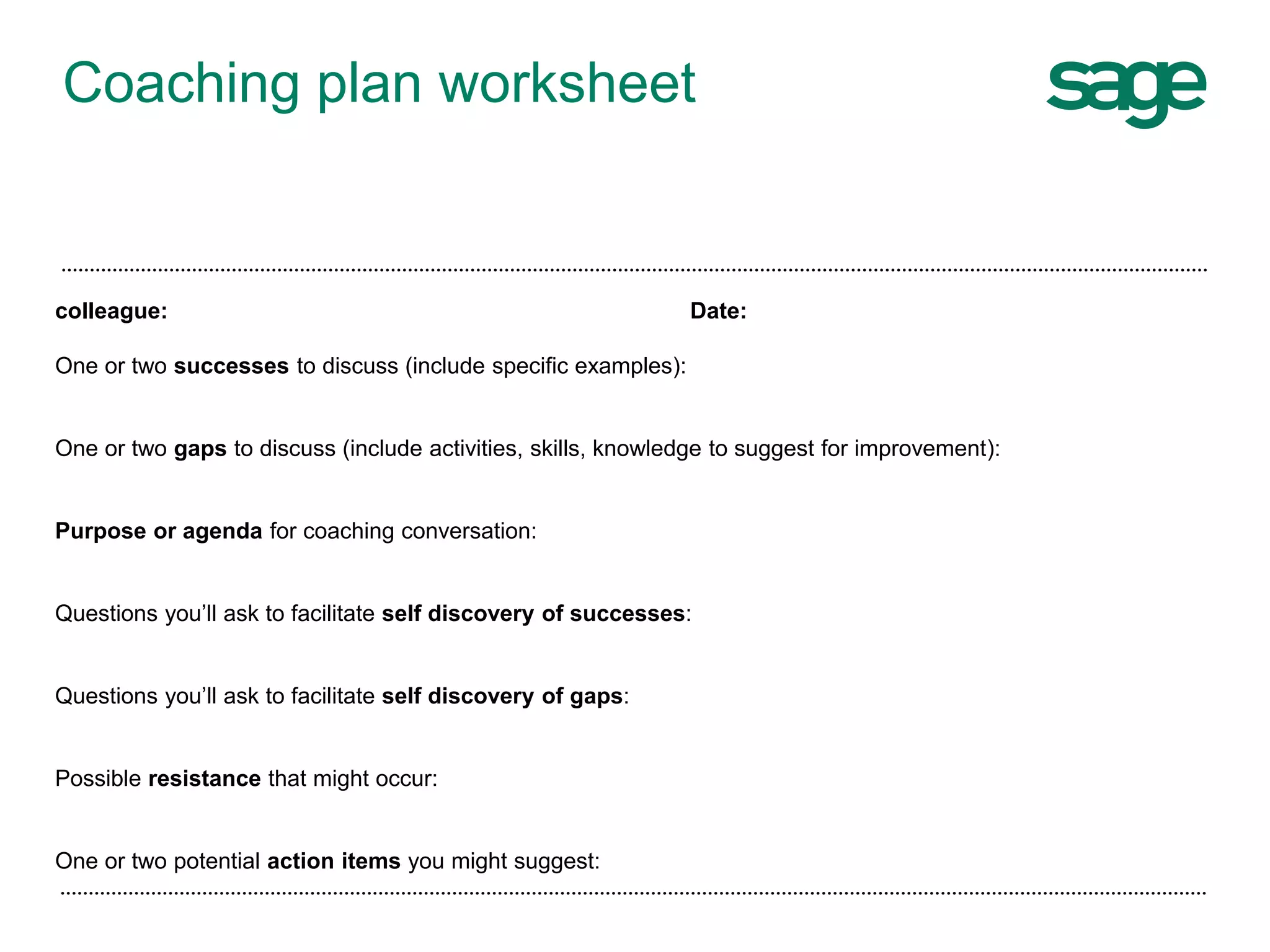
Coaching plan worksheet
colleague: Date:
One or two successes to discuss (include specific examples):
One or two gaps to discuss (include activities, skills, knowledge to suggest for improvement):
Purpose or agenda for coaching conversation:
Questions you’ll ask to facilitate self discovery of successes:
Questions you’ll ask to facilitate self discovery of gaps:
Possible resistance that might occur:
One or two potential action items you might suggest:
54
Planning for success
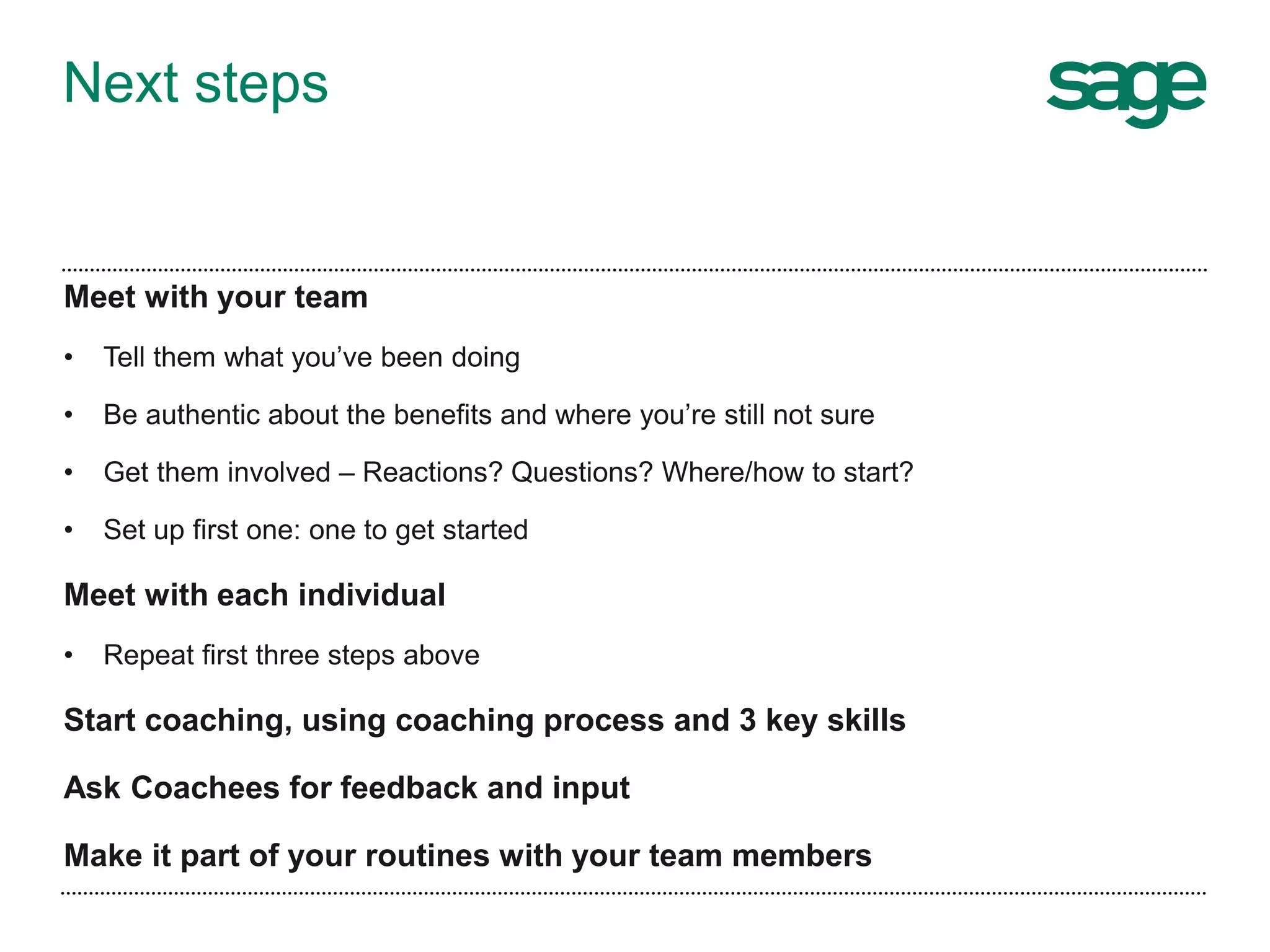
Next steps
Meet with your team
• Tell them what you’ve been doing
• Be authentic about the benefits and where you’re still not sure
• Get them involved – Reactions? Questions? Where/how to start?
• Set up first one: one to get started
Meet with each individual
• Repeat first three steps above
Start coaching, using coaching process and 3 key skills
Ask Coachees for feedback and input
Make it part of your routines with your team members
56
Appendix
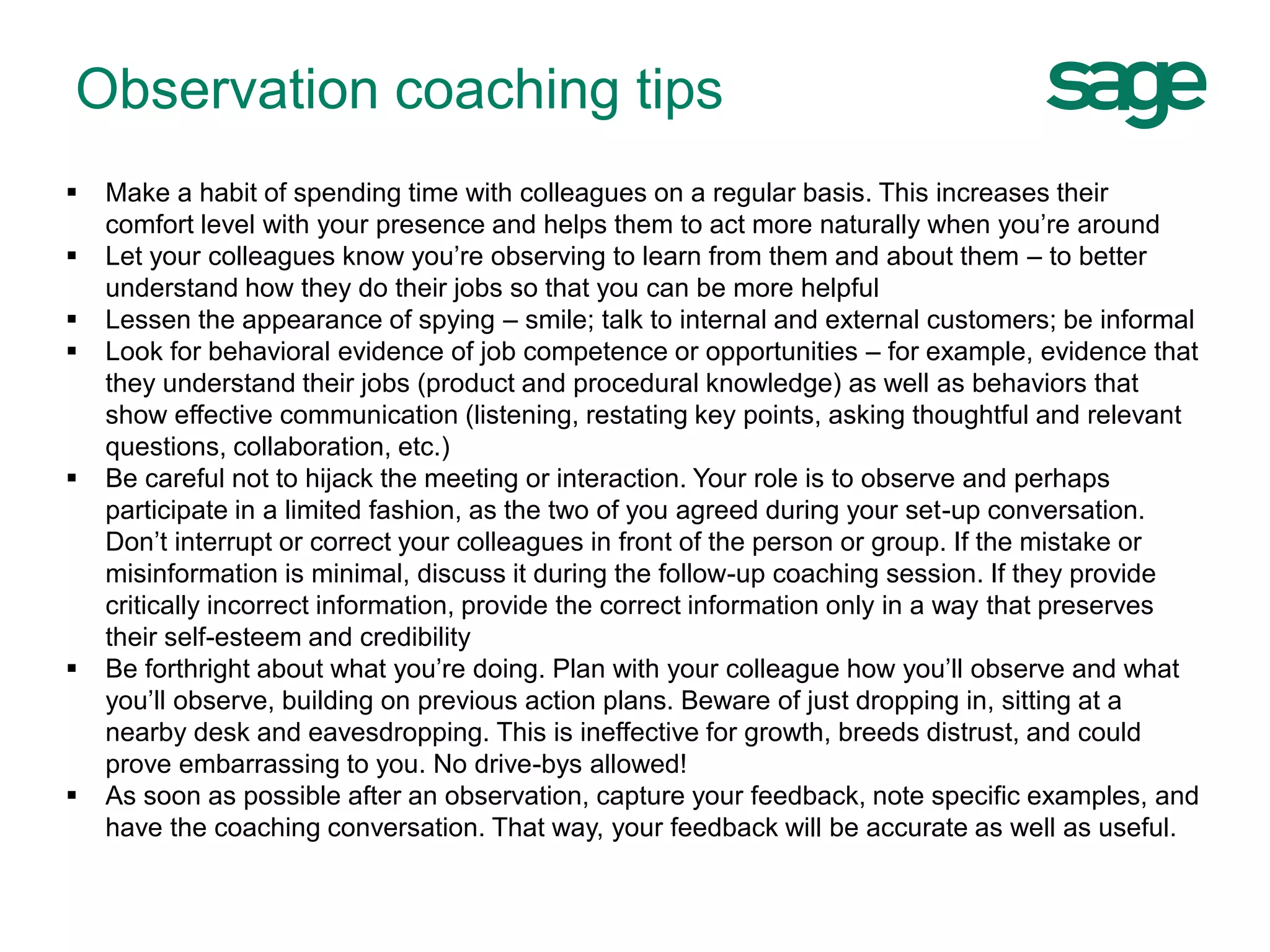
 Make a habit of spending time with colleagues on a regular basis. This increases their
comfort level with your presence and helps them to act more naturally when you’re around
 Let your colleagues know you’re observing to learn from them and about them – to better
understand how they do their jobs so that you can be more helpful
 Lessen the appearance of spying – smile; talk to internal and external customers; be informal
 Look for behavioral evidence of job competence or opportunities – for example, evidence that
they understand their jobs (product and procedural knowledge) as well as behaviors that
show effective communication (listening, restating key points, asking thoughtful and relevant
questions, collaboration, etc.)
 Be careful not to hijack the meeting or interaction. Your role is to observe and perhaps
participate in a limited fashion, as the two of you agreed during your set-up conversation.
Don’t interrupt or correct your colleagues in front of the person or group. If the mistake or
misinformation is minimal, discuss it during the follow-up coaching session. If they provide
critically incorrect information, provide the correct information only in a way that preserves
their self-esteem and credibility
 Be forthright about what you’re doing. Plan with your colleague how you’ll observe and what
you’ll observe, building on previous action plans. Beware of just dropping in, sitting at a
nearby desk and eavesdropping. This is ineffective for growth, breeds distrust, and could
prove embarrassing to you. No drive-bys allowed!
 As soon as possible after an observation, capture your feedback, note specific examples, and
have the coaching conversation. That way, your feedback will be accurate as well as useful.
Observation coaching tips

CoachingPresentation_VersionII

  • 1.
  • 2.
    Life cycle ofa business
  • 3.
    Session purposes To reinforce,remind, learn: • A coaching model/framework for driving dialogue, colleague development, and organizational change To ignite Sage’s vision in every colleague: • Heighten colleague engagement • Foster greater motivation, commitment, and 100% discretionary effort
  • 4.
    Agenda 1. The casefor change 2. Driving excellence in everything we do 3. What is coaching? 4. What do I coach to? The performance pyramid 5. How do I coach? The coaching model 6. The triumvirate of coaching skills Creating dialogue Balancing feedback Planning for action 7. Handling resistance 8. Practicing for improved execution 9. Wrap-up and commitments
  • 5.
    Introductions Why am Ihere? What’s important to me/what do I want to accomplish here at Sage? What do I want to accomplish during our time together?
  • 6.
    The case forchange Sage is on a rapidand transformative journey Most pivotal asset for success are our colleagues To achieve our ambition: We need to develop a strong, strategically aligned, confident workforce whose focus is executing with excellence, drive and speed
  • 7.
    • Sage Leaders setthe tone for excellence in all that we do • Clear goals and performance expectations Clarity • Ownership established through regular coaching and goals review, continuous improvement conversations Commitment • Colleague goals and aspirations connected to Sage NA strategic focus and our Brand Promise Connection Brand Promise Conversations for Excellence Customer Experience Colleague Experience
  • 8.
    Results Through People Your role asa Sage people leader Results through people See It! Want It! Own It!
  • 9.
    Tell our storyand translate Sage’s vision and strategic priorities into team and individual goals Set the bar for excellence Clarity Hold people accountable through strong execution plans, coaching, and feedback Drive success across Sage Commitment Connect each and every colleague with their passion, career aspirations, and strengths Build strong relationships and networks across Sage Connection Your Role as a Manager
  • 10.
    Start with clarity •I understand Sage’s strategic focus and direction. • I know what is expected of me at work. • I feel that my work is important. • At Sage, excellence matters. Your role as a manager is to tell our story and translate Sage’s vision and strategic priorities into team and individual goals
  • 11.
    Build connection • Iget to build off of my strengths every day. • I have goals that I am passionate about. • I’m learning and growing. • I’m adding value to my customers. • I am having a positive impact on our business. • Sage cares about me. Your role as a people manager is to connect each and every colleague with their passions, career aspirations, and strengths—and to build networks across Sage
  • 12.
    Attain and keepcommitment • I am focused on the right priorities. • I know what the desired end result looks like. • I have regular check- ins. • I receive ongoing feedback and coaching. • I am held accountable. Your role as a manager is to hold people accountable through strong execution plans, coaching, and feedback
  • 13.
  • 14.
    Coaching defined One/one conversationswith each colleague • Based on results and/or observation of job performance • Regularly scheduled • Both prepare and participate • Analyzes results, activities, skills, behaviors, and knowledge • Focuses on business goals • Results in action steps to sustain and improve The Result: A relationship in which collaboration produces accountability, development, and results Coaching is more like a marathon and less like a sprint – why?
  • 15.
    What coaching isnot • Only for problem colleagues • A performance plan session • A meeting where I tell you what you’re doing wrong • A meeting where I tell you how to do things
  • 16.
    What does effectivecoaching look like? • During quarterly performance meetings? • During 1:1’s? • For a high performing person? • In stressful situations? • When you don’t have positional power?
  • 17.
    Goal – 90% Excellence, Consistency ThePerformance Pyramid Not completely controllable Controllable Controllable © Omega Performance Making result more predictable
  • 18.
    What to coach Theperformance pyramid Work with your team. Compare your Performance Pyramid pre-work exercises. Choose one to present as a group, highlighting and being ready to explain the: • Result or outcome • High-impact activities • Critical skills, behaviors, knowledge
  • 19.
    Measure and observe Coachagain Agree on agenda Ask, then tell, did wells (Coachable Moments) Ask, then tell, next times (Coachable Moments) Agree on action plan (Next steps, noted down) Schedule PrepareB efore D uring A fter © Omega Performance How to coach The coaching model
  • 20.
    Who do youcoach? Star Above Average Average ROJ
  • 21.
    How do peoplefeel when they’ve been coached effectively? • Motivated • Respected • Valued • Validated • Energized • Enlightened • Confident • Empowered • Appreciated • Encouraged • Excited • Understood • Satisfied • Important • Part of a team • Making a difference
  • 22.
    Coaching big rocks Createdialogue • Ask first, then tell • Use 3 levels of questions to foster self discovery Drive change with action planning
  • 23.
    Creating dialogue and balancingfeedback Discuss successes before improvements Ask first, then tell Focus on future behavior • Say next time Be specific • Give examples Describe impact
  • 24.
    Creating dialogue Ask first Startwith strengths – did wells Ask questions that get people thinking and talking • What do you see as your greatest success this week/month/quarter? • What are you proudest of? • Tell me about your biggest accomplishment. • Which goals are you on target with? Ahead of target? Follow up with questions that dig deeper – activities, skills, behavior, knowledge • How did you do that? • What made you so successful? • What did you do to accomplish these successes? • Why was that effective? • Why did that work?
  • 25.
    Creating dialogue Respond, acknowledge,and then tell Respond to create conversation; paraphrase/summarize as necessary • That’s great! So it sounds like…. Tell coachee something else that he/she has done well • Here’s something else that I want to discuss… • I’ve also observed… • I’ve gotten feedback on … Include positive impact on customers, peers, goals Create action steps to sustain and expand skills • What will you continue to do? • How can you use ___ in other projects? • What do you want to note down and capture, because it’s one of your strengths?
  • 26.
    Balancing feedback Ask first Transitionto improvement opportunities – next times Ask questions that get people thinking and talking • What do you need to work on? • What is off track? • Tell me about the gap in _____you identified. • Which goals are behind? Follow up with questions that dig deeper – activities, skills, behavior, knowledge in future-oriented terms • How will you do that? • What will make you successful in improving ____? • What benefits do you see in changing ________? • How/Why will that change the outcome? • What will you actually say and do? • How comfortable are you . . . ? • What obstacles do you anticipate?
  • 27.
    Balancing feedback Respond, acknowledge,and then tell Respond to create conversation; paraphrase/summarize as necessary • Those are good ideas. So it sounds like…. • I think that will work well. Tell coachee something else that you want him/her to work on using future oriented terms • Here’s something else that I want you to work on … • Going forward….Next time… Include anticipated positive impact on customers, peers, results Create action steps to improve results and skills • What will you do differently going forward?
  • 28.
    Self discovery Impact/Result What wasthe impact? What will be the impact? Action How did you do it? How will you do it? “Did Well” Behavior “Next Time” What did you do? What will you do?
  • 29.
    High impact telling Impact/Result Howcan you use in other situations? What will be the impact? Action How did you do it? How might you do that? “Did Well” Behavior “Next Time” Here’s what you did: Next time…
  • 30.
    High impact telling Impact/Result Youcan use this in these situations… This will help you in this way… Action Specifically… It could sound/look like this… “Did Well” Behavior “Next Time” Here’s what you did: Next time…
  • 31.
    High impact questions Didwells • What did you do that led to the project’s success? • How did those things impact the project? • What specific actions/knowledge did you use to make that happen? • How did you know to do/use that? • What will you do to remind yourself to keep doing that?
  • 32.
    High impact questions Nexttimes • What area do you want to work on for next time? • How comfortable are you with…(that area)? • What would you do differently? • What actions will you take to make that happen? • What will get in your way and keep you from doing this?
  • 33.
    • What wouldyou like to discuss today? • What is the most important thing on your plate right now? • What is the next step you need to take? • What progress has been made? • How are you feeling about your work? • What are you most proud of this week? • In what way can I be more helpful to you? • What’s working? What’s not working? • In what areas do you feel you could develop professionally? Conversations for excellence
  • 34.
    Ask first Step 1 Formgroups of three. There will be three roles • Coachee • Coach • Observer Coachee: Frame your coaching case study scenario from pre-work (1 minute). Coachee answers questions. Coach: Gather more information on Coachee’s case study, using only questions. Go down three levels. Observer: Monitors time and takes notes of questions asked. Total time to ask questions: 5 minutes
  • 35.
    Then tell Step 2 Coachnow tells • What you think the coachee did well in the case study/approach • What you want him/her to do differently, using future-oriented language • Include specifics and impact Observer monitors time and takes notes on the coach’s tells Observer leads a short debrief on coach’s use of 3 levels of questions and use of balanced feedback Switch roles and repeat Total time for each round: 15 minutes
  • 36.
    Agree on actionplan Ask for summary of what colleague will do next time Respond to action plan Express confidence in colleague and support for plan
  • 37.
    SMART action steps SM A R T Specific Measureable Achievable Relevant Time bound • Answers these W questions (what, why, where, which) • How much? • How many? • How will I know when I have succeeded? • Within my control? • What do I need to learn? • Is it aligned with my overall goal/objec tive? • When? • What can I do before next coaching session? • What can I do today?
  • 38.
    Guidelines for effectiveaction plans 1. Start with an action verb • Increase • Decrease • Continue to • Stop doing 2. List what you want to continue or to change • Sales • Average handle time • Customer satisfaction score 3. How do you want to continue it or change it? • Number, percentage • Use in other areas/ways 4. How will you do it • By doing what activity? • Using what skill or behavior? 5. Date you’ll finish or date(s) for significant milestone accomplishments
  • 39.
    Example of anindividual contributor’s FY14 Q4 Objectives Objective: Manage and execute Sage 50-Accounting Canadian Edition launch for SAN Members Objective Detail: •Create direct marketing brand resource kit to be mailed to partners mid-September. Kit to include datasheets, templates and resources (similar to Sage 50 US kit but create one set of collateral with a Canadian theme) •Create two partner focused launch events, East coast and West coast, that celebrate Sage 50 and tie back to the Canadian theme of the launch North American Sage Accountants Network – FY14 business priorities Strategic Performance Support our strategic initiatives currently underway as we move towards a unified Sage in North America. These initiatives include: • Differentiating Sage through our Extraordinary Customer Experience • One Sage through our Sage branded house • Developing a new pricing model • Our move to the cloud • Leveraging best practices and best features across the Sage product line North American Goal Examples of Related Department Goals • Increase program value by increasing CPE accredited training for accountants • Effectively launch the new Sage brand, increasing awareness in the accountant channel • Create new and grow existing strategic partnerships, including CPA State Societies and AICPA, to bring greater awareness and exposure to Sage Example of Related Individual Goal
  • 40.
    Effective or not? •Ask a good mix of open and closed questions when on sales calls. • Increase customer satisfaction score 3% in the next 30 days by employing all required behaviors. • During my next team meeting, be sure to include all group members in the discussion by asking more questions, e.g. ‘How do the rest of you feel? Mary? John?’ Keep a list of questions used and their impact; to be debriefed at next week’s 1:1. • Meet with my team members at least once/month to keep them apprised of project progress and get their feedback.
  • 41.
    Exercise Action planning Work withyour neighbor(s) What will you be ready to offer to your case study coachee as potential action items? • At least 1 continue action item • No more than 2 stop or start action items Share with your neighbor(s) and get their help to ensure they’re SMART
  • 42.
    When colleagues pushback and resist What do they say? What do they do?
  • 43.
    Become defensive Get angry! Tell Argue Avoid Whatdo leaders do in response? Human reactions to resistance
  • 44.
    Before it everhappens Preparing for resistance Imagine it happening – worst case scenario Then picture yourself being successful in handling it • What will you say? • How will you act? Ask questions to get colleague involved throughout the conversation Specifically ask about obstacles—get them on the table early Directly address a likely concern before the colleague even brings it up
  • 45.
    Handling resistance  ProvideInformation  Position with Benefits or  Provide Alternative C R E A cknowledge xplore esolve heck for Satisfaction © Omega Performance
  • 46.
    How will yourespond? Work in groups of three – Coach, Coachee, Observer • Pick one of the resistance examples surfaced earlier that you think you’ll hear when you coach • Ask your Coachee partner to give you that particular resistance example • Take turns applying the steps for handling resistance: Round 1: Coach Coachee Observer Round 2: Rotate positions Round 3: Rotate positions again Each person plays each role once
  • 47.
  • 48.
    Measure and observe Coachagain Agree on agenda Ask, then tell, did wells Ask, then tell, next times Agree on action plan Schedule PrepareB efore D uring A fter © Omega Performance The coaching model
  • 49.
    Skill practice process Youwill play yourself Your partner will play your case study coachee You’ll be assigned to a small team and to a break-out room You’ll take turns recording each other as you practice facilitating your case study coaching session After all are recorded, play back each recording and practice peer coaching • What worked well? What did the coach say/do? • Why was it effective (what was the impact)? • What would you suggest be done differently? How might it sound? • What will be the impact of doing/saying it differently? Repeat for each person
  • 50.
    Roles For each recording •Coach – Uses his/her pre-work case study • Coachee – Plays the part of the case study subject • Timekeeper – Monitors time and keeps people on track • Observers (includes Timekeeper) – Take notes For each playback • Facilitator – Leads the debrief, ensuring steps of the coaching process are followed • Technician – Runs the camera and sets up for playback • Peer Coaches – Offers did-well and next-time feedback - includes everyone!
  • 51.
    Skill practice preparation Plan •Complete your Coaching Plan worksheet – your strategy for conducting a coaching session with your case study • Get with your practice partner • Discuss case studies so that each is prepared to play that role Do • Convene in your groups and in your breakout room • Record each person practicing their coaching conversation (10-12 minutes each) Review • Play back each taping • Self-coach and receive peer coaching (10 minutes each)
  • 52.
    Effective peer coaching •Ask more than you tell • Coach identifies 1-2 strengths/successes and why effective (did wells) • Peer Coaches share 1-2 strengths and positive impact (did wells) • Coach identifies 1-2 improvement areas/skills and anticipated positive impact next time (did wells) • Peer Coaches share 1-2 improvement areas/skills, what it would sound/look like, and anticipated positive impact (next times)
  • 53.
    Coaching plan worksheet colleague:Date: One or two successes to discuss (include specific examples): One or two gaps to discuss (include activities, skills, knowledge to suggest for improvement): Purpose or agenda for coaching conversation: Questions you’ll ask to facilitate self discovery of successes: Questions you’ll ask to facilitate self discovery of gaps: Possible resistance that might occur: One or two potential action items you might suggest:
  • 54.
  • 55.
    Next steps Meet withyour team • Tell them what you’ve been doing • Be authentic about the benefits and where you’re still not sure • Get them involved – Reactions? Questions? Where/how to start? • Set up first one: one to get started Meet with each individual • Repeat first three steps above Start coaching, using coaching process and 3 key skills Ask Coachees for feedback and input Make it part of your routines with your team members
  • 56.
  • 57.
     Make ahabit of spending time with colleagues on a regular basis. This increases their comfort level with your presence and helps them to act more naturally when you’re around  Let your colleagues know you’re observing to learn from them and about them – to better understand how they do their jobs so that you can be more helpful  Lessen the appearance of spying – smile; talk to internal and external customers; be informal  Look for behavioral evidence of job competence or opportunities – for example, evidence that they understand their jobs (product and procedural knowledge) as well as behaviors that show effective communication (listening, restating key points, asking thoughtful and relevant questions, collaboration, etc.)  Be careful not to hijack the meeting or interaction. Your role is to observe and perhaps participate in a limited fashion, as the two of you agreed during your set-up conversation. Don’t interrupt or correct your colleagues in front of the person or group. If the mistake or misinformation is minimal, discuss it during the follow-up coaching session. If they provide critically incorrect information, provide the correct information only in a way that preserves their self-esteem and credibility  Be forthright about what you’re doing. Plan with your colleague how you’ll observe and what you’ll observe, building on previous action plans. Beware of just dropping in, sitting at a nearby desk and eavesdropping. This is ineffective for growth, breeds distrust, and could prove embarrassing to you. No drive-bys allowed!  As soon as possible after an observation, capture your feedback, note specific examples, and have the coaching conversation. That way, your feedback will be accurate as well as useful. Observation coaching tips