WESTeast
A review of Reefton Area School as part of a wider review of 4
       west coast schools and their link with Te Kura
Method
Revisit Institutional Review (2010) What has changed?

Survey teaching staff - practice, beliefs in relation to blended/networked learning

Interview key staff - management, VC/Distance learning teacher
 - networks - existing and possibilities

Interview a number of senior students - perceptions of blended/networked
learning

Collaborate with Karamea, Westland and Greymouth to
compare/contrast
Method contd.


 Connections with Te Kura - current situation

 Analysis of current networks

 Future directions in relation to networked schooling
2010 review revisited
                   Key changes since 2010


Some senior students bring their own device to school

ipods in the two junior classes

Staff have an understanding of blended teaching/learning and have
participated in professional development

Many students are able to access materials/communicate in an online
environment

The school’s strategic plan contains goals and expectations about online
communication outside of the school day
Teaching Staff
                              Key points from survey and general discussion
                                     on networked learning/schools
   Current Networks                                        Use of lap tops, desktops is
           Te Kura
      Sport Canterbury                                        daily in most classes
           Westnet
 National Library/NorthWest
         Careers NZ                                        Google used at a basic level
      Trades Academy
     Gateway/employers
       email, phone, LMS                                    Power point still used
                                                             most - at basic level

    Assistance needed
          time                                                  Web tools/LMS used
         BYOD                                           for online resources/communication
hardware not meeting                                                     Wiki
    needs so flipped                                                   Edublog
                                                                        Moodle
classroom might be the                                                Google site
         answer                                                       Schoolzone
                                   Technology wish list                Edmodo
                                                                       You Tube
                     ipods, reliable lap tops, adobe connect, BYOD
                                        integration
Teaching Staff
                                 Key points from survey and general discussion
                                        on networked learning/schools
 Benefits of networking with
educational agencies/schools                                      Barriers of networking with
                                                                 educational agencies/schools
         Overcomes isolation
            Sharing skills                                                      Time
         Sharing information                                                  Distance
          Sharing expertise                                           Hardware not effective
          Shared planning                                                 System problems
             Moderating                                          Size of schools - better if they are
         Access to resources                                           May not be reciprocal
         Maximise expertise                                   Communication can be difficult - used as
          Shared planning                                           an excuse by some students
                Sports
               Support


                     Te Kura                              Obvious networking partners
Collegial and collaborative                             TOSI network
Essential for Distance Learning support                 Need inspiration who ever we network with
Not always up to date to reflect ict/blended learning
practices
Management Perspectives
                                    Networked schooling
                                                          Established procedures for
                                                                     Westnet
              Issues raised                                           VLN
Online relationships need to be worked on                            Te Kura
Students need to develop self managing                                Porse
Teachers need to build students competencies                    Open Polytechnic
through building their own                                     Tai Poutini Polytech
Open teachers eyes to the possibilities                         Fairview Motors
Flexible time table needs to be developed                      Waikato University


     TOSI area schools might be an obvious network to
                       build further
Students
                                             Distance Learning
                      Positives
  All of the students interviewed mentioned that
 the most positive aspect of distance learning was
    the ability to choose when to work. They all                                       Currently there are
     acknowledged, some with prompting, that                                            4 students enrolled with Telford (Agriculture)
distance learning courses offered more variety and                                     16 students enrolled with Te Kura
  allowed them to take courses not offered at the                                      4 students enrolled with PORSE (ECE)
                       school.                                                         8 students enrolled with Fairview(automotive)
                                                 Negatives                             1 student enrolled with HITO (Hairdressing)
                                               Most students                           7 students enrolled with Tourism course
                                             mentioned the lack                        1 student enrolled with Waikato University
              Skills Needed                          of                                1 student enrolled in VLN course through
     All of the students interviewed             immediate                             Westnet
      stated that self management             feedback if they
      skills are important as it was          had a problem.
       easy to be distracted from
       completing work on time.


                                                            Networking
      All of the students stated that they got most support from teachers on site. One student was not aware they could
                                                                                                                          at
      contact their tutor or course controller. Contact is by email. Most students had not contacted their distance tutor
                                                                                                                        to
       all, relying on onsite support. So, the information shows that the students are not using any on-line networks
         support their learning other than completing the course materials. Also, they are not networking with other
                                       students completing the same course at a distance.
Distance learning coordinators

            On Te Kura...                                                            On Westnet...
 Internal systems seem to need revising -                               One student at Reefton Area School is
there seems to be a lack of communication                               taking a VLN course. The interviewee
             between personnel.                                         teaches a class through the VLN.
Individual teacher records do not seem to                               Westnet provides PD for the ecoordinators
                be very good                                            from each member school- online
  OTLE learning management system is a                                  meetings, ehui once a year. Marlborough
 positive step - needs to be extended to all                            has just joined Westnet. The courses
     courses and expanded so that all                                   offered are quite diverse amongst the
  assignments etc can be uploaded. This                                 members of this network. This
 would give coordinators an oversight to                                interviewee has branched out to a wider
   assist students to manage workload                                   network - Cantanet - as,professional
                                                                        development wise, needs are no longer met
                                                                        by the smaller network.


                                               Students’networks
    There are networks available for students taking distance courses. Currently, the students do not make use of
    them. Most rely on the on site teachers for support - this is not often the best support as the on site teachers
    may not be experts in the online subjects. Education needed to make students aware of the necessity of using
    these support networks to increase their chances of being successful in their chosen fields. One aspect that
    may help future students in collaboration and communication is the use of blended learning teaching and
    learning strategies throughout their schooling from an early age.
How does Reefton Area School compare to two other
west coast schools...
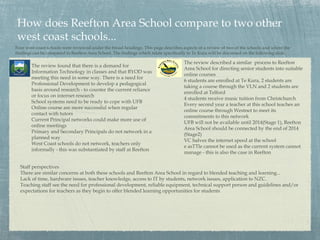
Four west coast schools were reviewed under the broad headings. This page describes aspects of a review of two of the schools and where the
findings can be compared to Reefton Area School. The findings which relate specifically to Te Kura will be discussed on the following slide

                                                                                     The review described a similar process to Reefton
        The review found that there is a demand for
                                                                                     Area School for directing senior students into suitable
        Information Technology in classes and that BYOD was
                                                                                     online courses
        meeting this need in some way. There is a need for
                                                                                     6 students are enrolled at Te Kura, 2 students are
        Professional Development to develop a pedagogical
                                                                                     taking a course through the VLN and 2 students are
        basis around research - to counter the current reliance
                                                                                     enrolled at Telford
        or focus on internet research
                                                                                     4 students receive music tuition from Christchurch
        School systems need to be ready to cope with UFB
                                                                                     Every second year a teacher at this school teaches an
        Online course are more successful when regular
                                                                                     online course through Westnet to meet its
        contact with tutors
                                                                                     commitments to this network
        Current Principal networks could make more use of
                                                                                     UFB will not be available until 2014(Stage 1), Reefton
        online meetings
                                                                                     Area School should be connected by the end of 2014
        Primary and Secondary Principals do not network in a
                                                                                     (Stage2)
        planned way
                                                                                     VC halves the internet speed at the school
        West Coast schools do not network, teachers only
                                                                                     e asTTle cannot be used as the current system cannot
        informally - this was substantiated by staff at Reefton
                                                                                     manage - this is also the case in Reefton

  Staff perspectives
  There are similar concerns at both these schools and Reefton Area School in regard to blended teaching and learning...
  Lack of time, hardware issues, teacher knowledge, access to IT by students, network issues, application to NZC.
  Teaching staff see the need for professional development, reliable equipment, technical support person and guidelines and/or
  expectations for teachers as they begin to offer blended learning opportunities for students
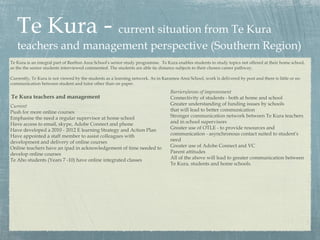
Te Kura - current situation from Te Kura
   teachers and management perspective (Southern Region)
Te Kura is an integral part of Reefton Area School’s senior study programme. Te Kura enables students to study topics not offered at their home school,
as the the senior students interviewed commented. The students are able tie distance subjects to their chosen career pathway.

Currently, Te Kura is not viewed by the students as a learning network. As in Karamea Area School, work is delivered by post and there is little or no
communication between student and tutor other than on paper.
                                                                                  Barriers/areas of improvement
Te Kura teachers and management                                                   Connectivity of students - both at home and school
Current                                                                           Greater understanding of funding issues by schools
Push for more online courses                                                      that will lead to better communication
Emphasise the need a regular supervisor at home school                            Stronger communication network between Te Kura teachers
Have access to email, skype, Adobe Connect and phone                              and in school supervisors
Have developed a 2010 - 2012 E learning Strategy and Action Plan                  Greater use of OTLE - to provide resources and
Have appointed a staff member to assist colleagues with                           communication - asynchronous contact suited to student’s
development and delivery of online courses                                        need
Online teachers have an ipad in acknowledgement of time needed to                 Greater use of Adobe Connect and VC
develop online courses                                                            Parent attitudes
Te Aho students (Years 7 -10) have online integrated classes                      All of the above will lead to greater communication between
                                                                                  Te Kura, students and home schools.
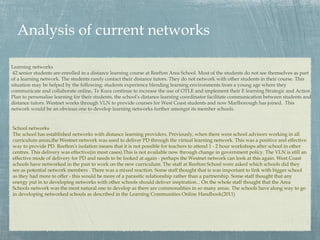
Analysis of current networks

Learning networks
 42 senior students are enrolled in a distance learning course at Reefton Area School. Most of the students do not see themselves as part
of a learning network. The students rarely contact their distance tutors. They do not network with other students in their course. This
situation may be helped by the following: students experience blending learning environments from a young age where they
communicate and collaborate online, Te Kura continue to increase the use of OTLE and implement their E learning Strategic and Action
Plan to personalise learning for their students, the school’s distance learning coordinator facilitate communication between students and
distance tutors. Westnet works through VLN to provide courses for West Coast students and now Marlborough has joined. This
network would be an obvious one to develop learning networks further amongst its member schools.


School networks
The school has established networks with distance learning providers. Previously, when there were school advisors working in all
curriculum areas,the Westnet network was used to deliver PD through the virtual learning network. This was a positive and effective
way to provide PD. Reefton’s isolation means that it is not possible for teachers to attend 1 - 2 hour workshops after school in other
centres. This delivery was effective(in most cases).This is not available now through change in government policy. The VLN is still an
effective mode of delivery for PD and needs to be looked at again - perhaps the Westnet network can look at this again. West Coast
schools have networked in the past to work on the new curriculum. The staff at Reefton School were asked which schools did they
see as potential network members . There was a mixed reaction. Some staff thought that is was important to link with bigger school
as they had more to offer - this would be more of a parasitic relationship rather than a partnership. Some staff thought that any
energy put in to developing networks with other schools should deliver inspiration... On the whole staff thought that the Area
Schools network was the most natural one to develop as there are commonalities in so many areas. The schools have along way to go
in developing networked schools as described in the Learning Communities Online Handbook(2011)
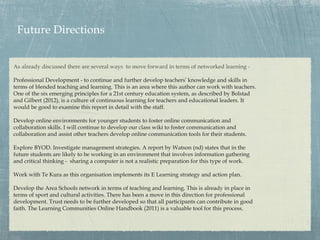
Future Directions


As already discussed there are several ways to move forward in terms of networked learning -

Professional Development - to continue and further develop teachers’ knowledge and skills in
terms of blended teaching and learning. This is an area where this author can work with teachers.
One of the six emerging principles for a 21st century education system, as described by Bolstad
and Gilbert (2012), is a culture of continuous learning for teachers and educational leaders. It
would be good to examine this report in detail with the staff.

Develop online environments for younger students to foster online communication and
collaboration skills. I will continue to develop our class wiki to foster communication and
collaboration and assist other teachers develop online communication tools for their students.

Explore BYOD. Investigate management strategies. A report by Watson (nd) states that in the
future students are likely to be working in an environment that involves information gathering
and critical thinking - sharing a computer is not a realistic preparation for this type of work.

Work with Te Kura as this organisation implements its E Learning strategy and action plan.

Develop the Area Schools network in terms of teaching and learning. This is already in place in
terms of sport and cultural activities. There has been a move in this direction for professional
development. Trust needs to be further developed so that all participants can contribute in good
faith. The Learning Communities Online Handbook (2011) is a valuable tool for this process.
References


  Bacsich, P & Davis, N. A conversation at Canterbury University.(2012). http://connect.canterbury.ac.nz/p3yhw9dymp5/


  Barbour et al (2011). Online and Blended Learning: A Survey of Policy and Practice of K-12 Schools Around the World. Retrieved from http://www.inacol.org/research/bookstore/detail.php?id=31


  Bolstad, R. & Lin, M (2010). Students’ experiences of learning in virtual classrooms. Wellington:New Zealand Council for Educational Research.


  Bolstad, R. & Gilbert, J.(2012). Supporting future-oriented learning and teaching - a New Zealand perspective. Wellington: New Zealand Council for Educational Research.


  Dabner, N. & Chowfin, A. (2011). Project-based professional development: Reflections in and on action implementing blended learning with primary school students (HTML). Computers in New


  Gerbic, P. (2011): Teaching using a blended approach – what does the literature tell us?, Educational Media International, 48(3), 221-234


  Ministry of Education (2011). Learning Communities Online (LCO) Handbook. Retrieved February 10, 2011 from http://www.vln.school.nz/pg/groups/2644/lco-handbook/


  Pratt, K. & Trewern, A. (2011). Students’ experiences of flexible learning options: What can they tell us about what they need for success?
  Computers in New Zealand Schools: Learning, Teaching, Technology, 23 (2), 137-152.


  Watson, J. (2009). Blended Learning: The Convergence of Online and Face-To-Face Education [N. America moving from entirely distance to include F2F]. Retrieved January 10, 2012 from
  http://www.inacol.org/research/promisingpractices/index.php


  Te Kura - The Correspondence School - E learning Strategy and Action Plan, 2010 – 2012

Westeast review

  • 1.
    WESTeast A review ofReefton Area School as part of a wider review of 4 west coast schools and their link with Te Kura
  • 2.
    Method Revisit Institutional Review(2010) What has changed? Survey teaching staff - practice, beliefs in relation to blended/networked learning Interview key staff - management, VC/Distance learning teacher - networks - existing and possibilities Interview a number of senior students - perceptions of blended/networked learning Collaborate with Karamea, Westland and Greymouth to compare/contrast
  • 3.
    Method contd. Connectionswith Te Kura - current situation Analysis of current networks Future directions in relation to networked schooling
  • 4.
    2010 review revisited Key changes since 2010 Some senior students bring their own device to school ipods in the two junior classes Staff have an understanding of blended teaching/learning and have participated in professional development Many students are able to access materials/communicate in an online environment The school’s strategic plan contains goals and expectations about online communication outside of the school day
  • 5.
    Teaching Staff Key points from survey and general discussion on networked learning/schools Current Networks Use of lap tops, desktops is Te Kura Sport Canterbury daily in most classes Westnet National Library/NorthWest Careers NZ Google used at a basic level Trades Academy Gateway/employers email, phone, LMS Power point still used most - at basic level Assistance needed time Web tools/LMS used BYOD for online resources/communication hardware not meeting Wiki needs so flipped Edublog Moodle classroom might be the Google site answer Schoolzone Technology wish list Edmodo You Tube ipods, reliable lap tops, adobe connect, BYOD integration
  • 6.
    Teaching Staff Key points from survey and general discussion on networked learning/schools Benefits of networking with educational agencies/schools Barriers of networking with educational agencies/schools Overcomes isolation Sharing skills Time Sharing information Distance Sharing expertise Hardware not effective Shared planning System problems Moderating Size of schools - better if they are Access to resources May not be reciprocal Maximise expertise Communication can be difficult - used as Shared planning an excuse by some students Sports Support Te Kura Obvious networking partners Collegial and collaborative TOSI network Essential for Distance Learning support Need inspiration who ever we network with Not always up to date to reflect ict/blended learning practices
  • 7.
    Management Perspectives Networked schooling Established procedures for Westnet Issues raised VLN Online relationships need to be worked on Te Kura Students need to develop self managing Porse Teachers need to build students competencies Open Polytechnic through building their own Tai Poutini Polytech Open teachers eyes to the possibilities Fairview Motors Flexible time table needs to be developed Waikato University TOSI area schools might be an obvious network to build further
  • 8.
    Students Distance Learning Positives All of the students interviewed mentioned that the most positive aspect of distance learning was the ability to choose when to work. They all Currently there are acknowledged, some with prompting, that 4 students enrolled with Telford (Agriculture) distance learning courses offered more variety and 16 students enrolled with Te Kura allowed them to take courses not offered at the 4 students enrolled with PORSE (ECE) school. 8 students enrolled with Fairview(automotive) Negatives 1 student enrolled with HITO (Hairdressing) Most students 7 students enrolled with Tourism course mentioned the lack 1 student enrolled with Waikato University Skills Needed of 1 student enrolled in VLN course through All of the students interviewed immediate Westnet stated that self management feedback if they skills are important as it was had a problem. easy to be distracted from completing work on time. Networking All of the students stated that they got most support from teachers on site. One student was not aware they could at contact their tutor or course controller. Contact is by email. Most students had not contacted their distance tutor to all, relying on onsite support. So, the information shows that the students are not using any on-line networks support their learning other than completing the course materials. Also, they are not networking with other students completing the same course at a distance.
  • 9.
    Distance learning coordinators On Te Kura... On Westnet... Internal systems seem to need revising - One student at Reefton Area School is there seems to be a lack of communication taking a VLN course. The interviewee between personnel. teaches a class through the VLN. Individual teacher records do not seem to Westnet provides PD for the ecoordinators be very good from each member school- online OTLE learning management system is a meetings, ehui once a year. Marlborough positive step - needs to be extended to all has just joined Westnet. The courses courses and expanded so that all offered are quite diverse amongst the assignments etc can be uploaded. This members of this network. This would give coordinators an oversight to interviewee has branched out to a wider assist students to manage workload network - Cantanet - as,professional development wise, needs are no longer met by the smaller network. Students’networks There are networks available for students taking distance courses. Currently, the students do not make use of them. Most rely on the on site teachers for support - this is not often the best support as the on site teachers may not be experts in the online subjects. Education needed to make students aware of the necessity of using these support networks to increase their chances of being successful in their chosen fields. One aspect that may help future students in collaboration and communication is the use of blended learning teaching and learning strategies throughout their schooling from an early age.
  • 10.
    How does ReeftonArea School compare to two other west coast schools... Four west coast schools were reviewed under the broad headings. This page describes aspects of a review of two of the schools and where the findings can be compared to Reefton Area School. The findings which relate specifically to Te Kura will be discussed on the following slide The review described a similar process to Reefton The review found that there is a demand for Area School for directing senior students into suitable Information Technology in classes and that BYOD was online courses meeting this need in some way. There is a need for 6 students are enrolled at Te Kura, 2 students are Professional Development to develop a pedagogical taking a course through the VLN and 2 students are basis around research - to counter the current reliance enrolled at Telford or focus on internet research 4 students receive music tuition from Christchurch School systems need to be ready to cope with UFB Every second year a teacher at this school teaches an Online course are more successful when regular online course through Westnet to meet its contact with tutors commitments to this network Current Principal networks could make more use of UFB will not be available until 2014(Stage 1), Reefton online meetings Area School should be connected by the end of 2014 Primary and Secondary Principals do not network in a (Stage2) planned way VC halves the internet speed at the school West Coast schools do not network, teachers only e asTTle cannot be used as the current system cannot informally - this was substantiated by staff at Reefton manage - this is also the case in Reefton Staff perspectives There are similar concerns at both these schools and Reefton Area School in regard to blended teaching and learning... Lack of time, hardware issues, teacher knowledge, access to IT by students, network issues, application to NZC. Teaching staff see the need for professional development, reliable equipment, technical support person and guidelines and/or expectations for teachers as they begin to offer blended learning opportunities for students
  • 11.
    Te Kura -current situation from Te Kura teachers and management perspective (Southern Region) Te Kura is an integral part of Reefton Area School’s senior study programme. Te Kura enables students to study topics not offered at their home school, as the the senior students interviewed commented. The students are able tie distance subjects to their chosen career pathway. Currently, Te Kura is not viewed by the students as a learning network. As in Karamea Area School, work is delivered by post and there is little or no communication between student and tutor other than on paper. Barriers/areas of improvement Te Kura teachers and management Connectivity of students - both at home and school Current Greater understanding of funding issues by schools Push for more online courses that will lead to better communication Emphasise the need a regular supervisor at home school Stronger communication network between Te Kura teachers Have access to email, skype, Adobe Connect and phone and in school supervisors Have developed a 2010 - 2012 E learning Strategy and Action Plan Greater use of OTLE - to provide resources and Have appointed a staff member to assist colleagues with communication - asynchronous contact suited to student’s development and delivery of online courses need Online teachers have an ipad in acknowledgement of time needed to Greater use of Adobe Connect and VC develop online courses Parent attitudes Te Aho students (Years 7 -10) have online integrated classes All of the above will lead to greater communication between Te Kura, students and home schools.
  • 12.
    Analysis of currentnetworks Learning networks 42 senior students are enrolled in a distance learning course at Reefton Area School. Most of the students do not see themselves as part of a learning network. The students rarely contact their distance tutors. They do not network with other students in their course. This situation may be helped by the following: students experience blending learning environments from a young age where they communicate and collaborate online, Te Kura continue to increase the use of OTLE and implement their E learning Strategic and Action Plan to personalise learning for their students, the school’s distance learning coordinator facilitate communication between students and distance tutors. Westnet works through VLN to provide courses for West Coast students and now Marlborough has joined. This network would be an obvious one to develop learning networks further amongst its member schools. School networks The school has established networks with distance learning providers. Previously, when there were school advisors working in all curriculum areas,the Westnet network was used to deliver PD through the virtual learning network. This was a positive and effective way to provide PD. Reefton’s isolation means that it is not possible for teachers to attend 1 - 2 hour workshops after school in other centres. This delivery was effective(in most cases).This is not available now through change in government policy. The VLN is still an effective mode of delivery for PD and needs to be looked at again - perhaps the Westnet network can look at this again. West Coast schools have networked in the past to work on the new curriculum. The staff at Reefton School were asked which schools did they see as potential network members . There was a mixed reaction. Some staff thought that is was important to link with bigger school as they had more to offer - this would be more of a parasitic relationship rather than a partnership. Some staff thought that any energy put in to developing networks with other schools should deliver inspiration... On the whole staff thought that the Area Schools network was the most natural one to develop as there are commonalities in so many areas. The schools have along way to go in developing networked schools as described in the Learning Communities Online Handbook(2011)
  • 13.
    Future Directions As alreadydiscussed there are several ways to move forward in terms of networked learning - Professional Development - to continue and further develop teachers’ knowledge and skills in terms of blended teaching and learning. This is an area where this author can work with teachers. One of the six emerging principles for a 21st century education system, as described by Bolstad and Gilbert (2012), is a culture of continuous learning for teachers and educational leaders. It would be good to examine this report in detail with the staff. Develop online environments for younger students to foster online communication and collaboration skills. I will continue to develop our class wiki to foster communication and collaboration and assist other teachers develop online communication tools for their students. Explore BYOD. Investigate management strategies. A report by Watson (nd) states that in the future students are likely to be working in an environment that involves information gathering and critical thinking - sharing a computer is not a realistic preparation for this type of work. Work with Te Kura as this organisation implements its E Learning strategy and action plan. Develop the Area Schools network in terms of teaching and learning. This is already in place in terms of sport and cultural activities. There has been a move in this direction for professional development. Trust needs to be further developed so that all participants can contribute in good faith. The Learning Communities Online Handbook (2011) is a valuable tool for this process.
  • 14.
    References Bacsich,P & Davis, N. A conversation at Canterbury University.(2012). http://connect.canterbury.ac.nz/p3yhw9dymp5/ Barbour et al (2011). Online and Blended Learning: A Survey of Policy and Practice of K-12 Schools Around the World. Retrieved from http://www.inacol.org/research/bookstore/detail.php?id=31 Bolstad, R. & Lin, M (2010). Students’ experiences of learning in virtual classrooms. Wellington:New Zealand Council for Educational Research. Bolstad, R. & Gilbert, J.(2012). Supporting future-oriented learning and teaching - a New Zealand perspective. Wellington: New Zealand Council for Educational Research. Dabner, N. & Chowfin, A. (2011). Project-based professional development: Reflections in and on action implementing blended learning with primary school students (HTML). Computers in New Gerbic, P. (2011): Teaching using a blended approach – what does the literature tell us?, Educational Media International, 48(3), 221-234 Ministry of Education (2011). Learning Communities Online (LCO) Handbook. Retrieved February 10, 2011 from http://www.vln.school.nz/pg/groups/2644/lco-handbook/ Pratt, K. & Trewern, A. (2011). Students’ experiences of flexible learning options: What can they tell us about what they need for success? Computers in New Zealand Schools: Learning, Teaching, Technology, 23 (2), 137-152. Watson, J. (2009). Blended Learning: The Convergence of Online and Face-To-Face Education [N. America moving from entirely distance to include F2F]. Retrieved January 10, 2012 from http://www.inacol.org/research/promisingpractices/index.php Te Kura - The Correspondence School - E learning Strategy and Action Plan, 2010 – 2012

Editor's Notes

  • #6 No teachers mentioned VLN - students at this school have not had success in the past - mainly due to a mix of the following -mismatch of subject and student, lack of self management skills, VC teacher competence.1 student currently taking a subject through VC. I teacher teaching a VC sub. Reading by Gerbic (2011) - the research identified 4 conceptions of blended learning - practice so far at RAS mainly reflects “ Providing students with information ” no connection between the learning outcomes and the media - role of teacher still emphasised. At this stage existing practice may be replicated online - the literature reviewed by Gerbic cites lack of time and professional support reason for the potential of the technology and reality.
  • #7 Paul Bacsich - monolithic organisations like Te Kura are left alone in other countries - not networked with
  • #8 Paul Bacsich states that blended learning is needed as a foundation to make virtual learning work. As the younger students take part in online learning, communication and collaboration most will feel at home in this environment.It is interesting to note that most teaching staff and management feel that only students who have self management skills are able to succeed in distance learning courses. Bolstad and Lin(2010) states that this is not the case and found that online distance teachers need to be proactive and engage their students by ensuring that they show the students that they care about them as learners. Also the home school needs to actively support the students.
  • #10 Bolstad (2010) states that all students have the potential to be online learners.
  • #11 The author of Karamea Area school ’ s review concluded that slow paced professional development was needed. This is true for all three schools. Blended teaching and learning must be based on pedagogy. Teachers need to be given time to explore web tools, and their use, to assist them to deliver the curriculum. Hardware is an issue in all three schools. Reefton Area school has found that laptop pods do not stand up to multi users. A small number of students are bring their own laptops as they are at Westland High School. This is working at the moment as numbers are small. However, as the number brought in grows other issues will need to be addressed - how will the network be adapted to cope? What procedures need to be put in place?
  • #12 Students may be the only one taking the course in their home school, an online community developed around the subject would help alleviate a student ’ s isolation. Te Kura teachers emphasised the need for a regular supervisor at the home school to guide the student that needs help. Te Kura have developed a 2010 - 2012 E learning Strategic and Action Plan that is in the early stages of implementation. The document describes the need for personalised learning that engages students. It was interesting that some home schools do not cooperate fully with Te Kura, for example, students have difficulty printing work or may not have access to the technology needed to complete work. As already mentioned by this author above, Paul Bacsich stated in Christchurch this year, in other countries monolithic education organisations like Te Kura are left alone. This is counter to the research by Bolstad and Lin (2010) that states it is crucial to support online learners in the home school. However, it is not to say the teachers at home schools do not support Te Kura students - it may be a school ’ s bureaucracy.