Gossip-based Resource Allocation
for Green Computing in Large Clouds
Rerngvit Yanggratoke Fetahi Wuhib Rolf Stadler
ACCESS Linnaeus Center
KTH Royal Institute of Technology, Sweden
CNSM2011
October 27, 2011
Paris, France
1 / 19
Motivation
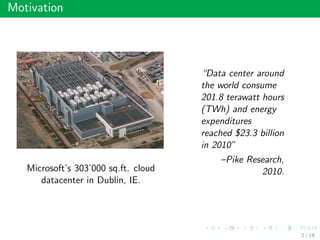
Microsoft’s 303’000 sq.ft. cloud
datacenter in Dublin, IE.
“Data center around
the world consume
201.8 terawatt hours
(TWh) and energy
expenditures
reached $23.3 billion
in 2010”
–Pike Research,
2010.
2 / 19
Approach: Server Consolidation
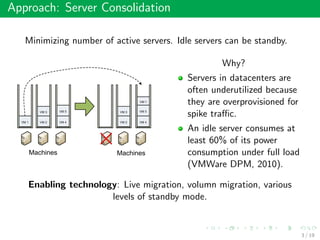
Minimizing number of active servers. Idle servers can be standby.
Why?
Servers in datacenters are
often underutilized because
they are overprovisioned for
spike traffic.
An idle server consumes at
least 60% of its power
consumption under full load
(VMWare DPM, 2010).
Enabling technology: Live migration, volumn migration, various
levels of standby mode.
3 / 19
Related work
Products : VMWare DPM, Ubuntu Entreprise Cloud Power
Management.
Research :
Static consolidation solution: (Verma et al., 2009),
(Cardosa, et al., 2009), (Speitkamp and Bichler, 2010),
(Subramanian et al., 2010)
Dynamic consolidation solution: (Jung et al., 2010),
(Gmach, et al., 2008)
Combined energy efficiency solution: (Petrucci et al., 2010),
(Tolia et al., 2009)
All of them based on some centralized solutions that have
well-known problem regarding scalability.
4 / 19
Design goals and design principles
Design goals for Resource Management System
Server consolidation in case of underload.
Fair resource allocation in case of overload.
Dynamic adaptation to changes in load patterns.
Scalable operation (> 100, 000 machines).
Design principles
A distributed middleware architecture.
Distributed protocols - gossip-based algorithms.
Generic protocol for resource management(GRMP).
Instantiation for solving the goals above(GRMP-Q).
5 / 19
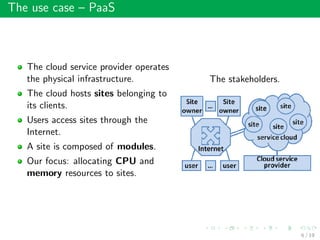
The use case – PaaS
The cloud service provider operates
the physical infrastructure.
The cloud hosts sites belonging to
its clients.
Users access sites through the
Internet.
A site is composed of modules.
Our focus: allocating CPU and
memory resources to sites.
The stakeholders.
6 / 19
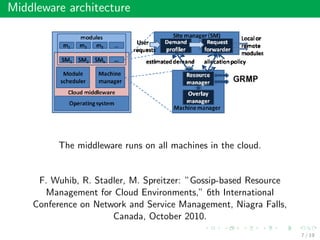
Middleware architecture
The middleware runs on all machines in the cloud.
F. Wuhib, R. Stadler, M. Spreitzer: ”Gossip-based Resource
Management for Cloud Environments,” 6th International
Conference on Network and Service Management, Niagra Falls,
Canada, October 2010.
7 / 19
Middleware architecture (Cont.)
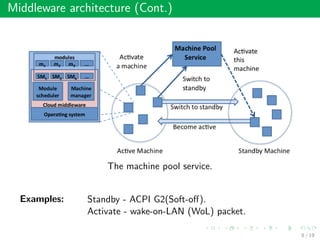
The machine pool service.
Examples: Standby - ACPI G2(Soft-off).
Activate - wake-on-LAN (WoL) packet.
8 / 19
Modeling resource allocation
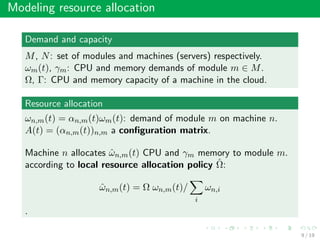
Demand and capacity
M, N: set of modules and machines (servers) respectively.
ωm(t), γm: CPU and memory demands of module m ∈ M.
Ω, Γ: CPU and memory capacity of a machine in the cloud.
Resource allocation
ωn,m(t) = αn,m(t)ωm(t): demand of module m on machine n.
A(t) = (αn,m(t))n,m a configuration matrix.
Machine n allocates ˆωn,m(t) CPU and γm memory to module m.
according to local resource allocation policy ˆΩ:
ˆωn,m(t) = Ω ωn,m(t)/
i
ωn,i
.
9 / 19
Modeling utility and power consumption
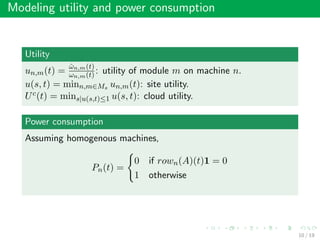
Utility
un,m(t) =
ˆωn,m(t)
ωn,m(t): utility of module m on machine n.
u(s, t) = minn,m∈Ms un,m(t): site utility.
Uc(t) = mins|u(s,t)≤1 u(s, t): cloud utility.
Power consumption
Assuming homogenous machines,
Pn(t) =
0 if rown(A)(t)1 = 0
1 otherwise
10 / 19
The resource allocation problem
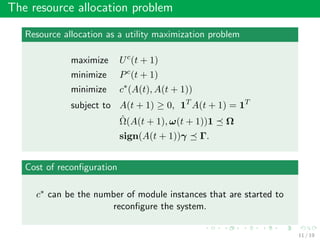
Resource allocation as a utility maximization problem
maximize Uc
(t + 1)
minimize Pc
(t + 1)
minimize c∗
(A(t), A(t + 1))
subject to A(t + 1) ≥ 0, 1T
A(t + 1) = 1T
ˆΩ(A(t + 1), ω(t + 1))1 Ω
sign(A(t + 1))γ Γ.
Cost of reconfiguration
c∗ can be the number of module instances that are started to
reconfigure the system.
11 / 19
Protocol GRMP: pseudocode for machine n
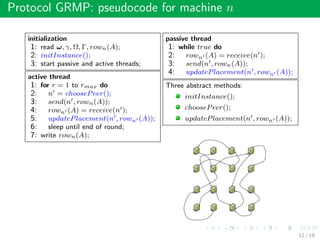
initialization
1: read ω, γ, Ω, Γ, rown(A);
2: initInstance();
3: start passive and active threads;
active thread
1: for r = 1 to rmax do
2: n = choosePeer();
3: send(n , rown(A));
4: rown (A) = receive(n );
5: updatePlacement(n , rown (A));
6: sleep until end of round;
7: write rown(A);
passive thread
1: while true do
2: rown (A) = receive(n );
3: send(n , rown(A));
4: updatePlacement(n , rown (A));
Three abstract methods:
initInstance();
choosePeer();
updatePlacement(n , rown (A));
12 / 19
Protocol GRMP-Q: pseudocode for machine n
initInstance()
1: read Nn;
choosePeer()
1: if rand(0..1) < p then
2: n = unifrand(Nn);
3: else
4: n = unifrand(N − Nn);
Prefer a gossiping peer with
common modules.
Nn = {j ∈ N, where j has
common modules with n}.
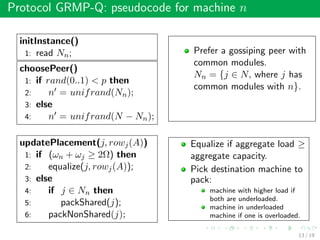
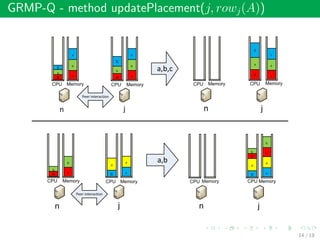
updatePlacement(j, rowj(A))
1: if (ωn + ωj ≥ 2Ω) then
2: equalize(j, rowj(A));
3: else
4: if j ∈ Nn then
5: packShared(j);
6: packNonShared(j);
Equalize if aggregate load ≥
aggregate capacity.
Pick destination machine to
pack:
machine with higher load if
both are underloaded.
machine in underloaded
machine if one is overloaded.
13 / 19
GRMP-Q - method updatePlacement(j, rowj(A))
14 / 19
Properties of GRMP-Q
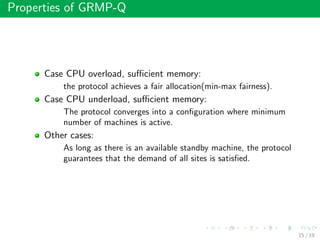
Case CPU overload, sufficient memory:
the protocol achieves a fair allocation(min-max fairness).
Case CPU underload, sufficient memory:
The protocol converges into a configuration where minimum
number of machines is active.
Other cases:
As long as there is an available standby machine, the protocol
guarantees that the demand of all sites is satisfied.
15 / 19
Simulation: demand, capacity and evaluation metrics
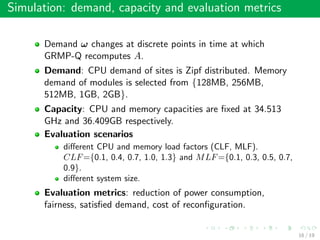
Demand ω changes at discrete points in time at which
GRMP-Q recomputes A.
Demand: CPU demand of sites is Zipf distributed. Memory
demand of modules is selected from {128MB, 256MB,
512MB, 1GB, 2GB}.
Capacity: CPU and memory capacities are fixed at 34.513
GHz and 36.409GB respectively.
Evaluation scenarios
different CPU and memory load factors (CLF, MLF).
CLF={0.1, 0.4, 0.7, 1.0, 1.3} and MLF={0.1, 0.3, 0.5, 0.7,
0.9}.
different system size.
Evaluation metrics: reduction of power consumption,
fairness, satisfied demand, cost of reconfiguration.
16 / 19
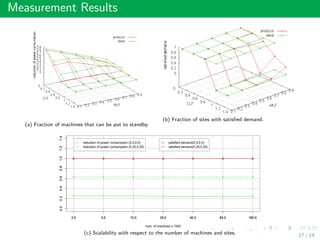
Measurement Results
(a) Fraction of machines that can be put to standby.
(b) Fraction of sites with satisfied demand.
(c) Scalability with respect to the number of machines and sites. 17 / 19
Conclusion
We introduce and formalize the resource allocation problem
with green objective.
We develop GRMP, a generic gossip-based protocol for
resource management that can be instantiated with
different objectives.
We develop an instance of GRMP which we call
GRMP-Q, and which provides a heuristic solution to the
server consolidation problem. This is the second instance of
GRMP.
We perform a simulation study of the performance of
GRMP-Q, which indicates that the protocol qualitatively
behaves as expected based on its design.
Implementation in Openstack is in progress.
18 / 19
Future work
Works relating to resource allocation protocol GRMP-Q:
Extend the model to capture other resources including storage
and network.
Improve its convergence property for large CLF values.
Develop a support for heterogeneous machines.
Customize so that it would have robustness regarding failures.
Regarding the middleware architecture:
Design a mechanism for deploying new sites.
Scalable design of the machine pool manager.
Extend design to span multiple clusters / data centers.
Ongoing implementation of the protocol.
19 / 19

cnsm2011_slide

  • 1.
    Gossip-based Resource Allocation forGreen Computing in Large Clouds Rerngvit Yanggratoke Fetahi Wuhib Rolf Stadler ACCESS Linnaeus Center KTH Royal Institute of Technology, Sweden CNSM2011 October 27, 2011 Paris, France 1 / 19
  • 2.
    Motivation Microsoft’s 303’000 sq.ft.cloud datacenter in Dublin, IE. “Data center around the world consume 201.8 terawatt hours (TWh) and energy expenditures reached $23.3 billion in 2010” –Pike Research, 2010. 2 / 19
  • 3.
    Approach: Server Consolidation Minimizingnumber of active servers. Idle servers can be standby. Why? Servers in datacenters are often underutilized because they are overprovisioned for spike traffic. An idle server consumes at least 60% of its power consumption under full load (VMWare DPM, 2010). Enabling technology: Live migration, volumn migration, various levels of standby mode. 3 / 19
  • 4.
    Related work Products :VMWare DPM, Ubuntu Entreprise Cloud Power Management. Research : Static consolidation solution: (Verma et al., 2009), (Cardosa, et al., 2009), (Speitkamp and Bichler, 2010), (Subramanian et al., 2010) Dynamic consolidation solution: (Jung et al., 2010), (Gmach, et al., 2008) Combined energy efficiency solution: (Petrucci et al., 2010), (Tolia et al., 2009) All of them based on some centralized solutions that have well-known problem regarding scalability. 4 / 19
  • 5.
    Design goals anddesign principles Design goals for Resource Management System Server consolidation in case of underload. Fair resource allocation in case of overload. Dynamic adaptation to changes in load patterns. Scalable operation (> 100, 000 machines). Design principles A distributed middleware architecture. Distributed protocols - gossip-based algorithms. Generic protocol for resource management(GRMP). Instantiation for solving the goals above(GRMP-Q). 5 / 19
  • 6.
    The use case– PaaS The cloud service provider operates the physical infrastructure. The cloud hosts sites belonging to its clients. Users access sites through the Internet. A site is composed of modules. Our focus: allocating CPU and memory resources to sites. The stakeholders. 6 / 19
  • 7.
    Middleware architecture The middlewareruns on all machines in the cloud. F. Wuhib, R. Stadler, M. Spreitzer: ”Gossip-based Resource Management for Cloud Environments,” 6th International Conference on Network and Service Management, Niagra Falls, Canada, October 2010. 7 / 19
  • 8.
    Middleware architecture (Cont.) Themachine pool service. Examples: Standby - ACPI G2(Soft-off). Activate - wake-on-LAN (WoL) packet. 8 / 19
  • 9.
    Modeling resource allocation Demandand capacity M, N: set of modules and machines (servers) respectively. ωm(t), γm: CPU and memory demands of module m ∈ M. Ω, Γ: CPU and memory capacity of a machine in the cloud. Resource allocation ωn,m(t) = αn,m(t)ωm(t): demand of module m on machine n. A(t) = (αn,m(t))n,m a configuration matrix. Machine n allocates ˆωn,m(t) CPU and γm memory to module m. according to local resource allocation policy ˆΩ: ˆωn,m(t) = Ω ωn,m(t)/ i ωn,i . 9 / 19
  • 10.
    Modeling utility andpower consumption Utility un,m(t) = ˆωn,m(t) ωn,m(t): utility of module m on machine n. u(s, t) = minn,m∈Ms un,m(t): site utility. Uc(t) = mins|u(s,t)≤1 u(s, t): cloud utility. Power consumption Assuming homogenous machines, Pn(t) = 0 if rown(A)(t)1 = 0 1 otherwise 10 / 19
  • 11.
    The resource allocationproblem Resource allocation as a utility maximization problem maximize Uc (t + 1) minimize Pc (t + 1) minimize c∗ (A(t), A(t + 1)) subject to A(t + 1) ≥ 0, 1T A(t + 1) = 1T ˆΩ(A(t + 1), ω(t + 1))1 Ω sign(A(t + 1))γ Γ. Cost of reconfiguration c∗ can be the number of module instances that are started to reconfigure the system. 11 / 19
  • 12.
    Protocol GRMP: pseudocodefor machine n initialization 1: read ω, γ, Ω, Γ, rown(A); 2: initInstance(); 3: start passive and active threads; active thread 1: for r = 1 to rmax do 2: n = choosePeer(); 3: send(n , rown(A)); 4: rown (A) = receive(n ); 5: updatePlacement(n , rown (A)); 6: sleep until end of round; 7: write rown(A); passive thread 1: while true do 2: rown (A) = receive(n ); 3: send(n , rown(A)); 4: updatePlacement(n , rown (A)); Three abstract methods: initInstance(); choosePeer(); updatePlacement(n , rown (A)); 12 / 19
  • 13.
    Protocol GRMP-Q: pseudocodefor machine n initInstance() 1: read Nn; choosePeer() 1: if rand(0..1) < p then 2: n = unifrand(Nn); 3: else 4: n = unifrand(N − Nn); Prefer a gossiping peer with common modules. Nn = {j ∈ N, where j has common modules with n}. updatePlacement(j, rowj(A)) 1: if (ωn + ωj ≥ 2Ω) then 2: equalize(j, rowj(A)); 3: else 4: if j ∈ Nn then 5: packShared(j); 6: packNonShared(j); Equalize if aggregate load ≥ aggregate capacity. Pick destination machine to pack: machine with higher load if both are underloaded. machine in underloaded machine if one is overloaded. 13 / 19
  • 14.
    GRMP-Q - methodupdatePlacement(j, rowj(A)) 14 / 19
  • 15.
    Properties of GRMP-Q CaseCPU overload, sufficient memory: the protocol achieves a fair allocation(min-max fairness). Case CPU underload, sufficient memory: The protocol converges into a configuration where minimum number of machines is active. Other cases: As long as there is an available standby machine, the protocol guarantees that the demand of all sites is satisfied. 15 / 19
  • 16.
    Simulation: demand, capacityand evaluation metrics Demand ω changes at discrete points in time at which GRMP-Q recomputes A. Demand: CPU demand of sites is Zipf distributed. Memory demand of modules is selected from {128MB, 256MB, 512MB, 1GB, 2GB}. Capacity: CPU and memory capacities are fixed at 34.513 GHz and 36.409GB respectively. Evaluation scenarios different CPU and memory load factors (CLF, MLF). CLF={0.1, 0.4, 0.7, 1.0, 1.3} and MLF={0.1, 0.3, 0.5, 0.7, 0.9}. different system size. Evaluation metrics: reduction of power consumption, fairness, satisfied demand, cost of reconfiguration. 16 / 19
  • 17.
    Measurement Results (a) Fractionof machines that can be put to standby. (b) Fraction of sites with satisfied demand. (c) Scalability with respect to the number of machines and sites. 17 / 19
  • 18.
    Conclusion We introduce andformalize the resource allocation problem with green objective. We develop GRMP, a generic gossip-based protocol for resource management that can be instantiated with different objectives. We develop an instance of GRMP which we call GRMP-Q, and which provides a heuristic solution to the server consolidation problem. This is the second instance of GRMP. We perform a simulation study of the performance of GRMP-Q, which indicates that the protocol qualitatively behaves as expected based on its design. Implementation in Openstack is in progress. 18 / 19
  • 19.
    Future work Works relatingto resource allocation protocol GRMP-Q: Extend the model to capture other resources including storage and network. Improve its convergence property for large CLF values. Develop a support for heterogeneous machines. Customize so that it would have robustness regarding failures. Regarding the middleware architecture: Design a mechanism for deploying new sites. Scalable design of the machine pool manager. Extend design to span multiple clusters / data centers. Ongoing implementation of the protocol. 19 / 19