1
Sharad Institute Of Technology
College Of Engineering Yadrav
Seminar
On
Introcution To CNN
Submitted To: Submitted By:
Miss. P. B. Shinde Vidya Vijay Mali
A Technical Presentation on
Presented By:
Vidya Vijay Mali
2
Introductionto
CNN
Contents
3
Background of CNNs
What Is a CNN?
How does it work?
What Is a Pooling Layer?
CNNs vs. neural networks
Benefits of using CNNs
Drawbacks of CNN
Application
Background of CNNs
4 8 March 2015
 first developed and used around the 1980s
 It was mostly used in the postal sectors to read zip
codes, pin codes, digit recognition.
 CNNs were only limited to the postal sectors and it
failed to enter the world of machine learning.
 Because it requires a large amount of data to train
and also requires a lot of computing resources.
What is CNN?
5
 CNN/ConvNet
 class of deep neural networks, most commonly applied to
analyze visual imagery
 It uses a special technique called Convolution.
 in mathematics convolution is a mathematical operation on two
functions that produces a third function that expresses how the
shape of one is modified by the other.
6
9
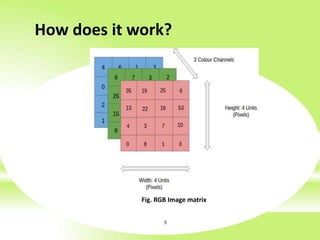
How does it work?
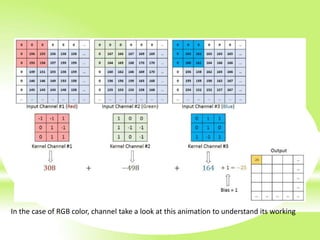
Fig. RGB Image matrix
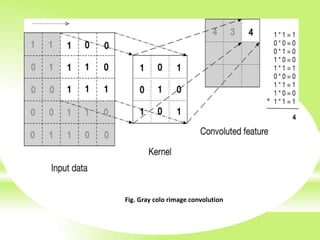
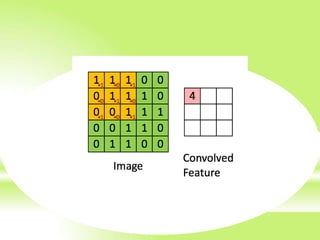
Fig. Gray colo rimage convolution
In the case of RGB color, channel take a look at this animation to understand its working
12
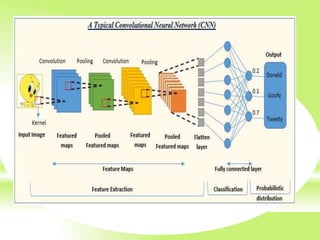
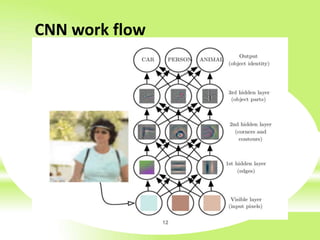
CNN work flow
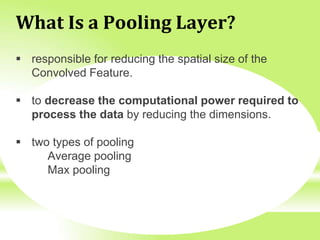
What Is a Pooling Layer?
 responsible for reducing the spatial size of the
Convolved Feature.
 to decrease the computational power required to
process the data by reducing the dimensions.
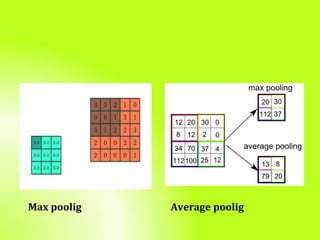
 two types of pooling
Average pooling
Max pooling
Max poolig Average poolig
Advantages
Excellent in spotting patterns and characteristics in
signals like as photos, movies, and sounds.
Resistant to scaling, rotation, and translation invariance.
There's no need for manually extracting features with
end-to-end training.
Can attain excellent accuracy while handling massive
amounts of data.
Drawbacks
Expensive to train computationally and memory-
intensive.
Insufficient data or improper regularisation might lead to
overfitting.
Need a lot of data that has been tagged.
Limited interpretability makes it challenging to
comprehend what the network has discovered
Applications
Healthcare
Automotive
Social media
Facial recognition
Audio processing for virtual assistants
18
19

CNN-ppt.pptx

  • 1.
    1 Sharad Institute OfTechnology College Of Engineering Yadrav Seminar On Introcution To CNN Submitted To: Submitted By: Miss. P. B. Shinde Vidya Vijay Mali
  • 2.
    A Technical Presentationon Presented By: Vidya Vijay Mali 2 Introductionto CNN
  • 3.
    Contents 3 Background of CNNs WhatIs a CNN? How does it work? What Is a Pooling Layer? CNNs vs. neural networks Benefits of using CNNs Drawbacks of CNN Application
  • 4.
    Background of CNNs 48 March 2015  first developed and used around the 1980s  It was mostly used in the postal sectors to read zip codes, pin codes, digit recognition.  CNNs were only limited to the postal sectors and it failed to enter the world of machine learning.  Because it requires a large amount of data to train and also requires a lot of computing resources.
  • 5.
  • 6.
     CNN/ConvNet  classof deep neural networks, most commonly applied to analyze visual imagery  It uses a special technique called Convolution.  in mathematics convolution is a mathematical operation on two functions that produces a third function that expresses how the shape of one is modified by the other. 6
  • 7.
    9 How does itwork? Fig. RGB Image matrix
  • 9.
    Fig. Gray colorimage convolution
  • 11.
    In the caseof RGB color, channel take a look at this animation to understand its working
  • 12.
  • 13.
    What Is aPooling Layer?  responsible for reducing the spatial size of the Convolved Feature.  to decrease the computational power required to process the data by reducing the dimensions.  two types of pooling Average pooling Max pooling
  • 14.
  • 15.
    Advantages Excellent in spottingpatterns and characteristics in signals like as photos, movies, and sounds. Resistant to scaling, rotation, and translation invariance. There's no need for manually extracting features with end-to-end training. Can attain excellent accuracy while handling massive amounts of data.
  • 16.
    Drawbacks Expensive to traincomputationally and memory- intensive. Insufficient data or improper regularisation might lead to overfitting. Need a lot of data that has been tagged. Limited interpretability makes it challenging to comprehend what the network has discovered
  • 17.
  • 18.
  • 19.