Contents
Introduction to ComputerVision
What is CNN ?
Different Types of CNN and use of CNN
in Computer Vision
Application of Computer Vision
Conclusion
2
3.
Introduction to ComputerVision
● Computer vision is concerned with the automatic extraction, analysis and
understanding of useful information from a single image or a sequence of
images.
- The British Machine Vision Association and Society for Pattern Recognition
(BMVA)
(or)
● It is an interdisciplinary field that deals with how computers can be made to
gain high-level understanding from digital images or videos.
- Wikipedia
3
4.
What is CNN(ConvolutionNeural Network)
4
● It is a class of deep learning.
● Convolutional neural network (ConvNet’s or CNNs) is one of the main
categories to do images recognition, images classifications, objects
detections, recognition faces etc.,
● It is similar to the basic neural network. CNN also have learnable
parameter like neural network i.e., weights, biases etc.
● CNN is heavily used in computer vision
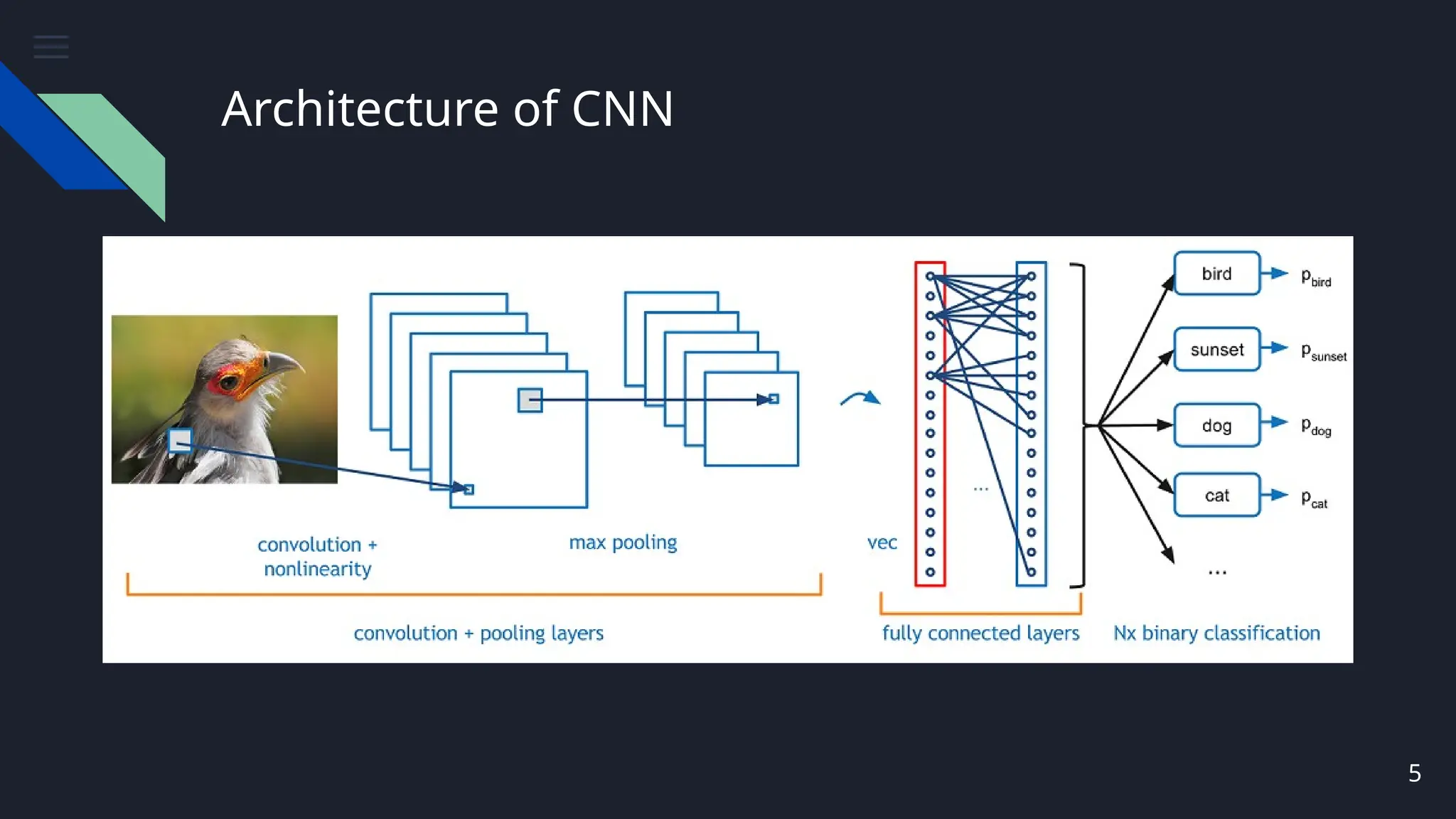
● There 3 basic components to define CNN
○ The Convolution Layer
○ The Pooling Layer
○ The Output Layer (or) Fully Connected Layer
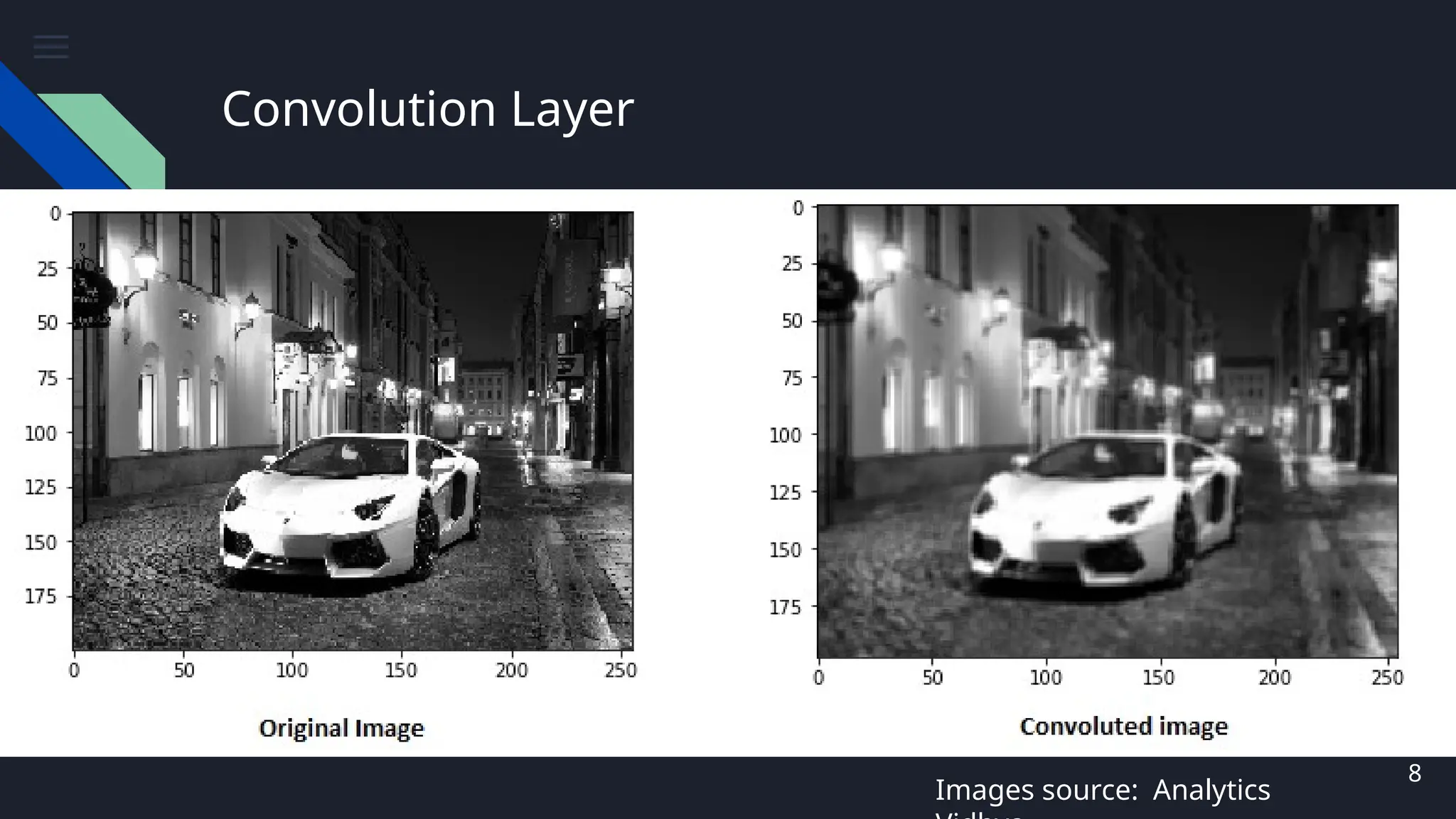
Convolution Layer
6
● Computersread images as pixels and it is expressed as matrix (NxNx3)—
(height by width by depth).
● The Convolutional Layer makes use of a set of learnable filters. A filter is
used to detect the presence of specific features or patterns present in the
original image (input).
● It is usually expressed as a matrix (MxMx3), with a smaller dimension but
the same depth as the input file.
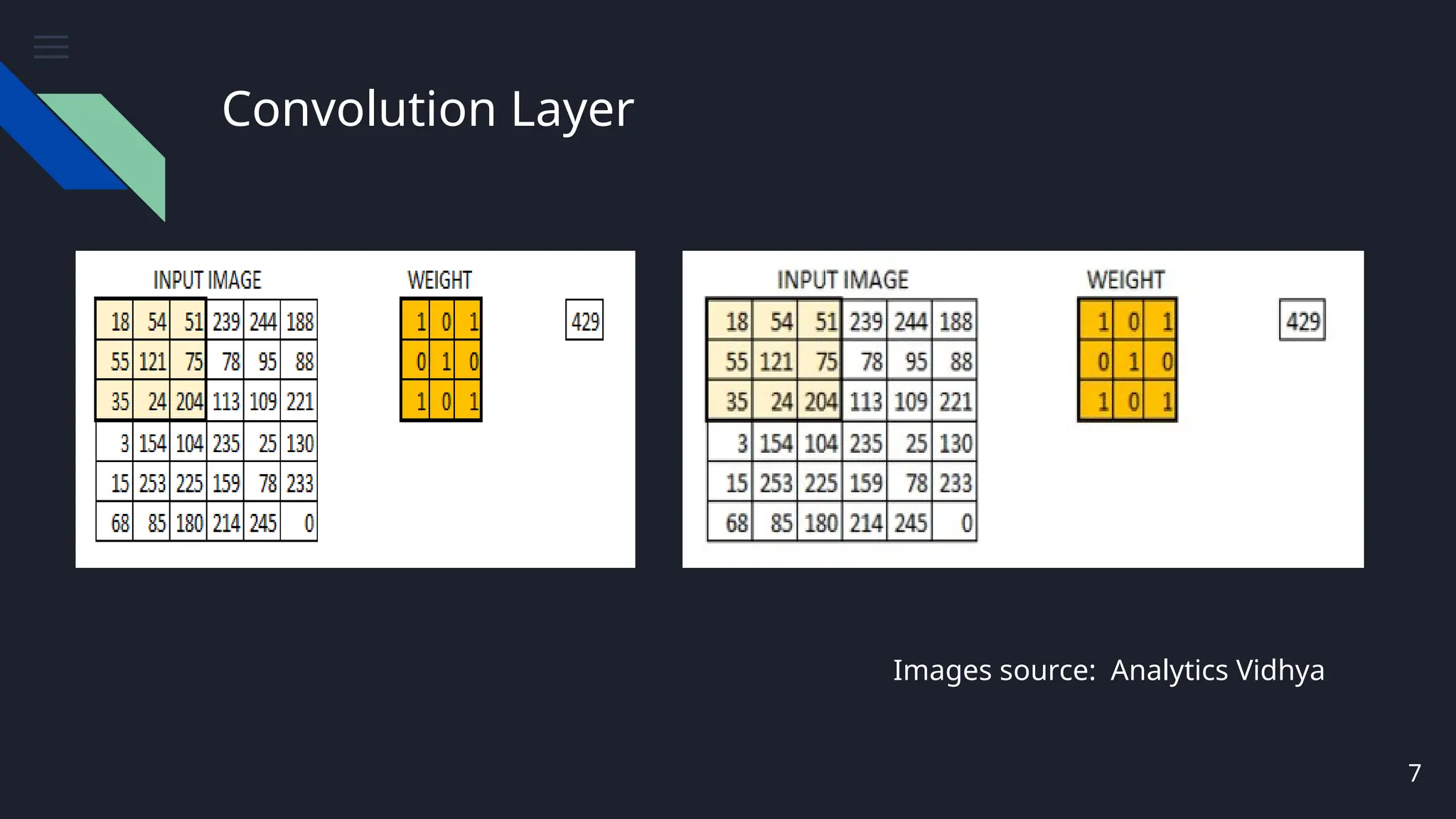
● This filter is convolved (slided) across the width and height of the input
file, and a dot product is computed to give an activation map.
Convolution Layer
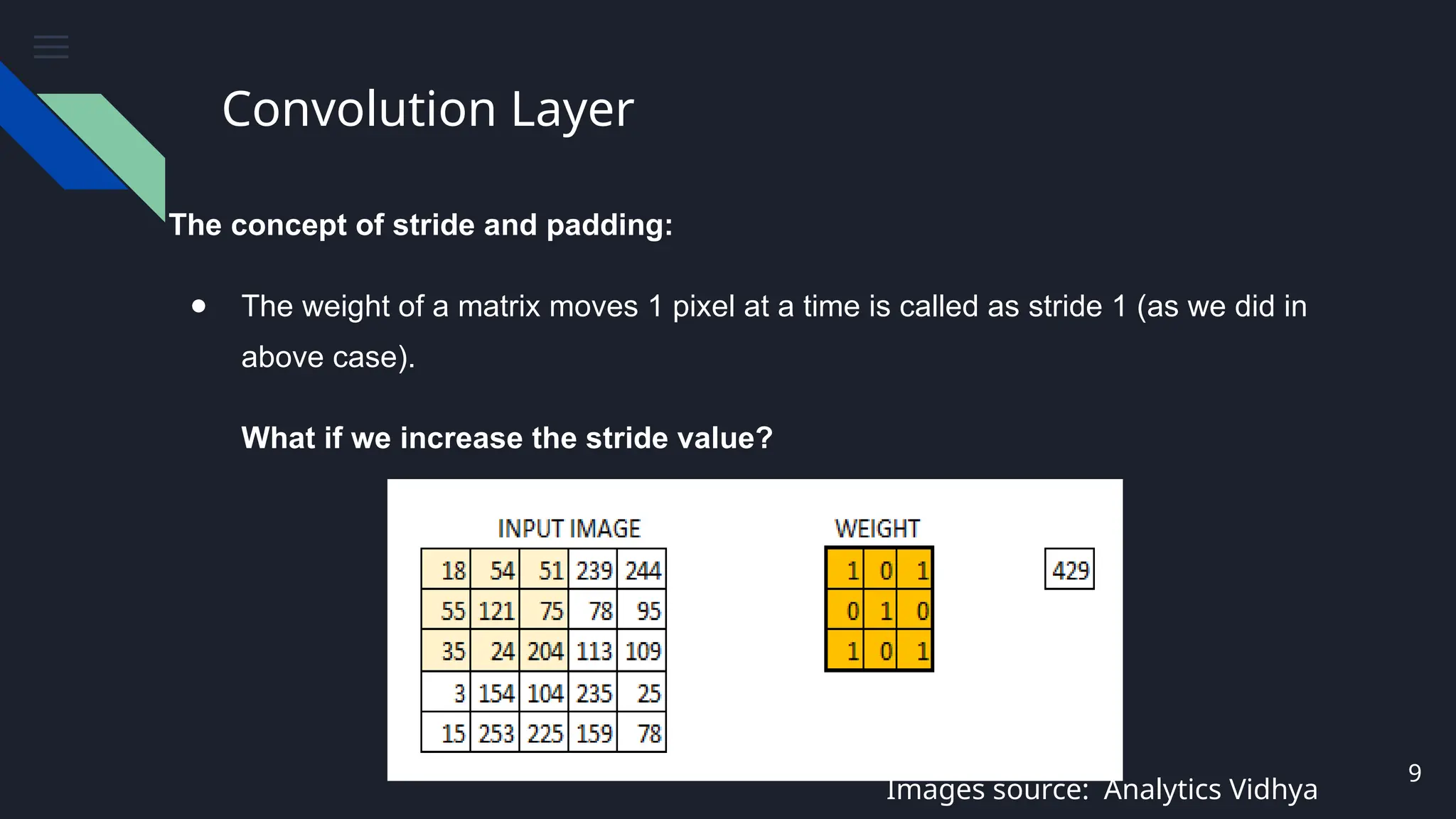
The conceptof stride and padding:
● The weight of a matrix moves 1 pixel at a time is called as stride 1 (as we did in
above case).
What if we increase the stride value?
9
Images source: Analytics Vidhya
10.
Convolution Layer
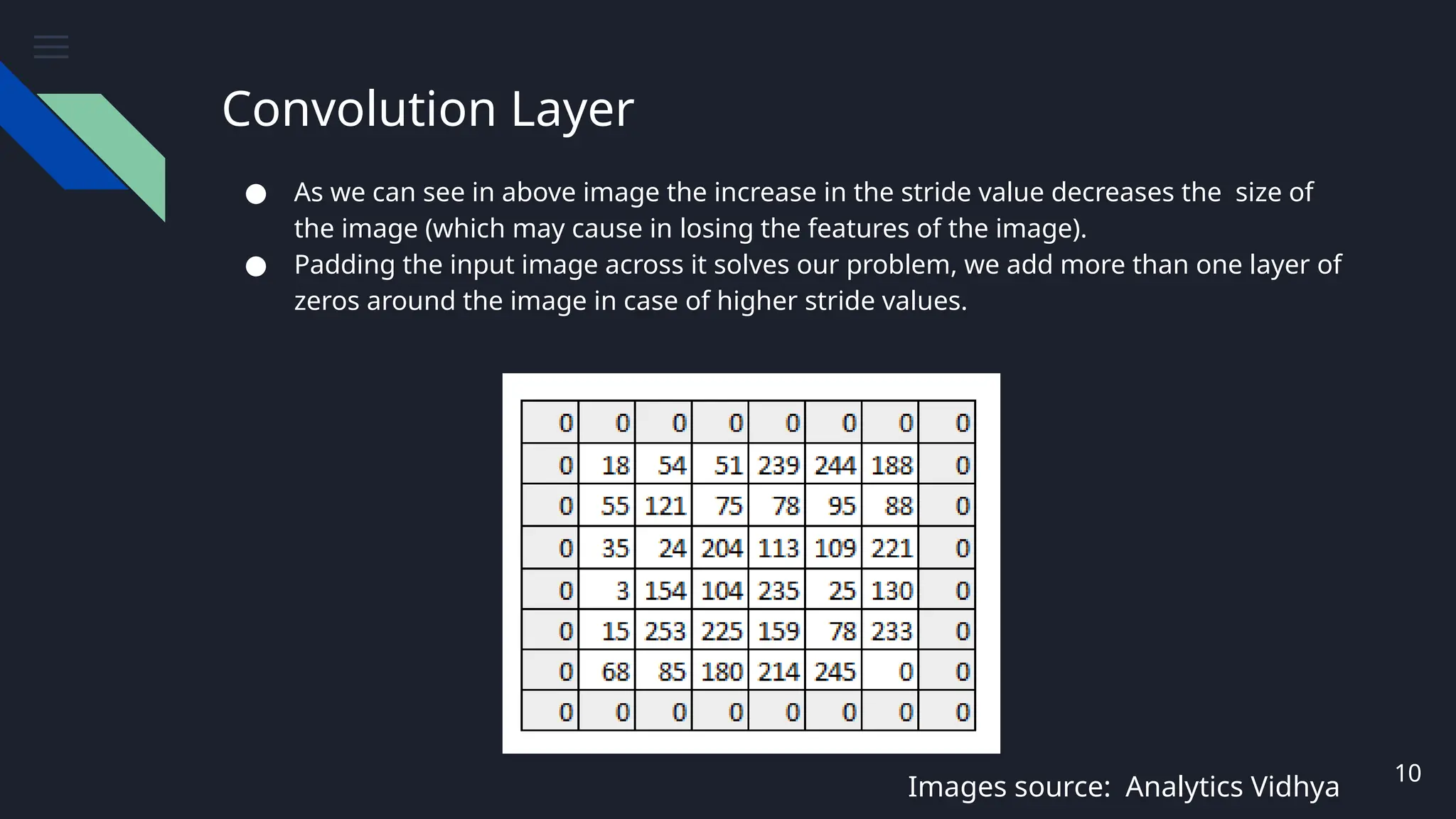
● Aswe can see in above image the increase in the stride value decreases the size of
the image (which may cause in losing the features of the image).
● Padding the input image across it solves our problem, we add more than one layer of
zeros around the image in case of higher stride values.
10
Images source: Analytics Vidhya
11.
Convolution Layer
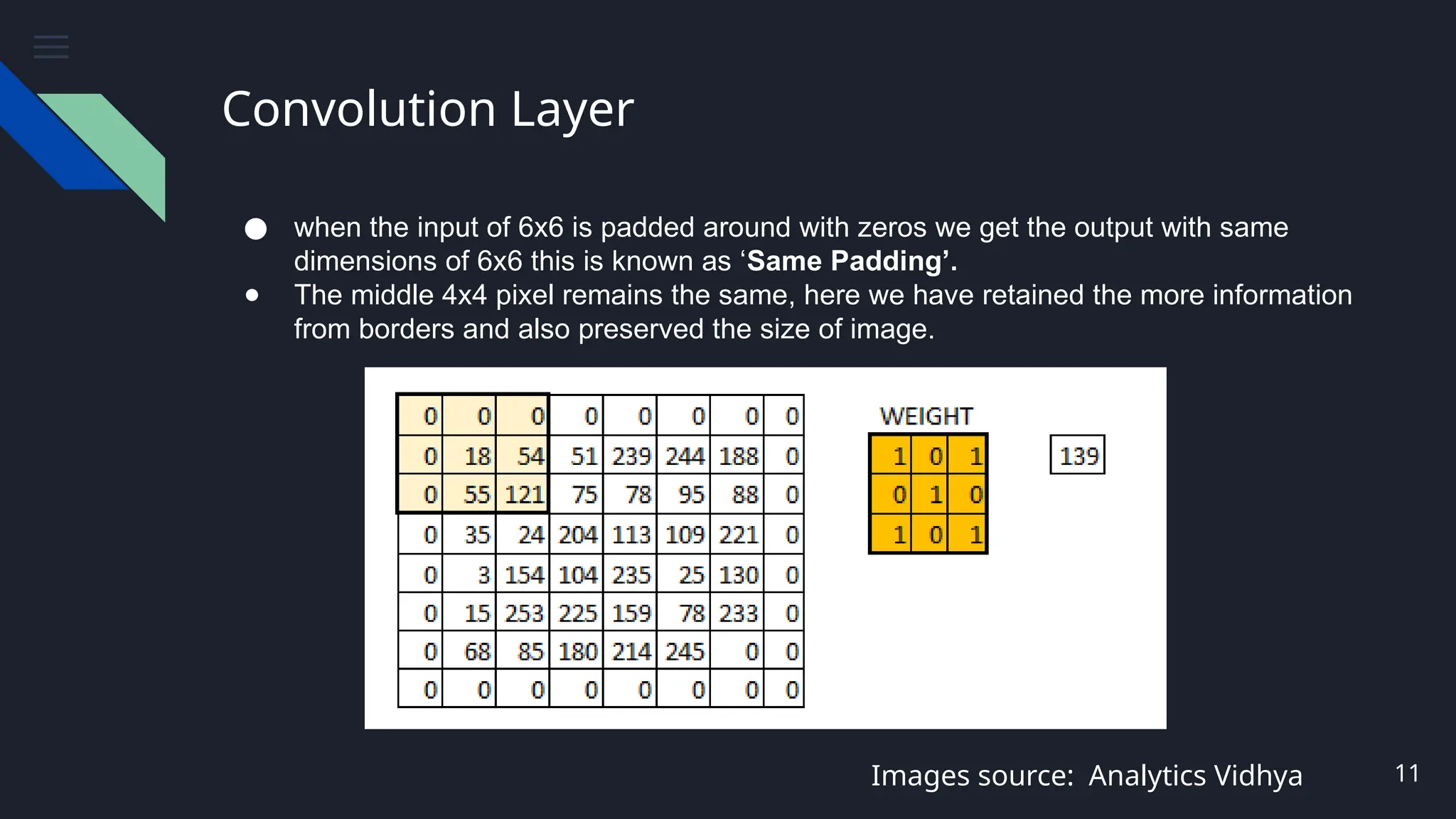
● whenthe input of 6x6 is padded around with zeros we get the output with same
dimensions of 6x6 this is known as ‘Same Padding’.
● The middle 4x4 pixel remains the same, here we have retained the more information
from borders and also preserved the size of image.
11
Images source: Analytics Vidhya
12.
The Pooling Layer
●It can be seen in between the convolution layers in CNN architecture.
● This layer basically reduces the amount of parameters and computation in the
network.
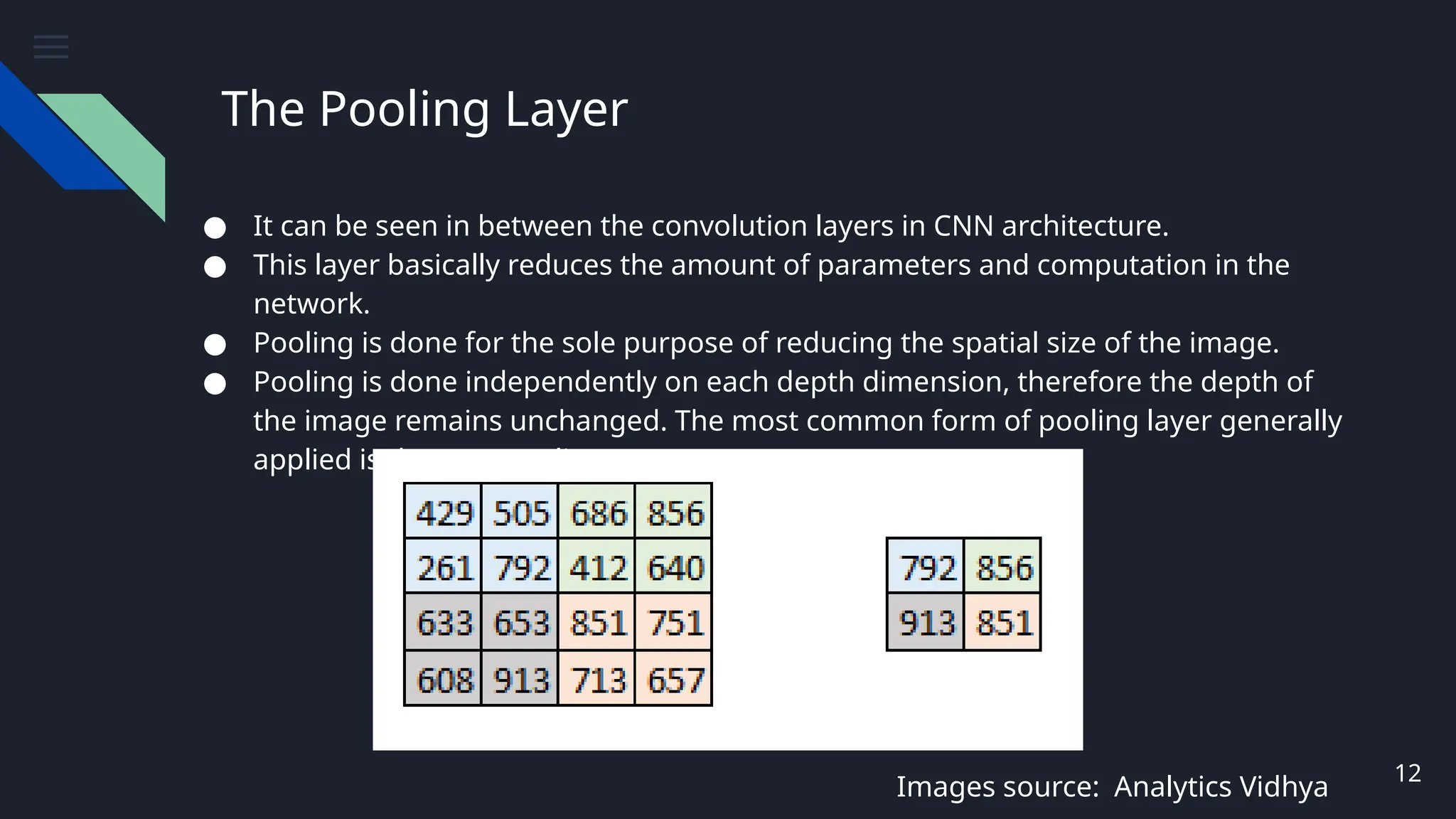
● Pooling is done for the sole purpose of reducing the spatial size of the image.
● Pooling is done independently on each depth dimension, therefore the depth of
the image remains unchanged. The most common form of pooling layer generally
applied is the max pooling.
12
Images source: Analytics Vidhya
13.
The Pooling Layer
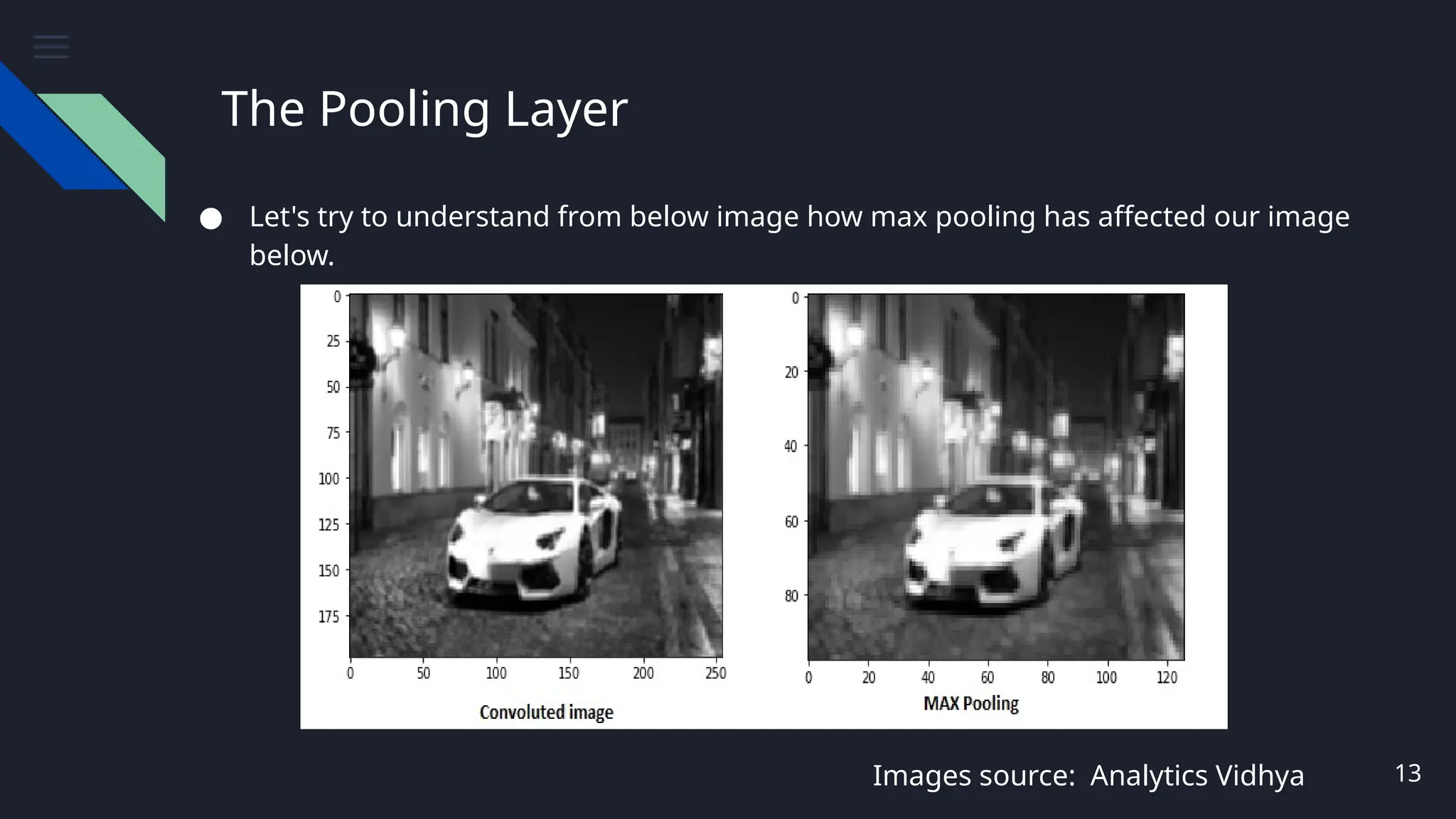
●Let's try to understand from below image how max pooling has affected our image
below.
13
Images source: Analytics Vidhya
14.
The Output Layer
●After multiple layers of convolution and padding, we would need the output in the
form of a class.
● The convolution and pooling layers would only be able to extract features and
reduce the number of parameters from the original images.
● However, to generate the final output we need to apply a fully connected layer to
generate an output equal to the number of classes we need.
● Convolution layers generate 3D activation maps while we just need the output as
whether or not an image belongs to a particular class.
● The output layer will have the loss function like categorical cross-entropy, to
compute the error in prediction.
● Once the forward pass is complete the backpropagation begins to update the
weight and biases for error and loss reduction.
14
15.
CNN
How to decidethe number of convolution layers and number of filters in
CNN ?
● Deeper networks is always better, at the cost of more data and increased
complexity of learning.
● You should initially use fewer filters and gradually increase and monitor the
error rate to see how it is varying.
● Very small filter sizes will capture very fine details of the image. On the other
hand having a bigger filter size will leave out minute details in the image.
15
16.
Types of CNN
●Based on the problems, we have the different CNN’s which are used in
computer vision.
● The five major computer vision techniques which can be addressed using
CNN.
■ Image Classification
■ Object Detection
■ Object Tracking
■ Semantic Segmentation
■ Instance Segmentation
16
17.
Types of CNN
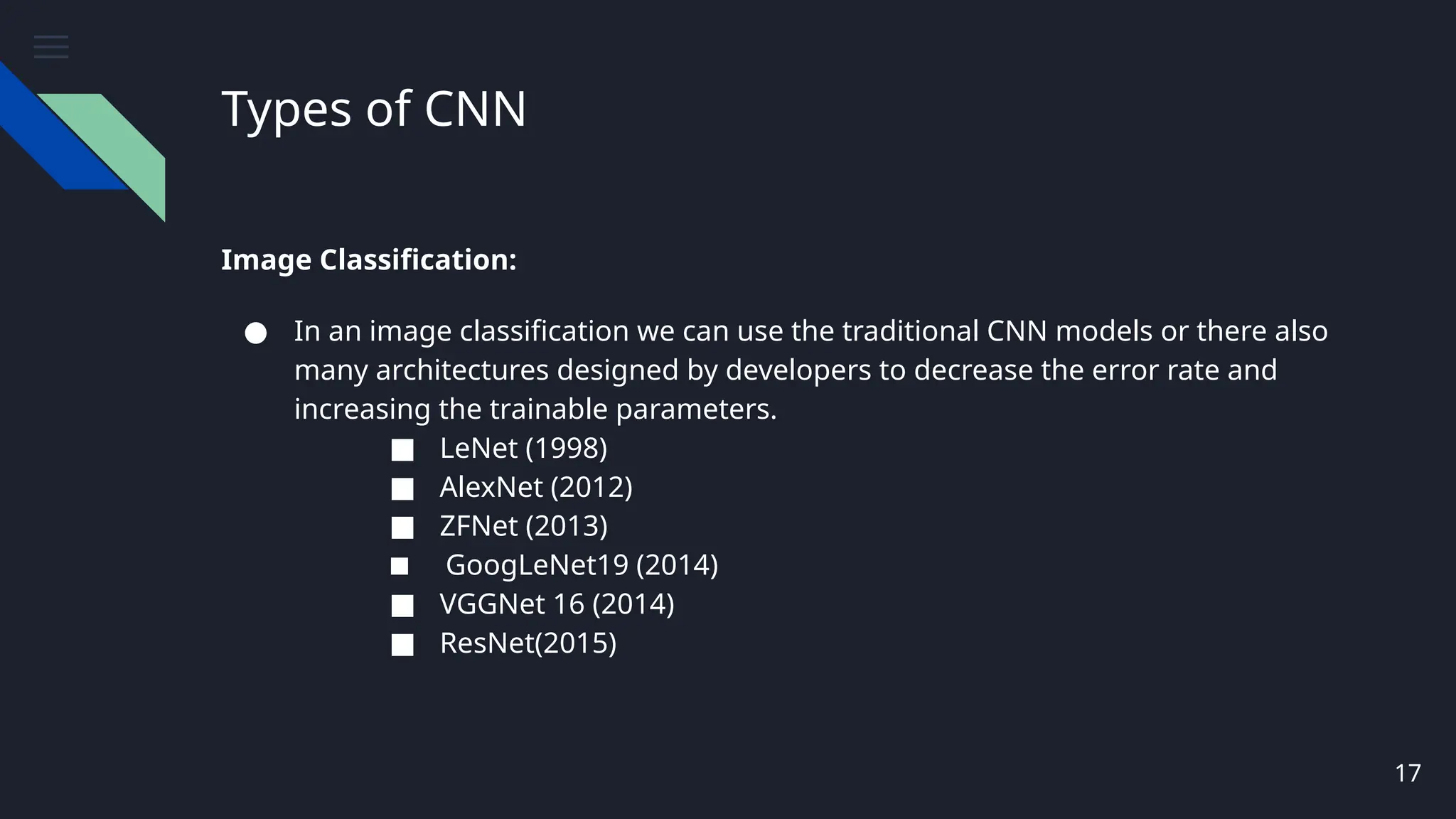
ImageClassification:
● In an image classification we can use the traditional CNN models or there also
many architectures designed by developers to decrease the error rate and
increasing the trainable parameters.
■ LeNet (1998)
■ AlexNet (2012)
■ ZFNet (2013)
■ GoogLeNet19 (2014)
■ VGGNet 16 (2014)
■ ResNet(2015)
17
18.
Types of CNN
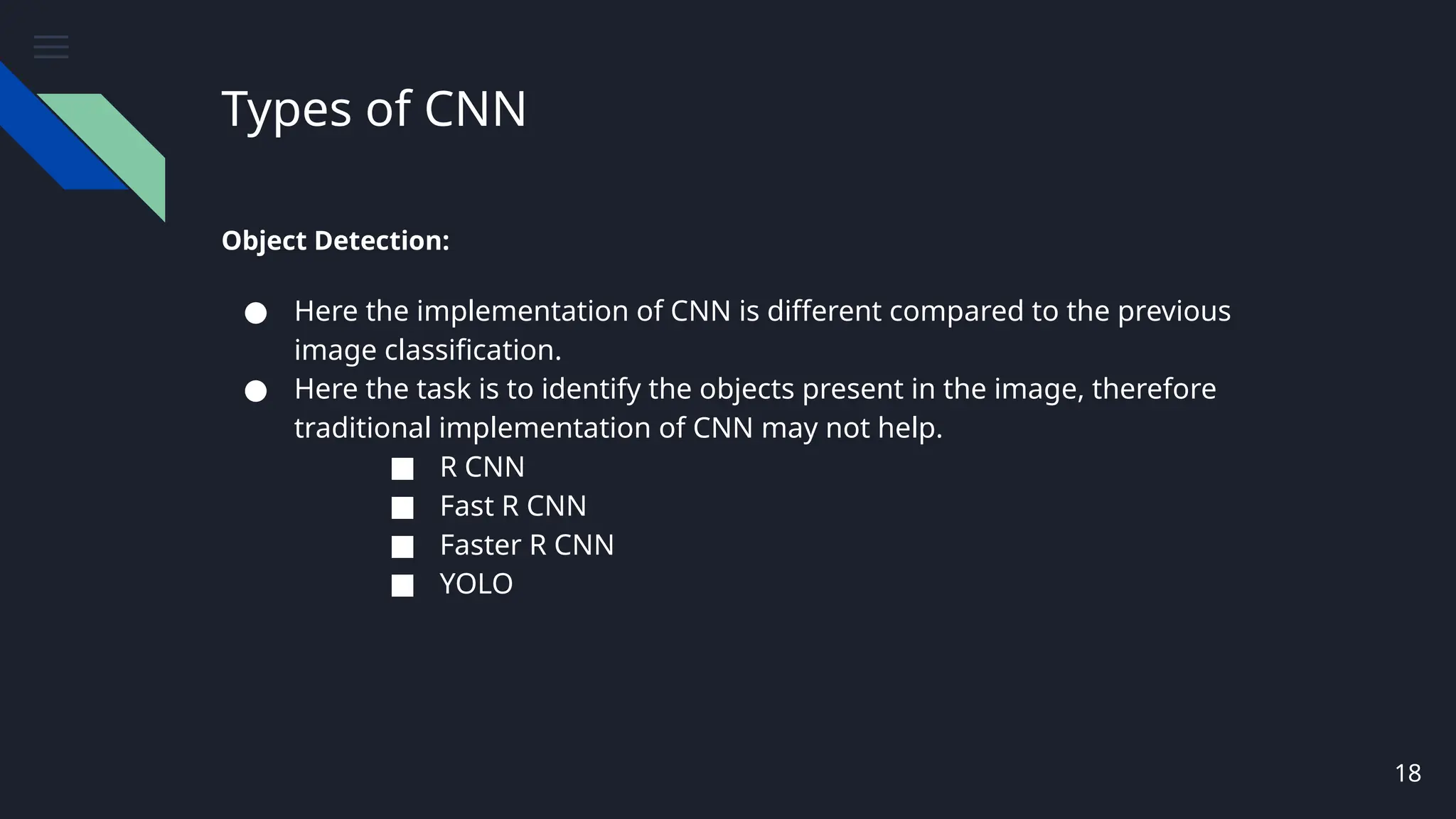
ObjectDetection:
● Here the implementation of CNN is different compared to the previous
image classification.
● Here the task is to identify the objects present in the image, therefore
traditional implementation of CNN may not help.
■ R CNN
■ Fast R CNN
■ Faster R CNN
■ YOLO
18
19.
Applications of ComputerVision
● Computer vision, an AI technology that allows computers to understand
and label images, is now used in convenience stores, driverless car
testing, daily medical diagnostics, and in monitoring the health of crops
and livestock.
● Different use cases found in the computer vision as follows
■ Retail and Retail Security
■ Automotive
■ Healthcare
■ Banking
■ Agriculture
■ Industrial
19
20.
Conclusion
● Here inthis seminar we tried to understand what is Computer
Vision.
● What is CNN and its different layers.
● Different types of CNN and its uses in Computer Vision
techniques.
● Different Applications of Computer Vision.
20
#3 Start the discussion with the human eye and take them to the computer vision.
Explain about computer vision definition and speak about what are the different fields it deals with.
Take the topic to machine learning
#4 Say why CNN why not Feed forward NN(example MNIST image 28 x 28 x 1(black & white image contains only 1 channel)
Total number of neurons in input layer will 28 x 28 = 784, this can be manageable.
What if the size of image is 1000 x 1000, which means you need 10⁶ neurons in input layer.
#9 What is stride and explain with image
Increase in stride value loss of pixels
#10 Discuss the same padding concept: when the input of 6x6 is padded around with zeros we get the output with same dimensions of 6x6.
And feature are extracted without loss.
#11 The output of the Convolution layer is passes through the activation function
#13 As you can see I have taken convoluted image and have applied max pooling on it.
The max pooled image still retains the information that it’s a car on a street.
If you look carefully, the dimensions if the image have been halved. This helps to reduce the parameters to a great extent.
#14 Discuss about the flattening of pixels before sending it to the output layer.
Explain the flattening process.
When weights are updated, they take place on both convolution layers and fully connected layers.
#19 Discuss Amazon Go store for retail and security
Google cars for Automotive
Cheque sign recognition in banks