Convolutional Neural Network (CNN)
Image processing is a method to perform some operations on an image, in order to get an enhanced
image or to extract some useful information from it. It is a type of signal processing in which input is an image
and output may be image or characteristics/features associated with that image.
Computer vision is a field of computer science that works on enabling computers to see, identify and
process images in the same way that human vision does, and then provide appropriate output. It is like
imparting human intelligence and instincts to a computer. In reality though, it is a difficult task to enable
computers to recognize images of different objects.
Before understanding the CNN, lets understand first about these two core subject
Convolutional Neural Network (CNN)
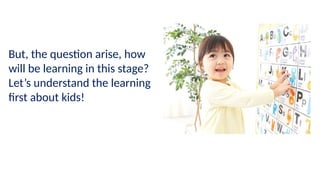
But, the question arise, how
will be learning in this stage?
Let’s understand the learning
first about kids!
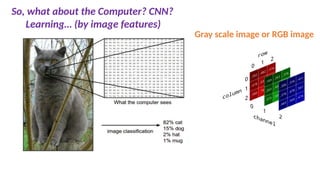
So, what about the Computer? CNN?
Learning… (by image features)
Gray scale image or RGB image
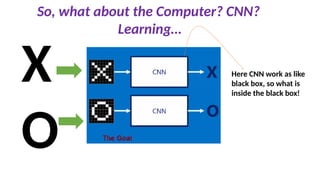
So, what about the Computer? CNN?
Learning…
X
O
Here CNN work as like
black box, so what is
inside the black box!
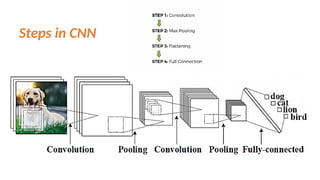
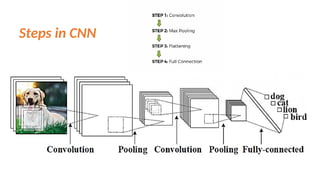
Steps in CNN
Thanks
Steps in CNN
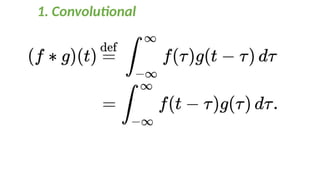
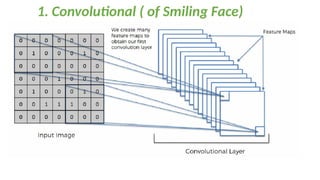
1. Convolutional
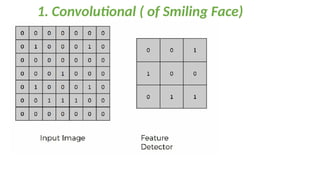
1. Convolutional ( of Smiling Face)
http://setosa.io/ev/image-kernels/
Different kind of filters / kernels in image processing!
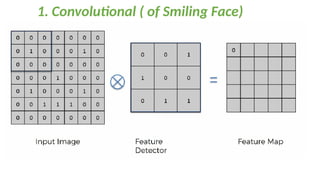
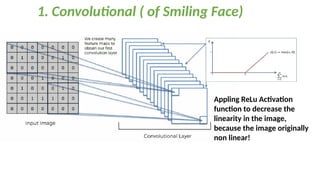
1. Convolutional ( of Smiling Face)
Appling ReLu Activation
function to decrease the
linearity in the image,
because the image originally
non linear!
Thanks
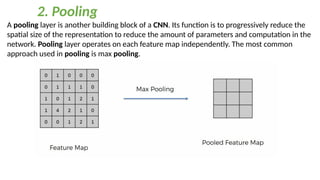
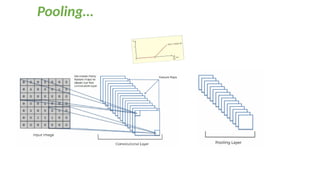
A pooling layer is another building block of a CNN. Its function is to progressively reduce the
spatial size of the representation to reduce the amount of parameters and computation in the
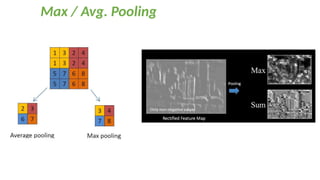
network. Pooling layer operates on each feature map independently. The most common
approach used in pooling is max pooling.
2. Pooling
Max / Avg. Pooling
Pooling…
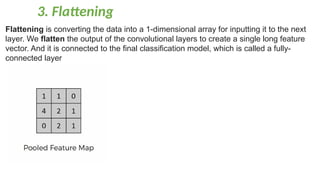
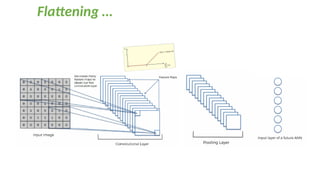
3. Flattening
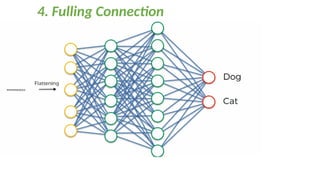
Flattening is converting the data into a 1-dimensional array for inputting it to the next
layer. We flatten the output of the convolutional layers to create a single long feature
vector. And it is connected to the final classification model, which is called a fully-
connected layer
Flattening …
4. Fulling Connection
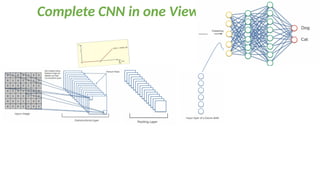
Complete CNN in one View
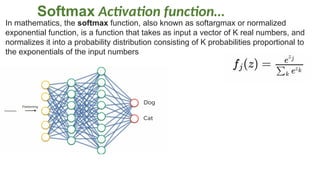
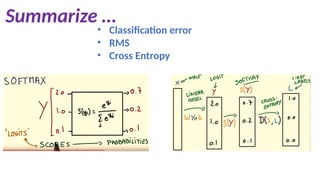
Softmax Activation function…
In mathematics, the softmax function, also known as softargmax or normalized
exponential function, is a function that takes as input a vector of K real numbers, and
normalizes it into a probability distribution consisting of K probabilities proportional to
the exponentials of the input numbers
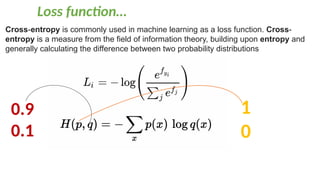
Loss function…
Cross-entropy is commonly used in machine learning as a loss function. Cross-
entropy is a measure from the field of information theory, building upon entropy and
generally calculating the difference between two probability distributions
0.9
0.1
1
0
Summarize …
• Classification error
• RMS
• Cross Entropy
Thanks
https://en.wikipedia.org/wiki/Cross_entropy
https://towardsdatascience.com/understanding-binary-cross-entropy-log-loss-a-visual-explanation-a3ac6025181
a
CNN for Categorical Variables (output)
So far, we have discussed the CNN using binary outcome result (0,1), so what
about the Categorical variable result means more than 0,1 therefore we are going
the understand the CNN using MNIST dataset.
So, what is MNIST dataset...
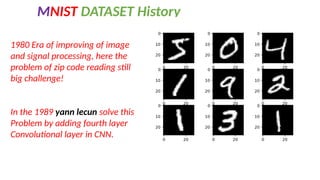
It is a data-set, consisting images of handwritten digits from 0 to 9. Each image is
a monochrome, 28 * 28 pixels.
MNIST DATASET History
1980 Era of improving of image
and signal processing, here the
problem of zip code reading still
big challenge!
In the 1989 yann lecun solve this
Problem by adding fourth layer
Convolutional layer in CNN.
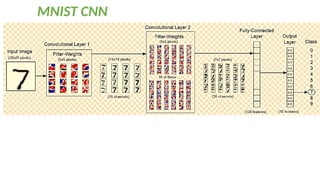
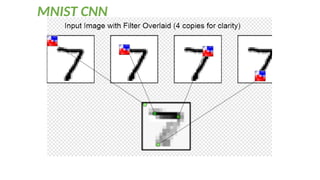
MNIST CNN
MNIST CNN
Useful links:
https://en.wikipedia.org/wiki/MNIST_database
http://yann.lecun.com/exdb/mnist/
http://colah.github.io/posts/2014-10-Visualizing-MNIST/
Lets move towards CODE!

Deep Learning course slides Week 5.pptx