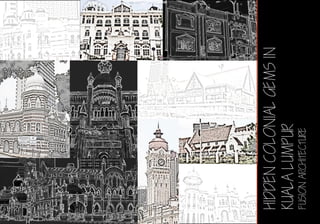
HIDDENCOLONIALGEMSIN
KUALALUMPUR
FUSIONARCHITECTURE
1
2
34
5
6 8
7
10
9
1. Malayan
Railway
Administration
Building
2. Kuala Lumpur
Railway Station
3. National Textile
Museum
4. National History
Museum
5. Sultan Abdul
Samad Building
6. Royal Selangor
Club
7. St Mary’s
Cathedral
8. Old High Court
Building
9. DBKL City
Theatre
10. Jalan Tuanku
Abdul Rahman
MY JOURNEY IN KUALA LUMPUR
As the capital of Malaysia,
Kuala Lumpur has a
fascinating history
combining Malay, Islamic,
Chinese, Indian and
colonial British influences.
It indicated an end of the
Federation of Malaya and
of British colonial rule
when Malaya gained
independence from the
British Empire in 1957 and
formed Malaysia in 1963.
Although British colonial
rule which began in the
early 1800s had end, it
had left behind some
impressive examples of
colonial architecture
mostly clustered around
Kuala Lumpur’s Old City
Centre.
Malay
Islamic Chinese
Indian
Colonial
British
influences
3
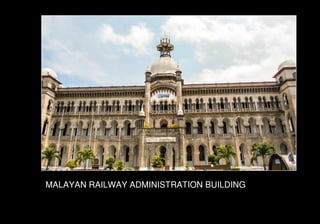
MALAYAN RAILWAY ADMINISTRATION BUILDING
Orthodox Greek designed spiral columns
Dome
Arched verandahs
Three-storeys structure that adopting Westernised vernacular designs with
surrounding verandahs and Gothic designed arches of various widths. Four spiral
columns of orthodox Greek design surround five domes that sit majestically atop the
building.
5
KUALA LUMPUR RAILWAY STATION
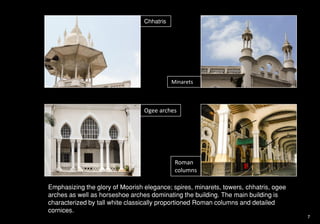
Chhatris
Minarets
Ogee arches
Roman
columns
Emphasizing the glory of Moorish elegance; spires, minarets, towers, chhatris, ogee
arches as well as horseshoe arches dominating the building. The main building is
characterized by tall white classically proportioned Roman columns and detailed
cornices.
7
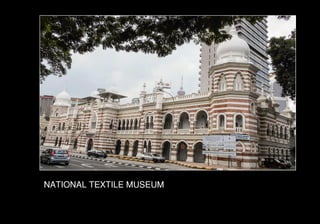
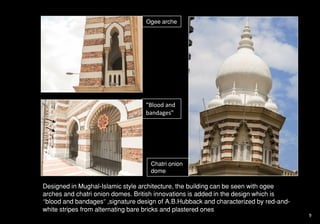
NATIONAL TEXTILE MUSEUM
Ogee arche
“Blood and
bandages”
Chatri onion
dome
Designed in Mughal-Islamic style architecture, the building can be seen with ogee
arches and chatri onion domes. British innovations is added in the design which is
“blood and bandages” ,signature design of A.B.Hubback and characterized by red-and-
white stripes from alternating bare bricks and plastered ones
9
NATIONAL HISTORY MUSEUM
The Moorish features and Islamic motifs of this building blend well with the neighbouring
Mogul buildings.
11
SULTAN ABDUL SAMAD BUILDING
Cornices and
exterior trimmings
40m high
clock tower
Shiny copper
dome
The major landmark in the city is in Indo-Saracenic Revival style with shiny copper
dome and a 40 meter high clock tower. Cornices and exterior trimmings of the
structure are made of cement plaster with the surface depth achieved by careful
arrangements of masonry brickwork. British and Islamic features are also added in.
13
ROYAL SELANGOR CLUB
Mock-Tudor structure can be seen from the Dataran Merdeka. It is a small plank
building with thatched roof as well as distinctive black and white facade
15
ST MARY’S CATHEDRAL
Originally a simple
timber building
Whitewashed structure
A beautiful whitewashed structure in Early English Gothic architecture style with
stained glass windows, tasseled tile paving and buttresses.
17
OLD HIGH COURT BUILDING
Towers topped with cupola with decorative
buttresses around the base
Keyhole arches and ogee arches
The distinctive feature of this structure is the towers that are linked by verandahs with
two different types of arches which is another typical traits of Mughal architecture.
19
DBKL CITY THEATRE
Its façade which bears rich
Mughal influences
Ogee arched
verandah
Islamic influences
It is an elegant building with Mughal architectural-styled faade, ogee arched verandah as
well as black color domes.
21
JALAN TUANKU ABDUL RAHMAN
Plaster scrolls
and emblems
Cornice
Giant
pilasters
Bay
windows
The shophouses are mostly designed in Neo-Classical features. The highly decorative
pediments punctuate the faade are supported by giant pilasters. Bay windows adorn
the first floor and the block is unified by the cornice treatment. The plaster scrolls and
emblems embellish the faade.
23
AUTHOR:LIMZIAHUEI
PHOTOTAKENBY:AUTHOR
Fusion architecture can be defined as
architecture style that combines culture,
technology, style, shapes and even ‘time’.
Fusion architecture can combines the classic
elements and the modern elements together in
a single structure. Some say fusion
architecture is the combination of beauty and
I totally agree with that. There are no rules
that limit in fusion architecture, creativity
move freely, just like ‘the sky is the only limit
of creativity’. This is why I like fusion
architecture style.

CNC FINAL.pdf

  • 1.
  • 2.
    1 2 34 5 6 8 7 10 9 1. Malayan Railway Administration Building 2.Kuala Lumpur Railway Station 3. National Textile Museum 4. National History Museum 5. Sultan Abdul Samad Building 6. Royal Selangor Club 7. St Mary’s Cathedral 8. Old High Court Building 9. DBKL City Theatre 10. Jalan Tuanku Abdul Rahman MY JOURNEY IN KUALA LUMPUR
  • 3.
    As the capitalof Malaysia, Kuala Lumpur has a fascinating history combining Malay, Islamic, Chinese, Indian and colonial British influences. It indicated an end of the Federation of Malaya and of British colonial rule when Malaya gained independence from the British Empire in 1957 and formed Malaysia in 1963. Although British colonial rule which began in the early 1800s had end, it had left behind some impressive examples of colonial architecture mostly clustered around Kuala Lumpur’s Old City Centre. Malay Islamic Chinese Indian Colonial British influences 3
  • 4.
  • 5.
    Orthodox Greek designedspiral columns Dome Arched verandahs Three-storeys structure that adopting Westernised vernacular designs with surrounding verandahs and Gothic designed arches of various widths. Four spiral columns of orthodox Greek design surround five domes that sit majestically atop the building. 5
  • 6.
  • 7.
    Chhatris Minarets Ogee arches Roman columns Emphasizing theglory of Moorish elegance; spires, minarets, towers, chhatris, ogee arches as well as horseshoe arches dominating the building. The main building is characterized by tall white classically proportioned Roman columns and detailed cornices. 7
  • 8.
  • 9.
    Ogee arche “Blood and bandages” Chatrionion dome Designed in Mughal-Islamic style architecture, the building can be seen with ogee arches and chatri onion domes. British innovations is added in the design which is “blood and bandages” ,signature design of A.B.Hubback and characterized by red-and- white stripes from alternating bare bricks and plastered ones 9
  • 10.
  • 11.
    The Moorish featuresand Islamic motifs of this building blend well with the neighbouring Mogul buildings. 11
  • 12.
  • 13.
    Cornices and exterior trimmings 40mhigh clock tower Shiny copper dome The major landmark in the city is in Indo-Saracenic Revival style with shiny copper dome and a 40 meter high clock tower. Cornices and exterior trimmings of the structure are made of cement plaster with the surface depth achieved by careful arrangements of masonry brickwork. British and Islamic features are also added in. 13
  • 14.
  • 15.
    Mock-Tudor structure canbe seen from the Dataran Merdeka. It is a small plank building with thatched roof as well as distinctive black and white facade 15
  • 16.
  • 17.
    Originally a simple timberbuilding Whitewashed structure A beautiful whitewashed structure in Early English Gothic architecture style with stained glass windows, tasseled tile paving and buttresses. 17
  • 18.
  • 19.
    Towers topped withcupola with decorative buttresses around the base Keyhole arches and ogee arches The distinctive feature of this structure is the towers that are linked by verandahs with two different types of arches which is another typical traits of Mughal architecture. 19
  • 20.
  • 21.
    Its façade whichbears rich Mughal influences Ogee arched verandah Islamic influences It is an elegant building with Mughal architectural-styled faade, ogee arched verandah as well as black color domes. 21
  • 22.
  • 23.
    Plaster scrolls and emblems Cornice Giant pilasters Bay windows Theshophouses are mostly designed in Neo-Classical features. The highly decorative pediments punctuate the faade are supported by giant pilasters. Bay windows adorn the first floor and the block is unified by the cornice treatment. The plaster scrolls and emblems embellish the faade. 23
  • 24.
    AUTHOR:LIMZIAHUEI PHOTOTAKENBY:AUTHOR Fusion architecture canbe defined as architecture style that combines culture, technology, style, shapes and even ‘time’. Fusion architecture can combines the classic elements and the modern elements together in a single structure. Some say fusion architecture is the combination of beauty and I totally agree with that. There are no rules that limit in fusion architecture, creativity move freely, just like ‘the sky is the only limit of creativity’. This is why I like fusion architecture style.