ARCHITECTURE CULTURE & HISTORY 2 [ARC 1323]
ARCHITECTURE HERITAGE BUILDING ANALYSIS

ESSAY DOCUMENTATION:

PRE- WAR SHOPLOTS AT JALAN RAYA TIMUR

Tutor:
Ms Sharrianne

Group Members:
Goh Yee Thong (0310044)
Kiew Wee Kee (0310202)
Ho Leon (0310402)
Teo Kean Hui (0310165)
PRE-WAR SHOPLOTS

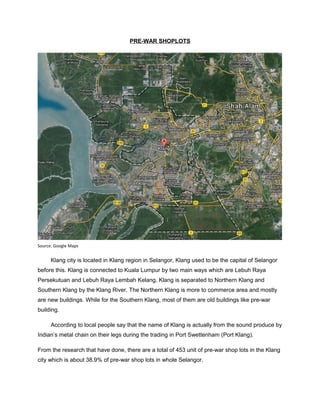
Source: Google Maps

Klang city is located in Klang region in Selangor, Klang used to be the capital of Selangor
before this. Klang is connected to Kuala Lumpur by two main ways which are Lebuh Raya
Persekutuan and Lebuh Raya Lembah Kelang. Klang is separated to Northern Klang and
Southern Klang by the Klang River. The Northern Klang is more to commerce area and mostly
are new buildings. While for the Southern Klang, most of them are old buildings like pre-war
building.
According to local people say that the name of Klang is actually from the sound produce by
Indian’s metal chain on their legs during the trading in Port Swettenham (Port Klang).
From the research that have done, there are a total of 453 unit of pre-war shop lots in the Klang
city which is about 38.9% of pre-war shop lots in whole Selangor.
Most of the pre-war buildings were built in Eclectic style shop houses in Jalan Raya Timur while
the other building style found are early shop houses, Neo-classic and Art Deco style.

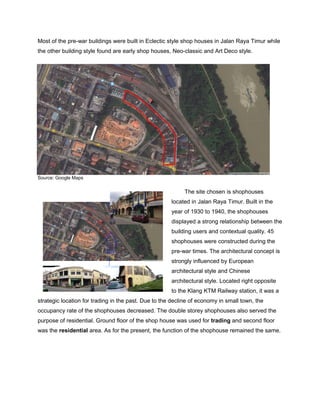
Source: Google Maps

The site chosen is shophouses
located in Jalan Raya Timur. Built in the
year of 1930 to 1940, the shophouses
displayed a strong relationship between the
building users and contextual quality. 45
shophouses were constructed during the
pre-war times. The architectural concept is
strongly influenced by European
architectural style and Chinese
architectural style. Located right opposite
to the Klang KTM Railway station, it was a
strategic location for trading in the past. Due to the decline of economy in small town, the
occupancy rate of the shophouses decreased. The double storey shophouses also served the
purpose of residential. Ground floor of the shop house was used for trading and second floor
was the residential area. As for the present, the function of the shophouse remained the same.
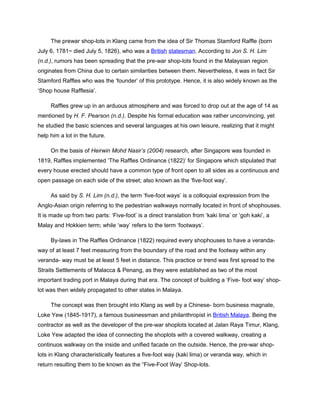
The prewar shop-lots in Klang came from the idea of Sir Thomas Stamford Raffle (born
July 6, 1781~ died July 5, 1826), who was a British statesman. According to Jon S. H. Lim
(n.d.), rumors has been spreading that the pre-war shop-lots found in the Malaysian region
originates from China due to certain similarities between them. Nevertheless, it was in fact Sir
Stamford Raffles who was the ‘founder’ of this prototype. Hence, it is also widely known as the
‘Shop house Rafflesia’.
Raffles grew up in an arduous atmosphere and was forced to drop out at the age of 14 as
mentioned by H. F. Pearson (n.d.). Despite his formal education was rather unconvincing, yet
he studied the basic sciences and several languages at his own leisure, realizing that it might
help him a lot in the future.
On the basis of Heirwin Mohd Nasir’s (2004) research, after Singapore was founded in
1819, Raffles implemented ‘The Raffles Ordinance (1822)’ for Singapore which stipulated that
every house erected should have a common type of front open to all sides as a continuous and
open passage on each side of the street; also known as the ‘five-foot way’.
As said by S. H. Lim (n.d.), the term ‘five-foot ways’ is a colloquial expression from the
Anglo-Asian origin referring to the pedestrian walkways normally located in front of shophouses.
It is made up from two parts: ‘Five-foot’ is a direct translation from ‘kaki lima’ or ‘goh kaki’, a
Malay and Hokkien term; while ‘way’ refers to the term ‘footways’.
By-laws in The Raffles Ordinance (1822) required every shophouses to have a verandaway of at least 7 feet measuring from the boundary of the road and the footway within any
veranda- way must be at least 5 feet in distance. This practice or trend was first spread to the
Straits Settlements of Malacca & Penang, as they were established as two of the most
important trading port in Malaya during that era. The concept of building a ‘Five- foot way’ shoplot was then widely propagated to other states in Malaya.
The concept was then brought into Klang as well by a Chinese- born business magnate,
Loke Yew (1845-1917), a famous businessman and philanthropist in British Malaya. Being the
contractor as well as the developer of the pre-war shoplots located at Jalan Raya Timur, Klang,
Loke Yew adapted the idea of connecting the shoplots with a covered walkway, creating a
continuos walkway on the inside and unified facade on the outside. Hence, the pre-war shoplots in Klang characteristically features a five-foot way (kaki lima) or veranda way, which in
return resulting them to be known as the “Five-Foot Way’ Shop-lots.
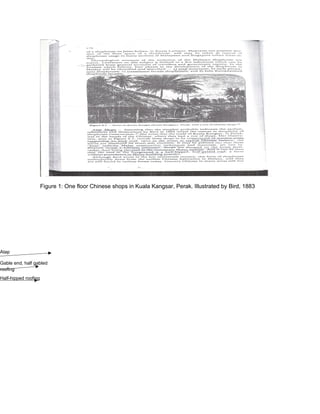
Figure 1: One floor Chinese shops in Kuala Kangsar, Perak. Illustrated by Bird, 1883

Atap
Gable end, half gabled
roofing
Half-hipped roofing
Penang Island, Malacca and Singapore were the main international trading ports to the
British government at the 19th century. Many business trades were running in the states,
therefore it resulted in the building of the shop houses where business trades could also happen
in the local communities. The reason why the shop lots could be found in Klang because the
trading activities from Penang Island, Malacca and Singapore were expanding from the
coastal area to the inner land.
According to Bird, the shop houses in street of Kuala Kangsar, in Perak was constructed
with atap roof supported by the wooden posts and opened to the street in a Chinese fashion
(Kohl, D.G., 1984). Although the huts of the house indicated Malay construction techniques and
materials, but the roof of these shops were half-hipped and half gabled roofing (Kohl, D.G.,
1984). Atap shop houses were the first physical mark of the Chinese in all major settlements
of Malaya (Kohl, D.G., 1984). Because of its rapid destruction and fire weakness, the
shopkeepers often constructed a 10 feet square strong brick vault to protect their wealth
(Kohl, D.G., 1984).

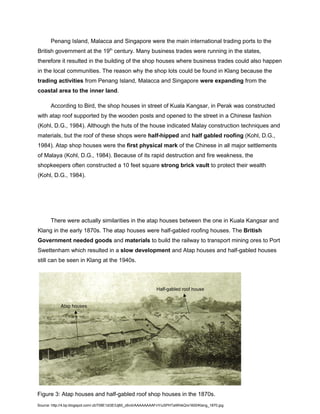
There were actually similarities in the atap houses between the one in Kuala Kangsar and
Klang in the early 1870s. The atap houses were half-gabled roofing houses. The British
Government needed goods and materials to build the railway to transport mining ores to Port
Swettenham which resulted in a slow development and Atap houses and half-gabled houses
still can be seen in Klang at the 1940s.

Half-gabled roof house
Atap houses

Figure 3: Atap houses and half-gabled roof shop houses in the 1870s.
Source: http://4.bp.blogspot.com/-zbT09E1di3E/Uj60_z6viiI/AAAAAAAAFnY/uSPHTaWhikQ/s1600/Klang_1870.jpg
Brick coated with
stucco huose

Wood
houses

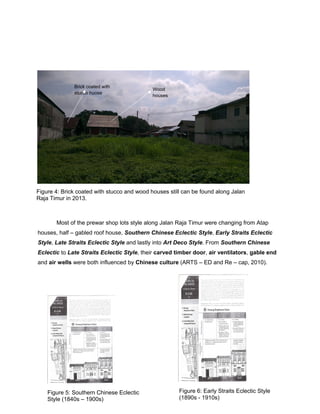
Figure 4: Brick coated with stucco and wood houses still can be found along Jalan
Raja Timur in 2013.

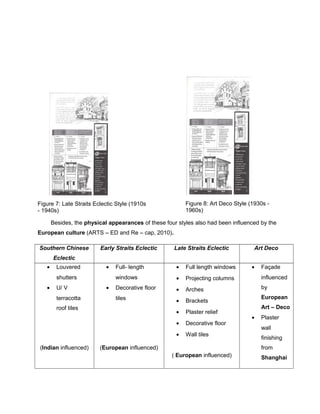
Most of the prewar shop lots style along Jalan Raja Timur were changing from Atap
houses, half – gabled roof house, Southern Chinese Eclectic Style, Early Straits Eclectic
Style, Late Straits Eclectic Style and lastly into Art Deco Style. From Southern Chinese
Eclectic to Late Straits Eclectic Style, their carved timber door, air ventilators, gable end
and air wells were both influenced by Chinese culture (ARTS – ED and Re – cap, 2010).

Figure 5: Southern Chinese Eclectic
Style (1840s – 1900s)

Figure 6: Early Straits Eclectic Style
(1890s - 1910s)
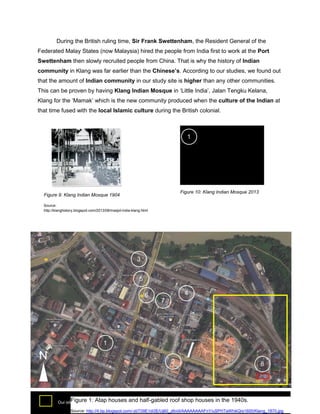
Figure 8: Art Deco Style (1930s 1960s)

Figure 7: Late Straits Eclectic Style (1910s
- 1940s)

Besides, the physical appearances of these four styles also had been influenced by the
European culture (ARTS – ED and Re – cap, 2010).
Southern Chinese

Early Straits Eclectic

Late Straits Eclectic

Art Deco

Eclectic
•

•

U/ V
terracotta

•

Projecting columns

influenced

Decorative floor

•

Arches

by

tiles

•

Brackets

•

•

Full length windows

Plaster relief
Decorative floor

•

•

•

windows

shutters

Full- length

•

Louvered

Wall tiles

roof tiles

(Indian influenced)

(European influenced)

•

Façade

European
Art – Deco
•

Plaster
wall
finishing
from

( European influenced)

Shanghai
During the British ruling time, Sir Frank Swettenham, the Resident General of the
Federated Malay States (now Malaysia) hired the people from India first to work at the Port
Swettenham then slowly recruited people from China. That is why the history of Indian
community in Klang was far earlier than the Chinese’s. According to our studies, we found out
that the amount of Indian community in our study site is higher than any other communities.
This can be proven by having Klang Indian Mosque in ‘Little India’, Jalan Tengku Kelana,
Klang for the ‘Mamak’ which is the new community produced when the culture of the Indian at
that time fused with the local Islamic culture during the British colonial.

1

Figure 10: Klang Indian Mosque 2013

Figure 9: Klang Indian Mosque 1904
Source:
http://klanghistory.blogspot.com/2013/08/masjid-india-klang.html

3
5
6

4
7

1

N

2

Figure 1: Atap houses
Our site (Pre – war shop house row)

8

Mr. Mah’s tailoring shop we
and half-gabled roof shop houses in the 1940s. studied

specifically
Source: http://4.bp.blogspot.com/-zbT09E1di3E/Uj60_z6viiI/AAAAAAAAFnY/uSPHTaWhikQ/s1600/Klang_1870.jpg
9

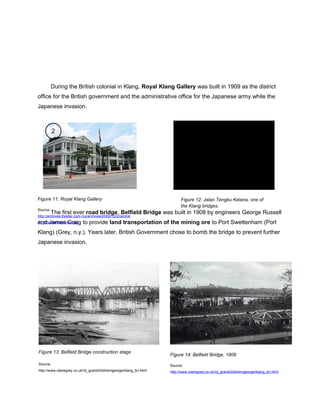
During the British colonial in Klang, Royal Klang Gallery was built in 1909 as the district
office for the British government and the administrative office for the Japanese army while the
Japanese invasion.

3

2

Figure 11: Royal Klang Gallery
Source:

Figure 12: Jalan Tengku Kelana, one of
the Klang bridges.

The first ever road bridge, Belfield Bridge was built in 1908 by engineers George Russell

http://archives.thestar.com.my/archives/2009/12/2/central
/m_02sultansuleiman.jpg
and James Craig

to provide land transportation of the mining ore to Port Swettenham (Port

Klang) (Grey, n.y.). Years later, British Government chose to bomb the bridge to prevent further
Japanese invasion.

Figure 13: Belfield Bridge construction stage

Figure 14: Belfield Bridge, 1908

Source:

Source:

http://www.clairegrey.co.uk/rd_grandchildren/george/klang_bri.html

http://www.clairegrey.co.uk/rd_grandchildren/george/klang_bri.html
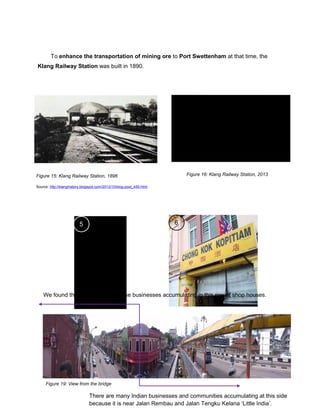
To enhance the transportation of mining ore to Port Swettenham at that time, the
Klang Railway Station was built in 1890.

4

Figure 16: Klang Railway Station, 2013

Figure 15: Klang Railway Station, 1896
Source: http://klanghistory.blogspot.com/2013/10/blog-post_450.html

6

5

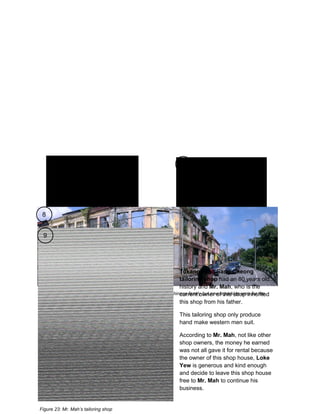
We found there are many Chinese businesses accumulating in this row of shop houses.

Figure 17: Bat Kut Teh Stall under
the Jalan Tengku Kelana Bridge

Figure 18: The name ‘Chong Kok’ means
China was named to express a deep love of
hometown from the Chinese workers during
the British colonial.

Figure 19: View from the bridge

There are many Indian businesses and communities accumulating at this side
because it is near Jalan Rembau and Jalan Tengku Kelana ‘Little India’.
7

8

Figure 20: Indian stall

Figure 21: Mamak stall

9

Tukang Jahit Sang Cheong
tailoring shop had an 80 years old
history and Mr. Mah, who is the
Figure 22: Abandoned shop houses were once belonged to a Chinese family but now athis shop inherited
current owner of parking area for the
neighboring shop houses’ owner
this shop from his father.
This tailoring shop only produce
hand make western men suit.
According to Mr. Mah, not like other
shop owners, the money he earned
was not all gave it for rental because
the owner of this shop house, Loke
Yew is generous and kind enough
and decide to leave this shop house
free to Mr. Mah to continue his
business.

Figure 23: Mr. Mah’s tailoring shop
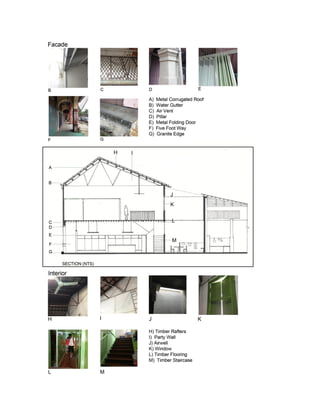
Façade
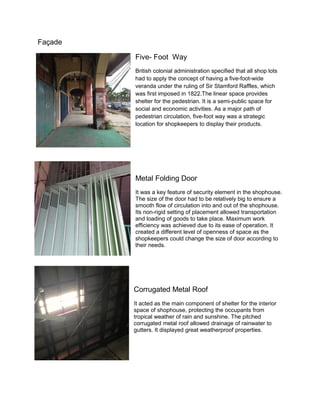
Five- Foot Way
British colonial administration specified that all shop lots
had to apply the concept of having a five-foot-wide
veranda under the ruling of Sir Stamford Raffles, which
was first imposed in 1822.The linear space provides
shelter for the pedestrian. It is a semi-public space for
social and economic activities. As a major path of
pedestrian circulation, five-foot way was a strategic
location for shopkeepers to display their products.

Metal Folding Door
It was a key feature of security element in the shophouse.
The size of the door had to be relatively big to ensure a
smooth flow of circulation into and out of the shophouse.
Its non-rigid setting of placement allowed transportation
and loading of goods to take place. Maximum work
efficiency was achieved due to its ease of operation. It
created a different level of openness of space as the
shopkeepers could change the size of door according to
their needs.

Corrugated Metal Roof
It acted as the main component of shelter for the interior
space of shophouse, protecting the occupants from
tropical weather of rain and sunshine. The pitched
corrugated metal roof allowed drainage of rainwater to
gutters. It displayed great weatherproof properties.
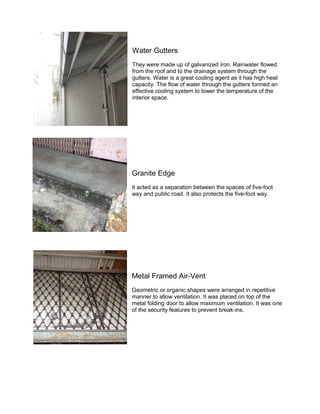
Water Gutters
They were made up of galvanized iron. Rainwater flowed
from the roof and to the drainage system through the
gutters. Water is a great cooling agent as it has high heat
capacity. The flow of water through the gutters formed an
effective cooling system to lower the temperature of the
interior space.

Granite Edge
It acted as a separation between the spaces of five-foot
way and public road. It also protects the five-foot way.

Metal Framed Air-Vent
Geometric or organic shapes were arranged in repetitive
manner to allow ventilation. It was placed on top of the
metal folding door to allow maximum ventilation. It was one
of the security features to prevent break-ins.
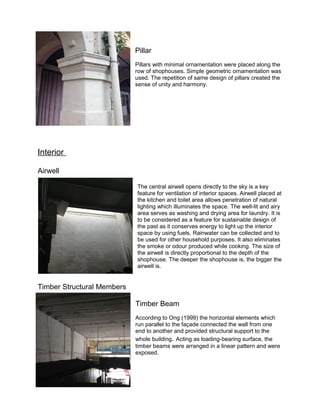
Pillar
Pillars with minimal ornamentation were placed along the
row of shophouses. Simple geometric ornamentation was
used. The repetition of same design of pillars created the
sense of unity and harmony.

Interior
Airwell
The central airwell opens directly to the sky is a key
feature for ventilation of interior spaces. Airwell placed at
the kitchen and toilet area allows penetration of natural
lighting which illuminates the space. The well-lit and airy
area serves as washing and drying area for laundry. It is
to be considered as a feature for sustainable design of
the past as it conserves energy to light up the interior
space by using fuels. Rainwater can be collected and to
be used for other household purposes. It also eliminates
the smoke or odour produced while cooking. The size of
the airwell is directly proportional to the depth of the
shophouse. The deeper the shophouse is, the bigger the
airwell is.

Timber Structural Members
Timber Beam
According to Ong (1999) the horizontal elements which
run parallel to the façade connected the wall from one
end to another and provided structural support to the
whole building. Acting as loading-bearing surface, the
timber beams were arranged in a linear pattern and were
exposed.
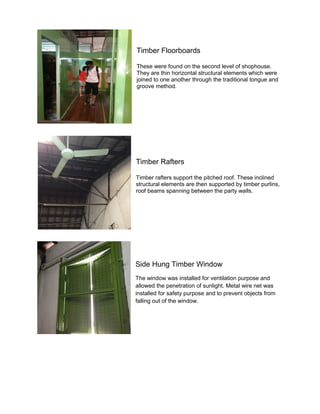
Timber Floorboards
These were found on the second level of shophouse.
They are thin horizontal structural elements which were
joined to one another through the traditional tongue and
groove method.

Timber Rafters
Timber rafters support the pitched roof. These inclined
structural elements are then supported by timber purlins,
roof beams spanning between the party walls.

Side Hung Timber Window
The window was installed for ventilation purpose and
allowed the penetration of sunlight. Metal wire net was
installed for safety purpose and to prevent objects from
falling out of the window.
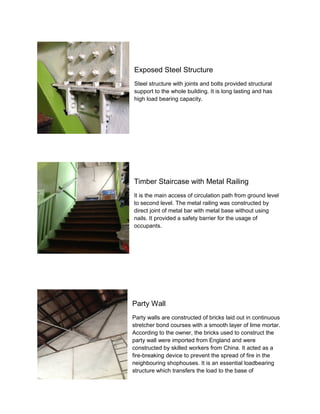
Exposed Steel Structure
Steel structure with joints and bolts provided structural
support to the whole building. It is long lasting and has
high load bearing capacity.

Timber Staircase with Metal Railing
It is the main access of circulation path from ground level
to second level. The metal railing was constructed by
direct joint of metal bar with metal base without using
nails. It provided a safety barrier for the usage of
occupants.

Party Wall
Party walls are constructed of bricks laid out in continuous
stretcher bond courses with a smooth layer of lime mortar.
According to the owner, the bricks used to construct the
party wall were imported from England and were
constructed by skilled workers from China. It acted as a
fire-breaking device to prevent the spread of fire in the
neighbouring shophouses. It is an essential loadbearing
structure which transfers the load to the base of
foundation.
In conclusion, Jalan Raya Timur shophouses were located in the strategic location of
Klang, which is nearby Klang KTM Railway Station. This enables commercial activities to take
place efficiently with the ease of transportation. Planning of the shophouses is influenced by
town planning system implemented in the Straits Settlement, which is named The Raffles
Ordinances, directed by Sir Stamford Raffles. The architectural style changes chronologically
along the timeline to adapt to the users and its context. From Straits Eclectic style to Art Deco
Style, the architectural elements changed to further enhance the practicality of the building.
In terms of social context, the shophouses accommodate the trading of a multicultural
social background which consists of the Malay, Chinese and Indian. It was caused by the import
of manpower from China and India during the pre-war time for ore mining industry. In terms of
transportation, it has great access as it is located opposite of KTM Railway Station and
surrounded by roads.
In terms of architectural elements, the design of shophouses emphasizes on its ventilation,
lighting and safety. The elements response to the site climate and social content. Windows, air
vents and airwells are the elements for ventilating the interior spaces. Timber structural
members are used as load bearing structure.
(2389 words)
Reference List
1. Pearson, H.F. (n.d.) Sir Stamford Raffles. [online] (Updated n.d.n.m. 2013) Available
at <http://global.britannica.com/EBchecked/topic/489451/Sir-Stamford-Raffles>
[Accessesed 2 November 2013].

2.

Mohd Nasir, H. (2004). Sir Stamford Raffles' career and contributions to
Singapore. [online] (Updated n.d.n.m. 2004) Available at
<http://infopedia.nl.sg/articles/SIP_715_2004-12-15.html> [Accessed 2 November 2013]

3. Grey, C. (n.d.). Dearie Russell: Family History. [online] (Updated n.d.) Available at <
http://www.clairegrey.co.uk/rd_grandchildren/george/klang_bri.html> [Accessed 11
November 2013]

4. Kohl, D.G. (1984). Chinese Architecture in the Straits Settlements and Western
Malaya: Temples, Kongsis and Houses. Petaling Jaya: Heinemann Educational Books
(Asia) Ltd.

5. Ong, K.S. (1999). The Conversation of Pre – War Shophouses: A Case Study of
Penang and Singapore. Kuala Lumpur: Department of Building Surveying, Built
Environment Division, Faculty of Engineering, University of Malaya.

6. Jon Lim, S.H. (n.d.). Georgetown: Heritage Buildings of Penang Island Georgetown.
Kuala Lumpur: Badan Warisan Library.
7. ARTS – ED and Re – cap (2010). Georgetown: World Heritage Site. George Town:
CIMB Foundation.

History 2 essay pre war shoplots

  • 1.
    ARCHITECTURE CULTURE &HISTORY 2 [ARC 1323] ARCHITECTURE HERITAGE BUILDING ANALYSIS ESSAY DOCUMENTATION: PRE- WAR SHOPLOTS AT JALAN RAYA TIMUR Tutor: Ms Sharrianne Group Members: Goh Yee Thong (0310044) Kiew Wee Kee (0310202) Ho Leon (0310402) Teo Kean Hui (0310165)
  • 2.
    PRE-WAR SHOPLOTS Source: GoogleMaps Klang city is located in Klang region in Selangor, Klang used to be the capital of Selangor before this. Klang is connected to Kuala Lumpur by two main ways which are Lebuh Raya Persekutuan and Lebuh Raya Lembah Kelang. Klang is separated to Northern Klang and Southern Klang by the Klang River. The Northern Klang is more to commerce area and mostly are new buildings. While for the Southern Klang, most of them are old buildings like pre-war building. According to local people say that the name of Klang is actually from the sound produce by Indian’s metal chain on their legs during the trading in Port Swettenham (Port Klang). From the research that have done, there are a total of 453 unit of pre-war shop lots in the Klang city which is about 38.9% of pre-war shop lots in whole Selangor.
  • 3.
    Most of thepre-war buildings were built in Eclectic style shop houses in Jalan Raya Timur while the other building style found are early shop houses, Neo-classic and Art Deco style. Source: Google Maps The site chosen is shophouses located in Jalan Raya Timur. Built in the year of 1930 to 1940, the shophouses displayed a strong relationship between the building users and contextual quality. 45 shophouses were constructed during the pre-war times. The architectural concept is strongly influenced by European architectural style and Chinese architectural style. Located right opposite to the Klang KTM Railway station, it was a strategic location for trading in the past. Due to the decline of economy in small town, the occupancy rate of the shophouses decreased. The double storey shophouses also served the purpose of residential. Ground floor of the shop house was used for trading and second floor was the residential area. As for the present, the function of the shophouse remained the same.
  • 4.
    The prewar shop-lotsin Klang came from the idea of Sir Thomas Stamford Raffle (born July 6, 1781~ died July 5, 1826), who was a British statesman. According to Jon S. H. Lim (n.d.), rumors has been spreading that the pre-war shop-lots found in the Malaysian region originates from China due to certain similarities between them. Nevertheless, it was in fact Sir Stamford Raffles who was the ‘founder’ of this prototype. Hence, it is also widely known as the ‘Shop house Rafflesia’. Raffles grew up in an arduous atmosphere and was forced to drop out at the age of 14 as mentioned by H. F. Pearson (n.d.). Despite his formal education was rather unconvincing, yet he studied the basic sciences and several languages at his own leisure, realizing that it might help him a lot in the future. On the basis of Heirwin Mohd Nasir’s (2004) research, after Singapore was founded in 1819, Raffles implemented ‘The Raffles Ordinance (1822)’ for Singapore which stipulated that every house erected should have a common type of front open to all sides as a continuous and open passage on each side of the street; also known as the ‘five-foot way’. As said by S. H. Lim (n.d.), the term ‘five-foot ways’ is a colloquial expression from the Anglo-Asian origin referring to the pedestrian walkways normally located in front of shophouses. It is made up from two parts: ‘Five-foot’ is a direct translation from ‘kaki lima’ or ‘goh kaki’, a Malay and Hokkien term; while ‘way’ refers to the term ‘footways’. By-laws in The Raffles Ordinance (1822) required every shophouses to have a verandaway of at least 7 feet measuring from the boundary of the road and the footway within any veranda- way must be at least 5 feet in distance. This practice or trend was first spread to the Straits Settlements of Malacca & Penang, as they were established as two of the most important trading port in Malaya during that era. The concept of building a ‘Five- foot way’ shoplot was then widely propagated to other states in Malaya. The concept was then brought into Klang as well by a Chinese- born business magnate, Loke Yew (1845-1917), a famous businessman and philanthropist in British Malaya. Being the contractor as well as the developer of the pre-war shoplots located at Jalan Raya Timur, Klang, Loke Yew adapted the idea of connecting the shoplots with a covered walkway, creating a continuos walkway on the inside and unified facade on the outside. Hence, the pre-war shoplots in Klang characteristically features a five-foot way (kaki lima) or veranda way, which in return resulting them to be known as the “Five-Foot Way’ Shop-lots.
  • 5.
    Figure 1: Onefloor Chinese shops in Kuala Kangsar, Perak. Illustrated by Bird, 1883 Atap Gable end, half gabled roofing Half-hipped roofing
  • 6.
    Penang Island, Malaccaand Singapore were the main international trading ports to the British government at the 19th century. Many business trades were running in the states, therefore it resulted in the building of the shop houses where business trades could also happen in the local communities. The reason why the shop lots could be found in Klang because the trading activities from Penang Island, Malacca and Singapore were expanding from the coastal area to the inner land. According to Bird, the shop houses in street of Kuala Kangsar, in Perak was constructed with atap roof supported by the wooden posts and opened to the street in a Chinese fashion (Kohl, D.G., 1984). Although the huts of the house indicated Malay construction techniques and materials, but the roof of these shops were half-hipped and half gabled roofing (Kohl, D.G., 1984). Atap shop houses were the first physical mark of the Chinese in all major settlements of Malaya (Kohl, D.G., 1984). Because of its rapid destruction and fire weakness, the shopkeepers often constructed a 10 feet square strong brick vault to protect their wealth (Kohl, D.G., 1984). There were actually similarities in the atap houses between the one in Kuala Kangsar and Klang in the early 1870s. The atap houses were half-gabled roofing houses. The British Government needed goods and materials to build the railway to transport mining ores to Port Swettenham which resulted in a slow development and Atap houses and half-gabled houses still can be seen in Klang at the 1940s. Half-gabled roof house Atap houses Figure 3: Atap houses and half-gabled roof shop houses in the 1870s. Source: http://4.bp.blogspot.com/-zbT09E1di3E/Uj60_z6viiI/AAAAAAAAFnY/uSPHTaWhikQ/s1600/Klang_1870.jpg
  • 7.
    Brick coated with stuccohuose Wood houses Figure 4: Brick coated with stucco and wood houses still can be found along Jalan Raja Timur in 2013. Most of the prewar shop lots style along Jalan Raja Timur were changing from Atap houses, half – gabled roof house, Southern Chinese Eclectic Style, Early Straits Eclectic Style, Late Straits Eclectic Style and lastly into Art Deco Style. From Southern Chinese Eclectic to Late Straits Eclectic Style, their carved timber door, air ventilators, gable end and air wells were both influenced by Chinese culture (ARTS – ED and Re – cap, 2010). Figure 5: Southern Chinese Eclectic Style (1840s – 1900s) Figure 6: Early Straits Eclectic Style (1890s - 1910s)
  • 8.
    Figure 8: ArtDeco Style (1930s 1960s) Figure 7: Late Straits Eclectic Style (1910s - 1940s) Besides, the physical appearances of these four styles also had been influenced by the European culture (ARTS – ED and Re – cap, 2010). Southern Chinese Early Straits Eclectic Late Straits Eclectic Art Deco Eclectic • • U/ V terracotta • Projecting columns influenced Decorative floor • Arches by tiles • Brackets • • Full length windows Plaster relief Decorative floor • • • windows shutters Full- length • Louvered Wall tiles roof tiles (Indian influenced) (European influenced) • Façade European Art – Deco • Plaster wall finishing from ( European influenced) Shanghai
  • 9.
    During the Britishruling time, Sir Frank Swettenham, the Resident General of the Federated Malay States (now Malaysia) hired the people from India first to work at the Port Swettenham then slowly recruited people from China. That is why the history of Indian community in Klang was far earlier than the Chinese’s. According to our studies, we found out that the amount of Indian community in our study site is higher than any other communities. This can be proven by having Klang Indian Mosque in ‘Little India’, Jalan Tengku Kelana, Klang for the ‘Mamak’ which is the new community produced when the culture of the Indian at that time fused with the local Islamic culture during the British colonial. 1 Figure 10: Klang Indian Mosque 2013 Figure 9: Klang Indian Mosque 1904 Source: http://klanghistory.blogspot.com/2013/08/masjid-india-klang.html 3 5 6 4 7 1 N 2 Figure 1: Atap houses Our site (Pre – war shop house row) 8 Mr. Mah’s tailoring shop we and half-gabled roof shop houses in the 1940s. studied specifically Source: http://4.bp.blogspot.com/-zbT09E1di3E/Uj60_z6viiI/AAAAAAAAFnY/uSPHTaWhikQ/s1600/Klang_1870.jpg
  • 10.
    9 During the Britishcolonial in Klang, Royal Klang Gallery was built in 1909 as the district office for the British government and the administrative office for the Japanese army while the Japanese invasion. 3 2 Figure 11: Royal Klang Gallery Source: Figure 12: Jalan Tengku Kelana, one of the Klang bridges. The first ever road bridge, Belfield Bridge was built in 1908 by engineers George Russell http://archives.thestar.com.my/archives/2009/12/2/central /m_02sultansuleiman.jpg and James Craig to provide land transportation of the mining ore to Port Swettenham (Port Klang) (Grey, n.y.). Years later, British Government chose to bomb the bridge to prevent further Japanese invasion. Figure 13: Belfield Bridge construction stage Figure 14: Belfield Bridge, 1908 Source: Source: http://www.clairegrey.co.uk/rd_grandchildren/george/klang_bri.html http://www.clairegrey.co.uk/rd_grandchildren/george/klang_bri.html
  • 11.
    To enhance thetransportation of mining ore to Port Swettenham at that time, the Klang Railway Station was built in 1890. 4 Figure 16: Klang Railway Station, 2013 Figure 15: Klang Railway Station, 1896 Source: http://klanghistory.blogspot.com/2013/10/blog-post_450.html 6 5 We found there are many Chinese businesses accumulating in this row of shop houses. Figure 17: Bat Kut Teh Stall under the Jalan Tengku Kelana Bridge Figure 18: The name ‘Chong Kok’ means China was named to express a deep love of hometown from the Chinese workers during the British colonial. Figure 19: View from the bridge There are many Indian businesses and communities accumulating at this side because it is near Jalan Rembau and Jalan Tengku Kelana ‘Little India’.
  • 12.
    7 8 Figure 20: Indianstall Figure 21: Mamak stall 9 Tukang Jahit Sang Cheong tailoring shop had an 80 years old history and Mr. Mah, who is the Figure 22: Abandoned shop houses were once belonged to a Chinese family but now athis shop inherited current owner of parking area for the neighboring shop houses’ owner this shop from his father. This tailoring shop only produce hand make western men suit. According to Mr. Mah, not like other shop owners, the money he earned was not all gave it for rental because the owner of this shop house, Loke Yew is generous and kind enough and decide to leave this shop house free to Mr. Mah to continue his business. Figure 23: Mr. Mah’s tailoring shop
  • 15.
    Façade Five- Foot Way Britishcolonial administration specified that all shop lots had to apply the concept of having a five-foot-wide veranda under the ruling of Sir Stamford Raffles, which was first imposed in 1822.The linear space provides shelter for the pedestrian. It is a semi-public space for social and economic activities. As a major path of pedestrian circulation, five-foot way was a strategic location for shopkeepers to display their products. Metal Folding Door It was a key feature of security element in the shophouse. The size of the door had to be relatively big to ensure a smooth flow of circulation into and out of the shophouse. Its non-rigid setting of placement allowed transportation and loading of goods to take place. Maximum work efficiency was achieved due to its ease of operation. It created a different level of openness of space as the shopkeepers could change the size of door according to their needs. Corrugated Metal Roof It acted as the main component of shelter for the interior space of shophouse, protecting the occupants from tropical weather of rain and sunshine. The pitched corrugated metal roof allowed drainage of rainwater to gutters. It displayed great weatherproof properties.
  • 16.
    Water Gutters They weremade up of galvanized iron. Rainwater flowed from the roof and to the drainage system through the gutters. Water is a great cooling agent as it has high heat capacity. The flow of water through the gutters formed an effective cooling system to lower the temperature of the interior space. Granite Edge It acted as a separation between the spaces of five-foot way and public road. It also protects the five-foot way. Metal Framed Air-Vent Geometric or organic shapes were arranged in repetitive manner to allow ventilation. It was placed on top of the metal folding door to allow maximum ventilation. It was one of the security features to prevent break-ins.
  • 17.
    Pillar Pillars with minimalornamentation were placed along the row of shophouses. Simple geometric ornamentation was used. The repetition of same design of pillars created the sense of unity and harmony. Interior Airwell The central airwell opens directly to the sky is a key feature for ventilation of interior spaces. Airwell placed at the kitchen and toilet area allows penetration of natural lighting which illuminates the space. The well-lit and airy area serves as washing and drying area for laundry. It is to be considered as a feature for sustainable design of the past as it conserves energy to light up the interior space by using fuels. Rainwater can be collected and to be used for other household purposes. It also eliminates the smoke or odour produced while cooking. The size of the airwell is directly proportional to the depth of the shophouse. The deeper the shophouse is, the bigger the airwell is. Timber Structural Members Timber Beam According to Ong (1999) the horizontal elements which run parallel to the façade connected the wall from one end to another and provided structural support to the whole building. Acting as loading-bearing surface, the timber beams were arranged in a linear pattern and were exposed.
  • 18.
    Timber Floorboards These werefound on the second level of shophouse. They are thin horizontal structural elements which were joined to one another through the traditional tongue and groove method. Timber Rafters Timber rafters support the pitched roof. These inclined structural elements are then supported by timber purlins, roof beams spanning between the party walls. Side Hung Timber Window The window was installed for ventilation purpose and allowed the penetration of sunlight. Metal wire net was installed for safety purpose and to prevent objects from falling out of the window.
  • 19.
    Exposed Steel Structure Steelstructure with joints and bolts provided structural support to the whole building. It is long lasting and has high load bearing capacity. Timber Staircase with Metal Railing It is the main access of circulation path from ground level to second level. The metal railing was constructed by direct joint of metal bar with metal base without using nails. It provided a safety barrier for the usage of occupants. Party Wall Party walls are constructed of bricks laid out in continuous stretcher bond courses with a smooth layer of lime mortar. According to the owner, the bricks used to construct the party wall were imported from England and were constructed by skilled workers from China. It acted as a fire-breaking device to prevent the spread of fire in the neighbouring shophouses. It is an essential loadbearing structure which transfers the load to the base of
  • 20.
    foundation. In conclusion, JalanRaya Timur shophouses were located in the strategic location of Klang, which is nearby Klang KTM Railway Station. This enables commercial activities to take place efficiently with the ease of transportation. Planning of the shophouses is influenced by town planning system implemented in the Straits Settlement, which is named The Raffles Ordinances, directed by Sir Stamford Raffles. The architectural style changes chronologically along the timeline to adapt to the users and its context. From Straits Eclectic style to Art Deco Style, the architectural elements changed to further enhance the practicality of the building. In terms of social context, the shophouses accommodate the trading of a multicultural social background which consists of the Malay, Chinese and Indian. It was caused by the import of manpower from China and India during the pre-war time for ore mining industry. In terms of transportation, it has great access as it is located opposite of KTM Railway Station and surrounded by roads. In terms of architectural elements, the design of shophouses emphasizes on its ventilation, lighting and safety. The elements response to the site climate and social content. Windows, air vents and airwells are the elements for ventilating the interior spaces. Timber structural members are used as load bearing structure. (2389 words)
  • 21.
    Reference List 1. Pearson,H.F. (n.d.) Sir Stamford Raffles. [online] (Updated n.d.n.m. 2013) Available at <http://global.britannica.com/EBchecked/topic/489451/Sir-Stamford-Raffles> [Accessesed 2 November 2013]. 2. Mohd Nasir, H. (2004). Sir Stamford Raffles' career and contributions to Singapore. [online] (Updated n.d.n.m. 2004) Available at <http://infopedia.nl.sg/articles/SIP_715_2004-12-15.html> [Accessed 2 November 2013] 3. Grey, C. (n.d.). Dearie Russell: Family History. [online] (Updated n.d.) Available at < http://www.clairegrey.co.uk/rd_grandchildren/george/klang_bri.html> [Accessed 11 November 2013] 4. Kohl, D.G. (1984). Chinese Architecture in the Straits Settlements and Western Malaya: Temples, Kongsis and Houses. Petaling Jaya: Heinemann Educational Books (Asia) Ltd. 5. Ong, K.S. (1999). The Conversation of Pre – War Shophouses: A Case Study of Penang and Singapore. Kuala Lumpur: Department of Building Surveying, Built Environment Division, Faculty of Engineering, University of Malaya. 6. Jon Lim, S.H. (n.d.). Georgetown: Heritage Buildings of Penang Island Georgetown. Kuala Lumpur: Badan Warisan Library.
  • 22.
    7. ARTS –ED and Re – cap (2010). Georgetown: World Heritage Site. George Town: CIMB Foundation.