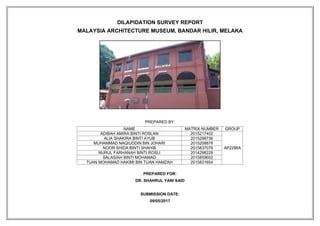
DILAPIDATION SURVEY REPORT
MALAYSIA ARCHITECTURE MUSEUM, BANDAR HILIR, MELAKA
PREPARED BY:
NAME MATRIX NUMBER GROUP
ADIBAH AMIRA BINTI ROSLAN 2015217402
AP2296A
ALIA SHAKIRA BINTI AYUB 2015298736
MUHAMMAD NAQIUDDIN BIN JOHARI 2015208878
NOOR SHIDA BINTI SHAHIB 2015837078
NURUL FARHANAH BINTI ROSLI 2014298228
SALASIAH BINTI MOHAMAD 2015859602
TUAN MOHAMAD HAKIMI BIN TUAN HAMZAH 2015831654
PREPARED FOR:
DR. SHAHRUL YANI SAID
SUBMISSION DATE:
09/05/2017
MALAYSIA ARCHITECTURE MUSEUM i
TABLE OF CONTENT
TABLE OF CONTENT i
LIST OF PHOTOS i
LIST OF FIGURES i
LIST OF TABLES i
1.0. CHAPTER 1 INTRODUCTION 1
2.0. CHAPTER 2 BACKGROUND AND HISTORY OF BUILDING 2
3.0. CHAPTER 3 DESIGN AND ARCHITECTURE OF BUILDING 2
4.0. CHAPTER 4 DEFECT ANALYSIS 5
5.0. CHAPTER 5 RECOMMENDATION 9
6.0. CHAPTER 6 CONCLUSION 9
7.0. BIBLOGRAPHY 10
8.0. APPENDIX
1. Appendix A (Defect Sheets) 11
2. Appendix B
i. Ground floor plan (B-1) 29
ii. First floor plan (B-2) 29
iii. Front view (B-3) 29
iv. Rear view (B-4) 29
v. Right elevation (B-5) 30
vi. Left elevation (B-6) 30
LIST OF TABLES
Table 1: Building Condition Assessment (BARIS) 5
Table 2: Building element 8
Table 3: Building floor 8
Table 4: Defect colour 8
Table 5: Building Defect 8
LIST OF PHOTOS
Photo 1: Satellite image of the museum location 1
Photo 2: Satellite image of the museum 1
Photos 3: Timber and terracotta tiles finishes for floors 2
Photo 4: Laterite stones and Dutch bricks for wall 2
Photo 5: Door and window of the museum 2
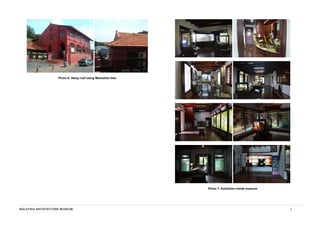
Photo 6: Steep roof using Marseilles tiles 3
Photo 7: Exhibition inside museum 3
LIST OF FIGURES
Figure 1: Location plan of the museum 1
Figure 2: Location plan (Bandar Hilir) 1
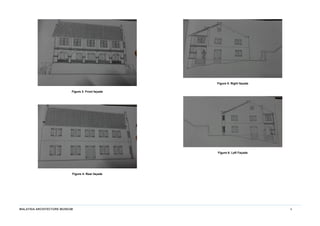
Figure 3: Front façade 4
Figure 4: Rear façade 4
Figure 5: Right façade 4
Figure 6: Left Façade 4
Figure 7: Ground floor 5
Figure 8: First floor 5
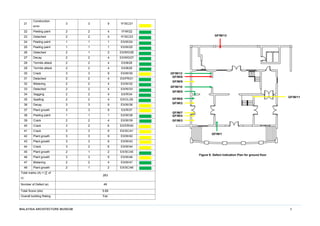
Figure 9: Defect Indication Plan for ground floor 6
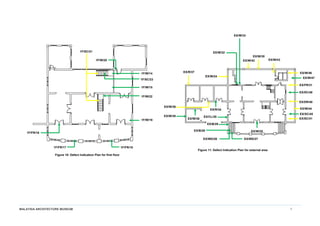
Figure 10: Defect Indication Plan for first floor 7
Figure 11: Defect Indication Plan for external area 7
Figure 12: Defect analysis pie chart 9
MALAYSIA ARCHITECTURE MUSEUM 1
CHAPTER 1 INTRODUCTION
The purpose of the inspection is to determine the element of the building and also its material
using condition survey tools, investigate the defects on the building, the causes of defects, analysis the
data and suggest ways overcome the problems.
The scope of work of our inspections are to study the building elements and its component of
the building, determine the space usage of the building, determine the defects in the building and
making the condition survey, prepare the remedies of the defects in the building and prepare the
measured drawing of the building and prepare dilapidation survey report. We provide the location plan
and the building lot plan.
For the inspection there are few areas within the building external and internal that we were
unable to access due to restriction from the museum. We had classified these areas as our limitation
and the survey cannot be conducted. All information provided in the Appendix will assist and correlate
with our findings and data.
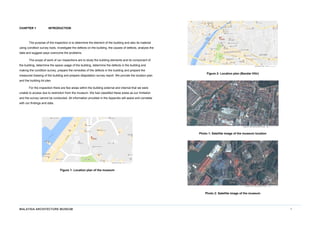
Figure 1: Location plan of the museum
Figure 2: Location plan (Bandar Hilir)
Photo 1: Satellite image of the museum location
Photo 2: Satellite image of the museum
MALAYSIA ARCHITECTURE MUSEUM 2
CHAPTER 2 BACKGROUND AND HISTORY OF BUILDING
This two-storey building which houses the museum is distinctive on its own way with its long
history and the uniqueness of architectural design. Built in the 1700s during the Dutch colonial period in
Melaka, the building was used as a dwelling place for dignitaries and centre of administration. Located at
Jalan Kota, Bandar Hilir, this building which also known as the “Red Building” has undergone several
processes of change in its usage.
The building was used as an administration office during the British colonial rule. Aster the
independence, it was occupied by the Malacca Water Board (MWB) from 1978 to 1980s under Malacca
State Government. In 1999, the Department of Museums and Antiquities carried out restoration works
until its full completion in 2000 and in 2004, this building was converted into museum known as the
Malaysia Architecture Museum.
CHAPTER 3 DESIGN AND ARCHITECTURE OF BUILDING
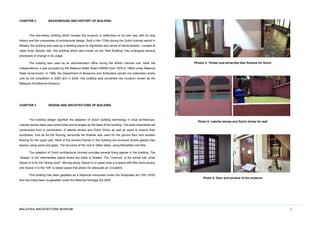
The building design signified the adaption of Dutch building technology in local architecture.
Laterite stones slabs was constructed and arranged as the base of the building. The walls meanwhile are
constructed from a combination of laterite stones and Dutch bricks as well as wood to ensure their
sturdiness. And as for the flooring, terracotta tile finishes was used for the ground floor and wooden
flooring for the upper part. Most of the window frames in this building are louvered double-glazed (two
leaves) using wood and glass. The structure of the roof is rather steep, using Marseilles roof tiles.
The adaption of Dutch architectural concept provides several living spaces in the building. The
“stoepe” is the intermediate space where the lobby is located. The “voorhuis” is the arrival hall, while
Space III is for the “dining room”. Moving along, Space IV or upper area is a space with little more privacy
and Space V or the “loft” is raised space that allows for adequate air circulation.
This building has been gazetted as a historical monument under the Antiquities Act 168 (1976)
and has today been re-gazetted under the National Heritage Act 2005.
Photos 3: Timber and terracotta tiles finishes for floors
Photo 4: Laterite stones and Dutch bricks for wall
Photo 5: Door and window of the museum
MALAYSIA ARCHITECTURE MUSEUM 3
Photo 6: Steep roof using Marseilles tiles
Photo 7: Exhibition inside museum
MALAYSIA ARCHITECTURE MUSEUM 4
Figure 3: Front façade
Figure 4: Rear façade
Figure 5: Right façade
Figure 6: Left Façade
MALAYSIA ARCHITECTURE MUSEUM 5
Figure 7: Ground floor
Figure 8: First floor
CHAPTER 4 DEFECT ANALYSIS
This is the defect analysis that has been prepared based on the condition survey conducted at the
museum.
Table 1: Building Condition Assessment (BARIS)
BUILDING ASSESSMENT RATING SYSTEM (BARIS)
Schedule of Building Condition (SBC)
Sheet
No.
Defects
BARIS
Condition
Assessment
[a]
Priority
Assessment
[b]
Matrix
Analysis
[c] = (a x
b)
Defect
Sheet
Defect
Indication
Plan
1 Rotten 2 2 4 GF/D/1
2 Peeling paint 3 3 9 GF/W/2
3 Peeling paint 3 3 9 GF/W/3
4 Discoloration 3 3 9 GF/W/4
5 Peeling paint 3 3 9 GF/W/5
6 Crack 2 2 4 GF/W/6
7 Peeling paint 4 3 12 GF/W/7
8 Spalling 4 4 16 GF/W/8
9 Rusting 3 3 9 GF/W/9
10 Crack 1 1 1 GF/W/10
11 Peeling paint 4 3 12 GF/W/11
12 Crack 2 2 4 GF/W/12
13 Crack 4 4 16 GF/DR/13
14 Dampness 2 2 4 1F/W/14
15 Blistering 2 2 4 1F/W/15
16 Crack 2 2 4 1F/FR/16
17 Detached 2 2 4 1F/W/17
18 Detached 2 2 4 1F/W/18
19 Dampness 2 2 4 1F/W/19
20 Dampness 2 2 4 1F/W/20
vxv
vxv
vxv
vxv
vxv
vxv
vxv
vxv
vxv
MALAYSIA ARCHITECTURE MUSEUM 6
21
Construction
error
3 3 9 1F/SC/21
22 Peeling paint 2 2 4 1F/W/22
23 Detached 2 2 4 1F/SC/23
24 Peeling paint 1 1 1 EX/W/24
25 Peeling paint 1 1 1 EX/W/25
26 Detached 2 1 2 EX/WD/26
27 Decay 2 2 4 EX/WD/27
28 Termite attack 2 2 4 EX/B/28
29 Termite attack 2 2 4 EX/B/29
30 Crack 3 3 9 EX/W/30
31 Detached 2 2 4 EX/FR/31
32 Blistering 2 2 4 EX/W/32
33 Detached 2 2 4 EX/W/33
34 Sagging 2 2 4 EX/R/34
35 Spalling 2 2 4 EX/CL/35
36 Decay 3 3 9 EX/W/36
37 Plant growth 3 3 9 EX/R/37
38 Peeling paint 1 1 1 EX/W/38
39 Crack 2 2 4 EX/W/39
40 Crack 3 2 6 EX/DR/40
41 Crack 3 3 9 EX/SC/41
42 Plant growth 3 3 9 EX/W/42
43 Plant growth 3 3 9 EX/W/43
44 Crack 3 2 6 EX/W/44
45 Plant growth 2 1 2 EX/SC/45
46 Plant growth 3 3 9 EX/W/46
47 Blistering 2 2 4 EX/W/47
48 Plant growth 2 1 2 EX/SC/48
Total marks (A) = (∑ of
c)
283
Number of Defect (e) 48
Total Score (d/e) 5.89
Overall building Rating Fair
Figure 9: Defect Indication Plan for ground floor
vxv
vxv
vxv
vxv
vxv
vxv
vxv
vxv
vxv
vxv
vxv
vxv
vxv
vxv
vxv
vxv
vxv
vxv
GF/W/2
GF/W/3
GF/W/4
GF/W/1
GF/W/6
GF/W/5
GF/W/7
GF/W/8
GF/W/9
GF/W/10
GF/W/11
GF/W/12
GF/W/13
MALAYSIA ARCHITECTURE MUSEUM 7
Figure 10: Defect Indication Plan for first floor
Figure 11: Defect Indication Plan for external area
1F/W/14
1F/FR/16
1F/W/15
1F/FR/17 1F/FR/18
1F/W/19
1F/W/20
1F/SC/21
1F/W/22
1F/SC/23
EX/WD/27EX/WD/26
EX/B/29
EX/B/28 EX/W/25
EX/W/24
EX/FR/31
EX/W/30
EX/W/32
EX/W/33
EX/R/34
EX/CL/35
EX/W/36
EX/R/37
EX/W/38
EX/W/39
EX/DR/40
EX/SC/41
EX/W/42 EX/W/43
EX/SC/45
EX/W/44
EX/W/46
EX/W/47
EX/SC/48
MALAYSIA ARCHITECTURE MUSEUM 8
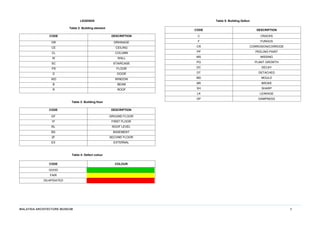
LEGENDS
Table 2: Building element
CODE DESCRIPTION
DR DRAINAGE
CE CEILING
CL COLUMN
W WALL
SC STAIRCASE
FR FLOOR
D DOOR
WD WINDOW
B BEAM
R ROOF
Table 3: Building floor
CODE DESCRIPTION
GF GROUND FLOOR
1F FIRST FLOOR
RL ROOF LEVEL
BS BASEMENT
2F SECOND FLOOR
EX EXTERNAL
Table 4: Defect colour
CODE COLOUR
GOOD
FAIR
DILAPIDATED
Table 5: Building Defect
CODE DESCRIPTION
C CRACKS
F FUNGUS
CR CORROSION/CORRODE
PP PEELING PAINT
MS MISSING
PG PLANT GROWTH
DC DECAY
DT DETACHED
MD MOULD
BR BROKE
SH SHARP
LK LEAKAGE
DP DAMPNESS
MALAYSIA ARCHITECTURE MUSEUM 9
Most of the defects occur in this building is minor defect and only have one is major defect
based on the inspection work that we have done. The major defect at this building is slope of the
staircase are too high and can be a dangerous for occupants when in rushing use that staircase and
can possible accidently occur. That is because the construction error. That defect just a condition
monitoring. Those elements still fulfill their function but risks that can lead to fatality or injury. For
the minor categories of defect which are rotten, peeling of paint, discoloration, crack, spalling,
rusting, dampness, blistering, detached, decay, termite attack, sagging and plant growth. All these
defects are not serious but if left unattended, it could lead to a serious damage or failure in the
building structure.
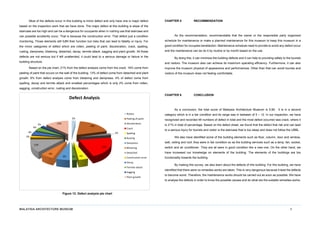
Based on the pie chart, 21% from the defect analysis come from the crack. 19% come from
peeling of paint that occurs on the wall of the building. 13% of defect come from detached and plant
growth. 6% from defect analysis come from blistering and dampness. 4% of defect come from
spalling, decay and termite attack and smallest percentages which is only 2% come from rotten,
sagging, construction error, rusting and discoloration.
Figure 12: Defect analysis pie chart
CHAPTER 5 RECOMMENDATION
As the recommendation, recommendable that the owner or the responsible party organized
schedule for maintenance or make a planned maintenance for this museum to keep this museum in a
good condition for occupies benefaction. Maintenance schedule need to provide to avoid any defect occur
and the maintenance can be do it by routine or by month based on the use.
By doing this, it can minimize the building defects and it can help to providing safety to the tourists
and visitors. The museum also can achieve its maximum operating efficiency. Furthermore, it can also
improve the museum physical of appearance and performances. Other than that can avoid tourists and
visitors of the museum does not feeling comfortable.
CHAPTER 6 CONCLUSION
As a conclusion, the total score of Malaysia Architecture Museum is 5.89. It is in a second
category which is in a fair condition and its range was in between of 5 – 12. In our inspection, we have
recognized and recorded 48 numbers of defect in total and the most defect occurred was crack, where it
is 21% in total of percentage. Based on the defect sheet, we found that the defect that risk and can lead
to a serious injury for tourists and visitor is the staircase that is too steep and does not follow the UBBL.
We also have identified some of the building elements such as floor, column, door and window,
wall, ceiling and roof, they were in fair condition so as the building services such as a lamp, fan, socket,
switch and air conditioner. They are all were in good condition like a new one. On the other hand, we
have increased our knowledge on elements of the building. The elements of the buildings are too
functionality towards the building.
By making this survey, we also learn about the defects of this building. For this building, we have
identified that there were no remedies works are taken. This is very dangerous because it lead the defects
to become worst. Therefore, the maintenance works should be carried out as soon as possible. We have
to analyse the defects in order to know the possible causes and do what are the suitable remedies works.
2%
19%
2%
21%
4%2%6%
6%
13%
2%
4%
4%
2% 13%
Defect Analysis
Rotten
Peeling of paint
Discoloration
Crack
Spalling
Rusting
Dampness
Blistering
Detached
Construction error
Decay
Termite attack
Sagging
Plant growth
MALAYSIA ARCHITECTURE MUSEUM 10
BIBLIOGRAPHY
Guideline for the conservation of building (2010). Institute of Architect of Ireland. Retrieved at
http://www.riai.ie/uploads/files/Conservation_Guidelines_December_2010.pdf
Handbook of conservation of heritage building (2013). Directorate General, Central Public Works
Department. Retrieved at http://cpwd.gov.in/Publication/ConservationHertBuildings.pdf
Kamal K.S. (2007). Rehabilitation of heritage building in Malaysia. Retrieved at
http://buildingconservation.blogspot.my/2007/03/rehabilitation-of-heritage-buildings-in.html
Malaysia Architecture Museum, Department of Museum Malaysia (2014). Retrieved at
http://www.jmm.gov.my/en/museum/malaysia-architectural-museum
Muzium Senibina Melaka Bandar Hilir, Perbadanan Muzium Negeri Melaka (2017). Retrieved at
http://www.perzim.gov.my/
APPENDIX
1. Appendix A (Defect Sheets)
2. Appendix B
i. Ground floor plan (B-1)
ii. First floor plan (B-2)
iii. Front view (B-4)
iv. Rear view (B-5)
v. Right elevation (B-6)
vi. Left elevation (B-7)
MALAYSIA ARCHITECTURE MUSEUM 11
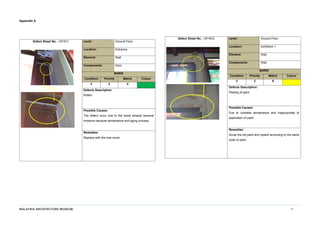
Appendix A
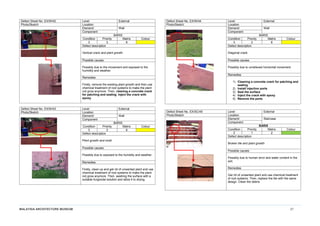
Defect Sheet No. : GF/D/1 Level: Ground Floor
Location: Entrance
Element: Wall
Components: Door
BARIS
Condition Priority Matrix Colour
2 2 4
Defects Description:
Rotten
Possible Causes:
The defect occur due to the wood already became
moisture because temperature and aging process..
Remedies:
Replace with the new wood.
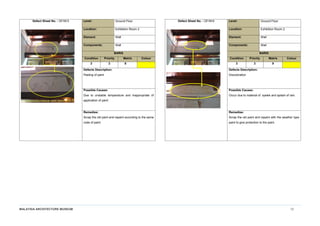
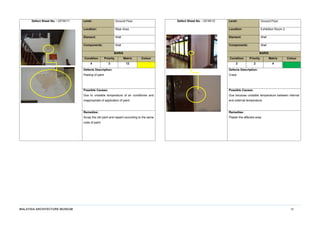
Defect Sheet No. : GF/W/2 Level: Ground Floor
Location: Exhibition 1
Element: Wall
Components: Wall
BARIS
Condition Priority Matrix Colour
3 3 9
Defects Description:
Peeling of paint
Possible Causes:
Due to unstable temperature and inappropriate of
application of paint
Remedies:
Scrap the old paint and repaint according to the same
code of paint.
MALAYSIA ARCHITECTURE MUSEUM 12
Defect Sheet No. : GF/W/3 Level: Ground Floor
Location: Exhibition Room 2
Element: Wall
Components: Wall
BARIS
Condition Priority Matrix Colour
3 3 9
Defects Description:
Peeling of paint
Possible Causes:
Due to unstable temperature and inappropriate of
application of paint
Remedies:
Scrap the old paint and repaint according to the same
code of paint.
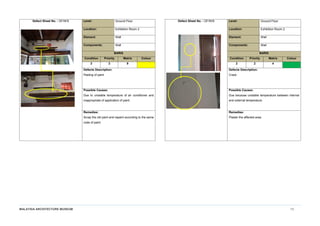
Defect Sheet No. : GF/W/4 Level: Ground Floor
Location: Exhibition Room 2
Element: Wall
Components: Wall
BARIS
Condition Priority Matrix Colour
3 3 9
Defects Description:
Discoloration
Possible Causes:
Occur due to material of syelek and splash of rain.
Remedies:
Scrap the old paint and repaint with the weather type
paint to give protection to the paint.
MALAYSIA ARCHITECTURE MUSEUM 13
Defect Sheet No. : GF/W/5 Level: Ground Floor
Location: Exhibition Room 2
Element: Wall
Components: Wall
BARIS
Condition Priority Matrix Colour
3 3 9
Defects Description:
Peeling of paint
Possible Causes:
Due to unstable temperature of air conditioner and
inappropriate of application of paint
Remedies:
Scrap the old paint and repaint according to the same
code of paint.
Defect Sheet No. : GF/W/6 Level: Ground Floor
Location: Exhibition Room 2
Element: Wall
Components: Wall
BARIS
Condition Priority Matrix Colour
2 2 4
Defects Description:
Crack
Possible Causes:
Due because unstable temperature between internal
and external temperature.
Remedies:
Plaster the affected area.
MALAYSIA ARCHITECTURE MUSEUM 14
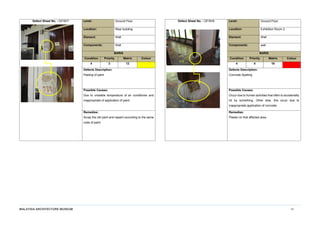
Defect Sheet No. : GF/W/7 Level: Ground Floor
Location: Rear building
Element: Wall
Components: Wall
BARIS
Condition Priority Matrix Colour
4 3 12
Defects Description:
Peeling of paint
Possible Causes:
Due to unstable temperature of air conditioner and
inappropriate of application of paint
Remedies:
Scrap the old paint and repaint according to the same
code of paint.
Defect Sheet No. : GF/W/8 Level: Ground Floor
Location: Exhibition Room 2
Element: Wall
Components: wall
BARIS
Condition Priority Matrix Colour
4 4 16
Defects Description:
Concrete Spalling
Possible Causes:
Occur due to human activities that often to accidentally
hit by something. Other else, this occur due to
inappropriate application of concrete.
Remedies:
Plaster on that affected area.
MALAYSIA ARCHITECTURE MUSEUM 15
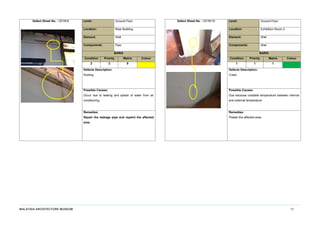
Defect Sheet No. : GF/W/9 Level: Ground Floor
Location: Rear Building
Element: Wall
Components: Pipe
BARIS
Condition Priority Matrix Colour
3 3 9
Defects Description:
Rusting
Possible Causes:
Occur due to leaking and splash of water from air
conditioning.
Remedies:
Repair the leakage pipe and repaint the affected
area.
Defect Sheet No. : GF/W/10 Level: Ground Floor
Location: Exhibition Room 2
Element: Wall
Components: Wall
BARIS
Condition Priority Matrix Colour
1 1 1
Defects Description:
Crack
Possible Causes:
Due because unstable temperature between internal
and external temperature.
Remedies:
Plaster the affected area.
MALAYSIA ARCHITECTURE MUSEUM 16
Defect Sheet No. : GF/W/11 Level: Ground Floor
Location: Rear Area
Element: Wall
Components: Wall
BARIS
Condition Priority Matrix Colour
4 3 12
Defects Description:
Peeling of paint
Possible Causes:
Due to unstable temperature of air conditioner and
inappropriate of application of paint
Remedies:
Scrap the old paint and repaint according to the same
code of paint.
Defect Sheet No. : GF/W/12 Level: Ground Floor
Location: Exhibition Room 2
Element: Wall
Components: Wall
BARIS
Condition Priority Matrix Colour
2 2 4
Defects Description:
Crack
Possible Causes:
Due because unstable temperature between internal
and external temperature.
Remedies:
Plaster the affected area.
MALAYSIA ARCHITECTURE MUSEUM 17
Defect Sheet No. : GF/DR/13 Level: Ground Floor
Location: Rear Area
Element: Drainage
Components: Drainage
BARIS
Condition Priority Matrix Colour
4 4 16
Defects Description:
Crack Open
Possible Causes:
Structural Settlement occurs to brickwork, excessive
structural sagging.
Remedies:
Professional Advices should be obtained.
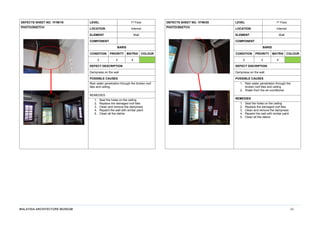
DEFECTS SHEET NO. 1F/W/14 LEVEL 1st
Floor
PHOTO/SKETCH LOCATION Internal
ELEMENT Wall
COMPONENT
BARIS
CONDITION PRIORITY MATRIX COLOUR
2 2 4
DEFECT DISCRIPTION
Dampness on the wall
POSSIBLE CAUSES
Rain water penetration through the broken roof
tiles and ceiling
REMEDIES
1. Seal the holes on the ceiling
2. Replace the damaged roof tiles
3. Clean and remove the dampness
4. Repaint the wall with similar paint
5. Clean all the debris
MALAYSIA ARCHITECTURE MUSEUM 18
DEFECTS SHEET NO. 1F/W/15 LEVEL 1st
Floor
PHOTO/SKETCH LOCATION Internal
ELEMENT Wall
COMPONENT
BARIS
CONDITION PRIORITY MATRIX COLOUR
2 2 4
DEFECT DISCRIPTION
Blistering of paint on the wall
POSSIBLE CAUSES
1. The paint did dry well due to condition
inside of the museum.
2. Second coat of paint was applied even
though the first layer did dry first
3. The humidity inside the museum doesn’t
allowed the paint to dry well.
REMEDIES
1. Scrap away the existing paint
2. Repaint with similar paint
3. Make sure the paint dry well with the aid
of mechanical dryer
4. Clean the debris
DEFECTS SHEET NO. 1F/FR/16 LEVEL 1st
Floor
PHOTO/SKETCH LOCATION Internal
ELEMENT Floor
COMPONENT
BARIS
CONDITION PRIORITY MATRIX COLOUR
2 2 4
DEFECT DISCRIPTION
Cracking and detach of floor joint at the door
POSSIBLE CAUSES
1. Abrasive use by the museum visitor
2. Connection between the concrete and
wood is not suitable
REMEDIES
1. Hack the floor joint
2. Repair and insert the suitable connection
3. Re-plaster the floor joint
4. Paint according to similar paint
5. Clean all the debris
MALAYSIA ARCHITECTURE MUSEUM 19
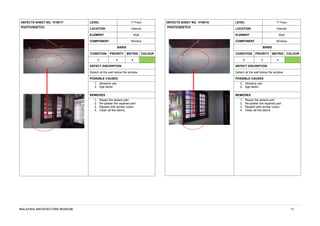
DEFECTS SHEET NO. 1F/W/17 LEVEL 1st
Floor
PHOTO/SKETCH LOCATION Internal
ELEMENT Wall
COMPONENT Window
BARIS
CONDITION PRIORITY MATRIX COLOUR
2 2 4
DEFECT DISCRIPTION
Detach at the wall below the window
POSSIBLE CAUSES
1. Abrasive use
2. Age factor
REMEDIES
1. Repair the detach part
2. Re-plaster the repaired part
3. Repaint with similar colour
4. Clean all the debris
DEFECTS SHEET NO. 1F/W/18 LEVEL 1st
Floor
PHOTO/SKETCH LOCATION Internal
ELEMENT Wall
COMPONENT Window
BARIS
CONDITION PRIORITY MATRIX COLOUR
2 2 4
DEFECT DISCRIPTION
Detach at the wall below the window
POSSIBLE CAUSES
3. Abrasive use
4. Age factor
REMEDIES
1. Repair the detach part
2. Re-plaster the repaired part
3. Repaint with similar colour
4. Clean all the debris
MALAYSIA ARCHITECTURE MUSEUM 20
DEFECTS SHEET NO. 1F/W/19 LEVEL 1st
Floor
PHOTO/SKETCH LOCATION Internal
ELEMENT Wall
COMPONENT
BARIS
CONDITION PRIORITY MATRIX COLOUR
2 2 4
DEFECT DESCRIPTION
Dampness on the wall
POSSIBLE CAUSES
Rain water penetration through the broken roof
tiles and ceiling
REMEDIES
1. Seal the holes on the ceiling
2. Replace the damaged roof tiles
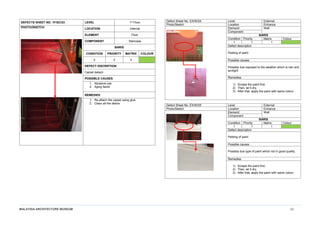
3. Clean and remove the dampness
4. Repaint the wall with similar paint
5. Clean all the debris
DEFECTS SHEET NO. 1F/W/20 LEVEL 1st
Floor
PHOTO/SKETCH LOCATION Internal
ELEMENT Wall
COMPONENT
BARIS
CONDITION PRIORITY MATRIX COLOUR
2 2 4
DEFECT DISCRIPTION
Dampness on the wall
POSSIBLE CAUSES
1. Rain water penetration through the
broken roof tiles and ceiling
2. Water from the air-conditioner
REMEDIES
1. Seal the holes on the ceiling
2. Replace the damaged roof tiles
3. Clean and remove the dampness
4. Repaint the wall with similar paint
5. Clean all the debris
MALAYSIA ARCHITECTURE MUSEUM 21
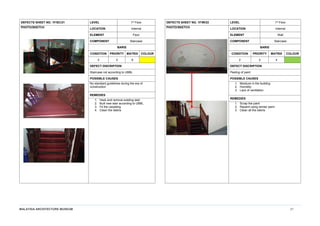
DEFECTS SHEET NO. 1F/SC/21 LEVEL 1st
Floor
PHOTO/SKETCH LOCATION Internal
ELEMENT Floor
COMPONENT Staircase
BARIS
CONDITION PRIORITY MATRIX COLOUR
3 3 9
DEFECT DISCRIPTION
Staircase not according to UBBL
POSSIBLE CAUSES
No standard guidelines during the era of
construction
REMEDIES
1. Hack and remove existing stair
2. Built new stair according to UBBL
3. Fit the carpeting
4. Clean the debris
DEFECTS SHEET NO. 1F/W/22 LEVEL 1st
Floor
PHOTO/SKETCH LOCATION Internal
ELEMENT Wall
COMPONENT Staircase
BARIS
CONDITION PRIORITY MATRIX COLOUR
2 2 4
DEFECT DISCRIPTION
Peeling of paint
POSSIBLE CAUSES
1. Moisture in the building
2. Humidity
3. Lack of ventilation
REMEDIES
1. Scrap the paint
2. Repaint using similar paint
3. Clean all the debris
MALAYSIA ARCHITECTURE MUSEUM 22
DEFECTS SHEET NO. 1F/SC/23 LEVEL 1st
Floor
PHOTO/SKETCH LOCATION Internal
ELEMENT Floor
COMPONENT Staircase
BARIS
CONDITION PRIORITY MATRIX COLOUR
2 2 4
DEFECT DISCRIPTION
Carpet detach
POSSIBLE CAUSES
1. Abrasive use
2. Aging factor
REMEDIES
1. Re-attach the carpet using glue
2. Clean all the debris
Defect Sheet No. EX/W/24 Level External
Photo/Sketch Location Entrance
Element/ Wall
Component
BARIS
Condition Priority Matrix Colour
1 1 1
Defect description
Peeling of paint
Possible causes
Possibly due exposed to the weather which is rain and
sunlight.
Remedies
1) Scrape the paint first,
2) Then, let it dry.
3) After that, apply the paint with same colour.
Defect Sheet No. EX/W/25 Level External
Photo/Sketch Location Entrance
Element/ Wall
Component
BARIS
Condition Priority Matrix Colour
1 1 1
Defect description
Peeling of paint
Possible causes
Possibly due type of paint which not in good quality.
Remedies
1) Scrape the paint first,
2) Then, let it dry.
3) After that, apply the paint with same colour.
MALAYSIA ARCHITECTURE MUSEUM 23
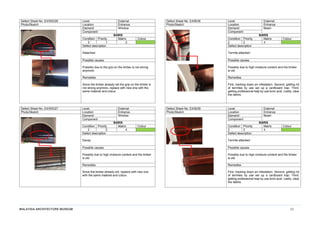
Defect Sheet No. EX/WD/26 Level External
Photo/Sketch Location Entrance
Element/ Window
Component
BARIS
Condition Priority Matrix Colour
2 1 2
Defect description
Detached
Possible causes
Possibly due to the grip on the timber is not strong
anymore
Remedies
Since the timber already old the grip on the timber is
not strong anymore, replace with new one with the
same material and colour.
Defect Sheet No. EX/WD/27 Level External
Photo/Sketch Location Entrance
Element/ Window
Component
BARIS
Condition Priority Matrix Colour
2 2 4
Defect description
Decay
Possible causes
Possibly due to high moisture content and the timber
is old.
Remedies
Since the timber already old, replace with new one
with the same material and colour.
Defect Sheet No. EX/B/28 Level External
Photo/Sketch Location Entrance
Element/ Beam
Component
BARIS
Condition Priority Matrix Colour
2 2 4
Defect description
Termite attacked
Possible causes
Possibly due to high moisture content and the timber
is old.
Remedies
First, tracking down an infestation. Second, getting rid
of termites by use set up a cardboard trap. Third,
getting professional help by use boric acid. Lastly, clear
the debris.
Defect Sheet No. EX/B/29 Level External
Photo/Sketch Location Entrance
Element/ Beam
Component
BARIS
Condition Priority Matrix Colour
2 2 4
Defect description
Termite attacked
Possible causes
Possibly due to high moisture content and the timber
is old.
Remedies
First, tracking down an infestation. Second, getting rid
of termites by use set up a cardboard trap. Third,
getting professional help by use boric acid. Lastly, clear
the debris.
MALAYSIA ARCHITECTURE MUSEUM 24
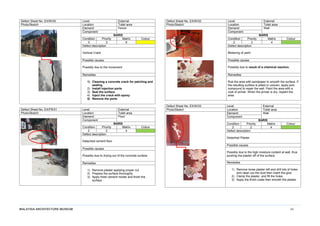
Defect Sheet No. EX/W/30 Level External
Photo/Sketch Location Toilet area
Element/ Fence
Component
BARIS
Condition Priority Matrix Colour
3 3 9
Defect description
Vertical Crack
Possible causes
Possibly due to the movement.
Remedies
1) Cleaning a concrete crack for patching and
sealing
2) Install injection ports
3) Seal the surface
4) Inject the crack with epoxy
5) Remove the ports
Defect Sheet No. EX/FR/31 Level External
Photo/Sketch Location Toilet area
Element/ Floor
Component
BARIS
Condition Priority Matrix Colour
2 2 4
Defect description
Detached cement floor
Possible causes
Possibly due to drying out of the concrete surface.
Remedies
1) Remove plaster applying proper cut
2) Prepare the surface thoroughly
3) Apply fresh cement mortar and finish the
surface
Defect Sheet No. EX/W/32 Level External
Photo/Sketch Location Toilet area
Element/ Wall
Component
BARIS
Condition Priority Matrix Colour
2 2 4
Defect description
Blistering of paint
Possible causes
Possibly due to result of a chemical reaction.
Remedies
Rub the area with sandpaper to smooth the surface. If
the resulting surface is pitted or uneven, apply joint
compound to repair the wall. Paint the area with a
coat of primer. When the primer is dry, repaint the
area.
Defect Sheet No. EX/W/33 Level External
Photo/Sketch Location Toilet area
Element/ Wall
Component
BARIS
Condition Priority Matrix Colour
2 2 4
Defect description
Detached Plaster
Possible causes
Possibly due to the high moisture content at wall, thus
pushing the plaster off of the surface.
Remedies
1) Remove loose plaster left and drill lots of holes
and clean out the dust then insert the glue
2) Clamp the plaster and fill the holes
3) Apply the finish coats then smooth the plaster
MALAYSIA ARCHITECTURE MUSEUM 25
Defect Sheet No. EX/R/34 Level External
Photo/Sketch Location Assembly Point
Element/ Gutter
Component
BARIS
Condition Priority Matrix Colour
2 2 4
Defect description
Sagging
Possible causes
The screws that hold the brackets is loose
Remedies
Remove the section of sagging gutter from the loose
gutter brackets. Take all the screws out that hold the
brackets to the fascia. Fill the screw holes with a
weatherproof. Drill new pilot holes for the brackets.
Attach the gutter brackets in the new holes. Put the
gutters back in the brackets
Defect Sheet No. EX/CL/35 Level External
Photo/Sketch Location Assembly Point
Element/ Column
Component
BARIS
Condition Priority Matrix Colour
2 2 4
Defect description
Concrete Spalling
Possible causes
Possibly due to improper concrete finishing
operations
Remedies
Firstly, scrape and clean the area and use a wire
brush to remove the rust. Apply two coats of anti-rust
paint to the steel bars. Before patching the area, apply
a bonding agent to the affected surface to ensure
proper adhesion. Patch up the hacked area using
polymer modified cement mortar.
Defect Sheet No. EX/W/36 Level External
Photo/Sketch Location Assembly Point
Element/ Wall
Component
BARIS
Condition Priority Matrix Colour
3 3 9
Defect description
Decay and Mold
Possible causes
Possibly due to stems from a lot of water content
in building components, especially in the walls is near
to the toilet
Remedies
Since the timber already at decay condition, so
replace with the new one with the same material and
colour.
Defect Sheet No. EX/R/37 Level External
Photo/Sketch Location Assembly Point
Element/ Gutter
Component
BARIS
Condition Priority Matrix Colour
3 3 9
Defect description
Plant growth
Possible causes
Possibly due to seeds carried by wind and the water
content at gutter make the seeds growth.
Remedies
Firstly, remove the existing plant growth and then use
chemical treatment of root systems to make the plant
not grow anymore.
MALAYSIA ARCHITECTURE MUSEUM 26
Defect Sheet No. EX/W/38 Level External
Photo/Sketch Location Assembly Point
Element/ Wall
Component
BARIS
Condition Priority Matrix Colour
1 1 1
Defect description
Peeling of paint
Possible causes
Possibly due exposed to the weather which is rain and
sunlight.
Remedies
1) Scrape the paint first,
2) Then, let it dry.
3) After that, apply the paint with same colour
Defect Sheet No. EX/W/39 Level External
Photo/Sketch Location Assembly Point
Element/ Wall
Component
BARIS
Condition Priority Matrix Colour
2 2 4
Defect description
Fine Vertical Crack (plaster)
Possible causes
Possibly due to poor workmanship when mixing the
cement not properly follow the ratio.
Remedies
Firstly, reattach the cracked plaster to its lath with
plaster washers or adhesives. Then, bed all the
screening in a thin coat of joint compound, wait a day
for it to dry, then skim over it again. To get it smooth
do a third coat.
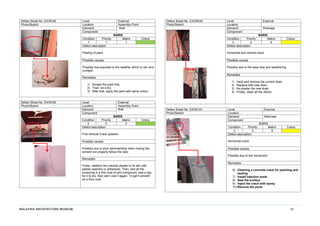
Defect Sheet No. EX/DR/40 Level External
Photo/Sketch Location
Element/ Drainage
Component
BARIS
Condition Priority Matrix Colour
3 2 6
Defect description
Horizontal and vertical crack
Possible causes
Possibly due to the wear tear and weathering.
Remedies
1) Hack and remove the current drain.
2) Replace with new drain.
3) Re-plaster the new drain.
4) Finally, clean all the debris.
Defect Sheet No. EX/SC/41 Level External
Photo/Sketch Location
Element/ Staircase
Component
BARIS
Condition Priority Matrix Colour
3 3 9
Defect description
Horizontal crack
Possible causes
Possibly due to the movement
Remedies
6) Cleaning a concrete crack for patching and
sealing
7) Install injection ports
8) Seal the surface
9) Inject the crack with epoxy
10) Remove the ports
MALAYSIA ARCHITECTURE MUSEUM 27
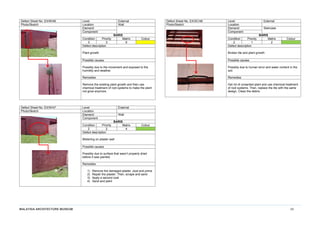
Defect Sheet No. EX/W/42 Level External
Photo/Sketch Location
Element/ Wall
Component
BARIS
Condition Priority Matrix Colour
3 3 9
Defect description
Vertical crack and plant growth
Possible causes
Possibly due to the movement and exposed to the
humidity and weather.
Remedies
Firstly, remove the existing plant growth and then use
chemical treatment of root systems to make the plant
not grow anymore. Then, cleaning a concrete crack
for patching and sealing. Inject the crack with
epoxy.
Defect Sheet No. EX/W/43 Level External
Photo/Sketch Location
Element/ Wall
Component
BARIS
Condition Priority Matrix Colour
3 3 9
Defect description
Plant growth and mold
Possible causes
Possibly due to exposed to the humidity and weather.
Remedies
Firstly, clean up and get rid of unwanted plant and use
chemical treatment of root systems to make the plant
not grow anymore. Then, washing the surface with a
suitable fungicidal solution and allow it to drying.
Defect Sheet No. EX/W/44 Level External
Photo/Sketch Location
Element/ Wall
Component
BARIS
Condition Priority Matrix Colour
3 2 6
Defect description
Diagonal crack
Possible causes
Possibly due to unrelieved horizontal movement.
Remedies
1) Cleaning a concrete crack for patching and
sealing
2) Install injection ports
3) Seal the surface
4) Inject the crack with epoxy
5) Remove the ports
Defect Sheet No. EX/SC/45 Level External
Photo/Sketch Location
Element/ Staircase
Component
BARIS
Condition Priority Matrix Colour
2 1 2
Defect description
Broken tile and plant growth
Possible causes
Possibly due to human error and water content in the
soil.
Remedies
Get rid of unwanted plant and use chemical treatment
of root systems. Then, replace the tile with the same
design. Clean the debris
MALAYSIA ARCHITECTURE MUSEUM 28
Defect Sheet No. EX/W/46 Level External
Photo/Sketch Location Wall
Element/
Component
BARIS
Condition Priority Matrix Colour
3 3 9
Defect description
Plant growth
Possible causes
Possibly due to the movement and exposed to the
humidity and weather.
Remedies
Remove the existing plant growth and then use
chemical treatment of root systems to make the plant
not grow anymore.
Defect Sheet No. EX/W/47 Level External
Photo/Sketch Location
Element/ Wall
Component
BARIS
Condition Priority Matrix Colour
2 2 4
Defect description
Blistering on plaster wall
Possible causes
Possibly due to surface that wasn’t properly dried
before it was painted.
Remedies
1) Remove the damaged plaster ,dust and prime
2) Repair the plaster. Then, scrape and sand
3) Apply a second coat
4) Sand and paint
Defect Sheet No. EX/SC/48 Level External
Photo/Sketch Location
Element/ Staircase
Component
BARIS
Condition Priority Matrix Colour
2 1 2
Defect description
Broken tile and plant growth
Possible causes
Possibly due to human error and water content in the
soil.
Remedies
Get rid of unwanted plant and use chemical treatment
of root systems. Then, replace the tile with the same
design. Clean the debris
MALAYSIA ARCHITECTURE MUSEUM 29
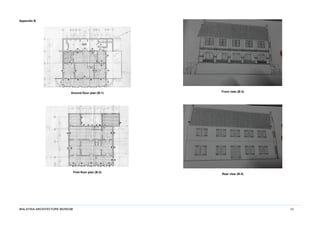
Appendix B
Ground floor plan (B-1)
First floor plan (B-2)
Front view (B-3)
Rear view (B-4)
MALAYSIA ARCHITECTURE MUSEUM 30
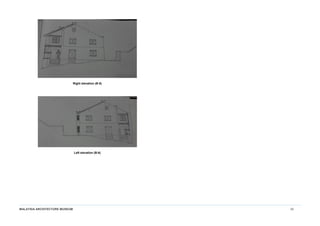
Right elevation (B-5)
Left elevation (B-6)

Architecture Museum Malacca Dilapidation Report

  • 1.
    DILAPIDATION SURVEY REPORT MALAYSIAARCHITECTURE MUSEUM, BANDAR HILIR, MELAKA PREPARED BY: NAME MATRIX NUMBER GROUP ADIBAH AMIRA BINTI ROSLAN 2015217402 AP2296A ALIA SHAKIRA BINTI AYUB 2015298736 MUHAMMAD NAQIUDDIN BIN JOHARI 2015208878 NOOR SHIDA BINTI SHAHIB 2015837078 NURUL FARHANAH BINTI ROSLI 2014298228 SALASIAH BINTI MOHAMAD 2015859602 TUAN MOHAMAD HAKIMI BIN TUAN HAMZAH 2015831654 PREPARED FOR: DR. SHAHRUL YANI SAID SUBMISSION DATE: 09/05/2017
  • 2.
    MALAYSIA ARCHITECTURE MUSEUMi TABLE OF CONTENT TABLE OF CONTENT i LIST OF PHOTOS i LIST OF FIGURES i LIST OF TABLES i 1.0. CHAPTER 1 INTRODUCTION 1 2.0. CHAPTER 2 BACKGROUND AND HISTORY OF BUILDING 2 3.0. CHAPTER 3 DESIGN AND ARCHITECTURE OF BUILDING 2 4.0. CHAPTER 4 DEFECT ANALYSIS 5 5.0. CHAPTER 5 RECOMMENDATION 9 6.0. CHAPTER 6 CONCLUSION 9 7.0. BIBLOGRAPHY 10 8.0. APPENDIX 1. Appendix A (Defect Sheets) 11 2. Appendix B i. Ground floor plan (B-1) 29 ii. First floor plan (B-2) 29 iii. Front view (B-3) 29 iv. Rear view (B-4) 29 v. Right elevation (B-5) 30 vi. Left elevation (B-6) 30 LIST OF TABLES Table 1: Building Condition Assessment (BARIS) 5 Table 2: Building element 8 Table 3: Building floor 8 Table 4: Defect colour 8 Table 5: Building Defect 8 LIST OF PHOTOS Photo 1: Satellite image of the museum location 1 Photo 2: Satellite image of the museum 1 Photos 3: Timber and terracotta tiles finishes for floors 2 Photo 4: Laterite stones and Dutch bricks for wall 2 Photo 5: Door and window of the museum 2 Photo 6: Steep roof using Marseilles tiles 3 Photo 7: Exhibition inside museum 3 LIST OF FIGURES Figure 1: Location plan of the museum 1 Figure 2: Location plan (Bandar Hilir) 1 Figure 3: Front façade 4 Figure 4: Rear façade 4 Figure 5: Right façade 4 Figure 6: Left Façade 4 Figure 7: Ground floor 5 Figure 8: First floor 5 Figure 9: Defect Indication Plan for ground floor 6 Figure 10: Defect Indication Plan for first floor 7 Figure 11: Defect Indication Plan for external area 7 Figure 12: Defect analysis pie chart 9
  • 3.
    MALAYSIA ARCHITECTURE MUSEUM1 CHAPTER 1 INTRODUCTION The purpose of the inspection is to determine the element of the building and also its material using condition survey tools, investigate the defects on the building, the causes of defects, analysis the data and suggest ways overcome the problems. The scope of work of our inspections are to study the building elements and its component of the building, determine the space usage of the building, determine the defects in the building and making the condition survey, prepare the remedies of the defects in the building and prepare the measured drawing of the building and prepare dilapidation survey report. We provide the location plan and the building lot plan. For the inspection there are few areas within the building external and internal that we were unable to access due to restriction from the museum. We had classified these areas as our limitation and the survey cannot be conducted. All information provided in the Appendix will assist and correlate with our findings and data. Figure 1: Location plan of the museum Figure 2: Location plan (Bandar Hilir) Photo 1: Satellite image of the museum location Photo 2: Satellite image of the museum
  • 4.
    MALAYSIA ARCHITECTURE MUSEUM2 CHAPTER 2 BACKGROUND AND HISTORY OF BUILDING This two-storey building which houses the museum is distinctive on its own way with its long history and the uniqueness of architectural design. Built in the 1700s during the Dutch colonial period in Melaka, the building was used as a dwelling place for dignitaries and centre of administration. Located at Jalan Kota, Bandar Hilir, this building which also known as the “Red Building” has undergone several processes of change in its usage. The building was used as an administration office during the British colonial rule. Aster the independence, it was occupied by the Malacca Water Board (MWB) from 1978 to 1980s under Malacca State Government. In 1999, the Department of Museums and Antiquities carried out restoration works until its full completion in 2000 and in 2004, this building was converted into museum known as the Malaysia Architecture Museum. CHAPTER 3 DESIGN AND ARCHITECTURE OF BUILDING The building design signified the adaption of Dutch building technology in local architecture. Laterite stones slabs was constructed and arranged as the base of the building. The walls meanwhile are constructed from a combination of laterite stones and Dutch bricks as well as wood to ensure their sturdiness. And as for the flooring, terracotta tile finishes was used for the ground floor and wooden flooring for the upper part. Most of the window frames in this building are louvered double-glazed (two leaves) using wood and glass. The structure of the roof is rather steep, using Marseilles roof tiles. The adaption of Dutch architectural concept provides several living spaces in the building. The “stoepe” is the intermediate space where the lobby is located. The “voorhuis” is the arrival hall, while Space III is for the “dining room”. Moving along, Space IV or upper area is a space with little more privacy and Space V or the “loft” is raised space that allows for adequate air circulation. This building has been gazetted as a historical monument under the Antiquities Act 168 (1976) and has today been re-gazetted under the National Heritage Act 2005. Photos 3: Timber and terracotta tiles finishes for floors Photo 4: Laterite stones and Dutch bricks for wall Photo 5: Door and window of the museum
  • 5.
    MALAYSIA ARCHITECTURE MUSEUM3 Photo 6: Steep roof using Marseilles tiles Photo 7: Exhibition inside museum
  • 6.
    MALAYSIA ARCHITECTURE MUSEUM4 Figure 3: Front façade Figure 4: Rear façade Figure 5: Right façade Figure 6: Left Façade
  • 7.
    MALAYSIA ARCHITECTURE MUSEUM5 Figure 7: Ground floor Figure 8: First floor CHAPTER 4 DEFECT ANALYSIS This is the defect analysis that has been prepared based on the condition survey conducted at the museum. Table 1: Building Condition Assessment (BARIS) BUILDING ASSESSMENT RATING SYSTEM (BARIS) Schedule of Building Condition (SBC) Sheet No. Defects BARIS Condition Assessment [a] Priority Assessment [b] Matrix Analysis [c] = (a x b) Defect Sheet Defect Indication Plan 1 Rotten 2 2 4 GF/D/1 2 Peeling paint 3 3 9 GF/W/2 3 Peeling paint 3 3 9 GF/W/3 4 Discoloration 3 3 9 GF/W/4 5 Peeling paint 3 3 9 GF/W/5 6 Crack 2 2 4 GF/W/6 7 Peeling paint 4 3 12 GF/W/7 8 Spalling 4 4 16 GF/W/8 9 Rusting 3 3 9 GF/W/9 10 Crack 1 1 1 GF/W/10 11 Peeling paint 4 3 12 GF/W/11 12 Crack 2 2 4 GF/W/12 13 Crack 4 4 16 GF/DR/13 14 Dampness 2 2 4 1F/W/14 15 Blistering 2 2 4 1F/W/15 16 Crack 2 2 4 1F/FR/16 17 Detached 2 2 4 1F/W/17 18 Detached 2 2 4 1F/W/18 19 Dampness 2 2 4 1F/W/19 20 Dampness 2 2 4 1F/W/20 vxv vxv vxv vxv vxv vxv vxv vxv vxv
  • 8.
    MALAYSIA ARCHITECTURE MUSEUM6 21 Construction error 3 3 9 1F/SC/21 22 Peeling paint 2 2 4 1F/W/22 23 Detached 2 2 4 1F/SC/23 24 Peeling paint 1 1 1 EX/W/24 25 Peeling paint 1 1 1 EX/W/25 26 Detached 2 1 2 EX/WD/26 27 Decay 2 2 4 EX/WD/27 28 Termite attack 2 2 4 EX/B/28 29 Termite attack 2 2 4 EX/B/29 30 Crack 3 3 9 EX/W/30 31 Detached 2 2 4 EX/FR/31 32 Blistering 2 2 4 EX/W/32 33 Detached 2 2 4 EX/W/33 34 Sagging 2 2 4 EX/R/34 35 Spalling 2 2 4 EX/CL/35 36 Decay 3 3 9 EX/W/36 37 Plant growth 3 3 9 EX/R/37 38 Peeling paint 1 1 1 EX/W/38 39 Crack 2 2 4 EX/W/39 40 Crack 3 2 6 EX/DR/40 41 Crack 3 3 9 EX/SC/41 42 Plant growth 3 3 9 EX/W/42 43 Plant growth 3 3 9 EX/W/43 44 Crack 3 2 6 EX/W/44 45 Plant growth 2 1 2 EX/SC/45 46 Plant growth 3 3 9 EX/W/46 47 Blistering 2 2 4 EX/W/47 48 Plant growth 2 1 2 EX/SC/48 Total marks (A) = (∑ of c) 283 Number of Defect (e) 48 Total Score (d/e) 5.89 Overall building Rating Fair Figure 9: Defect Indication Plan for ground floor vxv vxv vxv vxv vxv vxv vxv vxv vxv vxv vxv vxv vxv vxv vxv vxv vxv vxv GF/W/2 GF/W/3 GF/W/4 GF/W/1 GF/W/6 GF/W/5 GF/W/7 GF/W/8 GF/W/9 GF/W/10 GF/W/11 GF/W/12 GF/W/13
  • 9.
    MALAYSIA ARCHITECTURE MUSEUM7 Figure 10: Defect Indication Plan for first floor Figure 11: Defect Indication Plan for external area 1F/W/14 1F/FR/16 1F/W/15 1F/FR/17 1F/FR/18 1F/W/19 1F/W/20 1F/SC/21 1F/W/22 1F/SC/23 EX/WD/27EX/WD/26 EX/B/29 EX/B/28 EX/W/25 EX/W/24 EX/FR/31 EX/W/30 EX/W/32 EX/W/33 EX/R/34 EX/CL/35 EX/W/36 EX/R/37 EX/W/38 EX/W/39 EX/DR/40 EX/SC/41 EX/W/42 EX/W/43 EX/SC/45 EX/W/44 EX/W/46 EX/W/47 EX/SC/48
  • 10.
    MALAYSIA ARCHITECTURE MUSEUM8 LEGENDS Table 2: Building element CODE DESCRIPTION DR DRAINAGE CE CEILING CL COLUMN W WALL SC STAIRCASE FR FLOOR D DOOR WD WINDOW B BEAM R ROOF Table 3: Building floor CODE DESCRIPTION GF GROUND FLOOR 1F FIRST FLOOR RL ROOF LEVEL BS BASEMENT 2F SECOND FLOOR EX EXTERNAL Table 4: Defect colour CODE COLOUR GOOD FAIR DILAPIDATED Table 5: Building Defect CODE DESCRIPTION C CRACKS F FUNGUS CR CORROSION/CORRODE PP PEELING PAINT MS MISSING PG PLANT GROWTH DC DECAY DT DETACHED MD MOULD BR BROKE SH SHARP LK LEAKAGE DP DAMPNESS
  • 11.
    MALAYSIA ARCHITECTURE MUSEUM9 Most of the defects occur in this building is minor defect and only have one is major defect based on the inspection work that we have done. The major defect at this building is slope of the staircase are too high and can be a dangerous for occupants when in rushing use that staircase and can possible accidently occur. That is because the construction error. That defect just a condition monitoring. Those elements still fulfill their function but risks that can lead to fatality or injury. For the minor categories of defect which are rotten, peeling of paint, discoloration, crack, spalling, rusting, dampness, blistering, detached, decay, termite attack, sagging and plant growth. All these defects are not serious but if left unattended, it could lead to a serious damage or failure in the building structure. Based on the pie chart, 21% from the defect analysis come from the crack. 19% come from peeling of paint that occurs on the wall of the building. 13% of defect come from detached and plant growth. 6% from defect analysis come from blistering and dampness. 4% of defect come from spalling, decay and termite attack and smallest percentages which is only 2% come from rotten, sagging, construction error, rusting and discoloration. Figure 12: Defect analysis pie chart CHAPTER 5 RECOMMENDATION As the recommendation, recommendable that the owner or the responsible party organized schedule for maintenance or make a planned maintenance for this museum to keep this museum in a good condition for occupies benefaction. Maintenance schedule need to provide to avoid any defect occur and the maintenance can be do it by routine or by month based on the use. By doing this, it can minimize the building defects and it can help to providing safety to the tourists and visitors. The museum also can achieve its maximum operating efficiency. Furthermore, it can also improve the museum physical of appearance and performances. Other than that can avoid tourists and visitors of the museum does not feeling comfortable. CHAPTER 6 CONCLUSION As a conclusion, the total score of Malaysia Architecture Museum is 5.89. It is in a second category which is in a fair condition and its range was in between of 5 – 12. In our inspection, we have recognized and recorded 48 numbers of defect in total and the most defect occurred was crack, where it is 21% in total of percentage. Based on the defect sheet, we found that the defect that risk and can lead to a serious injury for tourists and visitor is the staircase that is too steep and does not follow the UBBL. We also have identified some of the building elements such as floor, column, door and window, wall, ceiling and roof, they were in fair condition so as the building services such as a lamp, fan, socket, switch and air conditioner. They are all were in good condition like a new one. On the other hand, we have increased our knowledge on elements of the building. The elements of the buildings are too functionality towards the building. By making this survey, we also learn about the defects of this building. For this building, we have identified that there were no remedies works are taken. This is very dangerous because it lead the defects to become worst. Therefore, the maintenance works should be carried out as soon as possible. We have to analyse the defects in order to know the possible causes and do what are the suitable remedies works. 2% 19% 2% 21% 4%2%6% 6% 13% 2% 4% 4% 2% 13% Defect Analysis Rotten Peeling of paint Discoloration Crack Spalling Rusting Dampness Blistering Detached Construction error Decay Termite attack Sagging Plant growth
  • 12.
    MALAYSIA ARCHITECTURE MUSEUM10 BIBLIOGRAPHY Guideline for the conservation of building (2010). Institute of Architect of Ireland. Retrieved at http://www.riai.ie/uploads/files/Conservation_Guidelines_December_2010.pdf Handbook of conservation of heritage building (2013). Directorate General, Central Public Works Department. Retrieved at http://cpwd.gov.in/Publication/ConservationHertBuildings.pdf Kamal K.S. (2007). Rehabilitation of heritage building in Malaysia. Retrieved at http://buildingconservation.blogspot.my/2007/03/rehabilitation-of-heritage-buildings-in.html Malaysia Architecture Museum, Department of Museum Malaysia (2014). Retrieved at http://www.jmm.gov.my/en/museum/malaysia-architectural-museum Muzium Senibina Melaka Bandar Hilir, Perbadanan Muzium Negeri Melaka (2017). Retrieved at http://www.perzim.gov.my/ APPENDIX 1. Appendix A (Defect Sheets) 2. Appendix B i. Ground floor plan (B-1) ii. First floor plan (B-2) iii. Front view (B-4) iv. Rear view (B-5) v. Right elevation (B-6) vi. Left elevation (B-7)
  • 13.
    MALAYSIA ARCHITECTURE MUSEUM11 Appendix A Defect Sheet No. : GF/D/1 Level: Ground Floor Location: Entrance Element: Wall Components: Door BARIS Condition Priority Matrix Colour 2 2 4 Defects Description: Rotten Possible Causes: The defect occur due to the wood already became moisture because temperature and aging process.. Remedies: Replace with the new wood. Defect Sheet No. : GF/W/2 Level: Ground Floor Location: Exhibition 1 Element: Wall Components: Wall BARIS Condition Priority Matrix Colour 3 3 9 Defects Description: Peeling of paint Possible Causes: Due to unstable temperature and inappropriate of application of paint Remedies: Scrap the old paint and repaint according to the same code of paint.
  • 14.
    MALAYSIA ARCHITECTURE MUSEUM12 Defect Sheet No. : GF/W/3 Level: Ground Floor Location: Exhibition Room 2 Element: Wall Components: Wall BARIS Condition Priority Matrix Colour 3 3 9 Defects Description: Peeling of paint Possible Causes: Due to unstable temperature and inappropriate of application of paint Remedies: Scrap the old paint and repaint according to the same code of paint. Defect Sheet No. : GF/W/4 Level: Ground Floor Location: Exhibition Room 2 Element: Wall Components: Wall BARIS Condition Priority Matrix Colour 3 3 9 Defects Description: Discoloration Possible Causes: Occur due to material of syelek and splash of rain. Remedies: Scrap the old paint and repaint with the weather type paint to give protection to the paint.
  • 15.
    MALAYSIA ARCHITECTURE MUSEUM13 Defect Sheet No. : GF/W/5 Level: Ground Floor Location: Exhibition Room 2 Element: Wall Components: Wall BARIS Condition Priority Matrix Colour 3 3 9 Defects Description: Peeling of paint Possible Causes: Due to unstable temperature of air conditioner and inappropriate of application of paint Remedies: Scrap the old paint and repaint according to the same code of paint. Defect Sheet No. : GF/W/6 Level: Ground Floor Location: Exhibition Room 2 Element: Wall Components: Wall BARIS Condition Priority Matrix Colour 2 2 4 Defects Description: Crack Possible Causes: Due because unstable temperature between internal and external temperature. Remedies: Plaster the affected area.
  • 16.
    MALAYSIA ARCHITECTURE MUSEUM14 Defect Sheet No. : GF/W/7 Level: Ground Floor Location: Rear building Element: Wall Components: Wall BARIS Condition Priority Matrix Colour 4 3 12 Defects Description: Peeling of paint Possible Causes: Due to unstable temperature of air conditioner and inappropriate of application of paint Remedies: Scrap the old paint and repaint according to the same code of paint. Defect Sheet No. : GF/W/8 Level: Ground Floor Location: Exhibition Room 2 Element: Wall Components: wall BARIS Condition Priority Matrix Colour 4 4 16 Defects Description: Concrete Spalling Possible Causes: Occur due to human activities that often to accidentally hit by something. Other else, this occur due to inappropriate application of concrete. Remedies: Plaster on that affected area.
  • 17.
    MALAYSIA ARCHITECTURE MUSEUM15 Defect Sheet No. : GF/W/9 Level: Ground Floor Location: Rear Building Element: Wall Components: Pipe BARIS Condition Priority Matrix Colour 3 3 9 Defects Description: Rusting Possible Causes: Occur due to leaking and splash of water from air conditioning. Remedies: Repair the leakage pipe and repaint the affected area. Defect Sheet No. : GF/W/10 Level: Ground Floor Location: Exhibition Room 2 Element: Wall Components: Wall BARIS Condition Priority Matrix Colour 1 1 1 Defects Description: Crack Possible Causes: Due because unstable temperature between internal and external temperature. Remedies: Plaster the affected area.
  • 18.
    MALAYSIA ARCHITECTURE MUSEUM16 Defect Sheet No. : GF/W/11 Level: Ground Floor Location: Rear Area Element: Wall Components: Wall BARIS Condition Priority Matrix Colour 4 3 12 Defects Description: Peeling of paint Possible Causes: Due to unstable temperature of air conditioner and inappropriate of application of paint Remedies: Scrap the old paint and repaint according to the same code of paint. Defect Sheet No. : GF/W/12 Level: Ground Floor Location: Exhibition Room 2 Element: Wall Components: Wall BARIS Condition Priority Matrix Colour 2 2 4 Defects Description: Crack Possible Causes: Due because unstable temperature between internal and external temperature. Remedies: Plaster the affected area.
  • 19.
    MALAYSIA ARCHITECTURE MUSEUM17 Defect Sheet No. : GF/DR/13 Level: Ground Floor Location: Rear Area Element: Drainage Components: Drainage BARIS Condition Priority Matrix Colour 4 4 16 Defects Description: Crack Open Possible Causes: Structural Settlement occurs to brickwork, excessive structural sagging. Remedies: Professional Advices should be obtained. DEFECTS SHEET NO. 1F/W/14 LEVEL 1st Floor PHOTO/SKETCH LOCATION Internal ELEMENT Wall COMPONENT BARIS CONDITION PRIORITY MATRIX COLOUR 2 2 4 DEFECT DISCRIPTION Dampness on the wall POSSIBLE CAUSES Rain water penetration through the broken roof tiles and ceiling REMEDIES 1. Seal the holes on the ceiling 2. Replace the damaged roof tiles 3. Clean and remove the dampness 4. Repaint the wall with similar paint 5. Clean all the debris
  • 20.
    MALAYSIA ARCHITECTURE MUSEUM18 DEFECTS SHEET NO. 1F/W/15 LEVEL 1st Floor PHOTO/SKETCH LOCATION Internal ELEMENT Wall COMPONENT BARIS CONDITION PRIORITY MATRIX COLOUR 2 2 4 DEFECT DISCRIPTION Blistering of paint on the wall POSSIBLE CAUSES 1. The paint did dry well due to condition inside of the museum. 2. Second coat of paint was applied even though the first layer did dry first 3. The humidity inside the museum doesn’t allowed the paint to dry well. REMEDIES 1. Scrap away the existing paint 2. Repaint with similar paint 3. Make sure the paint dry well with the aid of mechanical dryer 4. Clean the debris DEFECTS SHEET NO. 1F/FR/16 LEVEL 1st Floor PHOTO/SKETCH LOCATION Internal ELEMENT Floor COMPONENT BARIS CONDITION PRIORITY MATRIX COLOUR 2 2 4 DEFECT DISCRIPTION Cracking and detach of floor joint at the door POSSIBLE CAUSES 1. Abrasive use by the museum visitor 2. Connection between the concrete and wood is not suitable REMEDIES 1. Hack the floor joint 2. Repair and insert the suitable connection 3. Re-plaster the floor joint 4. Paint according to similar paint 5. Clean all the debris
  • 21.
    MALAYSIA ARCHITECTURE MUSEUM19 DEFECTS SHEET NO. 1F/W/17 LEVEL 1st Floor PHOTO/SKETCH LOCATION Internal ELEMENT Wall COMPONENT Window BARIS CONDITION PRIORITY MATRIX COLOUR 2 2 4 DEFECT DISCRIPTION Detach at the wall below the window POSSIBLE CAUSES 1. Abrasive use 2. Age factor REMEDIES 1. Repair the detach part 2. Re-plaster the repaired part 3. Repaint with similar colour 4. Clean all the debris DEFECTS SHEET NO. 1F/W/18 LEVEL 1st Floor PHOTO/SKETCH LOCATION Internal ELEMENT Wall COMPONENT Window BARIS CONDITION PRIORITY MATRIX COLOUR 2 2 4 DEFECT DISCRIPTION Detach at the wall below the window POSSIBLE CAUSES 3. Abrasive use 4. Age factor REMEDIES 1. Repair the detach part 2. Re-plaster the repaired part 3. Repaint with similar colour 4. Clean all the debris
  • 22.
    MALAYSIA ARCHITECTURE MUSEUM20 DEFECTS SHEET NO. 1F/W/19 LEVEL 1st Floor PHOTO/SKETCH LOCATION Internal ELEMENT Wall COMPONENT BARIS CONDITION PRIORITY MATRIX COLOUR 2 2 4 DEFECT DESCRIPTION Dampness on the wall POSSIBLE CAUSES Rain water penetration through the broken roof tiles and ceiling REMEDIES 1. Seal the holes on the ceiling 2. Replace the damaged roof tiles 3. Clean and remove the dampness 4. Repaint the wall with similar paint 5. Clean all the debris DEFECTS SHEET NO. 1F/W/20 LEVEL 1st Floor PHOTO/SKETCH LOCATION Internal ELEMENT Wall COMPONENT BARIS CONDITION PRIORITY MATRIX COLOUR 2 2 4 DEFECT DISCRIPTION Dampness on the wall POSSIBLE CAUSES 1. Rain water penetration through the broken roof tiles and ceiling 2. Water from the air-conditioner REMEDIES 1. Seal the holes on the ceiling 2. Replace the damaged roof tiles 3. Clean and remove the dampness 4. Repaint the wall with similar paint 5. Clean all the debris
  • 23.
    MALAYSIA ARCHITECTURE MUSEUM21 DEFECTS SHEET NO. 1F/SC/21 LEVEL 1st Floor PHOTO/SKETCH LOCATION Internal ELEMENT Floor COMPONENT Staircase BARIS CONDITION PRIORITY MATRIX COLOUR 3 3 9 DEFECT DISCRIPTION Staircase not according to UBBL POSSIBLE CAUSES No standard guidelines during the era of construction REMEDIES 1. Hack and remove existing stair 2. Built new stair according to UBBL 3. Fit the carpeting 4. Clean the debris DEFECTS SHEET NO. 1F/W/22 LEVEL 1st Floor PHOTO/SKETCH LOCATION Internal ELEMENT Wall COMPONENT Staircase BARIS CONDITION PRIORITY MATRIX COLOUR 2 2 4 DEFECT DISCRIPTION Peeling of paint POSSIBLE CAUSES 1. Moisture in the building 2. Humidity 3. Lack of ventilation REMEDIES 1. Scrap the paint 2. Repaint using similar paint 3. Clean all the debris
  • 24.
    MALAYSIA ARCHITECTURE MUSEUM22 DEFECTS SHEET NO. 1F/SC/23 LEVEL 1st Floor PHOTO/SKETCH LOCATION Internal ELEMENT Floor COMPONENT Staircase BARIS CONDITION PRIORITY MATRIX COLOUR 2 2 4 DEFECT DISCRIPTION Carpet detach POSSIBLE CAUSES 1. Abrasive use 2. Aging factor REMEDIES 1. Re-attach the carpet using glue 2. Clean all the debris Defect Sheet No. EX/W/24 Level External Photo/Sketch Location Entrance Element/ Wall Component BARIS Condition Priority Matrix Colour 1 1 1 Defect description Peeling of paint Possible causes Possibly due exposed to the weather which is rain and sunlight. Remedies 1) Scrape the paint first, 2) Then, let it dry. 3) After that, apply the paint with same colour. Defect Sheet No. EX/W/25 Level External Photo/Sketch Location Entrance Element/ Wall Component BARIS Condition Priority Matrix Colour 1 1 1 Defect description Peeling of paint Possible causes Possibly due type of paint which not in good quality. Remedies 1) Scrape the paint first, 2) Then, let it dry. 3) After that, apply the paint with same colour.
  • 25.
    MALAYSIA ARCHITECTURE MUSEUM23 Defect Sheet No. EX/WD/26 Level External Photo/Sketch Location Entrance Element/ Window Component BARIS Condition Priority Matrix Colour 2 1 2 Defect description Detached Possible causes Possibly due to the grip on the timber is not strong anymore Remedies Since the timber already old the grip on the timber is not strong anymore, replace with new one with the same material and colour. Defect Sheet No. EX/WD/27 Level External Photo/Sketch Location Entrance Element/ Window Component BARIS Condition Priority Matrix Colour 2 2 4 Defect description Decay Possible causes Possibly due to high moisture content and the timber is old. Remedies Since the timber already old, replace with new one with the same material and colour. Defect Sheet No. EX/B/28 Level External Photo/Sketch Location Entrance Element/ Beam Component BARIS Condition Priority Matrix Colour 2 2 4 Defect description Termite attacked Possible causes Possibly due to high moisture content and the timber is old. Remedies First, tracking down an infestation. Second, getting rid of termites by use set up a cardboard trap. Third, getting professional help by use boric acid. Lastly, clear the debris. Defect Sheet No. EX/B/29 Level External Photo/Sketch Location Entrance Element/ Beam Component BARIS Condition Priority Matrix Colour 2 2 4 Defect description Termite attacked Possible causes Possibly due to high moisture content and the timber is old. Remedies First, tracking down an infestation. Second, getting rid of termites by use set up a cardboard trap. Third, getting professional help by use boric acid. Lastly, clear the debris.
  • 26.
    MALAYSIA ARCHITECTURE MUSEUM24 Defect Sheet No. EX/W/30 Level External Photo/Sketch Location Toilet area Element/ Fence Component BARIS Condition Priority Matrix Colour 3 3 9 Defect description Vertical Crack Possible causes Possibly due to the movement. Remedies 1) Cleaning a concrete crack for patching and sealing 2) Install injection ports 3) Seal the surface 4) Inject the crack with epoxy 5) Remove the ports Defect Sheet No. EX/FR/31 Level External Photo/Sketch Location Toilet area Element/ Floor Component BARIS Condition Priority Matrix Colour 2 2 4 Defect description Detached cement floor Possible causes Possibly due to drying out of the concrete surface. Remedies 1) Remove plaster applying proper cut 2) Prepare the surface thoroughly 3) Apply fresh cement mortar and finish the surface Defect Sheet No. EX/W/32 Level External Photo/Sketch Location Toilet area Element/ Wall Component BARIS Condition Priority Matrix Colour 2 2 4 Defect description Blistering of paint Possible causes Possibly due to result of a chemical reaction. Remedies Rub the area with sandpaper to smooth the surface. If the resulting surface is pitted or uneven, apply joint compound to repair the wall. Paint the area with a coat of primer. When the primer is dry, repaint the area. Defect Sheet No. EX/W/33 Level External Photo/Sketch Location Toilet area Element/ Wall Component BARIS Condition Priority Matrix Colour 2 2 4 Defect description Detached Plaster Possible causes Possibly due to the high moisture content at wall, thus pushing the plaster off of the surface. Remedies 1) Remove loose plaster left and drill lots of holes and clean out the dust then insert the glue 2) Clamp the plaster and fill the holes 3) Apply the finish coats then smooth the plaster
  • 27.
    MALAYSIA ARCHITECTURE MUSEUM25 Defect Sheet No. EX/R/34 Level External Photo/Sketch Location Assembly Point Element/ Gutter Component BARIS Condition Priority Matrix Colour 2 2 4 Defect description Sagging Possible causes The screws that hold the brackets is loose Remedies Remove the section of sagging gutter from the loose gutter brackets. Take all the screws out that hold the brackets to the fascia. Fill the screw holes with a weatherproof. Drill new pilot holes for the brackets. Attach the gutter brackets in the new holes. Put the gutters back in the brackets Defect Sheet No. EX/CL/35 Level External Photo/Sketch Location Assembly Point Element/ Column Component BARIS Condition Priority Matrix Colour 2 2 4 Defect description Concrete Spalling Possible causes Possibly due to improper concrete finishing operations Remedies Firstly, scrape and clean the area and use a wire brush to remove the rust. Apply two coats of anti-rust paint to the steel bars. Before patching the area, apply a bonding agent to the affected surface to ensure proper adhesion. Patch up the hacked area using polymer modified cement mortar. Defect Sheet No. EX/W/36 Level External Photo/Sketch Location Assembly Point Element/ Wall Component BARIS Condition Priority Matrix Colour 3 3 9 Defect description Decay and Mold Possible causes Possibly due to stems from a lot of water content in building components, especially in the walls is near to the toilet Remedies Since the timber already at decay condition, so replace with the new one with the same material and colour. Defect Sheet No. EX/R/37 Level External Photo/Sketch Location Assembly Point Element/ Gutter Component BARIS Condition Priority Matrix Colour 3 3 9 Defect description Plant growth Possible causes Possibly due to seeds carried by wind and the water content at gutter make the seeds growth. Remedies Firstly, remove the existing plant growth and then use chemical treatment of root systems to make the plant not grow anymore.
  • 28.
    MALAYSIA ARCHITECTURE MUSEUM26 Defect Sheet No. EX/W/38 Level External Photo/Sketch Location Assembly Point Element/ Wall Component BARIS Condition Priority Matrix Colour 1 1 1 Defect description Peeling of paint Possible causes Possibly due exposed to the weather which is rain and sunlight. Remedies 1) Scrape the paint first, 2) Then, let it dry. 3) After that, apply the paint with same colour Defect Sheet No. EX/W/39 Level External Photo/Sketch Location Assembly Point Element/ Wall Component BARIS Condition Priority Matrix Colour 2 2 4 Defect description Fine Vertical Crack (plaster) Possible causes Possibly due to poor workmanship when mixing the cement not properly follow the ratio. Remedies Firstly, reattach the cracked plaster to its lath with plaster washers or adhesives. Then, bed all the screening in a thin coat of joint compound, wait a day for it to dry, then skim over it again. To get it smooth do a third coat. Defect Sheet No. EX/DR/40 Level External Photo/Sketch Location Element/ Drainage Component BARIS Condition Priority Matrix Colour 3 2 6 Defect description Horizontal and vertical crack Possible causes Possibly due to the wear tear and weathering. Remedies 1) Hack and remove the current drain. 2) Replace with new drain. 3) Re-plaster the new drain. 4) Finally, clean all the debris. Defect Sheet No. EX/SC/41 Level External Photo/Sketch Location Element/ Staircase Component BARIS Condition Priority Matrix Colour 3 3 9 Defect description Horizontal crack Possible causes Possibly due to the movement Remedies 6) Cleaning a concrete crack for patching and sealing 7) Install injection ports 8) Seal the surface 9) Inject the crack with epoxy 10) Remove the ports
  • 29.
    MALAYSIA ARCHITECTURE MUSEUM27 Defect Sheet No. EX/W/42 Level External Photo/Sketch Location Element/ Wall Component BARIS Condition Priority Matrix Colour 3 3 9 Defect description Vertical crack and plant growth Possible causes Possibly due to the movement and exposed to the humidity and weather. Remedies Firstly, remove the existing plant growth and then use chemical treatment of root systems to make the plant not grow anymore. Then, cleaning a concrete crack for patching and sealing. Inject the crack with epoxy. Defect Sheet No. EX/W/43 Level External Photo/Sketch Location Element/ Wall Component BARIS Condition Priority Matrix Colour 3 3 9 Defect description Plant growth and mold Possible causes Possibly due to exposed to the humidity and weather. Remedies Firstly, clean up and get rid of unwanted plant and use chemical treatment of root systems to make the plant not grow anymore. Then, washing the surface with a suitable fungicidal solution and allow it to drying. Defect Sheet No. EX/W/44 Level External Photo/Sketch Location Element/ Wall Component BARIS Condition Priority Matrix Colour 3 2 6 Defect description Diagonal crack Possible causes Possibly due to unrelieved horizontal movement. Remedies 1) Cleaning a concrete crack for patching and sealing 2) Install injection ports 3) Seal the surface 4) Inject the crack with epoxy 5) Remove the ports Defect Sheet No. EX/SC/45 Level External Photo/Sketch Location Element/ Staircase Component BARIS Condition Priority Matrix Colour 2 1 2 Defect description Broken tile and plant growth Possible causes Possibly due to human error and water content in the soil. Remedies Get rid of unwanted plant and use chemical treatment of root systems. Then, replace the tile with the same design. Clean the debris
  • 30.
    MALAYSIA ARCHITECTURE MUSEUM28 Defect Sheet No. EX/W/46 Level External Photo/Sketch Location Wall Element/ Component BARIS Condition Priority Matrix Colour 3 3 9 Defect description Plant growth Possible causes Possibly due to the movement and exposed to the humidity and weather. Remedies Remove the existing plant growth and then use chemical treatment of root systems to make the plant not grow anymore. Defect Sheet No. EX/W/47 Level External Photo/Sketch Location Element/ Wall Component BARIS Condition Priority Matrix Colour 2 2 4 Defect description Blistering on plaster wall Possible causes Possibly due to surface that wasn’t properly dried before it was painted. Remedies 1) Remove the damaged plaster ,dust and prime 2) Repair the plaster. Then, scrape and sand 3) Apply a second coat 4) Sand and paint Defect Sheet No. EX/SC/48 Level External Photo/Sketch Location Element/ Staircase Component BARIS Condition Priority Matrix Colour 2 1 2 Defect description Broken tile and plant growth Possible causes Possibly due to human error and water content in the soil. Remedies Get rid of unwanted plant and use chemical treatment of root systems. Then, replace the tile with the same design. Clean the debris
  • 31.
    MALAYSIA ARCHITECTURE MUSEUM29 Appendix B Ground floor plan (B-1) First floor plan (B-2) Front view (B-3) Rear view (B-4)
  • 32.
    MALAYSIA ARCHITECTURE MUSEUM30 Right elevation (B-5) Left elevation (B-6)