SULTAN ABDUL
SAMAD BUILDING
BSR 453 BUILDING DESIGN
GROUPMEMBER
AIMI SYAHIRA BINTI MARZUKI
(2018262204)
EBBYFAIZ FIRDAUS BIN BOJENG
(2018663648)
NORMAISARAH BINTI NORDIN
(2018226958)
SYAHIDATUL FILZAH BINTI ABDUL KADIR
(2018299964)
HISTORY
OF
THE BUILDING
HISTORY OF THE BUILDING
• It is a late nineteenth century building that located along Jalan Raja in front of Dataran Merdeka and the Royal Selangor Club
in Kuala Lumpur
• The land for this building was initially the settlement of Yap Ah Loy and was used as a vegetable garden where that time, the
administration centre for Kuala Lumpur was at the east part of Klang River. During the year 1875 to 1978, the land was said
to be a valley and was took over by the British under the development plan, Swettenham 1882. Yap Ah Loy had to accept
the offer of $50 an acre.
• When Malaya gained independence in 1957, the building was named as Dataran Merdeka or Merdeka Palace as the
declaration of the independence of Malaysia was done in front of this building on August 31, 1957 where the lowering of
the Union Jack Flag took place and replaced with the national flag of Malaysia.
• In the year of 1974 all the state of Selangor Government offices were relocated to Shah Alam and the various department of
Federal Government also moved their offices elsewhere. The building itself renamed again as Bangunan Sultan Abdul Samad
after Sultan Abdul Samad the reigning Sultan of Selangor at that time.
• In the year of 1978 the building housed the superior courts of the country: the Federal Court of Malaysia, the Court of
Appeals and the High Court of Malaya.
• The Federal Court and the Court of Appeals had shifted to the Palace of Justice in Putrajaya during the early 2000s, while
the High Court of Malaya shifted to the Kuala Lumpur Courts Complex in 2007.
• Now The Ministry of Information, Communications and Culture of Malaysia (Malay: Kementerian Penerangan, Komunikasi
dan Kebudayaan Malaysia) took over the building since 2007.
YEAR BUILT,
COMPLETED
AND
CONSTRUCTION
DURATION
Construction of the building
began.
3 SEP. 1894
The foundation stone was laid by
H.E Sir Charles B.H Mitchell, the
Governor of the Federated Malay
State (FMS).
6 OCT. 1894
The construction of the building
was completed and officiated by
Sir Frank Swettenham, the
General Resident. It was also in
1897, the clock chimed for the
first time to coincide with Queen
Victoria's Diamond Jubilee parade.
4 APR. 1897
Kuala Lumpur was hit by flash flood
after a heavy rainfall and Sultan
Abdul Samad building was heavily
damaged.
1971
In 1978, major renovation and
restoration were undertaken to
house the nation's Apex Courts
which took six years to complete
with a total cost of RM 17.2
million.
1978–1984
DESIGN
CONCEPT
&
IDEA OF THE
BUILDING
DESIGN CONCEPT AND IDEA OFTHE BUILING
- The idea of this building is from Mahomaten style that was so much influenced by C.E
Spooner who had working experienced in Ceylon (Sri Lanka).
• Ceylon is the India neighboring country that have eclentive mixture of gothic and Italian
as well as Islamic elements.
• The building contains of 4 millions of bricks, 50 tons of fabricated steel and iron, 30,000
cubic feet of timber, 2,500 barrels of cement, 18,000 pikuls of lime and 4,000 cubic
yards of sand.
• This building has a front façade stretching 137.2 metre (450 feet).
• 50 tons of fabricated steel and iron, 30,000 cubic feet of timber, 2,500 barrels of
cement, 18,000 pikuls of lime and 4,000 cubic yards of sand.
• This building has 3 towers namely the tallest Central Clock Tower and 2 shorter
circulation towers.
PRINCIPLE
&
ELEMENTS
OF THE
BUILDING
RHYTHM
RHYTHM
• Rhythm is a regular and repeated pattern
• As a design principle, rhythm can be defined in building design as a
patterned repetition of elements in space
• Rhythm in building design is characterised by patterns, elements or
motifs at irregular or regular intervals
• Rhythm in this circumstance is the organization of the repetitive forms,
elements and space in building design
• Usually rhythm in architecture is present in columns, windows, walls and
other elements of a building designed in such a way that it transmits a
repetition of the same element
• The Sultan Abdul Samad building incorporates rhythm in its architecture
• The element on the walls of this building shows the principle of rhythm
• It is shown as a repetitive shape moving in different cadences throughout
the wall
• The building stairways also has this principle present
• With the stairway the rhythm in its design is shown in a more
mesmerizing way as the repeating arches coincide in a melodic fashion
REPETITION
REPETITION
• Repetition is repeating a single element many times in
a design
• It is the use of the same element more than one
throughout a space
• Repetition can include the repeated use of shape,
color, or other art element; a repeated shape of color
helps unify different parts into a whole
• Repetition can bring harmony and create a theme to
design
• Repetition can be used to create a pattern, create
rhythm, create harmony and create emphasis.
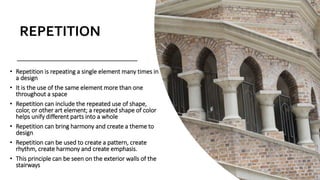
• This principle can be seen on the exterior walls of the
stairways
REPETITION
• The Sultan Abdul Samad building has plenty of repeating
patterns in its design
• The principle of repetition can be seen in its corridor
arches
• The repeating design of the arches come in various
shapes and sizes
• This creates a mesmerizing pattern due to the repeating
arches that creates a rhythmic pattern
• This building showcases Islamic aesthetic design and it is
prevalent and obvious through the whole building
SYMMETRY
FLOOR PLAN
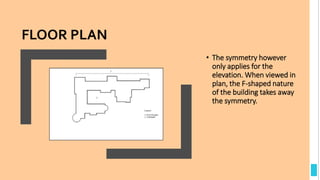
• The symmetry however
only applies for the
elevation. When viewed in
plan, the F-shaped nature
of the building takes away
the symmetry.
FRONT ELEVATIONS
• For the front facade, the clock
tower acts the axis of symmetry for
the building.
• The front facade of the building is
extremely symmetrical. Two
circular tower with the same
height of 17.2 metre stand on each
side of porch, separated only by a
41.2 metre high clock tower.
COPPER DOMES
• Another striking feature of the Sultan
Abdul Samad Building are the three
towers that protrude from the building.
One of the two circular towers. A copper
dome peeping out from behind the roof.
The copper domes that cap them are
based on the Indo-Saracenic
architectural style.
• The element design that have been apply
to copper domes is radial symmetry. Two
lower towers flanked the clock tower,
each containing a staircase.
HIERACHY
CENTRAL
CLOCKTOWER
• Hierarchy implies in most all architectural
compositions, where it reflects the degree of
importance of these forms and space, as well as the
functional, formal and symbolic roles they play in the
organization.
• In this building, hierarchy can be found at the 3 towers
namely the tallest Central Clock Tower and 2 shorter
circulation towers.
• The tower stand in three different places, the tallest
tower namely Central Clock Tower stand in the middle of
the building while the other two tower stands at both
side of the building.
• This shows that the hierarchy by placement is applied.
conclusion
- So, from here we know that they are 4 types
of principle that can be found in this building :
a) Rhythm
b) Repetition
c) Hierarchy
d) Symmetry
- In conclusion, among all of the principle use
in this building symmetry is the most
prominent.
Sultan abdul samad building

Sultan abdul samad building

  • 1.
  • 2.
    GROUPMEMBER AIMI SYAHIRA BINTIMARZUKI (2018262204) EBBYFAIZ FIRDAUS BIN BOJENG (2018663648) NORMAISARAH BINTI NORDIN (2018226958) SYAHIDATUL FILZAH BINTI ABDUL KADIR (2018299964)
  • 3.
  • 4.
    HISTORY OF THEBUILDING • It is a late nineteenth century building that located along Jalan Raja in front of Dataran Merdeka and the Royal Selangor Club in Kuala Lumpur • The land for this building was initially the settlement of Yap Ah Loy and was used as a vegetable garden where that time, the administration centre for Kuala Lumpur was at the east part of Klang River. During the year 1875 to 1978, the land was said to be a valley and was took over by the British under the development plan, Swettenham 1882. Yap Ah Loy had to accept the offer of $50 an acre. • When Malaya gained independence in 1957, the building was named as Dataran Merdeka or Merdeka Palace as the declaration of the independence of Malaysia was done in front of this building on August 31, 1957 where the lowering of the Union Jack Flag took place and replaced with the national flag of Malaysia. • In the year of 1974 all the state of Selangor Government offices were relocated to Shah Alam and the various department of Federal Government also moved their offices elsewhere. The building itself renamed again as Bangunan Sultan Abdul Samad after Sultan Abdul Samad the reigning Sultan of Selangor at that time. • In the year of 1978 the building housed the superior courts of the country: the Federal Court of Malaysia, the Court of Appeals and the High Court of Malaya. • The Federal Court and the Court of Appeals had shifted to the Palace of Justice in Putrajaya during the early 2000s, while the High Court of Malaya shifted to the Kuala Lumpur Courts Complex in 2007. • Now The Ministry of Information, Communications and Culture of Malaysia (Malay: Kementerian Penerangan, Komunikasi dan Kebudayaan Malaysia) took over the building since 2007.
  • 5.
  • 6.
    Construction of thebuilding began. 3 SEP. 1894 The foundation stone was laid by H.E Sir Charles B.H Mitchell, the Governor of the Federated Malay State (FMS). 6 OCT. 1894 The construction of the building was completed and officiated by Sir Frank Swettenham, the General Resident. It was also in 1897, the clock chimed for the first time to coincide with Queen Victoria's Diamond Jubilee parade. 4 APR. 1897 Kuala Lumpur was hit by flash flood after a heavy rainfall and Sultan Abdul Samad building was heavily damaged. 1971 In 1978, major renovation and restoration were undertaken to house the nation's Apex Courts which took six years to complete with a total cost of RM 17.2 million. 1978–1984
  • 7.
  • 8.
    DESIGN CONCEPT ANDIDEA OFTHE BUILING - The idea of this building is from Mahomaten style that was so much influenced by C.E Spooner who had working experienced in Ceylon (Sri Lanka). • Ceylon is the India neighboring country that have eclentive mixture of gothic and Italian as well as Islamic elements. • The building contains of 4 millions of bricks, 50 tons of fabricated steel and iron, 30,000 cubic feet of timber, 2,500 barrels of cement, 18,000 pikuls of lime and 4,000 cubic yards of sand. • This building has a front façade stretching 137.2 metre (450 feet). • 50 tons of fabricated steel and iron, 30,000 cubic feet of timber, 2,500 barrels of cement, 18,000 pikuls of lime and 4,000 cubic yards of sand. • This building has 3 towers namely the tallest Central Clock Tower and 2 shorter circulation towers.
  • 9.
  • 10.
  • 11.
    RHYTHM • Rhythm isa regular and repeated pattern • As a design principle, rhythm can be defined in building design as a patterned repetition of elements in space • Rhythm in building design is characterised by patterns, elements or motifs at irregular or regular intervals • Rhythm in this circumstance is the organization of the repetitive forms, elements and space in building design • Usually rhythm in architecture is present in columns, windows, walls and other elements of a building designed in such a way that it transmits a repetition of the same element • The Sultan Abdul Samad building incorporates rhythm in its architecture • The element on the walls of this building shows the principle of rhythm • It is shown as a repetitive shape moving in different cadences throughout the wall • The building stairways also has this principle present • With the stairway the rhythm in its design is shown in a more mesmerizing way as the repeating arches coincide in a melodic fashion
  • 12.
  • 13.
    REPETITION • Repetition isrepeating a single element many times in a design • It is the use of the same element more than one throughout a space • Repetition can include the repeated use of shape, color, or other art element; a repeated shape of color helps unify different parts into a whole • Repetition can bring harmony and create a theme to design • Repetition can be used to create a pattern, create rhythm, create harmony and create emphasis. • This principle can be seen on the exterior walls of the stairways
  • 14.
    REPETITION • The SultanAbdul Samad building has plenty of repeating patterns in its design • The principle of repetition can be seen in its corridor arches • The repeating design of the arches come in various shapes and sizes • This creates a mesmerizing pattern due to the repeating arches that creates a rhythmic pattern • This building showcases Islamic aesthetic design and it is prevalent and obvious through the whole building
  • 15.
  • 16.
    FLOOR PLAN • Thesymmetry however only applies for the elevation. When viewed in plan, the F-shaped nature of the building takes away the symmetry.
  • 17.
    FRONT ELEVATIONS • Forthe front facade, the clock tower acts the axis of symmetry for the building. • The front facade of the building is extremely symmetrical. Two circular tower with the same height of 17.2 metre stand on each side of porch, separated only by a 41.2 metre high clock tower.
  • 18.
    COPPER DOMES • Anotherstriking feature of the Sultan Abdul Samad Building are the three towers that protrude from the building. One of the two circular towers. A copper dome peeping out from behind the roof. The copper domes that cap them are based on the Indo-Saracenic architectural style. • The element design that have been apply to copper domes is radial symmetry. Two lower towers flanked the clock tower, each containing a staircase.
  • 19.
  • 20.
    CENTRAL CLOCKTOWER • Hierarchy impliesin most all architectural compositions, where it reflects the degree of importance of these forms and space, as well as the functional, formal and symbolic roles they play in the organization. • In this building, hierarchy can be found at the 3 towers namely the tallest Central Clock Tower and 2 shorter circulation towers. • The tower stand in three different places, the tallest tower namely Central Clock Tower stand in the middle of the building while the other two tower stands at both side of the building. • This shows that the hierarchy by placement is applied.
  • 21.
    conclusion - So, fromhere we know that they are 4 types of principle that can be found in this building : a) Rhythm b) Repetition c) Hierarchy d) Symmetry - In conclusion, among all of the principle use in this building symmetry is the most prominent.