Chapter 3: Sensors and/or Transducers
1
Introduction to Different Types of
Sensors
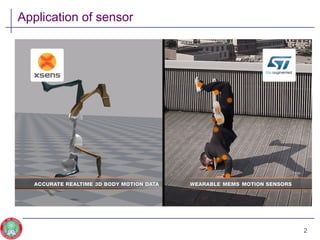
Application of sensor
2
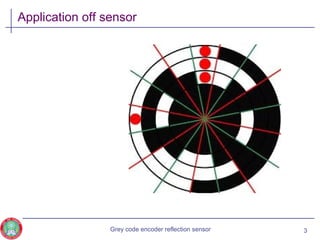
Application off sensor
Grey code encoder reflection sensor 3
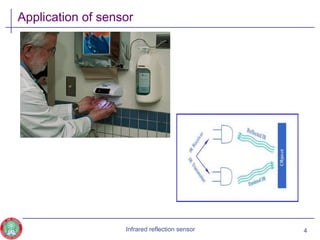
Application of sensor
Infrared reflection sensor 4
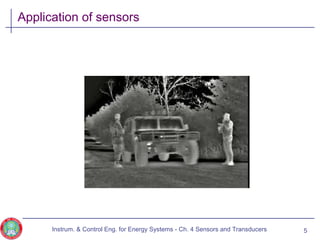
Application of sensors
Instrum. & Control Eng. for Energy Systems - Ch. 4 Sensors and Transducers 5
Goals of the Chapter
• Define classification of sensors and some terminologies
• Introduce various types of sensors for measurement
purpose and their applications
• Example: Displacement, motion, level, pressure, temperature, …
6Introduction to Instrumntaion Eng‘g - Ch. 4 Sensors and Transducers
Overview
• Introduction
• Classification of sensors
• Passive sensors
• Active sensors
7Instrum. & Control Eng. for Energy Systems - Ch. 4 Sensors and Transducers
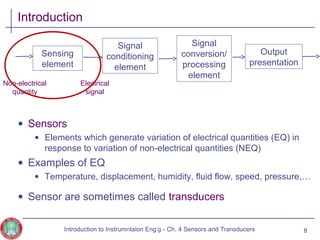
Introduction
• Sensors
• Elements which generate variation of electrical quantities (EQ) in
response to variation of non-electrical quantities (NEQ)
• Examples of EQ
• Temperature, displacement, humidity, fluid flow, speed, pressure,…
• Sensor are sometimes called transducers
8
Sensing
element
Signal
conditioning
element
Signal
conversion/
processing
element
Output
presentation
Non-electrical
quantity
Electrical
signal
Introduction to Instrumntaion Eng‘g - Ch. 4 Sensors and Transducers
Introduction …
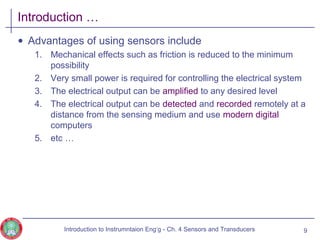
• Advantages of using sensors include
1. Mechanical effects such as friction is reduced to the minimum
possibility
2. Very small power is required for controlling the electrical system
3. The electrical output can be amplified to any desired level
4. The electrical output can be detected and recorded remotely at a
distance from the sensing medium and use modern digital
computers
5. etc …
9Introduction to Instrumntaion Eng‘g - Ch. 4 Sensors and Transducers
Introduction - Use of Sensors
1. Information gathering: Provide data for display purpose
• This gives an understanding of the current status of the system
parameters
• Example: Car speed sensor and speedometer, which records the
speed of a car against time
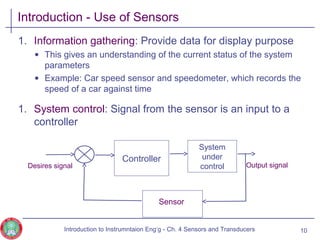
1. System control: Signal from the sensor is an input to a
controller
10
Controller
System
under
control Output signalDesires signal
Sensor
Introduction to Instrumntaion Eng‘g - Ch. 4 Sensors and Transducers
Introduction – Sensor Requirements
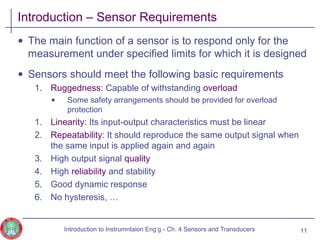
• The main function of a sensor is to respond only for the
measurement under specified limits for which it is designed
• Sensors should meet the following basic requirements
1. Ruggedness: Capable of withstanding overload
• Some safety arrangements should be provided for overload
protection
1. Linearity: Its input-output characteristics must be linear
2. Repeatability: It should reproduce the same output signal when
the same input is applied again and again
3. High output signal quality
4. High reliability and stability
5. Good dynamic response
6. No hysteresis, …
11Introduction to Instrumntaion Eng‘g - Ch. 4 Sensors and Transducers
Overview
• Introduction
• Classification of sensors
• Passive sensors
• Active sensors
12Introduction to Instrumntaion Eng‘g - Ch. 4 Sensors and Transducers
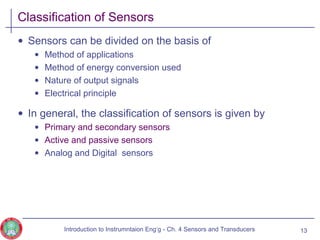
Classification of Sensors
• Sensors can be divided on the basis of
• Method of applications
• Method of energy conversion used
• Nature of output signals
• Electrical principle
• In general, the classification of sensors is given by
• Primary and secondary sensors
• Active and passive sensors
• Analog and Digital sensors
13Introduction to Instrumntaion Eng‘g - Ch. 4 Sensors and Transducers
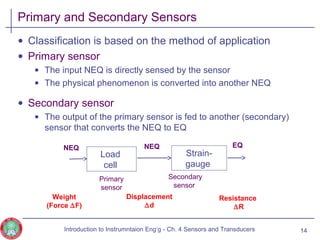
Primary and Secondary Sensors
• Classification is based on the method of application
• Primary sensor
• The input NEQ is directly sensed by the sensor
• The physical phenomenon is converted into another NEQ
• Secondary sensor
• The output of the primary sensor is fed to another (secondary)
sensor that converts the NEQ to EQ
14
Load
cell
Strain-
gauge
NEQ
Secondary
sensor
Weight
(Force ∆F)
Primary
sensor
NEQ EQ
Displacement
∆d
Resistance
∆R
Introduction to Instrumntaion Eng‘g - Ch. 4 Sensors and Transducers
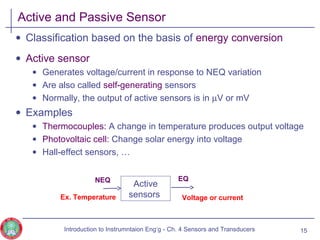
Active and Passive Sensor
• Classification based on the basis of energy conversion
• Active sensor
• Generates voltage/current in response to NEQ variation
• Are also called self-generating sensors
• Normally, the output of active sensors is in µV or mV
• Examples
• Thermocouples: A change in temperature produces output voltage
• Photovoltaic cell: Change solar energy into voltage
• Hall-effect sensors, …
15
Active
sensors
NEQ
Ex. Temperature
EQ
Voltage or current
Introduction to Instrumntaion Eng‘g - Ch. 4 Sensors and Transducers
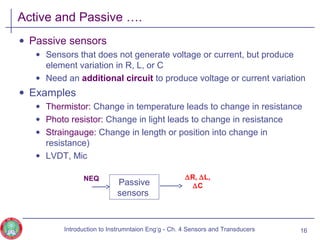
Active and Passive ….
• Passive sensors
• Sensors that does not generate voltage or current, but produce
element variation in R, L, or C
• Need an additional circuit to produce voltage or current variation
• Examples
• Thermistor: Change in temperature leads to change in resistance
• Photo resistor: Change in light leads to change in resistance
• Straingauge: Change in length or position into change in
resistance)
• LVDT, Mic
16
Passive
sensors
NEQ ∆R, ∆L,
∆C
Introduction to Instrumntaion Eng‘g - Ch. 4 Sensors and Transducers
Analog and Digital Sensors
• Classification based on the nature of the output signal
• Analog sensor
• Gives an output that varies continuously as the input changes
• Output can have infinite number of values within the sensor’s range
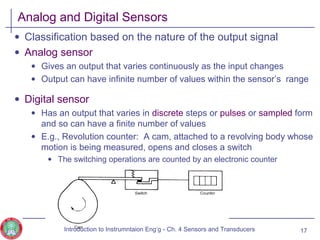
• Digital sensor
• Has an output that varies in discrete steps or pulses or sampled form
and so can have a finite number of values
• E.g., Revolution counter: A cam, attached to a revolving body whose
motion is being measured, opens and closes a switch
• The switching operations are counted by an electronic counter
17Introduction to Instrumntaion Eng‘g - Ch. 4 Sensors and Transducers
Sensor Classification
• Sensors can also be classified according to the application
• Example
• Measurement of displacement, motion, temperature, intensity,
sensors
18Introduction to Instrumntaion Eng‘g - Ch. 4 Sensors and Transducers
Overview
• Introduction
• Classification of sensors
• Passive sensors
• Resistive sensors
• Potentiometers, temperature dependent resistors, strain gauge,
photoconductors (photoresistors), Piezoresistive
• Capacitive sensors
• Inductive sensors
• Active sensors
19Introduction to Instrumntaion Eng‘g - Ch. 4 Sensors and Transducers
Resistive Sensors - Potentiometer
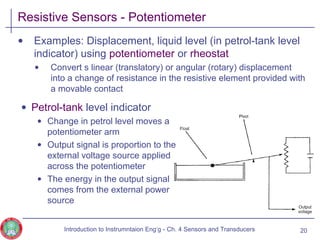
• Examples: Displacement, liquid level (in petrol-tank level
indicator) using potentiometer or rheostat
• Convert s linear (translatory) or angular (rotary) displacement
into a change of resistance in the resistive element provided with
a movable contact
20
• Petrol-tank level indicator
• Change in petrol level moves a
potentiometer arm
• Output signal is proportion to the
external voltage source applied
across the potentiometer
• The energy in the output signal
comes from the external power
source
Introduction to Instrumntaion Eng‘g - Ch. 4 Sensors and Transducers
Resistive Sensors – Potentiometer …
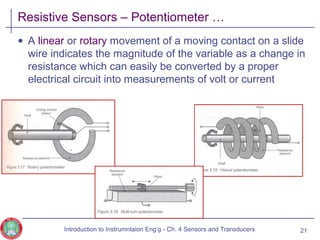
• A linear or rotary movement of a moving contact on a slide
wire indicates the magnitude of the variable as a change in
resistance which can easily be converted by a proper
electrical circuit into measurements of volt or current
21Introduction to Instrumntaion Eng‘g - Ch. 4 Sensors and Transducers
Resistive Sensors – Temperature Dependent Resistors
• Two classes of thermal resistors are
• Metallic element
• Semiconductor
• For most metals, the resistance increases with increase in
temperature
• Where α is the temperature coefficient of resistance and given as
• Example: Platinum
• Has a linear temperature-resistance characteristics
• Reproducible over a wide range of temperature
• Platinum Thermometers are used for temperature measurement
22
]1[...]1[)(R 0
2
210 TRTTRT ααα +≈+++=
0
1
R
R
T
∆
∆
=α
Introduction to Instrumntaion Eng‘g - Ch. 4 Sensors and Transducers
Resistive Sensors – Temperature Dependent…
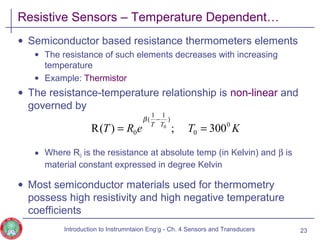
• Semiconductor based resistance thermometers elements
• The resistance of such elements decreases with increasing
temperature
• Example: Thermistor
• The resistance-temperature relationship is non-linear and
governed by
• Where R0 is the resistance at absolute temp (in Kelvin) and β is
material constant expressed in degree Kelvin
• Most semiconductor materials used for thermometry
possess high resistivity and high negative temperature
coefficients
23
KTeRT TT 0
0
)
11
(
0 300;)(R 0
==
−β
Introduction to Instrumntaion Eng‘g - Ch. 4 Sensors and Transducers
Resistive Sensors – Temperature Dependent…
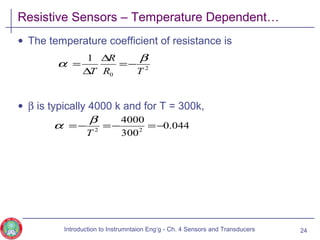
• The temperature coefficient of resistance is
• β is typically 4000 k and for T = 300k,
24
2
0
1
TR
R
T
β
α −=
∆
∆
=
044.0
300
4000
22
−=−=−=
T
β
α
Introduction to Instrumntaion Eng‘g - Ch. 4 Sensors and Transducers
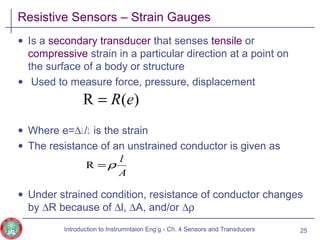
Resistive Sensors – Strain Gauges
• Is a secondary transducer that senses tensile or
compressive strain in a particular direction at a point on
the surface of a body or structure
• Used to measure force, pressure, displacement
• Where e=∆l/l is the strain
• The resistance of an unstrained conductor is given as
• Under strained condition, resistance of conductor changes
by ∆R because of ∆l, ∆A, and/or ∆ρ
25
)(R eR=
A
l
ρ=R
Introduction to Instrumntaion Eng‘g - Ch. 4 Sensors and Transducers
Resistive Sensors – Strain Gauges …
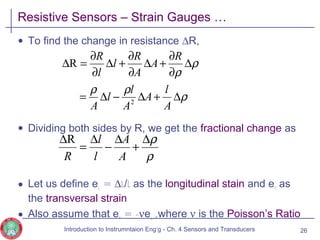
• To find the change in resistance ∆R,
• Dividing both sides by R, we get the fractional change as
• Let us define eL = ∆l/l as the longitudinal stain and eT as
the transversal strain
• Also assume that eT = -νeL ,where ν is the Poisson’s Ratio
26
ρ
ρρ
ρ
ρ
∆+∆−∆=
∆
∂
∂
+∆
∂
∂
+∆
∂
∂
=∆
A
l
A
A
l
l
A
R
A
A
R
l
l
R
2
R
ρ
ρ∆
+
∆
−
∆
=
∆
A
A
l
l
R
R
Introduction to Instrumntaion Eng‘g - Ch. 4 Sensors and Transducers
Resistive Sensors – Strain Gauges …
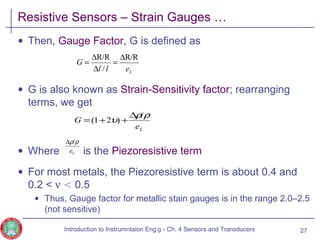
• Then, Gauge Factor, G is defined as
• G is also known as Strain-Sensitivity factor; rearranging
terms, we get
• Where is the Piezoresistive term
• For most metals, the Piezoresistive term is about 0.4 and
0.2 < ν < 0.5
• Thus, Gauge factor for metallic stain gauges is in the range 2.0–2.5
(not sensitive)
27
Le
G
ρρ
υ
/
)21(
∆
++=
Le
ρρ/∆
Lell
G
R/R
/
R/R ∆
=
∆
∆
=
Introduction to Instrumntaion Eng‘g - Ch. 4 Sensors and Transducers
Resistive Sensors – Strain Gauges …
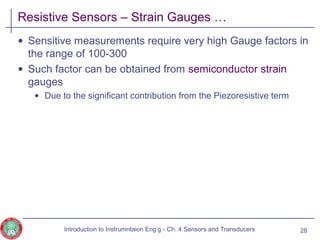
• Sensitive measurements require very high Gauge factors in
the range of 100-300
• Such factor can be obtained from semiconductor strain
gauges
• Due to the significant contribution from the Piezoresistive term
28Introduction to Instrumntaion Eng‘g - Ch. 4 Sensors and Transducers
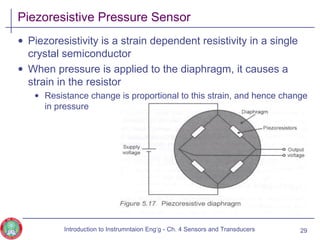
Piezoresistive Pressure Sensor
• Piezoresistivity is a strain dependent resistivity in a single
crystal semiconductor
• When pressure is applied to the diaphragm, it causes a
strain in the resistor
• Resistance change is proportional to this strain, and hence change
in pressure
29Introduction to Instrumntaion Eng‘g - Ch. 4 Sensors and Transducers
Resistive Sensors – Photoconductor
• Are light sensitive resistors with non-linear negative
temperature coefficient
• Are resistive optical radiation transducers
• Photoconductors have resistance variation that depends on
illumination
• The resistance illumination characteristics is given by
• Where RD is Dark Resistance and E is illumination level in Lux
• Photoconductors are used in
• Cameras, light sensors in spectrophotometer
• Counting systems where an object interrupts a light beam hitting
the photoconductor, etc.
30
E
DeR α−
=R
Introduction to Instrumntaion Eng‘g - Ch. 4 Sensors and Transducers
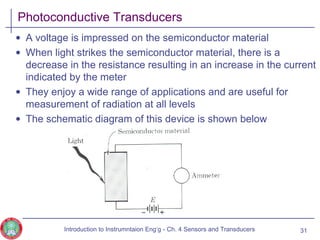
Photoconductive Transducers
• A voltage is impressed on the semiconductor material
• When light strikes the semiconductor material, there is a
decrease in the resistance resulting in an increase in the current
indicated by the meter
• They enjoy a wide range of applications and are useful for
measurement of radiation at all levels
• The schematic diagram of this device is shown below
31Introduction to Instrumntaion Eng‘g - Ch. 4 Sensors and Transducers
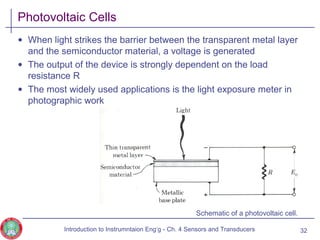
Photovoltaic Cells
• When light strikes the barrier between the transparent metal layer
and the semiconductor material, a voltage is generated
• The output of the device is strongly dependent on the load
resistance R
• The most widely used applications is the light exposure meter in
photographic work
Schematic of a photovoltaic cell.
32Introduction to Instrumntaion Eng‘g - Ch. 4 Sensors and Transducers
Overview
• Introduction
• Classification of sensors
• Passive sensors
• Resistive sensors
• Capacitive sensors
• Inductive sensors
• Active sensors
33Introduction to Instrumntaion Eng‘g - Ch. 4 Sensors and Transducers
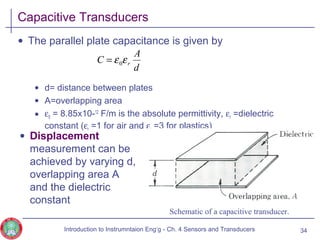
Capacitive Transducers
• The parallel plate capacitance is given by
• d= distance between plates
• A=overlapping area
• ε0 = 8.85x10⁻¹²
F/m is the absolute permittivity, εr =dielectric
constant (εr =1 for air and εr =3 for plastics)
d
A
C rεε0=
• Displacement
measurement can be
achieved by varying d,
overlapping area A
and the dielectric
constant
Schematic of a capacitive transducer.
34Introduction to Instrumntaion Eng‘g - Ch. 4 Sensors and Transducers
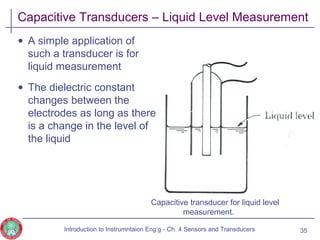
Capacitive Transducers – Liquid Level Measurement
• A simple application of
such a transducer is for
liquid measurement
• The dielectric constant
changes between the
electrodes as long as there
is a change in the level of
the liquid
Capacitive transducer for liquid level
measurement.
35Introduction to Instrumntaion Eng‘g - Ch. 4 Sensors and Transducers
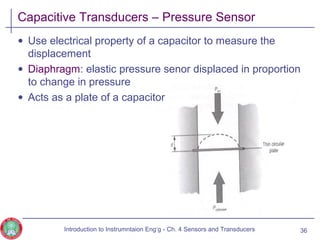
Capacitive Transducers – Pressure Sensor
• Use electrical property of a capacitor to measure the
displacement
• Diaphragm: elastic pressure senor displaced in proportion
to change in pressure
• Acts as a plate of a capacitor
36Introduction to Instrumntaion Eng‘g - Ch. 4 Sensors and Transducers
Capacitive Transducers – Pressure Sensor
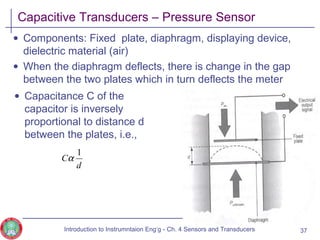
• Components: Fixed plate, diaphragm, displaying device,
dielectric material (air)
• When the diaphragm deflects, there is change in the gap
between the two plates which in turn deflects the meter
d
C
1
α
37
• Capacitance C of the
capacitor is inversely
proportional to distance d
between the plates, i.e.,
Introduction to Instrumntaion Eng‘g - Ch. 4 Sensors and Transducers
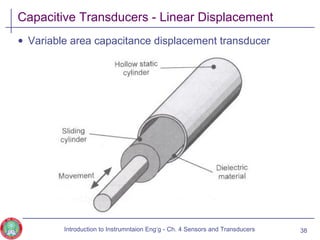
Capacitive Transducers - Linear Displacement
• Variable area capacitance displacement transducer
38Introduction to Instrumntaion Eng‘g - Ch. 4 Sensors and Transducers
Overview
• Introduction
• Classification of sensors
• Passive sensors
• Resistive sensors
• Capacitive sensors
• Inductive sensors
• Active sensors
39Introduction to Instrumntaion Eng‘g - Ch. 4 Sensors and Transducers
Inductive Sensors
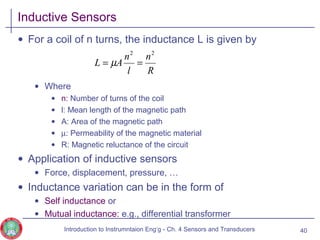
• For a coil of n turns, the inductance L is given by
• Where
• n: Number of turns of the coil
• l: Mean length of the magnetic path
• A: Area of the magnetic path
• µ: Permeability of the magnetic material
• R: Magnetic reluctance of the circuit
• Application of inductive sensors
• Force, displacement, pressure, …
• Inductance variation can be in the form of
• Self inductance or
• Mutual inductance: e.g., differential transformer
40
R
n
l
n
AL
22
== µ
Introduction to Instrumntaion Eng‘g - Ch. 4 Sensors and Transducers
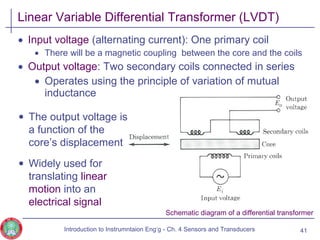
• Input voltage (alternating current): One primary coil
• There will be a magnetic coupling between the core and the coils
• Output voltage: Two secondary coils connected in series
• Operates using the principle of variation of mutual
inductance
Linear Variable Differential Transformer (LVDT)
Schematic diagram of a differential transformer
• The output voltage is
a function of the
core’s displacement
• Widely used for
translating linear
motion into an
electrical signal
41Introduction to Instrumntaion Eng‘g - Ch. 4 Sensors and Transducers
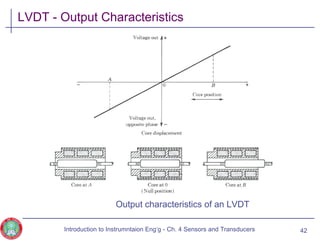
LVDT - Output Characteristics
Output characteristics of an LVDT
42Introduction to Instrumntaion Eng‘g - Ch. 4 Sensors and Transducers
LVDT – Applications
• Measure linear mechanical displacement
• Provides resolution about 0.05mm, operating range from ± 0.1mm
to ± 300 mm, accuracy of ± 0.5% of full-scale reading
• The input ac excitation of LVDT can range in frequency from 50 Hz
to 20kHz
• Used to measure position in control systems and precision
manufacturing
• Can also be used to measure force, pressure, acceleration,
etc..
43Introduction to Instrumntaion Eng‘g - Ch. 4 Sensors and Transducers
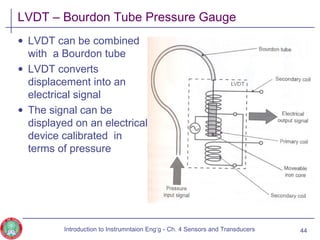
LVDT – Bourdon Tube Pressure Gauge
• LVDT can be combined
with a Bourdon tube
• LVDT converts
displacement into an
electrical signal
• The signal can be
displayed on an electrical
device calibrated in
terms of pressure
44Introduction to Instrumntaion Eng‘g - Ch. 4 Sensors and Transducers
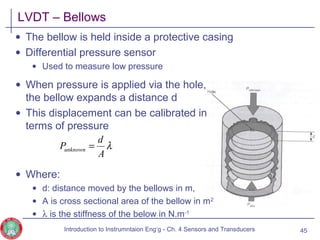
• When pressure is applied via the hole,
the bellow expands a distance d
• This displacement can be calibrated in
terms of pressure
• Where:
• d: distance moved by the bellows in m,
• A is cross sectional area of the bellow in m2
• λ is the stiffness of the below in N.m-1
LVDT – Bellows
• The bellow is held inside a protective casing
• Differential pressure sensor
• Used to measure low pressure
45
λ
A
d
Punknown =
Introduction to Instrumntaion Eng‘g - Ch. 4 Sensors and Transducers
LVDT and Bellow Combination
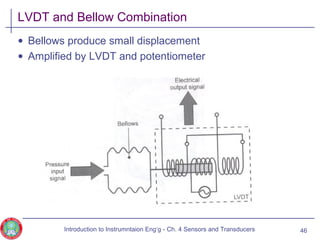
• Bellows produce small displacement
• Amplified by LVDT and potentiometer
46Introduction to Instrumntaion Eng‘g - Ch. 4 Sensors and Transducers
Overview
• Introduction
• Classification of sensors
• Passive sensors
• Active sensors
• Thermoelectric transducers
• Photoelectric transducers
• Piezoelectric transducers
• Hall-effect transudes
• Tachometric generators
47Introduction to Instrumntaion Eng‘g - Ch. 4 Sensors and Transducers
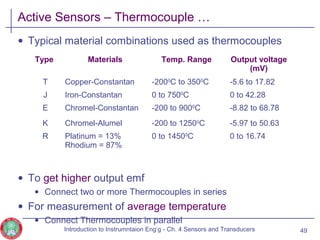
Active Sensors - Thermocouple
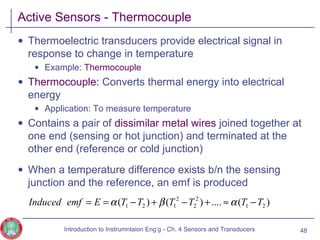
• Thermoelectric transducers provide electrical signal in
response to change in temperature
• Example: Thermocouple
• Thermocouple: Converts thermal energy into electrical
energy
• Application: To measure temperature
• Contains a pair of dissimilar metal wires joined together at
one end (sensing or hot junction) and terminated at the
other end (reference or cold junction)
• When a temperature difference exists b/n the sensing
junction and the reference, an emf is produced
48
)(....)()( 21
2
2
2
121 TTTTTTEemfInduced −≈+−+−== αβα
Introduction to Instrumntaion Eng‘g - Ch. 4 Sensors and Transducers
Active Sensors – Thermocouple …
• Typical material combinations used as thermocouples
• To get higher output emf
• Connect two or more Thermocouples in series
• For measurement of average temperature
• Connect Thermocouples in parallel
49
Type Materials Temp. Range Output voltage
(mV)
T Copper-Constantan -2000
C to 3500
C -5.6 to 17.82
J Iron-Constantan 0 to 7500
C 0 to 42.28
E Chromel-Constantan -200 to 9000
C -8.82 to 68.78
K Chromel-Alumel -200 to 12500
C -5.97 to 50.63
R Platinum = 13%
Rhodium = 87%
0 to 14500
C 0 to 16.74
Introduction to Instrumntaion Eng‘g - Ch. 4 Sensors and Transducers
Active Sensors – Thermocouple …
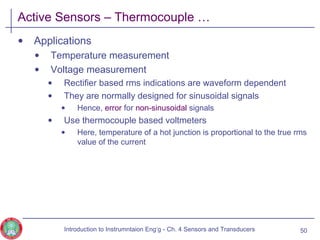
• Applications
• Temperature measurement
• Voltage measurement
• Rectifier based rms indications are waveform dependent
• They are normally designed for sinusoidal signals
• Hence, error for non-sinusoidal signals
• Use thermocouple based voltmeters
• Here, temperature of a hot junction is proportional to the true rms
value of the current
50Introduction to Instrumntaion Eng‘g - Ch. 4 Sensors and Transducers
Active Sensors – Thermocouple Meter
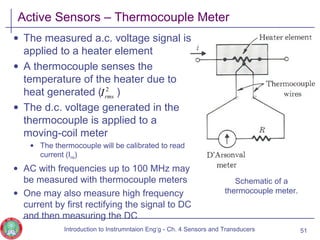
• The measured a.c. voltage signal is
applied to a heater element
• A thermocouple senses the
temperature of the heater due to
heat generated ( )
• The d.c. voltage generated in the
thermocouple is applied to a
moving-coil meter
• The thermocouple will be calibrated to read
current (Irms)
• AC with frequencies up to 100 MHz may
be measured with thermocouple meters
• One may also measure high frequency
current by first rectifying the signal to DC
and then measuring the DC
Schematic of a
thermocouple meter.
2
rmsI
51Introduction to Instrumntaion Eng‘g - Ch. 4 Sensors and Transducers
Overview
• Introduction
• Classification of sensors
• Passive sensors
• Active sensors
• Thermoelectric transducers
• Photoelectric transducers
• Piezoelectric transducers
• Hall-effect transudes
• Tachometric generators
52Introduction to Instrumntaion Eng‘g - Ch. 4 Sensors and Transducers
Photoelectric Transducers
• Versatile tools for detecting radiant energy or light
• Are extensively used in instrumentation
• Most known photosensitive devices include
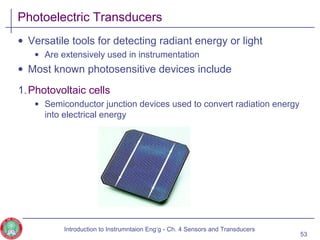
1.Photovoltaic cells
• Semiconductor junction devices used to convert radiation energy
into electrical energy
53
Introduction to Instrumntaion Eng‘g - Ch. 4 Sensors and Transducers
Photoelectric Transducers …
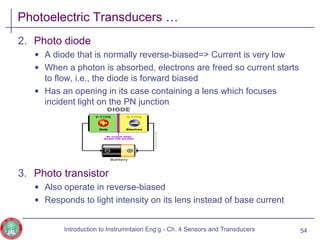
2. Photo diode
• A diode that is normally reverse-biased=> Current is very low
• When a photon is absorbed, electrons are freed so current starts
to flow, i.e., the diode is forward biased
• Has an opening in its case containing a lens which focuses
incident light on the PN junction
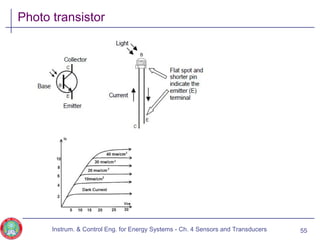
3. Photo transistor
• Also operate in reverse-biased
• Responds to light intensity on its lens instead of base current
54Introduction to Instrumntaion Eng‘g - Ch. 4 Sensors and Transducers
Photo transistor
Instrum. & Control Eng. for Energy Systems - Ch. 4 Sensors and Transducers 55
Overview
• Introduction
• Classification of sensors
• Passive sensors
• Active sensors
• Thermoelectric transducers
• Photoelectric transducers
• Piezoelectric transducers
• Hall-effect transudes
• Tachometric generators
56Introduction to Instrumntaion Eng‘g - Ch. 4 Sensors and Transducers
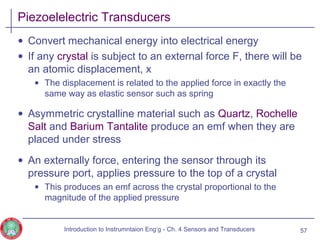
Piezoelelectric Transducers
• Convert mechanical energy into electrical energy
• If any crystal is subject to an external force F, there will be
an atomic displacement, x
• The displacement is related to the applied force in exactly the
same way as elastic sensor such as spring
• Asymmetric crystalline material such as Quartz, Rochelle
Salt and Barium Tantalite produce an emf when they are
placed under stress
• An externally force, entering the sensor through its
pressure port, applies pressure to the top of a crystal
• This produces an emf across the crystal proportional to the
magnitude of the applied pressure
57Introduction to Instrumntaion Eng‘g - Ch. 4 Sensors and Transducers
Piezoelelectric Transducers
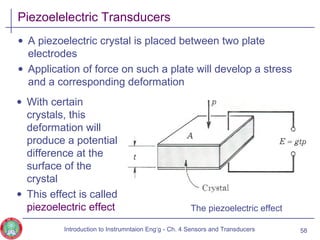
• A piezoelectric crystal is placed between two plate
electrodes
• Application of force on such a plate will develop a stress
and a corresponding deformation
The piezoelectric effect
• With certain
crystals, this
deformation will
produce a potential
difference at the
surface of the
crystal
• This effect is called
piezoelectric effect
58Introduction to Instrumntaion Eng‘g - Ch. 4 Sensors and Transducers
Piezoelelectric Transducers …
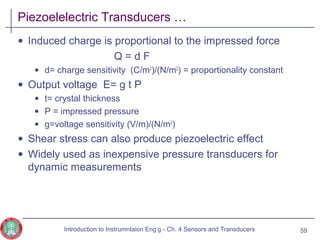
• Induced charge is proportional to the impressed force
Q = d F
• d= charge sensitivity (C/m2
)/(N/m2
) = proportionality constant
• Output voltage E= g t P
• t= crystal thickness
• P = impressed pressure
• g=voltage sensitivity (V/m)/(N/m2
)
• Shear stress can also produce piezoelectric effect
• Widely used as inexpensive pressure transducers for
dynamic measurements
59Introduction to Instrumntaion Eng‘g - Ch. 4 Sensors and Transducers
Piezoelelectric Transducers ….
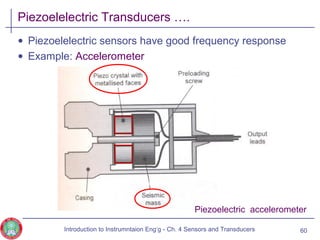
• Piezoelelectric sensors have good frequency response
• Example: Accelerometer
60
Piezoelectric accelerometer
Introduction to Instrumntaion Eng‘g - Ch. 4 Sensors and Transducers
Piezoelelectric Transducers …
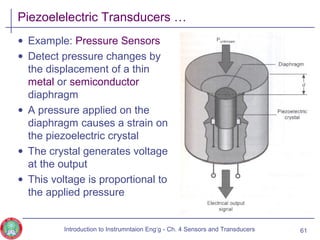
• Example: Pressure Sensors
• Detect pressure changes by
the displacement of a thin
metal or semiconductor
diaphragm
• A pressure applied on the
diaphragm causes a strain on
the piezoelectric crystal
• The crystal generates voltage
at the output
• This voltage is proportional to
the applied pressure
61Introduction to Instrumntaion Eng‘g - Ch. 4 Sensors and Transducers
Overview
• Introduction
• Classification of sensors
• Passive sensors
• Active sensors
• Thermoelectric transducers
• Photoelectric transducers
• Piezoelectric transducers
• Hall-effect transudes
• Tachometric generators
62Introduction to Instrumntaion Eng‘g - Ch. 4 Sensors and Transducers
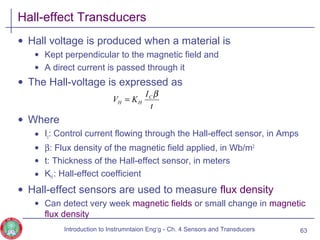
Hall-effect Transducers
• Hall voltage is produced when a material is
• Kept perpendicular to the magnetic field and
• A direct current is passed through it
• The Hall-voltage is expressed as
• Where
• Ic: Control current flowing through the Hall-effect sensor, in Amps
• β: Flux density of the magnetic field applied, in Wb/m2
• t: Thickness of the Hall-effect sensor, in meters
• KH : Hall-effect coefficient
• Hall-effect sensors are used to measure flux density
• Can detect very week magnetic fields or small change in magnetic
flux density
63
t
I
KV C
HH
β
=
Introduction to Instrumntaion Eng‘g - Ch. 4 Sensors and Transducers
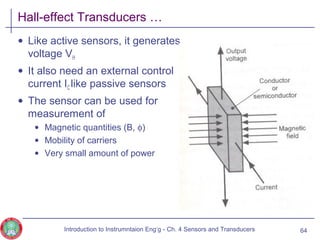
Hall-effect Transducers …
• Like active sensors, it generates
voltage VH
• It also need an external control
current IC like passive sensors
• The sensor can be used for
measurement of
• Magnetic quantities (B, φ)
• Mobility of carriers
• Very small amount of power
64Introduction to Instrumntaion Eng‘g - Ch. 4 Sensors and Transducers
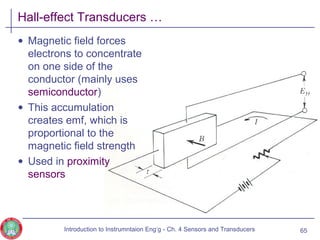
Hall-effect Transducers …
• Magnetic field forces
electrons to concentrate
on one side of the
conductor (mainly uses
semiconductor)
• This accumulation
creates emf, which is
proportional to the
magnetic field strength
• Used in proximity
sensors
65Introduction to Instrumntaion Eng‘g - Ch. 4 Sensors and Transducers
Overview
• Introduction
• Classification of sensors
• Passive sensors
• Active sensors
• Thermoelectric transducers
• Photoelectric transducers
• Piezoelectric transducers
• Hall-effect transudes
• Tachometric generators
66Introduction to Instrumntaion Eng‘g - Ch. 4 Sensors and Transducers
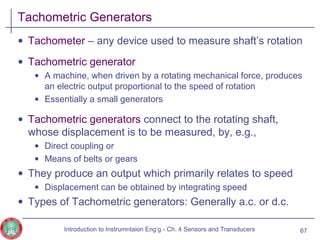
Tachometric Generators
• Tachometer – any device used to measure shaft’s rotation
• Tachometric generator
• A machine, when driven by a rotating mechanical force, produces
an electric output proportional to the speed of rotation
• Essentially a small generators
• Tachometric generators connect to the rotating shaft,
whose displacement is to be measured, by, e.g.,
• Direct coupling or
• Means of belts or gears
• They produce an output which primarily relates to speed
• Displacement can be obtained by integrating speed
• Types of Tachometric generators: Generally a.c. or d.c.
67Introduction to Instrumntaion Eng‘g - Ch. 4 Sensors and Transducers
Tachometric Generators
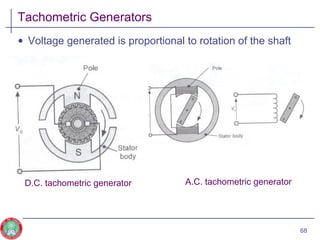
• Voltage generated is proportional to rotation of the shaft
68
D.C. tachometric generator A.C. tachometric generator

Cn3 sensors and transducers-1

  • 1.
    Chapter 3: Sensorsand/or Transducers 1 Introduction to Different Types of Sensors
  • 2.
  • 3.
    Application off sensor Greycode encoder reflection sensor 3
  • 4.
    Application of sensor Infraredreflection sensor 4
  • 5.
    Application of sensors Instrum.& Control Eng. for Energy Systems - Ch. 4 Sensors and Transducers 5
  • 6.
    Goals of theChapter • Define classification of sensors and some terminologies • Introduce various types of sensors for measurement purpose and their applications • Example: Displacement, motion, level, pressure, temperature, … 6Introduction to Instrumntaion Eng‘g - Ch. 4 Sensors and Transducers
  • 7.
    Overview • Introduction • Classificationof sensors • Passive sensors • Active sensors 7Instrum. & Control Eng. for Energy Systems - Ch. 4 Sensors and Transducers
  • 8.
    Introduction • Sensors • Elementswhich generate variation of electrical quantities (EQ) in response to variation of non-electrical quantities (NEQ) • Examples of EQ • Temperature, displacement, humidity, fluid flow, speed, pressure,… • Sensor are sometimes called transducers 8 Sensing element Signal conditioning element Signal conversion/ processing element Output presentation Non-electrical quantity Electrical signal Introduction to Instrumntaion Eng‘g - Ch. 4 Sensors and Transducers
  • 9.
    Introduction … • Advantagesof using sensors include 1. Mechanical effects such as friction is reduced to the minimum possibility 2. Very small power is required for controlling the electrical system 3. The electrical output can be amplified to any desired level 4. The electrical output can be detected and recorded remotely at a distance from the sensing medium and use modern digital computers 5. etc … 9Introduction to Instrumntaion Eng‘g - Ch. 4 Sensors and Transducers
  • 10.
    Introduction - Useof Sensors 1. Information gathering: Provide data for display purpose • This gives an understanding of the current status of the system parameters • Example: Car speed sensor and speedometer, which records the speed of a car against time 1. System control: Signal from the sensor is an input to a controller 10 Controller System under control Output signalDesires signal Sensor Introduction to Instrumntaion Eng‘g - Ch. 4 Sensors and Transducers
  • 11.
    Introduction – SensorRequirements • The main function of a sensor is to respond only for the measurement under specified limits for which it is designed • Sensors should meet the following basic requirements 1. Ruggedness: Capable of withstanding overload • Some safety arrangements should be provided for overload protection 1. Linearity: Its input-output characteristics must be linear 2. Repeatability: It should reproduce the same output signal when the same input is applied again and again 3. High output signal quality 4. High reliability and stability 5. Good dynamic response 6. No hysteresis, … 11Introduction to Instrumntaion Eng‘g - Ch. 4 Sensors and Transducers
  • 12.
    Overview • Introduction • Classificationof sensors • Passive sensors • Active sensors 12Introduction to Instrumntaion Eng‘g - Ch. 4 Sensors and Transducers
  • 13.
    Classification of Sensors •Sensors can be divided on the basis of • Method of applications • Method of energy conversion used • Nature of output signals • Electrical principle • In general, the classification of sensors is given by • Primary and secondary sensors • Active and passive sensors • Analog and Digital sensors 13Introduction to Instrumntaion Eng‘g - Ch. 4 Sensors and Transducers
  • 14.
    Primary and SecondarySensors • Classification is based on the method of application • Primary sensor • The input NEQ is directly sensed by the sensor • The physical phenomenon is converted into another NEQ • Secondary sensor • The output of the primary sensor is fed to another (secondary) sensor that converts the NEQ to EQ 14 Load cell Strain- gauge NEQ Secondary sensor Weight (Force ∆F) Primary sensor NEQ EQ Displacement ∆d Resistance ∆R Introduction to Instrumntaion Eng‘g - Ch. 4 Sensors and Transducers
  • 15.
    Active and PassiveSensor • Classification based on the basis of energy conversion • Active sensor • Generates voltage/current in response to NEQ variation • Are also called self-generating sensors • Normally, the output of active sensors is in µV or mV • Examples • Thermocouples: A change in temperature produces output voltage • Photovoltaic cell: Change solar energy into voltage • Hall-effect sensors, … 15 Active sensors NEQ Ex. Temperature EQ Voltage or current Introduction to Instrumntaion Eng‘g - Ch. 4 Sensors and Transducers
  • 16.
    Active and Passive…. • Passive sensors • Sensors that does not generate voltage or current, but produce element variation in R, L, or C • Need an additional circuit to produce voltage or current variation • Examples • Thermistor: Change in temperature leads to change in resistance • Photo resistor: Change in light leads to change in resistance • Straingauge: Change in length or position into change in resistance) • LVDT, Mic 16 Passive sensors NEQ ∆R, ∆L, ∆C Introduction to Instrumntaion Eng‘g - Ch. 4 Sensors and Transducers
  • 17.
    Analog and DigitalSensors • Classification based on the nature of the output signal • Analog sensor • Gives an output that varies continuously as the input changes • Output can have infinite number of values within the sensor’s range • Digital sensor • Has an output that varies in discrete steps or pulses or sampled form and so can have a finite number of values • E.g., Revolution counter: A cam, attached to a revolving body whose motion is being measured, opens and closes a switch • The switching operations are counted by an electronic counter 17Introduction to Instrumntaion Eng‘g - Ch. 4 Sensors and Transducers
  • 18.
    Sensor Classification • Sensorscan also be classified according to the application • Example • Measurement of displacement, motion, temperature, intensity, sensors 18Introduction to Instrumntaion Eng‘g - Ch. 4 Sensors and Transducers
  • 19.
    Overview • Introduction • Classificationof sensors • Passive sensors • Resistive sensors • Potentiometers, temperature dependent resistors, strain gauge, photoconductors (photoresistors), Piezoresistive • Capacitive sensors • Inductive sensors • Active sensors 19Introduction to Instrumntaion Eng‘g - Ch. 4 Sensors and Transducers
  • 20.
    Resistive Sensors -Potentiometer • Examples: Displacement, liquid level (in petrol-tank level indicator) using potentiometer or rheostat • Convert s linear (translatory) or angular (rotary) displacement into a change of resistance in the resistive element provided with a movable contact 20 • Petrol-tank level indicator • Change in petrol level moves a potentiometer arm • Output signal is proportion to the external voltage source applied across the potentiometer • The energy in the output signal comes from the external power source Introduction to Instrumntaion Eng‘g - Ch. 4 Sensors and Transducers
  • 21.
    Resistive Sensors –Potentiometer … • A linear or rotary movement of a moving contact on a slide wire indicates the magnitude of the variable as a change in resistance which can easily be converted by a proper electrical circuit into measurements of volt or current 21Introduction to Instrumntaion Eng‘g - Ch. 4 Sensors and Transducers
  • 22.
    Resistive Sensors –Temperature Dependent Resistors • Two classes of thermal resistors are • Metallic element • Semiconductor • For most metals, the resistance increases with increase in temperature • Where α is the temperature coefficient of resistance and given as • Example: Platinum • Has a linear temperature-resistance characteristics • Reproducible over a wide range of temperature • Platinum Thermometers are used for temperature measurement 22 ]1[...]1[)(R 0 2 210 TRTTRT ααα +≈+++= 0 1 R R T ∆ ∆ =α Introduction to Instrumntaion Eng‘g - Ch. 4 Sensors and Transducers
  • 23.
    Resistive Sensors –Temperature Dependent… • Semiconductor based resistance thermometers elements • The resistance of such elements decreases with increasing temperature • Example: Thermistor • The resistance-temperature relationship is non-linear and governed by • Where R0 is the resistance at absolute temp (in Kelvin) and β is material constant expressed in degree Kelvin • Most semiconductor materials used for thermometry possess high resistivity and high negative temperature coefficients 23 KTeRT TT 0 0 ) 11 ( 0 300;)(R 0 == −β Introduction to Instrumntaion Eng‘g - Ch. 4 Sensors and Transducers
  • 24.
    Resistive Sensors –Temperature Dependent… • The temperature coefficient of resistance is • β is typically 4000 k and for T = 300k, 24 2 0 1 TR R T β α −= ∆ ∆ = 044.0 300 4000 22 −=−=−= T β α Introduction to Instrumntaion Eng‘g - Ch. 4 Sensors and Transducers
  • 25.
    Resistive Sensors –Strain Gauges • Is a secondary transducer that senses tensile or compressive strain in a particular direction at a point on the surface of a body or structure • Used to measure force, pressure, displacement • Where e=∆l/l is the strain • The resistance of an unstrained conductor is given as • Under strained condition, resistance of conductor changes by ∆R because of ∆l, ∆A, and/or ∆ρ 25 )(R eR= A l ρ=R Introduction to Instrumntaion Eng‘g - Ch. 4 Sensors and Transducers
  • 26.
    Resistive Sensors –Strain Gauges … • To find the change in resistance ∆R, • Dividing both sides by R, we get the fractional change as • Let us define eL = ∆l/l as the longitudinal stain and eT as the transversal strain • Also assume that eT = -νeL ,where ν is the Poisson’s Ratio 26 ρ ρρ ρ ρ ∆+∆−∆= ∆ ∂ ∂ +∆ ∂ ∂ +∆ ∂ ∂ =∆ A l A A l l A R A A R l l R 2 R ρ ρ∆ + ∆ − ∆ = ∆ A A l l R R Introduction to Instrumntaion Eng‘g - Ch. 4 Sensors and Transducers
  • 27.
    Resistive Sensors –Strain Gauges … • Then, Gauge Factor, G is defined as • G is also known as Strain-Sensitivity factor; rearranging terms, we get • Where is the Piezoresistive term • For most metals, the Piezoresistive term is about 0.4 and 0.2 < ν < 0.5 • Thus, Gauge factor for metallic stain gauges is in the range 2.0–2.5 (not sensitive) 27 Le G ρρ υ / )21( ∆ ++= Le ρρ/∆ Lell G R/R / R/R ∆ = ∆ ∆ = Introduction to Instrumntaion Eng‘g - Ch. 4 Sensors and Transducers
  • 28.
    Resistive Sensors –Strain Gauges … • Sensitive measurements require very high Gauge factors in the range of 100-300 • Such factor can be obtained from semiconductor strain gauges • Due to the significant contribution from the Piezoresistive term 28Introduction to Instrumntaion Eng‘g - Ch. 4 Sensors and Transducers
  • 29.
    Piezoresistive Pressure Sensor •Piezoresistivity is a strain dependent resistivity in a single crystal semiconductor • When pressure is applied to the diaphragm, it causes a strain in the resistor • Resistance change is proportional to this strain, and hence change in pressure 29Introduction to Instrumntaion Eng‘g - Ch. 4 Sensors and Transducers
  • 30.
    Resistive Sensors –Photoconductor • Are light sensitive resistors with non-linear negative temperature coefficient • Are resistive optical radiation transducers • Photoconductors have resistance variation that depends on illumination • The resistance illumination characteristics is given by • Where RD is Dark Resistance and E is illumination level in Lux • Photoconductors are used in • Cameras, light sensors in spectrophotometer • Counting systems where an object interrupts a light beam hitting the photoconductor, etc. 30 E DeR α− =R Introduction to Instrumntaion Eng‘g - Ch. 4 Sensors and Transducers
  • 31.
    Photoconductive Transducers • Avoltage is impressed on the semiconductor material • When light strikes the semiconductor material, there is a decrease in the resistance resulting in an increase in the current indicated by the meter • They enjoy a wide range of applications and are useful for measurement of radiation at all levels • The schematic diagram of this device is shown below 31Introduction to Instrumntaion Eng‘g - Ch. 4 Sensors and Transducers
  • 32.
    Photovoltaic Cells • Whenlight strikes the barrier between the transparent metal layer and the semiconductor material, a voltage is generated • The output of the device is strongly dependent on the load resistance R • The most widely used applications is the light exposure meter in photographic work Schematic of a photovoltaic cell. 32Introduction to Instrumntaion Eng‘g - Ch. 4 Sensors and Transducers
  • 33.
    Overview • Introduction • Classificationof sensors • Passive sensors • Resistive sensors • Capacitive sensors • Inductive sensors • Active sensors 33Introduction to Instrumntaion Eng‘g - Ch. 4 Sensors and Transducers
  • 34.
    Capacitive Transducers • Theparallel plate capacitance is given by • d= distance between plates • A=overlapping area • ε0 = 8.85x10⁻¹² F/m is the absolute permittivity, εr =dielectric constant (εr =1 for air and εr =3 for plastics) d A C rεε0= • Displacement measurement can be achieved by varying d, overlapping area A and the dielectric constant Schematic of a capacitive transducer. 34Introduction to Instrumntaion Eng‘g - Ch. 4 Sensors and Transducers
  • 35.
    Capacitive Transducers –Liquid Level Measurement • A simple application of such a transducer is for liquid measurement • The dielectric constant changes between the electrodes as long as there is a change in the level of the liquid Capacitive transducer for liquid level measurement. 35Introduction to Instrumntaion Eng‘g - Ch. 4 Sensors and Transducers
  • 36.
    Capacitive Transducers –Pressure Sensor • Use electrical property of a capacitor to measure the displacement • Diaphragm: elastic pressure senor displaced in proportion to change in pressure • Acts as a plate of a capacitor 36Introduction to Instrumntaion Eng‘g - Ch. 4 Sensors and Transducers
  • 37.
    Capacitive Transducers –Pressure Sensor • Components: Fixed plate, diaphragm, displaying device, dielectric material (air) • When the diaphragm deflects, there is change in the gap between the two plates which in turn deflects the meter d C 1 α 37 • Capacitance C of the capacitor is inversely proportional to distance d between the plates, i.e., Introduction to Instrumntaion Eng‘g - Ch. 4 Sensors and Transducers
  • 38.
    Capacitive Transducers -Linear Displacement • Variable area capacitance displacement transducer 38Introduction to Instrumntaion Eng‘g - Ch. 4 Sensors and Transducers
  • 39.
    Overview • Introduction • Classificationof sensors • Passive sensors • Resistive sensors • Capacitive sensors • Inductive sensors • Active sensors 39Introduction to Instrumntaion Eng‘g - Ch. 4 Sensors and Transducers
  • 40.
    Inductive Sensors • Fora coil of n turns, the inductance L is given by • Where • n: Number of turns of the coil • l: Mean length of the magnetic path • A: Area of the magnetic path • µ: Permeability of the magnetic material • R: Magnetic reluctance of the circuit • Application of inductive sensors • Force, displacement, pressure, … • Inductance variation can be in the form of • Self inductance or • Mutual inductance: e.g., differential transformer 40 R n l n AL 22 == µ Introduction to Instrumntaion Eng‘g - Ch. 4 Sensors and Transducers
  • 41.
    • Input voltage(alternating current): One primary coil • There will be a magnetic coupling between the core and the coils • Output voltage: Two secondary coils connected in series • Operates using the principle of variation of mutual inductance Linear Variable Differential Transformer (LVDT) Schematic diagram of a differential transformer • The output voltage is a function of the core’s displacement • Widely used for translating linear motion into an electrical signal 41Introduction to Instrumntaion Eng‘g - Ch. 4 Sensors and Transducers
  • 42.
    LVDT - OutputCharacteristics Output characteristics of an LVDT 42Introduction to Instrumntaion Eng‘g - Ch. 4 Sensors and Transducers
  • 43.
    LVDT – Applications •Measure linear mechanical displacement • Provides resolution about 0.05mm, operating range from ± 0.1mm to ± 300 mm, accuracy of ± 0.5% of full-scale reading • The input ac excitation of LVDT can range in frequency from 50 Hz to 20kHz • Used to measure position in control systems and precision manufacturing • Can also be used to measure force, pressure, acceleration, etc.. 43Introduction to Instrumntaion Eng‘g - Ch. 4 Sensors and Transducers
  • 44.
    LVDT – BourdonTube Pressure Gauge • LVDT can be combined with a Bourdon tube • LVDT converts displacement into an electrical signal • The signal can be displayed on an electrical device calibrated in terms of pressure 44Introduction to Instrumntaion Eng‘g - Ch. 4 Sensors and Transducers
  • 45.
    • When pressureis applied via the hole, the bellow expands a distance d • This displacement can be calibrated in terms of pressure • Where: • d: distance moved by the bellows in m, • A is cross sectional area of the bellow in m2 • λ is the stiffness of the below in N.m-1 LVDT – Bellows • The bellow is held inside a protective casing • Differential pressure sensor • Used to measure low pressure 45 λ A d Punknown = Introduction to Instrumntaion Eng‘g - Ch. 4 Sensors and Transducers
  • 46.
    LVDT and BellowCombination • Bellows produce small displacement • Amplified by LVDT and potentiometer 46Introduction to Instrumntaion Eng‘g - Ch. 4 Sensors and Transducers
  • 47.
    Overview • Introduction • Classificationof sensors • Passive sensors • Active sensors • Thermoelectric transducers • Photoelectric transducers • Piezoelectric transducers • Hall-effect transudes • Tachometric generators 47Introduction to Instrumntaion Eng‘g - Ch. 4 Sensors and Transducers
  • 48.
    Active Sensors -Thermocouple • Thermoelectric transducers provide electrical signal in response to change in temperature • Example: Thermocouple • Thermocouple: Converts thermal energy into electrical energy • Application: To measure temperature • Contains a pair of dissimilar metal wires joined together at one end (sensing or hot junction) and terminated at the other end (reference or cold junction) • When a temperature difference exists b/n the sensing junction and the reference, an emf is produced 48 )(....)()( 21 2 2 2 121 TTTTTTEemfInduced −≈+−+−== αβα Introduction to Instrumntaion Eng‘g - Ch. 4 Sensors and Transducers
  • 49.
    Active Sensors –Thermocouple … • Typical material combinations used as thermocouples • To get higher output emf • Connect two or more Thermocouples in series • For measurement of average temperature • Connect Thermocouples in parallel 49 Type Materials Temp. Range Output voltage (mV) T Copper-Constantan -2000 C to 3500 C -5.6 to 17.82 J Iron-Constantan 0 to 7500 C 0 to 42.28 E Chromel-Constantan -200 to 9000 C -8.82 to 68.78 K Chromel-Alumel -200 to 12500 C -5.97 to 50.63 R Platinum = 13% Rhodium = 87% 0 to 14500 C 0 to 16.74 Introduction to Instrumntaion Eng‘g - Ch. 4 Sensors and Transducers
  • 50.
    Active Sensors –Thermocouple … • Applications • Temperature measurement • Voltage measurement • Rectifier based rms indications are waveform dependent • They are normally designed for sinusoidal signals • Hence, error for non-sinusoidal signals • Use thermocouple based voltmeters • Here, temperature of a hot junction is proportional to the true rms value of the current 50Introduction to Instrumntaion Eng‘g - Ch. 4 Sensors and Transducers
  • 51.
    Active Sensors –Thermocouple Meter • The measured a.c. voltage signal is applied to a heater element • A thermocouple senses the temperature of the heater due to heat generated ( ) • The d.c. voltage generated in the thermocouple is applied to a moving-coil meter • The thermocouple will be calibrated to read current (Irms) • AC with frequencies up to 100 MHz may be measured with thermocouple meters • One may also measure high frequency current by first rectifying the signal to DC and then measuring the DC Schematic of a thermocouple meter. 2 rmsI 51Introduction to Instrumntaion Eng‘g - Ch. 4 Sensors and Transducers
  • 52.
    Overview • Introduction • Classificationof sensors • Passive sensors • Active sensors • Thermoelectric transducers • Photoelectric transducers • Piezoelectric transducers • Hall-effect transudes • Tachometric generators 52Introduction to Instrumntaion Eng‘g - Ch. 4 Sensors and Transducers
  • 53.
    Photoelectric Transducers • Versatiletools for detecting radiant energy or light • Are extensively used in instrumentation • Most known photosensitive devices include 1.Photovoltaic cells • Semiconductor junction devices used to convert radiation energy into electrical energy 53 Introduction to Instrumntaion Eng‘g - Ch. 4 Sensors and Transducers
  • 54.
    Photoelectric Transducers … 2.Photo diode • A diode that is normally reverse-biased=> Current is very low • When a photon is absorbed, electrons are freed so current starts to flow, i.e., the diode is forward biased • Has an opening in its case containing a lens which focuses incident light on the PN junction 3. Photo transistor • Also operate in reverse-biased • Responds to light intensity on its lens instead of base current 54Introduction to Instrumntaion Eng‘g - Ch. 4 Sensors and Transducers
  • 55.
    Photo transistor Instrum. &Control Eng. for Energy Systems - Ch. 4 Sensors and Transducers 55
  • 56.
    Overview • Introduction • Classificationof sensors • Passive sensors • Active sensors • Thermoelectric transducers • Photoelectric transducers • Piezoelectric transducers • Hall-effect transudes • Tachometric generators 56Introduction to Instrumntaion Eng‘g - Ch. 4 Sensors and Transducers
  • 57.
    Piezoelelectric Transducers • Convertmechanical energy into electrical energy • If any crystal is subject to an external force F, there will be an atomic displacement, x • The displacement is related to the applied force in exactly the same way as elastic sensor such as spring • Asymmetric crystalline material such as Quartz, Rochelle Salt and Barium Tantalite produce an emf when they are placed under stress • An externally force, entering the sensor through its pressure port, applies pressure to the top of a crystal • This produces an emf across the crystal proportional to the magnitude of the applied pressure 57Introduction to Instrumntaion Eng‘g - Ch. 4 Sensors and Transducers
  • 58.
    Piezoelelectric Transducers • Apiezoelectric crystal is placed between two plate electrodes • Application of force on such a plate will develop a stress and a corresponding deformation The piezoelectric effect • With certain crystals, this deformation will produce a potential difference at the surface of the crystal • This effect is called piezoelectric effect 58Introduction to Instrumntaion Eng‘g - Ch. 4 Sensors and Transducers
  • 59.
    Piezoelelectric Transducers … •Induced charge is proportional to the impressed force Q = d F • d= charge sensitivity (C/m2 )/(N/m2 ) = proportionality constant • Output voltage E= g t P • t= crystal thickness • P = impressed pressure • g=voltage sensitivity (V/m)/(N/m2 ) • Shear stress can also produce piezoelectric effect • Widely used as inexpensive pressure transducers for dynamic measurements 59Introduction to Instrumntaion Eng‘g - Ch. 4 Sensors and Transducers
  • 60.
    Piezoelelectric Transducers …. •Piezoelelectric sensors have good frequency response • Example: Accelerometer 60 Piezoelectric accelerometer Introduction to Instrumntaion Eng‘g - Ch. 4 Sensors and Transducers
  • 61.
    Piezoelelectric Transducers … •Example: Pressure Sensors • Detect pressure changes by the displacement of a thin metal or semiconductor diaphragm • A pressure applied on the diaphragm causes a strain on the piezoelectric crystal • The crystal generates voltage at the output • This voltage is proportional to the applied pressure 61Introduction to Instrumntaion Eng‘g - Ch. 4 Sensors and Transducers
  • 62.
    Overview • Introduction • Classificationof sensors • Passive sensors • Active sensors • Thermoelectric transducers • Photoelectric transducers • Piezoelectric transducers • Hall-effect transudes • Tachometric generators 62Introduction to Instrumntaion Eng‘g - Ch. 4 Sensors and Transducers
  • 63.
    Hall-effect Transducers • Hallvoltage is produced when a material is • Kept perpendicular to the magnetic field and • A direct current is passed through it • The Hall-voltage is expressed as • Where • Ic: Control current flowing through the Hall-effect sensor, in Amps • β: Flux density of the magnetic field applied, in Wb/m2 • t: Thickness of the Hall-effect sensor, in meters • KH : Hall-effect coefficient • Hall-effect sensors are used to measure flux density • Can detect very week magnetic fields or small change in magnetic flux density 63 t I KV C HH β = Introduction to Instrumntaion Eng‘g - Ch. 4 Sensors and Transducers
  • 64.
    Hall-effect Transducers … •Like active sensors, it generates voltage VH • It also need an external control current IC like passive sensors • The sensor can be used for measurement of • Magnetic quantities (B, φ) • Mobility of carriers • Very small amount of power 64Introduction to Instrumntaion Eng‘g - Ch. 4 Sensors and Transducers
  • 65.
    Hall-effect Transducers … •Magnetic field forces electrons to concentrate on one side of the conductor (mainly uses semiconductor) • This accumulation creates emf, which is proportional to the magnetic field strength • Used in proximity sensors 65Introduction to Instrumntaion Eng‘g - Ch. 4 Sensors and Transducers
  • 66.
    Overview • Introduction • Classificationof sensors • Passive sensors • Active sensors • Thermoelectric transducers • Photoelectric transducers • Piezoelectric transducers • Hall-effect transudes • Tachometric generators 66Introduction to Instrumntaion Eng‘g - Ch. 4 Sensors and Transducers
  • 67.
    Tachometric Generators • Tachometer– any device used to measure shaft’s rotation • Tachometric generator • A machine, when driven by a rotating mechanical force, produces an electric output proportional to the speed of rotation • Essentially a small generators • Tachometric generators connect to the rotating shaft, whose displacement is to be measured, by, e.g., • Direct coupling or • Means of belts or gears • They produce an output which primarily relates to speed • Displacement can be obtained by integrating speed • Types of Tachometric generators: Generally a.c. or d.c. 67Introduction to Instrumntaion Eng‘g - Ch. 4 Sensors and Transducers
  • 68.
    Tachometric Generators • Voltagegenerated is proportional to rotation of the shaft 68 D.C. tachometric generator A.C. tachometric generator