U-II
Multiple Access
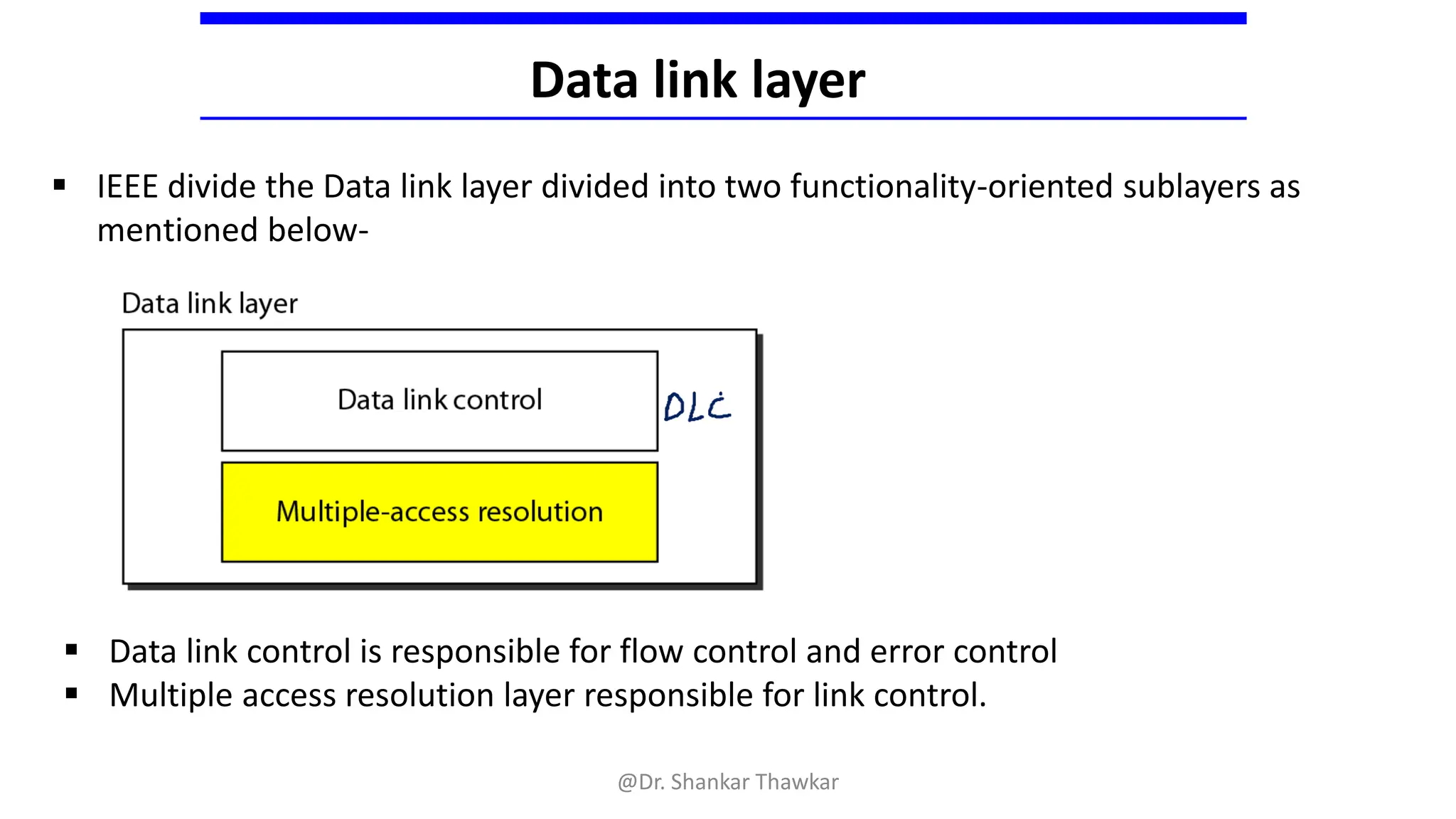
▪ IEEE divide the Data link layer divided into two functionality-oriented sublayers as
mentioned below-
Data link layer
▪ Data link control is responsible for flow control and error control
▪ Multiple access resolution layer responsible for link control.
@Dr. Shankar Thawkar
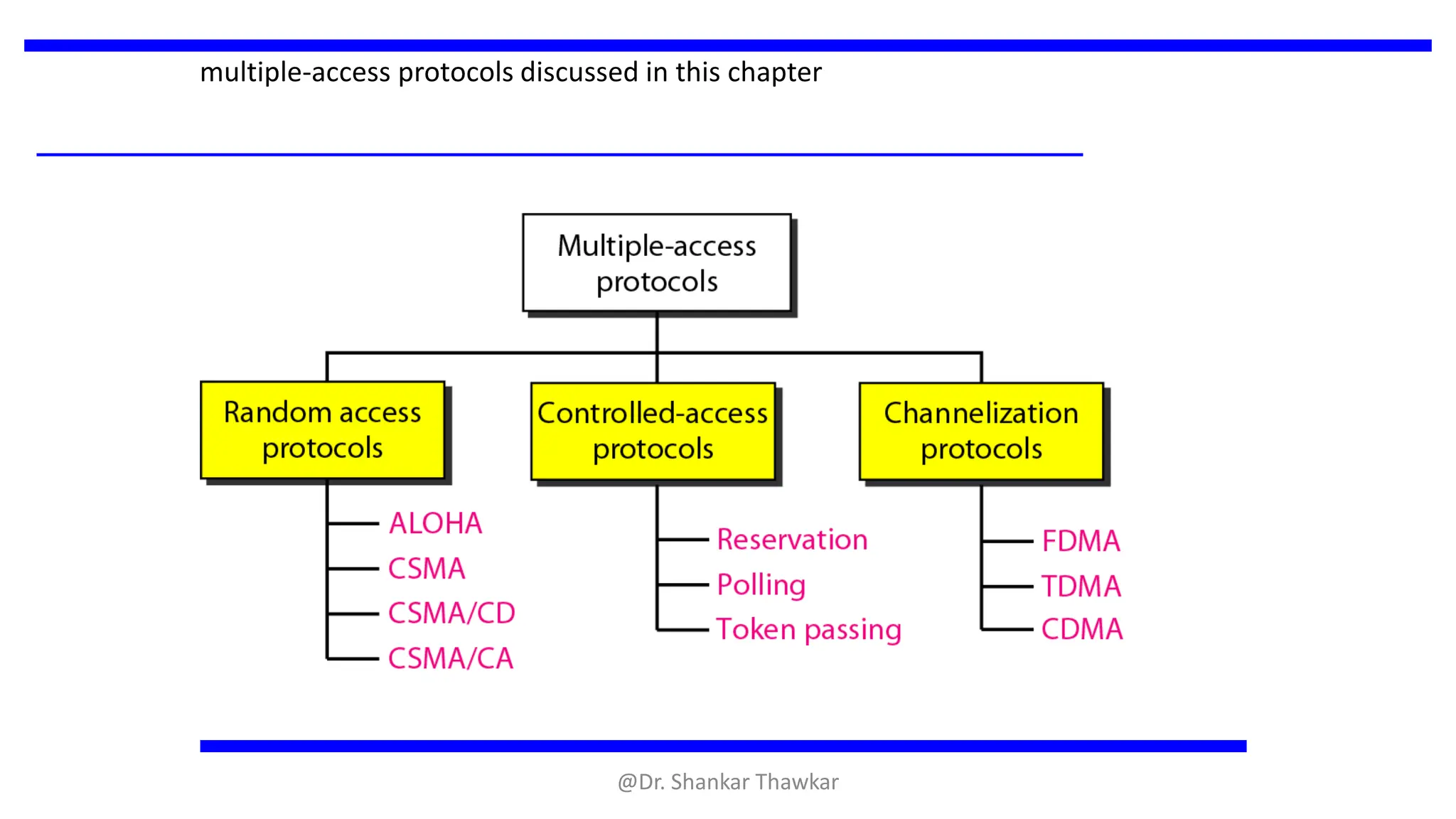
multiple-access protocols discussed in this chapter
@Dr. Shankar Thawkar
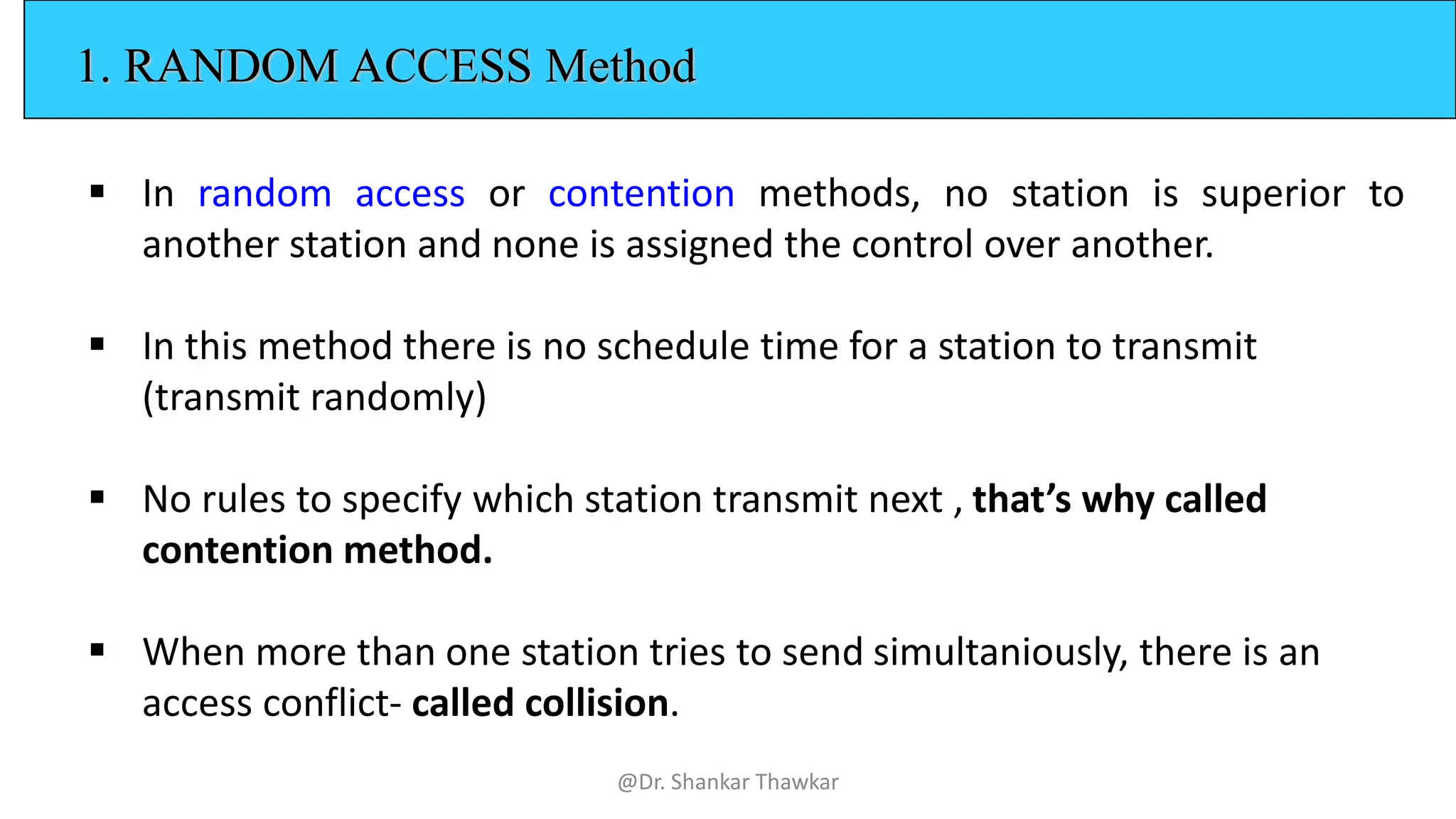
1. RANDOM ACCESS Method
▪ In random access or contention methods, no station is superior to
another station and none is assigned the control over another.
▪ In this method there is no schedule time for a station to transmit
(transmit randomly)
▪ No rules to specify which station transmit next , that’s why called
contention method.
▪ When more than one station tries to send simultaniously, there is an
access conflict- called collision.
@Dr. Shankar Thawkar
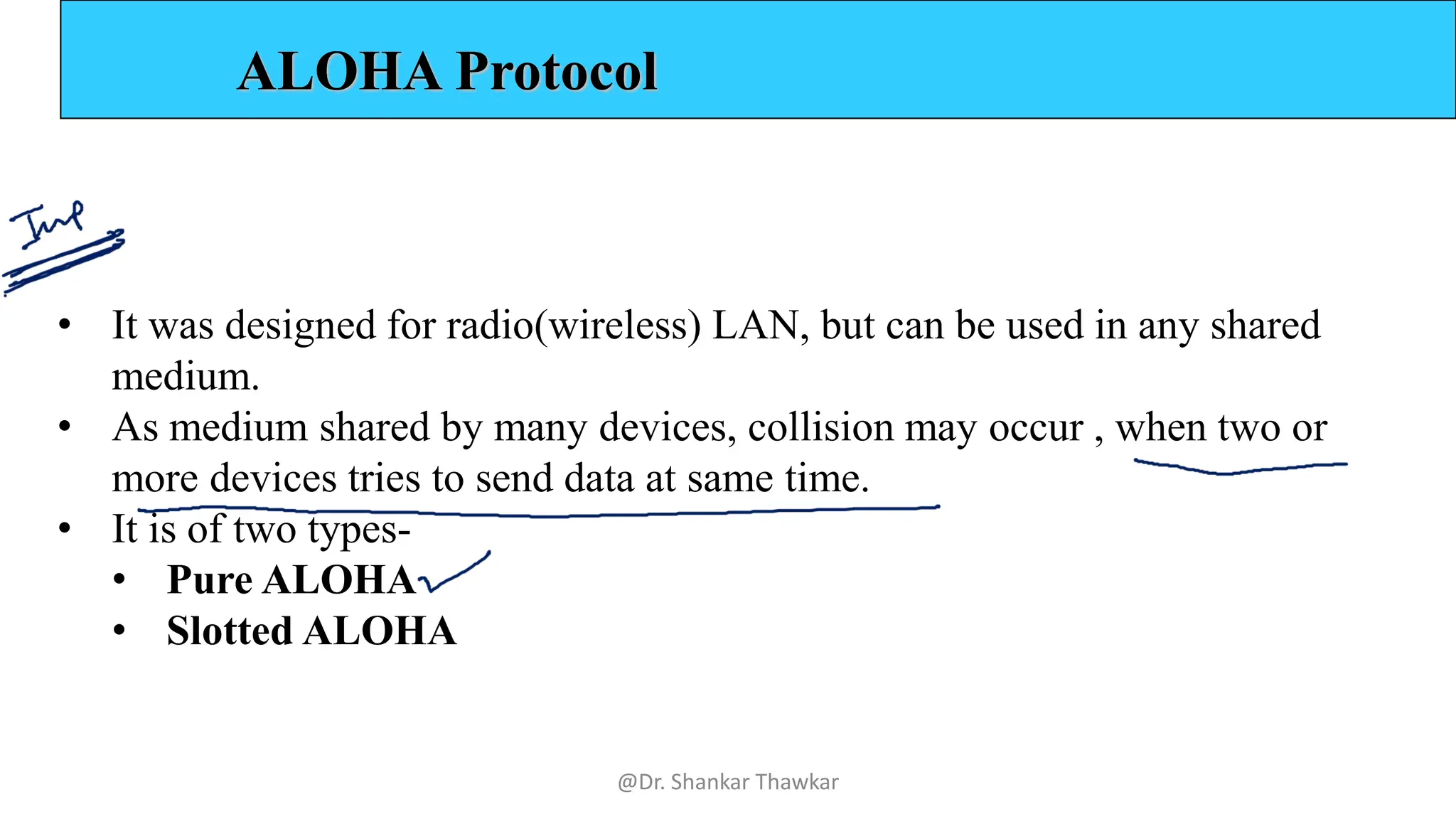
ALOHA Protocol
• It was designed for radio(wireless) LAN, but can be used in any shared
medium.
• As medium shared by many devices, collision may occur , when two or
more devices tries to send data at same time.
• It is of two types-
• Pure ALOHA
• Slotted ALOHA
@Dr. Shankar Thawkar
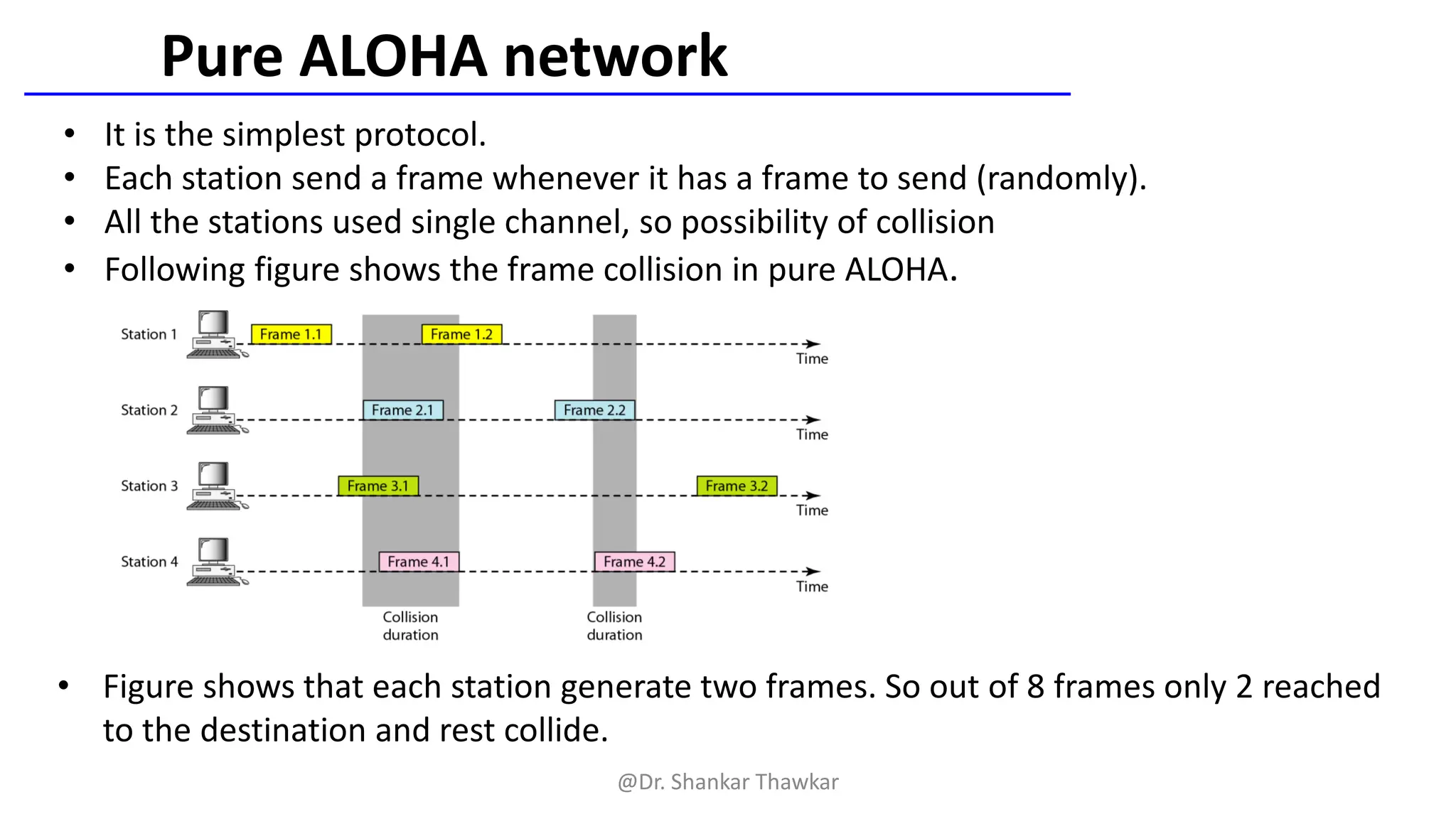
Pure ALOHA network
• It is the simplest protocol.
• Each station send a frame whenever it has a frame to send (randomly).
• All the stations used single channel, so possibility of collision
• Following figure shows the frame collision in pure ALOHA.
• Figure shows that each station generate two frames. So out of 8 frames only 2 reached
to the destination and rest collide.
@Dr. Shankar Thawkar
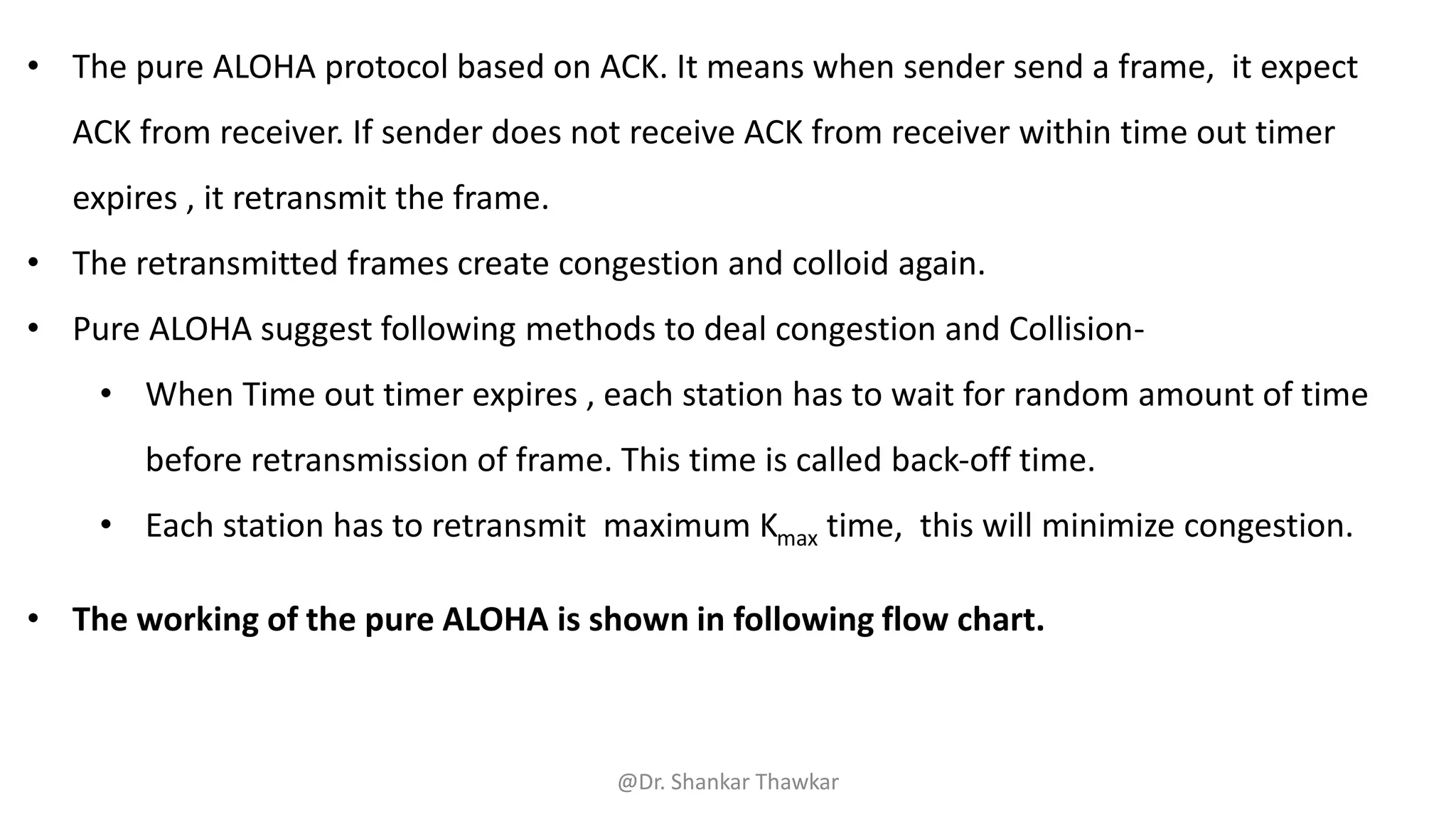
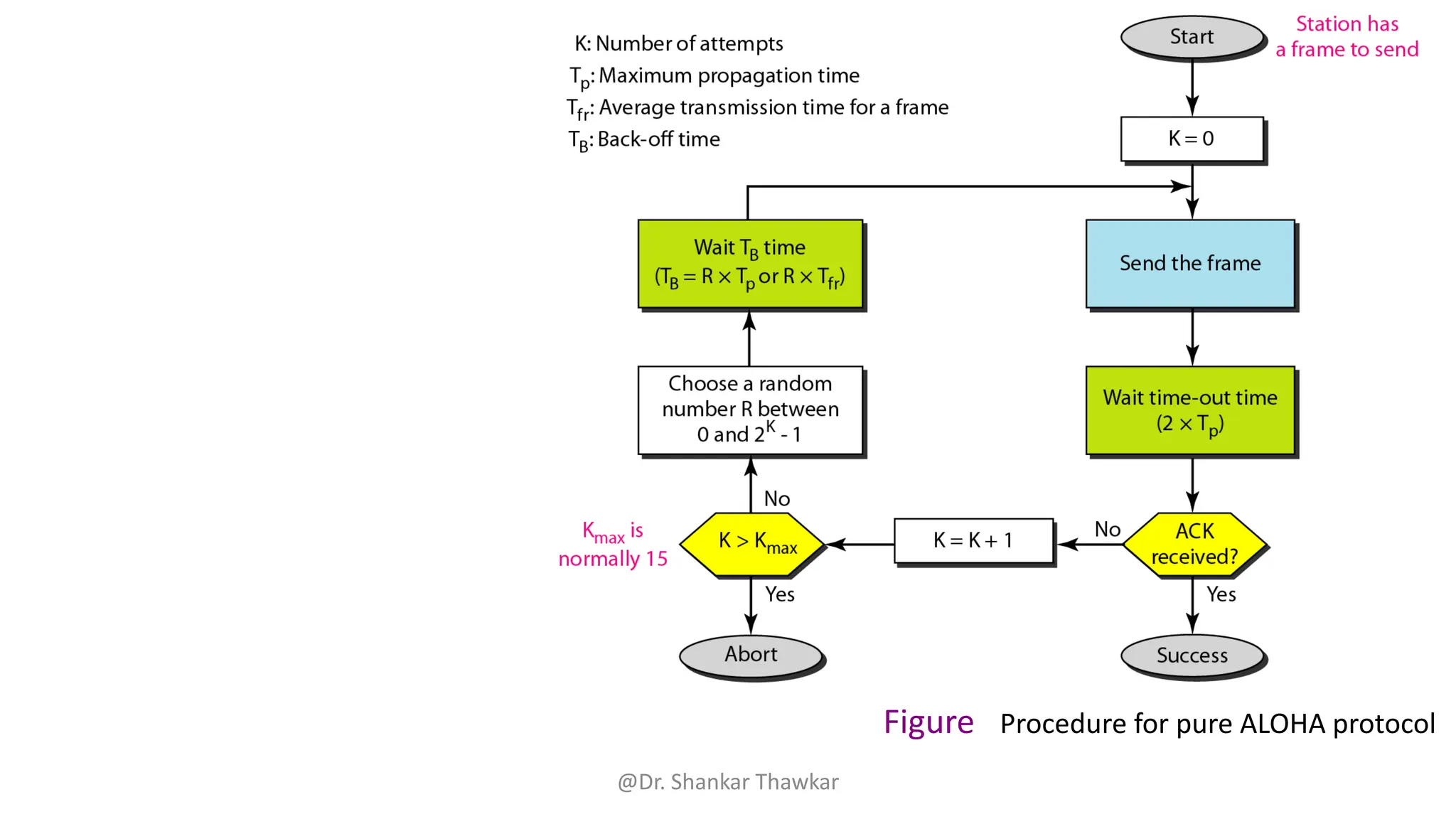
• The pure ALOHA protocol based on ACK. It means when sender send a frame, it expect
ACK from receiver. If sender does not receive ACK from receiver within time out timer
expires , it retransmit the frame.
• The retransmitted frames create congestion and colloid again.
• Pure ALOHA suggest following methods to deal congestion and Collision-
• When Time out timer expires , each station has to wait for random amount of time
before retransmission of frame. This time is called back-off time.
• Each station has to retransmit maximum Kmax time, this will minimize congestion.
• The working of the pure ALOHA is shown in following flow chart.
@Dr. Shankar Thawkar
Figure Procedure for pure ALOHA protocol
@Dr. Shankar Thawkar
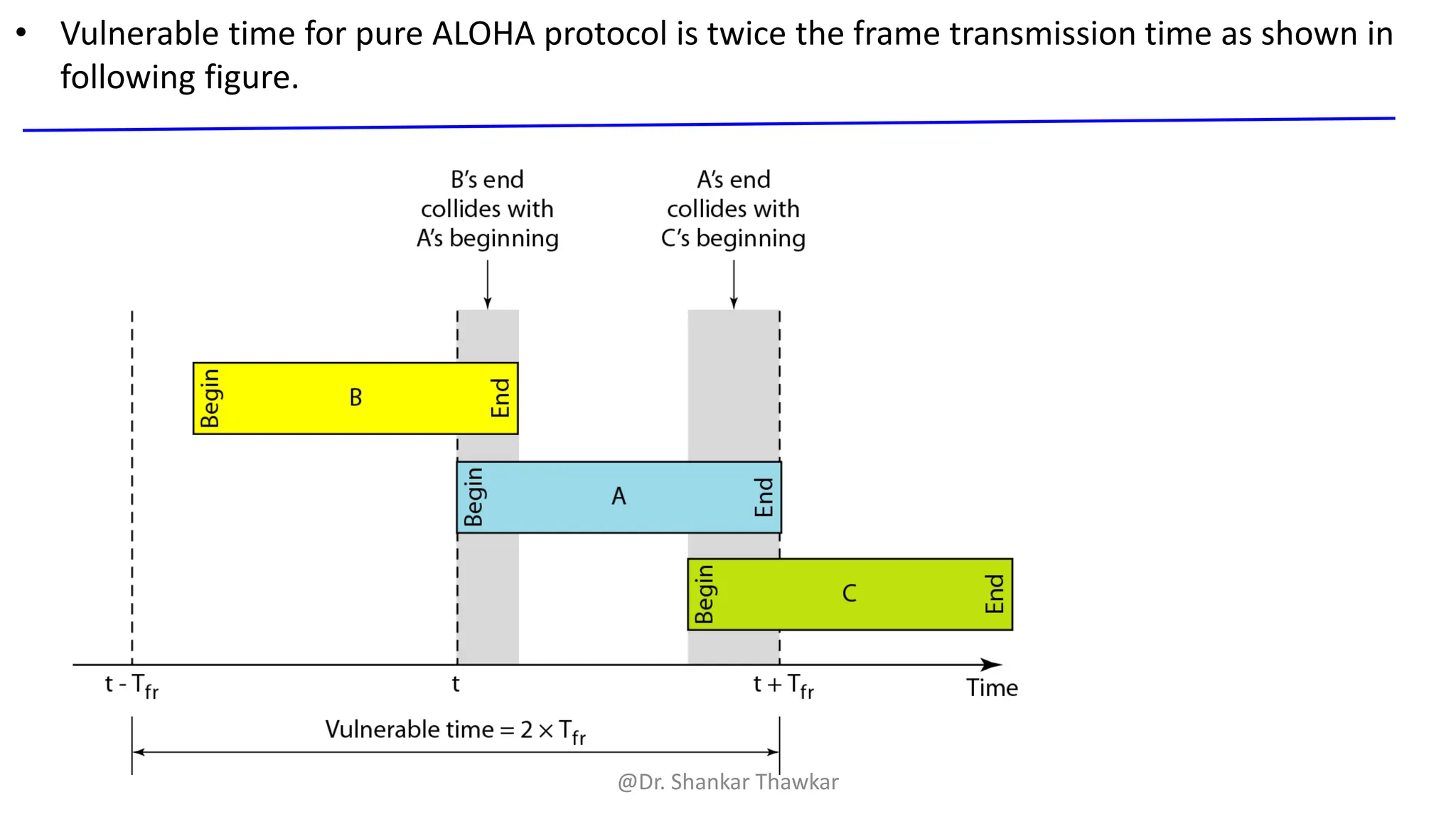
• Vulnerable time for pure ALOHA protocol is twice the frame transmission time as shown in
following figure.
@Dr. Shankar Thawkar
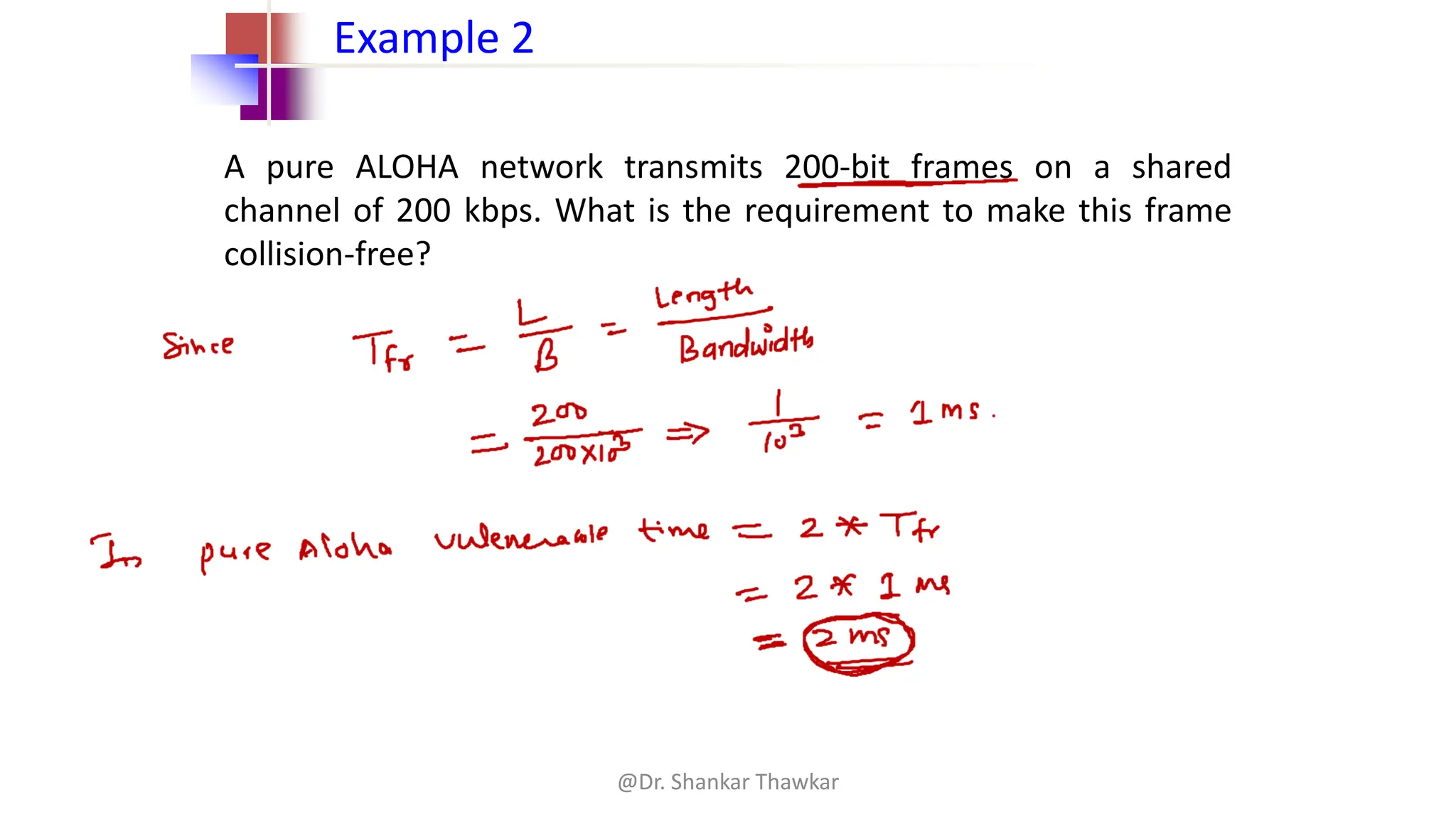
A pure ALOHA network transmits 200-bit frames on a shared
channel of 200 kbps. What is the requirement to make this frame
collision-free?
Example 2
@Dr. Shankar Thawkar
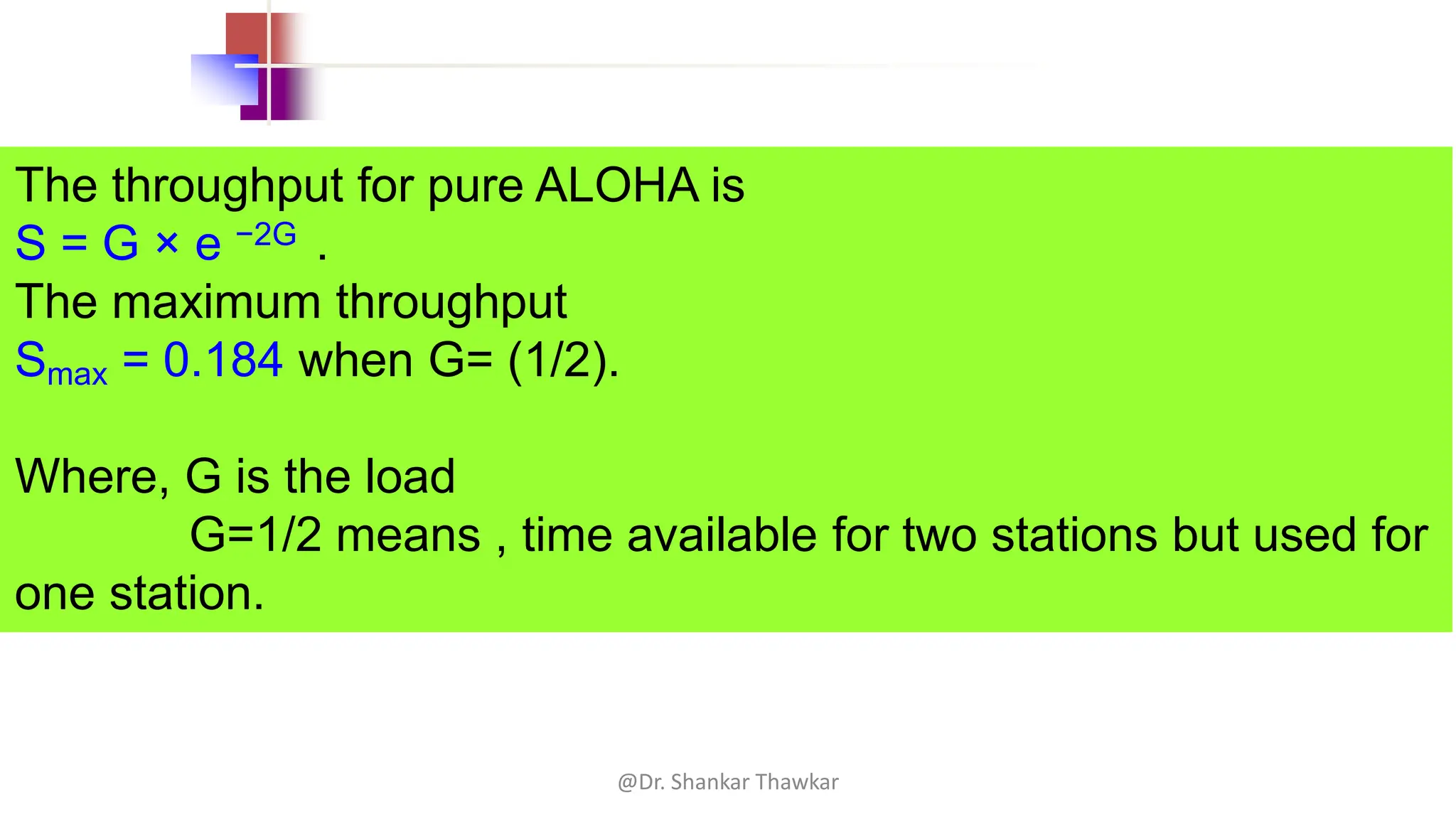
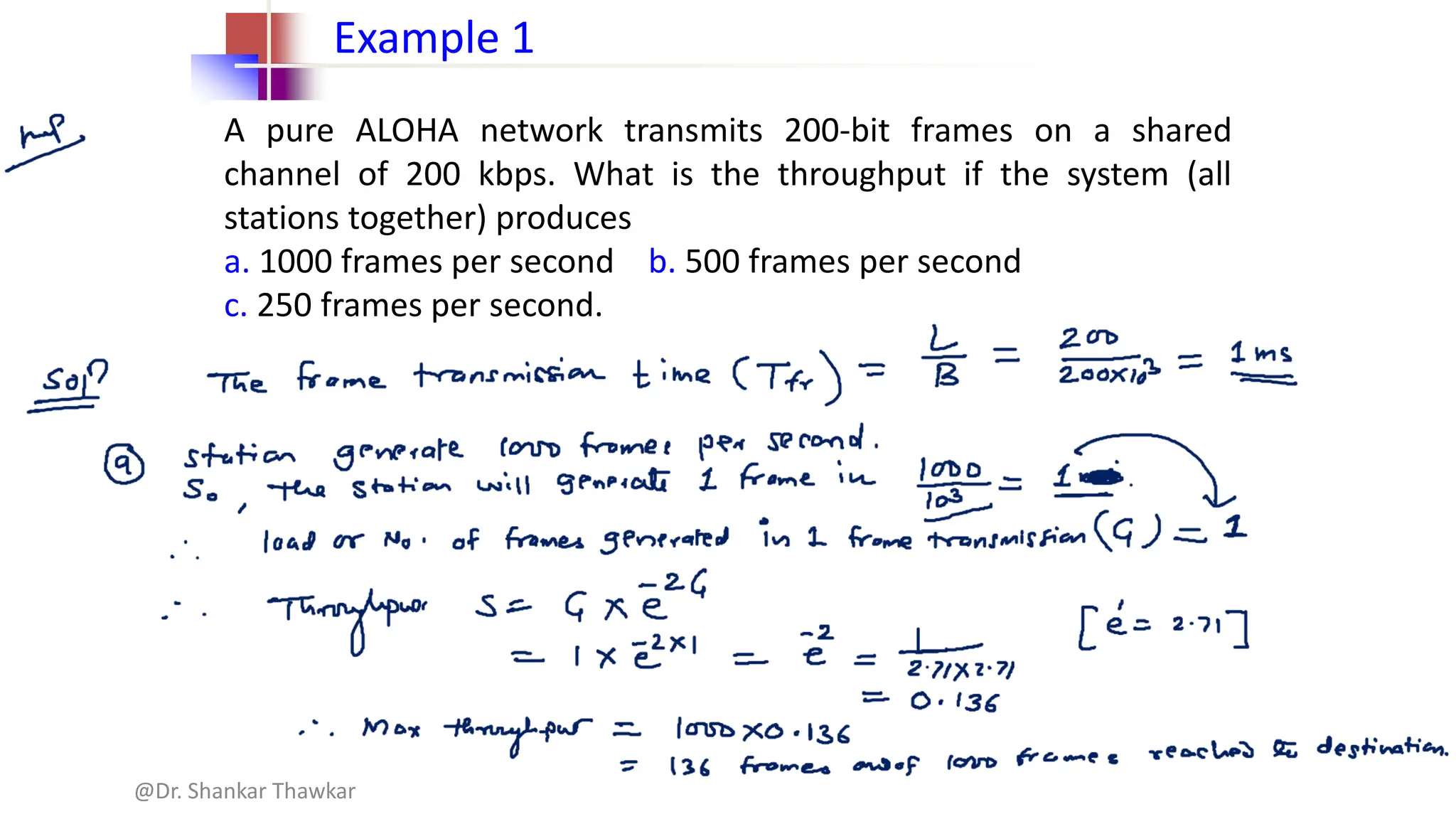
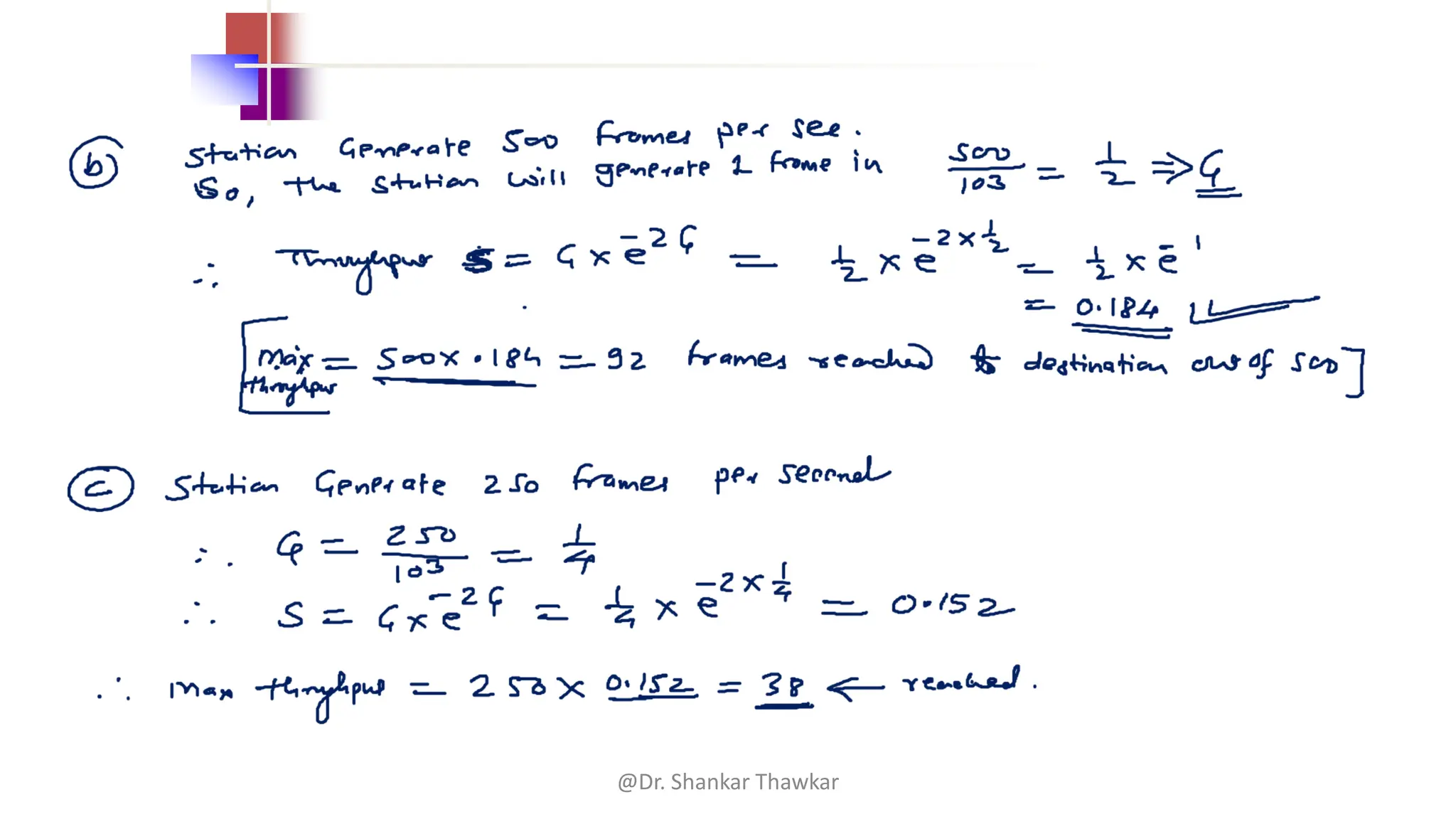
The throughput for pure ALOHA is
S = G × e −2G .
The maximum throughput
Smax = 0.184 when G= (1/2).
Where, G is the load
G=1/2 means , time available for two stations but used for
one station.
@Dr. Shankar Thawkar
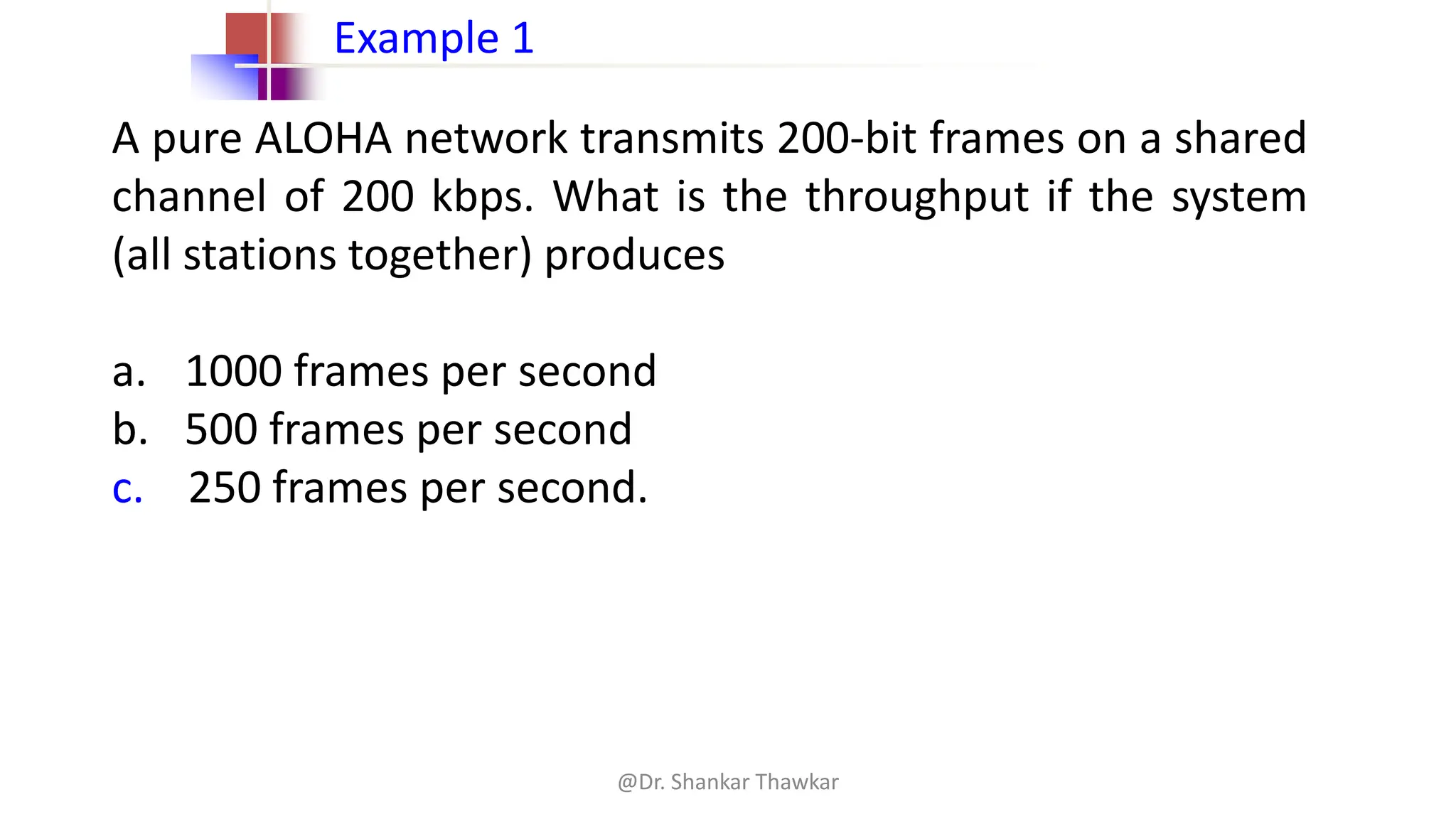
A pure ALOHA network transmits 200-bit frames on a shared
channel of 200 kbps. What is the throughput if the system
(all stations together) produces
a. 1000 frames per second
b. 500 frames per second
c. 250 frames per second.
Example 1
@Dr. Shankar Thawkar
A pure ALOHA network transmits 200-bit frames on a shared
channel of 200 kbps. What is the throughput if the system (all
stations together) produces
a. 1000 frames per second b. 500 frames per second
c. 250 frames per second.
Example 1
@Dr. Shankar Thawkar
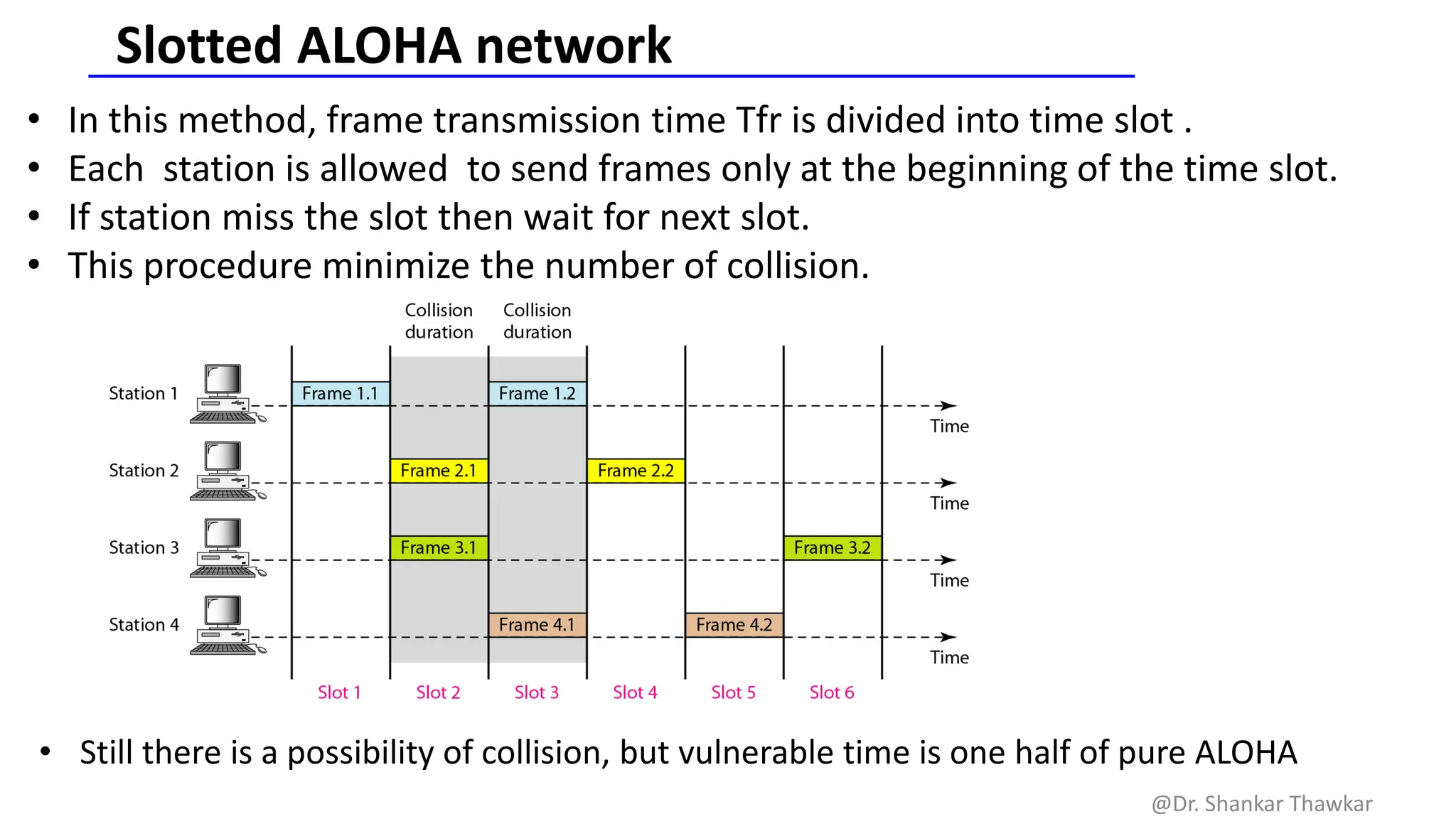
Slotted ALOHA network
• In this method, frame transmission time Tfr is divided into time slot .
• Each station is allowed to send frames only at the beginning of the time slot.
• If station miss the slot then wait for next slot.
• This procedure minimize the number of collision.
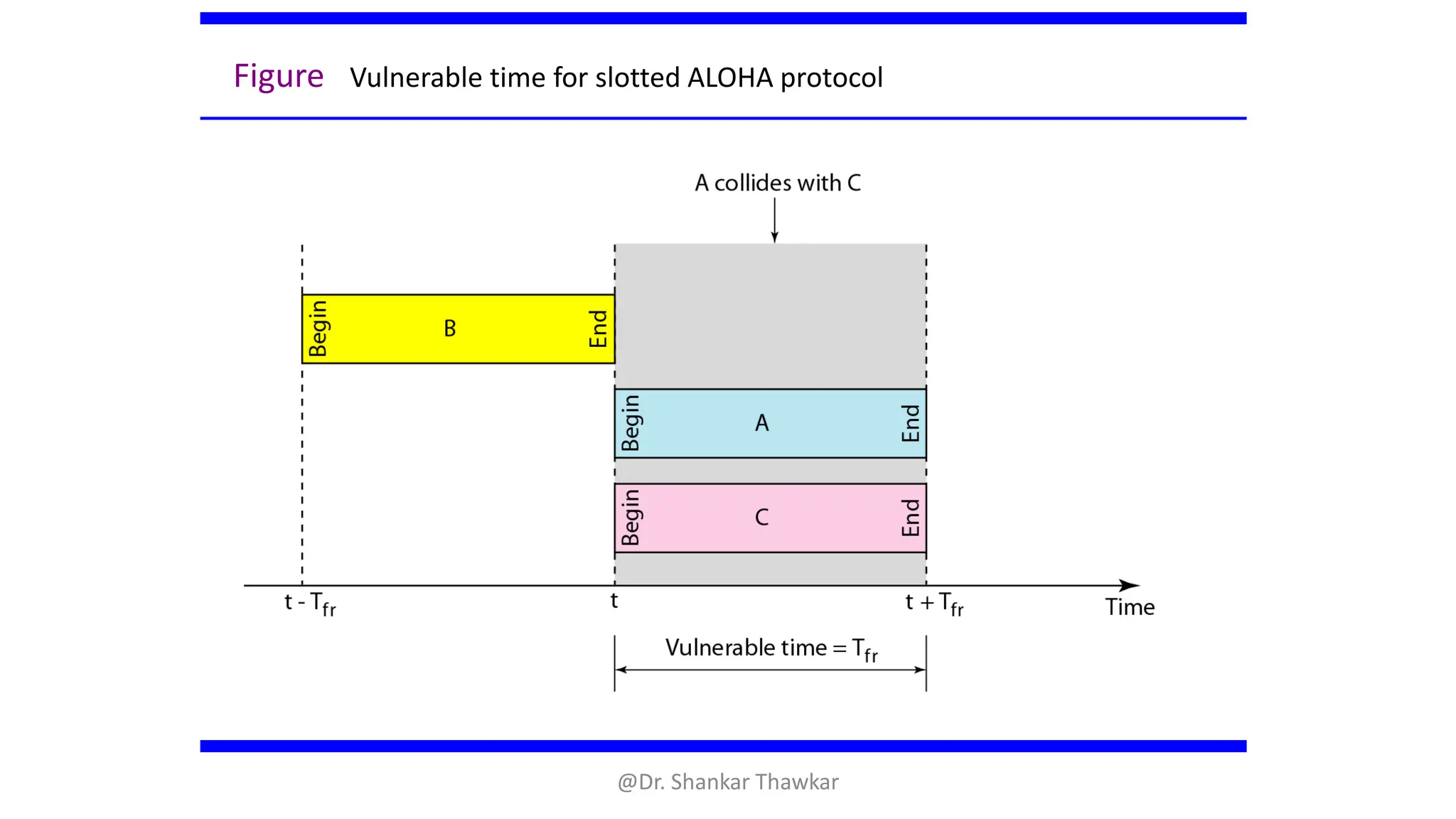
• Still there is a possibility of collision, but vulnerable time is one half of pure ALOHA
@Dr. Shankar Thawkar
Figure Vulnerable time for slotted ALOHA protocol
@Dr. Shankar Thawkar
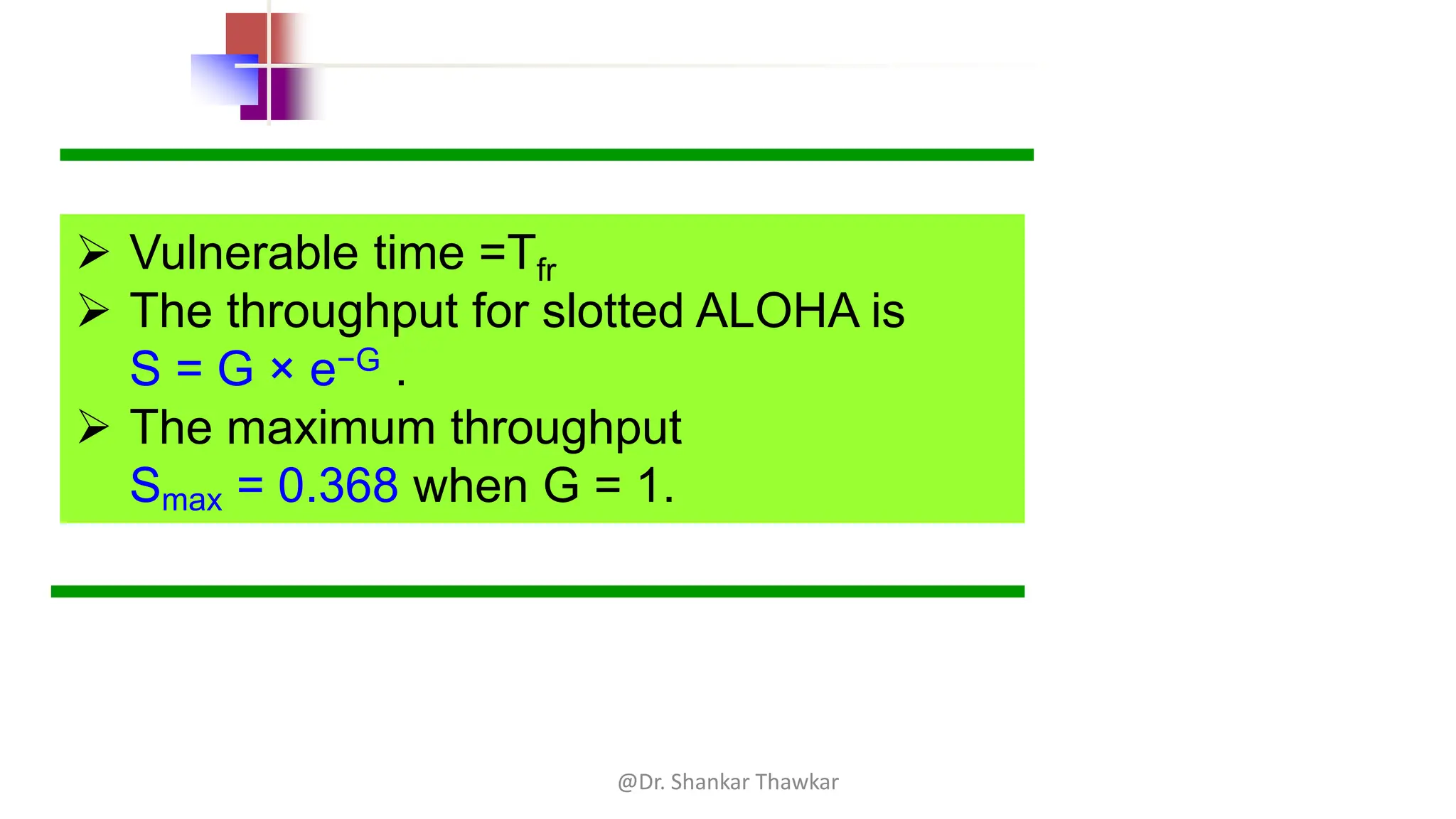
➢ Vulnerable time =Tfr
➢ The throughput for slotted ALOHA is
S = G × e−G .
➢ The maximum throughput
Smax = 0.368 when G = 1.
@Dr. Shankar Thawkar
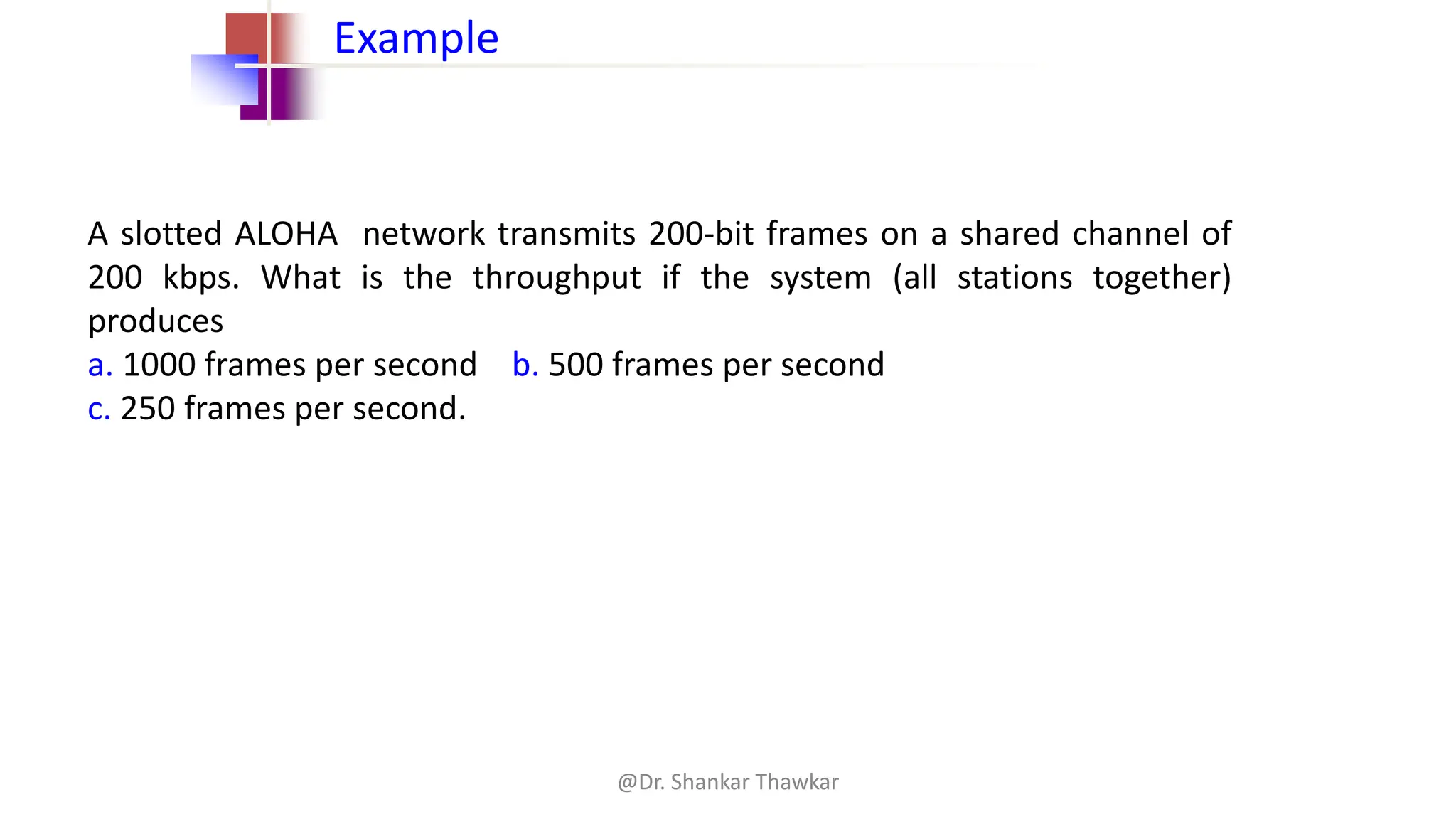
A slotted ALOHA network transmits 200-bit frames on a shared channel of
200 kbps. What is the throughput if the system (all stations together)
produces
a. 1000 frames per second b. 500 frames per second
c. 250 frames per second.
Example
@Dr. Shankar Thawkar
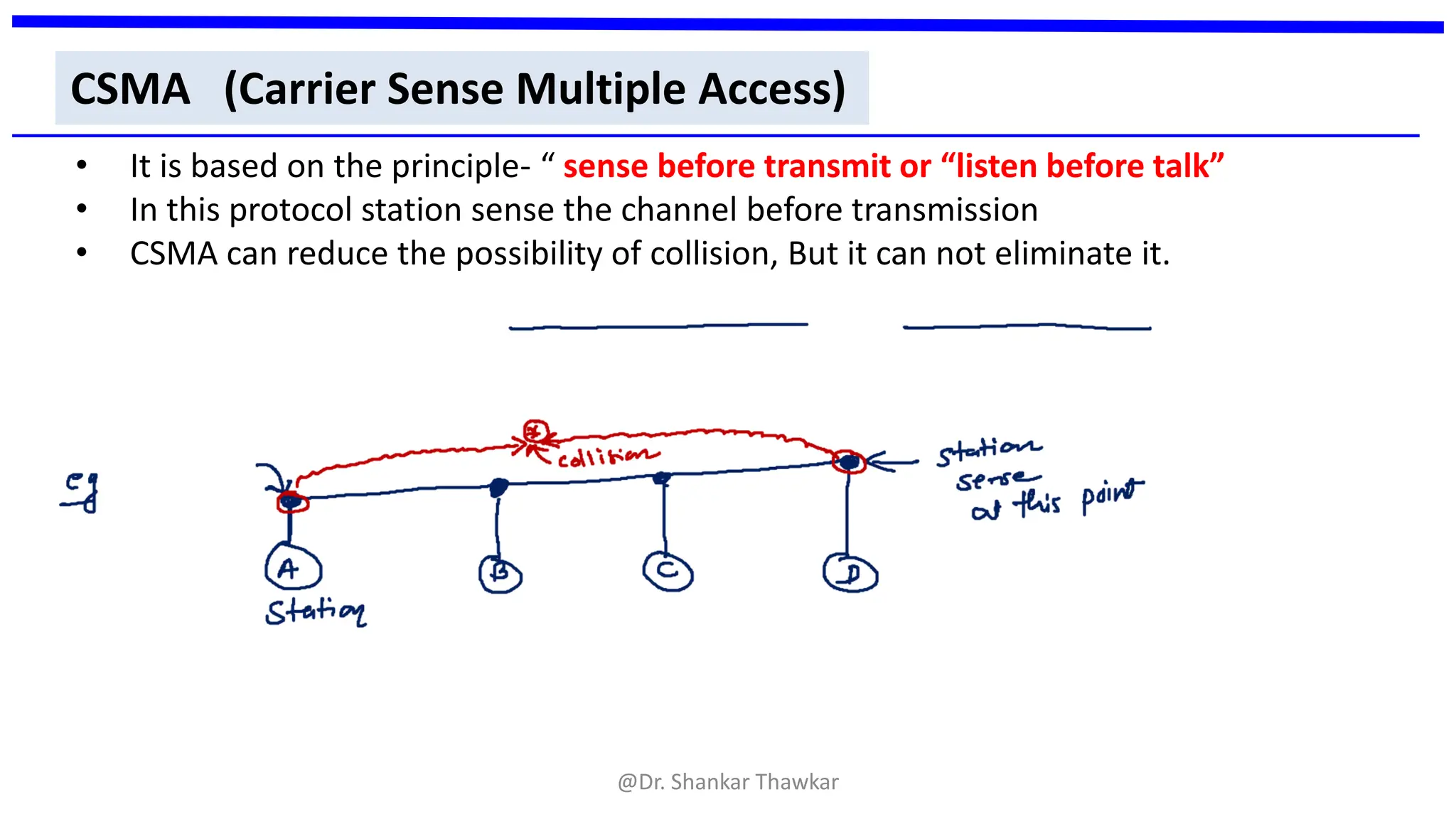
CSMA (Carrier Sense Multiple Access)
• It is based on the principle- “ sense before transmit or “listen before talk”
• In this protocol station sense the channel before transmission
• CSMA can reduce the possibility of collision, But it can not eliminate it.
@Dr. Shankar Thawkar
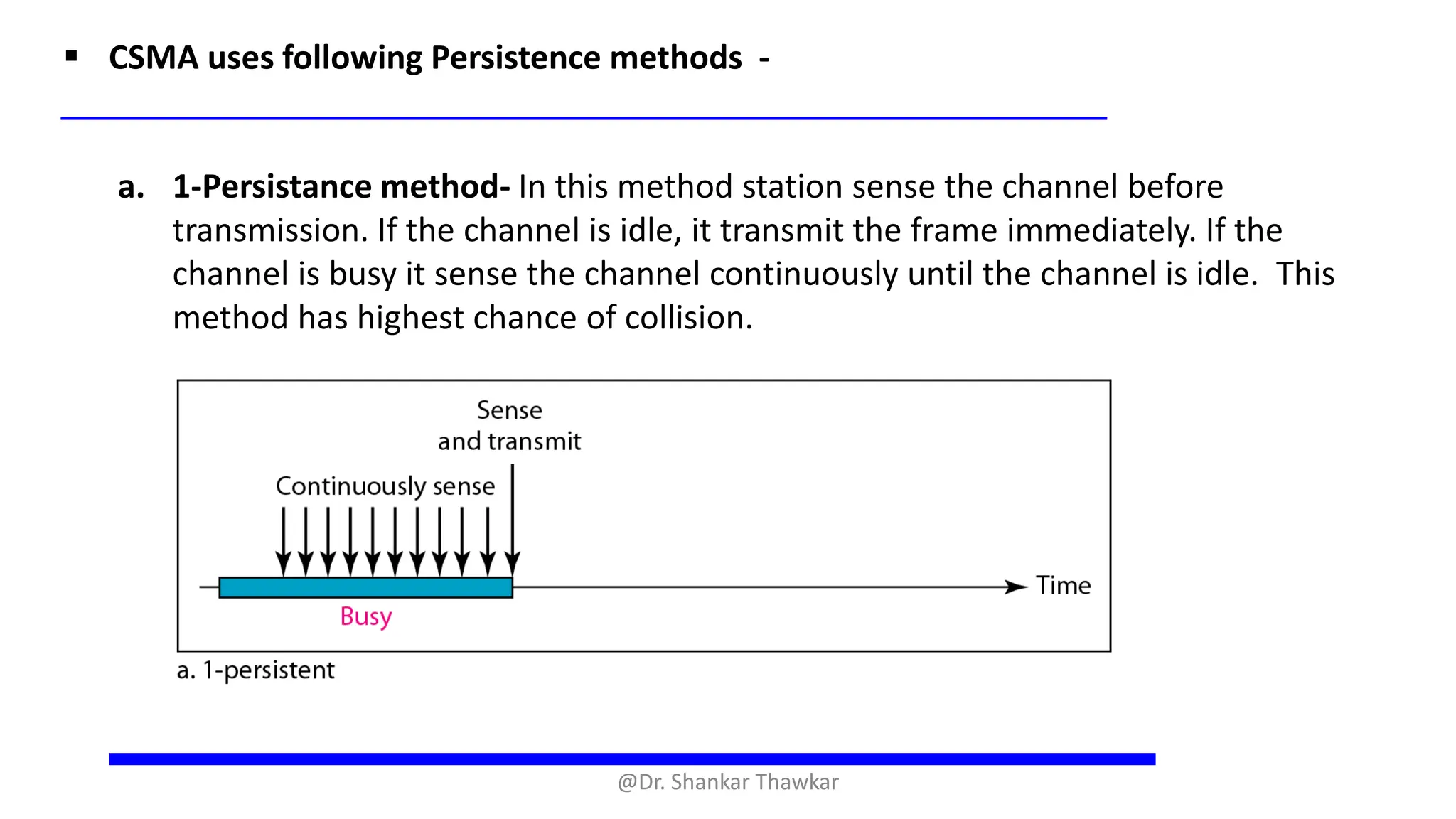
▪ CSMA uses following Persistence methods -
a. 1-Persistance method- In this method station sense the channel before
transmission. If the channel is idle, it transmit the frame immediately. If the
channel is busy it sense the channel continuously until the channel is idle. This
method has highest chance of collision.
@Dr. Shankar Thawkar
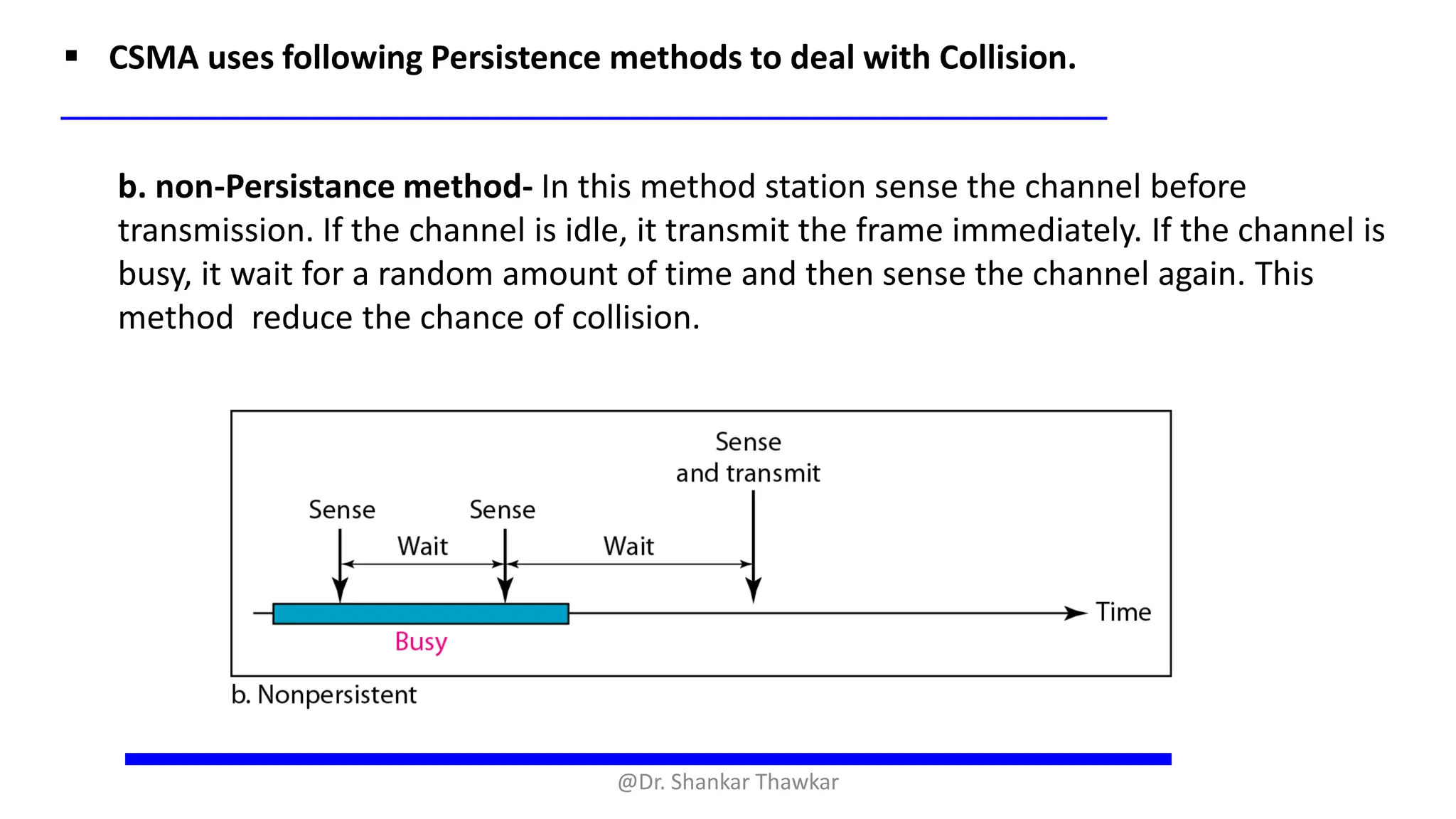
▪ CSMA uses following Persistence methods to deal with Collision.
b. non-Persistance method- In this method station sense the channel before
transmission. If the channel is idle, it transmit the frame immediately. If the channel is
busy, it wait for a random amount of time and then sense the channel again. This
method reduce the chance of collision.
@Dr. Shankar Thawkar
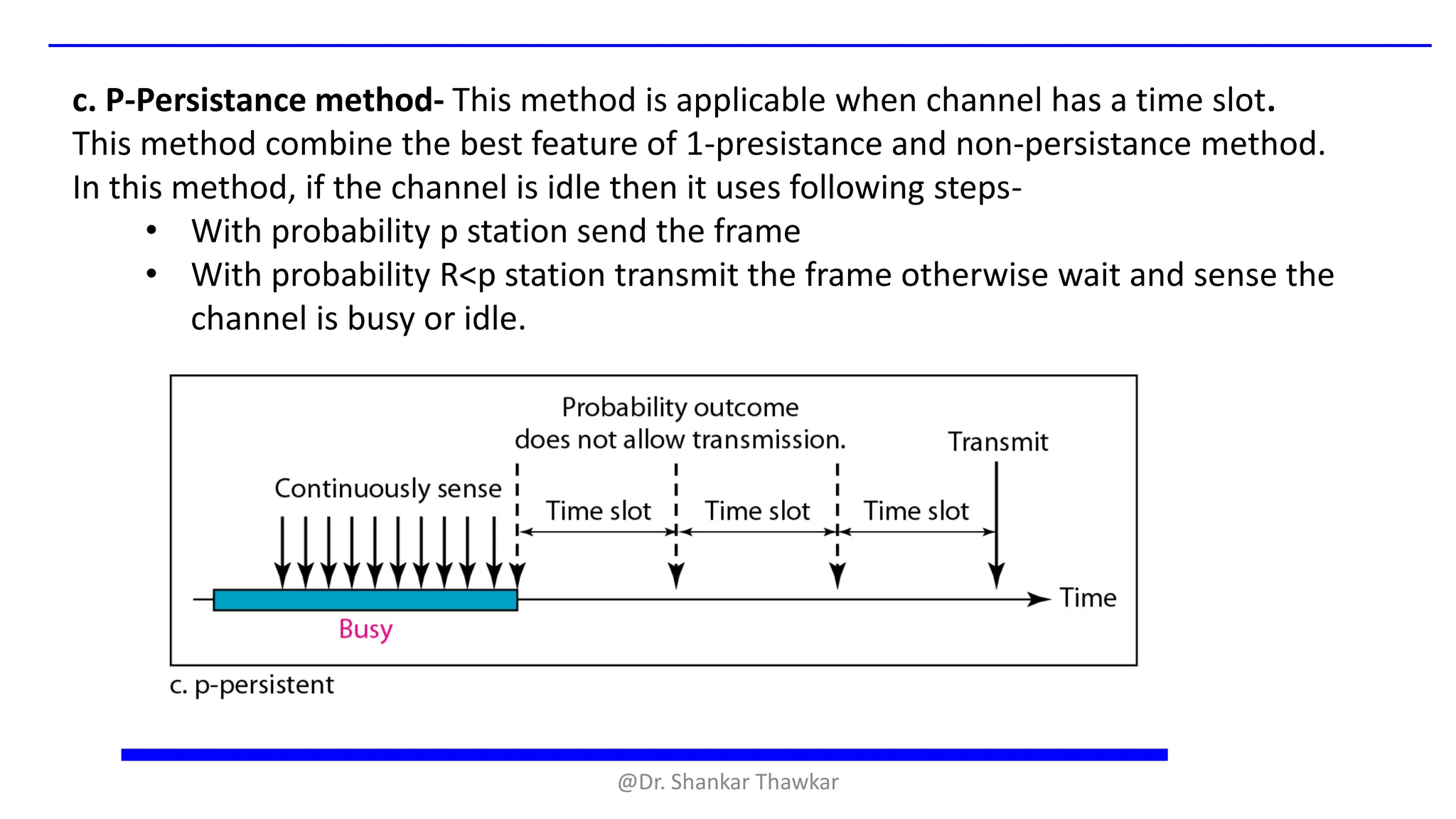
c. P-Persistance method- This method is applicable when channel has a time slot.
This method combine the best feature of 1-presistance and non-persistance method.
In this method, if the channel is idle then it uses following steps-
• With probability p station send the frame
• With probability R<p station transmit the frame otherwise wait and sense the
channel is busy or idle.
@Dr. Shankar Thawkar
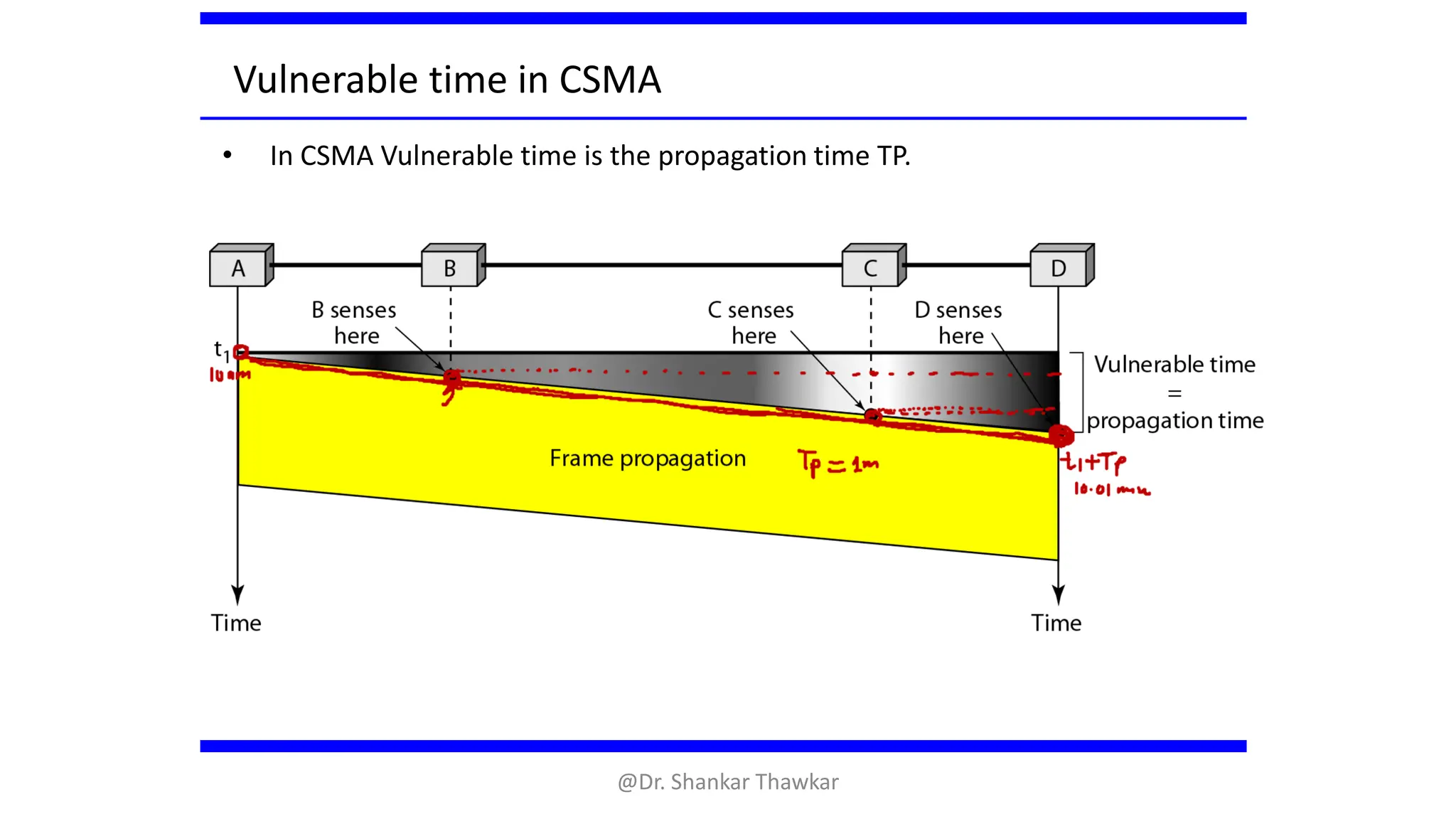
Vulnerable time in CSMA
• In CSMA Vulnerable time is the propagation time TP.
@Dr. Shankar Thawkar
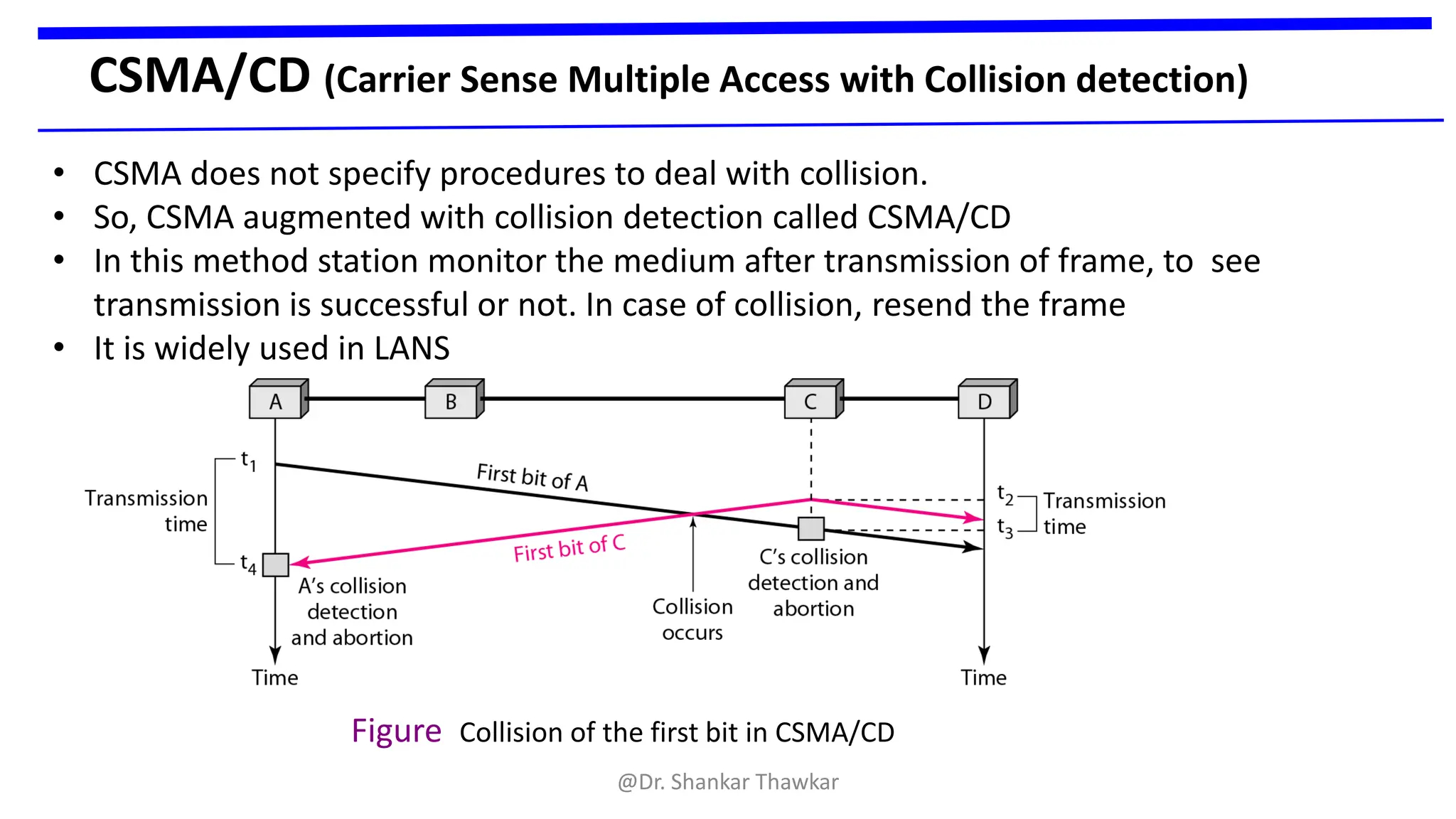
CSMA/CD (Carrier Sense Multiple Access with Collision detection)
Figure Collision of the first bit in CSMA/CD
• CSMA does not specify procedures to deal with collision.
• So, CSMA augmented with collision detection called CSMA/CD
• In this method station monitor the medium after transmission of frame, to see
transmission is successful or not. In case of collision, resend the frame
• It is widely used in LANS
@Dr. Shankar Thawkar
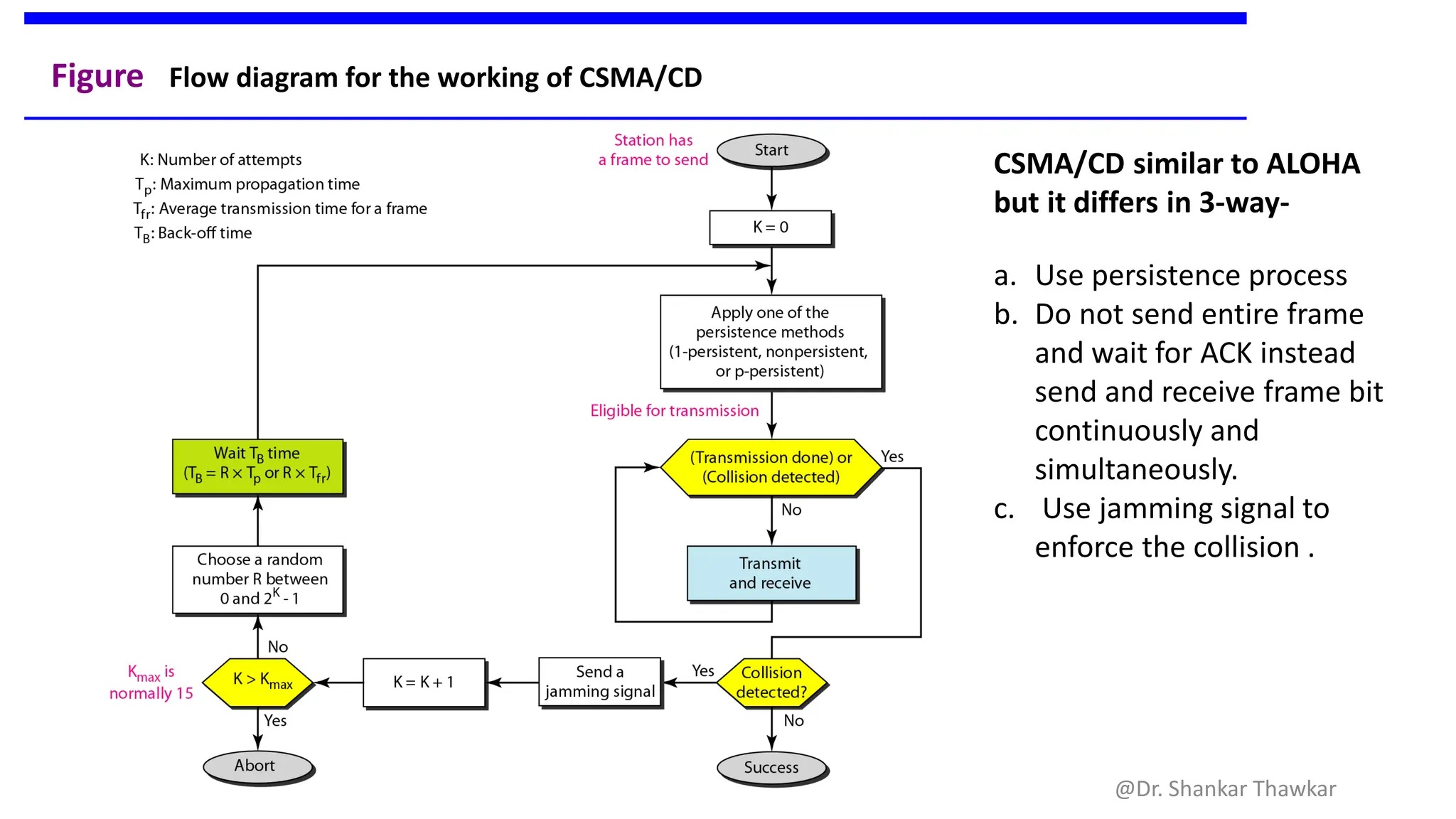
Figure Flow diagram for the working of CSMA/CD
CSMA/CD similar to ALOHA
but it differs in 3-way-
a. Use persistence process
b. Do not send entire frame
and wait for ACK instead
send and receive frame bit
continuously and
simultaneously.
c. Use jamming signal to
enforce the collision .
@Dr. Shankar Thawkar
Frame Size
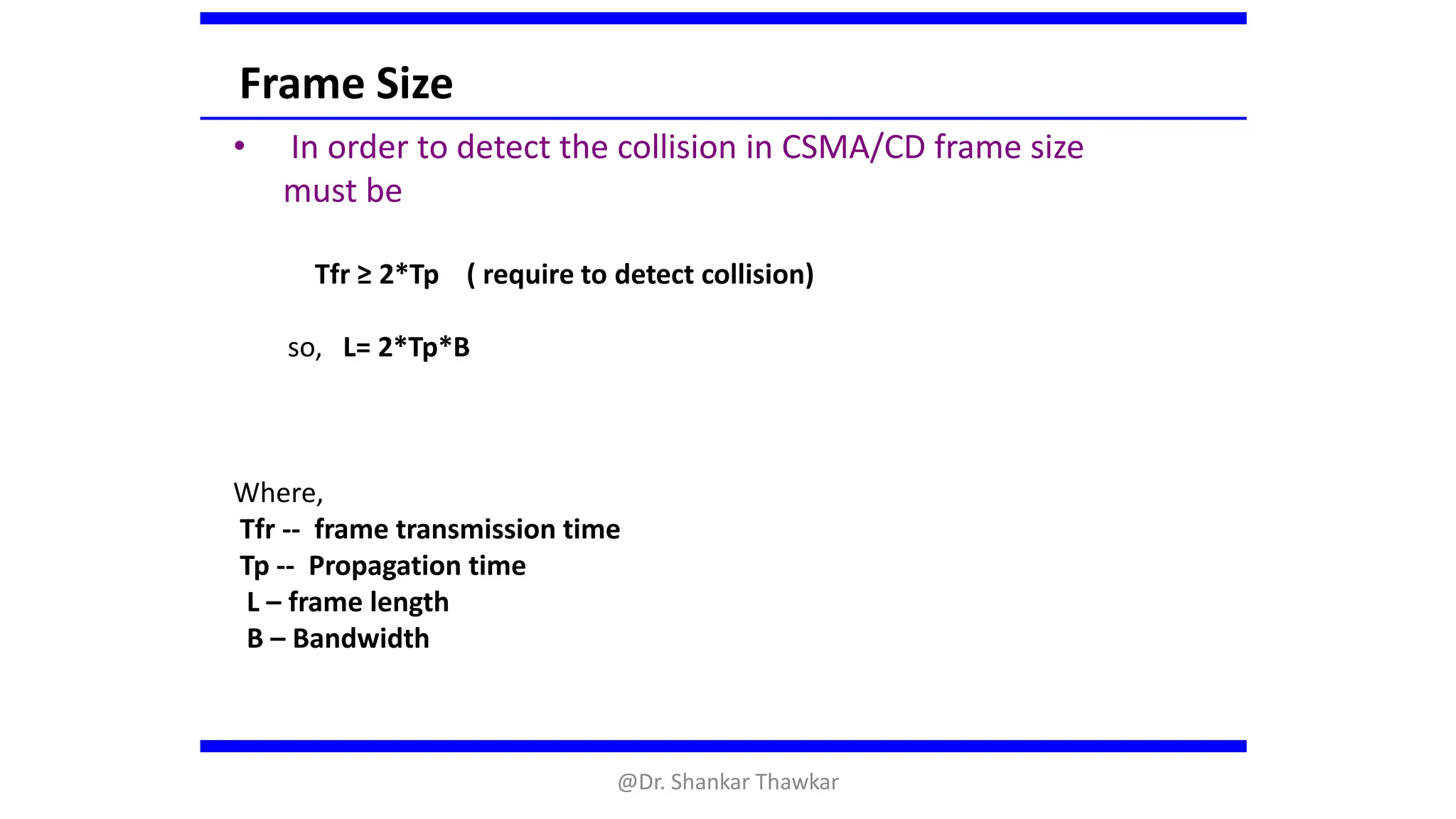
• In order to detect the collision in CSMA/CD frame size
must be
Tfr ≥ 2*Tp ( require to detect collision)
so, L= 2*Tp*B
Where,
Tfr -- frame transmission time
Tp -- Propagation time
L – frame length
B – Bandwidth
@Dr. Shankar Thawkar
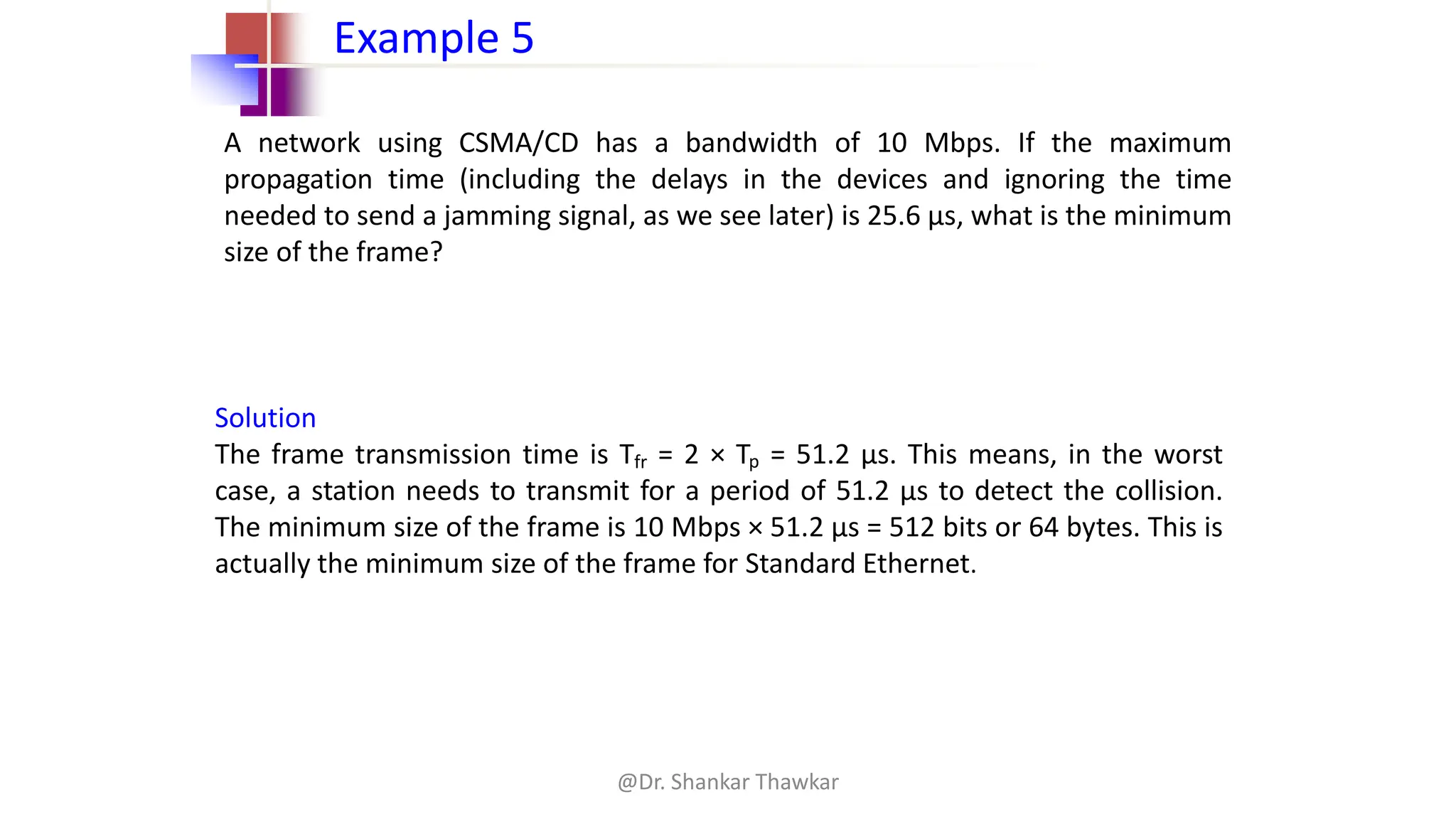
A network using CSMA/CD has a bandwidth of 10 Mbps. If the maximum
propagation time (including the delays in the devices and ignoring the time
needed to send a jamming signal, as we see later) is 25.6 μs, what is the minimum
size of the frame?
Example 5
Solution
The frame transmission time is Tfr = 2 × Tp = 51.2 μs. This means, in the worst
case, a station needs to transmit for a period of 51.2 μs to detect the collision.
The minimum size of the frame is 10 Mbps × 51.2 μs = 512 bits or 64 bytes. This is
actually the minimum size of the frame for Standard Ethernet.
@Dr. Shankar Thawkar
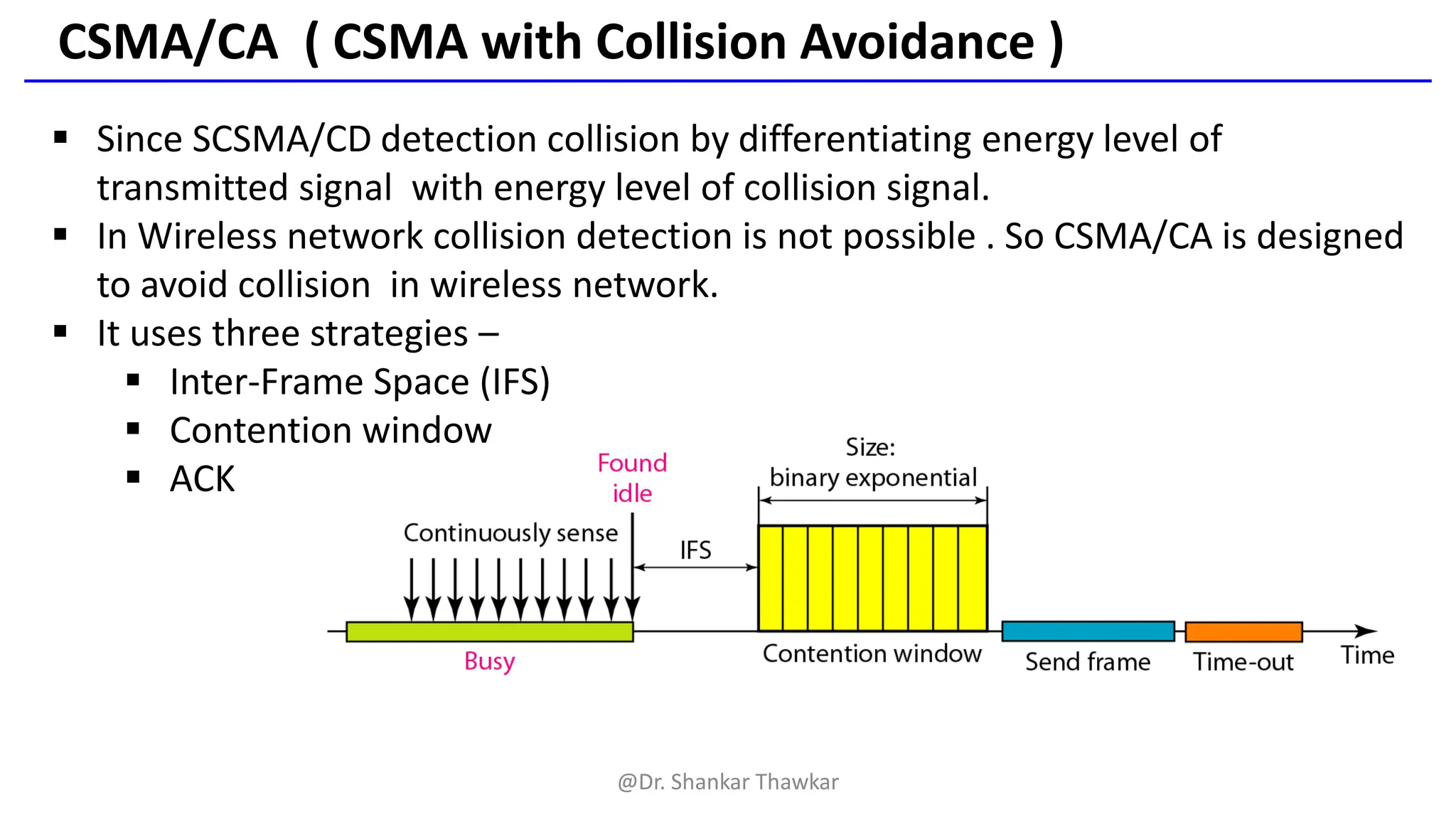
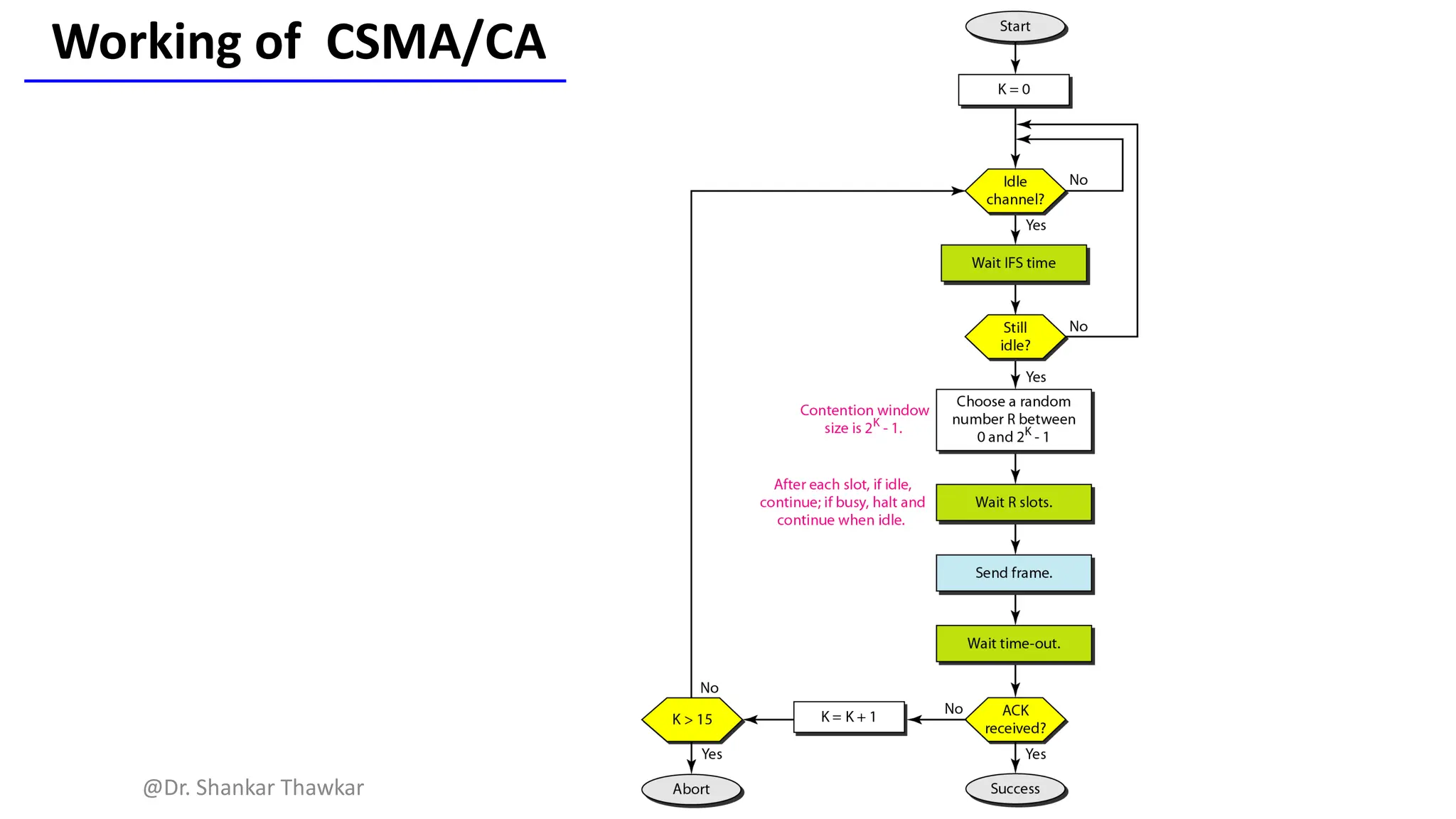
CSMA/CA ( CSMA with Collision Avoidance )
▪ Since SCSMA/CD detection collision by differentiating energy level of
transmitted signal with energy level of collision signal.
▪ In Wireless network collision detection is not possible . So CSMA/CA is designed
to avoid collision in wireless network.
▪ It uses three strategies –
▪ Inter-Frame Space (IFS)
▪ Contention window
▪ ACK
@Dr. Shankar Thawkar
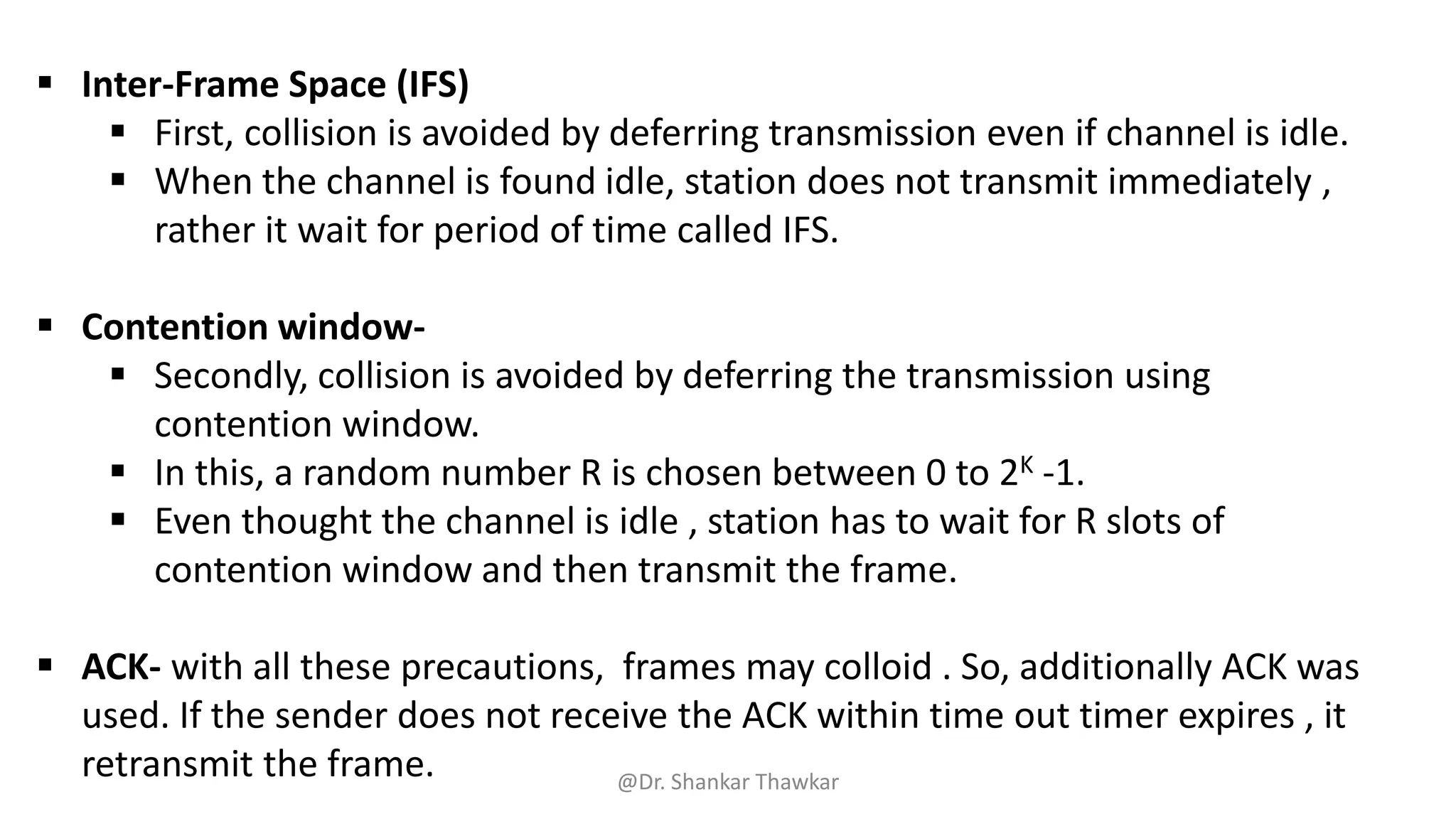
▪ Inter-Frame Space (IFS)
▪ First, collision is avoided by deferring transmission even if channel is idle.
▪ When the channel is found idle, station does not transmit immediately ,
rather it wait for period of time called IFS.
▪ Contention window-
▪ Secondly, collision is avoided by deferring the transmission using
contention window.
▪ In this, a random number R is chosen between 0 to 2K -1.
▪ Even thought the channel is idle , station has to wait for R slots of
contention window and then transmit the frame.
▪ ACK- with all these precautions, frames may colloid . So, additionally ACK was
used. If the sender does not receive the ACK within time out timer expires , it
retransmit the frame. @Dr. Shankar Thawkar
Working of CSMA/CA
@Dr. Shankar Thawkar
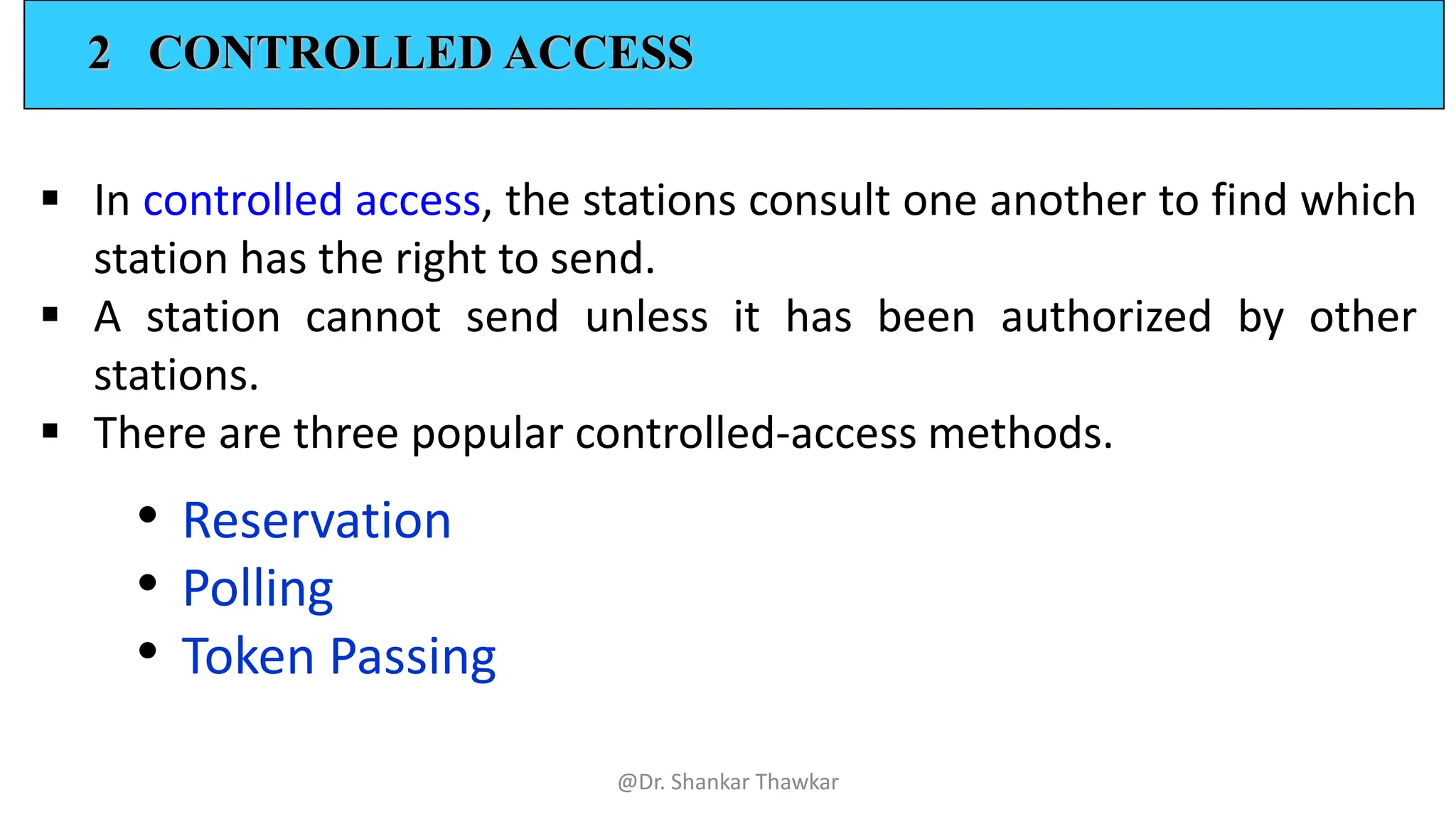
2 CONTROLLED ACCESS
▪ In controlled access, the stations consult one another to find which
station has the right to send.
▪ A station cannot send unless it has been authorized by other
stations.
▪ There are three popular controlled-access methods.
• Reservation
• Polling
• Token Passing
@Dr. Shankar Thawkar
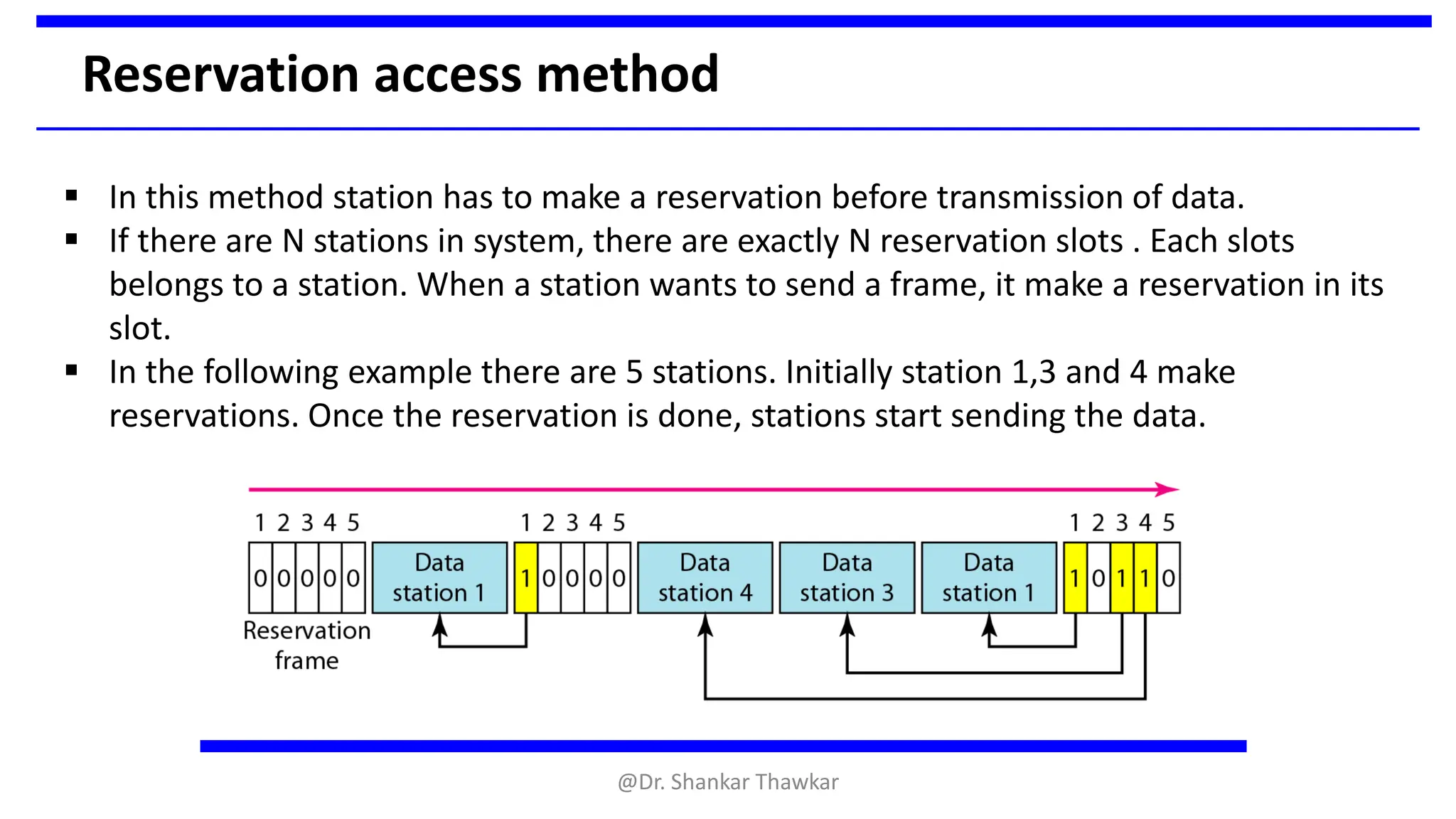
Reservation access method
▪ In this method station has to make a reservation before transmission of data.
▪ If there are N stations in system, there are exactly N reservation slots . Each slots
belongs to a station. When a station wants to send a frame, it make a reservation in its
slot.
▪ In the following example there are 5 stations. Initially station 1,3 and 4 make
reservations. Once the reservation is done, stations start sending the data.
@Dr. Shankar Thawkar
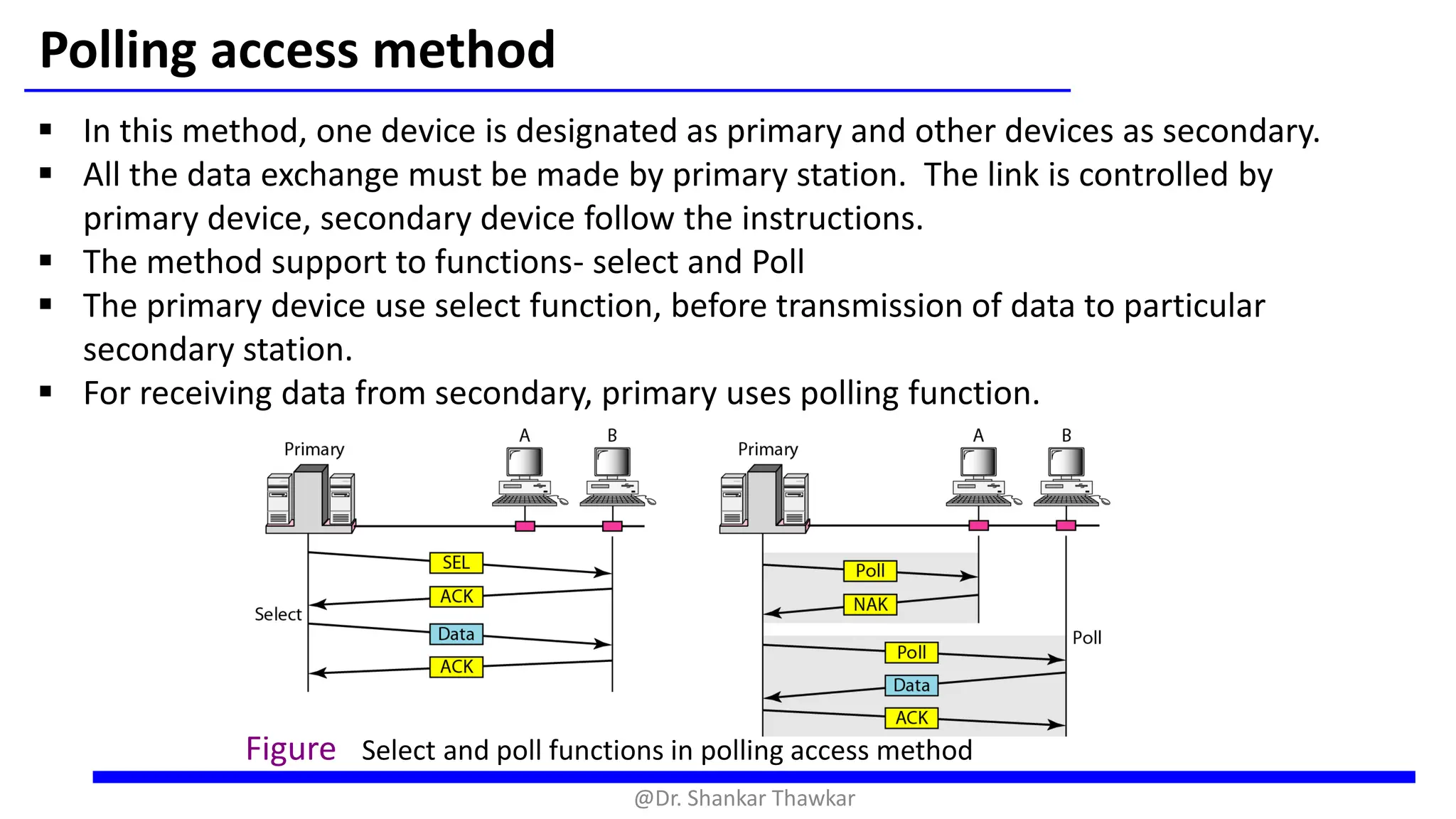
Figure Select and poll functions in polling access method
Polling access method
▪ In this method, one device is designated as primary and other devices as secondary.
▪ All the data exchange must be made by primary station. The link is controlled by
primary device, secondary device follow the instructions.
▪ The method support to functions- select and Poll
▪ The primary device use select function, before transmission of data to particular
secondary station.
▪ For receiving data from secondary, primary uses polling function.
@Dr. Shankar Thawkar
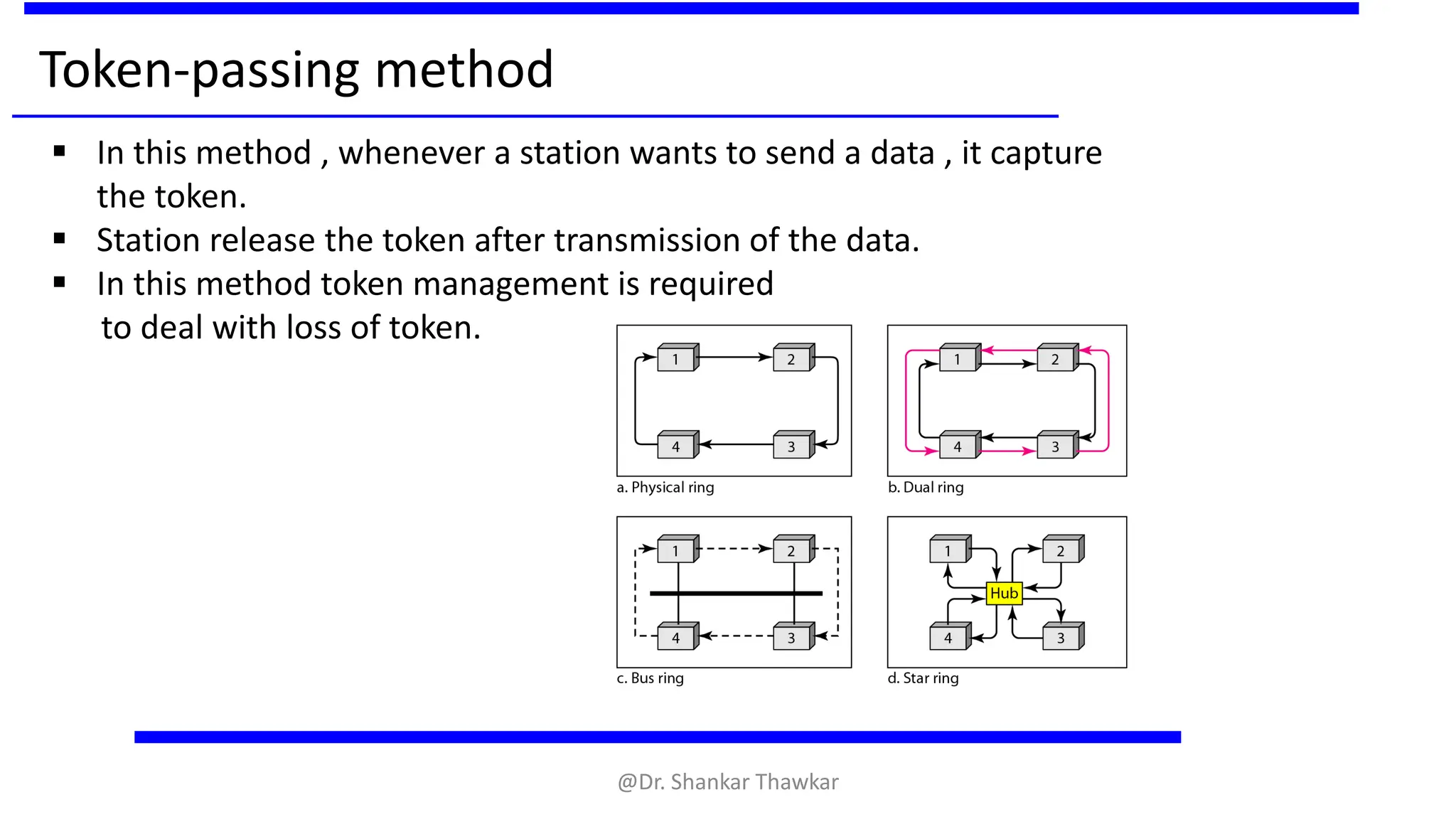
Token-passing method
▪ In this method , whenever a station wants to send a data , it capture
the token.
▪ Station release the token after transmission of the data.
▪ In this method token management is required
to deal with loss of token.
@Dr. Shankar Thawkar
CN-U-II- Multiple access control Algo.pdf

  • 1.
  • 2.
    ▪ IEEE dividethe Data link layer divided into two functionality-oriented sublayers as mentioned below- Data link layer ▪ Data link control is responsible for flow control and error control ▪ Multiple access resolution layer responsible for link control. @Dr. Shankar Thawkar
  • 3.
    multiple-access protocols discussedin this chapter @Dr. Shankar Thawkar
  • 4.
    1. RANDOM ACCESSMethod ▪ In random access or contention methods, no station is superior to another station and none is assigned the control over another. ▪ In this method there is no schedule time for a station to transmit (transmit randomly) ▪ No rules to specify which station transmit next , that’s why called contention method. ▪ When more than one station tries to send simultaniously, there is an access conflict- called collision. @Dr. Shankar Thawkar
  • 5.
    ALOHA Protocol • Itwas designed for radio(wireless) LAN, but can be used in any shared medium. • As medium shared by many devices, collision may occur , when two or more devices tries to send data at same time. • It is of two types- • Pure ALOHA • Slotted ALOHA @Dr. Shankar Thawkar
  • 6.
    Pure ALOHA network •It is the simplest protocol. • Each station send a frame whenever it has a frame to send (randomly). • All the stations used single channel, so possibility of collision • Following figure shows the frame collision in pure ALOHA. • Figure shows that each station generate two frames. So out of 8 frames only 2 reached to the destination and rest collide. @Dr. Shankar Thawkar
  • 7.
    • The pureALOHA protocol based on ACK. It means when sender send a frame, it expect ACK from receiver. If sender does not receive ACK from receiver within time out timer expires , it retransmit the frame. • The retransmitted frames create congestion and colloid again. • Pure ALOHA suggest following methods to deal congestion and Collision- • When Time out timer expires , each station has to wait for random amount of time before retransmission of frame. This time is called back-off time. • Each station has to retransmit maximum Kmax time, this will minimize congestion. • The working of the pure ALOHA is shown in following flow chart. @Dr. Shankar Thawkar
  • 8.
    Figure Procedure forpure ALOHA protocol @Dr. Shankar Thawkar
  • 9.
    • Vulnerable timefor pure ALOHA protocol is twice the frame transmission time as shown in following figure. @Dr. Shankar Thawkar
  • 10.
    A pure ALOHAnetwork transmits 200-bit frames on a shared channel of 200 kbps. What is the requirement to make this frame collision-free? Example 2 @Dr. Shankar Thawkar
  • 11.
    The throughput forpure ALOHA is S = G × e −2G . The maximum throughput Smax = 0.184 when G= (1/2). Where, G is the load G=1/2 means , time available for two stations but used for one station. @Dr. Shankar Thawkar
  • 12.
    A pure ALOHAnetwork transmits 200-bit frames on a shared channel of 200 kbps. What is the throughput if the system (all stations together) produces a. 1000 frames per second b. 500 frames per second c. 250 frames per second. Example 1 @Dr. Shankar Thawkar
  • 13.
    A pure ALOHAnetwork transmits 200-bit frames on a shared channel of 200 kbps. What is the throughput if the system (all stations together) produces a. 1000 frames per second b. 500 frames per second c. 250 frames per second. Example 1 @Dr. Shankar Thawkar
  • 14.
  • 15.
    Slotted ALOHA network •In this method, frame transmission time Tfr is divided into time slot . • Each station is allowed to send frames only at the beginning of the time slot. • If station miss the slot then wait for next slot. • This procedure minimize the number of collision. • Still there is a possibility of collision, but vulnerable time is one half of pure ALOHA @Dr. Shankar Thawkar
  • 16.
    Figure Vulnerable timefor slotted ALOHA protocol @Dr. Shankar Thawkar
  • 17.
    ➢ Vulnerable time=Tfr ➢ The throughput for slotted ALOHA is S = G × e−G . ➢ The maximum throughput Smax = 0.368 when G = 1. @Dr. Shankar Thawkar
  • 18.
    A slotted ALOHAnetwork transmits 200-bit frames on a shared channel of 200 kbps. What is the throughput if the system (all stations together) produces a. 1000 frames per second b. 500 frames per second c. 250 frames per second. Example @Dr. Shankar Thawkar
  • 19.
    CSMA (Carrier SenseMultiple Access) • It is based on the principle- “ sense before transmit or “listen before talk” • In this protocol station sense the channel before transmission • CSMA can reduce the possibility of collision, But it can not eliminate it. @Dr. Shankar Thawkar
  • 20.
    ▪ CSMA usesfollowing Persistence methods - a. 1-Persistance method- In this method station sense the channel before transmission. If the channel is idle, it transmit the frame immediately. If the channel is busy it sense the channel continuously until the channel is idle. This method has highest chance of collision. @Dr. Shankar Thawkar
  • 21.
    ▪ CSMA usesfollowing Persistence methods to deal with Collision. b. non-Persistance method- In this method station sense the channel before transmission. If the channel is idle, it transmit the frame immediately. If the channel is busy, it wait for a random amount of time and then sense the channel again. This method reduce the chance of collision. @Dr. Shankar Thawkar
  • 22.
    c. P-Persistance method-This method is applicable when channel has a time slot. This method combine the best feature of 1-presistance and non-persistance method. In this method, if the channel is idle then it uses following steps- • With probability p station send the frame • With probability R<p station transmit the frame otherwise wait and sense the channel is busy or idle. @Dr. Shankar Thawkar
  • 23.
    Vulnerable time inCSMA • In CSMA Vulnerable time is the propagation time TP. @Dr. Shankar Thawkar
  • 24.
    CSMA/CD (Carrier SenseMultiple Access with Collision detection) Figure Collision of the first bit in CSMA/CD • CSMA does not specify procedures to deal with collision. • So, CSMA augmented with collision detection called CSMA/CD • In this method station monitor the medium after transmission of frame, to see transmission is successful or not. In case of collision, resend the frame • It is widely used in LANS @Dr. Shankar Thawkar
  • 25.
    Figure Flow diagramfor the working of CSMA/CD CSMA/CD similar to ALOHA but it differs in 3-way- a. Use persistence process b. Do not send entire frame and wait for ACK instead send and receive frame bit continuously and simultaneously. c. Use jamming signal to enforce the collision . @Dr. Shankar Thawkar
  • 26.
    Frame Size • Inorder to detect the collision in CSMA/CD frame size must be Tfr ≥ 2*Tp ( require to detect collision) so, L= 2*Tp*B Where, Tfr -- frame transmission time Tp -- Propagation time L – frame length B – Bandwidth @Dr. Shankar Thawkar
  • 27.
    A network usingCSMA/CD has a bandwidth of 10 Mbps. If the maximum propagation time (including the delays in the devices and ignoring the time needed to send a jamming signal, as we see later) is 25.6 μs, what is the minimum size of the frame? Example 5 Solution The frame transmission time is Tfr = 2 × Tp = 51.2 μs. This means, in the worst case, a station needs to transmit for a period of 51.2 μs to detect the collision. The minimum size of the frame is 10 Mbps × 51.2 μs = 512 bits or 64 bytes. This is actually the minimum size of the frame for Standard Ethernet. @Dr. Shankar Thawkar
  • 28.
    CSMA/CA ( CSMAwith Collision Avoidance ) ▪ Since SCSMA/CD detection collision by differentiating energy level of transmitted signal with energy level of collision signal. ▪ In Wireless network collision detection is not possible . So CSMA/CA is designed to avoid collision in wireless network. ▪ It uses three strategies – ▪ Inter-Frame Space (IFS) ▪ Contention window ▪ ACK @Dr. Shankar Thawkar
  • 29.
    ▪ Inter-Frame Space(IFS) ▪ First, collision is avoided by deferring transmission even if channel is idle. ▪ When the channel is found idle, station does not transmit immediately , rather it wait for period of time called IFS. ▪ Contention window- ▪ Secondly, collision is avoided by deferring the transmission using contention window. ▪ In this, a random number R is chosen between 0 to 2K -1. ▪ Even thought the channel is idle , station has to wait for R slots of contention window and then transmit the frame. ▪ ACK- with all these precautions, frames may colloid . So, additionally ACK was used. If the sender does not receive the ACK within time out timer expires , it retransmit the frame. @Dr. Shankar Thawkar
  • 30.
    Working of CSMA/CA @Dr.Shankar Thawkar
  • 31.
    2 CONTROLLED ACCESS ▪In controlled access, the stations consult one another to find which station has the right to send. ▪ A station cannot send unless it has been authorized by other stations. ▪ There are three popular controlled-access methods. • Reservation • Polling • Token Passing @Dr. Shankar Thawkar
  • 32.
    Reservation access method ▪In this method station has to make a reservation before transmission of data. ▪ If there are N stations in system, there are exactly N reservation slots . Each slots belongs to a station. When a station wants to send a frame, it make a reservation in its slot. ▪ In the following example there are 5 stations. Initially station 1,3 and 4 make reservations. Once the reservation is done, stations start sending the data. @Dr. Shankar Thawkar
  • 33.
    Figure Select andpoll functions in polling access method Polling access method ▪ In this method, one device is designated as primary and other devices as secondary. ▪ All the data exchange must be made by primary station. The link is controlled by primary device, secondary device follow the instructions. ▪ The method support to functions- select and Poll ▪ The primary device use select function, before transmission of data to particular secondary station. ▪ For receiving data from secondary, primary uses polling function. @Dr. Shankar Thawkar
  • 34.
    Token-passing method ▪ Inthis method , whenever a station wants to send a data , it capture the token. ▪ Station release the token after transmission of the data. ▪ In this method token management is required to deal with loss of token. @Dr. Shankar Thawkar