© Cross-Media Innovation Center – RIT
CMIC Summit 2013
Ink reduction for food packaging
Eddy Hagen
General manager
VIGC
Industry Challenge
• Producing food packaging is a challenge,
certainly carton printed with lithography:
– Ink setoff can create migration
– Oxidative inks dry very slowly (multiple days)
– UV inks contain photo initiators, all of them were
black listed in the EU a few years ago
– Many designers LOVE a 400% black…
10/10/2013
© Cross-Media Innovation Center – RIT
CMIC Summit 2013
2
Audience Survey
• Do you see a difference between the 4
samples that are distributed?
– 1: I don’t see a difference
– 2: I do see a difference, but all samples are
acceptable (i.e. I would not reject the job)
– 3: I do see a difference, one of them is unacceptable
(i.e. I would reject that one or claim a discount)
– 4: I do see a difference, multiple samples are
unacceptable
10/10/2013
© Cross-Media Innovation Center – RIT
CMIC Summit 2013
3
VIGC
• Flemish Innovation Center for Graphic
Communication (Belgium)
• Practical solutions to real live problems
– Inspired by questions from our members
– Search for the root of the problem
10/10/2013
© Cross-Media Innovation Center – RIT
CMIC Summit 2013
4
VIGC
• Some examples: deviations between
spectrophotometers
– Everybody thinks his/her device tells the truth
• Discussion between screen printer and his customer
– VIGC study in printing companies (2008)
• Deviations up to 3.77 delta E*ab
• Differences between different brands
• Maintenance is an issue
10/10/2013
© Cross-Media Innovation Center – RIT
CMIC Summit 2013
5
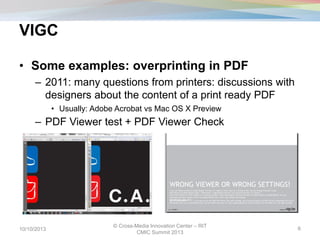
VIGC
• Some examples: overprinting in PDF
– 2011: many questions from printers: discussions with
designers about the content of a print ready PDF
• Usually: Adobe Acrobat vs Mac OS X Preview
– PDF Viewer test + PDF Viewer Check
10/10/2013
© Cross-Media Innovation Center – RIT
CMIC Summit 2013
6
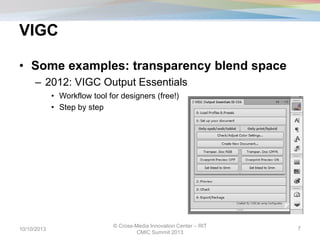
VIGC
• Some examples: transparency blend space
– 2012: VIGC Output Essentials
• Workflow tool for designers (free!)
• Step by step
10/10/2013
© Cross-Media Innovation Center – RIT
CMIC Summit 2013
7
The origins of our ‘Max TAC’ project
• Meeting with a food packaging printer
– Complaining about the designs he receives: way too
much ink (350% or even higher)
– Ink dries very slowly: only after a few days 100% dry
• A real risk for contamination / migration!
– Coating is not a solution: only top layer is dry
• Die cutting: knives cut through the wet ink
• Folding: edge might touch inside when folded
– UV ink: all photo initiators blacklisted at that time
– The root of the problem: designers are not aware of
issues with high TAC
10/10/2013
© Cross-Media Innovation Center – RIT
CMIC Summit 2013
8
How black is black?
• Immediate result of meeting: tutorial file
– Show the different possibilities of ‘Rich Black’
– Show the influence of varnish
• Some designers want a matte varnish (specific tactile experience!)
but then complain that the black looks dull…
10/10/2013
© Cross-Media Innovation Center – RIT
CMIC Summit 2012
9
How low can you go?
• Nobody could answer me…
– Conventional wisdom: 350%, 300% is already ‘low’
• Launch X-Rite i1 Publish: initial tests
– Small vs large profiles
– Dozen profiles, increments of 20%, from 320% to
180%
– Conversion of multiple images, not only pictures with
deep black
• Visual evaluation on monitor
• Visual evaluation inkjet proof
10/10/2013
© Cross-Media Innovation Center – RIT
CMIC Summit 2012
10
First print test
• 6 images, up to 9 different renderings
– VIGC: 200, 220, 240, 260, 280, 300, 320%
– ECI ISOcoated v2: 330, 300%
– Adobe CoatedFogra 39 (330%)
– Basiccolor ISOcoated v2 (330%)
• Evaluation by a few seasoned printers (active
in high quality and in food packaging)
– They could barely see a difference… and were
amazed by that…
10/10/2013
© Cross-Media Innovation Center – RIT
CMIC Summit 2012
11
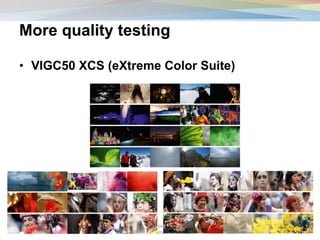
More quality testing
• VIGC50 XCS (eXtreme Color Suite)
10/10/2013
© Cross-Media Innovation Center – RIT
CMIC Summit 2012
12
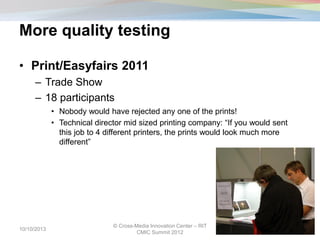
More quality testing
• Print/Easyfairs 2011
– Trade Show
– 18 participants
• Nobody would have rejected any one of the prints!
• Technical director mid sized printing company: “If you would sent
this job to 4 different printers, the prints would look much more
different”
10/10/2013
© Cross-Media Innovation Center – RIT
CMIC Summit 2012
13
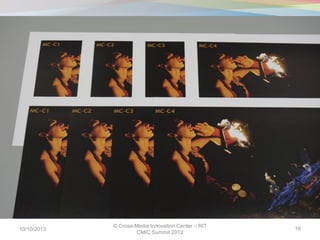
More quality testing
• Measurements vs visual perception
– We are addicted to numbers, loups and calculations
most people don’t understand (e.g. delta E)
– What matters: do you see a difference?
– Matte coated samples – image C (the one with the
highest deviations)
• 320%: L = 11.91
• 300%: L = 12.47 (0.56 difference with 320%)
• 260%: L = 13.97 (2.06 difference with 320%)
• 220%: L = 15.06 (3.15 difference with 320%)
10/10/2013
© Cross-Media Innovation Center – RIT
CMIC Summit 2012
14
More quality testing
10/10/2013
© Cross-Media Innovation Center – RIT
CMIC Summit 2012
15
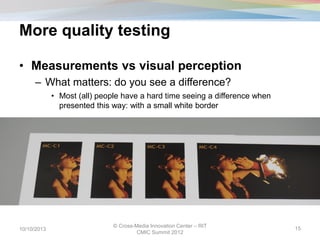
• Measurements vs visual perception
– What matters: do you see a difference?
• Most (all) people have a hard time seeing a difference when
presented this way: with a small white border
More quality testing
10/10/2013
© Cross-Media Innovation Center – RIT
CMIC Summit 2012
16
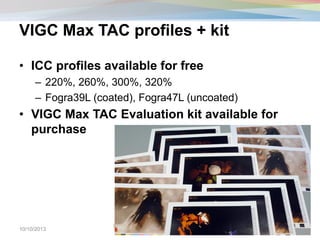
VIGC Max TAC profiles + kit
• ICC profiles available for free
– 220%, 260%, 300%, 320%
– Fogra39L (coated), Fogra47L (uncoated)
• VIGC Max TAC Evaluation kit available for
purchase
10/10/2013
© Cross-Media Innovation Center – RIT
CMIC Summit 2012
17
But… old habits die hard
• “Ink reducation doesn’t work!”
– The main issue: highlights (small dots) in CMY
• Film based workflows vs Computer-to-Plate
• Question: what about flexo?
– 4-color printing on 2- or 1-color presses, with visual
control by press operator vs 4-color presses with
measurement systems
– “100% K may cause picking”
• Quality of paper has improved, due to higher press speeds
– So: historical reasons!
10/10/2013
© Cross-Media Innovation Center – RIT
CMIC Summit 2012
18
But… where to convert?
• What is the best place/worklow for ink
reduction?
• Use the right profile from the beginning!
– And only convert 1 time!
– If designers delivers CMYK PDF: they should use a
low TAC profile!
– But they don’t care… or they don’t know…
• Educate!
• Use the right incentives!
10/10/2013
© Cross-Media Innovation Center – RIT
CMIC Summit 2012
19
But… where to convert?
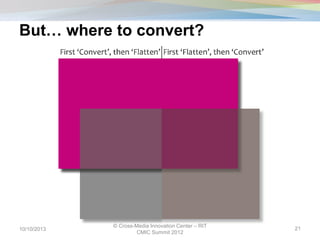
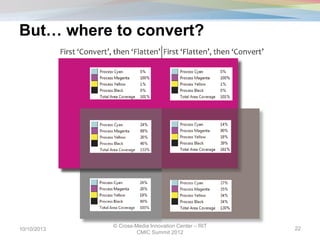
• Ink reduction software / ‘color servers’ come
with a risk…
– PDFs with transparency: first convert, then flatten or
the other way around?
– Topic recent GWG meeting
10/10/2013
© Cross-Media Innovation Center – RIT
CMIC Summit 2012
20
But… where to convert?
10/10/2013
© Cross-Media Innovation Center – RIT
CMIC Summit 2012
21
But… where to convert?
10/10/2013
© Cross-Media Innovation Center – RIT
CMIC Summit 2012
22
But… where to convert?
10/10/2013
© Cross-Media Innovation Center – RIT
CMIC Summit 2012
23
• The designer must do his job right!
– And the printer must respect what the designer did…
– But probably the designer needs to be educated…
• And the printer does have a responsability there!
Conclusion
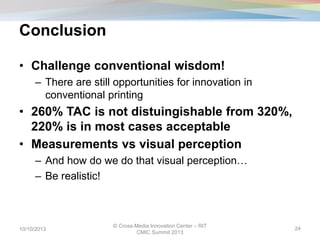
• Challenge conventional wisdom!
– There are still opportunities for innovation in
conventional printing
• 260% TAC is not distuingishable from 320%,
220% is in most cases acceptable
• Measurements vs visual perception
– And how do we do that visual perception…
– Be realistic!
10/10/2013
© Cross-Media Innovation Center – RIT
CMIC Summit 2013
24
Conclusion
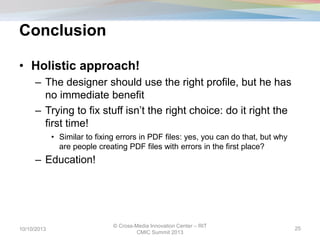
• Holistic approach!
– The designer should use the right profile, but he has
no immediate benefit
– Trying to fix stuff isn’t the right choice: do it right the
first time!
• Similar to fixing errors in PDF files: yes, you can do that, but why
are people creating PDF files with errors in the first place?
– Education!
10/10/2013
© Cross-Media Innovation Center – RIT
CMIC Summit 2013
25
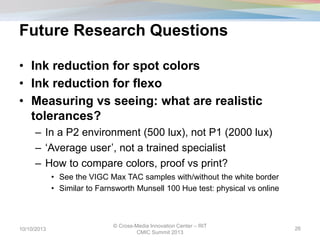
Future Research Questions
• Ink reduction for spot colors
• Ink reduction for flexo
• Measuring vs seeing: what are realistic
tolerances?
– In a P2 environment (500 lux), not P1 (2000 lux)
– ‘Average user’, not a trained specialist
– How to compare colors, proof vs print?
• See the VIGC Max TAC samples with/without the white border
• Similar to Farnsworth Munsell 100 Hue test: physical vs online
10/10/2013
© Cross-Media Innovation Center – RIT
CMIC Summit 2013
26
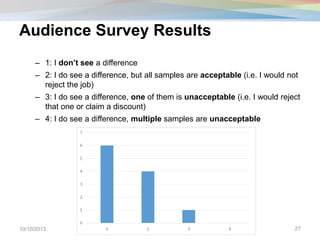
Audience Survey Results
– 1: I don’t see a difference
– 2: I do see a difference, but all samples are acceptable (i.e. I would not
reject the job)
– 3: I do see a difference, one of them is unacceptable (i.e. I would reject
that one or claim a discount)
– 4: I do see a difference, multiple samples are unacceptable
10/10/2013
© Cross-Media Innovation Center – RIT
CMIC Summit 2013
27
10/10/2013
© Cross-Media Innovation Center – RIT
CMIC Summit 2013
28
Thank You!
Q & A
Eddy Hagen
General manager
VIGC
eddy.hagen@vigc.org

CMIC Summit 2013: Ink reduction for food packaging printers

  • 1.
    © Cross-Media InnovationCenter – RIT CMIC Summit 2013 Ink reduction for food packaging Eddy Hagen General manager VIGC
  • 2.
    Industry Challenge • Producingfood packaging is a challenge, certainly carton printed with lithography: – Ink setoff can create migration – Oxidative inks dry very slowly (multiple days) – UV inks contain photo initiators, all of them were black listed in the EU a few years ago – Many designers LOVE a 400% black… 10/10/2013 © Cross-Media Innovation Center – RIT CMIC Summit 2013 2
  • 3.
    Audience Survey • Doyou see a difference between the 4 samples that are distributed? – 1: I don’t see a difference – 2: I do see a difference, but all samples are acceptable (i.e. I would not reject the job) – 3: I do see a difference, one of them is unacceptable (i.e. I would reject that one or claim a discount) – 4: I do see a difference, multiple samples are unacceptable 10/10/2013 © Cross-Media Innovation Center – RIT CMIC Summit 2013 3
  • 4.
    VIGC • Flemish InnovationCenter for Graphic Communication (Belgium) • Practical solutions to real live problems – Inspired by questions from our members – Search for the root of the problem 10/10/2013 © Cross-Media Innovation Center – RIT CMIC Summit 2013 4
  • 5.
    VIGC • Some examples:deviations between spectrophotometers – Everybody thinks his/her device tells the truth • Discussion between screen printer and his customer – VIGC study in printing companies (2008) • Deviations up to 3.77 delta E*ab • Differences between different brands • Maintenance is an issue 10/10/2013 © Cross-Media Innovation Center – RIT CMIC Summit 2013 5
  • 6.
    VIGC • Some examples:overprinting in PDF – 2011: many questions from printers: discussions with designers about the content of a print ready PDF • Usually: Adobe Acrobat vs Mac OS X Preview – PDF Viewer test + PDF Viewer Check 10/10/2013 © Cross-Media Innovation Center – RIT CMIC Summit 2013 6
  • 7.
    VIGC • Some examples:transparency blend space – 2012: VIGC Output Essentials • Workflow tool for designers (free!) • Step by step 10/10/2013 © Cross-Media Innovation Center – RIT CMIC Summit 2013 7
  • 8.
    The origins ofour ‘Max TAC’ project • Meeting with a food packaging printer – Complaining about the designs he receives: way too much ink (350% or even higher) – Ink dries very slowly: only after a few days 100% dry • A real risk for contamination / migration! – Coating is not a solution: only top layer is dry • Die cutting: knives cut through the wet ink • Folding: edge might touch inside when folded – UV ink: all photo initiators blacklisted at that time – The root of the problem: designers are not aware of issues with high TAC 10/10/2013 © Cross-Media Innovation Center – RIT CMIC Summit 2013 8
  • 9.
    How black isblack? • Immediate result of meeting: tutorial file – Show the different possibilities of ‘Rich Black’ – Show the influence of varnish • Some designers want a matte varnish (specific tactile experience!) but then complain that the black looks dull… 10/10/2013 © Cross-Media Innovation Center – RIT CMIC Summit 2012 9
  • 10.
    How low canyou go? • Nobody could answer me… – Conventional wisdom: 350%, 300% is already ‘low’ • Launch X-Rite i1 Publish: initial tests – Small vs large profiles – Dozen profiles, increments of 20%, from 320% to 180% – Conversion of multiple images, not only pictures with deep black • Visual evaluation on monitor • Visual evaluation inkjet proof 10/10/2013 © Cross-Media Innovation Center – RIT CMIC Summit 2012 10
  • 11.
    First print test •6 images, up to 9 different renderings – VIGC: 200, 220, 240, 260, 280, 300, 320% – ECI ISOcoated v2: 330, 300% – Adobe CoatedFogra 39 (330%) – Basiccolor ISOcoated v2 (330%) • Evaluation by a few seasoned printers (active in high quality and in food packaging) – They could barely see a difference… and were amazed by that… 10/10/2013 © Cross-Media Innovation Center – RIT CMIC Summit 2012 11
  • 12.
    More quality testing •VIGC50 XCS (eXtreme Color Suite) 10/10/2013 © Cross-Media Innovation Center – RIT CMIC Summit 2012 12
  • 13.
    More quality testing •Print/Easyfairs 2011 – Trade Show – 18 participants • Nobody would have rejected any one of the prints! • Technical director mid sized printing company: “If you would sent this job to 4 different printers, the prints would look much more different” 10/10/2013 © Cross-Media Innovation Center – RIT CMIC Summit 2012 13
  • 14.
    More quality testing •Measurements vs visual perception – We are addicted to numbers, loups and calculations most people don’t understand (e.g. delta E) – What matters: do you see a difference? – Matte coated samples – image C (the one with the highest deviations) • 320%: L = 11.91 • 300%: L = 12.47 (0.56 difference with 320%) • 260%: L = 13.97 (2.06 difference with 320%) • 220%: L = 15.06 (3.15 difference with 320%) 10/10/2013 © Cross-Media Innovation Center – RIT CMIC Summit 2012 14
  • 15.
    More quality testing 10/10/2013 ©Cross-Media Innovation Center – RIT CMIC Summit 2012 15 • Measurements vs visual perception – What matters: do you see a difference? • Most (all) people have a hard time seeing a difference when presented this way: with a small white border
  • 16.
    More quality testing 10/10/2013 ©Cross-Media Innovation Center – RIT CMIC Summit 2012 16
  • 17.
    VIGC Max TACprofiles + kit • ICC profiles available for free – 220%, 260%, 300%, 320% – Fogra39L (coated), Fogra47L (uncoated) • VIGC Max TAC Evaluation kit available for purchase 10/10/2013 © Cross-Media Innovation Center – RIT CMIC Summit 2012 17
  • 18.
    But… old habitsdie hard • “Ink reducation doesn’t work!” – The main issue: highlights (small dots) in CMY • Film based workflows vs Computer-to-Plate • Question: what about flexo? – 4-color printing on 2- or 1-color presses, with visual control by press operator vs 4-color presses with measurement systems – “100% K may cause picking” • Quality of paper has improved, due to higher press speeds – So: historical reasons! 10/10/2013 © Cross-Media Innovation Center – RIT CMIC Summit 2012 18
  • 19.
    But… where toconvert? • What is the best place/worklow for ink reduction? • Use the right profile from the beginning! – And only convert 1 time! – If designers delivers CMYK PDF: they should use a low TAC profile! – But they don’t care… or they don’t know… • Educate! • Use the right incentives! 10/10/2013 © Cross-Media Innovation Center – RIT CMIC Summit 2012 19
  • 20.
    But… where toconvert? • Ink reduction software / ‘color servers’ come with a risk… – PDFs with transparency: first convert, then flatten or the other way around? – Topic recent GWG meeting 10/10/2013 © Cross-Media Innovation Center – RIT CMIC Summit 2012 20
  • 21.
    But… where toconvert? 10/10/2013 © Cross-Media Innovation Center – RIT CMIC Summit 2012 21
  • 22.
    But… where toconvert? 10/10/2013 © Cross-Media Innovation Center – RIT CMIC Summit 2012 22
  • 23.
    But… where toconvert? 10/10/2013 © Cross-Media Innovation Center – RIT CMIC Summit 2012 23 • The designer must do his job right! – And the printer must respect what the designer did… – But probably the designer needs to be educated… • And the printer does have a responsability there!
  • 24.
    Conclusion • Challenge conventionalwisdom! – There are still opportunities for innovation in conventional printing • 260% TAC is not distuingishable from 320%, 220% is in most cases acceptable • Measurements vs visual perception – And how do we do that visual perception… – Be realistic! 10/10/2013 © Cross-Media Innovation Center – RIT CMIC Summit 2013 24
  • 25.
    Conclusion • Holistic approach! –The designer should use the right profile, but he has no immediate benefit – Trying to fix stuff isn’t the right choice: do it right the first time! • Similar to fixing errors in PDF files: yes, you can do that, but why are people creating PDF files with errors in the first place? – Education! 10/10/2013 © Cross-Media Innovation Center – RIT CMIC Summit 2013 25
  • 26.
    Future Research Questions •Ink reduction for spot colors • Ink reduction for flexo • Measuring vs seeing: what are realistic tolerances? – In a P2 environment (500 lux), not P1 (2000 lux) – ‘Average user’, not a trained specialist – How to compare colors, proof vs print? • See the VIGC Max TAC samples with/without the white border • Similar to Farnsworth Munsell 100 Hue test: physical vs online 10/10/2013 © Cross-Media Innovation Center – RIT CMIC Summit 2013 26
  • 27.
    Audience Survey Results –1: I don’t see a difference – 2: I do see a difference, but all samples are acceptable (i.e. I would not reject the job) – 3: I do see a difference, one of them is unacceptable (i.e. I would reject that one or claim a discount) – 4: I do see a difference, multiple samples are unacceptable 10/10/2013 © Cross-Media Innovation Center – RIT CMIC Summit 2013 27
  • 28.
    10/10/2013 © Cross-Media InnovationCenter – RIT CMIC Summit 2013 28 Thank You! Q & A Eddy Hagen General manager VIGC eddy.hagen@vigc.org