PSO-UPM-GB:SEE 25/11/11 19:23 Page1


                       PROCESS COLOUR STANDARDISATION - PRINTCITY SPECIAL REPORT
                                        CROSS INDUSTRY SPECIAL REPORT


                                                     GB


                                      Process Colour
                                      Standardisation
PSO-UPM-GB:SEE 25/11/11 19:23 Page2


                            PROCESS COLOUR STANDARDISATION - PRINTCITY SPECIAL REPORT


                                        Bibliography, contacts and recommended reading               Some useful contacts
                                        “Best Practice Tool Box”                                     Altona Test Suite Application Kit
                                        WOCG (Web Offset Champion Group) wocg.info                   www.altonatestsuite.com
                                        “Communicating Your Colour Needs”                            Altona Test Suite (online version download)
                                        Julie Shaffer, Centre Imaging Excellence, GATF               www.eci.org
                                        “Color Managing Premedia Production”                         ECI (characterisation data, profiles, etc.) www.eci.org
                                        Michael Robertson, RIT, GATFWorld
                                                                                                     Fogra (characterisation data etc.) www.fogra.org
                                        “Creating Print Standards” Don Hutcheson, 2005
                                        “Guidelines & Specifications 2007” IDEAlliance®              ICC (characterisation data, register etc.)
                                                                                                     www.color.org
                                        “Digital Color Management, Principles and
                                        Strategies for the standardized Print Production”            IDEAlliance® www.idealliance.org
                                        Homann, Spinger 2009                                         ISO (TC 130 Graphic Technology) www.iso.org
                                        “HOW TO — A step by Step Guide to Calibrating,               MediaStandard Print
                                        Printing & Proofing by the G7 Method” IDEAlliance®           www.point-online.de/download/pdf/free/86035.pdf
                                        “Nine Steps to Effective and Efficient Press Oks”            Paperdam Group www.Paperdam.org
                                        by Diane J. Biegert, GATF Press 2002
                                                                                                     Process Standard Offset www.psoinsider.de
                                        “Process Controls Primer” Josef Marin, PIA/GATF 2005
                                        Process Standard Offset (PSO)                                roman16 bvdm reference images www.roman16.com
                                        Manual by bvdm. A revised edition available in 2012
                                        “PDF/X Frequently Asked Questions”
                                        Global Graphics Software Limited, Martin Bailey, 2005/2010
                                        “Standard viewing conditions for the Graphic Arts”
                                        Richard W. Harold, David Q. McDowell, GATF 1999
                                        “Testing and Selecting Paper” UPM
                                        PrintCity project team
                                        Fujifilm Europe, Hiroki Chimura & Wieland Schwarz
                                        GMG Color, Nils Gottfried
                                        Hammesfahr, Klaus Valet
                                        manroland, Andreas Lorenz
                                        Sappi, Jouni Marttila, Han Haan (=)
                                        Sun Chemical, Bernhard Fritz (project leader),
                                        John Adkin & Detlef Trautewein
                                        Trelleborg, Manuela Re
                                        UPM, Gerd Carl & Peter Hanneman
                                        PrintCity, Nigel Wells (project manager & editor)
                                        Other contributors and reviewers
                                        bvdm, Karl Michael Meinecke
                                        DSL, Alex Dort & Jörg Schmitt
                                        f:mp (Fachverband Medienproduktioner), Rüdiger Maass
                                        Global Graphics, Martin Bailey
                                        homann colormanagement, Jan-Peter Homann
                                        HutchColor, Don Hutcheson
                                        IDEAlliance, Joe Fazzi
                                        RCC Consultants, Ricard & Jaume Casals
                                        RIT School of Print Media, Robert Chung
                                        Techkon, Albin Baranauskas
                                        UNIC France, Pascale Ginguené
                                        Welsh Centre for Printing and Coating,
                                        Swansea University, Tim Claypole


                                                Design and page make-up: ID-industry, Paris
                                                Printing: Hammesfahr
                                                Inks: Sun Chemical
                                                Paper: UPM Finesse Premium Silk 135 gsm
PSO-UPM-GB:SEE 25/11/11 19:23 Page1


                           PROCESS COLOUR STANDARDISATION - PRINTCITY SPECIAL REPORT                                                                          1


        Foreword
        The purpose of this PrintCity guide is to promote the better understanding and use of process
        standardisation and workflow optimisation. This guide is not intended to be a manual or a speci-
        fication and is complementary to the work of ISO, PSO, Fogra, IDEAlliance® ECI, ICC, and
                                                                                        ,
        other organisations.

        The PrintCity project members have share their combined competences to help implement
        standardisation to improve quality, consistency and productivity. An important part of this project was
        the case study PSO implementation and certification with the printer Hammesfahr in Germany.

        Successful implementation of a printing standard normally provides printers with the benefits of
        improved cost, quality and time performance, with better sustainability and reduced waste.

        The use and certification of a standard is an increasingly important business requirement for
        customers who require demonstrable quality control. To understand better print buyer motivation,
        PrintCity worked with f:mp to survey the views of over 50 German print users and designers. They
        identified their top three top benefits from working with standardised printing companies as
        improved quality, consistency and reduced errors. However, in 2010 less than 1000 printers were
        operating with a certified process — only a small proportion of the world’s printers equipped with
        4-colour production facilities. Printing without certification to a standard is probably higher, for
        example around 3500 PSO implementation manuals have been sold (up to early 2011).

        Correct colour setting depends significantly on how humans see, understand and communicate
        colour. It is also important to share reasonable expectations of 4-colour printing, which, due to the
        limits of pigment, paper and the process, can reproduce only around 10,000 colour shades. This            CONTENTS                                    PAGES
        means that good results requires all participants in the graphic chain to work with colour as a
        system. Standards with specific colour targets and specifications are a systematic tool to help           Frequently Asked Questions                      2
        achieve this. The trend to ‘print by numbers’ is driven by customer requirements for verifiable           Glossary & Some colour basics                   4
        quality control, globalisation and remote site printing using prepress data transmitted with numeric      Executive summary                               6
        control values.                                                                                           1: Introduction
                                                                                                                  Colour Management issues                        10
        Some of the primary elements for improved performance include:
                                                                                                                  Standards, Specifications & Implementation       12
        • Adequate planning, specification and job preparation by the customer and the printer.                   Certification                                    14
        • The selection, use and maintenance of a standard and its specifications because colour                  Key control parameters                          15
          management cannot fulfil its objectives without standardisation and process control.                    Measuring devices & Software tools              16
        • Certification of a standard or specification helps maintain process discipline and offers               2: Key influences on quality
          demonstrable business differentiation.                                                                  Print Job Preparation & Design                  18
        • An integrated industrial manufacturing strategy that combines standardisation, process control and      GCR                                             18
          defined procedures is essential to achieve higher quality and productivity benefits.                    PDF/X                                           20
        • Complete and coherent control of the printing workflow. Each output step needs to be controlled         Proofing system                                  22
          with measuring techniques and methods that achieve a predictable outcome. Success requires that         Plates and processing                           24
          within this approach the customer, prepress supplier and printer work together.                         Press                                           26
                                                                                                                  Blankets                                        27
        • The use of colour measurement tools with an appropriate on press approval method. Human
                                                                                                                  Maintenance and consumables + chart             28
          factors are often overlooked in the colour approval process. These include subjective and varying
          perceptions of colour, communication and expectations, and also different viewing environments          Inks & Dampening                                29
          amongst customer, agency and printer.                                                                   Paper                                           30

        • Effective maintenance and standard operating procedures are key success factors to ensure               3: Implementing standardisation
          rapid start-up, optimum quality, productivity and on-time delivery.                                     Step-by-step implementation                     34
                                                                                                                  Hammesfahr case study                           36

                                                                                                                  4: Faster colour Oks & Troubleshooting
                                                                                                                  Managing press OK and makeready                 40
                                                                                                                  Resolving some common problems                  42
PSO-UPM-GB:SEE 25/11/11 19:23 Page2


          2                 PROCESS COLOUR STANDARDISATION - PRINTCITY SPECIAL REPORT


                                        Frequently Asked Questions …
                                        What is a printing quality standard? See page 12
                                        Standards establish a common language across the entire value chain. Standardisation has a positive
                                        impact not only on internal workflows but also on communications between printer, print buyer and
                                        designer. Colour approval and acceptance of the printed job is influenced by the quality of prepress,
                                        press specifications and the working relationship between printer and customer. Standards are the
                                        base for predictable and comparable results independent of output device or location.

                                        What is the printers’ benefit from standardisation? See page 6
                                        Standards provide accountable quality control, increased reliability and efficiency leading to
                                        reduce costs, improved profitability, competitive differentiation and business sustainability.

                                        Do print buyers value standardisation? See page 7
                                        Yes. A survey of German print users and designers identified the top three benefits identified for them
                                        as improved quality, consistency and reduced errors.

                                        What is ISO 12647-2? See page 12
                                        This printing standard address 4-colour process control of halftone colour separations, proof and
                                        production prints for sheetfed and heatset web offset. It defines incoming data and how this is
                                        converted onto the plate and the outcome of ink-on-paper. www.iso.org

                                        What is a printing specification? See page 12
                                        Print specifications provide the guideline and framework for working with standards. The two most
                                        important specifications are Process Standard Offset (PSO) from bvdm/Fogra Germany, and
                                        GRACoL® from IDEAlliance®. USA.

                                        What is PS0?
                                        PSO stands for Process Standard Offset. It is a manual that provides guidelines and best practices
                                        on standardisation of offset processes, it was first published by bvdm in 1980. It fully supports
                                        ISO 12647 and other ISO standards used in the complete graphic workflow.

                                        What is certification? See page 14
                                        Certification is the written confirmation by a credible organisation that a company’s services,
                                        production processes or products have been tested to be in conformance with a relevant standard(s).

                                        Who makes a certification? See page 14
                                        The current ISO 12647 has no defined method of certification within the standard. As a result,
                                        current ISO 12647 certifications are private, and are more or less recognised by the international
                                        community. There are important differences between them in their requirements, criteria, testing,
                                        auditing etc. ISO has commissioned Working Group 13 to develop a print certification standard.

                                        How can standardisation benefits be measured? See page 7
                                        Key Performance Indicators (KPIs) can quantify standardisation benefits: they help diagnose
                                        current performance and monitor process workflow improvements.

                                        Why should we care about process control? See page 6
                                        The more we control the printing process, the less waste in time and materials. Every step in the
                                        printing process is influenced by variables that may create colour deviations. Effective process
                                        control measures defined variables and monitors their output in comparison to a standard definition
                                        – any deviations from optimal values can then be corrected.

                                        What are the key influences on quality? See page 18
                                        There are many variables that influence colour, even in a standardised process. Primary process
                                        parameters with a direct bearing on visual characteristics of the image include printing sequence,
                                        press, ink, substrate, screening, and plate. Secondary parameters that can indirectly influence the
                                        image include: speed, dampening solutions, additives, cylinder packaging and blankets, ink/water
                                        balance, roller setting, ink film thickness, trapping, temperature and humidity.
PSO-UPM-GB:SEE 25/11/11 19:23 Page3


                            PROCESS COLOUR STANDARDISATION - PRINTCITY SPECIAL REPORT                                3


        … and Some Answers
        What is profiling? See page 10
        A standardised colour managed workflow requires all input sources (cameras and scanner) and
        output devices (monitor, proofer, press) to be individually colour characterised and profiled.

        Why is the printing press profile the fixed point from which all other devices are set? See page 10
        The printing press has the smallest colour gamut and the most variables of all devices in the work-
        flow. Therefore, it is the fixed point from which all other devices are set, working backwards up the
        process flow. Ideally a single printing profile for all presses in a plant should be used, providing that
        all presses are printing within a common tolerance range.

        How important is using a standard for incoming digital data? See page 20
        ISO 15930 defines how applications to create and read PDF/X files should behave for reliable
        prepress data interchange. The aim for designers is to supply a digital content file that will be
        printed predictably, while printers and publishers receive robust files, avoiding reworking or errors.
        PDF/X is designed to be easy and cheap to create.

        Does my proofing system need to be calibrated? See page 22
        Yes. The contract proof is the visual constant in the process because it is produced with tighter
        tolerances than offset printing. Proofing systems must be able to calibrate the complete colour gamut
        to archive high quality results on a regular basis – only this can ensure a constant reproducible quality.

        Why are plates so important? See page 24
        Reliable printing requires stable plate and plate making that comes from the right combination
        of platesetter, plate, processor and developer for the technology selected. The plate has a major
        influence in print colour approval because the stability of dot reproduction within specified tolerances
        is critical.

        Why is blanket performance critical? See page 27
        The blanket is central to good offset printing and requires careful selection, packing, tensioning and
        cleaning to ensure printing quality, durability and minimum press down time. Excellent print quality
        requires a blanket that combines good registration and an accurate dot reproduction.

        How important are maintenance and consumables? See page 28
        Effective and systematic operating and maintenance procedures are fundamental to process stability
        and standardised materials are required to achieve the best possible results. All consumable mate-
        rials should be optimised as a system (ink, pressroom chemicals, blankets, paper and plates).

        What is the influence of paper? See page 30
        Paper has the single largest impact on print quality. Paper has visual (gloss, brightness, opacity)
        and tactile properties (stiffness, roughness,) that affect its quality perception. Equally as important
        is the combined effect of paper and ink on colour reproduction. The paper surface and shade
        impact on the reachable colour gamut and the colour reproduction is influenced by the paper
        surface effect on TVI.

        Is there an environmental impact from ISO 12647-2?
        Any manufacturing efficiency improvement from using standards not only reduces costs but also
        provides environmental benefits from reduced waste of paper, ink, consumables, energy, and
        carbon footprint.

        Is it possible to apply the ISO 12647-2 to digital printing?
        Some digital printing presses may be able to reproduce the colorimetric aim and simulate the TVI
        of ISO12647-2 standard, and at least one digital printer has applied for certification. However, the
        standard was created for offset printing and certification is only for this process. The ISO TC 130 WG3
        is currently working on a specific standard for digital printing that will address issues like data
        handling, substrates, achievable colour gamut, colour stability during the print run and visual
        comparison to 12647-2. The new standard series will probably be available under ISO 15311 in
        2012/13. (For more information see Fogra Extra issues 23 and 25 on Process Standard Digital
        Printing, download from www.fogra.org.
PSO-UPM-GB:SEE 25/11/11 19:23 Page4


          4                 PROCESS COLOUR STANDARDISATION - PRINTCITY SPECIAL REPORT


                                        Glossary & colour basics
                                        Brightness: Method developed to monitor the bleaching of pulp. Measures reflectivity at bluish
                                        wavelengths (400-500nm). Different brightness measures used include ISO (C-illumination),
                                        D65-illumination, UV-cut, Tappi.
                                        Characterisation tables: Compare the measured colour values of an original with the colour values
                                        of the data file.
                                        Control strip: An array of control patches for measurement purposes.
                                        Colour difference ΔE: Method to compare colours measured with CIELAB. In ISO 12647-2 it is
                                        defined as the difference in colour of the primary solid tones compared with the colorimetric aims
                                        should not differ more than ΔE 5. It is a 3-dimensional scale that includes the distance between two
                                        colours but excludes the direction of the deviation. The higher the value is, the larger the difference
                                        between two measured colours.
                                        CMYK: Process colours Cyan, Magenta, Yellow and BlacK.
                                        Dampening solution (fountain or font): Mixture of chemicals and water to prevent image acceptance
                                        on non-image areas of a printing plate.
                                        Density (paper): Indicates how compact the paper is (the inverse of its bulk).
                                        Device link profiles: A profile format that directly links two colour spaces. See page 11.
                                        Dot gain: See Tone Value Increase (TVI).
                                        ECI: European Colour Initiative – a group working on device-independent data processing in digital
                                        publication systems.
                                        GRACoL®: General Requirements for Applications in Commercial Offset Lithography is a US
                                        colour reproduction specification for sheetfed offset using ISO defined inks and paper.
                                        Gloss: The perceived appearance of the paper surface that makes it appear more or less shiny.
                                        Grey balance: Used to objectively assess colour as the eye easily detects any shift in neutrality when
                                        neutral areas are compared side-by-side and if there is any colour cast in the neutral area. ‘Grey’
                                        is a visual sensation of an object with distinct lightness, but with no distinct hue or chroma.
                                        ‘Balance’ refers to using some combinations of CMY values that produce a grey sensation under a
                                        specific printing condition.
                                        Grey reproduction (ISO 12647-1/2010 definition): Grey balance is a parameter in the device space,
                                        and grey reproduction is a parameter in the device-independent CIELAB colour space. Grey repro-
                                        duction assesses the degree of neutrality of pre-defined CMY triplets colorimetrically.
                                        Grey Component Replacement (GCR): A technique that uses the greying effect of black ink to
                                        replace process colour inks. GCR identifies the combined effect of the three inks and replaces
                                        them with a single black. If the black ink cannot reach a sufficiently high density then some CMY can
                                        be brought back to support very dark shadows (see UCA).
                                        ICC (International Color Consortium): International forum to define process-wide profiles for prepress
                                        file formats, paper and press for colour management systems.
                                        International Standardisation Organisation: ISO is a network of the national standards institutes
                                        of 163 countries.
                                        L*a*b*-values: The chromaticity coordinates for any measured colour are described with three
                                        points – L* for the lightness, a* for the red/green axis, and b* for the yellow/blue axis.
                                        OBAs: Optical Brightening Agents. Added to paper, they give a higher brightness impression to the
                                        paper than it originally has. OBAs are stimulated by UV light, and by the UV content of daylight.
                                        OBAs are not effective under light conditions with a low UV content, e.g. 2856 K.
                                        OK print/sheet: Production print selected as reference for the print run with a permissible tolerance.
                                        Opacity: The ability of a paper to obstruct the passage of light (the opposite of transparency); linked
                                        to “show through” but should not be confused with “print-through”, which includes ink oil pene-
                                        tration that reduces the sheet opacity.
                                        Optical density: Optical ink density of a solid colour.
                                        Paperdam: Organisation of paper suppliers to support paper in context of printing standardisation.
                                        Print contrast: Calculation that compares density readings of a 75% tint area to the density of a 100%
                                        solid area of the same colour. Good print contrast indicates a printing system’s ability to hold open
                                        the shadow areas while still maintaining high solid saturation (density).
                                        Production print tolerance: Permissible difference between OK print from a production run and
                                        the reference value.
                                        RIP (Raster Image Processor): Translates electronic file data into an array of dots and lines that
                                        can be printed.
PSO-UPM-GB:SEE 25/11/11 19:23 Page5


                            PROCESS COLOUR STANDARDISATION - PRINTCITY SPECIAL REPORT                                                                                5


        Roughness or Smoothness: Describes the paper surface being even (smooth) or uneven (rough) and
        is linked to its gloss. It depends also on the measuring method, Roughness Bendtsen in ml/min or
        Smoothness PPS in µm. (A paper measured in PPS is rough, it is still Smoothness PPS and not
        Roughness PPS, also vice versa with Bendtsen.)
        Screen: lpi (lines per inch) or l/cm (lines per centimetre). The number of lines of dot cells per linear
        length in a halftone screen. There is an optimum screen size for each paper grade.
        Separation curve: Tone reproduction represents the cumulative effect of each step of the process
        on the overall contrast of the final reproduction. It is these interrelationships and their effect that
        reproduce the grey scale with the proper shades of grey.
        SID (Solid Ink Density): A measure of how much complementary light (major filter) is absorbed by
        a solid patch in a colour bar as measured by a reflection densitometer.
        SOP: Standard Operating Procedures.
        SWOP®: Specifications for Web Offset Publications is a US colour reproduction specification using
        ISO defined inks and paper.
        TAC (Total Area Coverage): Defines by % the combined CMYK dot area (tonal value) by adding the values
        of each colour in the darkest area of the separation. Maximum TAC is influenced by the substrate.
        Tack: The relative measurement of the cohesion of an ink film that is responsible for its resistance
        to splitting between two rapidly separating surfaces.
        Trapping: The efficiency of a wet ink film layer being accepted by an underlying wet ink layer.
        Tone Value: Percentage of surface that appears to be covered by a single colour.
        TVI (Tone Value Increase): Also known as dot gain. The physical enlargement of halftone dots
        during image creation, the printing process and absorption of ink by the paper (mechanical TVI), and
        light scatter around and under dots (optical TVI). Their combination results in tone value for total
        apparent TVI during the print process.
        UCA (Under Colour Addition): Addition of chromatic colours to ensure TAC in shadow areas.
        UCR (Under Colour Removal): Reduces process colour content in dark, neutral areas of the reproduc-
        tion and replaces them with extra black. UCR may be only made in dark, neutral portions of the picture.


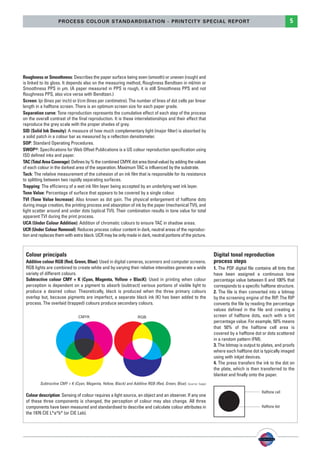
          Colour principals                                                                                              Digital tonal reproduction
          Additive colour RGB (Red, Green, Blue): Used in digital cameras, scanners and computer screens.                process steps
          RGB lights are combined to create white and by varying their relative intensities generate a wide              1. The PDF digital file contains all tints that
          variety of different colours.                                                                                  have been assigned a continuous tone
          Subtractive colour CMY + K (Cyan, Magenta, Yellow + BlacK): Used in printing when colour                       percentage value between 0 and 100% that
          perception is dependent on a pigment to absorb (subtract) various portions of visible light to                 corresponds to a specific halftone structure.
          produce a desired colour. Theoretically, black is produced when the three primary colours                      2. The file is then converted into a bitmap
          overlap but, because pigments are imperfect, a separate black ink (K) has been added to the                    by the screening engine of the RIP. The RIP
          process. The overlaid (trapped) colours produce secondary colours.                                             converts the file by reading the percentage
                                                                                                                         values defined in the file and creating a
                                                                                                                         screen of halftone dots, each with a tint
                                                                                                                         percentage value. For example, 50% means
                                                                                                                         that 50% of the halftone cell area is
                                                                                                                         covered by a halftone dot or dots scattered
                                                                                                                         in a random pattern (FM).
                                                                                                                         3. The bitmap is output to plates, and proofs
                                                                                                                         where each halftone dot is typically imaged
                                                                                                                         using with inkjet devices.
                                                                                                                         4. The press transfers the ink to the dot on
                                                                                                                         the plate, which is then transferred to the
                                                                                                                         blanket and finally onto the paper.
                 Subtractive CMY + K (Cyan, Magenta, Yellow, Black) and Additive RGB (Red, Green, Blue). Source: Sappi

                                                                                                                                                    Halftone cell
          Colour description: Sensing of colour requires a light source, an object and an observer. If any one
          of these three components is changed, the perception of colour may also change. All three
          components have been measured and standardised to describe and calculate colour attributes in                                             Halftone dot
          the 1976 CIE L*a*b* (or CIE Lab).
PSO-UPM-GB:SEE 25/11/11 19:23 Page6


          6                     PROCESS COLOUR STANDARDISATION - PRINTCITY SPECIAL REPORT


                                                             Executive summary
                                                             Why standardise?
                                                             Process colour standardisation improves cost, time and quality performance. Standards establish a
                                                             common language between the related parties in the business. Standardisation has a positive impact
                                                             not only on internal workflows but also on communications between printer, print buyer and designer.
                                                             Standards, measuring devices, quality procedures and standard operating practices are tools that
                                                             provide accountable quality control, increased reliability and efficiency leading to lower total
                                                             production costs. Standards are also the base for predictable and comparable results independent
                                                             of output device or location.
                                                             Effective process control measures defined variables and monitors their output in comparison to a
                                                             standard definition – any deviations from optimal values can then be corrected. Every step in the
                                                             printing process is influenced by variables that may create colour deviations.
                                                             Colour approval and acceptance of the printed job is influenced by the quality of press, prepress,
                                                             specifications and the working relationship between printer and customer. Applying a standardised
                                                             best practice production workflow provides benefits across the entire value chain.
                                                             Business benefits from standardisation
                                                             Studies show that standardisation generally improves business performance in different areas.
                                                             • Increased customer satisfaction. Fewer complaints and related costs (reprints, rebates, refusal to pay).
                                                             • Improved customer perception of printers’ brand value 'quality’. Standardisation helps retain
                                                               existing customers and attract new clients.
                                                             • Improved file quality and order processing efficiency with customers.
                                                             • Prepress has a clearer target of how to create the right profiles for printing.
                                                             • Standardised proofs can more easily be matched on press to reduce makeready time and waste.
                                                             • Lower total cost of production (less time, materials and energy waste).
                                                             • Shorter time on press. Fewer unscheduled press stops. Avoids the cost of shutting the press
                                                               down when colour cannot be matched, plus possibly the need to re-make plates and/or produce
                                                               more expensive proofs.
                                                             • Higher consistency in the run, from job to job, and between different press crews and sites. Improved
                                                               process control reduces dependence on personal judgement and variations of individual printers.
                                                             • A clear view of the total process (and its deviations) that increases internal and external compe-
                                                               tence and confidence. Tools to analyse quality problems more quickly and prevent their repetition.
                                                             • Any lean manufacturing improvement resulting from using standards provides environmental
                                                               benefits – any improvement in production efficiency has an environmental benefit. For example, ink
                                                               minimisation not only saves cost of ink but will also lower the carbon footprint.
                                                             • Improved understanding of process and how materials affect results.
                                                             The location and extent of improved performance can be variable, and it is recommended that
                                                             prior to introducing any changes that KPI measurements of current performance are established so
                                                             that improvements become clearly visible.
                                                             Key Performance Indicators (KPIs)
                                                                                      KPI                      Definition
                                                             General Workflow         Delivery time          % of jobs delivered on time
                                                             + Economical Benefit     Cost estimate          % of job delivered at or below cost estimate
                                                                                      Quality                % of jobs delivered with zero faults
                                                                                      Customer claims        Number of customer claims per month
                                                                                      Reprint                Number of jobs reprinted per month (quality claims)
                                                                                      Proofing Quality       Average number of proofs out of tolerance
                                                             Prepress                 Re-Plates              Number of re-plates per month caused by prepress or client
                                                                                      Proofing Quality       Average number of proofs out of tolerance
                                                             Press                    Re-Plates              Number of re-plates per month
                                                                                      Makeready waste        Average waste in sheets/job
                                                                                      Makeready time         Average time in minutes/job
                             PrintCity definition of Key                              Production waste       Average sheets/job
                     Performance Indicators (KPIs) to                                 Production time        Average production time per 1000 sheets
                     quantify standardisation benefits:
                           they help diagnose current        Postpress                Good copy ratio        Number of good copies over quantity ordered
                    performance and monitor process                                   Reprint                Number of jobs where postpress makeready waste
                              workflow improvements.                                                         too low and a section required reprinting
                                         Source: PrintCity
PSO-UPM-GB:SEE 25/11/11 19:23 Page7


                                 PROCESS COLOUR STANDARDISATION - PRINTCITY SPECIAL REPORT                                                                              7


        Do print buyers value standardisation?
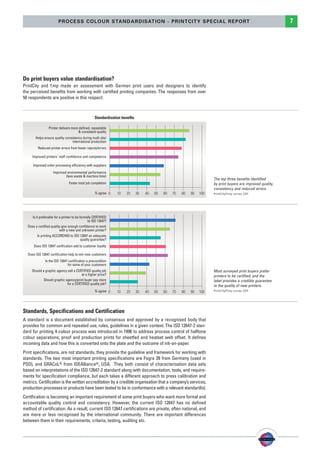
        PrintCity and f:mp made an assessment with German print users and designers to identify
        the perceived benefits from working with certified printing companies. The responses from over
        50 respondents are positive in this respect:


                                                             Standardisation benefits

                         Printer delivers more defined, repeatable
                                              & consistent quality
                Helps ensure quality consistency during multi site/
                                          international production
                 Reduced printer errors from fewer rejects/errors

             Improved printers' staff confidence and competence

              Improved order processing efficiency with suppliers
                             Improved environmental performance
                                     (less waste & machine time)
                                                                                                                                The top three benefits identified
                                         Faster total job completion                                                            by print buyers are improved quality,
                                                                                                                                consistency and reduced errors.
                                                            % agree 0    10    20      30   40   50   60   70   80   90   100   PrintCity/f:mp survey 2011


             Is it preferable for a printer to be formally CERTIFIED
                                                         to ISO 12647?
          Does a certified quality give enough confidence to work
                                  with a new and unknown printer?
                 Is printing ACCORDING to ISO 12647 an adequate
                                                   quality guarantee?
              Does ISO 12647 certfication add to customer loyalty

          Does ISO 12647 certification help to win new customers
                       Is the ISO 12647 certification a precondition
                                       for some of your customers
             Should a graphic agency sell a CERTIFIED quality job                                                               Most surveyed print buyers prefer
                                               at a higher price?                                                               printers to be certified, and the
                     Should graphic agency/print buyer pay more                                                                 label provides a credible guarantee
                                     for a CERTIFIED quality job?
                                                                                                                                to the quality of new printers.
                                                            % agree 0    10    20      30   40   50   60   70   80   90   100   PrintCity/f:mp survey 2011


        Standards, Specifications and Certification
        A standard is a document established by consensus and approved by a recognised body that
        provides for common and repeated use, rules, guidelines in a given context. The ISO 12647-2 stan-
        dard for printing 4-colour process was introduced in 1996 to address process control of halftone
        colour separations, proof and production prints for sheetfed and heatset web offset. It defines
        incoming data and how this is converted onto the plate and the outcome of ink-on-paper.
        Print specifications, are not standards, they provide the guideline and framework for working with
        standards. The two most important printing specifications are Fogra 39 from Germany (used in
        PSO), and GRACoL® from IDEAlliance®, USA. They both consist of characterisation data sets
        based on interpretations of the ISO 12647-2 standard along with documentation, tools, and require-
        ments for specification compliance, but each takes a different approach to press calibration and
        metrics. Certification is the written accreditation by a credible organisation that a company’s services,
        production processes or products have been tested to be in conformance with a relevant standard(s).
        Certification is becoming an important requirement of some print buyers who want more formal and
        accountable quality control and consistency. However, the current ISO 12647 has no defined
        method of certification. As a result, current ISO 12647 certifications are private, often national, and
        are more or less recognised by the international community. There are important differences
        between them in their requirements, criteria, testing, auditing etc.
PSO-UPM-GB:SEE 25/11/11 19:23 Page8


          8                          PROCESS COLOUR STANDARDISATION - PRINTCITY SPECIAL REPORT


                 RGB Input                     CMYK colour                    Proofing &                      Plate imaging                       Print
                                                conversion                    screening                      & processing                     production

                            Premedia                                                    Prepress                                                Press

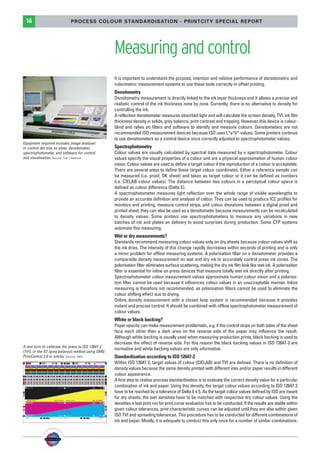
        Digital workflows have simplified and increased       Key control parameters of a printing standard
        the speed of offset workflows. However, the digital   1: Colour/grey balance: Relationship between the four process colours and is the key factor for a
        printing process workflow chain also has multiple
        potential sources of colour and other deviations.     good production match. Human perception is highly sensitive to technical deviations affecting the
        Digital technologies require stricter discipline      colour balance – particularly in midtones. Divergent TVI in the CMY process inks are the main
        to correctly implement and maintain workflows         reason for a shift of balance in printing.
        if they are to deliver consistent results to higher   2: TVI (Tone Value Increase): Expressed as the difference in ink coverage between a theoretical value
        expectations. Source: WOCG                            (prepress) and the print. TVI has a mechanical and an optical component. Mechanical TVI is when the
                                                              size of the printing dots tends to increase during transfer from plate to blanket and from blanket to paper.
                                                              Influencing factors can include CTP platemaking, ink and dampening solution. Optical TVI is due to the
                                                              refraction of light at the interface between the ink and the paper surface. TVI is the difference of the
                                                              tonal value of the digital data to the printed tonal value, e.g. a 50% field will appear on the print as 65%.
                                                              Achieving a similar TVI of the 4 process colours is the key for a good production match on press. If the
                                                              spread is too large between the colours the difference needs to be compensated on the plate.
                                                              3: SID (Solid Ink Density): SID affects the total contrast of a picture and, to a lesser extent, its
                                                              shadow balance. In ISO 12647-2 the target values for solid CMYK are expressed in L*a*b*-values.
                                                              Therefore, it is necessary to translate the standard shade targets into press density targets.
                                                              Measuring devices & Software tools
                                                              Densitometry measurement is directly linked to the ink layer thickness and it allows a precise and
                                                              realistic control of the ink thickness zone by zone. Currently, there is no alternative to density for
                                                              controlling the ink. A spectrophotometer measures light reflection over the whole range of visible
                                                              wavelengths to provide an accurate definition and analysis of colour — their use is mandatory in
                                                              standardisation process. They can be used to produce ICC profiles for monitors and printing,
                                                              measure control strips, and colour deviations between a digital proof and printed sheet; they can also
                                                              be used as a densitometer because measurements can be recalculated to density values. Printers
                                                              measures wet print while quality control measures dry print. While differences are small, they can
                                                              be significant enough to lead to complaints.
                                                              Key influences on quality
                                                              Multiple variables influence colour even in a standardised process. Colour rendition from print run to print
                                                              run, or during production printing, is subject to fluctuations in relation to solid inking, TVI and trapping, from
                                                              a changed ink/water balance or different substrates. Even under standard conditions with minimal varia-
                                                              tions it is practically impossible to exactly conform to a given set of primary parameters. This is due to
                                                              typical production tolerances and unavoidable differences in press, ink, paper that have to be accepted.
                                                              Primary process parameters with a direct bearing on visual characteristics of the image include
                                                              printing sequence, press, ink, substrate, screening, and plate. Secondary parameters that can indi-
                                                              rectly influence the image include: speed, dampening solutions, additives, cylinder packaging and
                                                              blankets, ink/water balance, roller setting, ink film thickness, trapping, temperature and humidity.
                                                              Some of the major influences include:
                                                              Incoming data PDF/X: ISO 15930 defines how applications to create and read PDF/X files should
                                                              behave for reliable prepress data interchange. The aim for designers is to supply a digital content
                                                              file that will be printed predictably, while printers and publishers receive robust files, avoiding
                                                              reworking or errors. PDF/X is designed to be easy and cheap to create.
                                                              Proofing: The role of the proof is to simulate the print output to make the right adjustments to the
                                                              pictures. The contract proof is the visual constant in the process because it is produced with
                                                              tolerances comparable with offset printing. Proofing systems must be able to calibrate the
                                                              complete colour gamut to achieve high quality results on a regular basis – only this can ensure a
                                                              constant reproducible quality.
                                                              Plates and processing: Reliable printing requires stable plate and plate making that comes from the
                                                              right combination of platesetter, plate, processor and developer for the technology selected. The
                                                              plate has a major influence in print colour approval because the stability of dot reproduction within
                                                              specified tolerances is critical.
                                                              Press: Needs to be correctly set up and maintained, and periodically measured to ensure that they
                                                              are within tolerance. The printing press has to be calibrated to match the standard. Calibration
                                                              must take into account all variables influencing final output. The goal is to enable consistent
PSO-UPM-GB:SEE 25/11/11 19:23 Page9


                             PROCESS COLOUR STANDARDISATION - PRINTCITY SPECIAL REPORT                                                                            9


        printing to a given standard and tolerances by producing certain target values when printed.
        Ideally, a single printing profile for all presses in a plant should be used, providing that all presses       Some key success factors
        are printing within a common tolerance range.                                                                  1. The starting point is an effective audit of
        Blankets: The blanket is central to good offset printing and requires careful selection, packing,              the current workflow. External expertise is
        tensioning and cleaning to ensure printing quality, durability and minimum press down time. Excellent          recommended.
        print quality requires a blanket that combines good registration and an accurate dot reproduction.             2. Establish an integrated industrial manu-
        Paper: Paper has the single largest impact on print quality. Paper has visual (gloss, brightness,              facturing strategy that combines stan-
        opacity) and tactile properties (stiffness, roughness,) that affect its quality perception. Equally as
                                                                                                                       dardisation, process control and defined
        important is the combined effect of paper and ink on colour reproduction. The paper surface and
                                                                                                                       procedures across the complete work-
        shade impact on the reachable colour gamut and the colour reproduction is influenced by the
                                                                                                                       flow chain.
        paper surface effect on TVI.
        Inks & Dampening: For best results, ISO 2846-1 compatible inks are recommended to assure compli-               3. Put into place Key Performance
        ance with colour, transparency and ink film thickness as defined in the standard. The standard                 Indicators (KPIs) to measure current
        provides colour (L*a*b*) and transparency specifications for 4-colour printing inks. Ensure the right          performance and monitor process work-
        combination of ink and dampening solution to match the press, papers, IPA level and water quality.             flow improvements from standardisation.
        Maintenance and consumables: Key quality parameters. Effective and systematic operating and                    4. Ensure staff are adequately motivated,
        maintenance procedures are fundamental to process stability. Standardised consumable mate-                     trained and informed to use all software
        rials achieve the best possible results and should be optimised as a system (ink, dampening solu-              and hardware tools correctly; and that
        tion, blankets, paper, plates).                                                                                workflow procedures are clear and
                                                                                                                       communicated.
        Case study and Implementation
                                                                                                                       5. Implement appropriate measurement
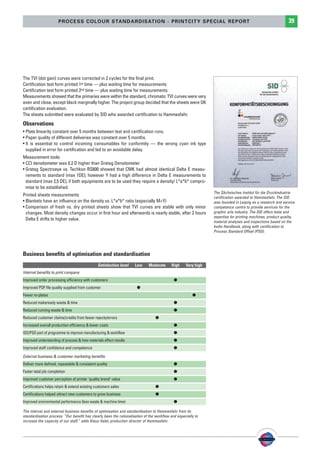
        To better understand the practicalities of process optimisation, standardisation, and certification, a
                                                                                                                       solutions to maintain consistency in each
        case study implementation was made by the PrintCity project team with the sheetfed printer
                                                                                                                       process step. Measuring instruments can
        Hammesfahr. The implementation was a 3-part process:
                                                                                                                       only produce accurate values if they are
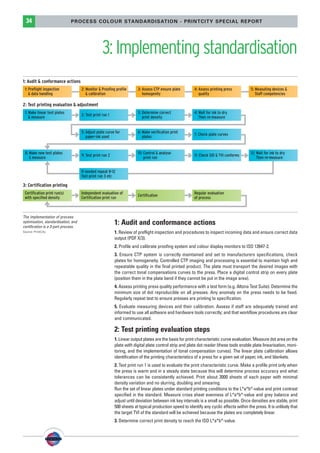
        1: Workflow audit and improvement actions: Includes procedures to inspect incoming data; profile
                                                                                                                       regularly calibrated to the supplier’s
        and calibrate proofing system and colour display monitors to ISO 12646; ensure CTP system is
                                                                                                                       recommendations.
        correctly maintained and set; test printing press quality performance; evaluate measuring devices
        and their calibration; assess if staff are adequately trained and informed to use all software and             6. Effective maintenance and correct
        hardware tools correctly; and that workflow procedures are clear and communicated.                             settings help ensure all production equip-
        2: Test printing evaluation steps: Test print of linear output plates are the basis for print characteristic   ment is operating to specification, and is
        curve evaluation, measure printed results both wet and dry; adjust plate calibration and reprint               fundamental to process stability.
        with new print characteristic curve; re-measure to check if SID and TVI curves conforms to                     7. Understanding the influence of
        ISO 12647-2. Several test-correction loops may be needed until curve is OK.                                    consumables (ink, paper, blanket, etc) and
        3: Certification printing: Repeats previous step but as specified by certification organisation being used.    selecting the optimum material combi-
                                                                                                                       nations to achieve the standard. It is
        More efficient press OKs and makeready                                                                         important to recalibrate press settings if
        While not necessarily part of standardisation, more efficient press OKs and makeready are important            consumables are changed. Standardised
        for all printers. Obtaining rapid colour approval is a team effort for which the essential key to success      consumable materials achieve the best
        is the preparation of the job before it arrives on press. The use of colour measurement tools with an          possible results and should be optimised
        appropriate on press approval method. Human factors are often overlooked in the colour approval                as a system.
        process. These include subjective and varying perceptions of colour, communication and expectations,
                                                                                                                       8. Only implement new plate curves
        and also different viewing environments amongst customer, agency and printer. The use of standard
                                                                                                                       based on controlled data and qualified
        operating procedures during makeready can significantly improve performance.
                                                                                                                       printing conditions. Do not adjust plate
        Members of Hammesfahr staff with PSO certificate. Photo: Hammesfahr                                            curves to compensate for a press in poor
                                                                                                                       condition.
                                                                                                                       9. The key to quality conformance and
                                                                                                                       sustained productivity is regular evalua-
                                                                                                                       tion of the process. Press and platesetter
                                                                                                                       characterisation should be made regu-
                                                                                                                       larly to monitor stability, and, after mainte-
                                                                                                                       nance or changes of consumables that
                                                                                                                       can impact reproduction.
                                                                                                                       10. A change to one press variable may
                                                                                                                       affect colour and/or productivity. Only
                                                                                                                       change a single variable at a time. It is
                                                                                                                       much more difficult to regain process
                                                                                                                       control if several items are changed
                                                                                                                       simultaneously.
PSO-UPM-GB:SEE 25/11/11 19:23 Page10


          10                PROCESS COLOUR STANDARDISATION - PRINTCITY SPECIAL REPORT


                                                     1: Introduction
                                                     Colour management
                                                     Standardisation and process control are core elements of effective colour management. Without
                                                     them, colour management cannot fulfil its objectives.

                                                     Profiles
                                                     Colour space characterisation and profiling: A standardised colour managed workflow requires all
                                                     input sources (cameras and scanner) and output devices (monitor, proofer, press) to be individually
                                                     colour characterised and profiled. Reliable colour management requires defined uniform colour
                                                     management settings in all software applications used at all points of the production chain. This
                                                     includes using profiles in Photoshop applications and embedding the profiles into the created
                                                     images and PDF files.
                                                     RGB workflows: All images are kept in the original profiled RGB colour space and are converted into
                                                     the press colour space before printing. To ensure predictable quality it is recommended to use colour
                                                     servers based on device link profiles. These convert the entire final PDF files into the required colour
                                                     spaces, and the device link profile technology ensures the quality is uniform and predictable.
                                                     Colour conversions: Automated colour servers convert incoming PDF files to the required printing
                                                     standard while harmonising the separation of the data for uniform printability and TAC.
                                                     Ink optimisation: An intelligent GCR separation can stabilise the printing process while saving ink.
                                                     The GCR should be applied automatically in the PDF file before going on the press.
                                                     Press characterisation and profiling: The printing press has the smallest colour gamut and the most
                                                     variables of all devices in the workflow. Therefore, it is the fixed point from which all other devices
                                                     are set, working backwards up the process flow. Official standard profiles should always be used
                                                     for standard printing conditions, as these are the targets for proofing as well as for print production.
                                                     The use of standard profiles for separation and proofing during both prepress and printing is a precon-
                                                     dition for a standardised print workflow that delivers shorter makeready times and less complaints.
                                                     Presses need to be correctly set up and maintained, and periodically measured to ensure that they
                                                     are within tolerance. The printing press has to be calibrated to match the standard (using methods
                                                     like PSO). Calibration must take into account all variables influencing final output. The goal is to
                                                     enable consistent printing to a given standard and tolerances by producing certain target values
                                                     when printed. Normally, a single printing profile for all presses in a plant should be used, providing
                                                     that all presses are printing within a common tolerance range.
                                                     A house standard may be considered when standard profiles do not meet the customer needs (paper
                                                     or ink specification, etc.) and when standard printing conditions cannot be applied. In this case, an indi-
                                                     vidual press profile is the starting point to create a profile using the required paper and ink – the choice
                                                     of paper determines the amount of ink that can be used. An individual press profile should be done only
                                                     for printing conditions where no official standard is available, e.g. when using highly pigmented inks.
                                                     Standard Printing Conditions
                                                     Standard printing conditions are available for offset and gavure printing with different paper cate-
                                                     gories. They exist both as pure measurement data (characterisation-data) and as ICC profiles
                                                     calculated from this data. The ICC acts as a worldwide registry for characterisation data of standard
                                                     printing conditions. The most commonly used standard printing conditions data is provided by
                                                     Fogra and CGATS. ICC profiles calculated from Fogra and CGATS characterisation data are available
                                                     free of charge from ECI (www.eci.org) and IDEAlliance® www.idealliance.org.
                                                     Some standard printing conditions represent printing processes and paper categories as defined in
                                                     ISO 12647-2 and ISO 12647-3. Other standard printing conditions represent paper categories
                                                     currently not defined in ISO 12647-2, but which are widely used in the printing industry.


                                                           Device color space A                         PCS                      Device color space B
                                       Source: GMG
PSO-UPM-GB:SEE 25/11/11 19:23 Page11


                            PROCESS COLOUR STANDARDISATION - PRINTCITY SPECIAL REPORT                                                                          11


        Using ICC standard profiles or device link technology                                                        The advantages of device link profiles for
        ICC colour management technology became increasingly important with the growth of inkjet                     proofing and colour conversion include:
        proofing in the 1990s. ICC is often regarded as the standard for colour management. However, it does         1. Proofing: A device link profile converts
        not always lead to a uniform and maximum quality for producing CMYK-to-CMYK conversions, or for              incoming CMYK data into the colour space
        contract proofs. The aim of ICC technology was to create a standard format for colour profiles to            of the proofing printer so that the colour
        permit simple colour conversion between different devices and give an accurate description of how            impression corresponds to the reference
        profiles must be structured and used. However, it did not contain a detailed description of workflows        printing conditions. The device link profile
        for colour accurate publishing, nor did it ensure that ICC compatible application programmes                 should always be based on a calibration
        function reliably; the ICC specification lacks references for quality assurance. These issues can lead       that enables constant colour rendition on
        to problems in the colour management including:                                                              proofing printers at different sites to ensure
        1. No standardised Colour Management Module (CMM): An ICC colour profile describes the rela-                 that a proof can be reproduced identically
        tionship between a device and an independent L*a*b* or XYZ colour space – the Profile                        at different locations. There are no
        Connection Space (PCS). The CMM handles conversion from the source colour space to the target                variables in the profile quality and the
        colour space with the help of the colour profiles. ICC conversion always involves the transformation         conversion strategy, attributes that are
        of device colour space A converted into the PCS and subsequently into device colour space B. ICC             fundamental for remote proofing.
        compliant CMMs are available from several manufacturers, but because they use different algo-                2. Colour conversion with device link
        rithms they can have different colour outcomes. Some CMMs offer their own Gamut Mapping                      profiles: Device link profiles have two
        methods that are not defined in the ICC specification.                                                       colour spaces directly linked to each other
        2. Gamut Mapping: Used when converting from a large colour space to a smaller one. Every                     that can have different functions in colour
        manufacturer of profiling tools applies its own Gamut Mapping strategies, particularly with the              conversion: separation-preserving colour
        perceptual rendering intent used for conversion from RGB to CMYK, resulting in clear visual                  conversion, e.g. from an industry standard
        differences in converted files.                                                                              to an in-house standard; separation-
        3. Profile quality: The ICC technology does not define a standardised calculation for profiling. Data         preserving colour conversion with reduc-
        processed using different tools will lead to different results. The quality of an ICC profile is             tion of total ink application; re-separating
        not defined and is highly dependent on the expertise of the software developers. Any breaks and              colour conversion with preservation of
        reversals occurring in the separations can have a negative impact when printing.                             pure black, e.g. for harmonising different
        4. Private tags: The ICC defines individual remarks as ‘private tags’ that can be attached to a profile.     separations in the data; re-separating
        These tags are rarely understood by other programmes, leading to their being ignored or incorrectly          colour conversion without black preserva-
        interpreted.                                                                                                 tion. Device link profiles have advantages
        5. Black channel problems: ICC profiles do not generally lead to the desired result in colour space          compared to ICC when performing
        transformation as the CMYK data of the target colour space are computed via the PCS conversion               CMYK-to-CMYK and RGB-to-CMYK colour
        colour space. The black composition characteristics – long or short black and first printable dot –          conversion.
        are lost in the process. Black texts and greyscale images are composed in CMYK. During printing,             3. Automatic colour conversion: Fully
        texts and greyscale images composed in four colours would lead to colour shifts in the event of a            automatic colour conversions can rapidly
        slight misregister.                                                                                          prepare print production sources from
        6. Variables in the ICC workflow: The quality of ICC colour conversion is highly dependent on the exper-      different colour spaces and output them
        tise of the software developer. It can be assumed that when using identical starting data, profiles gene-    for a variety of printing processes.
        rated using different profiling tools and interpreted with different CMMs will lead to unpredictable         4. Data conversion: CMYK conversion
        results. This contradicts the standardisation approach and makes communication difficult.                    optimally transforms printing data from one
                                                                                                                     standard or process to another to maintain
        Device link profile technology                                                                               the same colour result. CMYK re-separation
                                                                                                                     standardises the colour composition of the
        Device link technology is specified in the ICC methodology as an optional profile format that directly
                                                                                                                     data to ensure that data from different
        links two colour spaces without taking the detour via the PCS (unlike ICC). Because the method of
                                                                                                                     sources behave identically on the press
        calculation is stored in the device link profile it eliminates the variable parameters of the ICC work-
                                                                                                                     (grey balance is harmonised, the total
        flow (e.g. CMM and Gamut Mapping). Using the same device link profile in different workflows
                                                                                                                     amount of colour standardised). This
        guarantees identical colour rendition. Suitable software can calculate colour transformations as
                                                                                                                     reduces makeready time and waste.
        device link profiles and optimise them if necessary.
                                                                                                                     5. Gamut mapping: This technique ensures
                                                                                                                     that colours are ideally converted between
                                                                                                                     different colour spaces to maintain the
                                                                                                                     harmonious composition of vignettes, and
                                                                                                                     that images retain their contrast and defini-
                                                                                                                     tion in the shadows. Optimum use is made
                                                                                                                     of the printing colour space and colours
                                                                                                                     are not flattened. The files can be simul-
                                                                                                                     taneously scaled and appropriately
                             Device color space A                 Device color space B                               sharpened during processing.
                                                                                                       Source: GMG
PSO-UPM-GB:SEE 25/11/11 19:23 Page12


          12                       PROCESS COLOUR STANDARDISATION - PRINTCITY SPECIAL REPORT


                                                         Standards and implementation
                                                         A standard is a document established by consensus and approved by a recognised body that
          In 2011 there were 69 ISO standards            provides for common and repeated use, rules, guidelines or characteristics for activities or their
          under Graphic Technology (TC 130)              results, aimed at the achievement of the optimum degree of order in a given context. International
          these include:                                 Organisation for Standardisation (ISO) definition.
          ISO 2846 Defines the colorimetric charac-      A standard is a formal process that is reviewed and accepted by a governing body. The ISO is the
          teristics of 4-colour process ink set when     world's largest developer and publisher of International Standards. It is a network of national
          printed on reference papers. However,          standards institutes of 163 countries that forms a bridge between the public and private sectors.
          variations in ink film thickness and           A printing standard is the definition of optimal process target values and tolerances for the tech-
                                                         nology and production conditions. These should provide an optimal average result related to a
          substrate properties make meaningful
                                                         guideline that avoids extremes – they cannot reflect every variable.
          control difficult outside of a laboratory.
                                                         To work in a standardised manner does not only mean that the results meet the requirements
          ISO 3664 Viewing conditions.                   defined by the standard, but also that all processes have been brought under control, are
                                                         measurable, and repeatable. A tight control process to assure the best possible quality in the print
          ISO 12218 Offset plate making available
                                                         production is not dependent upon only one calibration test run. To achieve the best possible quality
          in 1997.
                                                         it is necessary to verify the print result frequently.
          ISO 12635 Plates for offset printing –
          dimensions (2008) is under review for CTP      ISO 12647-2 printing 4-colour process
          system requirements.
                                                         This standard was introduced in 1995 to address process control of halftone colour separations, proof
          ISO 12640 Prepress digital data exchange       and production prints for sheetfed and heatset web offset. It defines incoming data and how this is
          – the 1997 standard is film based.             converted onto the plate and the outcome of ink-on-paper. The target of this standard is NOT the
                                                         standardisation of materials such as paper, ink, press, blankets; it is the differentiation between
          ISO 12642 Input data for characterisation of
                                                         defined (e.g. print process) and undefined (printing ink) variables.
          4-colour process printing.
                                                         What's specified in ISO 12647-2:
          ISO 12646 Displays for colour proofing;        • Five different paper classes with CIELAB coordinates
          characteristics and viewing conditions.        • Primary colour (CMYK) CIELAB coordinates and tolerance for the five paper types
                                                         • Secondary (RGB) coordinates for the five paper types
          ISO 12647 Printing process control. Parts:
                                                         • Tone value references and tolerances for the five paper types
          1 Process control and measurement
                                                         • Definition of midtone spread
            methods
                                                         • CMYK values for use in grey balance patches
          2 Offset, sheetfed and heatset web
                                                         • Primary colour and TVI variation tolerance during the print run.
          3 Coldset offset newspaper
                                                         What's not specified in ISO 12647-2:
          4 Gravure
                                                         • Optimal densities for different paper classes
          5 Screen printing
                                                         • CIELAB values for grey balance
          6 Flexography
                                                         • Paper values from specific suppliers
          7 Hard-copy contract proof digital proofs
                                                         • Ink values from specific suppliers
          8 Validation print – in process.
                                                         • Plate specifications from specific suppliers
          ISO 13655 Spectral measurement and             • Any kind of specific additives or other print related material.
          colorimetric computation.                      This standard defines the measurable results to be achieved but not the specifications or methods
                                                         to attain them.
          ISO 15076 ICC colour management.
          ISO 15930 Digital prepress file exchange       Specifications, Calibration & Implementation
          using PDF/X. Part 7 is complete data for
                                                         A specification is not a standard. Print specifications provide the guideline and framework for
          printing (PDF/X-4) describes what a file
                                                         working with standards.
          needs to conform to for print. Part 8:
                                                         The two most important printing specifications are Fogra 39 from Germany (used in PSO), and
          Partial exchange of printing data using
                                                         GRACoL® from IDEAlliance®, USA. They both consist of characterisation data sets based on inter-
          PDF 1.6 (PDF/X-5).                             pretations of the ISO 12647-2 standard.
          The Ghent PDF Workgroup publishes              Fogra/bvdm and IDEAlliance provide documentation, tools, and requirements for specification
          PDF/X-Plus specifications built on ISO         compliance, but each takes a different approach to press calibration and metrics.
          15930 but with more restrictions (X-1, X-3     Some organisations and user groups make printing trials to help create characterisation charts with
          available, working on X-4).                    colour gamut, such as Fogra 39, to achieve ISO 12647:2specified colorimetric aims.
          ISO/CD 15311-1 Draft new standard              Process Standard Offset (PSO)
          “Requirements for printed matter               PSO is an implementation system (not a specification) that was originally developed in 1980 by Fogra
          utilizing digital printing technologies for    for bvdm (German printers association). It is now sourced from ISO 12647:2 and is an interpretation
          commercial and industrial production –         of the standard that overcomes some of its shortcomings and provides a practical guide to its appli-
          Part 1: Parameters and measurement             cation. After a printer has successfully implemented PSO they can apply for ISO 12647:2 certification.
          methods".                                      PSO uses the principle of TVI correction to ensure an even tone gradation. It also makes use
                                                         of several sets of characterisation data based on test prints on the principal types of paper.
PSO-UPM-GB:SEE 25/11/11 19:23 Page13


                           PROCESS COLOUR STANDARDISATION - PRINTCITY SPECIAL REPORT                                                                             13


        The largest gamut can be achieved on coated wood free paper by using the Fogra 39
        Characterisation data. The primary colours fully comply with the ISO 12647-2 AMD 2007, and while
        secondary colours are slightly different to the standard they are more practical to achieve.
        What's recommended to match Fogra 39 (used in PSO)
        Matching the CIELAB values and gloss values of paper types within tolerances
        Matching tone value increase on 40%, 70% and 80% fulcrum
        Matching maximum spread of CMY on 40% mid tone patch
        Control variation during the press run
        All other values in ISO 12647-2 are only informative and have no influence on pass/ fail criteria for
        standard compliance.
        In real life printing, density measurements are taken during the press run for process control.
        Density aim values are taken from the OK-sheet which needs to be checked for correct CIELAB
        CMYK values according to ISO 12647-2.
        GRACoL®
        The US non-profit industry association IDEAlliance® provides a route to achieve ISO compliant             The Process Standard Offset (PSO) manual was
        printing with GRACoL® specifications for sheetfed and Specifications for Web Offset Publications          first published in 1980 by bvdm. This manual is a
        (SWOP) along with the G7® calibration method and definition of greyscale appearance.                      comprehensive practical guide on how to organise
                                                                                                                  and optimise print production to conform to ISO
        The seventh edition of the GRACoL specification (GRACoL 7) consists of a characterisation data set        12647. A new revised edition in English and
        based upon an early beta version of the Fogra 39 data set, adjusted to fit the Neutral Print Density      German will be available in 2012 covering all offset
        Curve (NPDC) and grey balance definition defined by G7. Although closely tied to ISO 12647-2,             processes. www.pso-insider.de
        GRACoL 7’s NPDC curves are not part of the ISO standard but are based on the device-independent
        G7® specification. The NPDC is the heart of G7 and was derived by analysing the neutral tonality of
        typical ISO Standard commercial offset printing using CTP-based plates as opposed to film-based
        plates. G7 defines greyscale appearance and a calibration method to adjust any CMYK imaging
        device to simulate the G7 greyscale definition. It uses four one-dimensional curves to provide a visual
        neutral match between different imaging systems and enables shared neutral appearance
        between different printing devices or specifications when additional colour management is not
        available. It can be thought of as an implementation of the new ISO 10128 Technical Specification
        for “Near Neutral Calibration” but with a number of advantages not mentioned in ISO 10128,
        specifically shared neutral appearance, paper relative grey balance, automatic dynamic range
        adaptation and device-independent tonality. A key advantage of G7 compared to the Near Neutral
        Calibration definition described in ISO 10128 is that the NPDC, grey balance definition and calibra-
        tion methodology are the same for any imaging technology, regardless of substrate, pigments,
        screening technologies, etc. This means that G7 can be applied to any imaging system without
        alteration, and will result in similar print appearance (at least in neutral grey image areas), given
        similar substrate colour and similar maximum neutral density
        G7 is widely used in North America, Asia, Latin America and elsewhere, and was carefully
        designed to comply with the ISO 12647-2 standard when applied to commercial offset printing. The
        G7 calibration and process control method replaces separate TVI values with a single grey balance
        and NPDC aims. CTP curves are adjusted to achieve a predefined NPDC for CMY balanced grey
        scale and a K-only scale. IDEAlliance no longer specifies TVI, solid ink density [SID], or print
        contrast targets.
        IDEAlliance has always recognised the value of TVI as a process control tool and recommends a
        combination of standardised G7 aim points and custom (user-determined) TVI aim points as the ideal
        total process control approach.
        What's specified in GRACoL:
        • Primary colour (CMYK) CIELAB coordinates according to paper type
        • Secondary (RGB) CIELAB coordinates according to paper type
        • G7 NPDC (see below)
        • G7 Grey Balance (see below)
        What's specified in G7:                                                                                   “Guidelines & Specifications 2007” IDEAlliance®
        • Near neutral print density curve for combined CMY grey scale                                            “HOW TO — A step by Step Guide to Calibrating,
        • Near neutral print density curve for K black ink scale                                                  Printing & Proofing by the G7 Method” IDEAlliance®
        • Paper-relative CIELAB grey balance target values                                                        www.idealliance.org
        What's not specified in the G7 calibration method:
        • Tone value increase tolerances
        • Optimal densities for different paper classes to reach ISO CIELAB values for CMYK
PSO-UPM-GB:SEE 25/11/11 19:23 Page14


          14                PROCESS COLOUR STANDARDISATION - PRINTCITY SPECIAL REPORT


                                        Certification of a Standard?
                                        Certification is the written accreditation by a credible organisation that a company’s services,
                                        production processes or products have been tested to be in conformance with a relevant standard(s).
                                        An ISO TC 130 survey of printers certified to a standard worldwide reported in 2010 that only 661
                                        printers were operating with a certified process (60% Fogra, 15% UGRA and 25% other). This is less
                                        than 0.002% of the world’s printers. Printing without certification to a standard is probably much
                                        higher, for example around 3,500 PSO manuals have been sold up until 2010, but only around 10% of
                                        the manuals have led to certification. Certification is becoming an important requirement of some
                                        print buyers who want more formal and accountable quality control and consistency.
                                        Normally ISO audits and certifications can only be conducted and delivered by companies and
                                        organisations that are themselves authorised and accredited by their national ISO body represen-
                                        tative. However, the current ISO 12647 has no defined method of certification within the standard and
                                        for this reason an ISO/TC 130 group is working on recommendations for a single international certi-
                                        fication method.
                                        As a result, current ISO 12647 certifications are private, and are more or less recognised by the inter-
                                        national community. There are important differences between them in their requirements, criteria,
                                        testing, auditing etc. A key issue is the accreditation, competence, consistency and impartiality of
                                        the certifying organisation and their independence of related consulting activities. The costs,
                                        requirements, and frequency of private certifications are also variable.
                                        The most widely used certification (about 60%) is Germany’s Fogra/bvdm's PSO (Process Standard
                                        Offset); Switzerland’s UGRA is also long established and accounts for around 15% of certifications.
                                        A more recent approach in the UK, Sweden, and USA combines parts of ISO 9001 printing quality
                                        management system certification and the ISO 17021 general audit requirement as a vehicle to
                                        certify ISO 12647 (this includes documented procedures for customer complaints and corrective
                                        actions).
                                        Some of the principal national approaches with data correct to March 2011, include:
                                        China: 48 printers have G7 Master Printer certification from IDEAlliance and their partner APTEC in
                                        Hong Kong. There are 2 EUGRA and 2 Fogra certifications.
                                        France: Around 20 printers have UGRA certification. France-PSO is a non-profit organisation to promote
                                        and help implement ISO 12647-2, and guide printers to UGRA certification.
                                        Germany: Since 2002, Fogra and bvdm have acted together as certifier or co-certifier, and certified
                                        over 400 companies worldwide with around 300 in Germany (see www.psoinsider.de). The SID in
                                        Leipzig also has a certification service.
                                        Italy: CertiCarGraf from Italian Printing Association but with no certified companies to 2010. UGRA
                                        has certified some.
                                        Netherlands and Belgium, SCGM: The Stichting Certificatie Grafimedia Branche (SCGM) is the inde-
                                        pendent certification institute for the printing, media and packaging industry in the Netherlands and
                                        Belgium and provides ISO certification accredited by the Royal KVGO and the Kartoflex. www.scgm.nl
                                        Spain: Around 100 certified printers. Multiple certification services from local partners of UGRA and
                                        Fogra (RCC Consultants); AIDO, the Technological Institute for Optics, Colour and Imaging, has
                                        developed its own certification supported by the National Entity of Accreditation in Spain.
                                        Sweden: Printing Federation (GFF) recently introduced Certified Graphic Production (CGP) that
                                        incorporates ISO 9001 Quality Management System.
                                        Switzerland: The UGRA printing technology institute provides international certification of materials,
                                        persons and companies to different standards or specifications, including ISO. www.ugra.ch
                                        UK: About 100 printers have used multiple certification choices. A new scheme, Print and Media
                                        Certification (PMC), launched by the British Printers Industry Federation (BPIF) includes core parts
                                        of the ISO 9001 Quality Management principles, with accredited certification from UKAS. BPIF, as
                                        a part of ISO/TC130 WG13, is participating in the development of the printing quality management
                                        system standard. BPIF has stated it intends to replace its current Colour Quality Management
                                        Scheme with this new standard once development is completed.
                                        USA: Rochester Institute of Technology (RIT) launched Printing Standards AuditSM (PSA) Certification
                                        in May 2011. This certification is designed to be compatible with all recognised printing standards, and
                                        will certify both ISO 12647-2 and G7 Targeted compliant workflows. Two certification levels are:
                                        (1) PSASM Certified: Organisations technically capable of operating a standards compliant workflow.
                                        PSASM Certification will be extended to include the proposed Process Independent Standard (ISO 15339)
                                        as soon as this standard is approved by ISO/TC 130; and (2) PSASM Certified with HonorsHonours:
                                        Organisations routinely practicing and continuously improving a standards compliant workflow (under
                                        development as a part of ISO/TC130 WG13 activities).
PSO-UPM-GB:SEE 25/11/11 19:23 Page15


                            PROCESS COLOUR STANDARDISATION - PRINTCITY SPECIAL REPORT                                                                                   15


        Key control parameters
        1. Colour/grey balance
        Colour balance in printing is the relationship between the four process colours and is the key factor
        for a good production match. Human perception is highly sensitive to technical deviations affecting
        the colour balance – particularly in midtones. Divergent TVI in the CMY process inks are the main
        reason for a shift of balance in printing.
        To obtain visually consistent results for images with low contrast, or mainly grey areas, the devia-
        tions in midtone balance should ideally not be larger than +/-2% in TVI between the highest and
        lowest values. However, large printing variations often allow a tolerance of +/- 4% TVI spread in
        midtones and improving process consistency is the major prerequisite to achieve narrow tole-
        rances. The gap between perception of colour deviations and the technical limits can be reduced
        with grey stabilisation. It is better to keep the neutral balance on a higher or lower level of TVI
        because human perception is less sensitive to changes in gradation (darker or lighter) than it is to
        colour balance shifts.
        A midtone grey balance patch is an effective visual control method.

        2. TVI (Tone Value Increase)
        An important element in colour reproduction is TVI (also called dot gain). TVI is expressed as the
        difference in ink coverage between a theoretical value (prepress) and the print. TVI has a mecha-                       30
        nical and an optical component.
        Mechanical TVI is when the size of the printing dots tends to increase during transfer from plate to                    25
        blanket and from blanket to paper. CTP platemaking can increase or decrease dot size if the
        devices are not correctly calibrated. Other influencing factors can include the ink and dampening                       20
        solution.                                                                                                    dot gain
        Optical TVI is due to the refraction of light at the interface between the ink and the paper surface                    15
        (which is by definition uneven).
        A standard spectrophotometer using the Murray-Davis formula measures both the mechanical and                            10
        optical components. TVI is measured in the midtones, where it has the highest impact and the
        largest variations. There is a 6-8% difference in TVI between analogue positive and negative plates.                     5
        With CTP plate, this systematic difference can be corrected by a different transfer curve on the RIP,
        making TVI closer to the results of analogue positive plates. However, for many other reasons CTP                       0
        plate has more variations and the process has to be closely monitored. Screen ruling and paper                          %0         20    40        60    80      100
                                                                                                                                                dot percentage
        grade have a high influence on TVI and need to be specified with the customer.
        The relationship between the four process colours is the key factor for a good production match on                           52 l/cm          60 l/cm         70 l/cm
        press. It is better to keep the neutral balance on a higher or lower level of TVI because human
                                                                                                                                     80 l/cm          90 l/cm
        perception is less sensitive to changes in gradation (darker or lighter) than to colour balance shifts
                                                                                                                     A sheetfed example on the effect of screening
        3. SID (Solid Ink Density)                                                                                   on TVI. Source: Sappi
        SID affects the total contrast (saturation) of a picture and, to a lesser extent, its shadow balance
        (if SIDs in the CMY inks have divergent variations). The SID value changes with the type of density
        measurement, e.g. ISO Status E or Status T — mainly used in North America — Status T shows a
        lower SID value than Status E for yellow. Polarisation filters are often used when measuring print
        density in sheetfed offset. A polarisation filter reduces the amount of white light caused by surface
        scattering reaching the detector. In this way it mimics the situation when measuring wet ink film
        where surface scattering is reduced by the high gloss of wet ink film. The idea is to have similar print
        density values regardless of the status of ink film drying. For this reason the values with a polarisation
        filter are higher than corresponding values without the filter. In ISO 12647-2 the target values for solid
        CMYK are expressed in L*a*b*-values. Therefore, it is necessary to translate the standard shade
        targets into press density targets. One of the most accurate ways to do this is to print solids in all
        process colours and black on the chosen substrate, with the chosen ink. The prints are made at
        different densities – for example, increasing – and for each print, the shade on the print is
        measured and compared to the target. The colour difference ΔE can be calculated and the
        optimum density is found at the smallest ΔE.
PSO-UPM-GB:SEE 25/11/11 19:23 Page16


          16                        PROCESS COLOUR STANDARDISATION - PRINTCITY SPECIAL REPORT


                                                            Measuring and control
                                                            It is important to understand the purpose, intention and relative performance of densitometric and
                                                            colorimetric measurement systems to use these tools correctly in offset printing.
                                                            Densitometry
                                                            Densitometry measurement is directly linked to the ink layer thickness and it allows a precise and
                                                            realistic control of the ink thickness zone by zone. Currently, there is no alternative to density for
                                                            controlling the ink.
                                                            A reflection densitometer measures absorbed light and will calculate the screen density, TVI, ink film
                                                            thickness density in solids, grey balance, print contrast and trapping. However, this device is colour-
                                                            blind and relies on filters and software to identify and measure colours. Densitometers are not
                                                            recommended ISO measurement devices because ISO uses L*a*b*-values. Some printers continue
                                                            to use densitometers as a control device once correctly adjusted to spectrophotometer values,
        Equipment required includes image analyser
        to control dot size on plate, densitometer,         Spectrophotometry
        spectrophotometer, and software for control         Colour values are usually calculated by spectral data measured by a spectrophotometer. Colour
        and visualisation. Source: Sun Chemical             values specify the visual properties of a colour and are a physical approximation of human colour
                                                            vision. Colour values are used to define a target colour if the reproduction of a colour is acceptable.
                                                            There are several ways to define these target colour coordinates. Either a reference sample can
                                                            be measured (i.e. proof, OK sheet) and taken as target colour or it can be defined as numbers
                                                            (i.e. CIELAB colour values). The distance between two colours in a perceptual colour space is
                                                            defined as colour difference (Delta E).
                                                            A spectrophotometer measures light reflection over the whole range of visible wavelengths to
                                                            provide an accurate definition and analysis of colour. They can be used to produce ICC profiles for
                                                            monitors and printing, measure control strips, and colour deviations between a digital proof and
                                                            printed sheet; they can also be used as a densitometer because measurements can be recalculated
                                                            to density values. Some printers use spectrophotometers to measure any variations in new
                                                            batches of ink and plates on delivery to avoid surprises during production. Some CTP systems
                                                            automate this measuring.
                                                            Wet or dry measurements?
                                                            Standards recommend measuring colour values only on dry sheets because colour values shift as
                                                            the ink dries. The intensity of this change rapidly decreases within seconds of printing and is only
                                                            a minor problem for offline measuring systems. A polarisation filter on a densitometer provides a
                                                            comparable density measurement on wet and dry ink to accurately control press ink zones. The
                                                            polarisation filter eliminates surface scattering, making the dry ink film look like wet ink. A polarisation
                                                            filter is essential for inline on press devices that measure totally wet ink directly after printing.
                                                            Spectrophotometer colour measurement values approximate human colour vision and a polarisa-
                                                            tion filter cannot be used because it influences colour values in an unacceptable manner. Inline
                                                            measuring is therefore not recommended, as polarisation filters cannot be used to eliminate the
                                                            colour shifting effect due to drying.
                                                            Online density measurement with a closed loop system is recommended because it provides
                                                            instant and precise control. It should be combined with offline spectrophotometer measurement of
                                                            colour values.
                                                            White or black backing?
                                                            Paper opacity can make measurement problematic, e.g. if the control strips on both sides of the sheet
                                                            face each other then a dark area on the reverse side of the paper may influence the result.
                                                            Although white backing is usually used when measuring production prints, black backing is used to
                                                            decrease the effect of reverse side. For this reason the black backing values in ISO 12647-2 are
        A test form to calibrate the press to ISO 12647-2
                                                            normative and white backing values are only informative.
        (TVI), or the G7 (grey balance) method using GMG
        PrintControl 2.0 or similar. Source: GMG            Standardisation according to ISO 12647-2
                                                            Within ISO 12647-2, target values of colour (CIELAB) and TVI are defined. There is no definition of
                                                            density values because the same density printed with different inks and/or paper results in different
                                                            colour appearance.
                                                            A first step to realise process standardisation is to evaluate the correct density value for a particular
                                                            combination of ink and paper. Using this density, the target colour values according to ISO 12647-2
                                                            have to be reached by a tolerance of Delta E 5. As the target colour values defined by ISO are meant
                                                            for dry sheets, the wet densities have to be matched with respective dry colour values. Using the
                                                            densities a test print run for print curve evaluation has to be conducted. If the results are stable within
                                                            given colour tolerances, print characteristic curves can be adjusted until they are also within given
                                                            ISO TVI and spreading tolerances. This procedure has to be conducted for different combinations of
                                                            ink and paper. Mostly, it is adequate to conduct this only once for a number of similar combinations.
PSO-UPM-GB:SEE 25/11/11 19:23 Page17


                            PROCESS COLOUR STANDARDISATION - PRINTCITY SPECIAL REPORT                                                                               17


        Grey balance control
        Ink control based on solid ink density only partly matches the requirements of quality printing. Grey
        balance measurement and control gives significantly better process stability for 4-colour-printing
        (screen images), particularly for print jobs with difficult images.
        TAC (Total Area Coverage)
        Defines by % the combined CMYK dot area (tonal value) by adding the values of each colour in the
        darkest area of the separation. Theoretically, laying down 100% solids of each colour (TAC of 400%)
        would achieve the best black area but this causes colour variability. TAC is measured on the
        original file and controlled during image preparation. TAC should be checked in the darkest area of
        the film or electronic file and read in the same spot for each colour on final film or CTP file.
        Maximum TAC is influenced by the substrate.
                                                                                                                    Assessing plate evenness. Photo: UPM
        Other devices
        Colorimeter: Low cost device using filters and software; reads and expresses CIELab value to verify
        colour gamut (preferred in ISO 12647 standards and for measuring ICC profiles); also used to cali-
        brate and characterise monitors.
        Plate reader: Special device to measure screen density on printing plates to ensure that they are
        correctly exposed and processed and are within correct tolerances; essential to calibrate and
        linearise a CTP device.
        Processless plates do not always allow the measurement of the image on plates directly after
        exposure, as the image contrast between exposed and non-exposed area is less than that on tradi-
        tional processed plates. Processless plates can be measured by some plate readers like other CTP
        plates after manual removal of the non-image area using a cloth soaked with dampening solution.
        Measuring instruments can only produce accurate values if they are regularly calibrated to the
        supplier’s recommendations. Be cautious when selecting devices to ensure that their calibration
        does not require an external technician or factory calibration. Similarly, lamps and filters need
        periodic replacement.
        Calibration: All measurement devices need to be serviced and calibrated on a regular basis,
        usually once a year. For density meters, check and adjust using the density calibration card that is
        shipped with the device. Check with your provider for more information.
        Status E/Status T filter choice: Set the correct density filter settings. USA is usually Status T (or ANSI
        T); rest of the world Status E (or ANSI E). The colour most affected by the choice of filter is yellow,
        and can show differences of up to 0.3 density between Status E and Status T.
        Measurement conditions: Verify that the measuring conditions for the device are always D50
        illuminant; 2° observer; 0/45° or 45/0° geometry; absolute white for colorimetric measurements;
        relative or absolute white for densitometric measurements; a polarisation filter is recommended for
        density measurements (if supported in device) but NOT for colorimetric.
        Backing: Gives a more brilliant look to work. White backing is preferred by prepress, and is always
        used when judging/measuring contract proofs (the white backing must conform to ISO). However,
        black backing is required by printers to avoid show through of ink printed on first side (black
        backing or a stack of at least 5 sheets of the paper used).
        Viewing conditions: Lighting conditions should comply with ISO 3664. A measurement device can
        be used to check the quality of the light to the CRI (Colour Rendering Index). Check the lighting system
        counter (if present) for required tube change.
                                                                                                                    The Altona test suite includes a test form to visually
        Test Forms: Altona Test Suite, a joint industry development that includes:                                  compare print quality in reference to the standard.
        1. Altona Test Suite – Application Kit: Reference prints, colour specimens (Process Colour Solids),         Source: www.eci.org

        test suite files, characterisation data, ICC profiles, documentation (available from bvdm).
        2. Altona Measure: ECI 2002 , characterisation target, pattern for print definition characterisation,
        pattern for solid tone measurement, Altona Visual, form for visual judgement, elements to control right
        settings in prepress workflow (free of charge download from www.eci.org).
        3. Altona Test Suite: Purpose form for visual judgement, elements to control right settings in
        prepress workflow. Testing of ISO 12647 compatibility of output devices: proofer, printer (computer),
        monitors, presses, test of the compliance to an PDF X3 workflow ISO standard (free of charge
        download from www.eci.org).

        A completely new Altona Test Suite 2.0 Application Kit will be published in 2011 (bvdm) able to test
        all PDF/X-4 specifications (15930-7).
PSO-UPM-GB:SEE 25/11/11 19:23 Page18


          18                       PROCESS COLOUR STANDARDISATION - PRINTCITY SPECIAL REPORT


                                                       2: Key influences on quality
                                                       There are many variables that influence colour, even in a standardised process. Colour rendition from
                                                       print run to print run, or during production printing, is subject to fluctuations in relation to solid
                                                       inking, TVI and trapping, from a changed ink/water balance, or from different substrates. Even
                                                       under standard conditions with minimal variations, it is practically impossible to conform exactly
                                                       to a given set of primary parameters. This is due to typical production tolerances and unavoidable
                                                       differences in press, ink and paper that have to be accepted.
                                                       • Primary process parameters with a direct bearing on visual characteristics of the image include
                                                         printing sequence, press, ink, substrate, screening, and plate.
                                                       • Secondary parameters that can indirectly influence the image (by changing the values of the
                                                         primary parameters) include: speed, dampening solutions, additives, cylinder packaging and blan-
                                                         kets, ink/water balance, roller setting, ink film thickness, trapping, temperature and humidity.

                                                       Print job preparation & design
                                                       Obtaining reliable printed results is a team effort to plan and prepare a print job correctly before it
                                                       arrives on press. The print buyer/designer should:
                                                       • Define clear specifications including paper and bindery.
                                                       • Determine the quality expectation and industry standard to be used.
                                                       • Type of files to be supplied.
                                                       • Identify the type of proof required and viewing conditions.
                                                       Many printing problems can be avoided or minimised in the design stage by working within the
                                                       process limitations and the reproduction qualities of the paper. Printers and paper suppliers can
                                                       provide valuable advice in these areas. Ideally, these issues should be discussed with the printer at the
                                                       concept stage when modification of the design layout can be made to align with printing constraints.
                                                       Most prepress work and proofing is made before the printing data and proofs are send to the printer.
                                                       It is important to agree in advance the printing standard to be used by prepress, proofing and
                                                       printing. This will ensure the separation of RGB images and proofing fit to the standard of the printer.
                                                       Printers should be supplied with prepress adjusted to paper grade with specifications for SID, TVI
          10 common problems with digital              and contrast; colour control bars and patches on all forms; and, ideally, proofs that are compatible
          premedia files (Source GRACoL)               to the process. Applying GCR, UCA, or UCR techniques can improve printing quality, run performance
          • Wrong or missing fonts.                    and reduce ink consumption. See page 19.
          • Banding.                                   During job preparation use PSO, GRACoL and SWOP ICC profiles for the general paper category
          • Incomplete or corrupt files.               selected. It is recommended to use the standard profiles from ECI or IDEAlliance for the separation
          • Excessive sizing/rotating of image files   of RGB images and for proofing the print ready data before delivery to the printer. This ensures the
            in the page layout programme.              separation of RGB images is optimal for the chosen paper category and that the proof can be
          • Spot colours not converted to process      matched by the printer with a short makeready time.
            colours or vice versa.                     It is the content originator’s responsibility to calibrate their monitors, scanners and cameras. Good
          • Wrong page size.                           communication, workflow process understanding and submission of sample files prior to the start
          • Low-resolution images.                     of production are a good practice.
          • Inadequate bleeds.                         Correct software avoids colour management errors when moving from RGB to CMYK colour space
          • Improper or incorrect trapping.            for proofing and printing. The large RGB colour gamut needs to be compressed to the smaller
          • Improperly reformatted files.              CMYK gamut without compromising the colours in the image. Colours outside the CMYK gamut
                                                       are replaced with colours that come closest to the printing device being used.

                                                       GCR for process stabilisation in offset printing
                                                       Grey Colour Replacement (GCR) helps stabilise the printing process and improves the contrast and
                                                       the definition in the shadows. Separations are harmonised by the optimisation process, allowing
                                                       images from different data sources to behave identically on press. Ink savings of up to 20% are
                                                       possible because GCR increases the achromatic component. The lower level of inking leads to
                                                       easier control, tighter tolerances, faster makeready with less waste, and better drying properties.
                                                       The stability, colorimetric and visual match between production print and reference proof are
                                                       improved by using GCR to replace the chromatic grey components in grey and tertiary areas. This
                                                       overcomes the alternating colour shift of the grey balance that can be attributed to the separation
                                                       having too high a chromatic component in the quarter, middle and three-quartertones.
                                                       To reduce the chromatic ink, the black component has to be increased in the tertiary areas, and the
                                                       chromatic component harmoniously reduced. The black channel must be calculated correctly to
                                                       ensure the CMY separations are homogeneous; if not, breaks occur in the colour separations and
                                                       consequent printing. It is in this process that the quality of GCR software is demonstrated.
PSO-UPM-GB:SEE 25/11/11 19:23 Page19


                            PROCESS COLOUR STANDARDISATION - PRINTCITY SPECIAL REPORT                                                                                      19


        The starting point for black describes the tonal value in combined printing (CMY) where black
        starts replacing chromatic colours. A very early starting point can lead to the black screen
        structure being visible in the highlights, even when using fine screens. A starting point for black in
        the region of 8% is normally recommended and should be implemented in the optimisation profiles.
        The maximum tonal value for black determines the tonal value up to which black is added to the
        separations. Different printing processes and paper classes require different maximum tonal
        values for black.
        To avoid problems in printing and finishing, the total ink coverage has to be taken into account.
        Printing data are usually optimised before plate making, and generally include a limitation of the total
        ink application. The optimisation profiles should allow an automatic reduction of the total ink appli-
        cation and avoid problems from excessive ink coverage. Optimisation profiles with a very high level
        of GCR can be used in offset. Profiles should have different GCR intensities that can be selected to
        match the press, printer, job and reproducibility.
        The grey balance values for a given set of inks, paper and tone transfer characteristics describe
        the relationships of the three colours to each other necessary to maintain a grey throughout the
        tone scale.
        Printing tests
        A series of sheetfed and web offset printing tests confirms this process stabilisation. The sheetfed
        offset example (graphic) is printed to ISO 12647-2:2002 on a Class 1 paper. The test data were
                                                                                                                   The top scatter diagram shows the print with
        images and test charts were prepared using ECI's ISOcoated ICC profile. The data were addi-                non-optimised data and the comparison with
        tionally optimised with GMG InkOptimizer software with the option to maximise ink savings. The two         ISO-coated. A marked shift in the grey balance
        data records were printed next to each other on the same sheet and subsequently evaluated as               towards violet can be seen, and the brightness
        described below.                                                                                           distribution indicates a tendency towards
        Grey balance/tertiary colours: Optimisation significantly improves the rendition of the grey balance.      excessively bright colour rendition in print. The
                                                                                                                   same print with optimised data (bottom scatter
        Errors in the ratio of the TVIs to each other are compensated because the grey balance is primarily        diagram) does not display this tendency. The grey
        composed of black ink. This makes it easier for the printer to adjust grey balance simply by over- or      balance is far more neutral, and the brightness
        under-inking black. The printer can regulate CMY density to optimise the colours on the press              deviations are also visibly smaller.
                                                                                                                   Source: Based on report from David Radtke, GMG Color,
        relative to the proof without the grey balance changing. Tertiary colours are stabilised because the       originally published in Deutscher Drucker in 2007.
        total ink application is reduced from the higher black component, optimising the overprinting
        properties of the individual inks.
        Scatter diagrams: The improved quality of the tertiary colours and the grey balance from GCR opti-
        misation was colorimetric tested using an ECI 2002r chart. The scatter diagrams illustrate the local
        distribution of the differences between the colorimetric target and actual values (the ISO coated
        characterisation data and the test print). The scatter diagrams are divided into chroma and bright-
        ness. The more the values are scattered, the greater the deviations between the characterisation
        data and the measurements obtained on the print. The improvement achieved by using GCR is also
        illustrated on the basis of colorimetric figures (see Table).


          ! Available GCR optimisation solutions have a wide variation in quality; testing is recommended prior
          to selection. The test form should include critical images in the grey balance range and vignettes
          with tertiary colour ranges. Complete solutions for ink reduction should include an automated PDF
          colour server and profiles for ISO standards. These products work with Device Link Profiles that
          adapt (but also preserve) the separation of the data without changing the result colorimetric.
PSO-UPM-GB:SEE 25/11/11 19:23 Page20


          20                PROCESS COLOUR STANDARDISATION - PRINTCITY SPECIAL REPORT


                    PDF/X digital data standard and workflow
                                        The goals of PDF/X are to improve colour and content matches from proof-to-proof, proof-to-press,
                                        and press-to-press; reduce processing errors; enable effective preflighting of files; and enable use
                                        of multi-vendor systems at single or multiple sites. Poor files, errors in prepress and untrustworthy
                                        proofs lead to a waste of time and materials that increases costs, errors and delays to a print job.
                                        ISO 15930 defines how applications to create and read PDF/X files should behave for reliable
                                        prepress data interchange. The aim for designers is to supply a digital content file that will be
                                        printed predictably, while printers and publishers receive robust files, avoiding reworking or errors.
                                        PDF/X is designed to be easy and cheap to create. The key term is “process control”. Reliable
                                        content file delivery is every bit as important as waste management and is a prerequisite
                                        for automation.
                                        CMYK vs. device independent
                                        Two issues are treated separately in the standard. CMYK data exchange is used if the file originator
                                        wants complete control over the final appearance of printed image. Alternatively, device indepen-
                                        dent colour spaces (usually CIELab or RGB tagged with an ICC profile) give printers more flexibility
                                        to re-purpose content between multiple print formats, and to reduce file size.
                                        Open vs. blind exchange
                                        Users have different needs that require more (open) or less (blind) requirements for exchange of
                                        additional technical information. This led to the creation of several PDF/X standards; each is a
                                        superset of the preceding one and restrictions are removed in a staged manner.
                                        PDF/X-1a for CMYK-only blind exchange: Files are delivered in CMYK and their values do not
                                        specify a particular colour until the printing device is defined. The same values for printed gravure,
                                        flexo, offset, or inkjet will usually look different. Groups such as GRACoL, CGATS SC3, Fogra, and ECI
                                        are working on characterisations and associated ICC profiles.
                                        PDF/X-3 for colour-managed blind exchange: Files transfer data in colour spaces like CIELab or
                                        RGB with a profile attached. Different prepress software may handle embedded ICC profiles in
                                        colour managed jobs, which means care is needed that a proof of device independent colours will
                                        accurately predict the final printing.
                                        PDF/X Plus: Defines requirements specific to a sector, e.g. image resolution, type size, bleeds, etc.
                                        Each is a superset of a specified PDF/X standard.
                                        PDF/X-4: Becoming the standard for colour managed blind exchange, based on PDF 1.6, with live
                                        transparencies. Files transfer data in colour spaces like CIELab, RGB or CMYK with a profile
                                        attached. Different prepress software may handle embedded ICC profiles in colour managed jobs,
                                        and live transparencies flattening, which means care is needed that a proof of device independent
                                        colours will accurately predict the final printing.
                                        Application
                                        PDF/X should be used by anyone generating files to send to a print service provider and it is impor-
                                        tant to check specific requirements with printer or publisher. Making PDF/X files is a useful creative
                                        discipline to construct workflows with appropriate pre-transmission validation steps.
                                        A PDF/X file is always labelled with the name of the characterised printing condition that was
                                        assumed when the file was created. It provides an early warning to the printer if a customer sends
                                        a file that is not suitable for their presses. It also ensures that the supplier and the receiver can set
                                        up their proofing in a compatible way to see the same results. It is important to ensure that the label
                                        applied to the PDF matches how the file was made. If the file includes CMYK images separated from
                                        RGB or L*a*b*, the label in the resulting PDF/X file must match the profile used for the separation.
                                        It is extremely difficult for preflight software to validate the selection of a label. Other information
                                        required includes:
                                        ‘OutputConditionIdentifier’, this field must be exactly completed to allow automated preflighting. Some
                                        software will default to using ‘Custom’ for this field, and many printers will treat this as suspect
                                        because the file may need adjustment.
                                        ‘OutputCondition’ or ‘Info’ requires a more complete description of the print condition, e.g.
                                        embedded profile (if there is one), maximum total ink coverage, or if there are high- or low-key
                                        images. Caution: the printer’s prepress workflow may not display this data, so if it is important it
                                        should also be included as a comment on the order.
                                        Other key data includes the ‘TrimBox’ that indicates the position and size of the page surface; and
                                        ‘BleedBox’ that adds the area needed for the bleed trim.
PSO-UPM-GB:SEE 25/11/11 19:23 Page21


                            PROCESS COLOUR STANDARDISATION - PRINTCITY SPECIAL REPORT                                21


        Prepress workflows with PDF/X
        The complete prepress workflow (trapping, compositing partial page submissions, imposition and
        RIPing) must be PDF/X compliant for proofing and final output. There are only a few key issues to
        ensure that PDF/X files process reliably and predictably, and that the final printed piece can match
        the proof generated by the customer before submission.
        When files are delivered they should be preflighted to ensure:
        • Compliant with the appropriate version of PDF/X.
        • Created for the correct characterised printing condition.
        • Appropriate resolution of images (possibly apply extra tests, or use a PDF/X Plus specification
          designed for the purpose).
        • Trim and bleed appropriate for the job. In some print sectors it is difficult for an automated
          preflight tool to check this and a manual visual inspection is recommended.
        For the rest of the workflow, follow the designer’s intent:
        • If the file is already trapped do not re-trap it.
        • Fonts embedded within the file must be used when rendering the file (missing fonts or fonts
          without authorisation are common problems).
        • Overprinting should be applied as defined in the PDF when rendering the file (note that RIP default
          settings may not produce the required output).
        • Proof files using a system set up to match the characterised printing condition for the file. Use the
          ICC profile embedded within the supplied PDF/X-3 to ensure that the gamut and tone scale
          compression and black generation match what was intended by the designer.
        • The ICC profile embedded in the file should be used to ensure correct output when making plates
          from individual PDF/X-3 files that contain device independent colour data.
        • In many proofing cases, the file will have been reconstructed as it passes through trapping or impo-
          sition tools, or aggregated with other files. When processing PDF/X-3 files, these steps must be able
          to maintain the information about the intended printing condition and any embedded ICC profiles
          so that the data is acted on appropriately. It may be necessary to apply the embedded colour
          management to individual files, effectively converting them all to CMYK early in the workflow.
        There may be application data sheets available for the components of the prepress workflow to make
        configuration for reliable PDF/X handling much simpler. A number of free tools are available to
        assist in evaluation and application.
        Proof
        Originator: The graphic agency should proof the PDF/X file before dispatch (rather than proofs from
        the design application) to make visible any unexpected alterations that occur during conversion to
        PDF/X. If the file contains an embedded ICC colour profile, then the proof should use that profile as
        the emulation target.
        Recipient: Printers and publishers have a variety of policies for proofing customer files. Some proof
        all files and retain them in case of a dispute. It is useful to store the preflight report with the proof.
        For others, proofing all jobs may be too expensive or too slow. There are two ways in which the proof
        can be performed. Both can be useful in different ways:
        A. If the PDF/X file contains an embedded ICC colour profile, a proof may be generated using that
        profile as the emulation target. This gives a representation of what the customer produced in any
        proof that they created immediately before dispatching the job. First compare it with any hard copy
        proof from the customer; any significant differences will show that at least one of the two proofing
        systems is not correctly configured. Next compare the appearance of any device independent
        colour data on this proof with what appeared on the press. If they do not match, but the appearance
        of page elements in CMYK does match, then it is probable that the prepress workflow did not
        honour the embedded profile within the PDF/X file.
        B. Create a proof using the usual profile for press print characterisation as the emulation target,
        ignoring any embedded profile within the PDF/X file. The colour of any CMYK data in the file should
        match what appeared on the press; if it does not, then either the press is not running to the
        characterisation intended or the proofing system is not configured correctly.
PSO-UPM-GB:SEE 25/11/11 19:23 Page22


          22                             PROCESS COLOUR STANDARDISATION - PRINTCITY SPECIAL REPORT


                                                     Influence of proofing system
                                                      Proof                             Proof use                      Proofing system
                                                      Creative proof/ concept proof     Design discussion stage        Inkjet or laser printer
                                                                                                                       (non-Postscript 300 – 600 dpi)
                                                      Validation print ISO CD 12647-8   Imposition, typeface,          Inkjet or laser printer (8PS capability)
                                                      Draft published 06/2010           text breaks, text overflow,    Colour from this type can be acceptable
                                                                                        layout and style, type fonts   in meeting some production proofing
                                                                                                                       requirements
                                                      Contract proof ISO CD 12647-7     Guide for on press             Contone and halftone digital colour
                                                      Published 12/2007                 colour approval                proofing system

                                                     Contract proofs
                                                     The contract proof is the visual constant in the process because it is produced with tighter tolerances
                                                     than offset printing. It is essential that proofs are produced identically with the tightest tolerances
                                                     irrespective of the output inkjet printer used.
                                                     Proofing systems must be able to calibrate the complete colour gamut to archive high quality
                                                     results on a regular basis – only this can ensure a constant reproducible quality. The achieved quality
                                                     for contract proofs is a combination of output printer, proofing system, ink and toner used, proofing
                                                     media, and proofing profiles used. A proof produced on the same output printer but created with
                                                     different proofing software will vary in quality.
                                                     Some proofing systems are certified for industry specifications of standard applications like Fogra,
                                                     SWOP and GRACoL. If these systems work on a calibration base they can be used immediately
                                                     without individual profiling. Only a post-calibration is needed on a regular basis according to the
                                                     supplier’s specification.
                                                     Proof systems that work without a calibration require a periodic system profiling: 1, Linearisation
                                                     according to the software RIP aiming at optimal ink amounts and grey balance with the paper used
                                                     on the proofer; 2, Characterisation of the proofer by printing and measuring a test chart (e.g. ECI 2002
                                                     Random and IT8.7/4 Random) with a spectrophotometer and creating a proofer profile.
                                                     The success of a contract proof depends on that the production is standardised — both the
                                                     process and the press that the job is to printed on.


                                                     Characteristics of a contract proof: Produced on basis of the PDF file or the 1-bit data that is used
                                                     for the final print run. Use of the media wedge on the proof to check if the proof is produced in tight
                                                     tolerances (some suppliers give the option to measure the proof inline with a spectral photometer,
                                                     but this device must meet ISO 13655). Information required on the proof by ISO 12647-7 includes:
                                                     Description of the proof system (software and output device), file name, ink and proof media, simu-
        Media Wedge is a proofing                    lated print condition, source and target profile, date and time of proof creation, and declaration of
             control bar developed                   spot colours.
          by Fogra, compliant with                   The Ugra/Fogra Media Wedge CMYK is recognised globally as the control medium for digital contract
             12647-7 requirements.
                                                     proofs. Media Standard Print requires a designated contract proof must contain an Ugra/Fogra
               It is one of the most
        important control elements                   Media Wedge CMYK. Its colour values must correspond to the reference values of the printing
           in daily use. Source: Fogra               conditions (as ISO 12647) and the tolerances for the proofing process for digital data (as ISO 12647-7).
PSO-UPM-GB:SEE 25/11/11 19:23 Page23


                            PROCESS COLOUR STANDARDISATION - PRINTCITY SPECIAL REPORT                                                                      23


        Creative & intermediate proofs                                                                              Criteria to select a proofing
        Creative proofs are used between designer and customer to check creative prepress. These proofs             system:
        are usually inadequate for printing and often cause significant production problems. They may also
        create unrealistic expectations due to the potential gap between the proof and finished job (varia-         • Proof-to-proof consistency.
        tions in proof type and consistency) and non-standard viewing conditions at the customer and/or             • Adequate colour gamut.
        agency premises. The intermediate production content proof is used to communicate data for                  • Appropriate proofing substrate.
        imposition, typeface, text breaks, text overflow, layout and style. Both the creative proof and inter-      • Adjustable colour set-up to meet the
        mediate production content proof are described in the ISO CD 12647-8 as a "Validation Print" to               requirements of different printing appli-
        prevent any confusion with a contract proof.                                                                  cations.
                                                                                                                    • Calibration system for proofer-to-proofer
        Optimal proof conditions                                                                                      consistency.
                                                                                                                    • Incorporated colour control bars.
        Climate: Keep a constant and even temperature and maintain relative humidity according to the
                                                                                                                    • Ideally, use the same manufacture’s
        vendor specification. Storage conditions for proof media and inks should be between 15-20°C and
                                                                                                                      RIP technology that will generate the
        30-40% relative humidity.
                                                                                                                      printing plates. Alternatively, some
        Proofing media: It is recommended to use approved and certified proofing media of the proof system
                                                                                                                      systems can proof 1-bit TIFF files that
        vendor. Some proofing media is approved and certified by Fogra according to ISO 12647-7.
                                                                                                                      are typically produced by a CTP device.
        Proofing inks: It is recommended to use the original ink provided by the printer manufacturer.
                                                                                                                    • The selected system should match the
        Colour stability of the ink must allow the highest proof quality.
                                                                                                                      desired quality level; include measurable
        Measurement conditions: The exchange of colour measurement results requires constant conditions
                                                                                                                      control wedges.
        as described in ISO 13655: measurement geometry 0/45 or 45/0; viewing conditions 2° according to
                                                                                                                    • Simulate the paper shade in inkjet
        ISO 3664 (no matter which patch size is used); light source D50 (5000K); CIE-Lab colour space
                                                                                                                      proofing by adding the correct combina-
        (L*a*b*); white backing (for process control during print runs black backing is used); no polarisa-
                                                                                                                      tion of ink.
        tion filter; DeltaE according to ISO 13655.
                                                                                                                    • The proofing system must be able to
        Storage of proofing papers and proofs: Papers brightened by OBAs should be stored in a lightproof
                                                                                                                      correct visual differences that are not
        folder or bag. Even though OBAs are converting invisible UV light into visible blue light they are sensi-
        tive to higher UV light exposure. Lightproof storage ensures that the OBAs are not degrading or losing        covered by measurement nor affected
        their ability to convert UV light into visible bluish light. The same applies to all prepared proofs and      by metamerism or optical brighteners.
        OK sheets, especially if a reprint is likely.

        Remote proofing
        Remote proofing saves time and money, now with confidence that proofs at remote locations fully
        satisfy the stringent demands on a contract proof.
        To print a file identically on multiple proofing systems requires strictly separated calibration and
        profiling. The objective is to achieve identical colour rendering at all times for a given combination
        of proofing systems and media. Separated calibration enables the systems to reliably achieve the
        targets for an industry standard within the defined tolerances.
        Current proof systems allow a specialist to create an optimised colour profile once; then with the
        help of a simple calibration routine it can be reliably achieved with close tolerances at any time. The
        optimised colour profiles supplied by the proof system vendor for the various standards do not
        require external assistance to implement. Closed-loop printer calibration ensures that the printer
        always corresponds to the colour space on which profile creation was based. This is the prerequisite
        for ensuring that proofing results obtained within a printer family and using identical paper can be
        reproduced at any time and at any location. This eliminates the need for printer linearisation and
        renewed profile creation.
        Fully automatic calibration of inkjet printers allows simple handling at all locations to ensure iden-
        tical results. The remote site has only to make sure that the output device is operating within the
        specified tolerances – any deviation is automatically corrected on most new-generation proofing
        printers. The perfect remote proofing of spot colours is also now possible.
        Certification of Proofing Systems
        Both Fogra and IDEAlliance offeri certifications of proofing systems according ISO 12647-7.
        Certifications are given to a defined combination of proofing device, proofing software and proofing
        media. Selecting a certified proofing systems is a good starting point for producing proofs
        according ISO 12647-7, PSO, GRACoL or SWOP.
        Certification of Proof Production
        Fogra and IDEAlliance certify production of proofs according ISO 12647-7. After selecting a
        proofing system and its installation, the certification of proof production demonstrates that proofing
        conforms to ISO 12647-7, PSO, GRACoL or SWOP.
PSO-UPM-GB:SEE 25/11/11 19:24 Page24


          24                            PROCESS COLOUR STANDARDISATION - PRINTCITY SPECIAL REPORT


                                                       Influence of plates and processing
           Thermal (traditional)                   exposure                    Development, rinse & gumming                        Dot check                    Print

           Violet (traditional)                    exposure           Pre-heat, pre-wash, development, rinse & gumming             Dot check                    Print

           Thermal (processless)                   exposure                                                                                            Develop on press & print
                                                                                  If requested, manual wash for dot check

           Thermal (simple processing)             exposure                              Wash out                                  Dot check                    Print

           Violet (simple processing)              exposure                          Pre-heat, wash out                            Dot check                    Print

        The relationship between different plate types
        and their processing requirements. Source: Fujifilm         The plate transports to the press the desired image with its upstream calibration, specification and
                                                                    colour profiles. On press it must provide good lithographic qualities and consistency throughout
                                                                    the press run. Plates that are not within specified tolerances can affect colour. The plate must
                                                                    provide a clear baseline for colour approval but only begins to influence colour once it is on the
                                                                    press. There should be no factor from the prepress and/or plate production that requires over
                                                                    correction of inking or dampening on the press. Areas where CTP plate imaging and processing
                                                                    parameters can affect colour and consistency are:
                                                                                • Picture contrast.
                                                                                • Density control.
                                                                                • Colour balance – plate exposure and plate processing tolerance.
                                                                                • Image gradation – plate exposure and plate processing tolerance.
                                                                    Reliable printing requires stable plate and plate making that comes from the right combination of
                                                                    platesetter, plate, processor and developer for the technology selected, thermal, violet or UV plates;
                                                                    traditional, low chemistry or processless.


                                                                                                    ZAC (automatic control) Plate Processor
                                                                     52


                                                                     50
              The plate has a major influence in print colour
          approval because the stability of dot reproduction         48
         within specified tolerances is critical. Conditions in
            the developer bath can change the dot size that
         may cause a colour variation. The chart shows the           46
          impact of the developer bath against the dot size,
             comparison of a standard processor with fixed
           values for repl/m2 and repl/h against a processor         44
                                                                             0
                                                                           300
                                                                           330
                                                                           500
                                                                           800
                                                                           900
                                                                           950
                                                                          1250
                                                                          1550
                                                                          1800
                                                                          2000
                                                                          2300
                                                                          2600
                                                                          2800
                                                                          3000
                                                                          3500
                                                                          3700
                                                                          3750
                                                                          4000
                                                                          4250
                                                                          4600
                                                                          4700
                                                                          4850
                                                                          5100
                                                                          5300
                                                                          5600
                                                                          6000


                with intelligent measurement and automatic
           control (Fujifilm ZAC). Target during this trail was           1 3 5 8 10 12 15 17 19 22 24 26 29 31 33 36 38 40 43 45 47 50 52 54 57 59 61
                    to maintain 50% tone value. Source: Fujifilm


                                                                                                          ZAC System FLH-Z


                                                                                                                               Sensing the bath conductivity
                   The activity of a developer bath is always                                                     Processor
                    fluctuating and needs to be permanently                                    PLATE              Developer
              monitored. Simple fixed values do not permit a
           constant 100% stable activity and bath condition                                  Sensing a plate
              and leads to variable dot size and a short bath
           lifetime. Intelligent Automatic Control (ZAC) uses                DECA
                        sensors, timers and DECA (Developer
          Environmental Condition Analyzer) to analyze the
                  cause of any small change within the bath                                                                 Replenishing
          condition (e.g. by CO2 or dissolved coating) and if                                   TIMER                    DRM
          required a dedicated amount of replenishment is
         made. The DRM (Developer Replenisher Manager)                                    Measuring a time period
                  adjust the right replenishment value based
                            on DECA information. Source: Fujifilm
                                                                                                                               DECA: Developer Environment/Condition Analyzer
PSO-UPM-GB:SEE 25/11/11 19:24 Page25


                             PROCESS COLOUR STANDARDISATION - PRINTCITY SPECIAL REPORT                                                                               25


        Printing plates have a major influence on colour
        Measurement, control and ability to track in the platemaking process are vital to deliver consistency           Image visibility
        on press. Process stability requires best practice techniques, including:                                       of processless plates
        • Correct storage of plates to manufacture’s recommendations for temperature and relative                       To measure TVI of processless plates
          humidity.                                                                                                     (like Fujifilm Brillia HD PRO-T) requires
        • The use of correct development temperatures and processing speeds.                                            simply hand washing using dampening
        • The use of correct recommendations for developer life m2/litre.                                               solution to remove the non-exposed
        • The use of correct developer replenishment to maintain development activity.                                  coating. These photos show a process-
        • Replacement of processing chemicals at the recommended intervals.                                             less PRO-T plate before and after
        • Cleaning and maintenance of the plate processor.                                                              manual cleaning in comparison with a
                                                                                                                        conventional thermal plate.
        Platesetter laser beam needs to be stable and precise to expose an even image and to minimise the
        effect of scattered energy/light. A poorly focussed laser beam, or dirty optics cause uneven dot
        reproduction and weak printing stability. Regular power output monitoring of the platesetter and
        preventive maintenance are important. Use only qualified media with the CTP unit.
        Plates should only be cleaned with an approved developer.
        Monitor frequently the stability of the bath and development process; unless an automatic monitoring
        and control systems is used.
        Check the plate thickness with a micrometer because a thicker or thinner plate causes more or less
        pressure to the blanket that can affect TVI (this can be compensated by adjusting the packing
        when mounting on to the cylinder).
        Dot reproduction on plates should be checked to assure consistency.
        The plates/curves module in PrintControl can verify the platesetter calibration by measuring the                                                             a)
        exposed plates.
        Plates should be linear for the inking test.
        The plates for the second (verification) test run are exposed with new, compensated curves.

        Importance of Correct platesetter adjustment


                                                                                                                                                                     b)


        Stable dot reproduction requires accurate adjustment of the exposure unit, because only a small variation in
        focus will visibly impact dot reproduction. These enlarged photos show the impact of poor laser beam focus.                                                  c)
        The left photo is out of focus showing an increased tone value increase and non-sharp dot edge, that will not
        ensure stable printing. The right photo has perfect setting. Source: Fujifilm                                   a) An exposed PRO-T plate, image
                                                                                                                        identification and inspection is possible.
                                                                                                                        b) A PRO-T processless plate with its
        Processless plates                                                                                              non-exposed area manually cleaned with
        An important advantage of processless plate is that the “variable factor” of processing is eliminated.          dampening solution to allow dot reading
        For example, in the DoP process (Develop on Press) only ink and dampening solution are used, which              measurement.
        means there is no chemical reaction that can effect the dot size on the plate. The lower image                  c) An exposed and processed LH-PJE
        contrast on these plates means that older dot meters cannot measure TVI directly. Suppliers now                 standard thermal plate.
        offer digital plate readers with extra features to read TVI. Manual plate cleaning is needed for                Source: Fujifilm
        these tools which slightly increases the effort to inspect TVI.
PSO-UPM-GB:SEE 25/11/11 19:24 Page26


          26                          PROCESS COLOUR STANDARDISATION - PRINTCITY SPECIAL REPORT


                                                                Influence of printing press
                                                                A printing press is a moving target with a tendency to change pressures, densities, register and
                                                                other variables – it is essential to control key variables if the press is to be capable of consistent
                                                                reproduction.
                                                                • Assess the printing performance by running a test form (Altona Test Suite, PIA, etc). Determine the
                                                                  minimum size of dot reproducible on all presses. Any anomaly on the press needs to be fixed.
                                                                • Choose and use consumables that optimise reproduction quality. Only change one consumable at
                                                                  a time. Re-run the test form to check impact on the press profile where appropriate.
                                                                • Make a profile only when press is warm and in a steady state because this will determine
                                                                  process accuracy and what tolerances can be consistently achieved. Do not adjust plate curves
                                                                  to compensate for poor press condition.
                                                                Maintenance
                                                                Printing machines are complex electrical and mechanical systems. It is essential to bring the press
                                                                into an optimum and stable condition and maintain them on a regular basis.
                                                                • The surfaces of all cylinders should be free of paper, dust, and ink. Check that grippers are
                                                                  working correctly with no slippage that can cause slurring and doubling.
                                                                • Check blanket and plate cylinder packing.
                                                                • Check adjustment of the ink train rollers and the dampening unit.
                                                                • Optimal condition and adjustment of the ink train and dampening unit rollers must be ensured.
                                                                  Check the roller stripes and adjust the ink and dampening rollers and check the condition of the
                                                                  roller surface visually.
                                                                • Adjust the inking unit temperature control device (if fitted) to a suitable temperature.
                                                                • Check relevant parameters of the dampening solution (IPA percentage, temperature, pH value,
        Check the roller stripes and adjust the ink and           conductivity).
        dampening rollers as needed. Photo: manroland
                                                                • Check ink preset systems are functioning correctly to achieve uniform target density across the
                                                                  printed image.
                                                                Print run consistency considerations
                                                                A constant ink and dampening unit temperature is important; a 2°C rise in temperature can produce
                                                                a noticeable change in colour (TAGA research 1996).
                                                                Constant conductivity of dampening solution, and dosage of dampening additives.
                                                                Balanced filling of ink and dampening solution.
                                                                Regularly clean blankets according to paper characteristics.
                                                                Maintain constant production speed.
                                                                Offset presses have a cyclic copy-to-copy variation. Although imperceptible in solid colours they can
                                                                become a visible variation when CMY are combined in neutral colours. This is caused by roller oscil-
                                                                lation in the ink train and can be minimised by making the correct phase relationship of these
                                                                rollers; GCR also minimises the effect.
                                                                Register dependent colour variations. If screen angles are correct, small register shifts should not
                                                                affect colour.


                                       Presses are complex
                                  electrical and mechanical
                                     systems that needed to
                                    be correctly maintained.
                                             Photo: manroland
PSO-UPM-GB:SEE 25/11/11 19:24 Page27


                           PROCESS COLOUR STANDARDISATION - PRINTCITY SPECIAL REPORT                                                                           27


        Influence of blankets
        The blanket is central to good offset printing and requires careful selection, packing, tensioning and
        cleaning to ensure printing quality, durability and minimum press down time. Excellent print quality
        requires a blanket that combines good registration and an accurate dot reproduction.
        Accurate transfer of the ink/water emulsion at each cylinder revolution reduces ink piling, and is
        influenced by the surface roughness of the blanket. Correct morphology helps keep a film of water
        on the blanket surface to optimise ink/water balance consistency. Using fine screens may cause
        piling from negative ink build-up that can adversely affect blanket life.
        Some blanket best practices:
        • Re-profile the press if the blanket type or manufacturer is changed because this may have an
          impact on reproduction characteristics.
        • Blankets need to be stored, installed and maintained correctly.
        • Use a gauge to ensure blankets are mounted with correct packing. Adjust the pressure between
          the blanket and the plate, as well as pressure between the blanket and substrate. Increase
          pressure slightly up to one-tenth of a millimetre between blanket/plate/substrate.
        • Verify the blanket tension with a torque wrench according to the supplier’s recommendation.
        • Regularly check blankets for any damage.

        Blanket selection:
        With the help of the press manufacturer and blanket supplier(s), select the blanket best suited to the
        specific production requirements. Considerations include:
        Paper release: Poor release affects paper transport and print quality (slurring, mechanical ghosting
        smudging and even doubling); it can also be related to print-through. Paper release involves a           Check blanket packing and tension to ensure
        number of factors (paper, ink, water dampening solution and blanket) and its improvement                 printing quality. Photo: GMG
        may require adjusting several of them. The blanket can help reduce release through a selected
        roughness, hardness or top chemistry.
        Paper versatility: A single blanket type can be a good compromise for a variety of papers (quality,
        weight, thickness), but a specific design may be required to address a particular paper and colour
        registration issue.
        Ink & water transport: A high performing printing process requires an optimised combination of
        blanket + ink + dampening solution appropriate to the paper grades used and target quality levels.
        A blanket’s top surface chemistry and its roughness and hardness play a major role in rapidly
        achieving ink/water balance and emulsification on the blanket surface.
        Stability: Mechanical and chemical stability are essential. Dynamically unstable blankets (nip,
        surface, blanket cylinder) may cause poor ink transfer (blanket behaves like a sponge) and
        generate heat that changes ink/water balance (more evaporation on blanket surface) and creates
        loss of print and streaks.


                                                                                                                 The press manufacturer and
                                                                                                                 blanket supplier can help select
                                                                                                                 the blanket best suited to the
                                                                                                                 specific production requirements.
                                                                                                                 Photo: manroland
PSO-UPM-GB:SEE 25/11/11 19:24 Page28


          28                         PROCESS COLOUR STANDARDISATION - PRINTCITY SPECIAL REPORT


                                          Maintenance key quality parameters
                                                             Effective and systematic operating and maintenance procedures are fundamental to process stability.
        The chart highlights the relationship between        Standardised materials are required to achieve the best possible results. All consumable materials
        maintenance and quality (and related issues).        should be optimised as a system (ink, dampening solution, blankets, paper, plates). A change to any one
        Maintenance intervals depend on process,             of these may require a new RIP curve. A new inking and verification test run should be made for any
        devices and intensity of usage (printed sheets).     new combination of ink and paper.
        Source: WOCG/PrintCity
                                                                                   Frequency                                               Related problems
                                                           Daily   Weekly    1 month 3 months       6 months   12 months    Quality     Slow     Stop    Safety
        Prepress
        Check platesetter calibration                                           4                                             l                     l
        Check platesetter image quality                     4                                                                 l                     l
        Platesetter maintenance                                       4                                                       l                     l
        Check rollers                                       4                                                                 l                     l
        Clean rollers                                                           4
        Change air filters                                                       4                                             l                     l
        Plate production line
        Check & Clean plate punch dies                                                    4                                   l                     l
        Check chemistry activity                            4                                                                 l                     l
        Change developer depends on system consumption                4                                                       l                     l
        Check finisher                                       4                                                                 l                     l
        Clean processor rollers                             4                                                                 l                     l
        Replace processor filters                                                4                                             l                     l
        Check processor chiller                                                 4                                             l                     l
        Check baking oven                                                       4                                             l                     l        l
        Ink and Dampening systems
        Check incoming water quality                                  4                                                       l
        Check blade of ink train washing device                                 4                                             l
        Clean dampening system, change filters                         4                                                       l           l         l
        Refresh dampening water                                       4                                                       l           l         l
        Inking and damping rollers
        Hardness and visual surface check                                                 4                                   l
        Roller setting check                                                    4                                             l
        Roller cleaning                                     4                                                                 l
        Roller decalcifying                                           4                                                       l
        Roller deep cleaning                                          4                                                       l
        Bearing check                                                                     4                                   l                     l
        Blankets
        Clean blankets at end of run and inspect            4                                                                 l                     l
        Use correct washing solvents                                                                                          l
        Check blanket-packing thickness on press                                 4                                            l                              l
        Replace blanket and packing correctly                                             4                                   l                              l
        Tension correctly                                                                                                     l                              l
        Printing units
        Clean blanket cylinder                              4                                                                 l
        Clean impression cylinder                           4                                                                 l
        Guard grids, clean and check safety                 4                                                                 l                              l
        Check strip width inking rollers                                        4                                             l
        Check strip width dampening rollers                                     4                                             l
        Clean plate clamp bar                                                   4                                             l                              l
        Clean and lubricate bearer rings                    4                                                                 l                              l
        Check bearer ring pre-tension                                                                  4                      l                              l
        Cooling systems
        Clean water filters                                            4                                                       l                     l
        Compare temperature with setpoints                            4                                                       l           l
        Vent system & refill                                                                                       4           l                     l
        Complete system service                                                                                   4           l           l         l        l
        Machine
        Check electrical and mechanical guards              4                                                                                                l
        Clean sheet guiding tracks                                              4                                             l                     l
        Clean ventilator tracks                                                 4                                             l                     l
        Check and clean sensors                                         4                                                     l                     l        l
        Lubricate side guides                                           4                                                     l                     l
        Lubricate bearings, shafts etc.                      variable, keep to maintenance manual                             l                              l
        Check cylinders for wear & damage                                                              4                      l                     l        l
PSO-UPM-GB:SEE 25/11/11 19:24 Page29


                             PROCESS COLOUR STANDARDISATION - PRINTCITY SPECIAL REPORT                                                                                   29


        Influence of Inks
        For best results, ISO 2846-1 compatible inks are recommended to assure compliance with colour,
        transparency at the appropriate ink film thickness as defined in the standard. The standard provides
        colour (L*a*b*) and transparency specifications for 4-colour printing inks. The colorimetric portion of
        the standard requires that each colour be within a specified Delta E tolerance at within the ink film thick-
        ness range provided in the standard. The transparency portion of the standard involves printing over
        a black substrate at varying ink film thicknesses and measuring the ability of the ink film to transmit light.
        This ink property is extremely important to trapping and overprint ability (source: PIA/GATF).
        The ink system needs good all-round printability with a consistent wet ink transfer to keep blankets
        clean throughout the run and to reduce piling and plate build-up. The increased surface area of
        water-to-ink on the plate requires effective control of the emulsion with good water holdout. Even
        if the “working” ink contains some emulsified dampening solution, it must still retain a correct
        rheology and tack to provide good transfer and trap. The wet-ink/water balance is a result of the
        controlled emulsion and is crucial to keeping printing clean, avoiding piling and assuring even
        reproduction of the image (SID, TVI, ink trapping). Optimum results can be achieved by using an ink
        with a good balance between pigment, resins and varnish to provide good ink transfer and water
        balance. This avoids overloading the ink with too much pigment. The process colours require well
        balanced strengths to avoid one colour excessively carrying too much, or too little, ink.
        It may be necessary to recalibrate the process. Even small variations of the solid colour shade and
        of the sharpness of the screen dots may result in a detectable and measureable difference.
        Ink film thickness has a major impact and it is critical to monitor and control ink density so that the
        TVI remains consistent. There is no direct correlation between SID and TVI; changing SID is an
        indirect way to manipulate TVI.
        Sheetfed printing sequence is normally KCMY. It is important to check the trapping properties of the             Photo: manroland
        inks as this is a very important factor for the visual impression of the images and the proof-to-print
        match. In some cases it is necessary to change sequence to KMCY, e.g. when a blue cannot be
        achieved with the overprint sequence of C+M, the printer may use M+C.
        The addition of press auxiliaries may affect the rheology of the printing inks and the dot reproduc-
        tion and therefore should be avoided.

        Dampening solution
        Check the pH and conductivity daily because it influences the printing process; ensure good
        routine maintenance practices are used.
        The pH-values of the dampening solution should be at a level of 4,8–5,5. The percentage of the addi-
        tive in the dampening solution should be at the level specified by the manufacturer.
        Dampening systems are continually contaminated from paper and ink particles, organic pollution
        and blanket washing solvents. A poor quality solution causes difficult ink/water balance, higher
        chemistry costs, environmental problems, debris build-up on rollers, plate and blanket cylinders.
        Ensure the right combination of ink and dampening solution to match the press, papers, IPA level and
        water quality.

         100
                                                                                                                                   Black
          90
          80                                                                                                                       Cyan
          70                                                                                                                       Magenta
          60
          50                                                                                                                       Yellow
          40
          30                                                                                                             Print Definition Curve of SunLit™ Exact PSO™
          20                                                                                                             ink that has been specifically formulated for
          10                                                                                                             ISO 12647-2 to achieve required TVI and
           0                                                                                                             optimised shades. 80% of all available process
               0%     10%      20%       30%      40%      50%       60%      70%      80%       90%      100% Data      colour sets are able to fulfil ISO 12647-2 within
                                                                                                                         the accepted tolerances. Source: Sun Chemical


        Coatings
        Water and oil-based overprint coatings change colour reproduction and, therefore, only uncoated
        printed sheets should be used for calibration.
PSO-UPM-GB:SEE 25/11/11 19:24 Page30


                  30                               PROCESS COLOUR STANDARDISATION - PRINTCITY SPECIAL REPORT


                                                                           Influence of Paper
                                                                           Paper has the single largest impact on print quality. Paper has visual (gloss, brightness, opacity) and
                                                                           tactile properties (stiffness, roughness,) that affect its quality perception. Equally as important is the
                                                                           combined effect of paper and ink on colour reproduction.
                                                                           The paper surface and shade impact on the reachable colour gamut and the colour reproduction
                                                                           is influenced by the paper surface effect on TVI.

                                                                           Effect of paper on colour gamut
                                                                           Colour gamut and solid ink density (SID) have a direct correlation. A high SID is needed to achieve
                                                                           a larger colour gamut. There is an optimal level for each paper/ink combination to ensure good
                                                                           runability and printability (even if very different SIDs can be reached on different papers). This is
                                                                           defined by ink demand, because smoother and less porous papers have lower ink demand and need
                               Uncoated                Coated              less ink on paper to reach the same SID.
                                                                           Paper shade acts as fifth colour in printing and affects the colour gamut. Near-white objects in
        The reachable colour gamut depends on the                          pictures are defined by paper shade and it can be very difficult or nearly impossible to adjust those
        roughness and porosity of the paper. Part of the white
        light striking the paper surface is reflected away and
                                                                           colours in printing.
        part is absorbed by the ink layer. A very rough paper              The achievable colour gamut on uncoated paper is about half that of coated grades.
        will scatter the white light in all directions to decrease
        the chromaticity of the colour; ink penetrates more
        deeply into very porous paper and its effect decreases.
        Paper coating increases smoothness and decreases
        porosity. Source: Sappi


                a) Cyan ink on smooth and dense surface has
            higher chromaticity as ink has not penetrated into
           the paper and white light is reflected away. Below
                                       is shown the reflection.
        b) Cyan ink on rough and porous surface has lower
          chromaticity as ink penetrates into the paper and
         white light is reflected into the direction of reader.                                                                                                                  b)
                                                                                                 a)
                               Below is shown the reflection.


                                                                                                                      Coated                                                                           Uncoated
                                                                                        1,0                                                                               1,0
                                                                                        0,9                                                                               0,9
                                                                                        0,8                                                                               0,8
                                                                                        0,7                                                                               0,7
                                                                           Reflectance


                                                                                                                                                             Reflectance


                                                                                        0,6                                                                               0,6
                                                                                        0,5                                                                               0,5
            The reflection curves and the bluish wavelength                             0,4                                                                               0,4
         levels on both coated and uncoated are similar but                             0,3                                                                               0,3
             there is much more reflection in yellow and red                            0,2                                                                               0,2
                wavelengths with uncoated, indicating there                             0,1                                                                               0,1
            is more surface reflection of white light towards                           0,0                                                                               0,0
                                                                                           400 420 440 460 480 500 520 540 560 580 600 620 640 660 680 700                   400 420 440 460 480 500 520 540 560 580 600 620 640 660 680 700
                  the measuring device (reader). Source: Sappi
                                                                                                                  Wavelengt, nm                                                                     Wavelengt, nm


        Curves A to E are generally used for different
        types of papers with conventional AM screening                     Effect of paper on TVI
        and curve F is generally used for non-periodic
        screening (NP). Source: Sappi                                      TVI is an important element in colour reproduction; it is expressed as the difference in ink coverage
                                                                           between a theoretical value (prepress) and the print. TVI has a mechanical and an optical component.
                          30                                               From a mechanical point of view, the size of printing dots tends to increase in transfer from plate to blanket
                          25
                                                                           and from blanket to paper. Optical TVI is due to the refraction of light at the interface between the ink and
                                                                           the paper surface (which is by definition uneven). Standard spectrophotometers calculating TVI with the
                          20                                               Murray-Davis formula take into account both the mechanical and optical components.
         dot gain (TVI)


                                                                           TVI is dependent on press conditions as well as on paper and ink used. However, TVI changes
                          15
                                                                           caused by different materials and press conditions can be compensated in platemaking order to
                          10                                               stabilise the TVI below a certain level.
                                                                           Standard ICC profiles now target TVI curves expressed in ISO 12647-2:2004.
                           5                                               Ink demand also influences TVI. A thicker ink film on paper will result in higher TVI. Ink demand is
                          0                                                determined by paper roughness and porosity, the same as SID. Generally, the higher print densities
                          %0        20      40       60         80   100   (larger colour gamut) that can be achieved with a certain paper, the lower will be the TVI. Paper
                                          dot percentage                   thickness can influence TVI depending on how nip pressure is adjusted.
PSO-UPM-GB:SEE 25/11/11 19:24 Page31


                                             PROCESS COLOUR STANDARDISATION - PRINTCITY SPECIAL REPORT                                                                                         31


        Paper categorisation
        ECI ISO profile                                          Fogra N°              Paper type ISO 12647-2                  Paper grades, general terms
        ISOcoated v.2, ISOcoated v.2 300                         39                    PT 1,2                                  WFC & High quality MWC
        PSO LWC Improved                                         45                    Does not exist in 12647-2               MWC and high brightness LWC
        PSO LWC Standard                                         46                    PT 3                                    Standard LWC
        PSO Uncoated_ISO12647                                    47                    PT 4                                    UWF
        SC paper                                                 40                    Does not exist in 12647-2               SC
        PSO MFC Paper                                            41                    Does not exist in 12647-2               MFC (matt LWC)
        PSO SNP Paper                                            42                    Does not exist in 12647-2               Newsprint for heatset

        Paper is generally selected on the combination of suitability for use and cost. However, cate-                                  The table shows currently available standard ICC
        gorising is the key paper question for colour management and standardised printing, i.e. what ICC                               profiles created by European Color Initiative (ECI).
                                                                                                                                        WFC (Wood Free Coated), MWC (Medium Weight
        profiles, what prepress workflow and CTP compensation should be used with a paper?                                              Coated), LWC (Light Weight Coated), UWF (Uncoated
        The idea of paper categorisation in ISO 12647-2 was to give guidelines to substrate colour in                                   Woodfree), MFC (Machine Finished Coated, SC
        proofing, but it has been misleadingly used as target and tolerance to reach ISO 12647-2 printing. The                          (Super Calendered uncoated paper). Download from
        five sheetfed paper types chosen in ISO reflect the quality of papers in the early 1990s. Little has                            www.eci.org
        changed in paper categorisation in spite of the 2004 revision and the 2007 amendment. The shade
        for a large number of papers does not correspond to these ISO types.
        Coated papers often have a bluer/redder shade, which is appreciated by the market because this
        corresponds to the brightest papers, but also more yellowish papers exist than the standard
        dictates. The main issue in paper categorising should not be purely paper shade with strict
        tolerances, but rather what kind of colour gamut the paper can provide.                                                                 26
        Most paper manufacturers make prepress recommendations for their paper grades, including the                                            24
        appropriate ICC profile and printing conditions. Following these recommendations allows the full                                        22
        potential of the paper to be utilised with minimal problems in proof-to-print match and achieving                                       20
        colour target.
                                                                                                                                          TVI


                                                                                                                                                18
        The colour gamut of the printing press is much smaller than the human visible gamut and generally
        smaller than hard copy proofs and monitor proofs. To maximise offset printing colour gamut:                                             16
        1. Select the smoothest substrate available within the context of the job type and its budget.                                          14
        2. Print to recommended standard L*a*b*-values for the paper grade.                                                                     12
                                                                                                                                                % 1,05 1,1 1,15 1,2 1,25 1,3 1,35 1,4 1,45
        3. Use the specified printing colour sequence to achieve the correct trapping.
        4. Ensure that press settings and consumables are correct so that a uniform ink film and correct                                                Print density at 1.4 g/m² ink amount
           trapping can be achieved.                                                                                                     Effect of paper on TVI. Source: Sappi

                              180
                              170
                              160                  5
                              150
                              140
                              130                                                  1
          CIE Whiteness D65


                              120
                              110
                                                                                                                                        Target print densities for solid covered printing area.
                              100                                                                                                       Source: UPM
                               90             4                                                               2
                               80                                                                                                               Dot increase
                              70    7                                                                   3
                              60
                                                                                                                                                                                         Coated
                              50                            6
                              40
                              30    8
                                                                                                                                                                                         Uncoated SC
                              %0        10         20      30         40         50         60          70    80       90       100
                                                                Surface index 2 (pps 30% - Gloss 70%)

        Paper and its relation                    Coated Papers                           Uncoated Papers
        to printing conditions.                   PS1 Premium Coated – Fogra 39           PS5 Woodfree uncoated – Fogra 47                                                               Uncoated MF
        Source: Paperdam                          PS2 Improved Coated – Fogra 45          PS6 SC paper – Fogra 40
                                                  PS3 Magazine gloss – Fogra 46           PS7 Improved Newsprint – Fogra xx (t.b.a.)    The more even and dense the surface, the better
                                                  PS4 Magazine matt – Fogra 41            PS8 Standard Newsprint – Fogra 42             the dot coherence. Source: UPM
PSO-UPM-GB:SEE 25/11/11 19:24 Page32


          32                             PROCESS COLOUR STANDARDISATION - PRINTCITY SPECIAL REPORT


                                                                        OBAs and colour management
                                                                        Paper has a natural slightly yellow tint and Optical Brightening Agents (OBAs) are used to increase
                                                                        paper whiteness and brightness. OBA dyes absorb UV light and re-emit it into the blue area of the
                                                                        reflected spectrum; the yellowness is compensated by the blueness, resulting in an overall whiter
                                                                        shade with a crisper and fresher look.

        Optical brighteners (OBA or FWA) convert                        OBAs are often perceived in colour management as being responsible for difficulties in matching
        ultraviolet light in the blue sector into visible light.        colours between the print and proof. To obtain the best match between proof and final printed
        Source: “Testing and Selecting Paper” UPM                       product, it is necessary that the appearance of the proofing paper is as close as possible to that of
                                                                        the printing substrate. This can be achieved by
                                                                        • Using the same paper for proofing and printing (as recommended in ISO 12647-2)
                                                                        • Using a proofing paper similar in paper shade (and amount of OBAs) to the printing paper
                                                                        • Simulating the paper shade in inkjet proofing by adding the correct combination of ink.
                                                                        Proofing paper brightened by OBAs should be stored in a black lightproof folder or plastic bag
                                                                        to ensures that the OBAs do not degrade. The same applies to all prepared proofs and OK sheets,
                                                                        especially when there is the demand to use them again later for a re-print.
                                                                        Paper shade simulation is widely used because proofing papers have minimal amounts of OBAs due
                                                                        to archiving requirements. However, simulating very bluish paper with a near-neutral shade of
                                                                        inkjet proofing paper can be difficult.
                                                                        Light fastness of printing and proofing papers
                                                                        The shade and brightness of the paper will change over time when exposed to light because of
        Reflectance spectrum of uncoated offset paper                   degradation of OBAs in paper, and yellowing of lignin in mechanical paper grades. There is no
        with and without UV cut-off filter. Source: Sappi               reliable standardised light fastness test available.

                                                                             CIE Whiteness scale
                                                                                       low value


                        The whiter the papers are, the more
                           bluish they become. OBA has also
                    an effect on the blue shade of the paper.                                                                                                                  CIE Whiteness scale
                                                    Source: Paperdam                                            white backing data of 126 samples collected                    high value


                                                                                         Delta E change to unprinted paper                              Delta E change to grey balance (C46M35Y35)
                                                                                     4                                                              4
                        Paper with mechanical fibres
                                                                                   3,5                                                            3,5
                              Woodfree coated paper                                  3                                                              3
                                                                                   2,5                                                            2,5
                                                                         Delta E


                                                                                                                                        Delta E


                           This study results show significant
                                                                                     2                                                              2
                         changes in paper shade to a normal
                  wood-free coated paper over several days                         1,5                                                            1,5
                   under direct 5000 Kelvin illumination used                        1                                                              1
                     in printing houses. The effect on printed                     0,5                                                            0,5
                       colour is much smaller as can be seen
                                                                                     0                                                              0
                      from the other figure showing how grey
                                                                                         0h   24h 48h 72h 96h 120h 144h 168h 192h                       0h   24h 48h 72h 96h 120h 144h 168h 192h
                    balance shade has changed during time.
                                                        Source: Sappi
                                                                                                    Hours in illumination                                          Hours in illumination
PSO-UPM-GB:SEE 25/11/11 19:24 Page33


                            PROCESS COLOUR STANDARDISATION - PRINTCITY SPECIAL REPORT                                                                            33


        Colour Perception
        Human colour perception is subjective and varies with age, fatigue, heredity and even mood.
        Inherited colour blindness affects about one man in 12 but only one woman in 200. Even people with
        ‘normal’ vision can have variable perception because:
        • Physical and intellectual fatigue reduces ability to accurately match colour.
        • The eye has a poor colour memory and can only be precise for direct comparisons.
        • Ageing affects colour vision as a yellow filter forms on the eye.
        • A colour’s visual appearance is influenced by the colour adjacent to it.
        • Perceived colour is significantly changed when viewed under different light sources.
        Many people may be unaware that they have a deficiency in colour perception and some printers
        test their staff and customers to try and match similar perceptions together to better manage            Fruit collection under daylight illumination.
        colour OKs. Tests should only be applied and interpreted by a qualified person using the correct         Source: Sappi

        materials to give reliable results. These include Ishihara’s Tests for Colour Deficiency, Pilot Colour
        Tolerance Exercise, GATF/Rhem Light Indicator and Farnsworth-Munsell 100 Hue Test.

        Viewing conditions — light changes perception
        We can only see the colours of an object when it is illuminated by a light source. An illuminant is
        defined by a given power spectrum, which is the intensity of light emitted as a function of the
        wavelength. White light is a mixture of all of the colours of the spectrum. Colour temperature
        describes how ‘red’ or ‘blue’ the light will be and this will influence the perception of colour being
        viewed. A standard light source for viewing has been specified at 5000 Kelvin (CIE, ISO, ANSI) in
        response to the huge variations in natural and synthetic light. CIE standard illuminants are:
        Illuminant A: Represents the typical spectral curve of a standard light bulb (tungsten incandescent
                                                                                                                 Fruit collection under incandescent illumination.
        light).
                                                                                                                 Source: Sappi
        Illuminant D50: Represents daylight with a colour temperature of 5000 K, commonly used by print
        industry.
        Illuminant D65: Represents daylight with a colour temperature of 6500 K, commonly used by paper
        industry.
        Standard illuminants are used in calculations to allow comparable results because the actual light
        sources may differ from each other.
        D50 and D65 differ mainly in their power distributions, with less UV light in the D50 than the D65.
        Note that printed matter can look very different under the so-called "same light" but with a different
        amount of UV light. This happens on papers with a high amount of OBAs (Optical Brightening
        Agents) that are only stimulated by UV light. They give a brighter visual impression to the paper so
        that the paper seems to have a higher whiteness than it actually has. OBAs under UV light direct the
        visual colour impression into the bluish instead of just a neutral white. This can be a problem with
        light shades, such as a neutral grey, viewed by different people in different light booths with
        different D50 lamps.
        4 Effective viewing conditions require a dedicated physical environment with lamps that conform
        to an international standard (CIE, ISO, ANSI).
        4 Ensure that the lamps are clean and within their specified life. Many lamps require 45 minutes to
        warm up to their target colour temperature.

                                                  Printing industry           Paper industry
        Standard                                      ISO 13655                 ISO 5631
        Standard illuminant                              D50                        D65
        Physical light source                      Tungsten lamp               Xenon lamp
        Light emission                               Direct light              Diffuse light
        Geometry                                   0°/45° or 45°/0°                d/0°
        Observation angle                                 2°                        10°


                                                                                                                 Spectral curves of standard illuminants. Source: UPM
PSO-UPM-GB:SEE 25/11/11 19:24 Page34


          34                          PROCESS COLOUR STANDARDISATION - PRINTCITY SPECIAL REPORT


                                                           3: Implementing standardisation
        1: Audit & conformance actions
         1: Preflight inspection             2: Monitor & Proofing profile      3: Assess CTP ensure plate       4: Assess printing press         5: Measuting devices &
            & data handling                     & calibration                      homogenity                       quality                          Staff competencies

        2: Test printing evaluation & adjustment
         1: Make linear test plates                                             3: Determine correct             4: Wait for ink to dry
                                             2: Test print run 1
            & measure                                                              print density                    Then re-measure


                                             5: Adjust plate curve for          6: Make verification print
                                                                                                                 7: Check plate curves
                                                paper-ink used                     plates


         8: Make new test plates                                                10: Control & analyse                                             12: Wait for ink to dry
                                             9: Test print run 2                                                 11: Check SID & TVI conforms
            & measure                                                               print run                                                         Then re-measure


                                             If needed repeat 8-12
                                             Test print run 3 etc

        3: Certification printing
         Certification print run(s)          Independent evaluation of                                           Regular evaluation
                                                                                Certification
         with specified density              Certification print run                                             of process


        The implementation of process
        optimisation, standardisation, and
        certification is a 3-part process.
                                                                   1: Audit and conformance actions
        Source: PrintCity                                          1. Review of preflight inspection and procedures to inspect incoming data and ensure correct data
                                                                   output (PDF X/3).
                                                                   2. Profile and calibrate proofing system and colour display monitors to ISO 12647-2.
                                                                   3. Ensure CTP system is correctly maintained and set to manufacturers specifications, check
                                                                   plates for homogeneity. Controlled CTP imaging and processing is essential to maintain high and
                                                                   repeatable quality in the final printed product. The plate must transport the desired images with
                                                                   the correct tonal compensations curves to the press. Place a digital control strip on every plate
                                                                   (position them in the plate bend if they cannot be put in the image area).
                                                                   4. Assess printing press quality performance with a test form (e.g. Altona Test Suite). Determine the
                                                                   minimum size of dot reproducible on all presses. Any anomaly on the press needs to be fixed.
                                                                   Regularly repeat test to ensure presses are printing to specification.
                                                                   5. Evaluate measuring devices and their calibration. Assess if staff are adequately trained and
                                                                   informed to use all software and hardware tools correctly; and that workflow procedures are clear
                                                                   and communicated.

                                                                   2: Test printing evaluation steps
                                                                   1. Linear output plates are the basis for print characteristic curve evaluation. Measure dot area on the
                                                                   plate with digital plate control strip and plate dot reader (these tools enable plate linearisation, moni-
                                                                   toring, and the implementation of tonal compensation curves). The linear plate calibration allows
                                                                   identification of the printing characteristics of a press for a given set of paper, ink, and blankets.
                                                                   2. Test print run 1 is used to evaluate the print characteristic curve. Make a profile print only when
                                                                   the press is warm and in a steady state because this will determine process accuracy and what
                                                                   tolerances can be consistently achieved. Print about 3000 sheets of each paper with minimal
                                                                   density variation and no slurring, doubling and smearing.
                                                                   Run the set of linear plates under standard printing conditions to the L*a*b*-value and print contrast
                                                                   specified in the standard. Measure cross sheet evenness of L*a*b*-value and grey balance and
                                                                   adjust until deviation between ink key intervals is a small as possible. Once densities are stable, print
                                                                   500 sheets at typical production speed to identify any cyclic effects within the press. It is unlikely that
                                                                   the target TVI of the standard will be achieved because the plates are completely linear.
                                                                   3. Determine correct print density to reach the ISO L*a*b*-value.
PSO-UPM-GB:SEE 25/11/11 19:24 Page35


                            PROCESS COLOUR STANDARDISATION - PRINTCITY SPECIAL REPORT                                                                         35


        4. Wait 2-6 hours for conventional ink to dry and then re-measure. Analyse the sampled sheets over
        the whole print run and evaluate correction needed for tone values. Measure density v. L*A*B* and
        related TVI.
        Measure 20 samples (from the beginning, middle and end of the 500 copy run) to identify the print
        curve required. Measure the 40% dot for CMYK and determine the difference in TVI between the test
        sheet and the selected standard. (The 40% dot is used because it has the largest perimeter and will
        exhibit most TVI with highest fluctuation on press.) If the deviations between the TVI from the press
        and those specified are beyond the tolerance of the standard, then the printing units need correc-
        tive maintenance to bring them back into tolerance.
        Average the results of the measured tone values: Adjust plate calibration if needed. If there is an
        anomaly on the press test form (e.g. one colour not coherent) the press should be adjusted — not
        the profile.                                                                                            Team evaluation of test printing forme at
        Input correct values in RIP.                                                                            Hammesfahr. Photo: manroland

        5. Create plate correction curves for paper/ink combination(s).
        6. Make verification print plates.
        7. Check plate curves.
        8. Output new set of plates with new print characteristic curve. Measure plates.
        9. Control print run 2 to test corrected print curve on plates. Wash blankets between test runs.
        Print about 3000 sheets of each paper.
        10. Analyse print run 2 sample sheets from the whole print run. Evaluate correction recommenda-
        tions for tone values. Confirm that the tonal compensation curves are correctly applied and TVI
        curves conform to specifications of the corresponding paper type in ISO 12647-2.
                                                                                                                  Comments on print
        11. Check if solid ink L*a*b*-values are in range of max Delta E 5 compared with L*a*b* target values     characteristic curves
        of the corresponding paper type of ISO 12647-2.
                                                                                                                  The TVI for each printing colour is
        12. Wait 2-6 hours for conventional ink to dry and then re-measure.                                       examined to characterise the perfor-
        Several test-correction loops (6 to 12) may be needed until curve is OK.                                  mance of each colour. The overall tonal
                                                                                                                  value (effective dot area) is not considered
        3: Certification printing                                                                                 until later. The target is to bring the
                                                                                                                  curves for each colour as close to the
        Use steps 8-12 and print around 2000 sheets each paper (or as specified by certification organisation
                                                                                                                  centre of the tolerance as possible and
        being used).
                                                                                                                  to reduce the spread between TVI of
        The key to quality conformance and sustained productivity is regular evaluation of the process.
                                                                                                                  Cyan, Magenta, Yellow as much as
        • Only implement new plate curves based on controlled data and qualified printing conditions. Do not
                                                                                                                  possible. The tolerance window is set so
          adjust plate curves to compensate for a press in poor condition.
                                                                                                                  that if the TVI deviations are within these
        • Press and platesetter characterisation should be made regularly to monitor stability, and, after
                                                                                                                  limits then the grey balance is not severely
          maintenance or changes of consumables that can impact reproduction.
                                                                                                                  affected. This assumes that L*a*b*-
        • A change to one press variable may affect colour and/or productivity. Only change a single
                                                                                                                  values are within specified tolerances.
          variable at a time. It is much more difficult to regain process control if several are changed
          simultaneously.


                                                                                                                                                    Tone value
                                                                                                                                                    increase
                                                                                                                                                    before and
                                                                                                                                                    after correction.
                                                                                                                                                    Source: UPM
PSO-UPM-GB:SEE 25/11/11 19:24 Page36


          36                           PROCESS COLOUR STANDARDISATION - PRINTCITY SPECIAL REPORT


                                                           Hammesfahr case study
                                                           To better understand the practicalities of process optimisation, standardisation, and certification, a
                                                           case study implementation was made by the PrintCity project team with the sheetfed printer
                                                           Hammesfahr.
                                                           Hammesfahr Print Perfection is a privately owned company established in 1933 that produces
                                                           publication, packaging and label printing with a focus on value added printing and converting. The
                                                           company operates out of a modern factory in Haan, Germany, and has 30 employees. Equipment
                                                           operated includes in prepress: Agfa Apogee X-PDF-Workflow with software from CS Adobe and
                                                           Quark; Sherpa and Epson 9600 proofing systems; a Fujifilm low chemistry CTP line; a 6-colour
                                                           ROLAND 700 HiPrint sheetfed press with inline coating and a cold foil system, printing with either
                                                           conventional or UV inks; labels presses; die-cutting and embossing equipment, and short run laser
                                                           cutting systems for packaging.


                                                           1: Workflow audit
                                                           The purpose of the workflow audit is to identify any steps and procedures that can be optimised and
                                                           have an influence on print job quality and its standardisation. An essential first step is to involve
                                                           concerned staff to help define targets, requirements, resources and set a time frame.
                                                           Preparation and planning — audit status
                                                           Hammesfahr’s customers define/supply:
                                                           • Substrates to be used
        Test form printing on the Hammesfahr               • Ink spot colour tone (Pantone or HKS) and sometimes ink set or supplier
        ROLAND 700 HiPrint. Photo: manroland               • Colour tolerance card (+/-) is occasionally supplied, but no aim standard
                                                           • 90% of customer data is created by an external agency
                                                           • Contract proof supplied only for some jobs
                                                           Hammesfahr’s scope of supply:
                                                           • Customer is supplied with a PDF and/or a 1:1 imposition proof (created with Sherpa)
                                                           • Sometimes customer is on site for press approval, but not for reprints
                                                           • Customer is sent print samples but does not receive a report after the job is printed
                                                           All job information is placed in a job bag. A weekly print production plan manages job priorities, and
                                                           provides all information about substrate, ink, coating, print sequence, finishing, etc. The responsible
                                                           employee for each production step must sign-off the finalised plan.
                                                           Prepress — audit status
                                                           Incoming files are preflighted by Hammesfahr staff using PITSTOP. Particular attention is given to
                                                           checking die-cut lines, maximum area coverage, and transparencies. Incorrect incoming files are
                                                           referred back to originating graphic agency to discuss who and how to corrected data. Packaging
                                                           construction is delivered by customers or created in house.
        Standardisation report. Source: GMG PrintControl
                                                           Customer proofs were produced to Fogra 39/ISO coated v2. Internal imposition proof 1:1 made on
                                                           an Agfa Sherpa, and contract proofs on the Sherpa or Epson 9600. After imposition, a PDF is sent
                                                           to the customer for confirmation. At the time of audit, the in-house contract proof devices were not
                                                           calibrated, and the calibration method not communicated.
                                                           The platesetter was checked regularly, but its status was not documented. Two process calibration
                                                           curves for exposed plates established at installation of device for (1) conventional inks (2) UV inks.
                                                           Process curves were not related to ink set or substrates, no defined densities to match ISO/PSO,
                                                           and no plate process calibration curve available. Plate measurement device is a TECHKON
                                                           SpectroPlate.
                                                           Plates were checked visually, but without rules on what/ when to check. The plates and the job
                                                           bag are stored together, where appropriate, a die-cut film is provided for the operator to check
                                                           on press.
                                                           Press — audit status
                                                           Press operator takes data from the print production plan and the job pouch accompanying the
                                                           plates. Ink set and paper is prepared in advance.
                                                           The press was calibrated only once when set-up one year previously.
                                                           Measurement devices: handheld GRETAG DENS device; Grapho Metronic FM 19 scan device; Grey
                                                           balance control (okBalance) is available but not in use. Training required to use these quality
                                                           control devices effectively. Press operator checks only DENS on press and tries to match with
                                                           sample or proof; TVI, Grey balance and CIE-LAB are not checked during production.
PSO-UPM-GB:SEE 25/11/11 19:24 Page37


                              PROCESS COLOUR STANDARDISATION - PRINTCITY SPECIAL REPORT                                                                        37


        Print sheets are checked against customer samples, contract proofs, or prior printing. Often the print
        tone value looks too saturated compared with the customer sample or contract proof. OK sheet is
        signed, in some cases by the responsible production manager, and stored for 4-6 weeks along with
        pull sheets.
        No report is made to document the production — and had not been requested by customers.
        Audit observations and conclusions:
        1. The workflow needs improvement to meet PSO certification.
        2. The hardware and software to improve the process is available but needs to be calibrated and
           used correctly. Staff need some training to make full use of these tools.
        3. Employees knowledge is limited to their own department and needs to be increased across the
           complete process chain.
        4. Process control is only partly made and not documented. Full control and documentation
           needed.
        Steps to improve workflow and prepare for PSO certification
        Prepress:
        • Update and recalibrate proofing system.
        • Check platesetter output — including consistency from top to bottom and left to right.                   Comparison of paper tone with reference value.
                                                                                                                   Source: GMG PrintControl
        • Update process calibration curve on substrates and ink systems used.
        • Check calibration of measurement devices.
        • Prepress operators need training on process control and PSO certification.
        Press:
        • Check the machine settings (ink train, rollers, dampening unit, plate packing etc.). Machine found
          to be in very good condition and only minor adjustments carried out.
        • Press operators need additional training on control desk and colour control software; and for
          PSO certification and process control.
        • Review blankets for UV/Conventional inks.
        Other:
        • Send substrates to ink supplier to help define required ink set.
        • Test the substrate samples for PSO conformity.
        • Hammesfahr to select its PSO certification organisation.


        SID test form for certification print (4 times SID test layout on 70 x 100 cm sheet). Source: Hammesfahr


                                                                                                                   Overview on standardisation status.
                                                                                                                   Source: GMG PrintControl
PSO-UPM-GB:SEE 25/11/11 19:24 Page38


          38                          PROCESS COLOUR STANDARDISATION - PRINTCITY SPECIAL REPORT


                                                                2: Test printing evaluation for PSO certification
                                                                Materials used:
                                                                • Substrates: Checked to be within ISO 12647-2 tolerance. Target densities and print characteristic
                                                                  curves were evaluated during the test for: 150 and 300 gsm UPM Finesse Premium Silk gloss coated /
                                                                  220 gsm GC1 Carton Incada Silk / 350 gsm GD2 Carton JadeBoard / Tauro Offset, uncoated.
                                                                • Inks: Sun Chemical Sunlit SKF Process and Sunlit SKF Intense
                                                                • Blankets: Trelleborg Rollin Graffity & Vulcan Folio
                                                                • Plates: Fujifilm Brillia HD LH-PJE
                                                                • Software tools: GMG PrintControl 2.0
                                                                A special inking test form was printed with linear RIP settings (no process curve for exposure)
                                                                to evaluate the optimal densities for the paper, ink and machine combination. The test form has
                                                                patches and wedges to measure density, colour and TVI. The ink starvation ramps help to achieve
                                                                a density sweep over the sheet width. The form was measured immediately after pulling it from
                                                                the press to record wet ink densities; dry colorimetric values of the inks were measured after
                                                                three hours.
                                                                GMG PrintControl software was used to evaluate the optimal patch with the closest match to the
                                                                given CIE- L*a*b* values for CMYK of ISO 12647-2. The TVI of this linear press run was then
                                                                measured below the optimal patch of CMYK. The software displayed the current TVI and if these
        SID test form measurement. Photo: UPM                   values are within the ISO 12647-2 reference.
                                                                As expected, the achieved TVI with linear plates was out of tolerance and a TVI curve compensa-
                                                                tion was needed to achieve values to conform with ISO. (The GMG PrintControl created these
                                                                compensation curves in a ready to import file format for the RIP installed.)
                                                                The curve corrections were implemented and new plates made. Another test print was made and
                                                                measured and found the print characteristic curves were within tolerance.
                                                                The different measuring devices provided multiple values. For this reason, the master readings
                                                                were defined as the densities of the manroland FM19 Online Measuring System. These were
                                                                imported into GMG PrintControl. Target densities were stored within the ColorPilot data bank
                                                                for further reprints.
                                                                After drying, the print characteristic curves and the necessary corrections were evaluated with
                                                                GMG Print Control.
                                                                Test printing observations and actions
                                                                1. Machine checked and some minor adjustments made according to manufacturers specification
                                                                2. Solid density for paper type 1 (FM19 production device) evaluated and stored within the
                                                                   ColorPilot data base
                                                                3. Print characteristic curves for reference material UPM Finesse Premium Silk 150 g/m² gloss
                                                                   coated created
                                                                4. Test prints for other materials carried out but no curves evaluated

                                                                3: Certification print run
                                                                Day 1 — Total time 4 hours
                                                                Plate linearity tests
                                                                Plate exposure evenness tests
                                                                Create test plates with same test form as test printing evaluation (step 2)
        Test print 1 with wrong cyan ink. Density vs. L*a*b*    Print density and plate curve tests with same paper as test printing
        evaluation on a Trelleborg blanket. Source: PrintCity   Printed 2 sheets with different blankets
                                                                Day 2 — Total time 14 hours
                                                                Measure dry printed sheets from previous day. Results showed:
                                                                TVI curves very similar to prior test printing (step 2)
                                                                Cyan ink shade was outside the standard (closest Delta E was 5.5, far higher than test print run)
                                                                because the wrong ink type was used and a replacement was immediately ordered.
                                                                Order of activities during the certification print run
                                                                The project group decided that the final certification run would use a single paper and a single
                                                                blanket. The density test was reprinted, and a wait of two hours was needed for ink setting before
                                                                measuring density and TVI.
PSO-UPM-GB:SEE 25/11/11 19:24 Page39


                              PROCESS COLOUR STANDARDISATION - PRINTCITY SPECIAL REPORT                                                                              39


        The TVI (dot gain) curves were corrected in 2 cycles for the final print.
        Certification test form printed 1st time — plus waiting time for measurements
        Certification test form printed 2nd time — plus waiting time for measurements
        Measurements showed that the primaries were within the standard, chromatic TVI curves were very
        even and close, except black marginally higher. The project group decided that the sheets were OK
        certification evaluation.
        The sheets submitted were evaluated by SID who awarded certification to Hammesfahr.
        Observations
        • Plate linearity constant over 5 months between test and certification runs.
        • Paper quality of different deliveries was constant over 5 months.
        • It is essential to control incoming consumables for conformity — the wrong cyan ink type
          supplied in error for certification and led to an avoidable delay.
        Measurement tools:
        • CCI densitometer was 0.2 D higher than Gretag Densitometer
        • Gretag Spectroeye vs. Techkon RS800 showed that CMK had almost identical Delta E measu-
          rements to standard (max 1DE); however Y had a high difference in Delta E measurements to
          standard (max 2,5 DE), if both equipments are to be used they require a density/ L*a*b* compro-
          mise to be established.
                                                                                                                        The Sächsisches Institut für die Druckindustrie
        Printed sheets measurements                                                                                     certification awarded to Hammesfahr. The SID
        • Blankets have an influence on the density vs. L*a*b* ratio (especially M+Y)                                   was founded in Leipzig as a research and service
        • Comparison of fresh vs. dry printed sheets show that TVI curves are stable with only minor                    competence centre to provide services for the
          changes. Most density changes occur in first hour and afterwards is nearly stable, after 2 hours              graphic arts industry. The SID offers tests and
                                                                                                                        expertise for printing machines, product quality,
          Delta E drifts to higher value.
                                                                                                                        material analyses and inspections based on the
                                                                                                                        bvdm Handbook, along with certification to
                                                                                                                        Process Standard Offset (PSO).


        Business benefits of optimisation and standardisation
                                                       Satisfaction level    Low     Moderate      High     Very high
        Internal benefits to print company
        Improved order processing efficiency with customers                                          l
        Improved PDF file quality supplied from customer                      l
        Fewer re-plates                                                                                         l
        Reduced makeready waste & time                                                               l
        Reduced running waste & time                                                                 l
        Reduced customer claims/credits from fewer rejects/errors                        l
        Increased overall production efficiency & lower costs                                        l
        ISO/PSO part of programme to improve manufacturing & workflow                                l
        Improved understanding of process & how materials effect results                             l
        Improved staff confidence and competence                                                     l

        External business & customer marketing benefits
        Deliver more defined, repeatable & consistent quality                                        l
        Faster total job completion                                                                  l
        Improved customer perception of printer 'quality brand' value                                l
        Certifications helps retain & extend existing customers sales                    l
        Certifications helped attract new customers to grow business                     l
        Improved environmental performance (less waste & machine time)                               l

        The internal and external business benefits of optimisation and standardisation to Hammesfahr from its
        standardisation process. “Our benefit has clearly been the rationalisation of the workflow and especially to
        increase the capacity of our staff,” adds Klaus Valet, production director of Hammesfahr.
PSO-UPM-GB:SEE 25/11/11 19:24 Page40


          40                       PROCESS COLOUR STANDARDISATION - PRINTCITY SPECIAL REPORT


                                                         4: More efficient press OK
                                                         “Obtaining rapid colour approval is a team effort for which the essential key to success is the
                                                         preparation of the job before it arrives on press. Efficient colour approval then requires effective
                                                         working between the print buyer and the printer”. ‘9 Steps to Effective and Efficient Press OKs’ by
                                                         Diane J. Biegert, PIA/GATF

                                                         What is a press OK?
                                                         The colour OK is an objective comparison of the printed job with its proofs to help ensure it meets
                                                         the order specification. The customer or design agency may be present to approve the colour. In
                                                         some cases, specific targets may be specified using a reference to a standard or specification.

                                                         On Press Approval — the customer’s role
                                                         The print buyer/designer prepares for the press OK by:
                                                         • Determining the quality expectation of the printed product (preferably with an objective standard).
                                                         • Identifying the surface and shade of the paper.
                                                         • Identifying pages/images that are potentially difficult to print due to the design.
                                                         • Identifying the type of colour proof to be used.
                                                         • Determining the degree to which these factors can match the printed job.
                                                         At the printing plant
                                                         • Be well rested before making a colour OK as fatigue impairs colour perception. Allow your eyes
                                                           time to adjust if you have come from a bright sunlit area (45 minutes).
                                                         • Ensure that your proofs are made from the digital data used to make the plates, and on the same
                                                           (or simulated) substrate, otherwise they will have poor comparative validity.
                                                         • If you view the job in the pressroom, ask where you should stand in order to avoid being in the way
                                                           of the press crew. Don’t comment on the job until you are given a printed sheet to review.
          Check colour vision                            • The printer is your ally to achieve the optimal result from the materials supplied.
          Human colour perception is subjective and      When comparing proof to printing
          varies with age, fatigue, heredity and even    • The sheet should be free of ghosting with no tinting or scumming in non-printing areas.
          mood. Inherited colour blindness affects       • Look at the overall print impression. Stand at arm’s length from the sheet and look at it for about
          about one man in 12 but only one woman in        10 seconds, then look away. Are there any images or colours that appear incorrect?
          200. RCC Spain reports that around 7% of       • From the general impression identify the areas that require some adjustment and examine them closely.
          over 1000 printers tested could not read       • Are all of the graphic elements present (less of a problem in complete CTP plate workflows)?
          colour correctly with Ishihara tests. Even
                                                         • Clearly and rapidly communicate the end result of any adjustment requested (not how to achieve it).
          people with ‘normal’ vision can have
                                                         • The limits of the process may mean that not all changes can be made. Work with the printer to find
          variable perception because:
                                                           the best compromise and clearly communicate your priorities to help him.
          • Physical and intellectual fatigue.
                                                         • Work to the quality parameters established at the time of order.
          • The eye has poor colour memory.
                                                         • Register tolerance of around half a dot is relatively normal on dark colours. Yellow can be up to two
          • Ageing affects colour vision.
                                                           dots out without visual impairment in many cases. The importance is the printing effect to the naked
          • A colour’s visual appearance is influen-
                                                           eye. There is generally less visual register tolerance on borders, reverse type and overlay tints than
            ced by the colour adjacent to it.
                                                           on photographs.
          • Perceived colour is significantly changed
                                                         • Exercise caution when requesting increased ink film density because the human eye evaluates
            when viewed under different light sources.
                                                           optical stimuli on a logarithmic scale, e.g. a perceived 5% increase in a colour may require 25%
          Some printers test their staff and               more ink – which may be beyond the paper’s ink density limit.
          customers to try and match similar             • A Spectral Photometer should be used. L*a*b*-values and TVI should be according to ISO
          perceptions together to better manage            specifications, within certain tolerances. When these values are right, measure the SID for better
          colour OKs. Tests should only be applied         control of the ink film thickness. Alternatively use the GRACoL/G7 method.
          and interpreted by a qualified person          • When satisfied with the result, sign off two OK sheets and keep one for your records. The other is
          using the correct materials to give reliable     the printer’s reference to maintain continuity during the print run.
          results. These include Ishihara’s Tests for
                                                         • There will always be some SID variations during printing; these need to be within an agreed tolerance.
          Colour Deficiency, Pilot Colour Tolerance
          Exercise, GATF/Rhem Light Indicator and        Test fold: Some expensive and time consuming postpress problems can be prevented by folding the
          Farnsworth-Munsell 100 Hue Test.               sheet to ensure that printing is correctly positioned on the pages, and back up correctly from front
                                                         to reverse sides.
PSO-UPM-GB:SEE 25/11/11 19:24 Page41


                            PROCESS COLOUR STANDARDISATION - PRINTCITY SPECIAL REPORT                                                                           41


        Makeready — some best practices
        Makeready steps                                    Printer's task                                    Customer's task
        Pre-set ink keys via cip3, tension,                                                                  Check that all graphic elements are on printed copy
        press settings, density target values
        Start-up press makeready                           Achieve ink-water-balance and colour register
        Adjust settings with customer to achieve           Achieve colour (i.e. based on ISO target Lab      Identify where colour adjustment is needed
        colour OK                                          values or proof or customers wishes)
        Start production print run                         If colour is OK, start good OK copy count         Sign off 2 sheets, keep 1
        Monitor samples to colour ok, check print          Adjust press to maintain printing to ok.
        quality visually and via measuring device          Collect print samples and protocol of run

        Productivity maintenance is a prerequisite for efficient production. There is a clear relationship         Makeready steps and key tasks for Printers
                                                                                                                   and Customers. Source: manroland
        between effective maintenance and print quality, productivity, and reliability.
        Prior to start-up
        • Ensure all specifications and special instructions are clearly communicated to all staff. Define proof
          types and viewing conditions for each process step. Understand the issues of human perception
          and mutually define an objective colour approval approach.
        • Ensure plates have been measured.
        • Ensure that proofs are available at the press. Ideally make imposed colour proofs (profiled to
          press) that have been approved by the customer.
        • Make sure that all measuring devices are calibrated.
        • Always check blanket surface visually before starting a new job and avoid an unplanned press stop
          to change the blankets after start-up.
        • Check viewing conditions – are the lamps clean and within their specified life? Many lamps
          require 45 minutes to warm up to their target colour temperature.
                                                                                                                     Use quality control devices: The effective
        Priorities during makeready (and running)
                                                                                                                     use of correctly calibrated quality control
        1. Colour/grey balance: The effective use of the grey bar is a powerful tool for colour control and          devices is essential to ensure optimal
        consistency. Monitor midtone grey balance patches to get rapid overall colour balance. Intelligent           process results. Automatic closed loop
        regulation algorithms (i.e. okBalance®) facilitate keeping the grey balance, and with it the visual          colour control systems overcome the
        impression, very stable.                                                                                     issue of manual measuring. The measure-
        2. TVI (dot gain): Can vary between 6-35% depending on the screen size, press, process, paper, ink           ment of different attributes (grey balance,
        film thickness.                                                                                              TVI, L*a*b*, SID, print contrast, highlight
        • Measure the midtones where TVI has the highest impact and the largest variations.                          and trap) gives a more effective control of
        • Control of TVI consistency and balance is much more important than absolute values.                        the print process to achieve the best
        • To maintain grey balance, TVI values between the three colours should not differ by more than ± 4%         results with the materials available. While
          (traditional procedures) or ± 2% if the right tools and procedures are used (grey balance control).        measurement assists makeready and
                                                                                                                     output monitoring, some final manual
        3. Monitor L*a*b*-values: When reaching the target, measure the SID. Be aware that there is a
                                                                                                                     settings adjustment may still be required.
        remarkable colour shift between wet and dry sheets. It is, therefore, important to find out the
                                                                                                                     Key considerations are:
        SID-values for optimal L*a*b-values on the dry sheet.
                                                                                                                     • There is no single attribute to measure,
        4. Monitor SID: Measure and control ink film thickness. Many print customers want ‘colour punch’               all must be considered together.
        and pressmen often please them by overinking. When setting colour it is important to remember that           • Quality control tools should be system-
        the human eye works in a logarithmic scale, e.g. a perceived 5% increase in a colour may require               atically used, calibrated and maintained.
        25% more ink. However, each paper grade has an optimal ink density limit beyond which little addi-           • Printers should be supplied with
        tional perceived difference can be achieved. Use a properly calibrated densitometer as a tool to               prepress adjusted to paper grade with
        control ink film weight and avoid overinking and drying problems detrimental to quality. Do not                specifications for ICC profiles, charac-
        exceed the density specifications appropriate to each paper grade (UCR and UCA during prepress                 terisation data, L*a*b*-values, SID, TVI
        ensure good reproduction of solids without overinking). Overinking is the most frequent cause of a             and contrast, with colour control bars
        wide variety of process problems; it is an avoidable cost and increases the carbon footprint.                  and patches on all formes. Ideally proofs
        The balance between the values of process colours is more important than their absolute values,                should be compatible to the process and
        e.g. frequent densitometer measurement of the SID solid patch in the colour bar will prevent ink film          paper surface to be printed.
        weight from continuously creeping up during running (and keep job consistency closer to the                  Remember that between people there is
        colour OK sheet).                                                                                            a variable colour perception influenced
                                                                                                                     by their competencies, motivation, and
                                                                                                                     physical condition.
PSO-UPM-GB:SEE 25/11/11 19:24 Page42


          42                        PROCESS COLOUR STANDARDISATION - PRINTCITY SPECIAL REPORT


                                                            Trouble shooting


                                                                                                 ns


                                                                                                 s
                                                                           ba val res
                                                                                              tio
                                                                                            lu


                                                           Pr ter pH n p
                                                                                          so


                                                           In grip nce e
                                                                                          o
                                                                                         n


                                                                                         u
                                                                                       &

                                                                                      tio


                                                                                      ce
                                                                                     s
                                                                                   ms


                                                                         ffe re
                                                           Fa tem king
                                                                                    ra


                                                           In nin uen
                                                           Pl pro tion


                                                           Bl er s ngs

                                                           Pr t & gs


                                                                      t e atu
                                                                     rv alib


                                                           Pa sur g


                                                           Da lour n
                                                                                 le


                                                           Pa Pa g
                                                                               in


                                                                               la
                                                                  o itio


                                                                               c
                                                                             tin
                                                                               e


                                                                               q
                                                                              di

                                                                    & in


                                                                             ct
                                                                            ob


                                                                    a &


                                                                              ti
                                                                              r


                                                                              r
                                                                           Pa
                                                               pe ck

                                                              pe fac


                                                               mp se
                                                                          rc


                                                                          pe


                                                                          pe
                                                                           et
                                                              git on

                                                                          of


                                                              an et
                                                                           s
                                                               ht s


                                                             k/W g
                                                                         pr


                                                             kd e

                                                             kc y


                                                           Cy ler s
                                                           In mpo
                                                           Lig rve
                                                           RI ette

                                                                        e


                                                           In ton
                                                           Di g c


                                                           In nsit
                                                                     on


                                                                 cu


                                                                    e


                                                                 ke


                                                                 ou
                                                                  in
                                                                cu


                                                                 al
                                                                es


                                                                 ol
                                                                  e

                                                                  o
                                                              mm


                                                                 d
                                                                   r

                                                                   r


                                                                 s


                                                                 s
                                                                e


                                                             kc


                                                              lin
                                                              es


                                                              es
                                                             kr


                                                              n-
                                                               P
                                                             at


                                                             at
                                                              P
                                                           CT
                                                           Co


                                                           Pl
        Common problem
        1: Gamut does not match the standard                                                          l    l    l     l         l               l    l
        2: Grey balance out of tolerance                              l                    l          l    l    l          l          l         l    l     l
        3: Solids do not match reference values                                                       l    l    l               l
        4: Midtone spread values out of tolerance                     l                    l               l    l          l          l         l    l
        5: Print does not match proof                                      l     l    l    l          l    l    l               l                    l     l
        6: Slur/Doubling values are out of tolerance                                       l                                          l    l    l    l            l
        7: Trapping is out of tolerance                                                                    l    l     l         l               l    l     l
        8: TVI is out of tolerance                               l    l    l               l               l    l          l          l         l    l     l
        9: NPDC values (G7) do not match reference curve              l                    l          l    l    l          l          l         l    l     l
        Issues that can be resolved by printer l                                                                                                    Source: PrintCity/GMG

        Issues requiring external/expert assistance l

                                                            Some common problems
                                                            1. Gamut does not match the standard: The gamut represents the colour space, or colour reproduction
                                                            capability of a device, and is dependent upon the combination of ink, paper, and printing machine.
                                                            All printable combinations of CMYK are inside this gamut that is built from the measured solid
                                                            values of CMY as well as from the overprints Red (M + Y), Green (C + Y), and Blue (C + M).

                                                            2. Grey balance is out of tolerance: Grey balance is the ratio between the three process inks (CMY)
                                                            required to produce a neutral grey. The ratio is different at each halftone value from 0 to 100%, and
                                                            is predominantly a function of the ink hue. The three grey balance control patches are composed
                                                            of combinations of CMY. When printed correctly, the resulting tone should be neutral grey. Any incor-
                                                            rect parameter is immediately noticeable because the patches will display a colour other than
                                                            neutral grey – the colour can vary widely, from reddish to greenish or yellowish, depending upon the
                                                            cause. In some traditional approaches, grey balance was considered correct if there was minimal
                                                            visible difference between the CMY and the K patch alongside it, however when printing to simu-
                                                            late today’s colorimetric specifications such as Fogra 39 or GRACoL, it may be unwise to judge
                                                            CMY grey balance by visual comparison to a tint of black ink due to variations in the "colour" of many
                                                            black inks. The only reliable way to measure grey balance is in units of a* and b*, however the target
                                                            a*, b* values will vary according to specification or target colour space.

                                                            3. Solids do not match reference values: CIELAB is a mathematically derived colour space that can
                                                            be used for colour comparisons. The chromaticity coordinates for any measured colour are
                                                            described clearly in this colour space with three points; L* for the lightness, a* for the red/green axis,
                                                            and b* for the yellow/blue axis. The L*a*b*-values and tolerances for CMYK (primary colours) and
                                                            RGB (secondary colours) are specified in ISO 12647-2 for each paper class. The Delta-E formula that
                                                            is used describes the distance between two colours inside the CIELAB colour space. If the dE
                                                            value is zero, then the two colours are equal. A value of one means the colours are similar but not
                                                            equal, and the larger the dE value, the greater the distance between the two colours. (DeltaE
                                                            described in ISO 12647-1: "Difference between two colour stimuli defined as the Euclidean distance
                                                            between the points representing them in L*, a*, b* space." )

                                                            4. Midtone spread values are out of tolerance: Spread is the difference between the highest and the
                                                            lowest TVI at the same dot percent of CMY. The aim for spread as defined in ISO 12647-2 is the same
                                                            for production runs as well as for standardisation, i.e. 4% or less at the 40% or 50% midtone patch.

                                                            5. Print does not simulate the proof: Once the standardisation process is finished, print the verifica-
                                                            tion test form on the digital proofing system to compare results. There should be a very close visual
                                                            correspondence between the offset print and the digital contract proof. If not, it may be due to one
                                                            or more factors.
PSO-UPM-GB:SEE 25/11/11 19:24 Page43


                                PROCESS COLOUR STANDARDISATION - PRINTCITY SPECIAL REPORT                              43


             6. Slur/Doubling values are out of tolerance: Slur is caused by the difference in surface speed of two
             cylinders (plate/blanket or blanket/impression), and results in a thickening of lines that run across
             the printing direction, making them appear darker while parallel lines remain unaffected. Doubling
             is caused by register problems between different printing units and shows as a slightly misregistered
ct


             overprint of the same image. The visual effect is also that lines of a particular direction become
             darker. Contrary to slur, however, doubling can occur in any direction. There are patches on the test
             form for checking slur and doubling. The first allows a visual check without the need for a
             measuring device. Each of the four sets of concentric circles should appear uniform, with no wavy
             artefacts. There are also patches that can be measured to give a slur/doubling percentage value,
             which should be as low as possible.

             7. Trapping is out of tolerance: Trapping (ink acceptance) occurs as inks are overprinted and refers
             to the amount of the second or third ink which is able to print over the previous ink layers. The rela-
             tive amount is expressed as trapping percent, where 100% corresponds to the quantity of ink trans-
             ferred to a blank sheet. Trapping values generally differ from wet-on-wet printing to wet-on-dry, or
             dry-on-dry printing. Trapping values are typically less than 100% in wet-on-wet printing (without any
             inter-unit drying) and can be less than 70%. The secondary colours are very dependent upon trap-
             ping as the tone and saturation of red, green, and blue depend upon how well the second primary
             colour has been able to print over the first colour. Trapping values are only informative and not
             specified in any standard or specification and will change with different papers, inks and additives
             as well as with different printing speeds or types of printing machine construction.

             8. Correct compensation curves: Curves are smooth and uniform and CMY are closely matched. Black
             is often 3-4% higher. Incorrect compensation curves: When the curves are smooth and even, but not
             within tolerance, it is a matter of using the correct compensation curves. Plates may have been
             imaged using curves for a different substrate or printing machine, or could also be linear, with no
             compensation applied. Each colour should have its own compensation curve.

             9. NPDC values do not match the reference curve: The G7 specification defines tonality with a
             Neutral Print Density Curve (NPDC) that specifies the relationship between measured neutral
             density and original halftone percentages of a printed grey scale. The specification defines two stan-
             dard NPDCs – one for a combined CMY grey scale and one for a black ink grey scale. The 'natural'
             NPDC curves of commercial CTP based printing were determined by G7 research analysis of
             numerous press runs made with ISO conforming ink and paper and a variety of plate types imaged
             on non-calibrated CTP systems. To define the curves mathematically, the measured data was
             averaged and smoothed to remove measurement anomalies, then matched by trial and error to a
             variety of experimental formulae until one was found that fitted the data smoothly and accurately.
             To fit the neutral dynamic range of any other process, a non-linear dynamic range adaptation
             formula embodied in the G7 specification compresses or expands the standard NPDCs initially
             determined for the GRACoL neutral dynamic range.
             For the purpose of tolerances, NPDC accuracy is measured in L* on the K-only and CMY-only grey
             scales of the standard G7 25-step P2P target. Gray balance accuracy is measured on the CMY-only
             grey scale in units of “ F*”, where F* is the sum of absolute a* plus absolute b*. (Note that the
             name “ F* may be changed in future to ∅    Ch.) To minimize false errors in unstable shadow areas,
             a weighting formula reduces F* and L* in grey scale areas where the cyan percentage is higher
             than 50%. Tolerances vary according to process. The strictest tolerances apply to proofing, where
             the average weighted L* and F* values must be 1.5 or less and peak L* and F* must be 3.0 or
             less. Other printing processes are assigned more relaxed tolerances depending on the capabilities
             of each system.
PSO-UPM-GB:SEE 25/11/11 19:24 Page44


          44                PROCESS COLOUR STANDARDISATION - PRINTCITY SPECIAL REPORT


                                        Some solutions
                                        Platesetter calibration: If all colours show the same anomaly it is probably a platesetter calibration
                                        problem. It can also be caused by incorrect development conditions such as bath temperature,
                                        speed, or even a defective batch of plates. If only one colour has faulty tone curve, then there is
                                        probably a machine problem like slur or doubling.
                                        RIP curve: Measure the printing plates after exposure and check if the tone value curves for CMY
                                        are all too high or too low. If yes, then check if the solid printing densities are correct; if they are
                                        within tolerance, then check the CTP RIP curves and the exposure process.
                                        Paper tone: Check if the paper tone matches the L*a*b* values to the ISO 12647-2 standard for this
                                        paper class. A large colour shift of the paper will influence the overall appearance of the sheet, espe-
                                        cially in highlights and greys. Use substrates with the correct paper tone. Use of proofing paper with
                                        optical brighteners can have a dramatic effect on the visual match to press – the proof is generally
                                        seen as more bluish.
                                        Lighting: Check the lighting conditions. ISO 3664:2000 establishes the correct viewing conditions for
                                        graphic technology and photography. Digital proofing systems use different paper and inks than
                                        offset systems. Use a standardised lighting system, otherwise the metamerism effect will create a
                                        poor proof to press match.
                                        Ink composition: Tack, chromaticity, viscosity, pigment strength – check these with your ink supplier.
                                        Ink colour sequence: Make sure the colour printing sequence is either KCMY or CMYK, as other
                                        sequences are not ISO 12647 compliant. Many inks are tack adjusted to print in a certain order.
                                        A change in print sequence can lead to undesirable results.
                                        Ink density: Check the densities of the CMYK solids. Adjust the print density to within the optimum
                                        range. Variations in density will increase and decrease the TVI, so it is important to keep the
                                        density inside the range for all jobs. (Ink film thickness: Has a major impact and it is critical to
                                        monitor and control ink density so that the TVI remains consistent. There is no direct correlation
                                        between SID and TVI; changing SID is an indirect way to manipulate TVI.)
                                        Ink/water balance: Check the ink/water balance. A good ink/water balance is indicated through a
                                        slim scum line on the bend edge of the printing plate. An incorrect ink/water balance can negatively
                                        affect trapping, as the amount of dampening solution in the ink influences its splitting behaviour.
                                        Ink/water balance affects trapping that affects secondary and tertiary colours. Poor trapping leads
                                        to weaker overprinted colours and therefore a smaller gamut. Too much dampening solution can
                                        increase the fan-out effect resulting in slur/doubling.
                                        Dampening solution: Take into account pH/conductivity, water hardness, type of dampening
                                        system, dampening solution formulation.
                                        Plate packing: Check the packing under the printing plate. Incorrect packing changes the circum-
                                        ference of the printing cylinder, which has a major influence on correct rolling. The result is a print
                                        length change and a change of rotational speed.
                                        Plate/blanket squeeze: Check the pressure between blanket and the plate cylinder. Reduce the
                                        pressure as much as possible.
                                        Blanket/substrate squeeze: Check the pressure between the blanket and the print substrate, and
                                        reduce the pressure as much as possible. Use the "Kiss print" adjustment and increase pressure
                                        slightly afterwards.
                                        Blanket packing: Check the packing under the blanket. Too much packing will change the circum-
                                        ference of the blanket cylinder, which has a major influence on correct rolling. The result is a
                                        pressure change and flexing effect between the substrate and the blanket.
                                        Ink roller/plate squeeze: Check pressure between the ink roller and the printing plate is uniform with
                                        an ink roller stripe test. A different band thickness from one side to the other indicates an incorrect
                                        ink roller adjustment.
                                        Gripper bar: Grippers should be clean and well lubricated and the sheet edge perfectly straight in
                                        the gripper bite. Improperly adjusted grippers can cause slur and doubling which will affect the
                                        spread. If needed, request press manufacturer to check the the sheet gripper adjustment in the
                                        printing unit.
PSO-UPM-GB:SEE 25/11/11 19:24 Page45


                              PROCESS COLOUR STANDARDISATION - PRINTCITY SPECIAL REPORT                                      45


        P R O J E C T   P A R T N E R                                                     www.fujifilmholdings.com
        FUJIFILM Holdings Corporation brings continuous innovation and leading-edge products to a broad spectrum
        of industries, including electronic imaging, photofinishing equipment, medical systems, life sciences, graphic
        arts, flat panel display materials, and office products, based on a vast portfolio of digital, optical, fine chemical
        and thin film coating technologies. The company employs more than 70 000 people worldwide and in the year
        ended March 31, 2010, had global revenues exceeding 16 billion Euro. Fujifilm is committed to environmental
        stewardship and good corporate citizenship.
        P R O J E C T   P A R T N E R                                                            www.gmgcolor.com
        GMG is a leading developer and supplier of high end colour management software solutions. The company
        was founded in 1984 and is located in Tübingen, Germany. The GMG brand is synonymous with a guarantee
        for high quality systems for everything to do with colour. It's goal is to provide complete solutions for
        standardising and simplifying the colour management workflow to achieve consistent colour on all media
        types and with any printing technology. More than 11 000 systems are in use among customers worldwide
        spanning a wide range of industries and application areas that include advertising agencies, prepress houses,
        offset, gravure, flexo, packaging, digital, and large format printers. GMG is represented by branches and
        authorised dealers the world over.
        P R O J E C T   P A R T N E R                                                          www.hammesfahr.org
        Hammesfahr Vertriebs GmbH is a privately held printing company established in 1933 with approximately
        30 employees. The focus of the company since its inception is on the special needs of customers. The company’s
        portfolio includes packaging development and consulting, offset printing that includes inline finishing options
        such as UV inks, coating and cold foiling. Hot foil, embossing, die cuts and the corresponding processing to the
        assembly are offered offline.
        M E M B E R                                                                             www.manroland.com
        manroland AG is one of the leading printing systems manufacturer and the global market leader in web offset.
        Webfed and sheetfed offset presses from Augsburg and Offenbach provide tailor-made solutions for publishing,
        commercial, and packaging printing. A worldwide network of around 100 sales and service centers markets
        manroland’s own products and inkjet-based digital printing systems from Océ as well as ancillary printing
        equipment and pressroom products. www.manroland.com <http://www.manroland.com>
        M E M B E R                                                                                   www.sappi.com
        Sappi is the world’s leading producer of coated fine paper. Sappi offers a broad range of products, which
        comprises many of Europe’s leading paper brands: Galerie, Galerie Art, Era, Magno, Royal, Tempo, Cento,
        Furioso, Quatro and Tauro, as well as Algro, Leine and Parade speciality labelling and packaging papers and
        boards. The papers are produced in mills accredited with ISO9001, 14001 and in the EU with the EMAS
        certification. Sappi was the first paper company in Europe to hold group chain-of-custody certification for its
        entire European operations under both the Forest Stewardship Council (FSC) and the Programme for the
        Endorsement of Forest Certification (PEFC) schemes. Sappi supports print, the most tangible, sustainable,
        portable and efficient medium for advertising and promotion.
        M E M B E R                                                                          www.sunchemical.com
        Sun Chemical, the world’s largest producer of printing inks and pigments, is a leading provider of materials to
        packaging, publication, coatings, plastics, cosmetics, and other industrial markets. With annual sales over
        $4 billion, Sun Chemical has more than 11 000 employees supporting customers around the world. The Sun
        Chemical Group of companies includes such established names as Coates, Hartmann, Kohl & Madden, and US
        Ink. Sun Chemical Corporation is a subsidiary of Sun Chemical Group B.V., the Netherlands, and is headquartered
        in Parsippany, New Jersey, USA.
        M E M B E R                                                                    www.trelleborg.com/printing
        Trelleborg Printing Blankets is a product area within Trelleborg Coated Systems. The Trelleborg Group is a world
        industrial leader in advanced polymer technology for high performance solutions to seal, damp and protect in
        demanding environments. Over 50 years’ printing industry experience - more than any other blanket producer -
        is combined with innovative technology, patented processes, vertical integration and total quality management.
        Servicing 60 countries on five continents, Rollin® (formerly MacDermid Printing Blankets) and Vulcan® are brand
        leaders, providing offset printing blankets for the web, sheet-fed, newspaper, business forms, metal decorating
        and packaging markets.
        M E M B E R                                                                                    www.upm.com
        UPM - Paper touches the lives of hundreds of millions of people in many forms, including magazines,
        newspapers, catalogues, books, envelopes, labels, bags, sacks or office papers. UPM contributes to this with
        its exceptionally wide range of papers manufactured of sustainable fibres. The company’s know-how and use
        of advanced technology combined with the desire to find the best solutions for each customer, create superior
        products with low environmental impact. Across continents, UPM sales and distribution companies are working
        locally with customers to build strong and lasting relationships.
PSO-UPM-GB:SEE 25/11/11 19:24 Page46


                            PROCESS COLOUR STANDARDISATION - PRINTCITY SPECIAL REPORT


                     STANDARDISATION
                                Process Colour Standardisation

PrintCity process colour standardisation

  • 1.
    PSO-UPM-GB:SEE 25/11/11 19:23Page1 PROCESS COLOUR STANDARDISATION - PRINTCITY SPECIAL REPORT CROSS INDUSTRY SPECIAL REPORT GB Process Colour Standardisation
  • 2.
    PSO-UPM-GB:SEE 25/11/11 19:23Page2 PROCESS COLOUR STANDARDISATION - PRINTCITY SPECIAL REPORT Bibliography, contacts and recommended reading Some useful contacts “Best Practice Tool Box” Altona Test Suite Application Kit WOCG (Web Offset Champion Group) wocg.info www.altonatestsuite.com “Communicating Your Colour Needs” Altona Test Suite (online version download) Julie Shaffer, Centre Imaging Excellence, GATF www.eci.org “Color Managing Premedia Production” ECI (characterisation data, profiles, etc.) www.eci.org Michael Robertson, RIT, GATFWorld Fogra (characterisation data etc.) www.fogra.org “Creating Print Standards” Don Hutcheson, 2005 “Guidelines & Specifications 2007” IDEAlliance® ICC (characterisation data, register etc.) www.color.org “Digital Color Management, Principles and Strategies for the standardized Print Production” IDEAlliance® www.idealliance.org Homann, Spinger 2009 ISO (TC 130 Graphic Technology) www.iso.org “HOW TO — A step by Step Guide to Calibrating, MediaStandard Print Printing & Proofing by the G7 Method” IDEAlliance® www.point-online.de/download/pdf/free/86035.pdf “Nine Steps to Effective and Efficient Press Oks” Paperdam Group www.Paperdam.org by Diane J. Biegert, GATF Press 2002 Process Standard Offset www.psoinsider.de “Process Controls Primer” Josef Marin, PIA/GATF 2005 Process Standard Offset (PSO) roman16 bvdm reference images www.roman16.com Manual by bvdm. A revised edition available in 2012 “PDF/X Frequently Asked Questions” Global Graphics Software Limited, Martin Bailey, 2005/2010 “Standard viewing conditions for the Graphic Arts” Richard W. Harold, David Q. McDowell, GATF 1999 “Testing and Selecting Paper” UPM PrintCity project team Fujifilm Europe, Hiroki Chimura & Wieland Schwarz GMG Color, Nils Gottfried Hammesfahr, Klaus Valet manroland, Andreas Lorenz Sappi, Jouni Marttila, Han Haan (=) Sun Chemical, Bernhard Fritz (project leader), John Adkin & Detlef Trautewein Trelleborg, Manuela Re UPM, Gerd Carl & Peter Hanneman PrintCity, Nigel Wells (project manager & editor) Other contributors and reviewers bvdm, Karl Michael Meinecke DSL, Alex Dort & Jörg Schmitt f:mp (Fachverband Medienproduktioner), Rüdiger Maass Global Graphics, Martin Bailey homann colormanagement, Jan-Peter Homann HutchColor, Don Hutcheson IDEAlliance, Joe Fazzi RCC Consultants, Ricard & Jaume Casals RIT School of Print Media, Robert Chung Techkon, Albin Baranauskas UNIC France, Pascale Ginguené Welsh Centre for Printing and Coating, Swansea University, Tim Claypole Design and page make-up: ID-industry, Paris Printing: Hammesfahr Inks: Sun Chemical Paper: UPM Finesse Premium Silk 135 gsm
  • 3.
    PSO-UPM-GB:SEE 25/11/11 19:23Page1 PROCESS COLOUR STANDARDISATION - PRINTCITY SPECIAL REPORT 1 Foreword The purpose of this PrintCity guide is to promote the better understanding and use of process standardisation and workflow optimisation. This guide is not intended to be a manual or a speci- fication and is complementary to the work of ISO, PSO, Fogra, IDEAlliance® ECI, ICC, and , other organisations. The PrintCity project members have share their combined competences to help implement standardisation to improve quality, consistency and productivity. An important part of this project was the case study PSO implementation and certification with the printer Hammesfahr in Germany. Successful implementation of a printing standard normally provides printers with the benefits of improved cost, quality and time performance, with better sustainability and reduced waste. The use and certification of a standard is an increasingly important business requirement for customers who require demonstrable quality control. To understand better print buyer motivation, PrintCity worked with f:mp to survey the views of over 50 German print users and designers. They identified their top three top benefits from working with standardised printing companies as improved quality, consistency and reduced errors. However, in 2010 less than 1000 printers were operating with a certified process — only a small proportion of the world’s printers equipped with 4-colour production facilities. Printing without certification to a standard is probably higher, for example around 3500 PSO implementation manuals have been sold (up to early 2011). Correct colour setting depends significantly on how humans see, understand and communicate colour. It is also important to share reasonable expectations of 4-colour printing, which, due to the limits of pigment, paper and the process, can reproduce only around 10,000 colour shades. This CONTENTS PAGES means that good results requires all participants in the graphic chain to work with colour as a system. Standards with specific colour targets and specifications are a systematic tool to help Frequently Asked Questions 2 achieve this. The trend to ‘print by numbers’ is driven by customer requirements for verifiable Glossary & Some colour basics 4 quality control, globalisation and remote site printing using prepress data transmitted with numeric Executive summary 6 control values. 1: Introduction Colour Management issues 10 Some of the primary elements for improved performance include: Standards, Specifications & Implementation 12 • Adequate planning, specification and job preparation by the customer and the printer. Certification 14 • The selection, use and maintenance of a standard and its specifications because colour Key control parameters 15 management cannot fulfil its objectives without standardisation and process control. Measuring devices & Software tools 16 • Certification of a standard or specification helps maintain process discipline and offers 2: Key influences on quality demonstrable business differentiation. Print Job Preparation & Design 18 • An integrated industrial manufacturing strategy that combines standardisation, process control and GCR 18 defined procedures is essential to achieve higher quality and productivity benefits. PDF/X 20 • Complete and coherent control of the printing workflow. Each output step needs to be controlled Proofing system 22 with measuring techniques and methods that achieve a predictable outcome. Success requires that Plates and processing 24 within this approach the customer, prepress supplier and printer work together. Press 26 Blankets 27 • The use of colour measurement tools with an appropriate on press approval method. Human Maintenance and consumables + chart 28 factors are often overlooked in the colour approval process. These include subjective and varying perceptions of colour, communication and expectations, and also different viewing environments Inks & Dampening 29 amongst customer, agency and printer. Paper 30 • Effective maintenance and standard operating procedures are key success factors to ensure 3: Implementing standardisation rapid start-up, optimum quality, productivity and on-time delivery. Step-by-step implementation 34 Hammesfahr case study 36 4: Faster colour Oks & Troubleshooting Managing press OK and makeready 40 Resolving some common problems 42
  • 4.
    PSO-UPM-GB:SEE 25/11/11 19:23Page2 2 PROCESS COLOUR STANDARDISATION - PRINTCITY SPECIAL REPORT Frequently Asked Questions … What is a printing quality standard? See page 12 Standards establish a common language across the entire value chain. Standardisation has a positive impact not only on internal workflows but also on communications between printer, print buyer and designer. Colour approval and acceptance of the printed job is influenced by the quality of prepress, press specifications and the working relationship between printer and customer. Standards are the base for predictable and comparable results independent of output device or location. What is the printers’ benefit from standardisation? See page 6 Standards provide accountable quality control, increased reliability and efficiency leading to reduce costs, improved profitability, competitive differentiation and business sustainability. Do print buyers value standardisation? See page 7 Yes. A survey of German print users and designers identified the top three benefits identified for them as improved quality, consistency and reduced errors. What is ISO 12647-2? See page 12 This printing standard address 4-colour process control of halftone colour separations, proof and production prints for sheetfed and heatset web offset. It defines incoming data and how this is converted onto the plate and the outcome of ink-on-paper. www.iso.org What is a printing specification? See page 12 Print specifications provide the guideline and framework for working with standards. The two most important specifications are Process Standard Offset (PSO) from bvdm/Fogra Germany, and GRACoL® from IDEAlliance®. USA. What is PS0? PSO stands for Process Standard Offset. It is a manual that provides guidelines and best practices on standardisation of offset processes, it was first published by bvdm in 1980. It fully supports ISO 12647 and other ISO standards used in the complete graphic workflow. What is certification? See page 14 Certification is the written confirmation by a credible organisation that a company’s services, production processes or products have been tested to be in conformance with a relevant standard(s). Who makes a certification? See page 14 The current ISO 12647 has no defined method of certification within the standard. As a result, current ISO 12647 certifications are private, and are more or less recognised by the international community. There are important differences between them in their requirements, criteria, testing, auditing etc. ISO has commissioned Working Group 13 to develop a print certification standard. How can standardisation benefits be measured? See page 7 Key Performance Indicators (KPIs) can quantify standardisation benefits: they help diagnose current performance and monitor process workflow improvements. Why should we care about process control? See page 6 The more we control the printing process, the less waste in time and materials. Every step in the printing process is influenced by variables that may create colour deviations. Effective process control measures defined variables and monitors their output in comparison to a standard definition – any deviations from optimal values can then be corrected. What are the key influences on quality? See page 18 There are many variables that influence colour, even in a standardised process. Primary process parameters with a direct bearing on visual characteristics of the image include printing sequence, press, ink, substrate, screening, and plate. Secondary parameters that can indirectly influence the image include: speed, dampening solutions, additives, cylinder packaging and blankets, ink/water balance, roller setting, ink film thickness, trapping, temperature and humidity.
  • 5.
    PSO-UPM-GB:SEE 25/11/11 19:23Page3 PROCESS COLOUR STANDARDISATION - PRINTCITY SPECIAL REPORT 3 … and Some Answers What is profiling? See page 10 A standardised colour managed workflow requires all input sources (cameras and scanner) and output devices (monitor, proofer, press) to be individually colour characterised and profiled. Why is the printing press profile the fixed point from which all other devices are set? See page 10 The printing press has the smallest colour gamut and the most variables of all devices in the work- flow. Therefore, it is the fixed point from which all other devices are set, working backwards up the process flow. Ideally a single printing profile for all presses in a plant should be used, providing that all presses are printing within a common tolerance range. How important is using a standard for incoming digital data? See page 20 ISO 15930 defines how applications to create and read PDF/X files should behave for reliable prepress data interchange. The aim for designers is to supply a digital content file that will be printed predictably, while printers and publishers receive robust files, avoiding reworking or errors. PDF/X is designed to be easy and cheap to create. Does my proofing system need to be calibrated? See page 22 Yes. The contract proof is the visual constant in the process because it is produced with tighter tolerances than offset printing. Proofing systems must be able to calibrate the complete colour gamut to archive high quality results on a regular basis – only this can ensure a constant reproducible quality. Why are plates so important? See page 24 Reliable printing requires stable plate and plate making that comes from the right combination of platesetter, plate, processor and developer for the technology selected. The plate has a major influence in print colour approval because the stability of dot reproduction within specified tolerances is critical. Why is blanket performance critical? See page 27 The blanket is central to good offset printing and requires careful selection, packing, tensioning and cleaning to ensure printing quality, durability and minimum press down time. Excellent print quality requires a blanket that combines good registration and an accurate dot reproduction. How important are maintenance and consumables? See page 28 Effective and systematic operating and maintenance procedures are fundamental to process stability and standardised materials are required to achieve the best possible results. All consumable mate- rials should be optimised as a system (ink, pressroom chemicals, blankets, paper and plates). What is the influence of paper? See page 30 Paper has the single largest impact on print quality. Paper has visual (gloss, brightness, opacity) and tactile properties (stiffness, roughness,) that affect its quality perception. Equally as important is the combined effect of paper and ink on colour reproduction. The paper surface and shade impact on the reachable colour gamut and the colour reproduction is influenced by the paper surface effect on TVI. Is there an environmental impact from ISO 12647-2? Any manufacturing efficiency improvement from using standards not only reduces costs but also provides environmental benefits from reduced waste of paper, ink, consumables, energy, and carbon footprint. Is it possible to apply the ISO 12647-2 to digital printing? Some digital printing presses may be able to reproduce the colorimetric aim and simulate the TVI of ISO12647-2 standard, and at least one digital printer has applied for certification. However, the standard was created for offset printing and certification is only for this process. The ISO TC 130 WG3 is currently working on a specific standard for digital printing that will address issues like data handling, substrates, achievable colour gamut, colour stability during the print run and visual comparison to 12647-2. The new standard series will probably be available under ISO 15311 in 2012/13. (For more information see Fogra Extra issues 23 and 25 on Process Standard Digital Printing, download from www.fogra.org.
  • 6.
    PSO-UPM-GB:SEE 25/11/11 19:23Page4 4 PROCESS COLOUR STANDARDISATION - PRINTCITY SPECIAL REPORT Glossary & colour basics Brightness: Method developed to monitor the bleaching of pulp. Measures reflectivity at bluish wavelengths (400-500nm). Different brightness measures used include ISO (C-illumination), D65-illumination, UV-cut, Tappi. Characterisation tables: Compare the measured colour values of an original with the colour values of the data file. Control strip: An array of control patches for measurement purposes. Colour difference ΔE: Method to compare colours measured with CIELAB. In ISO 12647-2 it is defined as the difference in colour of the primary solid tones compared with the colorimetric aims should not differ more than ΔE 5. It is a 3-dimensional scale that includes the distance between two colours but excludes the direction of the deviation. The higher the value is, the larger the difference between two measured colours. CMYK: Process colours Cyan, Magenta, Yellow and BlacK. Dampening solution (fountain or font): Mixture of chemicals and water to prevent image acceptance on non-image areas of a printing plate. Density (paper): Indicates how compact the paper is (the inverse of its bulk). Device link profiles: A profile format that directly links two colour spaces. See page 11. Dot gain: See Tone Value Increase (TVI). ECI: European Colour Initiative – a group working on device-independent data processing in digital publication systems. GRACoL®: General Requirements for Applications in Commercial Offset Lithography is a US colour reproduction specification for sheetfed offset using ISO defined inks and paper. Gloss: The perceived appearance of the paper surface that makes it appear more or less shiny. Grey balance: Used to objectively assess colour as the eye easily detects any shift in neutrality when neutral areas are compared side-by-side and if there is any colour cast in the neutral area. ‘Grey’ is a visual sensation of an object with distinct lightness, but with no distinct hue or chroma. ‘Balance’ refers to using some combinations of CMY values that produce a grey sensation under a specific printing condition. Grey reproduction (ISO 12647-1/2010 definition): Grey balance is a parameter in the device space, and grey reproduction is a parameter in the device-independent CIELAB colour space. Grey repro- duction assesses the degree of neutrality of pre-defined CMY triplets colorimetrically. Grey Component Replacement (GCR): A technique that uses the greying effect of black ink to replace process colour inks. GCR identifies the combined effect of the three inks and replaces them with a single black. If the black ink cannot reach a sufficiently high density then some CMY can be brought back to support very dark shadows (see UCA). ICC (International Color Consortium): International forum to define process-wide profiles for prepress file formats, paper and press for colour management systems. International Standardisation Organisation: ISO is a network of the national standards institutes of 163 countries. L*a*b*-values: The chromaticity coordinates for any measured colour are described with three points – L* for the lightness, a* for the red/green axis, and b* for the yellow/blue axis. OBAs: Optical Brightening Agents. Added to paper, they give a higher brightness impression to the paper than it originally has. OBAs are stimulated by UV light, and by the UV content of daylight. OBAs are not effective under light conditions with a low UV content, e.g. 2856 K. OK print/sheet: Production print selected as reference for the print run with a permissible tolerance. Opacity: The ability of a paper to obstruct the passage of light (the opposite of transparency); linked to “show through” but should not be confused with “print-through”, which includes ink oil pene- tration that reduces the sheet opacity. Optical density: Optical ink density of a solid colour. Paperdam: Organisation of paper suppliers to support paper in context of printing standardisation. Print contrast: Calculation that compares density readings of a 75% tint area to the density of a 100% solid area of the same colour. Good print contrast indicates a printing system’s ability to hold open the shadow areas while still maintaining high solid saturation (density). Production print tolerance: Permissible difference between OK print from a production run and the reference value. RIP (Raster Image Processor): Translates electronic file data into an array of dots and lines that can be printed.
  • 7.
    PSO-UPM-GB:SEE 25/11/11 19:23Page5 PROCESS COLOUR STANDARDISATION - PRINTCITY SPECIAL REPORT 5 Roughness or Smoothness: Describes the paper surface being even (smooth) or uneven (rough) and is linked to its gloss. It depends also on the measuring method, Roughness Bendtsen in ml/min or Smoothness PPS in µm. (A paper measured in PPS is rough, it is still Smoothness PPS and not Roughness PPS, also vice versa with Bendtsen.) Screen: lpi (lines per inch) or l/cm (lines per centimetre). The number of lines of dot cells per linear length in a halftone screen. There is an optimum screen size for each paper grade. Separation curve: Tone reproduction represents the cumulative effect of each step of the process on the overall contrast of the final reproduction. It is these interrelationships and their effect that reproduce the grey scale with the proper shades of grey. SID (Solid Ink Density): A measure of how much complementary light (major filter) is absorbed by a solid patch in a colour bar as measured by a reflection densitometer. SOP: Standard Operating Procedures. SWOP®: Specifications for Web Offset Publications is a US colour reproduction specification using ISO defined inks and paper. TAC (Total Area Coverage): Defines by % the combined CMYK dot area (tonal value) by adding the values of each colour in the darkest area of the separation. Maximum TAC is influenced by the substrate. Tack: The relative measurement of the cohesion of an ink film that is responsible for its resistance to splitting between two rapidly separating surfaces. Trapping: The efficiency of a wet ink film layer being accepted by an underlying wet ink layer. Tone Value: Percentage of surface that appears to be covered by a single colour. TVI (Tone Value Increase): Also known as dot gain. The physical enlargement of halftone dots during image creation, the printing process and absorption of ink by the paper (mechanical TVI), and light scatter around and under dots (optical TVI). Their combination results in tone value for total apparent TVI during the print process. UCA (Under Colour Addition): Addition of chromatic colours to ensure TAC in shadow areas. UCR (Under Colour Removal): Reduces process colour content in dark, neutral areas of the reproduc- tion and replaces them with extra black. UCR may be only made in dark, neutral portions of the picture. Colour principals Digital tonal reproduction Additive colour RGB (Red, Green, Blue): Used in digital cameras, scanners and computer screens. process steps RGB lights are combined to create white and by varying their relative intensities generate a wide 1. The PDF digital file contains all tints that variety of different colours. have been assigned a continuous tone Subtractive colour CMY + K (Cyan, Magenta, Yellow + BlacK): Used in printing when colour percentage value between 0 and 100% that perception is dependent on a pigment to absorb (subtract) various portions of visible light to corresponds to a specific halftone structure. produce a desired colour. Theoretically, black is produced when the three primary colours 2. The file is then converted into a bitmap overlap but, because pigments are imperfect, a separate black ink (K) has been added to the by the screening engine of the RIP. The RIP process. The overlaid (trapped) colours produce secondary colours. converts the file by reading the percentage values defined in the file and creating a screen of halftone dots, each with a tint percentage value. For example, 50% means that 50% of the halftone cell area is covered by a halftone dot or dots scattered in a random pattern (FM). 3. The bitmap is output to plates, and proofs where each halftone dot is typically imaged using with inkjet devices. 4. The press transfers the ink to the dot on the plate, which is then transferred to the blanket and finally onto the paper. Subtractive CMY + K (Cyan, Magenta, Yellow, Black) and Additive RGB (Red, Green, Blue). Source: Sappi Halftone cell Colour description: Sensing of colour requires a light source, an object and an observer. If any one of these three components is changed, the perception of colour may also change. All three components have been measured and standardised to describe and calculate colour attributes in Halftone dot the 1976 CIE L*a*b* (or CIE Lab).
  • 8.
    PSO-UPM-GB:SEE 25/11/11 19:23Page6 6 PROCESS COLOUR STANDARDISATION - PRINTCITY SPECIAL REPORT Executive summary Why standardise? Process colour standardisation improves cost, time and quality performance. Standards establish a common language between the related parties in the business. Standardisation has a positive impact not only on internal workflows but also on communications between printer, print buyer and designer. Standards, measuring devices, quality procedures and standard operating practices are tools that provide accountable quality control, increased reliability and efficiency leading to lower total production costs. Standards are also the base for predictable and comparable results independent of output device or location. Effective process control measures defined variables and monitors their output in comparison to a standard definition – any deviations from optimal values can then be corrected. Every step in the printing process is influenced by variables that may create colour deviations. Colour approval and acceptance of the printed job is influenced by the quality of press, prepress, specifications and the working relationship between printer and customer. Applying a standardised best practice production workflow provides benefits across the entire value chain. Business benefits from standardisation Studies show that standardisation generally improves business performance in different areas. • Increased customer satisfaction. Fewer complaints and related costs (reprints, rebates, refusal to pay). • Improved customer perception of printers’ brand value 'quality’. Standardisation helps retain existing customers and attract new clients. • Improved file quality and order processing efficiency with customers. • Prepress has a clearer target of how to create the right profiles for printing. • Standardised proofs can more easily be matched on press to reduce makeready time and waste. • Lower total cost of production (less time, materials and energy waste). • Shorter time on press. Fewer unscheduled press stops. Avoids the cost of shutting the press down when colour cannot be matched, plus possibly the need to re-make plates and/or produce more expensive proofs. • Higher consistency in the run, from job to job, and between different press crews and sites. Improved process control reduces dependence on personal judgement and variations of individual printers. • A clear view of the total process (and its deviations) that increases internal and external compe- tence and confidence. Tools to analyse quality problems more quickly and prevent their repetition. • Any lean manufacturing improvement resulting from using standards provides environmental benefits – any improvement in production efficiency has an environmental benefit. For example, ink minimisation not only saves cost of ink but will also lower the carbon footprint. • Improved understanding of process and how materials affect results. The location and extent of improved performance can be variable, and it is recommended that prior to introducing any changes that KPI measurements of current performance are established so that improvements become clearly visible. Key Performance Indicators (KPIs) KPI Definition General Workflow Delivery time % of jobs delivered on time + Economical Benefit Cost estimate % of job delivered at or below cost estimate Quality % of jobs delivered with zero faults Customer claims Number of customer claims per month Reprint Number of jobs reprinted per month (quality claims) Proofing Quality Average number of proofs out of tolerance Prepress Re-Plates Number of re-plates per month caused by prepress or client Proofing Quality Average number of proofs out of tolerance Press Re-Plates Number of re-plates per month Makeready waste Average waste in sheets/job Makeready time Average time in minutes/job PrintCity definition of Key Production waste Average sheets/job Performance Indicators (KPIs) to Production time Average production time per 1000 sheets quantify standardisation benefits: they help diagnose current Postpress Good copy ratio Number of good copies over quantity ordered performance and monitor process Reprint Number of jobs where postpress makeready waste workflow improvements. too low and a section required reprinting Source: PrintCity
  • 9.
    PSO-UPM-GB:SEE 25/11/11 19:23Page7 PROCESS COLOUR STANDARDISATION - PRINTCITY SPECIAL REPORT 7 Do print buyers value standardisation? PrintCity and f:mp made an assessment with German print users and designers to identify the perceived benefits from working with certified printing companies. The responses from over 50 respondents are positive in this respect: Standardisation benefits Printer delivers more defined, repeatable & consistent quality Helps ensure quality consistency during multi site/ international production Reduced printer errors from fewer rejects/errors Improved printers' staff confidence and competence Improved order processing efficiency with suppliers Improved environmental performance (less waste & machine time) The top three benefits identified Faster total job completion by print buyers are improved quality, consistency and reduced errors. % agree 0 10 20 30 40 50 60 70 80 90 100 PrintCity/f:mp survey 2011 Is it preferable for a printer to be formally CERTIFIED to ISO 12647? Does a certified quality give enough confidence to work with a new and unknown printer? Is printing ACCORDING to ISO 12647 an adequate quality guarantee? Does ISO 12647 certfication add to customer loyalty Does ISO 12647 certification help to win new customers Is the ISO 12647 certification a precondition for some of your customers Should a graphic agency sell a CERTIFIED quality job Most surveyed print buyers prefer at a higher price? printers to be certified, and the Should graphic agency/print buyer pay more label provides a credible guarantee for a CERTIFIED quality job? to the quality of new printers. % agree 0 10 20 30 40 50 60 70 80 90 100 PrintCity/f:mp survey 2011 Standards, Specifications and Certification A standard is a document established by consensus and approved by a recognised body that provides for common and repeated use, rules, guidelines in a given context. The ISO 12647-2 stan- dard for printing 4-colour process was introduced in 1996 to address process control of halftone colour separations, proof and production prints for sheetfed and heatset web offset. It defines incoming data and how this is converted onto the plate and the outcome of ink-on-paper. Print specifications, are not standards, they provide the guideline and framework for working with standards. The two most important printing specifications are Fogra 39 from Germany (used in PSO), and GRACoL® from IDEAlliance®, USA. They both consist of characterisation data sets based on interpretations of the ISO 12647-2 standard along with documentation, tools, and require- ments for specification compliance, but each takes a different approach to press calibration and metrics. Certification is the written accreditation by a credible organisation that a company’s services, production processes or products have been tested to be in conformance with a relevant standard(s). Certification is becoming an important requirement of some print buyers who want more formal and accountable quality control and consistency. However, the current ISO 12647 has no defined method of certification. As a result, current ISO 12647 certifications are private, often national, and are more or less recognised by the international community. There are important differences between them in their requirements, criteria, testing, auditing etc.
  • 10.
    PSO-UPM-GB:SEE 25/11/11 19:23Page8 8 PROCESS COLOUR STANDARDISATION - PRINTCITY SPECIAL REPORT RGB Input CMYK colour Proofing & Plate imaging Print conversion screening & processing production Premedia Prepress Press Digital workflows have simplified and increased Key control parameters of a printing standard the speed of offset workflows. However, the digital 1: Colour/grey balance: Relationship between the four process colours and is the key factor for a printing process workflow chain also has multiple potential sources of colour and other deviations. good production match. Human perception is highly sensitive to technical deviations affecting the Digital technologies require stricter discipline colour balance – particularly in midtones. Divergent TVI in the CMY process inks are the main to correctly implement and maintain workflows reason for a shift of balance in printing. if they are to deliver consistent results to higher 2: TVI (Tone Value Increase): Expressed as the difference in ink coverage between a theoretical value expectations. Source: WOCG (prepress) and the print. TVI has a mechanical and an optical component. Mechanical TVI is when the size of the printing dots tends to increase during transfer from plate to blanket and from blanket to paper. Influencing factors can include CTP platemaking, ink and dampening solution. Optical TVI is due to the refraction of light at the interface between the ink and the paper surface. TVI is the difference of the tonal value of the digital data to the printed tonal value, e.g. a 50% field will appear on the print as 65%. Achieving a similar TVI of the 4 process colours is the key for a good production match on press. If the spread is too large between the colours the difference needs to be compensated on the plate. 3: SID (Solid Ink Density): SID affects the total contrast of a picture and, to a lesser extent, its shadow balance. In ISO 12647-2 the target values for solid CMYK are expressed in L*a*b*-values. Therefore, it is necessary to translate the standard shade targets into press density targets. Measuring devices & Software tools Densitometry measurement is directly linked to the ink layer thickness and it allows a precise and realistic control of the ink thickness zone by zone. Currently, there is no alternative to density for controlling the ink. A spectrophotometer measures light reflection over the whole range of visible wavelengths to provide an accurate definition and analysis of colour — their use is mandatory in standardisation process. They can be used to produce ICC profiles for monitors and printing, measure control strips, and colour deviations between a digital proof and printed sheet; they can also be used as a densitometer because measurements can be recalculated to density values. Printers measures wet print while quality control measures dry print. While differences are small, they can be significant enough to lead to complaints. Key influences on quality Multiple variables influence colour even in a standardised process. Colour rendition from print run to print run, or during production printing, is subject to fluctuations in relation to solid inking, TVI and trapping, from a changed ink/water balance or different substrates. Even under standard conditions with minimal varia- tions it is practically impossible to exactly conform to a given set of primary parameters. This is due to typical production tolerances and unavoidable differences in press, ink, paper that have to be accepted. Primary process parameters with a direct bearing on visual characteristics of the image include printing sequence, press, ink, substrate, screening, and plate. Secondary parameters that can indi- rectly influence the image include: speed, dampening solutions, additives, cylinder packaging and blankets, ink/water balance, roller setting, ink film thickness, trapping, temperature and humidity. Some of the major influences include: Incoming data PDF/X: ISO 15930 defines how applications to create and read PDF/X files should behave for reliable prepress data interchange. The aim for designers is to supply a digital content file that will be printed predictably, while printers and publishers receive robust files, avoiding reworking or errors. PDF/X is designed to be easy and cheap to create. Proofing: The role of the proof is to simulate the print output to make the right adjustments to the pictures. The contract proof is the visual constant in the process because it is produced with tolerances comparable with offset printing. Proofing systems must be able to calibrate the complete colour gamut to achieve high quality results on a regular basis – only this can ensure a constant reproducible quality. Plates and processing: Reliable printing requires stable plate and plate making that comes from the right combination of platesetter, plate, processor and developer for the technology selected. The plate has a major influence in print colour approval because the stability of dot reproduction within specified tolerances is critical. Press: Needs to be correctly set up and maintained, and periodically measured to ensure that they are within tolerance. The printing press has to be calibrated to match the standard. Calibration must take into account all variables influencing final output. The goal is to enable consistent
  • 11.
    PSO-UPM-GB:SEE 25/11/11 19:23Page9 PROCESS COLOUR STANDARDISATION - PRINTCITY SPECIAL REPORT 9 printing to a given standard and tolerances by producing certain target values when printed. Ideally, a single printing profile for all presses in a plant should be used, providing that all presses Some key success factors are printing within a common tolerance range. 1. The starting point is an effective audit of Blankets: The blanket is central to good offset printing and requires careful selection, packing, the current workflow. External expertise is tensioning and cleaning to ensure printing quality, durability and minimum press down time. Excellent recommended. print quality requires a blanket that combines good registration and an accurate dot reproduction. 2. Establish an integrated industrial manu- Paper: Paper has the single largest impact on print quality. Paper has visual (gloss, brightness, facturing strategy that combines stan- opacity) and tactile properties (stiffness, roughness,) that affect its quality perception. Equally as dardisation, process control and defined important is the combined effect of paper and ink on colour reproduction. The paper surface and procedures across the complete work- shade impact on the reachable colour gamut and the colour reproduction is influenced by the flow chain. paper surface effect on TVI. Inks & Dampening: For best results, ISO 2846-1 compatible inks are recommended to assure compli- 3. Put into place Key Performance ance with colour, transparency and ink film thickness as defined in the standard. The standard Indicators (KPIs) to measure current provides colour (L*a*b*) and transparency specifications for 4-colour printing inks. Ensure the right performance and monitor process work- combination of ink and dampening solution to match the press, papers, IPA level and water quality. flow improvements from standardisation. Maintenance and consumables: Key quality parameters. Effective and systematic operating and 4. Ensure staff are adequately motivated, maintenance procedures are fundamental to process stability. Standardised consumable mate- trained and informed to use all software rials achieve the best possible results and should be optimised as a system (ink, dampening solu- and hardware tools correctly; and that tion, blankets, paper, plates). workflow procedures are clear and communicated. Case study and Implementation 5. Implement appropriate measurement To better understand the practicalities of process optimisation, standardisation, and certification, a solutions to maintain consistency in each case study implementation was made by the PrintCity project team with the sheetfed printer process step. Measuring instruments can Hammesfahr. The implementation was a 3-part process: only produce accurate values if they are 1: Workflow audit and improvement actions: Includes procedures to inspect incoming data; profile regularly calibrated to the supplier’s and calibrate proofing system and colour display monitors to ISO 12646; ensure CTP system is recommendations. correctly maintained and set; test printing press quality performance; evaluate measuring devices and their calibration; assess if staff are adequately trained and informed to use all software and 6. Effective maintenance and correct hardware tools correctly; and that workflow procedures are clear and communicated. settings help ensure all production equip- 2: Test printing evaluation steps: Test print of linear output plates are the basis for print characteristic ment is operating to specification, and is curve evaluation, measure printed results both wet and dry; adjust plate calibration and reprint fundamental to process stability. with new print characteristic curve; re-measure to check if SID and TVI curves conforms to 7. Understanding the influence of ISO 12647-2. Several test-correction loops may be needed until curve is OK. consumables (ink, paper, blanket, etc) and 3: Certification printing: Repeats previous step but as specified by certification organisation being used. selecting the optimum material combi- nations to achieve the standard. It is More efficient press OKs and makeready important to recalibrate press settings if While not necessarily part of standardisation, more efficient press OKs and makeready are important consumables are changed. Standardised for all printers. Obtaining rapid colour approval is a team effort for which the essential key to success consumable materials achieve the best is the preparation of the job before it arrives on press. The use of colour measurement tools with an possible results and should be optimised appropriate on press approval method. Human factors are often overlooked in the colour approval as a system. process. These include subjective and varying perceptions of colour, communication and expectations, 8. Only implement new plate curves and also different viewing environments amongst customer, agency and printer. The use of standard based on controlled data and qualified operating procedures during makeready can significantly improve performance. printing conditions. Do not adjust plate Members of Hammesfahr staff with PSO certificate. Photo: Hammesfahr curves to compensate for a press in poor condition. 9. The key to quality conformance and sustained productivity is regular evalua- tion of the process. Press and platesetter characterisation should be made regu- larly to monitor stability, and, after mainte- nance or changes of consumables that can impact reproduction. 10. A change to one press variable may affect colour and/or productivity. Only change a single variable at a time. It is much more difficult to regain process control if several items are changed simultaneously.
  • 12.
    PSO-UPM-GB:SEE 25/11/11 19:23Page10 10 PROCESS COLOUR STANDARDISATION - PRINTCITY SPECIAL REPORT 1: Introduction Colour management Standardisation and process control are core elements of effective colour management. Without them, colour management cannot fulfil its objectives. Profiles Colour space characterisation and profiling: A standardised colour managed workflow requires all input sources (cameras and scanner) and output devices (monitor, proofer, press) to be individually colour characterised and profiled. Reliable colour management requires defined uniform colour management settings in all software applications used at all points of the production chain. This includes using profiles in Photoshop applications and embedding the profiles into the created images and PDF files. RGB workflows: All images are kept in the original profiled RGB colour space and are converted into the press colour space before printing. To ensure predictable quality it is recommended to use colour servers based on device link profiles. These convert the entire final PDF files into the required colour spaces, and the device link profile technology ensures the quality is uniform and predictable. Colour conversions: Automated colour servers convert incoming PDF files to the required printing standard while harmonising the separation of the data for uniform printability and TAC. Ink optimisation: An intelligent GCR separation can stabilise the printing process while saving ink. The GCR should be applied automatically in the PDF file before going on the press. Press characterisation and profiling: The printing press has the smallest colour gamut and the most variables of all devices in the workflow. Therefore, it is the fixed point from which all other devices are set, working backwards up the process flow. Official standard profiles should always be used for standard printing conditions, as these are the targets for proofing as well as for print production. The use of standard profiles for separation and proofing during both prepress and printing is a precon- dition for a standardised print workflow that delivers shorter makeready times and less complaints. Presses need to be correctly set up and maintained, and periodically measured to ensure that they are within tolerance. The printing press has to be calibrated to match the standard (using methods like PSO). Calibration must take into account all variables influencing final output. The goal is to enable consistent printing to a given standard and tolerances by producing certain target values when printed. Normally, a single printing profile for all presses in a plant should be used, providing that all presses are printing within a common tolerance range. A house standard may be considered when standard profiles do not meet the customer needs (paper or ink specification, etc.) and when standard printing conditions cannot be applied. In this case, an indi- vidual press profile is the starting point to create a profile using the required paper and ink – the choice of paper determines the amount of ink that can be used. An individual press profile should be done only for printing conditions where no official standard is available, e.g. when using highly pigmented inks. Standard Printing Conditions Standard printing conditions are available for offset and gavure printing with different paper cate- gories. They exist both as pure measurement data (characterisation-data) and as ICC profiles calculated from this data. The ICC acts as a worldwide registry for characterisation data of standard printing conditions. The most commonly used standard printing conditions data is provided by Fogra and CGATS. ICC profiles calculated from Fogra and CGATS characterisation data are available free of charge from ECI (www.eci.org) and IDEAlliance® www.idealliance.org. Some standard printing conditions represent printing processes and paper categories as defined in ISO 12647-2 and ISO 12647-3. Other standard printing conditions represent paper categories currently not defined in ISO 12647-2, but which are widely used in the printing industry. Device color space A PCS Device color space B Source: GMG
  • 13.
    PSO-UPM-GB:SEE 25/11/11 19:23Page11 PROCESS COLOUR STANDARDISATION - PRINTCITY SPECIAL REPORT 11 Using ICC standard profiles or device link technology The advantages of device link profiles for ICC colour management technology became increasingly important with the growth of inkjet proofing and colour conversion include: proofing in the 1990s. ICC is often regarded as the standard for colour management. However, it does 1. Proofing: A device link profile converts not always lead to a uniform and maximum quality for producing CMYK-to-CMYK conversions, or for incoming CMYK data into the colour space contract proofs. The aim of ICC technology was to create a standard format for colour profiles to of the proofing printer so that the colour permit simple colour conversion between different devices and give an accurate description of how impression corresponds to the reference profiles must be structured and used. However, it did not contain a detailed description of workflows printing conditions. The device link profile for colour accurate publishing, nor did it ensure that ICC compatible application programmes should always be based on a calibration function reliably; the ICC specification lacks references for quality assurance. These issues can lead that enables constant colour rendition on to problems in the colour management including: proofing printers at different sites to ensure 1. No standardised Colour Management Module (CMM): An ICC colour profile describes the rela- that a proof can be reproduced identically tionship between a device and an independent L*a*b* or XYZ colour space – the Profile at different locations. There are no Connection Space (PCS). The CMM handles conversion from the source colour space to the target variables in the profile quality and the colour space with the help of the colour profiles. ICC conversion always involves the transformation conversion strategy, attributes that are of device colour space A converted into the PCS and subsequently into device colour space B. ICC fundamental for remote proofing. compliant CMMs are available from several manufacturers, but because they use different algo- 2. Colour conversion with device link rithms they can have different colour outcomes. Some CMMs offer their own Gamut Mapping profiles: Device link profiles have two methods that are not defined in the ICC specification. colour spaces directly linked to each other 2. Gamut Mapping: Used when converting from a large colour space to a smaller one. Every that can have different functions in colour manufacturer of profiling tools applies its own Gamut Mapping strategies, particularly with the conversion: separation-preserving colour perceptual rendering intent used for conversion from RGB to CMYK, resulting in clear visual conversion, e.g. from an industry standard differences in converted files. to an in-house standard; separation- 3. Profile quality: The ICC technology does not define a standardised calculation for profiling. Data preserving colour conversion with reduc- processed using different tools will lead to different results. The quality of an ICC profile is tion of total ink application; re-separating not defined and is highly dependent on the expertise of the software developers. Any breaks and colour conversion with preservation of reversals occurring in the separations can have a negative impact when printing. pure black, e.g. for harmonising different 4. Private tags: The ICC defines individual remarks as ‘private tags’ that can be attached to a profile. separations in the data; re-separating These tags are rarely understood by other programmes, leading to their being ignored or incorrectly colour conversion without black preserva- interpreted. tion. Device link profiles have advantages 5. Black channel problems: ICC profiles do not generally lead to the desired result in colour space compared to ICC when performing transformation as the CMYK data of the target colour space are computed via the PCS conversion CMYK-to-CMYK and RGB-to-CMYK colour colour space. The black composition characteristics – long or short black and first printable dot – conversion. are lost in the process. Black texts and greyscale images are composed in CMYK. During printing, 3. Automatic colour conversion: Fully texts and greyscale images composed in four colours would lead to colour shifts in the event of a automatic colour conversions can rapidly slight misregister. prepare print production sources from 6. Variables in the ICC workflow: The quality of ICC colour conversion is highly dependent on the exper- different colour spaces and output them tise of the software developer. It can be assumed that when using identical starting data, profiles gene- for a variety of printing processes. rated using different profiling tools and interpreted with different CMMs will lead to unpredictable 4. Data conversion: CMYK conversion results. This contradicts the standardisation approach and makes communication difficult. optimally transforms printing data from one standard or process to another to maintain Device link profile technology the same colour result. CMYK re-separation standardises the colour composition of the Device link technology is specified in the ICC methodology as an optional profile format that directly data to ensure that data from different links two colour spaces without taking the detour via the PCS (unlike ICC). Because the method of sources behave identically on the press calculation is stored in the device link profile it eliminates the variable parameters of the ICC work- (grey balance is harmonised, the total flow (e.g. CMM and Gamut Mapping). Using the same device link profile in different workflows amount of colour standardised). This guarantees identical colour rendition. Suitable software can calculate colour transformations as reduces makeready time and waste. device link profiles and optimise them if necessary. 5. Gamut mapping: This technique ensures that colours are ideally converted between different colour spaces to maintain the harmonious composition of vignettes, and that images retain their contrast and defini- tion in the shadows. Optimum use is made of the printing colour space and colours are not flattened. The files can be simul- taneously scaled and appropriately Device color space A Device color space B sharpened during processing. Source: GMG
  • 14.
    PSO-UPM-GB:SEE 25/11/11 19:23Page12 12 PROCESS COLOUR STANDARDISATION - PRINTCITY SPECIAL REPORT Standards and implementation A standard is a document established by consensus and approved by a recognised body that In 2011 there were 69 ISO standards provides for common and repeated use, rules, guidelines or characteristics for activities or their under Graphic Technology (TC 130) results, aimed at the achievement of the optimum degree of order in a given context. International these include: Organisation for Standardisation (ISO) definition. ISO 2846 Defines the colorimetric charac- A standard is a formal process that is reviewed and accepted by a governing body. The ISO is the teristics of 4-colour process ink set when world's largest developer and publisher of International Standards. It is a network of national printed on reference papers. However, standards institutes of 163 countries that forms a bridge between the public and private sectors. variations in ink film thickness and A printing standard is the definition of optimal process target values and tolerances for the tech- nology and production conditions. These should provide an optimal average result related to a substrate properties make meaningful guideline that avoids extremes – they cannot reflect every variable. control difficult outside of a laboratory. To work in a standardised manner does not only mean that the results meet the requirements ISO 3664 Viewing conditions. defined by the standard, but also that all processes have been brought under control, are measurable, and repeatable. A tight control process to assure the best possible quality in the print ISO 12218 Offset plate making available production is not dependent upon only one calibration test run. To achieve the best possible quality in 1997. it is necessary to verify the print result frequently. ISO 12635 Plates for offset printing – dimensions (2008) is under review for CTP ISO 12647-2 printing 4-colour process system requirements. This standard was introduced in 1995 to address process control of halftone colour separations, proof ISO 12640 Prepress digital data exchange and production prints for sheetfed and heatset web offset. It defines incoming data and how this is – the 1997 standard is film based. converted onto the plate and the outcome of ink-on-paper. The target of this standard is NOT the standardisation of materials such as paper, ink, press, blankets; it is the differentiation between ISO 12642 Input data for characterisation of defined (e.g. print process) and undefined (printing ink) variables. 4-colour process printing. What's specified in ISO 12647-2: ISO 12646 Displays for colour proofing; • Five different paper classes with CIELAB coordinates characteristics and viewing conditions. • Primary colour (CMYK) CIELAB coordinates and tolerance for the five paper types • Secondary (RGB) coordinates for the five paper types ISO 12647 Printing process control. Parts: • Tone value references and tolerances for the five paper types 1 Process control and measurement • Definition of midtone spread methods • CMYK values for use in grey balance patches 2 Offset, sheetfed and heatset web • Primary colour and TVI variation tolerance during the print run. 3 Coldset offset newspaper What's not specified in ISO 12647-2: 4 Gravure • Optimal densities for different paper classes 5 Screen printing • CIELAB values for grey balance 6 Flexography • Paper values from specific suppliers 7 Hard-copy contract proof digital proofs • Ink values from specific suppliers 8 Validation print – in process. • Plate specifications from specific suppliers ISO 13655 Spectral measurement and • Any kind of specific additives or other print related material. colorimetric computation. This standard defines the measurable results to be achieved but not the specifications or methods to attain them. ISO 15076 ICC colour management. ISO 15930 Digital prepress file exchange Specifications, Calibration & Implementation using PDF/X. Part 7 is complete data for A specification is not a standard. Print specifications provide the guideline and framework for printing (PDF/X-4) describes what a file working with standards. needs to conform to for print. Part 8: The two most important printing specifications are Fogra 39 from Germany (used in PSO), and Partial exchange of printing data using GRACoL® from IDEAlliance®, USA. They both consist of characterisation data sets based on inter- PDF 1.6 (PDF/X-5). pretations of the ISO 12647-2 standard. The Ghent PDF Workgroup publishes Fogra/bvdm and IDEAlliance provide documentation, tools, and requirements for specification PDF/X-Plus specifications built on ISO compliance, but each takes a different approach to press calibration and metrics. 15930 but with more restrictions (X-1, X-3 Some organisations and user groups make printing trials to help create characterisation charts with available, working on X-4). colour gamut, such as Fogra 39, to achieve ISO 12647:2specified colorimetric aims. ISO/CD 15311-1 Draft new standard Process Standard Offset (PSO) “Requirements for printed matter PSO is an implementation system (not a specification) that was originally developed in 1980 by Fogra utilizing digital printing technologies for for bvdm (German printers association). It is now sourced from ISO 12647:2 and is an interpretation commercial and industrial production – of the standard that overcomes some of its shortcomings and provides a practical guide to its appli- Part 1: Parameters and measurement cation. After a printer has successfully implemented PSO they can apply for ISO 12647:2 certification. methods". PSO uses the principle of TVI correction to ensure an even tone gradation. It also makes use of several sets of characterisation data based on test prints on the principal types of paper.
  • 15.
    PSO-UPM-GB:SEE 25/11/11 19:23Page13 PROCESS COLOUR STANDARDISATION - PRINTCITY SPECIAL REPORT 13 The largest gamut can be achieved on coated wood free paper by using the Fogra 39 Characterisation data. The primary colours fully comply with the ISO 12647-2 AMD 2007, and while secondary colours are slightly different to the standard they are more practical to achieve. What's recommended to match Fogra 39 (used in PSO) Matching the CIELAB values and gloss values of paper types within tolerances Matching tone value increase on 40%, 70% and 80% fulcrum Matching maximum spread of CMY on 40% mid tone patch Control variation during the press run All other values in ISO 12647-2 are only informative and have no influence on pass/ fail criteria for standard compliance. In real life printing, density measurements are taken during the press run for process control. Density aim values are taken from the OK-sheet which needs to be checked for correct CIELAB CMYK values according to ISO 12647-2. GRACoL® The US non-profit industry association IDEAlliance® provides a route to achieve ISO compliant The Process Standard Offset (PSO) manual was printing with GRACoL® specifications for sheetfed and Specifications for Web Offset Publications first published in 1980 by bvdm. This manual is a (SWOP) along with the G7® calibration method and definition of greyscale appearance. comprehensive practical guide on how to organise and optimise print production to conform to ISO The seventh edition of the GRACoL specification (GRACoL 7) consists of a characterisation data set 12647. A new revised edition in English and based upon an early beta version of the Fogra 39 data set, adjusted to fit the Neutral Print Density German will be available in 2012 covering all offset Curve (NPDC) and grey balance definition defined by G7. Although closely tied to ISO 12647-2, processes. www.pso-insider.de GRACoL 7’s NPDC curves are not part of the ISO standard but are based on the device-independent G7® specification. The NPDC is the heart of G7 and was derived by analysing the neutral tonality of typical ISO Standard commercial offset printing using CTP-based plates as opposed to film-based plates. G7 defines greyscale appearance and a calibration method to adjust any CMYK imaging device to simulate the G7 greyscale definition. It uses four one-dimensional curves to provide a visual neutral match between different imaging systems and enables shared neutral appearance between different printing devices or specifications when additional colour management is not available. It can be thought of as an implementation of the new ISO 10128 Technical Specification for “Near Neutral Calibration” but with a number of advantages not mentioned in ISO 10128, specifically shared neutral appearance, paper relative grey balance, automatic dynamic range adaptation and device-independent tonality. A key advantage of G7 compared to the Near Neutral Calibration definition described in ISO 10128 is that the NPDC, grey balance definition and calibra- tion methodology are the same for any imaging technology, regardless of substrate, pigments, screening technologies, etc. This means that G7 can be applied to any imaging system without alteration, and will result in similar print appearance (at least in neutral grey image areas), given similar substrate colour and similar maximum neutral density G7 is widely used in North America, Asia, Latin America and elsewhere, and was carefully designed to comply with the ISO 12647-2 standard when applied to commercial offset printing. The G7 calibration and process control method replaces separate TVI values with a single grey balance and NPDC aims. CTP curves are adjusted to achieve a predefined NPDC for CMY balanced grey scale and a K-only scale. IDEAlliance no longer specifies TVI, solid ink density [SID], or print contrast targets. IDEAlliance has always recognised the value of TVI as a process control tool and recommends a combination of standardised G7 aim points and custom (user-determined) TVI aim points as the ideal total process control approach. What's specified in GRACoL: • Primary colour (CMYK) CIELAB coordinates according to paper type • Secondary (RGB) CIELAB coordinates according to paper type • G7 NPDC (see below) • G7 Grey Balance (see below) What's specified in G7: “Guidelines & Specifications 2007” IDEAlliance® • Near neutral print density curve for combined CMY grey scale “HOW TO — A step by Step Guide to Calibrating, • Near neutral print density curve for K black ink scale Printing & Proofing by the G7 Method” IDEAlliance® • Paper-relative CIELAB grey balance target values www.idealliance.org What's not specified in the G7 calibration method: • Tone value increase tolerances • Optimal densities for different paper classes to reach ISO CIELAB values for CMYK
  • 16.
    PSO-UPM-GB:SEE 25/11/11 19:23Page14 14 PROCESS COLOUR STANDARDISATION - PRINTCITY SPECIAL REPORT Certification of a Standard? Certification is the written accreditation by a credible organisation that a company’s services, production processes or products have been tested to be in conformance with a relevant standard(s). An ISO TC 130 survey of printers certified to a standard worldwide reported in 2010 that only 661 printers were operating with a certified process (60% Fogra, 15% UGRA and 25% other). This is less than 0.002% of the world’s printers. Printing without certification to a standard is probably much higher, for example around 3,500 PSO manuals have been sold up until 2010, but only around 10% of the manuals have led to certification. Certification is becoming an important requirement of some print buyers who want more formal and accountable quality control and consistency. Normally ISO audits and certifications can only be conducted and delivered by companies and organisations that are themselves authorised and accredited by their national ISO body represen- tative. However, the current ISO 12647 has no defined method of certification within the standard and for this reason an ISO/TC 130 group is working on recommendations for a single international certi- fication method. As a result, current ISO 12647 certifications are private, and are more or less recognised by the inter- national community. There are important differences between them in their requirements, criteria, testing, auditing etc. A key issue is the accreditation, competence, consistency and impartiality of the certifying organisation and their independence of related consulting activities. The costs, requirements, and frequency of private certifications are also variable. The most widely used certification (about 60%) is Germany’s Fogra/bvdm's PSO (Process Standard Offset); Switzerland’s UGRA is also long established and accounts for around 15% of certifications. A more recent approach in the UK, Sweden, and USA combines parts of ISO 9001 printing quality management system certification and the ISO 17021 general audit requirement as a vehicle to certify ISO 12647 (this includes documented procedures for customer complaints and corrective actions). Some of the principal national approaches with data correct to March 2011, include: China: 48 printers have G7 Master Printer certification from IDEAlliance and their partner APTEC in Hong Kong. There are 2 EUGRA and 2 Fogra certifications. France: Around 20 printers have UGRA certification. France-PSO is a non-profit organisation to promote and help implement ISO 12647-2, and guide printers to UGRA certification. Germany: Since 2002, Fogra and bvdm have acted together as certifier or co-certifier, and certified over 400 companies worldwide with around 300 in Germany (see www.psoinsider.de). The SID in Leipzig also has a certification service. Italy: CertiCarGraf from Italian Printing Association but with no certified companies to 2010. UGRA has certified some. Netherlands and Belgium, SCGM: The Stichting Certificatie Grafimedia Branche (SCGM) is the inde- pendent certification institute for the printing, media and packaging industry in the Netherlands and Belgium and provides ISO certification accredited by the Royal KVGO and the Kartoflex. www.scgm.nl Spain: Around 100 certified printers. Multiple certification services from local partners of UGRA and Fogra (RCC Consultants); AIDO, the Technological Institute for Optics, Colour and Imaging, has developed its own certification supported by the National Entity of Accreditation in Spain. Sweden: Printing Federation (GFF) recently introduced Certified Graphic Production (CGP) that incorporates ISO 9001 Quality Management System. Switzerland: The UGRA printing technology institute provides international certification of materials, persons and companies to different standards or specifications, including ISO. www.ugra.ch UK: About 100 printers have used multiple certification choices. A new scheme, Print and Media Certification (PMC), launched by the British Printers Industry Federation (BPIF) includes core parts of the ISO 9001 Quality Management principles, with accredited certification from UKAS. BPIF, as a part of ISO/TC130 WG13, is participating in the development of the printing quality management system standard. BPIF has stated it intends to replace its current Colour Quality Management Scheme with this new standard once development is completed. USA: Rochester Institute of Technology (RIT) launched Printing Standards AuditSM (PSA) Certification in May 2011. This certification is designed to be compatible with all recognised printing standards, and will certify both ISO 12647-2 and G7 Targeted compliant workflows. Two certification levels are: (1) PSASM Certified: Organisations technically capable of operating a standards compliant workflow. PSASM Certification will be extended to include the proposed Process Independent Standard (ISO 15339) as soon as this standard is approved by ISO/TC 130; and (2) PSASM Certified with HonorsHonours: Organisations routinely practicing and continuously improving a standards compliant workflow (under development as a part of ISO/TC130 WG13 activities).
  • 17.
    PSO-UPM-GB:SEE 25/11/11 19:23Page15 PROCESS COLOUR STANDARDISATION - PRINTCITY SPECIAL REPORT 15 Key control parameters 1. Colour/grey balance Colour balance in printing is the relationship between the four process colours and is the key factor for a good production match. Human perception is highly sensitive to technical deviations affecting the colour balance – particularly in midtones. Divergent TVI in the CMY process inks are the main reason for a shift of balance in printing. To obtain visually consistent results for images with low contrast, or mainly grey areas, the devia- tions in midtone balance should ideally not be larger than +/-2% in TVI between the highest and lowest values. However, large printing variations often allow a tolerance of +/- 4% TVI spread in midtones and improving process consistency is the major prerequisite to achieve narrow tole- rances. The gap between perception of colour deviations and the technical limits can be reduced with grey stabilisation. It is better to keep the neutral balance on a higher or lower level of TVI because human perception is less sensitive to changes in gradation (darker or lighter) than it is to colour balance shifts. A midtone grey balance patch is an effective visual control method. 2. TVI (Tone Value Increase) An important element in colour reproduction is TVI (also called dot gain). TVI is expressed as the difference in ink coverage between a theoretical value (prepress) and the print. TVI has a mecha- 30 nical and an optical component. Mechanical TVI is when the size of the printing dots tends to increase during transfer from plate to 25 blanket and from blanket to paper. CTP platemaking can increase or decrease dot size if the devices are not correctly calibrated. Other influencing factors can include the ink and dampening 20 solution. dot gain Optical TVI is due to the refraction of light at the interface between the ink and the paper surface 15 (which is by definition uneven). A standard spectrophotometer using the Murray-Davis formula measures both the mechanical and 10 optical components. TVI is measured in the midtones, where it has the highest impact and the largest variations. There is a 6-8% difference in TVI between analogue positive and negative plates. 5 With CTP plate, this systematic difference can be corrected by a different transfer curve on the RIP, making TVI closer to the results of analogue positive plates. However, for many other reasons CTP 0 plate has more variations and the process has to be closely monitored. Screen ruling and paper %0 20 40 60 80 100 dot percentage grade have a high influence on TVI and need to be specified with the customer. The relationship between the four process colours is the key factor for a good production match on 52 l/cm 60 l/cm 70 l/cm press. It is better to keep the neutral balance on a higher or lower level of TVI because human 80 l/cm 90 l/cm perception is less sensitive to changes in gradation (darker or lighter) than to colour balance shifts A sheetfed example on the effect of screening 3. SID (Solid Ink Density) on TVI. Source: Sappi SID affects the total contrast (saturation) of a picture and, to a lesser extent, its shadow balance (if SIDs in the CMY inks have divergent variations). The SID value changes with the type of density measurement, e.g. ISO Status E or Status T — mainly used in North America — Status T shows a lower SID value than Status E for yellow. Polarisation filters are often used when measuring print density in sheetfed offset. A polarisation filter reduces the amount of white light caused by surface scattering reaching the detector. In this way it mimics the situation when measuring wet ink film where surface scattering is reduced by the high gloss of wet ink film. The idea is to have similar print density values regardless of the status of ink film drying. For this reason the values with a polarisation filter are higher than corresponding values without the filter. In ISO 12647-2 the target values for solid CMYK are expressed in L*a*b*-values. Therefore, it is necessary to translate the standard shade targets into press density targets. One of the most accurate ways to do this is to print solids in all process colours and black on the chosen substrate, with the chosen ink. The prints are made at different densities – for example, increasing – and for each print, the shade on the print is measured and compared to the target. The colour difference ΔE can be calculated and the optimum density is found at the smallest ΔE.
  • 18.
    PSO-UPM-GB:SEE 25/11/11 19:23Page16 16 PROCESS COLOUR STANDARDISATION - PRINTCITY SPECIAL REPORT Measuring and control It is important to understand the purpose, intention and relative performance of densitometric and colorimetric measurement systems to use these tools correctly in offset printing. Densitometry Densitometry measurement is directly linked to the ink layer thickness and it allows a precise and realistic control of the ink thickness zone by zone. Currently, there is no alternative to density for controlling the ink. A reflection densitometer measures absorbed light and will calculate the screen density, TVI, ink film thickness density in solids, grey balance, print contrast and trapping. However, this device is colour- blind and relies on filters and software to identify and measure colours. Densitometers are not recommended ISO measurement devices because ISO uses L*a*b*-values. Some printers continue to use densitometers as a control device once correctly adjusted to spectrophotometer values, Equipment required includes image analyser to control dot size on plate, densitometer, Spectrophotometry spectrophotometer, and software for control Colour values are usually calculated by spectral data measured by a spectrophotometer. Colour and visualisation. Source: Sun Chemical values specify the visual properties of a colour and are a physical approximation of human colour vision. Colour values are used to define a target colour if the reproduction of a colour is acceptable. There are several ways to define these target colour coordinates. Either a reference sample can be measured (i.e. proof, OK sheet) and taken as target colour or it can be defined as numbers (i.e. CIELAB colour values). The distance between two colours in a perceptual colour space is defined as colour difference (Delta E). A spectrophotometer measures light reflection over the whole range of visible wavelengths to provide an accurate definition and analysis of colour. They can be used to produce ICC profiles for monitors and printing, measure control strips, and colour deviations between a digital proof and printed sheet; they can also be used as a densitometer because measurements can be recalculated to density values. Some printers use spectrophotometers to measure any variations in new batches of ink and plates on delivery to avoid surprises during production. Some CTP systems automate this measuring. Wet or dry measurements? Standards recommend measuring colour values only on dry sheets because colour values shift as the ink dries. The intensity of this change rapidly decreases within seconds of printing and is only a minor problem for offline measuring systems. A polarisation filter on a densitometer provides a comparable density measurement on wet and dry ink to accurately control press ink zones. The polarisation filter eliminates surface scattering, making the dry ink film look like wet ink. A polarisation filter is essential for inline on press devices that measure totally wet ink directly after printing. Spectrophotometer colour measurement values approximate human colour vision and a polarisa- tion filter cannot be used because it influences colour values in an unacceptable manner. Inline measuring is therefore not recommended, as polarisation filters cannot be used to eliminate the colour shifting effect due to drying. Online density measurement with a closed loop system is recommended because it provides instant and precise control. It should be combined with offline spectrophotometer measurement of colour values. White or black backing? Paper opacity can make measurement problematic, e.g. if the control strips on both sides of the sheet face each other then a dark area on the reverse side of the paper may influence the result. Although white backing is usually used when measuring production prints, black backing is used to decrease the effect of reverse side. For this reason the black backing values in ISO 12647-2 are A test form to calibrate the press to ISO 12647-2 normative and white backing values are only informative. (TVI), or the G7 (grey balance) method using GMG PrintControl 2.0 or similar. Source: GMG Standardisation according to ISO 12647-2 Within ISO 12647-2, target values of colour (CIELAB) and TVI are defined. There is no definition of density values because the same density printed with different inks and/or paper results in different colour appearance. A first step to realise process standardisation is to evaluate the correct density value for a particular combination of ink and paper. Using this density, the target colour values according to ISO 12647-2 have to be reached by a tolerance of Delta E 5. As the target colour values defined by ISO are meant for dry sheets, the wet densities have to be matched with respective dry colour values. Using the densities a test print run for print curve evaluation has to be conducted. If the results are stable within given colour tolerances, print characteristic curves can be adjusted until they are also within given ISO TVI and spreading tolerances. This procedure has to be conducted for different combinations of ink and paper. Mostly, it is adequate to conduct this only once for a number of similar combinations.
  • 19.
    PSO-UPM-GB:SEE 25/11/11 19:23Page17 PROCESS COLOUR STANDARDISATION - PRINTCITY SPECIAL REPORT 17 Grey balance control Ink control based on solid ink density only partly matches the requirements of quality printing. Grey balance measurement and control gives significantly better process stability for 4-colour-printing (screen images), particularly for print jobs with difficult images. TAC (Total Area Coverage) Defines by % the combined CMYK dot area (tonal value) by adding the values of each colour in the darkest area of the separation. Theoretically, laying down 100% solids of each colour (TAC of 400%) would achieve the best black area but this causes colour variability. TAC is measured on the original file and controlled during image preparation. TAC should be checked in the darkest area of the film or electronic file and read in the same spot for each colour on final film or CTP file. Maximum TAC is influenced by the substrate. Assessing plate evenness. Photo: UPM Other devices Colorimeter: Low cost device using filters and software; reads and expresses CIELab value to verify colour gamut (preferred in ISO 12647 standards and for measuring ICC profiles); also used to cali- brate and characterise monitors. Plate reader: Special device to measure screen density on printing plates to ensure that they are correctly exposed and processed and are within correct tolerances; essential to calibrate and linearise a CTP device. Processless plates do not always allow the measurement of the image on plates directly after exposure, as the image contrast between exposed and non-exposed area is less than that on tradi- tional processed plates. Processless plates can be measured by some plate readers like other CTP plates after manual removal of the non-image area using a cloth soaked with dampening solution. Measuring instruments can only produce accurate values if they are regularly calibrated to the supplier’s recommendations. Be cautious when selecting devices to ensure that their calibration does not require an external technician or factory calibration. Similarly, lamps and filters need periodic replacement. Calibration: All measurement devices need to be serviced and calibrated on a regular basis, usually once a year. For density meters, check and adjust using the density calibration card that is shipped with the device. Check with your provider for more information. Status E/Status T filter choice: Set the correct density filter settings. USA is usually Status T (or ANSI T); rest of the world Status E (or ANSI E). The colour most affected by the choice of filter is yellow, and can show differences of up to 0.3 density between Status E and Status T. Measurement conditions: Verify that the measuring conditions for the device are always D50 illuminant; 2° observer; 0/45° or 45/0° geometry; absolute white for colorimetric measurements; relative or absolute white for densitometric measurements; a polarisation filter is recommended for density measurements (if supported in device) but NOT for colorimetric. Backing: Gives a more brilliant look to work. White backing is preferred by prepress, and is always used when judging/measuring contract proofs (the white backing must conform to ISO). However, black backing is required by printers to avoid show through of ink printed on first side (black backing or a stack of at least 5 sheets of the paper used). Viewing conditions: Lighting conditions should comply with ISO 3664. A measurement device can be used to check the quality of the light to the CRI (Colour Rendering Index). Check the lighting system counter (if present) for required tube change. The Altona test suite includes a test form to visually Test Forms: Altona Test Suite, a joint industry development that includes: compare print quality in reference to the standard. 1. Altona Test Suite – Application Kit: Reference prints, colour specimens (Process Colour Solids), Source: www.eci.org test suite files, characterisation data, ICC profiles, documentation (available from bvdm). 2. Altona Measure: ECI 2002 , characterisation target, pattern for print definition characterisation, pattern for solid tone measurement, Altona Visual, form for visual judgement, elements to control right settings in prepress workflow (free of charge download from www.eci.org). 3. Altona Test Suite: Purpose form for visual judgement, elements to control right settings in prepress workflow. Testing of ISO 12647 compatibility of output devices: proofer, printer (computer), monitors, presses, test of the compliance to an PDF X3 workflow ISO standard (free of charge download from www.eci.org). A completely new Altona Test Suite 2.0 Application Kit will be published in 2011 (bvdm) able to test all PDF/X-4 specifications (15930-7).
  • 20.
    PSO-UPM-GB:SEE 25/11/11 19:23Page18 18 PROCESS COLOUR STANDARDISATION - PRINTCITY SPECIAL REPORT 2: Key influences on quality There are many variables that influence colour, even in a standardised process. Colour rendition from print run to print run, or during production printing, is subject to fluctuations in relation to solid inking, TVI and trapping, from a changed ink/water balance, or from different substrates. Even under standard conditions with minimal variations, it is practically impossible to conform exactly to a given set of primary parameters. This is due to typical production tolerances and unavoidable differences in press, ink and paper that have to be accepted. • Primary process parameters with a direct bearing on visual characteristics of the image include printing sequence, press, ink, substrate, screening, and plate. • Secondary parameters that can indirectly influence the image (by changing the values of the primary parameters) include: speed, dampening solutions, additives, cylinder packaging and blan- kets, ink/water balance, roller setting, ink film thickness, trapping, temperature and humidity. Print job preparation & design Obtaining reliable printed results is a team effort to plan and prepare a print job correctly before it arrives on press. The print buyer/designer should: • Define clear specifications including paper and bindery. • Determine the quality expectation and industry standard to be used. • Type of files to be supplied. • Identify the type of proof required and viewing conditions. Many printing problems can be avoided or minimised in the design stage by working within the process limitations and the reproduction qualities of the paper. Printers and paper suppliers can provide valuable advice in these areas. Ideally, these issues should be discussed with the printer at the concept stage when modification of the design layout can be made to align with printing constraints. Most prepress work and proofing is made before the printing data and proofs are send to the printer. It is important to agree in advance the printing standard to be used by prepress, proofing and printing. This will ensure the separation of RGB images and proofing fit to the standard of the printer. Printers should be supplied with prepress adjusted to paper grade with specifications for SID, TVI 10 common problems with digital and contrast; colour control bars and patches on all forms; and, ideally, proofs that are compatible premedia files (Source GRACoL) to the process. Applying GCR, UCA, or UCR techniques can improve printing quality, run performance • Wrong or missing fonts. and reduce ink consumption. See page 19. • Banding. During job preparation use PSO, GRACoL and SWOP ICC profiles for the general paper category • Incomplete or corrupt files. selected. It is recommended to use the standard profiles from ECI or IDEAlliance for the separation • Excessive sizing/rotating of image files of RGB images and for proofing the print ready data before delivery to the printer. This ensures the in the page layout programme. separation of RGB images is optimal for the chosen paper category and that the proof can be • Spot colours not converted to process matched by the printer with a short makeready time. colours or vice versa. It is the content originator’s responsibility to calibrate their monitors, scanners and cameras. Good • Wrong page size. communication, workflow process understanding and submission of sample files prior to the start • Low-resolution images. of production are a good practice. • Inadequate bleeds. Correct software avoids colour management errors when moving from RGB to CMYK colour space • Improper or incorrect trapping. for proofing and printing. The large RGB colour gamut needs to be compressed to the smaller • Improperly reformatted files. CMYK gamut without compromising the colours in the image. Colours outside the CMYK gamut are replaced with colours that come closest to the printing device being used. GCR for process stabilisation in offset printing Grey Colour Replacement (GCR) helps stabilise the printing process and improves the contrast and the definition in the shadows. Separations are harmonised by the optimisation process, allowing images from different data sources to behave identically on press. Ink savings of up to 20% are possible because GCR increases the achromatic component. The lower level of inking leads to easier control, tighter tolerances, faster makeready with less waste, and better drying properties. The stability, colorimetric and visual match between production print and reference proof are improved by using GCR to replace the chromatic grey components in grey and tertiary areas. This overcomes the alternating colour shift of the grey balance that can be attributed to the separation having too high a chromatic component in the quarter, middle and three-quartertones. To reduce the chromatic ink, the black component has to be increased in the tertiary areas, and the chromatic component harmoniously reduced. The black channel must be calculated correctly to ensure the CMY separations are homogeneous; if not, breaks occur in the colour separations and consequent printing. It is in this process that the quality of GCR software is demonstrated.
  • 21.
    PSO-UPM-GB:SEE 25/11/11 19:23Page19 PROCESS COLOUR STANDARDISATION - PRINTCITY SPECIAL REPORT 19 The starting point for black describes the tonal value in combined printing (CMY) where black starts replacing chromatic colours. A very early starting point can lead to the black screen structure being visible in the highlights, even when using fine screens. A starting point for black in the region of 8% is normally recommended and should be implemented in the optimisation profiles. The maximum tonal value for black determines the tonal value up to which black is added to the separations. Different printing processes and paper classes require different maximum tonal values for black. To avoid problems in printing and finishing, the total ink coverage has to be taken into account. Printing data are usually optimised before plate making, and generally include a limitation of the total ink application. The optimisation profiles should allow an automatic reduction of the total ink appli- cation and avoid problems from excessive ink coverage. Optimisation profiles with a very high level of GCR can be used in offset. Profiles should have different GCR intensities that can be selected to match the press, printer, job and reproducibility. The grey balance values for a given set of inks, paper and tone transfer characteristics describe the relationships of the three colours to each other necessary to maintain a grey throughout the tone scale. Printing tests A series of sheetfed and web offset printing tests confirms this process stabilisation. The sheetfed offset example (graphic) is printed to ISO 12647-2:2002 on a Class 1 paper. The test data were The top scatter diagram shows the print with images and test charts were prepared using ECI's ISOcoated ICC profile. The data were addi- non-optimised data and the comparison with tionally optimised with GMG InkOptimizer software with the option to maximise ink savings. The two ISO-coated. A marked shift in the grey balance data records were printed next to each other on the same sheet and subsequently evaluated as towards violet can be seen, and the brightness described below. distribution indicates a tendency towards Grey balance/tertiary colours: Optimisation significantly improves the rendition of the grey balance. excessively bright colour rendition in print. The same print with optimised data (bottom scatter Errors in the ratio of the TVIs to each other are compensated because the grey balance is primarily diagram) does not display this tendency. The grey composed of black ink. This makes it easier for the printer to adjust grey balance simply by over- or balance is far more neutral, and the brightness under-inking black. The printer can regulate CMY density to optimise the colours on the press deviations are also visibly smaller. Source: Based on report from David Radtke, GMG Color, relative to the proof without the grey balance changing. Tertiary colours are stabilised because the originally published in Deutscher Drucker in 2007. total ink application is reduced from the higher black component, optimising the overprinting properties of the individual inks. Scatter diagrams: The improved quality of the tertiary colours and the grey balance from GCR opti- misation was colorimetric tested using an ECI 2002r chart. The scatter diagrams illustrate the local distribution of the differences between the colorimetric target and actual values (the ISO coated characterisation data and the test print). The scatter diagrams are divided into chroma and bright- ness. The more the values are scattered, the greater the deviations between the characterisation data and the measurements obtained on the print. The improvement achieved by using GCR is also illustrated on the basis of colorimetric figures (see Table). ! Available GCR optimisation solutions have a wide variation in quality; testing is recommended prior to selection. The test form should include critical images in the grey balance range and vignettes with tertiary colour ranges. Complete solutions for ink reduction should include an automated PDF colour server and profiles for ISO standards. These products work with Device Link Profiles that adapt (but also preserve) the separation of the data without changing the result colorimetric.
  • 22.
    PSO-UPM-GB:SEE 25/11/11 19:23Page20 20 PROCESS COLOUR STANDARDISATION - PRINTCITY SPECIAL REPORT PDF/X digital data standard and workflow The goals of PDF/X are to improve colour and content matches from proof-to-proof, proof-to-press, and press-to-press; reduce processing errors; enable effective preflighting of files; and enable use of multi-vendor systems at single or multiple sites. Poor files, errors in prepress and untrustworthy proofs lead to a waste of time and materials that increases costs, errors and delays to a print job. ISO 15930 defines how applications to create and read PDF/X files should behave for reliable prepress data interchange. The aim for designers is to supply a digital content file that will be printed predictably, while printers and publishers receive robust files, avoiding reworking or errors. PDF/X is designed to be easy and cheap to create. The key term is “process control”. Reliable content file delivery is every bit as important as waste management and is a prerequisite for automation. CMYK vs. device independent Two issues are treated separately in the standard. CMYK data exchange is used if the file originator wants complete control over the final appearance of printed image. Alternatively, device indepen- dent colour spaces (usually CIELab or RGB tagged with an ICC profile) give printers more flexibility to re-purpose content between multiple print formats, and to reduce file size. Open vs. blind exchange Users have different needs that require more (open) or less (blind) requirements for exchange of additional technical information. This led to the creation of several PDF/X standards; each is a superset of the preceding one and restrictions are removed in a staged manner. PDF/X-1a for CMYK-only blind exchange: Files are delivered in CMYK and their values do not specify a particular colour until the printing device is defined. The same values for printed gravure, flexo, offset, or inkjet will usually look different. Groups such as GRACoL, CGATS SC3, Fogra, and ECI are working on characterisations and associated ICC profiles. PDF/X-3 for colour-managed blind exchange: Files transfer data in colour spaces like CIELab or RGB with a profile attached. Different prepress software may handle embedded ICC profiles in colour managed jobs, which means care is needed that a proof of device independent colours will accurately predict the final printing. PDF/X Plus: Defines requirements specific to a sector, e.g. image resolution, type size, bleeds, etc. Each is a superset of a specified PDF/X standard. PDF/X-4: Becoming the standard for colour managed blind exchange, based on PDF 1.6, with live transparencies. Files transfer data in colour spaces like CIELab, RGB or CMYK with a profile attached. Different prepress software may handle embedded ICC profiles in colour managed jobs, and live transparencies flattening, which means care is needed that a proof of device independent colours will accurately predict the final printing. Application PDF/X should be used by anyone generating files to send to a print service provider and it is impor- tant to check specific requirements with printer or publisher. Making PDF/X files is a useful creative discipline to construct workflows with appropriate pre-transmission validation steps. A PDF/X file is always labelled with the name of the characterised printing condition that was assumed when the file was created. It provides an early warning to the printer if a customer sends a file that is not suitable for their presses. It also ensures that the supplier and the receiver can set up their proofing in a compatible way to see the same results. It is important to ensure that the label applied to the PDF matches how the file was made. If the file includes CMYK images separated from RGB or L*a*b*, the label in the resulting PDF/X file must match the profile used for the separation. It is extremely difficult for preflight software to validate the selection of a label. Other information required includes: ‘OutputConditionIdentifier’, this field must be exactly completed to allow automated preflighting. Some software will default to using ‘Custom’ for this field, and many printers will treat this as suspect because the file may need adjustment. ‘OutputCondition’ or ‘Info’ requires a more complete description of the print condition, e.g. embedded profile (if there is one), maximum total ink coverage, or if there are high- or low-key images. Caution: the printer’s prepress workflow may not display this data, so if it is important it should also be included as a comment on the order. Other key data includes the ‘TrimBox’ that indicates the position and size of the page surface; and ‘BleedBox’ that adds the area needed for the bleed trim.
  • 23.
    PSO-UPM-GB:SEE 25/11/11 19:23Page21 PROCESS COLOUR STANDARDISATION - PRINTCITY SPECIAL REPORT 21 Prepress workflows with PDF/X The complete prepress workflow (trapping, compositing partial page submissions, imposition and RIPing) must be PDF/X compliant for proofing and final output. There are only a few key issues to ensure that PDF/X files process reliably and predictably, and that the final printed piece can match the proof generated by the customer before submission. When files are delivered they should be preflighted to ensure: • Compliant with the appropriate version of PDF/X. • Created for the correct characterised printing condition. • Appropriate resolution of images (possibly apply extra tests, or use a PDF/X Plus specification designed for the purpose). • Trim and bleed appropriate for the job. In some print sectors it is difficult for an automated preflight tool to check this and a manual visual inspection is recommended. For the rest of the workflow, follow the designer’s intent: • If the file is already trapped do not re-trap it. • Fonts embedded within the file must be used when rendering the file (missing fonts or fonts without authorisation are common problems). • Overprinting should be applied as defined in the PDF when rendering the file (note that RIP default settings may not produce the required output). • Proof files using a system set up to match the characterised printing condition for the file. Use the ICC profile embedded within the supplied PDF/X-3 to ensure that the gamut and tone scale compression and black generation match what was intended by the designer. • The ICC profile embedded in the file should be used to ensure correct output when making plates from individual PDF/X-3 files that contain device independent colour data. • In many proofing cases, the file will have been reconstructed as it passes through trapping or impo- sition tools, or aggregated with other files. When processing PDF/X-3 files, these steps must be able to maintain the information about the intended printing condition and any embedded ICC profiles so that the data is acted on appropriately. It may be necessary to apply the embedded colour management to individual files, effectively converting them all to CMYK early in the workflow. There may be application data sheets available for the components of the prepress workflow to make configuration for reliable PDF/X handling much simpler. A number of free tools are available to assist in evaluation and application. Proof Originator: The graphic agency should proof the PDF/X file before dispatch (rather than proofs from the design application) to make visible any unexpected alterations that occur during conversion to PDF/X. If the file contains an embedded ICC colour profile, then the proof should use that profile as the emulation target. Recipient: Printers and publishers have a variety of policies for proofing customer files. Some proof all files and retain them in case of a dispute. It is useful to store the preflight report with the proof. For others, proofing all jobs may be too expensive or too slow. There are two ways in which the proof can be performed. Both can be useful in different ways: A. If the PDF/X file contains an embedded ICC colour profile, a proof may be generated using that profile as the emulation target. This gives a representation of what the customer produced in any proof that they created immediately before dispatching the job. First compare it with any hard copy proof from the customer; any significant differences will show that at least one of the two proofing systems is not correctly configured. Next compare the appearance of any device independent colour data on this proof with what appeared on the press. If they do not match, but the appearance of page elements in CMYK does match, then it is probable that the prepress workflow did not honour the embedded profile within the PDF/X file. B. Create a proof using the usual profile for press print characterisation as the emulation target, ignoring any embedded profile within the PDF/X file. The colour of any CMYK data in the file should match what appeared on the press; if it does not, then either the press is not running to the characterisation intended or the proofing system is not configured correctly.
  • 24.
    PSO-UPM-GB:SEE 25/11/11 19:23Page22 22 PROCESS COLOUR STANDARDISATION - PRINTCITY SPECIAL REPORT Influence of proofing system Proof Proof use Proofing system Creative proof/ concept proof Design discussion stage Inkjet or laser printer (non-Postscript 300 – 600 dpi) Validation print ISO CD 12647-8 Imposition, typeface, Inkjet or laser printer (8PS capability) Draft published 06/2010 text breaks, text overflow, Colour from this type can be acceptable layout and style, type fonts in meeting some production proofing requirements Contract proof ISO CD 12647-7 Guide for on press Contone and halftone digital colour Published 12/2007 colour approval proofing system Contract proofs The contract proof is the visual constant in the process because it is produced with tighter tolerances than offset printing. It is essential that proofs are produced identically with the tightest tolerances irrespective of the output inkjet printer used. Proofing systems must be able to calibrate the complete colour gamut to archive high quality results on a regular basis – only this can ensure a constant reproducible quality. The achieved quality for contract proofs is a combination of output printer, proofing system, ink and toner used, proofing media, and proofing profiles used. A proof produced on the same output printer but created with different proofing software will vary in quality. Some proofing systems are certified for industry specifications of standard applications like Fogra, SWOP and GRACoL. If these systems work on a calibration base they can be used immediately without individual profiling. Only a post-calibration is needed on a regular basis according to the supplier’s specification. Proof systems that work without a calibration require a periodic system profiling: 1, Linearisation according to the software RIP aiming at optimal ink amounts and grey balance with the paper used on the proofer; 2, Characterisation of the proofer by printing and measuring a test chart (e.g. ECI 2002 Random and IT8.7/4 Random) with a spectrophotometer and creating a proofer profile. The success of a contract proof depends on that the production is standardised — both the process and the press that the job is to printed on. Characteristics of a contract proof: Produced on basis of the PDF file or the 1-bit data that is used for the final print run. Use of the media wedge on the proof to check if the proof is produced in tight tolerances (some suppliers give the option to measure the proof inline with a spectral photometer, but this device must meet ISO 13655). Information required on the proof by ISO 12647-7 includes: Description of the proof system (software and output device), file name, ink and proof media, simu- Media Wedge is a proofing lated print condition, source and target profile, date and time of proof creation, and declaration of control bar developed spot colours. by Fogra, compliant with The Ugra/Fogra Media Wedge CMYK is recognised globally as the control medium for digital contract 12647-7 requirements. proofs. Media Standard Print requires a designated contract proof must contain an Ugra/Fogra It is one of the most important control elements Media Wedge CMYK. Its colour values must correspond to the reference values of the printing in daily use. Source: Fogra conditions (as ISO 12647) and the tolerances for the proofing process for digital data (as ISO 12647-7).
  • 25.
    PSO-UPM-GB:SEE 25/11/11 19:23Page23 PROCESS COLOUR STANDARDISATION - PRINTCITY SPECIAL REPORT 23 Creative & intermediate proofs Criteria to select a proofing Creative proofs are used between designer and customer to check creative prepress. These proofs system: are usually inadequate for printing and often cause significant production problems. They may also create unrealistic expectations due to the potential gap between the proof and finished job (varia- • Proof-to-proof consistency. tions in proof type and consistency) and non-standard viewing conditions at the customer and/or • Adequate colour gamut. agency premises. The intermediate production content proof is used to communicate data for • Appropriate proofing substrate. imposition, typeface, text breaks, text overflow, layout and style. Both the creative proof and inter- • Adjustable colour set-up to meet the mediate production content proof are described in the ISO CD 12647-8 as a "Validation Print" to requirements of different printing appli- prevent any confusion with a contract proof. cations. • Calibration system for proofer-to-proofer Optimal proof conditions consistency. • Incorporated colour control bars. Climate: Keep a constant and even temperature and maintain relative humidity according to the • Ideally, use the same manufacture’s vendor specification. Storage conditions for proof media and inks should be between 15-20°C and RIP technology that will generate the 30-40% relative humidity. printing plates. Alternatively, some Proofing media: It is recommended to use approved and certified proofing media of the proof system systems can proof 1-bit TIFF files that vendor. Some proofing media is approved and certified by Fogra according to ISO 12647-7. are typically produced by a CTP device. Proofing inks: It is recommended to use the original ink provided by the printer manufacturer. • The selected system should match the Colour stability of the ink must allow the highest proof quality. desired quality level; include measurable Measurement conditions: The exchange of colour measurement results requires constant conditions control wedges. as described in ISO 13655: measurement geometry 0/45 or 45/0; viewing conditions 2° according to • Simulate the paper shade in inkjet ISO 3664 (no matter which patch size is used); light source D50 (5000K); CIE-Lab colour space proofing by adding the correct combina- (L*a*b*); white backing (for process control during print runs black backing is used); no polarisa- tion of ink. tion filter; DeltaE according to ISO 13655. • The proofing system must be able to Storage of proofing papers and proofs: Papers brightened by OBAs should be stored in a lightproof correct visual differences that are not folder or bag. Even though OBAs are converting invisible UV light into visible blue light they are sensi- tive to higher UV light exposure. Lightproof storage ensures that the OBAs are not degrading or losing covered by measurement nor affected their ability to convert UV light into visible bluish light. The same applies to all prepared proofs and by metamerism or optical brighteners. OK sheets, especially if a reprint is likely. Remote proofing Remote proofing saves time and money, now with confidence that proofs at remote locations fully satisfy the stringent demands on a contract proof. To print a file identically on multiple proofing systems requires strictly separated calibration and profiling. The objective is to achieve identical colour rendering at all times for a given combination of proofing systems and media. Separated calibration enables the systems to reliably achieve the targets for an industry standard within the defined tolerances. Current proof systems allow a specialist to create an optimised colour profile once; then with the help of a simple calibration routine it can be reliably achieved with close tolerances at any time. The optimised colour profiles supplied by the proof system vendor for the various standards do not require external assistance to implement. Closed-loop printer calibration ensures that the printer always corresponds to the colour space on which profile creation was based. This is the prerequisite for ensuring that proofing results obtained within a printer family and using identical paper can be reproduced at any time and at any location. This eliminates the need for printer linearisation and renewed profile creation. Fully automatic calibration of inkjet printers allows simple handling at all locations to ensure iden- tical results. The remote site has only to make sure that the output device is operating within the specified tolerances – any deviation is automatically corrected on most new-generation proofing printers. The perfect remote proofing of spot colours is also now possible. Certification of Proofing Systems Both Fogra and IDEAlliance offeri certifications of proofing systems according ISO 12647-7. Certifications are given to a defined combination of proofing device, proofing software and proofing media. Selecting a certified proofing systems is a good starting point for producing proofs according ISO 12647-7, PSO, GRACoL or SWOP. Certification of Proof Production Fogra and IDEAlliance certify production of proofs according ISO 12647-7. After selecting a proofing system and its installation, the certification of proof production demonstrates that proofing conforms to ISO 12647-7, PSO, GRACoL or SWOP.
  • 26.
    PSO-UPM-GB:SEE 25/11/11 19:24Page24 24 PROCESS COLOUR STANDARDISATION - PRINTCITY SPECIAL REPORT Influence of plates and processing Thermal (traditional) exposure Development, rinse & gumming Dot check Print Violet (traditional) exposure Pre-heat, pre-wash, development, rinse & gumming Dot check Print Thermal (processless) exposure Develop on press & print If requested, manual wash for dot check Thermal (simple processing) exposure Wash out Dot check Print Violet (simple processing) exposure Pre-heat, wash out Dot check Print The relationship between different plate types and their processing requirements. Source: Fujifilm The plate transports to the press the desired image with its upstream calibration, specification and colour profiles. On press it must provide good lithographic qualities and consistency throughout the press run. Plates that are not within specified tolerances can affect colour. The plate must provide a clear baseline for colour approval but only begins to influence colour once it is on the press. There should be no factor from the prepress and/or plate production that requires over correction of inking or dampening on the press. Areas where CTP plate imaging and processing parameters can affect colour and consistency are: • Picture contrast. • Density control. • Colour balance – plate exposure and plate processing tolerance. • Image gradation – plate exposure and plate processing tolerance. Reliable printing requires stable plate and plate making that comes from the right combination of platesetter, plate, processor and developer for the technology selected, thermal, violet or UV plates; traditional, low chemistry or processless. ZAC (automatic control) Plate Processor 52 50 The plate has a major influence in print colour approval because the stability of dot reproduction 48 within specified tolerances is critical. Conditions in the developer bath can change the dot size that may cause a colour variation. The chart shows the 46 impact of the developer bath against the dot size, comparison of a standard processor with fixed values for repl/m2 and repl/h against a processor 44 0 300 330 500 800 900 950 1250 1550 1800 2000 2300 2600 2800 3000 3500 3700 3750 4000 4250 4600 4700 4850 5100 5300 5600 6000 with intelligent measurement and automatic control (Fujifilm ZAC). Target during this trail was 1 3 5 8 10 12 15 17 19 22 24 26 29 31 33 36 38 40 43 45 47 50 52 54 57 59 61 to maintain 50% tone value. Source: Fujifilm ZAC System FLH-Z Sensing the bath conductivity The activity of a developer bath is always Processor fluctuating and needs to be permanently PLATE Developer monitored. Simple fixed values do not permit a constant 100% stable activity and bath condition Sensing a plate and leads to variable dot size and a short bath lifetime. Intelligent Automatic Control (ZAC) uses DECA sensors, timers and DECA (Developer Environmental Condition Analyzer) to analyze the cause of any small change within the bath Replenishing condition (e.g. by CO2 or dissolved coating) and if TIMER DRM required a dedicated amount of replenishment is made. The DRM (Developer Replenisher Manager) Measuring a time period adjust the right replenishment value based on DECA information. Source: Fujifilm DECA: Developer Environment/Condition Analyzer
  • 27.
    PSO-UPM-GB:SEE 25/11/11 19:24Page25 PROCESS COLOUR STANDARDISATION - PRINTCITY SPECIAL REPORT 25 Printing plates have a major influence on colour Measurement, control and ability to track in the platemaking process are vital to deliver consistency Image visibility on press. Process stability requires best practice techniques, including: of processless plates • Correct storage of plates to manufacture’s recommendations for temperature and relative To measure TVI of processless plates humidity. (like Fujifilm Brillia HD PRO-T) requires • The use of correct development temperatures and processing speeds. simply hand washing using dampening • The use of correct recommendations for developer life m2/litre. solution to remove the non-exposed • The use of correct developer replenishment to maintain development activity. coating. These photos show a process- • Replacement of processing chemicals at the recommended intervals. less PRO-T plate before and after • Cleaning and maintenance of the plate processor. manual cleaning in comparison with a conventional thermal plate. Platesetter laser beam needs to be stable and precise to expose an even image and to minimise the effect of scattered energy/light. A poorly focussed laser beam, or dirty optics cause uneven dot reproduction and weak printing stability. Regular power output monitoring of the platesetter and preventive maintenance are important. Use only qualified media with the CTP unit. Plates should only be cleaned with an approved developer. Monitor frequently the stability of the bath and development process; unless an automatic monitoring and control systems is used. Check the plate thickness with a micrometer because a thicker or thinner plate causes more or less pressure to the blanket that can affect TVI (this can be compensated by adjusting the packing when mounting on to the cylinder). Dot reproduction on plates should be checked to assure consistency. The plates/curves module in PrintControl can verify the platesetter calibration by measuring the a) exposed plates. Plates should be linear for the inking test. The plates for the second (verification) test run are exposed with new, compensated curves. Importance of Correct platesetter adjustment b) Stable dot reproduction requires accurate adjustment of the exposure unit, because only a small variation in focus will visibly impact dot reproduction. These enlarged photos show the impact of poor laser beam focus. c) The left photo is out of focus showing an increased tone value increase and non-sharp dot edge, that will not ensure stable printing. The right photo has perfect setting. Source: Fujifilm a) An exposed PRO-T plate, image identification and inspection is possible. b) A PRO-T processless plate with its Processless plates non-exposed area manually cleaned with An important advantage of processless plate is that the “variable factor” of processing is eliminated. dampening solution to allow dot reading For example, in the DoP process (Develop on Press) only ink and dampening solution are used, which measurement. means there is no chemical reaction that can effect the dot size on the plate. The lower image c) An exposed and processed LH-PJE contrast on these plates means that older dot meters cannot measure TVI directly. Suppliers now standard thermal plate. offer digital plate readers with extra features to read TVI. Manual plate cleaning is needed for Source: Fujifilm these tools which slightly increases the effort to inspect TVI.
  • 28.
    PSO-UPM-GB:SEE 25/11/11 19:24Page26 26 PROCESS COLOUR STANDARDISATION - PRINTCITY SPECIAL REPORT Influence of printing press A printing press is a moving target with a tendency to change pressures, densities, register and other variables – it is essential to control key variables if the press is to be capable of consistent reproduction. • Assess the printing performance by running a test form (Altona Test Suite, PIA, etc). Determine the minimum size of dot reproducible on all presses. Any anomaly on the press needs to be fixed. • Choose and use consumables that optimise reproduction quality. Only change one consumable at a time. Re-run the test form to check impact on the press profile where appropriate. • Make a profile only when press is warm and in a steady state because this will determine process accuracy and what tolerances can be consistently achieved. Do not adjust plate curves to compensate for poor press condition. Maintenance Printing machines are complex electrical and mechanical systems. It is essential to bring the press into an optimum and stable condition and maintain them on a regular basis. • The surfaces of all cylinders should be free of paper, dust, and ink. Check that grippers are working correctly with no slippage that can cause slurring and doubling. • Check blanket and plate cylinder packing. • Check adjustment of the ink train rollers and the dampening unit. • Optimal condition and adjustment of the ink train and dampening unit rollers must be ensured. Check the roller stripes and adjust the ink and dampening rollers and check the condition of the roller surface visually. • Adjust the inking unit temperature control device (if fitted) to a suitable temperature. • Check relevant parameters of the dampening solution (IPA percentage, temperature, pH value, Check the roller stripes and adjust the ink and conductivity). dampening rollers as needed. Photo: manroland • Check ink preset systems are functioning correctly to achieve uniform target density across the printed image. Print run consistency considerations A constant ink and dampening unit temperature is important; a 2°C rise in temperature can produce a noticeable change in colour (TAGA research 1996). Constant conductivity of dampening solution, and dosage of dampening additives. Balanced filling of ink and dampening solution. Regularly clean blankets according to paper characteristics. Maintain constant production speed. Offset presses have a cyclic copy-to-copy variation. Although imperceptible in solid colours they can become a visible variation when CMY are combined in neutral colours. This is caused by roller oscil- lation in the ink train and can be minimised by making the correct phase relationship of these rollers; GCR also minimises the effect. Register dependent colour variations. If screen angles are correct, small register shifts should not affect colour. Presses are complex electrical and mechanical systems that needed to be correctly maintained. Photo: manroland
  • 29.
    PSO-UPM-GB:SEE 25/11/11 19:24Page27 PROCESS COLOUR STANDARDISATION - PRINTCITY SPECIAL REPORT 27 Influence of blankets The blanket is central to good offset printing and requires careful selection, packing, tensioning and cleaning to ensure printing quality, durability and minimum press down time. Excellent print quality requires a blanket that combines good registration and an accurate dot reproduction. Accurate transfer of the ink/water emulsion at each cylinder revolution reduces ink piling, and is influenced by the surface roughness of the blanket. Correct morphology helps keep a film of water on the blanket surface to optimise ink/water balance consistency. Using fine screens may cause piling from negative ink build-up that can adversely affect blanket life. Some blanket best practices: • Re-profile the press if the blanket type or manufacturer is changed because this may have an impact on reproduction characteristics. • Blankets need to be stored, installed and maintained correctly. • Use a gauge to ensure blankets are mounted with correct packing. Adjust the pressure between the blanket and the plate, as well as pressure between the blanket and substrate. Increase pressure slightly up to one-tenth of a millimetre between blanket/plate/substrate. • Verify the blanket tension with a torque wrench according to the supplier’s recommendation. • Regularly check blankets for any damage. Blanket selection: With the help of the press manufacturer and blanket supplier(s), select the blanket best suited to the specific production requirements. Considerations include: Paper release: Poor release affects paper transport and print quality (slurring, mechanical ghosting smudging and even doubling); it can also be related to print-through. Paper release involves a Check blanket packing and tension to ensure number of factors (paper, ink, water dampening solution and blanket) and its improvement printing quality. Photo: GMG may require adjusting several of them. The blanket can help reduce release through a selected roughness, hardness or top chemistry. Paper versatility: A single blanket type can be a good compromise for a variety of papers (quality, weight, thickness), but a specific design may be required to address a particular paper and colour registration issue. Ink & water transport: A high performing printing process requires an optimised combination of blanket + ink + dampening solution appropriate to the paper grades used and target quality levels. A blanket’s top surface chemistry and its roughness and hardness play a major role in rapidly achieving ink/water balance and emulsification on the blanket surface. Stability: Mechanical and chemical stability are essential. Dynamically unstable blankets (nip, surface, blanket cylinder) may cause poor ink transfer (blanket behaves like a sponge) and generate heat that changes ink/water balance (more evaporation on blanket surface) and creates loss of print and streaks. The press manufacturer and blanket supplier can help select the blanket best suited to the specific production requirements. Photo: manroland
  • 30.
    PSO-UPM-GB:SEE 25/11/11 19:24Page28 28 PROCESS COLOUR STANDARDISATION - PRINTCITY SPECIAL REPORT Maintenance key quality parameters Effective and systematic operating and maintenance procedures are fundamental to process stability. The chart highlights the relationship between Standardised materials are required to achieve the best possible results. All consumable materials maintenance and quality (and related issues). should be optimised as a system (ink, dampening solution, blankets, paper, plates). A change to any one Maintenance intervals depend on process, of these may require a new RIP curve. A new inking and verification test run should be made for any devices and intensity of usage (printed sheets). new combination of ink and paper. Source: WOCG/PrintCity Frequency Related problems Daily Weekly 1 month 3 months 6 months 12 months Quality Slow Stop Safety Prepress Check platesetter calibration 4 l l Check platesetter image quality 4 l l Platesetter maintenance 4 l l Check rollers 4 l l Clean rollers 4 Change air filters 4 l l Plate production line Check & Clean plate punch dies 4 l l Check chemistry activity 4 l l Change developer depends on system consumption 4 l l Check finisher 4 l l Clean processor rollers 4 l l Replace processor filters 4 l l Check processor chiller 4 l l Check baking oven 4 l l l Ink and Dampening systems Check incoming water quality 4 l Check blade of ink train washing device 4 l Clean dampening system, change filters 4 l l l Refresh dampening water 4 l l l Inking and damping rollers Hardness and visual surface check 4 l Roller setting check 4 l Roller cleaning 4 l Roller decalcifying 4 l Roller deep cleaning 4 l Bearing check 4 l l Blankets Clean blankets at end of run and inspect 4 l l Use correct washing solvents l Check blanket-packing thickness on press 4 l l Replace blanket and packing correctly 4 l l Tension correctly l l Printing units Clean blanket cylinder 4 l Clean impression cylinder 4 l Guard grids, clean and check safety 4 l l Check strip width inking rollers 4 l Check strip width dampening rollers 4 l Clean plate clamp bar 4 l l Clean and lubricate bearer rings 4 l l Check bearer ring pre-tension 4 l l Cooling systems Clean water filters 4 l l Compare temperature with setpoints 4 l l Vent system & refill 4 l l Complete system service 4 l l l l Machine Check electrical and mechanical guards 4 l Clean sheet guiding tracks 4 l l Clean ventilator tracks 4 l l Check and clean sensors 4 l l l Lubricate side guides 4 l l Lubricate bearings, shafts etc. variable, keep to maintenance manual l l Check cylinders for wear & damage 4 l l l
  • 31.
    PSO-UPM-GB:SEE 25/11/11 19:24Page29 PROCESS COLOUR STANDARDISATION - PRINTCITY SPECIAL REPORT 29 Influence of Inks For best results, ISO 2846-1 compatible inks are recommended to assure compliance with colour, transparency at the appropriate ink film thickness as defined in the standard. The standard provides colour (L*a*b*) and transparency specifications for 4-colour printing inks. The colorimetric portion of the standard requires that each colour be within a specified Delta E tolerance at within the ink film thick- ness range provided in the standard. The transparency portion of the standard involves printing over a black substrate at varying ink film thicknesses and measuring the ability of the ink film to transmit light. This ink property is extremely important to trapping and overprint ability (source: PIA/GATF). The ink system needs good all-round printability with a consistent wet ink transfer to keep blankets clean throughout the run and to reduce piling and plate build-up. The increased surface area of water-to-ink on the plate requires effective control of the emulsion with good water holdout. Even if the “working” ink contains some emulsified dampening solution, it must still retain a correct rheology and tack to provide good transfer and trap. The wet-ink/water balance is a result of the controlled emulsion and is crucial to keeping printing clean, avoiding piling and assuring even reproduction of the image (SID, TVI, ink trapping). Optimum results can be achieved by using an ink with a good balance between pigment, resins and varnish to provide good ink transfer and water balance. This avoids overloading the ink with too much pigment. The process colours require well balanced strengths to avoid one colour excessively carrying too much, or too little, ink. It may be necessary to recalibrate the process. Even small variations of the solid colour shade and of the sharpness of the screen dots may result in a detectable and measureable difference. Ink film thickness has a major impact and it is critical to monitor and control ink density so that the TVI remains consistent. There is no direct correlation between SID and TVI; changing SID is an indirect way to manipulate TVI. Sheetfed printing sequence is normally KCMY. It is important to check the trapping properties of the Photo: manroland inks as this is a very important factor for the visual impression of the images and the proof-to-print match. In some cases it is necessary to change sequence to KMCY, e.g. when a blue cannot be achieved with the overprint sequence of C+M, the printer may use M+C. The addition of press auxiliaries may affect the rheology of the printing inks and the dot reproduc- tion and therefore should be avoided. Dampening solution Check the pH and conductivity daily because it influences the printing process; ensure good routine maintenance practices are used. The pH-values of the dampening solution should be at a level of 4,8–5,5. The percentage of the addi- tive in the dampening solution should be at the level specified by the manufacturer. Dampening systems are continually contaminated from paper and ink particles, organic pollution and blanket washing solvents. A poor quality solution causes difficult ink/water balance, higher chemistry costs, environmental problems, debris build-up on rollers, plate and blanket cylinders. Ensure the right combination of ink and dampening solution to match the press, papers, IPA level and water quality. 100 Black 90 80 Cyan 70 Magenta 60 50 Yellow 40 30 Print Definition Curve of SunLit™ Exact PSO™ 20 ink that has been specifically formulated for 10 ISO 12647-2 to achieve required TVI and 0 optimised shades. 80% of all available process 0% 10% 20% 30% 40% 50% 60% 70% 80% 90% 100% Data colour sets are able to fulfil ISO 12647-2 within the accepted tolerances. Source: Sun Chemical Coatings Water and oil-based overprint coatings change colour reproduction and, therefore, only uncoated printed sheets should be used for calibration.
  • 32.
    PSO-UPM-GB:SEE 25/11/11 19:24Page30 30 PROCESS COLOUR STANDARDISATION - PRINTCITY SPECIAL REPORT Influence of Paper Paper has the single largest impact on print quality. Paper has visual (gloss, brightness, opacity) and tactile properties (stiffness, roughness,) that affect its quality perception. Equally as important is the combined effect of paper and ink on colour reproduction. The paper surface and shade impact on the reachable colour gamut and the colour reproduction is influenced by the paper surface effect on TVI. Effect of paper on colour gamut Colour gamut and solid ink density (SID) have a direct correlation. A high SID is needed to achieve a larger colour gamut. There is an optimal level for each paper/ink combination to ensure good runability and printability (even if very different SIDs can be reached on different papers). This is defined by ink demand, because smoother and less porous papers have lower ink demand and need Uncoated Coated less ink on paper to reach the same SID. Paper shade acts as fifth colour in printing and affects the colour gamut. Near-white objects in The reachable colour gamut depends on the pictures are defined by paper shade and it can be very difficult or nearly impossible to adjust those roughness and porosity of the paper. Part of the white light striking the paper surface is reflected away and colours in printing. part is absorbed by the ink layer. A very rough paper The achievable colour gamut on uncoated paper is about half that of coated grades. will scatter the white light in all directions to decrease the chromaticity of the colour; ink penetrates more deeply into very porous paper and its effect decreases. Paper coating increases smoothness and decreases porosity. Source: Sappi a) Cyan ink on smooth and dense surface has higher chromaticity as ink has not penetrated into the paper and white light is reflected away. Below is shown the reflection. b) Cyan ink on rough and porous surface has lower chromaticity as ink penetrates into the paper and white light is reflected into the direction of reader. b) a) Below is shown the reflection. Coated Uncoated 1,0 1,0 0,9 0,9 0,8 0,8 0,7 0,7 Reflectance Reflectance 0,6 0,6 0,5 0,5 The reflection curves and the bluish wavelength 0,4 0,4 levels on both coated and uncoated are similar but 0,3 0,3 there is much more reflection in yellow and red 0,2 0,2 wavelengths with uncoated, indicating there 0,1 0,1 is more surface reflection of white light towards 0,0 0,0 400 420 440 460 480 500 520 540 560 580 600 620 640 660 680 700 400 420 440 460 480 500 520 540 560 580 600 620 640 660 680 700 the measuring device (reader). Source: Sappi Wavelengt, nm Wavelengt, nm Curves A to E are generally used for different types of papers with conventional AM screening Effect of paper on TVI and curve F is generally used for non-periodic screening (NP). Source: Sappi TVI is an important element in colour reproduction; it is expressed as the difference in ink coverage between a theoretical value (prepress) and the print. TVI has a mechanical and an optical component. 30 From a mechanical point of view, the size of printing dots tends to increase in transfer from plate to blanket 25 and from blanket to paper. Optical TVI is due to the refraction of light at the interface between the ink and the paper surface (which is by definition uneven). Standard spectrophotometers calculating TVI with the 20 Murray-Davis formula take into account both the mechanical and optical components. dot gain (TVI) TVI is dependent on press conditions as well as on paper and ink used. However, TVI changes 15 caused by different materials and press conditions can be compensated in platemaking order to 10 stabilise the TVI below a certain level. Standard ICC profiles now target TVI curves expressed in ISO 12647-2:2004. 5 Ink demand also influences TVI. A thicker ink film on paper will result in higher TVI. Ink demand is 0 determined by paper roughness and porosity, the same as SID. Generally, the higher print densities %0 20 40 60 80 100 (larger colour gamut) that can be achieved with a certain paper, the lower will be the TVI. Paper dot percentage thickness can influence TVI depending on how nip pressure is adjusted.
  • 33.
    PSO-UPM-GB:SEE 25/11/11 19:24Page31 PROCESS COLOUR STANDARDISATION - PRINTCITY SPECIAL REPORT 31 Paper categorisation ECI ISO profile Fogra N° Paper type ISO 12647-2 Paper grades, general terms ISOcoated v.2, ISOcoated v.2 300 39 PT 1,2 WFC & High quality MWC PSO LWC Improved 45 Does not exist in 12647-2 MWC and high brightness LWC PSO LWC Standard 46 PT 3 Standard LWC PSO Uncoated_ISO12647 47 PT 4 UWF SC paper 40 Does not exist in 12647-2 SC PSO MFC Paper 41 Does not exist in 12647-2 MFC (matt LWC) PSO SNP Paper 42 Does not exist in 12647-2 Newsprint for heatset Paper is generally selected on the combination of suitability for use and cost. However, cate- The table shows currently available standard ICC gorising is the key paper question for colour management and standardised printing, i.e. what ICC profiles created by European Color Initiative (ECI). WFC (Wood Free Coated), MWC (Medium Weight profiles, what prepress workflow and CTP compensation should be used with a paper? Coated), LWC (Light Weight Coated), UWF (Uncoated The idea of paper categorisation in ISO 12647-2 was to give guidelines to substrate colour in Woodfree), MFC (Machine Finished Coated, SC proofing, but it has been misleadingly used as target and tolerance to reach ISO 12647-2 printing. The (Super Calendered uncoated paper). Download from five sheetfed paper types chosen in ISO reflect the quality of papers in the early 1990s. Little has www.eci.org changed in paper categorisation in spite of the 2004 revision and the 2007 amendment. The shade for a large number of papers does not correspond to these ISO types. Coated papers often have a bluer/redder shade, which is appreciated by the market because this corresponds to the brightest papers, but also more yellowish papers exist than the standard dictates. The main issue in paper categorising should not be purely paper shade with strict tolerances, but rather what kind of colour gamut the paper can provide. 26 Most paper manufacturers make prepress recommendations for their paper grades, including the 24 appropriate ICC profile and printing conditions. Following these recommendations allows the full 22 potential of the paper to be utilised with minimal problems in proof-to-print match and achieving 20 colour target. TVI 18 The colour gamut of the printing press is much smaller than the human visible gamut and generally smaller than hard copy proofs and monitor proofs. To maximise offset printing colour gamut: 16 1. Select the smoothest substrate available within the context of the job type and its budget. 14 2. Print to recommended standard L*a*b*-values for the paper grade. 12 % 1,05 1,1 1,15 1,2 1,25 1,3 1,35 1,4 1,45 3. Use the specified printing colour sequence to achieve the correct trapping. 4. Ensure that press settings and consumables are correct so that a uniform ink film and correct Print density at 1.4 g/m² ink amount trapping can be achieved. Effect of paper on TVI. Source: Sappi 180 170 160 5 150 140 130 1 CIE Whiteness D65 120 110 Target print densities for solid covered printing area. 100 Source: UPM 90 4 2 80 Dot increase 70 7 3 60 Coated 50 6 40 30 8 Uncoated SC %0 10 20 30 40 50 60 70 80 90 100 Surface index 2 (pps 30% - Gloss 70%) Paper and its relation Coated Papers Uncoated Papers to printing conditions. PS1 Premium Coated – Fogra 39 PS5 Woodfree uncoated – Fogra 47 Uncoated MF Source: Paperdam PS2 Improved Coated – Fogra 45 PS6 SC paper – Fogra 40 PS3 Magazine gloss – Fogra 46 PS7 Improved Newsprint – Fogra xx (t.b.a.) The more even and dense the surface, the better PS4 Magazine matt – Fogra 41 PS8 Standard Newsprint – Fogra 42 the dot coherence. Source: UPM
  • 34.
    PSO-UPM-GB:SEE 25/11/11 19:24Page32 32 PROCESS COLOUR STANDARDISATION - PRINTCITY SPECIAL REPORT OBAs and colour management Paper has a natural slightly yellow tint and Optical Brightening Agents (OBAs) are used to increase paper whiteness and brightness. OBA dyes absorb UV light and re-emit it into the blue area of the reflected spectrum; the yellowness is compensated by the blueness, resulting in an overall whiter shade with a crisper and fresher look. Optical brighteners (OBA or FWA) convert OBAs are often perceived in colour management as being responsible for difficulties in matching ultraviolet light in the blue sector into visible light. colours between the print and proof. To obtain the best match between proof and final printed Source: “Testing and Selecting Paper” UPM product, it is necessary that the appearance of the proofing paper is as close as possible to that of the printing substrate. This can be achieved by • Using the same paper for proofing and printing (as recommended in ISO 12647-2) • Using a proofing paper similar in paper shade (and amount of OBAs) to the printing paper • Simulating the paper shade in inkjet proofing by adding the correct combination of ink. Proofing paper brightened by OBAs should be stored in a black lightproof folder or plastic bag to ensures that the OBAs do not degrade. The same applies to all prepared proofs and OK sheets, especially when there is the demand to use them again later for a re-print. Paper shade simulation is widely used because proofing papers have minimal amounts of OBAs due to archiving requirements. However, simulating very bluish paper with a near-neutral shade of inkjet proofing paper can be difficult. Light fastness of printing and proofing papers The shade and brightness of the paper will change over time when exposed to light because of Reflectance spectrum of uncoated offset paper degradation of OBAs in paper, and yellowing of lignin in mechanical paper grades. There is no with and without UV cut-off filter. Source: Sappi reliable standardised light fastness test available. CIE Whiteness scale low value The whiter the papers are, the more bluish they become. OBA has also an effect on the blue shade of the paper. CIE Whiteness scale Source: Paperdam white backing data of 126 samples collected high value Delta E change to unprinted paper Delta E change to grey balance (C46M35Y35) 4 4 Paper with mechanical fibres 3,5 3,5 Woodfree coated paper 3 3 2,5 2,5 Delta E Delta E This study results show significant 2 2 changes in paper shade to a normal wood-free coated paper over several days 1,5 1,5 under direct 5000 Kelvin illumination used 1 1 in printing houses. The effect on printed 0,5 0,5 colour is much smaller as can be seen 0 0 from the other figure showing how grey 0h 24h 48h 72h 96h 120h 144h 168h 192h 0h 24h 48h 72h 96h 120h 144h 168h 192h balance shade has changed during time. Source: Sappi Hours in illumination Hours in illumination
  • 35.
    PSO-UPM-GB:SEE 25/11/11 19:24Page33 PROCESS COLOUR STANDARDISATION - PRINTCITY SPECIAL REPORT 33 Colour Perception Human colour perception is subjective and varies with age, fatigue, heredity and even mood. Inherited colour blindness affects about one man in 12 but only one woman in 200. Even people with ‘normal’ vision can have variable perception because: • Physical and intellectual fatigue reduces ability to accurately match colour. • The eye has a poor colour memory and can only be precise for direct comparisons. • Ageing affects colour vision as a yellow filter forms on the eye. • A colour’s visual appearance is influenced by the colour adjacent to it. • Perceived colour is significantly changed when viewed under different light sources. Many people may be unaware that they have a deficiency in colour perception and some printers test their staff and customers to try and match similar perceptions together to better manage Fruit collection under daylight illumination. colour OKs. Tests should only be applied and interpreted by a qualified person using the correct Source: Sappi materials to give reliable results. These include Ishihara’s Tests for Colour Deficiency, Pilot Colour Tolerance Exercise, GATF/Rhem Light Indicator and Farnsworth-Munsell 100 Hue Test. Viewing conditions — light changes perception We can only see the colours of an object when it is illuminated by a light source. An illuminant is defined by a given power spectrum, which is the intensity of light emitted as a function of the wavelength. White light is a mixture of all of the colours of the spectrum. Colour temperature describes how ‘red’ or ‘blue’ the light will be and this will influence the perception of colour being viewed. A standard light source for viewing has been specified at 5000 Kelvin (CIE, ISO, ANSI) in response to the huge variations in natural and synthetic light. CIE standard illuminants are: Illuminant A: Represents the typical spectral curve of a standard light bulb (tungsten incandescent Fruit collection under incandescent illumination. light). Source: Sappi Illuminant D50: Represents daylight with a colour temperature of 5000 K, commonly used by print industry. Illuminant D65: Represents daylight with a colour temperature of 6500 K, commonly used by paper industry. Standard illuminants are used in calculations to allow comparable results because the actual light sources may differ from each other. D50 and D65 differ mainly in their power distributions, with less UV light in the D50 than the D65. Note that printed matter can look very different under the so-called "same light" but with a different amount of UV light. This happens on papers with a high amount of OBAs (Optical Brightening Agents) that are only stimulated by UV light. They give a brighter visual impression to the paper so that the paper seems to have a higher whiteness than it actually has. OBAs under UV light direct the visual colour impression into the bluish instead of just a neutral white. This can be a problem with light shades, such as a neutral grey, viewed by different people in different light booths with different D50 lamps. 4 Effective viewing conditions require a dedicated physical environment with lamps that conform to an international standard (CIE, ISO, ANSI). 4 Ensure that the lamps are clean and within their specified life. Many lamps require 45 minutes to warm up to their target colour temperature. Printing industry Paper industry Standard ISO 13655 ISO 5631 Standard illuminant D50 D65 Physical light source Tungsten lamp Xenon lamp Light emission Direct light Diffuse light Geometry 0°/45° or 45°/0° d/0° Observation angle 2° 10° Spectral curves of standard illuminants. Source: UPM
  • 36.
    PSO-UPM-GB:SEE 25/11/11 19:24Page34 34 PROCESS COLOUR STANDARDISATION - PRINTCITY SPECIAL REPORT 3: Implementing standardisation 1: Audit & conformance actions 1: Preflight inspection 2: Monitor & Proofing profile 3: Assess CTP ensure plate 4: Assess printing press 5: Measuting devices & & data handling & calibration homogenity quality Staff competencies 2: Test printing evaluation & adjustment 1: Make linear test plates 3: Determine correct 4: Wait for ink to dry 2: Test print run 1 & measure print density Then re-measure 5: Adjust plate curve for 6: Make verification print 7: Check plate curves paper-ink used plates 8: Make new test plates 10: Control & analyse 12: Wait for ink to dry 9: Test print run 2 11: Check SID & TVI conforms & measure print run Then re-measure If needed repeat 8-12 Test print run 3 etc 3: Certification printing Certification print run(s) Independent evaluation of Regular evaluation Certification with specified density Certification print run of process The implementation of process optimisation, standardisation, and certification is a 3-part process. 1: Audit and conformance actions Source: PrintCity 1. Review of preflight inspection and procedures to inspect incoming data and ensure correct data output (PDF X/3). 2. Profile and calibrate proofing system and colour display monitors to ISO 12647-2. 3. Ensure CTP system is correctly maintained and set to manufacturers specifications, check plates for homogeneity. Controlled CTP imaging and processing is essential to maintain high and repeatable quality in the final printed product. The plate must transport the desired images with the correct tonal compensations curves to the press. Place a digital control strip on every plate (position them in the plate bend if they cannot be put in the image area). 4. Assess printing press quality performance with a test form (e.g. Altona Test Suite). Determine the minimum size of dot reproducible on all presses. Any anomaly on the press needs to be fixed. Regularly repeat test to ensure presses are printing to specification. 5. Evaluate measuring devices and their calibration. Assess if staff are adequately trained and informed to use all software and hardware tools correctly; and that workflow procedures are clear and communicated. 2: Test printing evaluation steps 1. Linear output plates are the basis for print characteristic curve evaluation. Measure dot area on the plate with digital plate control strip and plate dot reader (these tools enable plate linearisation, moni- toring, and the implementation of tonal compensation curves). The linear plate calibration allows identification of the printing characteristics of a press for a given set of paper, ink, and blankets. 2. Test print run 1 is used to evaluate the print characteristic curve. Make a profile print only when the press is warm and in a steady state because this will determine process accuracy and what tolerances can be consistently achieved. Print about 3000 sheets of each paper with minimal density variation and no slurring, doubling and smearing. Run the set of linear plates under standard printing conditions to the L*a*b*-value and print contrast specified in the standard. Measure cross sheet evenness of L*a*b*-value and grey balance and adjust until deviation between ink key intervals is a small as possible. Once densities are stable, print 500 sheets at typical production speed to identify any cyclic effects within the press. It is unlikely that the target TVI of the standard will be achieved because the plates are completely linear. 3. Determine correct print density to reach the ISO L*a*b*-value.
  • 37.
    PSO-UPM-GB:SEE 25/11/11 19:24Page35 PROCESS COLOUR STANDARDISATION - PRINTCITY SPECIAL REPORT 35 4. Wait 2-6 hours for conventional ink to dry and then re-measure. Analyse the sampled sheets over the whole print run and evaluate correction needed for tone values. Measure density v. L*A*B* and related TVI. Measure 20 samples (from the beginning, middle and end of the 500 copy run) to identify the print curve required. Measure the 40% dot for CMYK and determine the difference in TVI between the test sheet and the selected standard. (The 40% dot is used because it has the largest perimeter and will exhibit most TVI with highest fluctuation on press.) If the deviations between the TVI from the press and those specified are beyond the tolerance of the standard, then the printing units need correc- tive maintenance to bring them back into tolerance. Average the results of the measured tone values: Adjust plate calibration if needed. If there is an anomaly on the press test form (e.g. one colour not coherent) the press should be adjusted — not the profile. Team evaluation of test printing forme at Input correct values in RIP. Hammesfahr. Photo: manroland 5. Create plate correction curves for paper/ink combination(s). 6. Make verification print plates. 7. Check plate curves. 8. Output new set of plates with new print characteristic curve. Measure plates. 9. Control print run 2 to test corrected print curve on plates. Wash blankets between test runs. Print about 3000 sheets of each paper. 10. Analyse print run 2 sample sheets from the whole print run. Evaluate correction recommenda- tions for tone values. Confirm that the tonal compensation curves are correctly applied and TVI curves conform to specifications of the corresponding paper type in ISO 12647-2. Comments on print 11. Check if solid ink L*a*b*-values are in range of max Delta E 5 compared with L*a*b* target values characteristic curves of the corresponding paper type of ISO 12647-2. The TVI for each printing colour is 12. Wait 2-6 hours for conventional ink to dry and then re-measure. examined to characterise the perfor- Several test-correction loops (6 to 12) may be needed until curve is OK. mance of each colour. The overall tonal value (effective dot area) is not considered 3: Certification printing until later. The target is to bring the curves for each colour as close to the Use steps 8-12 and print around 2000 sheets each paper (or as specified by certification organisation centre of the tolerance as possible and being used). to reduce the spread between TVI of The key to quality conformance and sustained productivity is regular evaluation of the process. Cyan, Magenta, Yellow as much as • Only implement new plate curves based on controlled data and qualified printing conditions. Do not possible. The tolerance window is set so adjust plate curves to compensate for a press in poor condition. that if the TVI deviations are within these • Press and platesetter characterisation should be made regularly to monitor stability, and, after limits then the grey balance is not severely maintenance or changes of consumables that can impact reproduction. affected. This assumes that L*a*b*- • A change to one press variable may affect colour and/or productivity. Only change a single values are within specified tolerances. variable at a time. It is much more difficult to regain process control if several are changed simultaneously. Tone value increase before and after correction. Source: UPM
  • 38.
    PSO-UPM-GB:SEE 25/11/11 19:24Page36 36 PROCESS COLOUR STANDARDISATION - PRINTCITY SPECIAL REPORT Hammesfahr case study To better understand the practicalities of process optimisation, standardisation, and certification, a case study implementation was made by the PrintCity project team with the sheetfed printer Hammesfahr. Hammesfahr Print Perfection is a privately owned company established in 1933 that produces publication, packaging and label printing with a focus on value added printing and converting. The company operates out of a modern factory in Haan, Germany, and has 30 employees. Equipment operated includes in prepress: Agfa Apogee X-PDF-Workflow with software from CS Adobe and Quark; Sherpa and Epson 9600 proofing systems; a Fujifilm low chemistry CTP line; a 6-colour ROLAND 700 HiPrint sheetfed press with inline coating and a cold foil system, printing with either conventional or UV inks; labels presses; die-cutting and embossing equipment, and short run laser cutting systems for packaging. 1: Workflow audit The purpose of the workflow audit is to identify any steps and procedures that can be optimised and have an influence on print job quality and its standardisation. An essential first step is to involve concerned staff to help define targets, requirements, resources and set a time frame. Preparation and planning — audit status Hammesfahr’s customers define/supply: • Substrates to be used Test form printing on the Hammesfahr • Ink spot colour tone (Pantone or HKS) and sometimes ink set or supplier ROLAND 700 HiPrint. Photo: manroland • Colour tolerance card (+/-) is occasionally supplied, but no aim standard • 90% of customer data is created by an external agency • Contract proof supplied only for some jobs Hammesfahr’s scope of supply: • Customer is supplied with a PDF and/or a 1:1 imposition proof (created with Sherpa) • Sometimes customer is on site for press approval, but not for reprints • Customer is sent print samples but does not receive a report after the job is printed All job information is placed in a job bag. A weekly print production plan manages job priorities, and provides all information about substrate, ink, coating, print sequence, finishing, etc. The responsible employee for each production step must sign-off the finalised plan. Prepress — audit status Incoming files are preflighted by Hammesfahr staff using PITSTOP. Particular attention is given to checking die-cut lines, maximum area coverage, and transparencies. Incorrect incoming files are referred back to originating graphic agency to discuss who and how to corrected data. Packaging construction is delivered by customers or created in house. Standardisation report. Source: GMG PrintControl Customer proofs were produced to Fogra 39/ISO coated v2. Internal imposition proof 1:1 made on an Agfa Sherpa, and contract proofs on the Sherpa or Epson 9600. After imposition, a PDF is sent to the customer for confirmation. At the time of audit, the in-house contract proof devices were not calibrated, and the calibration method not communicated. The platesetter was checked regularly, but its status was not documented. Two process calibration curves for exposed plates established at installation of device for (1) conventional inks (2) UV inks. Process curves were not related to ink set or substrates, no defined densities to match ISO/PSO, and no plate process calibration curve available. Plate measurement device is a TECHKON SpectroPlate. Plates were checked visually, but without rules on what/ when to check. The plates and the job bag are stored together, where appropriate, a die-cut film is provided for the operator to check on press. Press — audit status Press operator takes data from the print production plan and the job pouch accompanying the plates. Ink set and paper is prepared in advance. The press was calibrated only once when set-up one year previously. Measurement devices: handheld GRETAG DENS device; Grapho Metronic FM 19 scan device; Grey balance control (okBalance) is available but not in use. Training required to use these quality control devices effectively. Press operator checks only DENS on press and tries to match with sample or proof; TVI, Grey balance and CIE-LAB are not checked during production.
  • 39.
    PSO-UPM-GB:SEE 25/11/11 19:24Page37 PROCESS COLOUR STANDARDISATION - PRINTCITY SPECIAL REPORT 37 Print sheets are checked against customer samples, contract proofs, or prior printing. Often the print tone value looks too saturated compared with the customer sample or contract proof. OK sheet is signed, in some cases by the responsible production manager, and stored for 4-6 weeks along with pull sheets. No report is made to document the production — and had not been requested by customers. Audit observations and conclusions: 1. The workflow needs improvement to meet PSO certification. 2. The hardware and software to improve the process is available but needs to be calibrated and used correctly. Staff need some training to make full use of these tools. 3. Employees knowledge is limited to their own department and needs to be increased across the complete process chain. 4. Process control is only partly made and not documented. Full control and documentation needed. Steps to improve workflow and prepare for PSO certification Prepress: • Update and recalibrate proofing system. • Check platesetter output — including consistency from top to bottom and left to right. Comparison of paper tone with reference value. Source: GMG PrintControl • Update process calibration curve on substrates and ink systems used. • Check calibration of measurement devices. • Prepress operators need training on process control and PSO certification. Press: • Check the machine settings (ink train, rollers, dampening unit, plate packing etc.). Machine found to be in very good condition and only minor adjustments carried out. • Press operators need additional training on control desk and colour control software; and for PSO certification and process control. • Review blankets for UV/Conventional inks. Other: • Send substrates to ink supplier to help define required ink set. • Test the substrate samples for PSO conformity. • Hammesfahr to select its PSO certification organisation. SID test form for certification print (4 times SID test layout on 70 x 100 cm sheet). Source: Hammesfahr Overview on standardisation status. Source: GMG PrintControl
  • 40.
    PSO-UPM-GB:SEE 25/11/11 19:24Page38 38 PROCESS COLOUR STANDARDISATION - PRINTCITY SPECIAL REPORT 2: Test printing evaluation for PSO certification Materials used: • Substrates: Checked to be within ISO 12647-2 tolerance. Target densities and print characteristic curves were evaluated during the test for: 150 and 300 gsm UPM Finesse Premium Silk gloss coated / 220 gsm GC1 Carton Incada Silk / 350 gsm GD2 Carton JadeBoard / Tauro Offset, uncoated. • Inks: Sun Chemical Sunlit SKF Process and Sunlit SKF Intense • Blankets: Trelleborg Rollin Graffity & Vulcan Folio • Plates: Fujifilm Brillia HD LH-PJE • Software tools: GMG PrintControl 2.0 A special inking test form was printed with linear RIP settings (no process curve for exposure) to evaluate the optimal densities for the paper, ink and machine combination. The test form has patches and wedges to measure density, colour and TVI. The ink starvation ramps help to achieve a density sweep over the sheet width. The form was measured immediately after pulling it from the press to record wet ink densities; dry colorimetric values of the inks were measured after three hours. GMG PrintControl software was used to evaluate the optimal patch with the closest match to the given CIE- L*a*b* values for CMYK of ISO 12647-2. The TVI of this linear press run was then measured below the optimal patch of CMYK. The software displayed the current TVI and if these SID test form measurement. Photo: UPM values are within the ISO 12647-2 reference. As expected, the achieved TVI with linear plates was out of tolerance and a TVI curve compensa- tion was needed to achieve values to conform with ISO. (The GMG PrintControl created these compensation curves in a ready to import file format for the RIP installed.) The curve corrections were implemented and new plates made. Another test print was made and measured and found the print characteristic curves were within tolerance. The different measuring devices provided multiple values. For this reason, the master readings were defined as the densities of the manroland FM19 Online Measuring System. These were imported into GMG PrintControl. Target densities were stored within the ColorPilot data bank for further reprints. After drying, the print characteristic curves and the necessary corrections were evaluated with GMG Print Control. Test printing observations and actions 1. Machine checked and some minor adjustments made according to manufacturers specification 2. Solid density for paper type 1 (FM19 production device) evaluated and stored within the ColorPilot data base 3. Print characteristic curves for reference material UPM Finesse Premium Silk 150 g/m² gloss coated created 4. Test prints for other materials carried out but no curves evaluated 3: Certification print run Day 1 — Total time 4 hours Plate linearity tests Plate exposure evenness tests Create test plates with same test form as test printing evaluation (step 2) Test print 1 with wrong cyan ink. Density vs. L*a*b* Print density and plate curve tests with same paper as test printing evaluation on a Trelleborg blanket. Source: PrintCity Printed 2 sheets with different blankets Day 2 — Total time 14 hours Measure dry printed sheets from previous day. Results showed: TVI curves very similar to prior test printing (step 2) Cyan ink shade was outside the standard (closest Delta E was 5.5, far higher than test print run) because the wrong ink type was used and a replacement was immediately ordered. Order of activities during the certification print run The project group decided that the final certification run would use a single paper and a single blanket. The density test was reprinted, and a wait of two hours was needed for ink setting before measuring density and TVI.
  • 41.
    PSO-UPM-GB:SEE 25/11/11 19:24Page39 PROCESS COLOUR STANDARDISATION - PRINTCITY SPECIAL REPORT 39 The TVI (dot gain) curves were corrected in 2 cycles for the final print. Certification test form printed 1st time — plus waiting time for measurements Certification test form printed 2nd time — plus waiting time for measurements Measurements showed that the primaries were within the standard, chromatic TVI curves were very even and close, except black marginally higher. The project group decided that the sheets were OK certification evaluation. The sheets submitted were evaluated by SID who awarded certification to Hammesfahr. Observations • Plate linearity constant over 5 months between test and certification runs. • Paper quality of different deliveries was constant over 5 months. • It is essential to control incoming consumables for conformity — the wrong cyan ink type supplied in error for certification and led to an avoidable delay. Measurement tools: • CCI densitometer was 0.2 D higher than Gretag Densitometer • Gretag Spectroeye vs. Techkon RS800 showed that CMK had almost identical Delta E measu- rements to standard (max 1DE); however Y had a high difference in Delta E measurements to standard (max 2,5 DE), if both equipments are to be used they require a density/ L*a*b* compro- mise to be established. The Sächsisches Institut für die Druckindustrie Printed sheets measurements certification awarded to Hammesfahr. The SID • Blankets have an influence on the density vs. L*a*b* ratio (especially M+Y) was founded in Leipzig as a research and service • Comparison of fresh vs. dry printed sheets show that TVI curves are stable with only minor competence centre to provide services for the changes. Most density changes occur in first hour and afterwards is nearly stable, after 2 hours graphic arts industry. The SID offers tests and expertise for printing machines, product quality, Delta E drifts to higher value. material analyses and inspections based on the bvdm Handbook, along with certification to Process Standard Offset (PSO). Business benefits of optimisation and standardisation Satisfaction level Low Moderate High Very high Internal benefits to print company Improved order processing efficiency with customers l Improved PDF file quality supplied from customer l Fewer re-plates l Reduced makeready waste & time l Reduced running waste & time l Reduced customer claims/credits from fewer rejects/errors l Increased overall production efficiency & lower costs l ISO/PSO part of programme to improve manufacturing & workflow l Improved understanding of process & how materials effect results l Improved staff confidence and competence l External business & customer marketing benefits Deliver more defined, repeatable & consistent quality l Faster total job completion l Improved customer perception of printer 'quality brand' value l Certifications helps retain & extend existing customers sales l Certifications helped attract new customers to grow business l Improved environmental performance (less waste & machine time) l The internal and external business benefits of optimisation and standardisation to Hammesfahr from its standardisation process. “Our benefit has clearly been the rationalisation of the workflow and especially to increase the capacity of our staff,” adds Klaus Valet, production director of Hammesfahr.
  • 42.
    PSO-UPM-GB:SEE 25/11/11 19:24Page40 40 PROCESS COLOUR STANDARDISATION - PRINTCITY SPECIAL REPORT 4: More efficient press OK “Obtaining rapid colour approval is a team effort for which the essential key to success is the preparation of the job before it arrives on press. Efficient colour approval then requires effective working between the print buyer and the printer”. ‘9 Steps to Effective and Efficient Press OKs’ by Diane J. Biegert, PIA/GATF What is a press OK? The colour OK is an objective comparison of the printed job with its proofs to help ensure it meets the order specification. The customer or design agency may be present to approve the colour. In some cases, specific targets may be specified using a reference to a standard or specification. On Press Approval — the customer’s role The print buyer/designer prepares for the press OK by: • Determining the quality expectation of the printed product (preferably with an objective standard). • Identifying the surface and shade of the paper. • Identifying pages/images that are potentially difficult to print due to the design. • Identifying the type of colour proof to be used. • Determining the degree to which these factors can match the printed job. At the printing plant • Be well rested before making a colour OK as fatigue impairs colour perception. Allow your eyes time to adjust if you have come from a bright sunlit area (45 minutes). • Ensure that your proofs are made from the digital data used to make the plates, and on the same (or simulated) substrate, otherwise they will have poor comparative validity. • If you view the job in the pressroom, ask where you should stand in order to avoid being in the way of the press crew. Don’t comment on the job until you are given a printed sheet to review. Check colour vision • The printer is your ally to achieve the optimal result from the materials supplied. Human colour perception is subjective and When comparing proof to printing varies with age, fatigue, heredity and even • The sheet should be free of ghosting with no tinting or scumming in non-printing areas. mood. Inherited colour blindness affects • Look at the overall print impression. Stand at arm’s length from the sheet and look at it for about about one man in 12 but only one woman in 10 seconds, then look away. Are there any images or colours that appear incorrect? 200. RCC Spain reports that around 7% of • From the general impression identify the areas that require some adjustment and examine them closely. over 1000 printers tested could not read • Are all of the graphic elements present (less of a problem in complete CTP plate workflows)? colour correctly with Ishihara tests. Even • Clearly and rapidly communicate the end result of any adjustment requested (not how to achieve it). people with ‘normal’ vision can have • The limits of the process may mean that not all changes can be made. Work with the printer to find variable perception because: the best compromise and clearly communicate your priorities to help him. • Physical and intellectual fatigue. • Work to the quality parameters established at the time of order. • The eye has poor colour memory. • Register tolerance of around half a dot is relatively normal on dark colours. Yellow can be up to two • Ageing affects colour vision. dots out without visual impairment in many cases. The importance is the printing effect to the naked • A colour’s visual appearance is influen- eye. There is generally less visual register tolerance on borders, reverse type and overlay tints than ced by the colour adjacent to it. on photographs. • Perceived colour is significantly changed • Exercise caution when requesting increased ink film density because the human eye evaluates when viewed under different light sources. optical stimuli on a logarithmic scale, e.g. a perceived 5% increase in a colour may require 25% Some printers test their staff and more ink – which may be beyond the paper’s ink density limit. customers to try and match similar • A Spectral Photometer should be used. L*a*b*-values and TVI should be according to ISO perceptions together to better manage specifications, within certain tolerances. When these values are right, measure the SID for better colour OKs. Tests should only be applied control of the ink film thickness. Alternatively use the GRACoL/G7 method. and interpreted by a qualified person • When satisfied with the result, sign off two OK sheets and keep one for your records. The other is using the correct materials to give reliable the printer’s reference to maintain continuity during the print run. results. These include Ishihara’s Tests for • There will always be some SID variations during printing; these need to be within an agreed tolerance. Colour Deficiency, Pilot Colour Tolerance Exercise, GATF/Rhem Light Indicator and Test fold: Some expensive and time consuming postpress problems can be prevented by folding the Farnsworth-Munsell 100 Hue Test. sheet to ensure that printing is correctly positioned on the pages, and back up correctly from front to reverse sides.
  • 43.
    PSO-UPM-GB:SEE 25/11/11 19:24Page41 PROCESS COLOUR STANDARDISATION - PRINTCITY SPECIAL REPORT 41 Makeready — some best practices Makeready steps Printer's task Customer's task Pre-set ink keys via cip3, tension, Check that all graphic elements are on printed copy press settings, density target values Start-up press makeready Achieve ink-water-balance and colour register Adjust settings with customer to achieve Achieve colour (i.e. based on ISO target Lab Identify where colour adjustment is needed colour OK values or proof or customers wishes) Start production print run If colour is OK, start good OK copy count Sign off 2 sheets, keep 1 Monitor samples to colour ok, check print Adjust press to maintain printing to ok. quality visually and via measuring device Collect print samples and protocol of run Productivity maintenance is a prerequisite for efficient production. There is a clear relationship Makeready steps and key tasks for Printers and Customers. Source: manroland between effective maintenance and print quality, productivity, and reliability. Prior to start-up • Ensure all specifications and special instructions are clearly communicated to all staff. Define proof types and viewing conditions for each process step. Understand the issues of human perception and mutually define an objective colour approval approach. • Ensure plates have been measured. • Ensure that proofs are available at the press. Ideally make imposed colour proofs (profiled to press) that have been approved by the customer. • Make sure that all measuring devices are calibrated. • Always check blanket surface visually before starting a new job and avoid an unplanned press stop to change the blankets after start-up. • Check viewing conditions – are the lamps clean and within their specified life? Many lamps require 45 minutes to warm up to their target colour temperature. Use quality control devices: The effective Priorities during makeready (and running) use of correctly calibrated quality control 1. Colour/grey balance: The effective use of the grey bar is a powerful tool for colour control and devices is essential to ensure optimal consistency. Monitor midtone grey balance patches to get rapid overall colour balance. Intelligent process results. Automatic closed loop regulation algorithms (i.e. okBalance®) facilitate keeping the grey balance, and with it the visual colour control systems overcome the impression, very stable. issue of manual measuring. The measure- 2. TVI (dot gain): Can vary between 6-35% depending on the screen size, press, process, paper, ink ment of different attributes (grey balance, film thickness. TVI, L*a*b*, SID, print contrast, highlight • Measure the midtones where TVI has the highest impact and the largest variations. and trap) gives a more effective control of • Control of TVI consistency and balance is much more important than absolute values. the print process to achieve the best • To maintain grey balance, TVI values between the three colours should not differ by more than ± 4% results with the materials available. While (traditional procedures) or ± 2% if the right tools and procedures are used (grey balance control). measurement assists makeready and output monitoring, some final manual 3. Monitor L*a*b*-values: When reaching the target, measure the SID. Be aware that there is a settings adjustment may still be required. remarkable colour shift between wet and dry sheets. It is, therefore, important to find out the Key considerations are: SID-values for optimal L*a*b-values on the dry sheet. • There is no single attribute to measure, 4. Monitor SID: Measure and control ink film thickness. Many print customers want ‘colour punch’ all must be considered together. and pressmen often please them by overinking. When setting colour it is important to remember that • Quality control tools should be system- the human eye works in a logarithmic scale, e.g. a perceived 5% increase in a colour may require atically used, calibrated and maintained. 25% more ink. However, each paper grade has an optimal ink density limit beyond which little addi- • Printers should be supplied with tional perceived difference can be achieved. Use a properly calibrated densitometer as a tool to prepress adjusted to paper grade with control ink film weight and avoid overinking and drying problems detrimental to quality. Do not specifications for ICC profiles, charac- exceed the density specifications appropriate to each paper grade (UCR and UCA during prepress terisation data, L*a*b*-values, SID, TVI ensure good reproduction of solids without overinking). Overinking is the most frequent cause of a and contrast, with colour control bars wide variety of process problems; it is an avoidable cost and increases the carbon footprint. and patches on all formes. Ideally proofs The balance between the values of process colours is more important than their absolute values, should be compatible to the process and e.g. frequent densitometer measurement of the SID solid patch in the colour bar will prevent ink film paper surface to be printed. weight from continuously creeping up during running (and keep job consistency closer to the Remember that between people there is colour OK sheet). a variable colour perception influenced by their competencies, motivation, and physical condition.
  • 44.
    PSO-UPM-GB:SEE 25/11/11 19:24Page42 42 PROCESS COLOUR STANDARDISATION - PRINTCITY SPECIAL REPORT Trouble shooting ns s ba val res tio lu Pr ter pH n p so In grip nce e o n u & tio ce s ms ffe re Fa tem king ra In nin uen Pl pro tion Bl er s ngs Pr t & gs t e atu rv alib Pa sur g Da lour n le Pa Pa g in la o itio c tin e q di & in ct ob a & ti r r Pa pe ck pe fac mp se rc pe pe et git on of an et s ht s k/W g pr kd e kc y Cy ler s In mpo Lig rve RI ette e In ton Di g c In nsit on cu e ke ou in cu al es ol e o mm d r r s s e kc lin es es kr n- P at at P CT Co Pl Common problem 1: Gamut does not match the standard l l l l l l l 2: Grey balance out of tolerance l l l l l l l l l l 3: Solids do not match reference values l l l l 4: Midtone spread values out of tolerance l l l l l l l l 5: Print does not match proof l l l l l l l l l l 6: Slur/Doubling values are out of tolerance l l l l l l 7: Trapping is out of tolerance l l l l l l l 8: TVI is out of tolerance l l l l l l l l l l l 9: NPDC values (G7) do not match reference curve l l l l l l l l l l Issues that can be resolved by printer l Source: PrintCity/GMG Issues requiring external/expert assistance l Some common problems 1. Gamut does not match the standard: The gamut represents the colour space, or colour reproduction capability of a device, and is dependent upon the combination of ink, paper, and printing machine. All printable combinations of CMYK are inside this gamut that is built from the measured solid values of CMY as well as from the overprints Red (M + Y), Green (C + Y), and Blue (C + M). 2. Grey balance is out of tolerance: Grey balance is the ratio between the three process inks (CMY) required to produce a neutral grey. The ratio is different at each halftone value from 0 to 100%, and is predominantly a function of the ink hue. The three grey balance control patches are composed of combinations of CMY. When printed correctly, the resulting tone should be neutral grey. Any incor- rect parameter is immediately noticeable because the patches will display a colour other than neutral grey – the colour can vary widely, from reddish to greenish or yellowish, depending upon the cause. In some traditional approaches, grey balance was considered correct if there was minimal visible difference between the CMY and the K patch alongside it, however when printing to simu- late today’s colorimetric specifications such as Fogra 39 or GRACoL, it may be unwise to judge CMY grey balance by visual comparison to a tint of black ink due to variations in the "colour" of many black inks. The only reliable way to measure grey balance is in units of a* and b*, however the target a*, b* values will vary according to specification or target colour space. 3. Solids do not match reference values: CIELAB is a mathematically derived colour space that can be used for colour comparisons. The chromaticity coordinates for any measured colour are described clearly in this colour space with three points; L* for the lightness, a* for the red/green axis, and b* for the yellow/blue axis. The L*a*b*-values and tolerances for CMYK (primary colours) and RGB (secondary colours) are specified in ISO 12647-2 for each paper class. The Delta-E formula that is used describes the distance between two colours inside the CIELAB colour space. If the dE value is zero, then the two colours are equal. A value of one means the colours are similar but not equal, and the larger the dE value, the greater the distance between the two colours. (DeltaE described in ISO 12647-1: "Difference between two colour stimuli defined as the Euclidean distance between the points representing them in L*, a*, b* space." ) 4. Midtone spread values are out of tolerance: Spread is the difference between the highest and the lowest TVI at the same dot percent of CMY. The aim for spread as defined in ISO 12647-2 is the same for production runs as well as for standardisation, i.e. 4% or less at the 40% or 50% midtone patch. 5. Print does not simulate the proof: Once the standardisation process is finished, print the verifica- tion test form on the digital proofing system to compare results. There should be a very close visual correspondence between the offset print and the digital contract proof. If not, it may be due to one or more factors.
  • 45.
    PSO-UPM-GB:SEE 25/11/11 19:24Page43 PROCESS COLOUR STANDARDISATION - PRINTCITY SPECIAL REPORT 43 6. Slur/Doubling values are out of tolerance: Slur is caused by the difference in surface speed of two cylinders (plate/blanket or blanket/impression), and results in a thickening of lines that run across the printing direction, making them appear darker while parallel lines remain unaffected. Doubling is caused by register problems between different printing units and shows as a slightly misregistered ct overprint of the same image. The visual effect is also that lines of a particular direction become darker. Contrary to slur, however, doubling can occur in any direction. There are patches on the test form for checking slur and doubling. The first allows a visual check without the need for a measuring device. Each of the four sets of concentric circles should appear uniform, with no wavy artefacts. There are also patches that can be measured to give a slur/doubling percentage value, which should be as low as possible. 7. Trapping is out of tolerance: Trapping (ink acceptance) occurs as inks are overprinted and refers to the amount of the second or third ink which is able to print over the previous ink layers. The rela- tive amount is expressed as trapping percent, where 100% corresponds to the quantity of ink trans- ferred to a blank sheet. Trapping values generally differ from wet-on-wet printing to wet-on-dry, or dry-on-dry printing. Trapping values are typically less than 100% in wet-on-wet printing (without any inter-unit drying) and can be less than 70%. The secondary colours are very dependent upon trap- ping as the tone and saturation of red, green, and blue depend upon how well the second primary colour has been able to print over the first colour. Trapping values are only informative and not specified in any standard or specification and will change with different papers, inks and additives as well as with different printing speeds or types of printing machine construction. 8. Correct compensation curves: Curves are smooth and uniform and CMY are closely matched. Black is often 3-4% higher. Incorrect compensation curves: When the curves are smooth and even, but not within tolerance, it is a matter of using the correct compensation curves. Plates may have been imaged using curves for a different substrate or printing machine, or could also be linear, with no compensation applied. Each colour should have its own compensation curve. 9. NPDC values do not match the reference curve: The G7 specification defines tonality with a Neutral Print Density Curve (NPDC) that specifies the relationship between measured neutral density and original halftone percentages of a printed grey scale. The specification defines two stan- dard NPDCs – one for a combined CMY grey scale and one for a black ink grey scale. The 'natural' NPDC curves of commercial CTP based printing were determined by G7 research analysis of numerous press runs made with ISO conforming ink and paper and a variety of plate types imaged on non-calibrated CTP systems. To define the curves mathematically, the measured data was averaged and smoothed to remove measurement anomalies, then matched by trial and error to a variety of experimental formulae until one was found that fitted the data smoothly and accurately. To fit the neutral dynamic range of any other process, a non-linear dynamic range adaptation formula embodied in the G7 specification compresses or expands the standard NPDCs initially determined for the GRACoL neutral dynamic range. For the purpose of tolerances, NPDC accuracy is measured in L* on the K-only and CMY-only grey scales of the standard G7 25-step P2P target. Gray balance accuracy is measured on the CMY-only grey scale in units of “ F*”, where F* is the sum of absolute a* plus absolute b*. (Note that the name “ F* may be changed in future to ∅ Ch.) To minimize false errors in unstable shadow areas, a weighting formula reduces F* and L* in grey scale areas where the cyan percentage is higher than 50%. Tolerances vary according to process. The strictest tolerances apply to proofing, where the average weighted L* and F* values must be 1.5 or less and peak L* and F* must be 3.0 or less. Other printing processes are assigned more relaxed tolerances depending on the capabilities of each system.
  • 46.
    PSO-UPM-GB:SEE 25/11/11 19:24Page44 44 PROCESS COLOUR STANDARDISATION - PRINTCITY SPECIAL REPORT Some solutions Platesetter calibration: If all colours show the same anomaly it is probably a platesetter calibration problem. It can also be caused by incorrect development conditions such as bath temperature, speed, or even a defective batch of plates. If only one colour has faulty tone curve, then there is probably a machine problem like slur or doubling. RIP curve: Measure the printing plates after exposure and check if the tone value curves for CMY are all too high or too low. If yes, then check if the solid printing densities are correct; if they are within tolerance, then check the CTP RIP curves and the exposure process. Paper tone: Check if the paper tone matches the L*a*b* values to the ISO 12647-2 standard for this paper class. A large colour shift of the paper will influence the overall appearance of the sheet, espe- cially in highlights and greys. Use substrates with the correct paper tone. Use of proofing paper with optical brighteners can have a dramatic effect on the visual match to press – the proof is generally seen as more bluish. Lighting: Check the lighting conditions. ISO 3664:2000 establishes the correct viewing conditions for graphic technology and photography. Digital proofing systems use different paper and inks than offset systems. Use a standardised lighting system, otherwise the metamerism effect will create a poor proof to press match. Ink composition: Tack, chromaticity, viscosity, pigment strength – check these with your ink supplier. Ink colour sequence: Make sure the colour printing sequence is either KCMY or CMYK, as other sequences are not ISO 12647 compliant. Many inks are tack adjusted to print in a certain order. A change in print sequence can lead to undesirable results. Ink density: Check the densities of the CMYK solids. Adjust the print density to within the optimum range. Variations in density will increase and decrease the TVI, so it is important to keep the density inside the range for all jobs. (Ink film thickness: Has a major impact and it is critical to monitor and control ink density so that the TVI remains consistent. There is no direct correlation between SID and TVI; changing SID is an indirect way to manipulate TVI.) Ink/water balance: Check the ink/water balance. A good ink/water balance is indicated through a slim scum line on the bend edge of the printing plate. An incorrect ink/water balance can negatively affect trapping, as the amount of dampening solution in the ink influences its splitting behaviour. Ink/water balance affects trapping that affects secondary and tertiary colours. Poor trapping leads to weaker overprinted colours and therefore a smaller gamut. Too much dampening solution can increase the fan-out effect resulting in slur/doubling. Dampening solution: Take into account pH/conductivity, water hardness, type of dampening system, dampening solution formulation. Plate packing: Check the packing under the printing plate. Incorrect packing changes the circum- ference of the printing cylinder, which has a major influence on correct rolling. The result is a print length change and a change of rotational speed. Plate/blanket squeeze: Check the pressure between blanket and the plate cylinder. Reduce the pressure as much as possible. Blanket/substrate squeeze: Check the pressure between the blanket and the print substrate, and reduce the pressure as much as possible. Use the "Kiss print" adjustment and increase pressure slightly afterwards. Blanket packing: Check the packing under the blanket. Too much packing will change the circum- ference of the blanket cylinder, which has a major influence on correct rolling. The result is a pressure change and flexing effect between the substrate and the blanket. Ink roller/plate squeeze: Check pressure between the ink roller and the printing plate is uniform with an ink roller stripe test. A different band thickness from one side to the other indicates an incorrect ink roller adjustment. Gripper bar: Grippers should be clean and well lubricated and the sheet edge perfectly straight in the gripper bite. Improperly adjusted grippers can cause slur and doubling which will affect the spread. If needed, request press manufacturer to check the the sheet gripper adjustment in the printing unit.
  • 47.
    PSO-UPM-GB:SEE 25/11/11 19:24Page45 PROCESS COLOUR STANDARDISATION - PRINTCITY SPECIAL REPORT 45 P R O J E C T P A R T N E R www.fujifilmholdings.com FUJIFILM Holdings Corporation brings continuous innovation and leading-edge products to a broad spectrum of industries, including electronic imaging, photofinishing equipment, medical systems, life sciences, graphic arts, flat panel display materials, and office products, based on a vast portfolio of digital, optical, fine chemical and thin film coating technologies. The company employs more than 70 000 people worldwide and in the year ended March 31, 2010, had global revenues exceeding 16 billion Euro. Fujifilm is committed to environmental stewardship and good corporate citizenship. P R O J E C T P A R T N E R www.gmgcolor.com GMG is a leading developer and supplier of high end colour management software solutions. The company was founded in 1984 and is located in Tübingen, Germany. The GMG brand is synonymous with a guarantee for high quality systems for everything to do with colour. It's goal is to provide complete solutions for standardising and simplifying the colour management workflow to achieve consistent colour on all media types and with any printing technology. More than 11 000 systems are in use among customers worldwide spanning a wide range of industries and application areas that include advertising agencies, prepress houses, offset, gravure, flexo, packaging, digital, and large format printers. GMG is represented by branches and authorised dealers the world over. P R O J E C T P A R T N E R www.hammesfahr.org Hammesfahr Vertriebs GmbH is a privately held printing company established in 1933 with approximately 30 employees. The focus of the company since its inception is on the special needs of customers. The company’s portfolio includes packaging development and consulting, offset printing that includes inline finishing options such as UV inks, coating and cold foiling. Hot foil, embossing, die cuts and the corresponding processing to the assembly are offered offline. M E M B E R www.manroland.com manroland AG is one of the leading printing systems manufacturer and the global market leader in web offset. Webfed and sheetfed offset presses from Augsburg and Offenbach provide tailor-made solutions for publishing, commercial, and packaging printing. A worldwide network of around 100 sales and service centers markets manroland’s own products and inkjet-based digital printing systems from Océ as well as ancillary printing equipment and pressroom products. www.manroland.com <http://www.manroland.com> M E M B E R www.sappi.com Sappi is the world’s leading producer of coated fine paper. Sappi offers a broad range of products, which comprises many of Europe’s leading paper brands: Galerie, Galerie Art, Era, Magno, Royal, Tempo, Cento, Furioso, Quatro and Tauro, as well as Algro, Leine and Parade speciality labelling and packaging papers and boards. The papers are produced in mills accredited with ISO9001, 14001 and in the EU with the EMAS certification. Sappi was the first paper company in Europe to hold group chain-of-custody certification for its entire European operations under both the Forest Stewardship Council (FSC) and the Programme for the Endorsement of Forest Certification (PEFC) schemes. Sappi supports print, the most tangible, sustainable, portable and efficient medium for advertising and promotion. M E M B E R www.sunchemical.com Sun Chemical, the world’s largest producer of printing inks and pigments, is a leading provider of materials to packaging, publication, coatings, plastics, cosmetics, and other industrial markets. With annual sales over $4 billion, Sun Chemical has more than 11 000 employees supporting customers around the world. The Sun Chemical Group of companies includes such established names as Coates, Hartmann, Kohl & Madden, and US Ink. Sun Chemical Corporation is a subsidiary of Sun Chemical Group B.V., the Netherlands, and is headquartered in Parsippany, New Jersey, USA. M E M B E R www.trelleborg.com/printing Trelleborg Printing Blankets is a product area within Trelleborg Coated Systems. The Trelleborg Group is a world industrial leader in advanced polymer technology for high performance solutions to seal, damp and protect in demanding environments. Over 50 years’ printing industry experience - more than any other blanket producer - is combined with innovative technology, patented processes, vertical integration and total quality management. Servicing 60 countries on five continents, Rollin® (formerly MacDermid Printing Blankets) and Vulcan® are brand leaders, providing offset printing blankets for the web, sheet-fed, newspaper, business forms, metal decorating and packaging markets. M E M B E R www.upm.com UPM - Paper touches the lives of hundreds of millions of people in many forms, including magazines, newspapers, catalogues, books, envelopes, labels, bags, sacks or office papers. UPM contributes to this with its exceptionally wide range of papers manufactured of sustainable fibres. The company’s know-how and use of advanced technology combined with the desire to find the best solutions for each customer, create superior products with low environmental impact. Across continents, UPM sales and distribution companies are working locally with customers to build strong and lasting relationships.
  • 48.
    PSO-UPM-GB:SEE 25/11/11 19:24Page46 PROCESS COLOUR STANDARDISATION - PRINTCITY SPECIAL REPORT STANDARDISATION Process Colour Standardisation