Intercultural Competence Assessment and
Development Process (ICAD)
What is ICAD?
Intercultural Competence Assessment and Development Process


 •   ICAD is a service provided by Trompenaars Hampden-Turner Consulting
     that seeks to enhance the skills and knowledge of leaders and senior
     managers for our increasingly multi-cultural and diverse world
 •   ICAD includes an appropriate combination of:
        online Web Based competence assessments,
        trainer led participative workshop or workshops,
        follow-up competence development and progress monitoring,
        options for personal executive coaching support
        access to the THT multi-media Culture Compass and Cross-cultural
          database
        further support for expatriate working or diversity/inclusion
        Linkage to key business issues including globalization, mergers and
          acquisitions, and corporate social responsibility
 •   It has been assembled by combining earlier frameworks based on our
     extensive intellectual property that originally addressed each area
     separately.
ICP: Intercultural Competence Profiler
        A tool for assessing inter-cultural competence


 •   The ICP is multi-functional instrument that enables a participant to assess
     their current Inter-Cultural Competence or that of their organization or
     business unit as part of their learning.
 •   Unlike other competence tools, the ICP does not focus on a single basic
     area of cultural knowledge or behaviour, but addresses the complete
     spectrum from cross-cultural awareness through to the business benefits
     deriving from effective action in multi-cultural situations.
 •   It is normally completed online and produces personalized profiles reports
     (as pdf files).
 •   After any workshop, participants can rejoin the ICP online to explore their
     own personal profile in depth to make comparisons with other country and
     reference profiles
ICP - overview


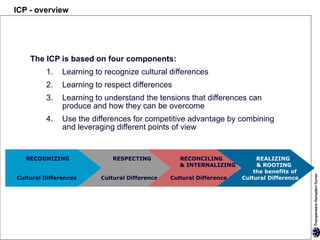
    The ICP is based on four components:
         1.    Learning to recognize cultural differences
         2.    Learning to respect differences
         3.    Learning to understand the tensions that differences can
               produce and how they can be overcome
         4.    Use the differences for competitive advantage by combining
               and leveraging different points of view


   RECOGNIZING               RESPECTING            RECONCILING             REALIZING
                                                   & INTERNALIZING         & ROOTING
                                                                          the benefits of
Cultural Differences      Cultural Difference   Cultural Difference   Cultural Difference
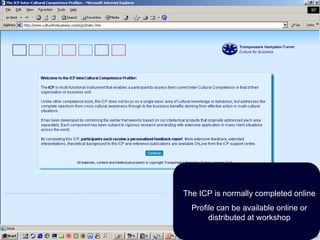
The ICP is normally completed online
  Profile can be available online or
       distributed at workshop
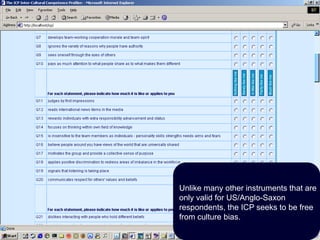
Unlike many other instruments that are
only valid for US/Anglo-Saxon
respondents, the ICP seeks to be free
from culture bias.
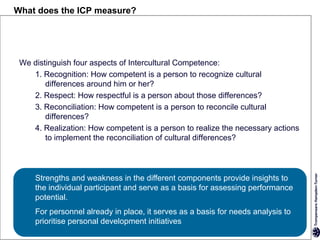
What does the ICP measure?


 We distinguish four aspects of Intercultural Competence:
    1. Recognition: How competent is a person to recognize cultural
        differences around him or her?
    2. Respect: How respectful is a person about those differences?
    3. Reconciliation: How competent is a person to reconcile cultural
        differences?
    4. Realization: How competent is a person to realize the necessary actions
        to implement the reconciliation of cultural differences?


     Strengths and weakness in the different components provide insights to
     the individual participant and serve as a basis for assessing performance
     potential.
     For personnel already in place, it serves as a basis for needs analysis to
     prioritise personal development initiatives
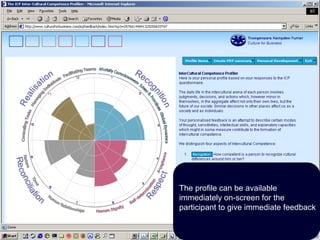
The profile can be available
immediately on-screen for the
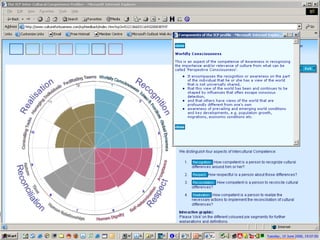
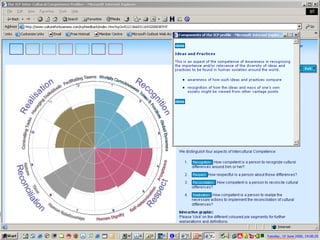
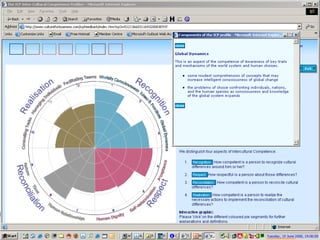
participant to give immediate feedback
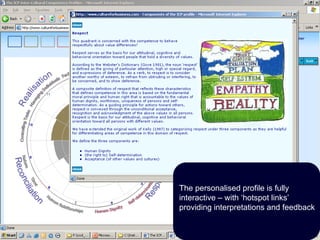
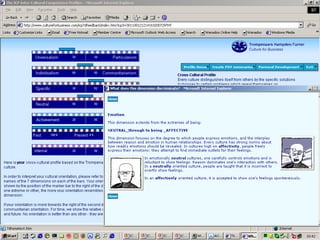
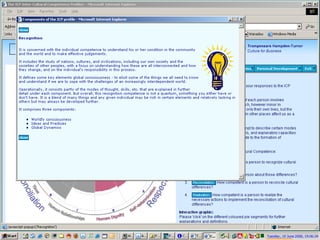
The personalised profile is fully
interactive – with ‘hotspot links’
providing interpretations and feedback
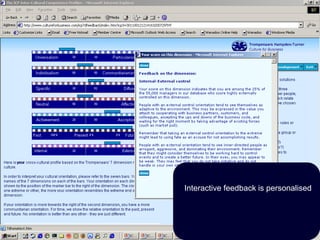
Interactive feedback is personalised
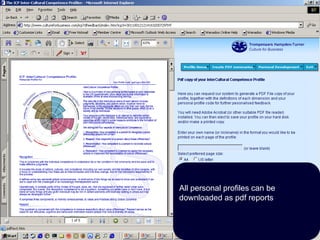
All personal profiles can be
downloaded as pdf reports
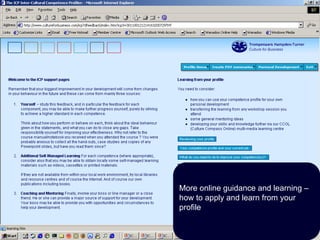
More online guidance and learning –
how to apply and learn from your
profile
Reviewing your IC profile


 It is important that you now consider your profile carefully and try to identify what
   it tells you about your behaviours and how you might be perceived by different
   groups of people.

  You might find it useful to consider:
 • In which quadrant do you demonstrate a relative strength?
 • In which quadrant is an area for development?
 • In which quadrant are you receiving mixed messages, with a variation in the way your
  behaviours are evaluated by the ICP and your own personal reflection of yourself?

 In making this analysis it is probably necessary to consider the relative ratings you have
   received as well as the absolute ratings.

 This is because different people might use different standards for assessment - some
  might mark more harshly than others - but they will still provide a view on relative
  strengths.
Your profile and your current job


 Most respondents will score average on a some of the competencies, good on particular
 issues related to their specialist field and possibility poor on some other competencies.
 This is because there is an element of self-selection in what work you do. That is, you
 tend to seek out a job where you can use and exploit the competencies you have.

 However, in today's fast changing world, we all need continually need to develop our
 InterCultural Competence to maintain the competitive edge in order to achieve superior
 performance.

 Even if you job role and title stays the same. it is likely you will meet and interact with
 people from different cultures as diversity in the workplace increases. This may result
 from age ranges, gender balance and staff turnover in addition to ethnicity.

 But overall, our research reveals that increasing your competence to reconcile dilemmas
 is what will really make a difference.
Improving your Competences


 Let us first remind you what Competencies are. Competencies are a way of focusing on
  whether an individual has the capacity to achieve certain outputs given the appropriate
  support and resources. There is less emphasis on general basic skills and knowledge
  which avoids being prescriptive about methods.

  Thus, in order to develop any particular competence, you need to think in two distinct
  areas:

       do you have the skills and knowledge necessary to be competent
       what do you do ? how do you behave ?

 So first you must reflect on the skills and knowledge you have. If they are insufficient in
  the two quadrants of Recognition or Respect at the moment, then the first priority for
  your development should be about acquiring the appropriate basic knowledge of cross
  culture.

  In practice this means gaining an appreciation of the seven dimensions of culture model
  because otherwise it is this lack of knowledge about HOW TO that is limiting what
  progress you can make.

  For the third and fourth quadrants ~ Reconciliation and Realisation, you need to learn
  the fundamentals of Dilemma Theory and how to reconcile dilemmas.
Improving your Competences (continued)


  However, research shows that the more usual problem derives from the second area.
  Competencies are really about behaviour - about what you do, rather than what you
  know.
  You probably know that planning is important to realise the benefits of decisions by
  taking action to implement. But although you probably know how to plan, the question is
  do you plan?
  To make progress in your behaviour is easy once you accept this mindset - and agree
  with yourself that you are going to do something about it - that you are going to behave
  differently from now on.
  So, try to compare your behaviour with another leader or senior manager who you
  observe is effective in dealing with tensions and dilemmas that derive from cultural
  differences. Remember, you are not thinking about their skill or knowledge for the
  competence. When trying to consider what behaviour change you need, try to observe
  how this manager behaves as your role model for the component of competence you
  are considering.

  Use the gap between how you behave and the ideal to determine what you need to do.
Benefits to the client organization


 The ICP intervention workshops are therefore based on:

 1. Assessed rather than assumed needs
 2. Identification of ‘maturity’ in life-cycle phases: where is the primary
    development need ~ ‘cross-cultural awareness’ or ‘leadership development’
    or ‘realising business benefits’ for example
 3. ‘Before’ and ‘After’ measurements: can be used to monitor the progress
    in competence development
 4. 360 degree extensions: ICP profiles can be extended to include peer/360
    input

Intercultural Competence Assessment and Development process (ICAD)

  • 1.
    Intercultural Competence Assessmentand Development Process (ICAD)
  • 2.
    What is ICAD? InterculturalCompetence Assessment and Development Process • ICAD is a service provided by Trompenaars Hampden-Turner Consulting that seeks to enhance the skills and knowledge of leaders and senior managers for our increasingly multi-cultural and diverse world • ICAD includes an appropriate combination of:  online Web Based competence assessments,  trainer led participative workshop or workshops,  follow-up competence development and progress monitoring,  options for personal executive coaching support  access to the THT multi-media Culture Compass and Cross-cultural database  further support for expatriate working or diversity/inclusion  Linkage to key business issues including globalization, mergers and acquisitions, and corporate social responsibility • It has been assembled by combining earlier frameworks based on our extensive intellectual property that originally addressed each area separately.
  • 3.
    ICP: Intercultural CompetenceProfiler A tool for assessing inter-cultural competence • The ICP is multi-functional instrument that enables a participant to assess their current Inter-Cultural Competence or that of their organization or business unit as part of their learning. • Unlike other competence tools, the ICP does not focus on a single basic area of cultural knowledge or behaviour, but addresses the complete spectrum from cross-cultural awareness through to the business benefits deriving from effective action in multi-cultural situations. • It is normally completed online and produces personalized profiles reports (as pdf files). • After any workshop, participants can rejoin the ICP online to explore their own personal profile in depth to make comparisons with other country and reference profiles
  • 4.
    ICP - overview The ICP is based on four components: 1. Learning to recognize cultural differences 2. Learning to respect differences 3. Learning to understand the tensions that differences can produce and how they can be overcome 4. Use the differences for competitive advantage by combining and leveraging different points of view RECOGNIZING RESPECTING RECONCILING REALIZING & INTERNALIZING & ROOTING the benefits of Cultural Differences Cultural Difference Cultural Difference Cultural Difference
  • 5.
    The ICP isnormally completed online Profile can be available online or distributed at workshop
  • 6.
    Unlike many otherinstruments that are only valid for US/Anglo-Saxon respondents, the ICP seeks to be free from culture bias.
  • 7.
    What does theICP measure? We distinguish four aspects of Intercultural Competence: 1. Recognition: How competent is a person to recognize cultural differences around him or her? 2. Respect: How respectful is a person about those differences? 3. Reconciliation: How competent is a person to reconcile cultural differences? 4. Realization: How competent is a person to realize the necessary actions to implement the reconciliation of cultural differences? Strengths and weakness in the different components provide insights to the individual participant and serve as a basis for assessing performance potential. For personnel already in place, it serves as a basis for needs analysis to prioritise personal development initiatives
  • 8.
    The profile canbe available immediately on-screen for the participant to give immediate feedback
  • 9.
    The personalised profileis fully interactive – with ‘hotspot links’ providing interpretations and feedback
  • 11.
  • 16.
    All personal profilescan be downloaded as pdf reports
  • 17.
    More online guidanceand learning – how to apply and learn from your profile
  • 18.
    Reviewing your ICprofile It is important that you now consider your profile carefully and try to identify what it tells you about your behaviours and how you might be perceived by different groups of people. You might find it useful to consider: • In which quadrant do you demonstrate a relative strength? • In which quadrant is an area for development? • In which quadrant are you receiving mixed messages, with a variation in the way your behaviours are evaluated by the ICP and your own personal reflection of yourself? In making this analysis it is probably necessary to consider the relative ratings you have received as well as the absolute ratings. This is because different people might use different standards for assessment - some might mark more harshly than others - but they will still provide a view on relative strengths.
  • 19.
    Your profile andyour current job Most respondents will score average on a some of the competencies, good on particular issues related to their specialist field and possibility poor on some other competencies. This is because there is an element of self-selection in what work you do. That is, you tend to seek out a job where you can use and exploit the competencies you have. However, in today's fast changing world, we all need continually need to develop our InterCultural Competence to maintain the competitive edge in order to achieve superior performance. Even if you job role and title stays the same. it is likely you will meet and interact with people from different cultures as diversity in the workplace increases. This may result from age ranges, gender balance and staff turnover in addition to ethnicity. But overall, our research reveals that increasing your competence to reconcile dilemmas is what will really make a difference.
  • 20.
    Improving your Competences Let us first remind you what Competencies are. Competencies are a way of focusing on whether an individual has the capacity to achieve certain outputs given the appropriate support and resources. There is less emphasis on general basic skills and knowledge which avoids being prescriptive about methods. Thus, in order to develop any particular competence, you need to think in two distinct areas:  do you have the skills and knowledge necessary to be competent  what do you do ? how do you behave ? So first you must reflect on the skills and knowledge you have. If they are insufficient in the two quadrants of Recognition or Respect at the moment, then the first priority for your development should be about acquiring the appropriate basic knowledge of cross culture. In practice this means gaining an appreciation of the seven dimensions of culture model because otherwise it is this lack of knowledge about HOW TO that is limiting what progress you can make. For the third and fourth quadrants ~ Reconciliation and Realisation, you need to learn the fundamentals of Dilemma Theory and how to reconcile dilemmas.
  • 21.
    Improving your Competences(continued) However, research shows that the more usual problem derives from the second area. Competencies are really about behaviour - about what you do, rather than what you know. You probably know that planning is important to realise the benefits of decisions by taking action to implement. But although you probably know how to plan, the question is do you plan? To make progress in your behaviour is easy once you accept this mindset - and agree with yourself that you are going to do something about it - that you are going to behave differently from now on. So, try to compare your behaviour with another leader or senior manager who you observe is effective in dealing with tensions and dilemmas that derive from cultural differences. Remember, you are not thinking about their skill or knowledge for the competence. When trying to consider what behaviour change you need, try to observe how this manager behaves as your role model for the component of competence you are considering. Use the gap between how you behave and the ideal to determine what you need to do.
  • 22.
    Benefits to theclient organization The ICP intervention workshops are therefore based on: 1. Assessed rather than assumed needs 2. Identification of ‘maturity’ in life-cycle phases: where is the primary development need ~ ‘cross-cultural awareness’ or ‘leadership development’ or ‘realising business benefits’ for example 3. ‘Before’ and ‘After’ measurements: can be used to monitor the progress in competence development 4. 360 degree extensions: ICP profiles can be extended to include peer/360 input