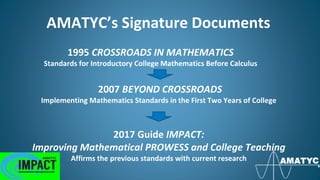
AMATYC’s Signature Documents
1995 CROSSROADS IN MATHEMATICS
Standards for Introductory College Mathematics Before Calculus
2007 BEYOND CROSSROADS
Implementing Mathematics Standards in the First Two Years of College
2017 Guide IMPACT:
Improving Mathematical PROWESS and College Teaching
Affirms the previous standards with current research
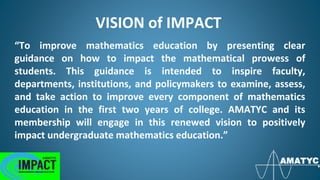
VISION of IMPACT
“To improve mathematics education by presenting clear
guidance on how to impact the mathematical prowess of
students. This guidance is intended to inspire faculty,
departments, institutions, and policymakers to examine, assess,
and take action to improve every component of mathematics
education in the first two years of college. AMATYC and its
membership will engage in this renewed vision to positively
impact undergraduate mathematics education.”
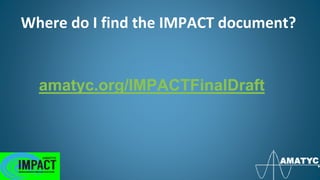
Where do I find the IMPACT document?
amatyc.org/IMPACTFinalDraft
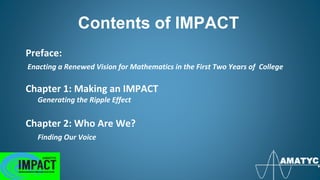
Contents of IMPACT
Preface:
Enacting a Renewed Vision for Mathematics in the First Two Years of College
Chapter 1: Making an IMPACT
Generating the Ripple Effect
Chapter 2: Who Are We?
Finding Our Voice
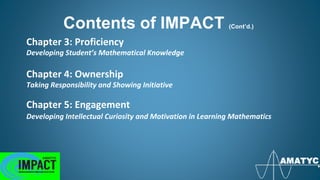
Chapter 3: Proficiency
Developing Student’s Mathematical Knowledge
Chapter 4: Ownership
Taking Responsibility and Showing Initiative
Chapter 5: Engagement
Developing Intellectual Curiosity and Motivation in Learning Mathematics
Contents of IMPACT (Cont’d.)
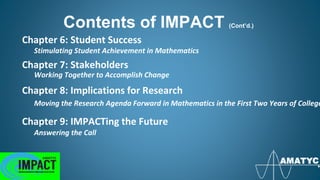
Chapter 6: Student Success
Stimulating Student Achievement in Mathematics
Chapter 7: Stakeholders
Working Together to Accomplish Change
Chapter 8: Implications for Research
Moving the Research Agenda Forward in Mathematics in the First Two Years of College
Chapter 9: IMPACTing the Future
Answering the Call
Contents of IMPACT (Cont’d.)
Who are we?
Chapter 2
Our students are changing!
What percent do you think replaces the ???
In the fall of 2015 in the United States, ???% of the 17 million
undergraduates were enrolled in two-year institution.
Between 2015 and 2026, undergraduate enrollment is projected
to increase by ???%, while enrollment at four-year institutions is
likely to increase by ???% (National Center for Educational
Statistics [NCES], 2017).
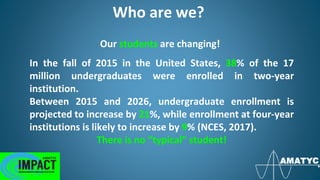
Who are we?
Our students are changing!
In the fall of 2015 in the United States, 38% of the 17
million undergraduates were enrolled in two-year
institution.
Between 2015 and 2026, undergraduate enrollment is
projected to increase by 21%, while enrollment at four-year
institutions is likely to increase by 9% (NCES, 2017).
There is no “typical” student!
Who are we?
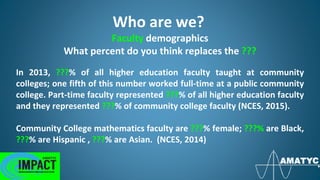
Faculty demographics
What percent do you think replaces the ???
In 2013, ???% of all higher education faculty taught at community
colleges; one fifth of this number worked full-time at a public community
college. Part-time faculty represented ???% of all higher education faculty
and they represented ???% of community college faculty (NCES, 2015).
Community College mathematics faculty are ???% female; ???% are Black,
???% are Hispanic , ???% are Asian. (NCES, 2014)
Who are we?
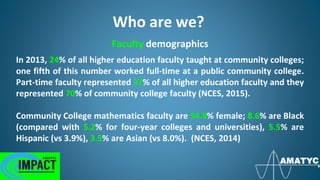
Faculty demographics
In 2013, 24% of all higher education faculty taught at community colleges;
one fifth of this number worked full-time at a public community college.
Part-time faculty represented 37% of all higher education faculty and they
represented 70% of community college faculty (NCES, 2015).
Community College mathematics faculty are 54.8% female; 8.6% are Black
(compared with 5.2% for four-year colleges and universities), 5.5% are
Hispanic (vs 3.9%), 3.5% are Asian (vs 8.0%). (NCES, 2014)
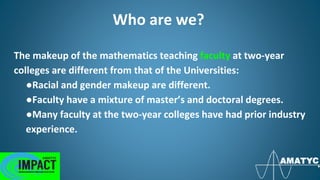
Who are we?
The makeup of the mathematics teaching faculty at two-year
colleges are different from that of the Universities:
●Racial and gender makeup are different.
●Faculty have a mixture of master’s and doctoral degrees.
●Many faculty at the two-year colleges have had prior industry
experience.
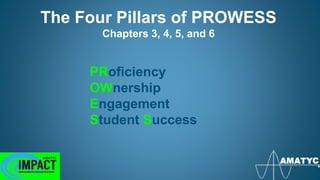
The Four Pillars of PROWESS
Chapters 3, 4, 5, and 6
PRoficiency
OWnership
Engagement
Student Success
PROFICIENCY
Chapter 3
Developing Students’ Mathematical Knowledge
“Time spent leads to experience, experience leads to
proficiency, and the more proficient you are
the more valuable you will be.”
~Malcolm Gladwell (2008)
REFLECTION on proficiency:
At a minimum, proficiency in my classroom
should mean ...
STOP AND REFLECT
PROFICIENCY
Overview
To be mathematically proficient, students need to:
● know mathematics procedures and execute core
computations fluently
● view mathematics as relevant to their daily lives
● demonstrate mathematical understanding
● utilize the structure in the mathematics; and
demonstrate mathematical understanding
PROFICIENCY (Cont’d.)
To be mathematically proficient, students need to:
● utilize the structure in mathematics to solve
problems
● apply mathematics to everyday situations
● and communicate mathematically.
Adopting routes to provide students and institutions for
options for instilling mathematical proficiency.
The five interdependent strands essential
to successful learning of mathematics:
● conceptual understanding
● procedural fluency
● strategic competence
● adaptive reasoning
● productive disposition (National
Research Council [NRC], 2001)
REFLECTION on proficiency:
At a minimum, proficiency in my classroom
should mean ...
STOP AND CHAT
Turn to the person nearest you and discuss
the following thought: (3 minutes)
OWNERSHIP
Chapter 4
Taking Responsibility and Showing Initiative
“You cannot teach a man anything; you can only
help him to find it within himself.”
~Galileo Galilei
Definition of Ownership
❖ Discovery
❖ Responsibility
❖ Continued Learning
The act or state of possessing something
which involves the following 3 components:
Who Needs Ownership?
❖ Students need to be empowered to take ownership of their
learning by promoting self-regulated learning
❖ Faculty develop ownership by being reflective practitioners
who examine curriculum and teaching practices to identify
areas that need improvement
❖ Departments and institutions need to support faculty by
providing faculty development to enhance their teaching.
REFLECTION on Ownership:
In my classroom I develop student ownership of
their own learning by ...
STOP AND CHAT
Turn to the person nearest you and discuss
the following thought: (3 minutes)
ENGAGEMENT
Chapter 5
Developing Intellectual Curiosity and Motivation
in Learning Mathematics
“The students who are most engaged are the ones who think they matter to
the teacher… When students feel like they have a voice at school,
they are 7 times more academically motivated.”
~Quaglia, 2016, p. 6
Engaging Students In and Out of the
Classroom
Robust learning environments have 3 components:
●Learner-centered
●Knowledge-centered
●Reflective learning (Bishop, Carson, & King,
2014)
ENGAGEMENT
Engaging students intellectually in the process of learning
mathematics through active and cognitive activities is
fundamental for improving student achievement in the first two
years of collegiate mathematics.
Engaging faculty in the pursuit of excellence in teaching through
innovative best practices results in an invigorated commitment
to teaching and innovation, which benefits students, the
department, the college, and society as a whole.
Engaging Faculty in the Pursuit of
Excellence
Engaging faculty to pursue excellence requires that
departments and institutions build an environment that:
● supports collegiality
● provides professional growth
● fosters self evaluation and growth
REFLECTION on Engagement:
In my classroom I encourage student
engagement in learning by ...
STOP AND CHAT
Turn to the person nearest you and discuss
the following thought: (3 minutes)
STUDENT SUCCESS
Chapter 6
Stimulating Student Achievement in Mathematics
“Action is the fundamental key to success.”
~Pablo Picasso
Definition of Student Success
The fulfillment of a student’s academic or professional
goals or outcomes.
Indicators of Student Success
● Student Persistence
● Educational Attainment
● Academic Achievement or Successful Course
Completion and Success in Subsequent Courses
● Holistic Development
Achieving Student Success
Student Success requires the entire college community to:
● work together to advise and place students into
appropriate coursework
● create a positive learning environment
● utilize a collaborative spirit that unites college leadership,
faculty, staff, and policy makers to produce and sustain a
learning environment that promotes student achievement.
Enhancing student success by design
● Initial Assessment and Placement – multiple measures
● Advising Students – multiple options
● Learning Environment
○ inside the classroom
○ outside the classroom
○ online and blended
Institutional Responsibility for
Enhancing Student Success
● Hiring Qualified Faculty and Staff
● Promote Professional Development
● Institution Responsibility for Creating Learning
Support Environments
● Linking Developmental Math with Student Success
REFLECTION on STUDENT SUCCESS:
My department contributes to the success of
students, as defined by IMPACT, by ...
STOP AND CHAT
Turn to the person nearest you and discuss the
following thought: (3 minutes)
STAKEHOLDERS
Chapter 7
Working Together to Accomplish Change
People are always looking for the single magic bullet
that will totally change everything.
There is no single magic bullet.
~ Temple Grandin (Autism Research Institute, 1996, para. 26)
STAKEHOLDERS
Examples of student-centered, policy-enabled,
administratively-supported, culturally reinforced, and
educator-driven successful initiatives are provided in
AMATYC IMPACT.
These examples show that increasing student success is
possible through the collaboration of stakeholders.
STAKEHOLDERS
Examples
Some of these examples demonstrate how changes in
mathematics instruction at the state, system, and
institutional level can impact students positively. Other
initiatives illustrate how degree-oriented mathematics
pathways, new state policy, and equity mentoring can
promote increased student success.
IMPLICATIONS FOR RESEARCH
chapter 8
Moving the Research Agenda Forward in Mathematics
in the First Two Years of College
“Research is to see what everybody else has seen,
and to think what nobody else has thought.”
~Albert Szent-Gyorgyi (1957, p. 56)
IMPLICATIONS FOR RESEARCH
Research in mathematics education at the two-year
college is emerging as a vital field of inquiry for
understanding the complexities of teaching and learning
mathematics at this level. The two-year college setting is
a fertile environment for research and faculty are
encouraged to engage in research investigations that
meet the needs of both students and faculty.
IMPLICATIONS FOR RESEARCH
The purpose of this chapter is to provide educators with
ideas of things that could be researched at the
community college level.
This chapter is intended to be one that could be
referenced when researchers are designing research
projects, seeking grant funding, etc.
STANDARDS COMMITTEE
A new AMATYC committee, Mathematics Standards in the First Two
Years of College, has been created to carry on the work of the
standards and is led by chair, Julie Phelps and digital coordinator, Evan
Evans.
To begin making an impact, read the document and apply it to your
own role in mathematics education. We would like representation
from each affiliate on AMATYC’s Standards Committee. Membership
in the committee is open to all AMATYC members.
STANDARDS COMMITTEE
To join:
● Go to http://amatyc.org and Sign-in.
● Click on the Groups tab, the last tab on the left side of the
page.
● Select AMATYC Committees followed by Mathematics
Standards (IMPACT).
● By joining the committee you will be part of creating digital
products for IMPACT Live!, the online component of
IMPACT, and promoting AMATYC’s standards.
Content of IMPACT Live!
❖Best Practices – Multiple Categories
❖Research – Links and Collaboration
❖Blogs – Links and ‘Guest’
❖Links - Organizations and Resources
The standards guide IMPACT will be supplemented by a living
document on the internet. The current plan is for IMPACT
Live! to contain:
IMPACT Live!
Have a suggestion for IMPACT Live? A great teaching
idea? A student you want to showcase? A question for
the group? Submit it at the website:
http://amatyc.org/impactlive
REFLECTION on AMATYC STANDARDS
I can have an IMPACT on my students,
colleagues, department / institution by ...
STOP AND CHAT
Turn to the person nearest you and discuss the
following thought: (3 minutes)
WANT TO KNOW MORE?
Contact the standards committee chair:
Julie Phelps, jphelps@valenciacollege.edu
Contact standards digital products coordinator:
Evan Evans, eevans@frederick.edu
REFERENCES
Bishop, C. F., Caston, M. I., & King, C.A. (2014). Learner-centered environments. Creating
strategies based on student attitudes and faculty reflection. Journal of
the Scholarship of Teaching and Learning, 14(3), 46-63.
National Center for Educational Statistics. (2014). Table 314.40. Employees in degree-granting
postsecondary institutions, by race/ethnicity, sex, employment status, control and level of
institution, and primary occupation: Fall 2013. Digest of educational statistics: 2014.
Retrieved from https://nces.ed.gov/programs/digest/d14/tables/dt14_314.40.asp
National Center for Educational Statistics. (2015). Table 314.30. Employees in degree-granting
postsecondary institutions, by employment status, sex, control, and level of institution, and
primary occupation: Fall 2013. Digest of educational statistics: 2015. Retrieved from
https://nces.ed.gov/programs/digest/d15/tables/dt15_314.30.asp?referrer=report
REFERENCES (Cont’d.)
National Center for Educational Statistics. (2017). The condition of education. Retrieved from
https://nces.ed.gov/pubs2017/2017144.pdf
National Research Council. (2001). Adding it up: Helping children learn mathematics. J. Kilpatrick, J.
Swafford, & B. Findell (Eds.). Mathematics Learning Study Committee, Center for Education, Division
of Behavioral and Social Sciences and Education. Washington, DC: National Academy Press
Quaglia (2016). School Voice Report. Retrieved from
http://quagliainstitute.org/qisva/library/view.do?id=844

AMATYC IMPACT affiliate presentation

  • 2.
    AMATYC’s Signature Documents 1995CROSSROADS IN MATHEMATICS Standards for Introductory College Mathematics Before Calculus 2007 BEYOND CROSSROADS Implementing Mathematics Standards in the First Two Years of College 2017 Guide IMPACT: Improving Mathematical PROWESS and College Teaching Affirms the previous standards with current research
  • 3.
    VISION of IMPACT “Toimprove mathematics education by presenting clear guidance on how to impact the mathematical prowess of students. This guidance is intended to inspire faculty, departments, institutions, and policymakers to examine, assess, and take action to improve every component of mathematics education in the first two years of college. AMATYC and its membership will engage in this renewed vision to positively impact undergraduate mathematics education.”
  • 4.
    Where do Ifind the IMPACT document? amatyc.org/IMPACTFinalDraft
  • 5.
    Contents of IMPACT Preface: Enactinga Renewed Vision for Mathematics in the First Two Years of College Chapter 1: Making an IMPACT Generating the Ripple Effect Chapter 2: Who Are We? Finding Our Voice
  • 6.
    Chapter 3: Proficiency DevelopingStudent’s Mathematical Knowledge Chapter 4: Ownership Taking Responsibility and Showing Initiative Chapter 5: Engagement Developing Intellectual Curiosity and Motivation in Learning Mathematics Contents of IMPACT (Cont’d.)
  • 7.
    Chapter 6: StudentSuccess Stimulating Student Achievement in Mathematics Chapter 7: Stakeholders Working Together to Accomplish Change Chapter 8: Implications for Research Moving the Research Agenda Forward in Mathematics in the First Two Years of College Chapter 9: IMPACTing the Future Answering the Call Contents of IMPACT (Cont’d.)
  • 8.
    Who are we? Chapter2 Our students are changing! What percent do you think replaces the ??? In the fall of 2015 in the United States, ???% of the 17 million undergraduates were enrolled in two-year institution. Between 2015 and 2026, undergraduate enrollment is projected to increase by ???%, while enrollment at four-year institutions is likely to increase by ???% (National Center for Educational Statistics [NCES], 2017).
  • 9.
    Who are we? Ourstudents are changing! In the fall of 2015 in the United States, 38% of the 17 million undergraduates were enrolled in two-year institution. Between 2015 and 2026, undergraduate enrollment is projected to increase by 21%, while enrollment at four-year institutions is likely to increase by 9% (NCES, 2017). There is no “typical” student!
  • 10.
    Who are we? Facultydemographics What percent do you think replaces the ??? In 2013, ???% of all higher education faculty taught at community colleges; one fifth of this number worked full-time at a public community college. Part-time faculty represented ???% of all higher education faculty and they represented ???% of community college faculty (NCES, 2015). Community College mathematics faculty are ???% female; ???% are Black, ???% are Hispanic , ???% are Asian. (NCES, 2014)
  • 11.
    Who are we? Facultydemographics In 2013, 24% of all higher education faculty taught at community colleges; one fifth of this number worked full-time at a public community college. Part-time faculty represented 37% of all higher education faculty and they represented 70% of community college faculty (NCES, 2015). Community College mathematics faculty are 54.8% female; 8.6% are Black (compared with 5.2% for four-year colleges and universities), 5.5% are Hispanic (vs 3.9%), 3.5% are Asian (vs 8.0%). (NCES, 2014)
  • 12.
    Who are we? Themakeup of the mathematics teaching faculty at two-year colleges are different from that of the Universities: ●Racial and gender makeup are different. ●Faculty have a mixture of master’s and doctoral degrees. ●Many faculty at the two-year colleges have had prior industry experience.
  • 13.
    The Four Pillarsof PROWESS Chapters 3, 4, 5, and 6 PRoficiency OWnership Engagement Student Success
  • 14.
    PROFICIENCY Chapter 3 Developing Students’Mathematical Knowledge “Time spent leads to experience, experience leads to proficiency, and the more proficient you are the more valuable you will be.” ~Malcolm Gladwell (2008)
  • 15.
    REFLECTION on proficiency: Ata minimum, proficiency in my classroom should mean ... STOP AND REFLECT
  • 16.
    PROFICIENCY Overview To be mathematicallyproficient, students need to: ● know mathematics procedures and execute core computations fluently ● view mathematics as relevant to their daily lives ● demonstrate mathematical understanding ● utilize the structure in the mathematics; and demonstrate mathematical understanding
  • 17.
    PROFICIENCY (Cont’d.) To bemathematically proficient, students need to: ● utilize the structure in mathematics to solve problems ● apply mathematics to everyday situations ● and communicate mathematically. Adopting routes to provide students and institutions for options for instilling mathematical proficiency.
  • 18.
    The five interdependentstrands essential to successful learning of mathematics: ● conceptual understanding ● procedural fluency ● strategic competence ● adaptive reasoning ● productive disposition (National Research Council [NRC], 2001)
  • 19.
    REFLECTION on proficiency: Ata minimum, proficiency in my classroom should mean ... STOP AND CHAT Turn to the person nearest you and discuss the following thought: (3 minutes)
  • 20.
    OWNERSHIP Chapter 4 Taking Responsibilityand Showing Initiative “You cannot teach a man anything; you can only help him to find it within himself.” ~Galileo Galilei
  • 21.
    Definition of Ownership ❖Discovery ❖ Responsibility ❖ Continued Learning The act or state of possessing something which involves the following 3 components:
  • 22.
    Who Needs Ownership? ❖Students need to be empowered to take ownership of their learning by promoting self-regulated learning ❖ Faculty develop ownership by being reflective practitioners who examine curriculum and teaching practices to identify areas that need improvement ❖ Departments and institutions need to support faculty by providing faculty development to enhance their teaching.
  • 23.
    REFLECTION on Ownership: Inmy classroom I develop student ownership of their own learning by ... STOP AND CHAT Turn to the person nearest you and discuss the following thought: (3 minutes)
  • 24.
    ENGAGEMENT Chapter 5 Developing IntellectualCuriosity and Motivation in Learning Mathematics “The students who are most engaged are the ones who think they matter to the teacher… When students feel like they have a voice at school, they are 7 times more academically motivated.” ~Quaglia, 2016, p. 6
  • 25.
    Engaging Students Inand Out of the Classroom Robust learning environments have 3 components: ●Learner-centered ●Knowledge-centered ●Reflective learning (Bishop, Carson, & King, 2014)
  • 26.
    ENGAGEMENT Engaging students intellectuallyin the process of learning mathematics through active and cognitive activities is fundamental for improving student achievement in the first two years of collegiate mathematics. Engaging faculty in the pursuit of excellence in teaching through innovative best practices results in an invigorated commitment to teaching and innovation, which benefits students, the department, the college, and society as a whole.
  • 27.
    Engaging Faculty inthe Pursuit of Excellence Engaging faculty to pursue excellence requires that departments and institutions build an environment that: ● supports collegiality ● provides professional growth ● fosters self evaluation and growth
  • 28.
    REFLECTION on Engagement: Inmy classroom I encourage student engagement in learning by ... STOP AND CHAT Turn to the person nearest you and discuss the following thought: (3 minutes)
  • 29.
    STUDENT SUCCESS Chapter 6 StimulatingStudent Achievement in Mathematics “Action is the fundamental key to success.” ~Pablo Picasso
  • 30.
    Definition of StudentSuccess The fulfillment of a student’s academic or professional goals or outcomes.
  • 31.
    Indicators of StudentSuccess ● Student Persistence ● Educational Attainment ● Academic Achievement or Successful Course Completion and Success in Subsequent Courses ● Holistic Development
  • 32.
    Achieving Student Success StudentSuccess requires the entire college community to: ● work together to advise and place students into appropriate coursework ● create a positive learning environment ● utilize a collaborative spirit that unites college leadership, faculty, staff, and policy makers to produce and sustain a learning environment that promotes student achievement.
  • 33.
    Enhancing student successby design ● Initial Assessment and Placement – multiple measures ● Advising Students – multiple options ● Learning Environment ○ inside the classroom ○ outside the classroom ○ online and blended
  • 34.
    Institutional Responsibility for EnhancingStudent Success ● Hiring Qualified Faculty and Staff ● Promote Professional Development ● Institution Responsibility for Creating Learning Support Environments ● Linking Developmental Math with Student Success
  • 35.
    REFLECTION on STUDENTSUCCESS: My department contributes to the success of students, as defined by IMPACT, by ... STOP AND CHAT Turn to the person nearest you and discuss the following thought: (3 minutes)
  • 36.
    STAKEHOLDERS Chapter 7 Working Togetherto Accomplish Change People are always looking for the single magic bullet that will totally change everything. There is no single magic bullet. ~ Temple Grandin (Autism Research Institute, 1996, para. 26)
  • 37.
    STAKEHOLDERS Examples of student-centered,policy-enabled, administratively-supported, culturally reinforced, and educator-driven successful initiatives are provided in AMATYC IMPACT. These examples show that increasing student success is possible through the collaboration of stakeholders.
  • 38.
    STAKEHOLDERS Examples Some of theseexamples demonstrate how changes in mathematics instruction at the state, system, and institutional level can impact students positively. Other initiatives illustrate how degree-oriented mathematics pathways, new state policy, and equity mentoring can promote increased student success.
  • 39.
    IMPLICATIONS FOR RESEARCH chapter8 Moving the Research Agenda Forward in Mathematics in the First Two Years of College “Research is to see what everybody else has seen, and to think what nobody else has thought.” ~Albert Szent-Gyorgyi (1957, p. 56)
  • 40.
    IMPLICATIONS FOR RESEARCH Researchin mathematics education at the two-year college is emerging as a vital field of inquiry for understanding the complexities of teaching and learning mathematics at this level. The two-year college setting is a fertile environment for research and faculty are encouraged to engage in research investigations that meet the needs of both students and faculty.
  • 41.
    IMPLICATIONS FOR RESEARCH Thepurpose of this chapter is to provide educators with ideas of things that could be researched at the community college level. This chapter is intended to be one that could be referenced when researchers are designing research projects, seeking grant funding, etc.
  • 42.
    STANDARDS COMMITTEE A newAMATYC committee, Mathematics Standards in the First Two Years of College, has been created to carry on the work of the standards and is led by chair, Julie Phelps and digital coordinator, Evan Evans. To begin making an impact, read the document and apply it to your own role in mathematics education. We would like representation from each affiliate on AMATYC’s Standards Committee. Membership in the committee is open to all AMATYC members.
  • 43.
    STANDARDS COMMITTEE To join: ●Go to http://amatyc.org and Sign-in. ● Click on the Groups tab, the last tab on the left side of the page. ● Select AMATYC Committees followed by Mathematics Standards (IMPACT). ● By joining the committee you will be part of creating digital products for IMPACT Live!, the online component of IMPACT, and promoting AMATYC’s standards.
  • 44.
    Content of IMPACTLive! ❖Best Practices – Multiple Categories ❖Research – Links and Collaboration ❖Blogs – Links and ‘Guest’ ❖Links - Organizations and Resources The standards guide IMPACT will be supplemented by a living document on the internet. The current plan is for IMPACT Live! to contain:
  • 45.
    IMPACT Live! Have asuggestion for IMPACT Live? A great teaching idea? A student you want to showcase? A question for the group? Submit it at the website: http://amatyc.org/impactlive
  • 46.
    REFLECTION on AMATYCSTANDARDS I can have an IMPACT on my students, colleagues, department / institution by ... STOP AND CHAT Turn to the person nearest you and discuss the following thought: (3 minutes)
  • 47.
    WANT TO KNOWMORE? Contact the standards committee chair: Julie Phelps, jphelps@valenciacollege.edu Contact standards digital products coordinator: Evan Evans, eevans@frederick.edu
  • 49.
    REFERENCES Bishop, C. F.,Caston, M. I., & King, C.A. (2014). Learner-centered environments. Creating strategies based on student attitudes and faculty reflection. Journal of the Scholarship of Teaching and Learning, 14(3), 46-63. National Center for Educational Statistics. (2014). Table 314.40. Employees in degree-granting postsecondary institutions, by race/ethnicity, sex, employment status, control and level of institution, and primary occupation: Fall 2013. Digest of educational statistics: 2014. Retrieved from https://nces.ed.gov/programs/digest/d14/tables/dt14_314.40.asp National Center for Educational Statistics. (2015). Table 314.30. Employees in degree-granting postsecondary institutions, by employment status, sex, control, and level of institution, and primary occupation: Fall 2013. Digest of educational statistics: 2015. Retrieved from https://nces.ed.gov/programs/digest/d15/tables/dt15_314.30.asp?referrer=report
  • 50.
    REFERENCES (Cont’d.) National Centerfor Educational Statistics. (2017). The condition of education. Retrieved from https://nces.ed.gov/pubs2017/2017144.pdf National Research Council. (2001). Adding it up: Helping children learn mathematics. J. Kilpatrick, J. Swafford, & B. Findell (Eds.). Mathematics Learning Study Committee, Center for Education, Division of Behavioral and Social Sciences and Education. Washington, DC: National Academy Press Quaglia (2016). School Voice Report. Retrieved from http://quagliainstitute.org/qisva/library/view.do?id=844