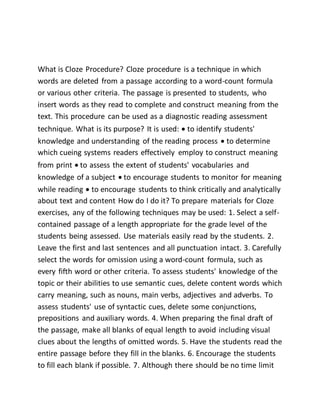
What is Cloze Procedure? Cloze procedure is a technique in which
words are deleted from a passage according to a word-count formula
or various other criteria. The passage is presented to students, who
insert words as they read to complete and construct meaning from the
text. This procedure can be used as a diagnostic reading assessment
technique. What is its purpose? It is used:  to identify students'
knowledge and understanding of the reading process  to determine
which cueing systems readers effectively employ to construct meaning
from print  to assess the extent of students' vocabularies and
knowledge of a subject  to encourage students to monitor for meaning
while reading  to encourage students to think critically and analytically
about text and content How do I do it? To prepare materials for Cloze
exercises, any of the following techniques may be used: 1. Select a self-
contained passage of a length appropriate for the grade level of the
students being assessed. Use materials easily read by the students. 2.
Leave the first and last sentences and all punctuation intact. 3. Carefully
select the words for omission using a word-count formula, such as
every fifth word or other criteria. To assess students' knowledge of the
topic or their abilities to use semantic cues, delete content words which
carry meaning, such as nouns, main verbs, adjectives and adverbs. To
assess students' use of syntactic cues, delete some conjunctions,
prepositions and auxiliary words. 4. When preparing the final draft of
the passage, make all blanks of equal length to avoid including visual
clues about the lengths of omitted words. 5. Have the students read the
entire passage before they fill in the blanks. 6. Encourage the students
to fill each blank if possible. 7. Although there should be no time limit
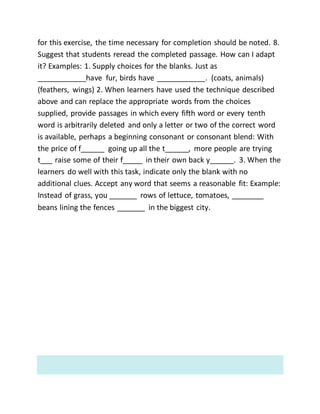
for this exercise, the time necessary for completion should be noted. 8.
Suggest that students reread the completed passage. How can I adapt
it? Examples: 1. Supply choices for the blanks. Just as
____________have fur, birds have ____________. (coats, animals)
(feathers, wings) 2. When learners have used the technique described
above and can replace the appropriate words from the choices
supplied, provide passages in which every fifth word or every tenth
word is arbitrarily deleted and only a letter or two of the correct word
is available, perhaps a beginning consonant or consonant blend: With
the price of f______ going up all the t______, more people are trying
t___ raise some of their f_____ in their own back y______. 3. When the
learners do well with this task, indicate only the blank with no
additional clues. Accept any word that seems a reasonable fit: Example:
Instead of grass, you _______ rows of lettuce, tomatoes, ________
beans lining the fences _______ in the biggest city.
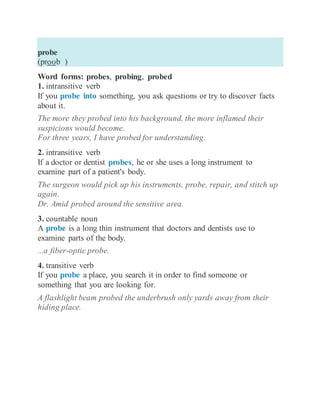
probe
(proʊb )
Word forms: probes, probing, probed
1. intransitive verb
If you probe into something, you ask questions or try to discover facts
about it.
The more they probed into his background, the more inflamed their
suspicions would become.
For three years, I have probed for understanding.
2. intransitive verb
If a doctor or dentist probes, he or she uses a long instrument to
examine part of a patient's body.
The surgeon would pick up his instruments, probe, repair, and stitch up
again.
Dr. Amid probed around the sensitive area.
3. countable noun
A probe is a long thin instrument that doctors and dentists use to
examine parts of the body.
...a fiber-optic probe.
4. transitive verb
If you probe a place, you search it in order to find someone or
something that you are looking for.
A flashlight beam probed the underbrush only yards away from their
hiding place.

Cloze Procedure

  • 1.
    What is ClozeProcedure? Cloze procedure is a technique in which words are deleted from a passage according to a word-count formula or various other criteria. The passage is presented to students, who insert words as they read to complete and construct meaning from the text. This procedure can be used as a diagnostic reading assessment technique. What is its purpose? It is used:  to identify students' knowledge and understanding of the reading process  to determine which cueing systems readers effectively employ to construct meaning from print  to assess the extent of students' vocabularies and knowledge of a subject  to encourage students to monitor for meaning while reading  to encourage students to think critically and analytically about text and content How do I do it? To prepare materials for Cloze exercises, any of the following techniques may be used: 1. Select a self- contained passage of a length appropriate for the grade level of the students being assessed. Use materials easily read by the students. 2. Leave the first and last sentences and all punctuation intact. 3. Carefully select the words for omission using a word-count formula, such as every fifth word or other criteria. To assess students' knowledge of the topic or their abilities to use semantic cues, delete content words which carry meaning, such as nouns, main verbs, adjectives and adverbs. To assess students' use of syntactic cues, delete some conjunctions, prepositions and auxiliary words. 4. When preparing the final draft of the passage, make all blanks of equal length to avoid including visual clues about the lengths of omitted words. 5. Have the students read the entire passage before they fill in the blanks. 6. Encourage the students to fill each blank if possible. 7. Although there should be no time limit
  • 2.
    for this exercise,the time necessary for completion should be noted. 8. Suggest that students reread the completed passage. How can I adapt it? Examples: 1. Supply choices for the blanks. Just as ____________have fur, birds have ____________. (coats, animals) (feathers, wings) 2. When learners have used the technique described above and can replace the appropriate words from the choices supplied, provide passages in which every fifth word or every tenth word is arbitrarily deleted and only a letter or two of the correct word is available, perhaps a beginning consonant or consonant blend: With the price of f______ going up all the t______, more people are trying t___ raise some of their f_____ in their own back y______. 3. When the learners do well with this task, indicate only the blank with no additional clues. Accept any word that seems a reasonable fit: Example: Instead of grass, you _______ rows of lettuce, tomatoes, ________ beans lining the fences _______ in the biggest city.
  • 3.
    probe (proʊb ) Word forms:probes, probing, probed 1. intransitive verb If you probe into something, you ask questions or try to discover facts about it. The more they probed into his background, the more inflamed their suspicions would become. For three years, I have probed for understanding. 2. intransitive verb If a doctor or dentist probes, he or she uses a long instrument to examine part of a patient's body. The surgeon would pick up his instruments, probe, repair, and stitch up again. Dr. Amid probed around the sensitive area. 3. countable noun A probe is a long thin instrument that doctors and dentists use to examine parts of the body. ...a fiber-optic probe. 4. transitive verb If you probe a place, you search it in order to find someone or something that you are looking for. A flashlight beam probed the underbrush only yards away from their hiding place.